

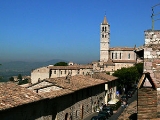
Assisi

Encyclopedia
Churches
- The Basilica of San Francesco d'AssisiBasilica of San Francesco d'AssisiThe Papal Basilica of St. Francis of Assisi is the mother church of the Roman Catholic Order of Friars Minor—commonly known as the Franciscan Order—in Assisi, Italy, the city where St. Francis was born and died. The basilica is one of the most important places of Christian pilgrimage in Italy...
(St. Francis) is a World Heritage SiteWorld Heritage SiteA UNESCO World Heritage Site is a place that is listed by the UNESCO as of special cultural or physical significance...
. The Franciscan monastery, il Sacro ConventoSacro ConventoThe Sacro Convento is a Franciscan friary in Assisi, Umbria, Italy. The friary is connected as part of three buildings to the upper and lower church of the Basilica of San Francesco d'Assisi, where the friars custody with great reverence the body of Saint Francis. St...
, and the lower and upper church (Basilica inferiore e superiore) of St Francis were begun immediately after his canonizationCanonizationCanonization is the act by which a Christian church declares a deceased person to be a saint, upon which declaration the person is included in the canon, or list, of recognized saints. Originally, individuals were recognized as saints without any formal process...
in 1228, and completed in 1253. The lower church has frescoFrescoFresco is any of several related mural painting types, executed on plaster on walls or ceilings. The word fresco comes from the Greek word affresca which derives from the Latin word for "fresh". Frescoes first developed in the ancient world and continued to be popular through the Renaissance...
s by renowned late-medievalLate Middle AgesThe Late Middle Ages was the period of European history generally comprising the 14th to the 16th century . The Late Middle Ages followed the High Middle Ages and preceded the onset of the early modern era ....
artists CimabueCimabueCimabue , also known as Bencivieni di Pepo or in modern Italian, Benvenuto di Giuseppe, was an Italian painter and creator of mosaics from Florence....
and GiottoGiotto di BondoneGiotto di Bondone , better known simply as Giotto, was an Italian painter and architect from Florence in the late Middle Ages...
; in the upper church are frescos of scenes in the life of St. Francis previously ascribed to Giotto and now thought to be by artists of the circle of Pietro CavalliniPietro CavalliniPietro Cavallini was an Italian painter and mosaic designer working during the late Middle Ages. Little is known about his biography, though it is known he was from Rome, since he signed pictor romanus....
of Rome. The Basilica was badly damaged by an earthquake of 26 September 1997 – during which part of the vault collapsed, killing four people inside the church and carrying with it a fresco by Cimabue. The edifice and was closed for two years for restoration. - Santa Maria Maggiore (St. Mary the Greater), the earliest extant church in Assisi.
- The Cathedral of San Rufino (St. Rufinus), with a RomanesqueRomanesque architectureRomanesque architecture is an architectural style of Medieval Europe characterised by semi-circular arches. There is no consensus for the beginning date of the Romanesque architecture, with proposals ranging from the 6th to the 10th century. It developed in the 12th century into the Gothic style,...
façadeFacadeA facade or façade is generally one exterior side of a building, usually, but not always, the front. The word comes from the French language, literally meaning "frontage" or "face"....
with three rose windowRose windowA Rose window is often used as a generic term applied to a circular window, but is especially used for those found in churches of the Gothic architectural style and being divided into segments by stone mullions and tracery...
s and a 16th‑century interior; part of it is built on a RomanRoman EmpireThe Roman Empire was the post-Republican period of the ancient Roman civilization, characterised by an autocratic form of government and large territorial holdings in Europe and around the Mediterranean....
cisternCisternA cistern is a waterproof receptacle for holding liquids, usually water. Cisterns are often built to catch and store rainwater. Cisterns are distinguished from wells by their waterproof linings...
. - Basilica of Santa Chiara (St Clare) with its massive lateral buttressButtressA buttress is an architectural structure built against or projecting from a wall which serves to support or reinforce the wall...
es, rose window, and simple GothicGothic architectureGothic architecture is a style of architecture that flourished during the high and late medieval period. It evolved from Romanesque architecture and was succeeded by Renaissance architecture....
interior, begun in 1257, contains the tombTombA tomb is a repository for the remains of the dead. It is generally any structurally enclosed interment space or burial chamber, of varying sizes...
of the saintSaint ClareSaint Clare may refer to:*Saint Clare of Assisi, founder of the Poor Clares and companion of Saint Francis of Assisi*Saint Clare of the Cross or Clare of Montefalco, 13th-century Italian abbess...
and 13th‑century frescoFrescoFresco is any of several related mural painting types, executed on plaster on walls or ceilings. The word fresco comes from the Greek word affresca which derives from the Latin word for "fresh". Frescoes first developed in the ancient world and continued to be popular through the Renaissance...
es and paintingPaintingPainting is the practice of applying paint, pigment, color or other medium to a surface . The application of the medium is commonly applied to the base with a brush but other objects can be used. In art, the term painting describes both the act and the result of the action. However, painting is...
s. - Basilica of Santa Maria degli AngeliBasilica of Santa Maria degli AngeliThe Basilica of Santa Maria degli Angeli is a church situated in the plain at the foot of the hill of Assisi, Italy, in the frazione of Santa Maria degli Angeli....
(St. Mary of the Angels), which houses the PorziuncolaPorziuncolaPorziuncola, also called Portiuncula or Porzioncula, Porciúncula is a small church located within the Basilica of Santa Maria degli Angeli in the frazione of Santa Maria degli Angeli, situated about from Assisi, Umbria...
. - Chiesa NuovaChiesa Nuova (Assisi)The Chiesa Nuova is a church in Assisi, Italy, built in 1615 on the site of the presumed birth place of St. Francis, the house of Pietro di Bernardone...
, built over the presumed parental home of St. Francis - Santo Stefano (Assisi), http://commons.wikimedia.org/wiki/Assisi#Santo_Stefano one of the oldest churches of Assisi.
- Eremo delle CarceriEremo delle CarceriThe Eremo delle Carceri is a small hermitage in a steep forest gorge at the Monte Subasio, in Umbria, in middle Italy, four kilometers above Assisi, the steps and bows of which arch over a quatrefoil-shaped hole in the smooth pink stone: the so-called "Devil Hole", a grotto...
, a small monastery with church at a canyon above Assisi, where S. Francis retreated and preached to birds
Other landmarks
The town is dominated by two medieval castleCastle
A castle is a type of fortified structure built in Europe and the Middle East during the Middle Ages by European nobility. Scholars debate the scope of the word castle, but usually consider it to be the private fortified residence of a lord or noble...
s. The larger, called Rocca Maggiore
Rocca (architecture)
Rocca is an Italian term meaning a high, fortifiable stronghold, usually located in smaller towns, beneath or on which the village or town clustered, within which its inhabitants might take refuge at times of trouble; under its owners' patronage the settlement might hope to find prosperity in...
, is a massive presence meant to intimidate the people of the town: it was built by Cardinal Albornoz (1367) and added to by Popes Pius II
Pope Pius II
Pope Pius II, born Enea Silvio Piccolomini was Pope from August 19, 1458 until his death in 1464. Pius II was born at Corsignano in the Sienese territory of a noble but decayed family...
and Paul III
Pope Paul III
Pope Paul III , born Alessandro Farnese, was Pope of the Roman Catholic Church from 1534 to his death in 1549. He came to the papal throne in an era following the sack of Rome in 1527 and rife with uncertainties in the Catholic Church following the Protestant Reformation...
. The smaller of the two was built much earlier, in the Roman era. However, not all of it stands, and only a small portion and three towers are open to the public.
UNESCO
UNESCO
The United Nations Educational, Scientific and Cultural Organization is a specialized agency of the United Nations...
collectively designated the major monuments and urban fabric of Assisi as a World Heritage Site
World Heritage Site
A UNESCO World Heritage Site is a place that is listed by the UNESCO as of special cultural or physical significance...
.
_basilica_inferiore_di_assisi_(1310-1329).jpg)
Art
- See also Art in Assisi
Assisi has had a rich tradition of art through the centuries and is now home to a number of well known artistic works.
Artists Pietro Lorenzetti
Pietro Lorenzetti
Pietro Lorenzetti was an Italian painter, active between approximately 1306 and 1345. His younger brother was the painter Ambrogio Lorenzetti....
and Simone Martini
Simone Martini
Simone Martini was an Italian painter born in Siena.He was a major figure in the development of early Italian painting and greatly influenced the development of the International Gothic style....
worked shoulder to shoulder at Assisi. The Basilica of San Francesco d'Assisi
Basilica of San Francesco d'Assisi
The Papal Basilica of St. Francis of Assisi is the mother church of the Roman Catholic Order of Friars Minor—commonly known as the Franciscan Order—in Assisi, Italy, the city where St. Francis was born and died. The basilica is one of the most important places of Christian pilgrimage in Italy...
includes a number of artistic works. Simone Martini's 1317 fresco there reflects the influence of Giotto
Giotto di Bondone
Giotto di Bondone , better known simply as Giotto, was an Italian painter and architect from Florence in the late Middle Ages...
in realism
Realism (arts)
Realism in the visual arts and literature refers to the general attempt to depict subjects "in accordance with secular, empirical rules", as they are considered to exist in third person objective reality, without embellishment or interpretation...
and the use of brilliant colors. Lorenzetti's fresco at the lower church of the Basilica includes a series of panels depicting the Crucifixion of Jesus
Crucifixion of Jesus
The crucifixion of Jesus and his ensuing death is an event that occurred during the 1st century AD. Jesus, who Christians believe is the Son of God as well as the Messiah, was arrested, tried, and sentenced by Pontius Pilate to be scourged, and finally executed on a cross...
, Deposition from the Cross
Descent from the Cross
The Descent from the Cross , or Deposition of Christ, is the scene, as depicted in art, from the Gospels' accounts of Joseph of Arimathea and Nicodemus taking Christ down from the cross after his crucifixion . In Byzantine art the topic became popular in the 9th century, and in the West from the...
, and Entombment of Christ
Entombment of Christ
The Entombment redirects here. For other uses, The Entombment The Entombment of Christ, that is to say the burial of Jesus Christ, occurred after his death by crucifixion, when, according to the gospel accounts, he was placed in a new tomb belonging to Joseph of Arimathea.-Biblical account:All four...
. The figures Lorenzetti painted display emotions, yet the figures in these scenes are governed by geometric emotional interactions, unlike many prior depictions which appeared to be independent iconic aggregations. Lorenzetti's 1330 Madonna dei Tramonti
Madonna dei Tramonti
Madonna dei Tramonti is a 1330 Madonna fresco by the Italian artist Pietro Lorenzetti. It is located in the Basilica of San Francesco d'Assisi, in Assisi, Italy.The fresco is accompanied by a frescoed niche containing the liturgical implements....
also reflects the ongoing influence of Giotto
Giotto di Bondone
Giotto di Bondone , better known simply as Giotto, was an Italian painter and architect from Florence in the late Middle Ages...
on his Marian art
Roman Catholic Marian art
The Blessed Virgin Mary has been one of the major subjects of Christian Art, Catholic Art and Western Art for many centuries. Literally hundreds of thousands of pieces of...
, midway through his career.
Culture
Festival Calendimaggio, held on 1–5 May, is a re-enactment of medieval and Renaissance life in the form of a challenge between the upper faction and the lower faction of the town. It includes processions, theatrical presentations, flag-weavers and dances.Assisi Embroidery
Assisi embroidery
Assisi embroidery is a form of counted-thread embroidery based on an ancient Italian tradition where the background is filled with embroidery stitches and the main motifs are left void i.e. unstitched...
is a form of counted-thread embroidery
Embroidery
Embroidery is the art or handicraft of decorating fabric or other materials with needle and thread or yarn. Embroidery may also incorporate other materials such as metal strips, pearls, beads, quills, and sequins....
which has been practised in Assisi since the 13th century.
Today the town has many groups coming to enjoy the simple peace of St. Francis. One such group has restored an 11th-century room and added altars to the world's religions. Other organizations, such as Assisi Performing Arts, complement Assisi's tranquility with music and other cultural events.
Saints
Assisi was the home of several saintSaint
A saint is a holy person. In various religions, saints are people who are believed to have exceptional holiness.In Christian usage, "saint" refers to any believer who is "in Christ", and in whom Christ dwells, whether in heaven or in earth...
s. They include:
- Agnes of AssisiAgnes of AssisiSaint Agnes of Assisi was the younger sister of Saint Clare of Assisi and Abbess of the Poor Ladies at Assisi, Italy .-Biography:...
- Clare of AssisiClare of AssisiClare of Assisi , born Chiara Offreduccio, is an Italian saint and one of the first followers of Saint Francis of Assisi...
- Francis of AssisiFrancis of AssisiSaint Francis of Assisi was an Italian Catholic friar and preacher. He founded the men's Franciscan Order, the women’s Order of St. Clare, and the lay Third Order of Saint Francis. St...
- Gabriel of Our Lady of SorrowsGabriel of Our Lady of SorrowsSaint Gabriel of Our Lady of Sorrows was an Italian Passionist clerical student. Born to a professional family, he gave up hopes of a secular career to enter the Passionist Congregation...
- Rufinus of AssisiRufinus of AssisiAccording to legend, Rufinus of Assisi , who is the patron saint of Assisi, Italy, was the first bishop of Assisi. He was responsible for converting Assisi to Christianity, but at what date is disputed...
- Vitalis of AssisiVitalis of AssisiSaint Vitalis of Assisi was an Italian hermit and monk. Born in Bastia Umbra, Vitalis as a youth was licentious and immoral. However, he attempted to expiate his sins by going on pilgrimage to various sanctuaries in Italy and Europe. When he returned to Umbria, he became a Benedictine monk at...
- Sylvester of AssisiSylvester of AssisiSylvester of Assisi was born in Assisi in the second half of the 12th century. He was the son of Rosone di Monaldo, who was the brother of Favarone di Monaldo, the father of St. Clare of Assisi....
Transport
Assisi railway stationAssisi railway station
Assisi railway station serves the town and comune of Assisi, in the Umbria region, central Italy. Opened in 1866, it forms part of the Foligno–Terontola railway, which also links Florence with Rome....
, opened in 1866, forms part of the Foligno–Terontola railway, which also links Florence with Rome
Roma Termini railway station
Roma Termini is the main train station of Rome. It is named after the district of the same name, which in turn took its name from ancient Baths of Diocletian , which lie across the street from the main entrance.-Overview:The station has regular train services to all major Italian cities as well...
. The station is located at Piazza Dante Alighieri
Dante Alighieri
Durante degli Alighieri, mononymously referred to as Dante , was an Italian poet, prose writer, literary theorist, moral philosopher, and political thinker. He is best known for the monumental epic poem La commedia, later named La divina commedia ...
, in the frazione
Frazione
A frazione , in Italy, is the name given in administrative law to a type of territorial subdivision of a comune; for other administrative divisions, see municipio, circoscrizione, quartiere...
of Santa Maria degli Angeli
Santa Maria degli Angeli (Assisi)
Santa Maria degli Angeli is a frazione of the comune of Assisi in the Province of Perugia, Umbria, central Italy. It stands at an elevation of 218 metres above sea level. At the time of the Istat census of 2001 it had 6665 inhabitants, and is located c. 4 km south from Assisi...
, about 5 kilometres (3.1 mi) southwest of the city centre.
Twin towns – Sister cities
Assisi is twinnedTown twinning
Twin towns and sister cities are two of many terms used to describe the cooperative agreements between towns, cities, and even counties in geographically and politically distinct areas to promote cultural and commercial ties.- Terminology :...
with: Bethlehem
Bethlehem
Bethlehem is a Palestinian city in the central West Bank of the Jordan River, near Israel and approximately south of Jerusalem, with a population of about 30,000 people. It is the capital of the Bethlehem Governorate of the Palestinian National Authority and a hub of Palestinian culture and tourism...
, Palestinian Authority Santiago de Compostela
Santiago de Compostela
Santiago de Compostela is the capital of the autonomous community of Galicia, Spain.The city's Cathedral is the destination today, as it has been throughout history, of the important 9th century medieval pilgrimage route, the Way of St. James...
, Spain San Francisco, USA