

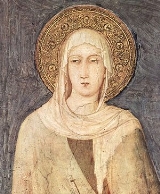
Clare of Assisi

Encyclopedia
Clare of Assisi (July 16, 1194 – August 11, 1253), born Chiara Offreduccio, is an Italian
saint
and one of the first followers of Saint Francis of Assisi. She founded the Order of Poor Ladies
, a monastic
religious order
for women in the Franciscan
tradition, and wrote their Rule of Life—the first monastic rule known to have been written by a woman. Following her death, the order she founded was renamed in her honor as the Order of Saint Clare, commonly referred to today as the Poor Clares.
, Santiago de Compostela
and the Holy Land
. Later on in her life, Ortolana entered Clare's monastery, together with Agnes
, Clare's sister.
Clare's parents decided she would marry a wealthy young man. In desperation Clare escaped her home and, on March 20, 1212, sought refuge with Francis, who received her into religious life.
Clare lived for a brief period in a nearby Benedictine
monastery of nun
s, San Paolo delle Abadesse, and then again for a short period at a house of female penitents, Sant'Angelo in Panza on Monte Subasio
.
Clare and her sister Agnes soon moved to the church of San Damiano, which Francis himself had rebuilt. Other women joined them there, and San Damiano became known for its radically austere lifestyle. The women were at first known as the "Poor Ladies".
San Damiano became the focal point for Clare's new religious order, which was known in her lifetime as the "Order of San Damiano." San Damiano was long thought to be the first house of this order, however, recent scholarship strongly suggests that San Damiano actually joined an existing network of women's religious houses organized by Hugolino (who later became Pope Gregory IX
). Hugolino wanted San Damiano as part of the order he founded because of the prestige of Clare's monastery. San Damiano emerged as the most important house in the order, and Clare became its undisputed leader. By 1263, just ten years after Clare's death, the order became known as the Order of Saint Clare.
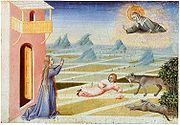 Unlike the Franciscan friars, whose members moved around the country to preach, Saint Clare's sisters lived in enclosure
, since an itinerant life was hardly conceivable at the time for women. Their life consisted of manual labour and prayer.
For a short period of time the order was directed by Francis himself. Then in 1216, Clare accepted the role of abbess
of San Damiano. As abbess, Clare had more authority to lead the order than when she was the prioress, who had to follow the orders of a priest heading the community. Clare defended her order from the attempts of prelates to impose a rule on them that more closely resembled the Rule of St Benedict
than Francis' stricter vows. Clare sought to imitate Francis' virtues and way of life so much so that she was sometimes titled alter Franciscus, another Francis. She also played a significant role in encouraging and aiding Francis, whom she saw as a spiritual father figure, and she took care of him during his illnesses at the end of his life, until his death in 1226.
After Francis's death, Clare continued to promote the growth of her order, writing letters to abbesses in other parts of Europe and thwarting every attempt by each successive pope
to impose a Rule on her order which watered down the radical commitment to corporate poverty
she had originally embraced. She did this despite the fact that she had endured a long period of poor health until her death. Clare's Franciscan theology of joyous poverty in imitation of Christ is evident in the Rule she wrote for her community and in her four letters to Agnes of Prague.
Solet annuere of Pope Innocent IV
confirmed that Clare's Rule would serve as the governing rule for Clare's Order of Poor Ladies. Two days later, on August 11, Clare died at the age of 59. Her remains were interred at the chapel of San Giorgio while a church to hold her remains was being constructed.
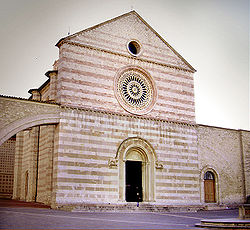 On August 15, 1255, Pope Alexander IV
canonized Clare as Saint Clare of Assisi. Construction of the Basilica of Saint Clare
was completed in 1260, and on October 3 of that year Clare's remains were transferred to the newly completed basilica where they were buried beneath the high altar. In further recognition of the saint, Pope Urban IV
officially changed the name of the Order of Poor Ladies to the Order of Saint Clare in 1263.
Some 600 years later in 1872, Saint Clare's remains were transferred to a newly constructed shrine in the crypt of the Basilica of Saint Clare
where they can still be seen today.
designated her as the patron saint
of television in 1958, on the basis that when she was too ill to attend Mass
, she had reportedly been able to see and hear it on the wall of her room. The Eternal Word Television Network
(EWTN) was founded by a Poor Clare nun
, Mother Angelica
.
In art, Clare is often shown carrying a monstrance
or pyx
, in commemoration of the time when she warded away the soldiers of Frederick II
at the gates of her convent by displaying the Blessed Sacrament
and kneeling in prayer.
Lake Saint Clair
and the Saint Clair River
in the Great Lakes region of North America
were named on her feast day August 11, 1679. Mission Santa Clara, founded by Spanish missionaries in northern California
in 1777, has given its name to the university
, city
, county, and valley
in which it sits. Southern California's Santa Clara River
is hundreds of miles to the south, and gave its name to the nearby city of Santa Clarita
. Santa Clara Pueblo, New Mexico
celebrates its Santa Clara Feast Day annually on August 12 , as the feast was celebrated before the 1960 calendar change.
In the Tridentine Calendar
, her feast day is celebrated as a Double on August 12, the day following her death, as August 11 was already assigned to Saints Tiburtius and Susanna
, two third-century Roman martyrs. It was changed to a Third-Class Feast in 1960 (see General Roman Calendar of 1962
). The 1969 calendar reform removed the feast of Ss. Tiburtius and Susanna from the calendar, allowing St. Clare's feast to be celebrated on August 11, as an Memorial. Although her body is no longer claimed to be incorrupt
, her skeleton is displayed in Assisi.
Italy
Italy , officially the Italian Republic languages]] under the European Charter for Regional or Minority Languages. In each of these, Italy's official name is as follows:;;;;;;;;), is a unitary parliamentary republic in South-Central Europe. To the north it borders France, Switzerland, Austria and...
saint
Saint
A saint is a holy person. In various religions, saints are people who are believed to have exceptional holiness.In Christian usage, "saint" refers to any believer who is "in Christ", and in whom Christ dwells, whether in heaven or in earth...
and one of the first followers of Saint Francis of Assisi. She founded the Order of Poor Ladies
Order of Poor Ladies
The Poor Clares also known as the Order of Saint Clare, the Order of Poor Ladies, the Poor Clare Sisters, the Clarisse, the Minoresses, the Franciscan Clarist Congregation, and the Second Order of St. Francis, , comprise several orders of nuns in the Catholic Church...
, a monastic
Monasticism
Monasticism is a religious way of life characterized by the practice of renouncing worldly pursuits to fully devote one's self to spiritual work...
religious order
Religious order
A religious order is a lineage of communities and organizations of people who live in some way set apart from society in accordance with their specific religious devotion, usually characterized by the principles of its founder's religious practice. The order is composed of initiates and, in some...
for women in the Franciscan
Franciscan
Most Franciscans are members of Roman Catholic religious orders founded by Saint Francis of Assisi. Besides Roman Catholic communities, there are also Old Catholic, Anglican, Lutheran, ecumenical and Non-denominational Franciscan communities....
tradition, and wrote their Rule of Life—the first monastic rule known to have been written by a woman. Following her death, the order she founded was renamed in her honor as the Order of Saint Clare, commonly referred to today as the Poor Clares.
Biography
Clare was born in Assisi, Italy as the eldest daughter of Favorino Scifi, Count of Sasso-Rosso and his wife Ortolana. Ortolana was a very devout woman who had undertaken pilgrimages to RomeRome
Rome is the capital of Italy and the country's largest and most populated city and comune, with over 2.7 million residents in . The city is located in the central-western portion of the Italian Peninsula, on the Tiber River within the Lazio region of Italy.Rome's history spans two and a half...
, Santiago de Compostela
Santiago de Compostela
Santiago de Compostela is the capital of the autonomous community of Galicia, Spain.The city's Cathedral is the destination today, as it has been throughout history, of the important 9th century medieval pilgrimage route, the Way of St. James...
and the Holy Land
Holy Land
The Holy Land is a term which in Judaism refers to the Kingdom of Israel as defined in the Tanakh. For Jews, the Land's identifiction of being Holy is defined in Judaism by its differentiation from other lands by virtue of the practice of Judaism often possible only in the Land of Israel...
. Later on in her life, Ortolana entered Clare's monastery, together with Agnes
Agnes of Assisi
Saint Agnes of Assisi was the younger sister of Saint Clare of Assisi and Abbess of the Poor Ladies at Assisi, Italy .-Biography:...
, Clare's sister.
Clare's parents decided she would marry a wealthy young man. In desperation Clare escaped her home and, on March 20, 1212, sought refuge with Francis, who received her into religious life.
Clare lived for a brief period in a nearby Benedictine
Benedictine
Benedictine refers to the spirituality and consecrated life in accordance with the Rule of St Benedict, written by Benedict of Nursia in the sixth century for the cenobitic communities he founded in central Italy. The most notable of these is Monte Cassino, the first monastery founded by Benedict...
monastery of nun
Nun
A nun is a woman who has taken vows committing her to live a spiritual life. She may be an ascetic who voluntarily chooses to leave mainstream society and live her life in prayer and contemplation in a monastery or convent...
s, San Paolo delle Abadesse, and then again for a short period at a house of female penitents, Sant'Angelo in Panza on Monte Subasio
Monte Subasio
Mount Subasio is a mountain of the Apennine mountains, in the province of Perugia, Umbria, central Italy. On its slopes are located the ancient towns of Assisi and Spello.The mountain stands about 1290 metres above sea level....
.
Clare and her sister Agnes soon moved to the church of San Damiano, which Francis himself had rebuilt. Other women joined them there, and San Damiano became known for its radically austere lifestyle. The women were at first known as the "Poor Ladies".
San Damiano became the focal point for Clare's new religious order, which was known in her lifetime as the "Order of San Damiano." San Damiano was long thought to be the first house of this order, however, recent scholarship strongly suggests that San Damiano actually joined an existing network of women's religious houses organized by Hugolino (who later became Pope Gregory IX
Pope Gregory IX
Pope Gregory IX, born Ugolino di Conti, was pope from March 19, 1227 to August 22, 1241.The successor of Pope Honorius III , he fully inherited the traditions of Pope Gregory VII and of his uncle Pope Innocent III , and zealously continued their policy of Papal supremacy.-Early life:Ugolino was...
). Hugolino wanted San Damiano as part of the order he founded because of the prestige of Clare's monastery. San Damiano emerged as the most important house in the order, and Clare became its undisputed leader. By 1263, just ten years after Clare's death, the order became known as the Order of Saint Clare.
Enclosure
Enclosure or inclosure is the process which ends traditional rights such as mowing meadows for hay, or grazing livestock on common land. Once enclosed, these uses of the land become restricted to the owner, and it ceases to be common land. In England and Wales the term is also used for the...
, since an itinerant life was hardly conceivable at the time for women. Their life consisted of manual labour and prayer.
For a short period of time the order was directed by Francis himself. Then in 1216, Clare accepted the role of abbess
Abbess
An abbess is the female superior, or mother superior, of a community of nuns, often an abbey....
of San Damiano. As abbess, Clare had more authority to lead the order than when she was the prioress, who had to follow the orders of a priest heading the community. Clare defended her order from the attempts of prelates to impose a rule on them that more closely resembled the Rule of St Benedict
Rule of St Benedict
The Rule of Saint Benedict is a book of precepts written by St. Benedict of Nursia for monks living communally under the authority of an abbot. Since about the 7th century it has also been adopted by communities of women...
than Francis' stricter vows. Clare sought to imitate Francis' virtues and way of life so much so that she was sometimes titled alter Franciscus, another Francis. She also played a significant role in encouraging and aiding Francis, whom she saw as a spiritual father figure, and she took care of him during his illnesses at the end of his life, until his death in 1226.
After Francis's death, Clare continued to promote the growth of her order, writing letters to abbesses in other parts of Europe and thwarting every attempt by each successive pope
Pope
The Pope is the Bishop of Rome, a position that makes him the leader of the worldwide Catholic Church . In the Catholic Church, the Pope is regarded as the successor of Saint Peter, the Apostle...
to impose a Rule on her order which watered down the radical commitment to corporate poverty
Corporate poverty
Corporate poverty is the practice of refusing to own property, either individually or corporately. This practice of Middle Ages religious communities developed based on Christian religious beliefs. Practical considerations generally allow for some exceptions....
she had originally embraced. She did this despite the fact that she had endured a long period of poor health until her death. Clare's Franciscan theology of joyous poverty in imitation of Christ is evident in the Rule she wrote for her community and in her four letters to Agnes of Prague.
Post death
On August 9, 1253, the Papal bullPapal bull
A Papal bull is a particular type of letters patent or charter issued by a Pope of the Catholic Church. It is named after the bulla that was appended to the end in order to authenticate it....
Solet annuere of Pope Innocent IV
Pope Innocent IV
Pope Innocent IV , born Sinibaldo Fieschi, was pope from June 25, 1243 until his death in 1254.-Early life:...
confirmed that Clare's Rule would serve as the governing rule for Clare's Order of Poor Ladies. Two days later, on August 11, Clare died at the age of 59. Her remains were interred at the chapel of San Giorgio while a church to hold her remains was being constructed.
Pope Alexander IV
Pope Alexander IV was Pope from 1254 until his death.Born as Rinaldo di Jenne, in Jenne , he was, on his mother's side, a member of the de' Conti di Segni family, the counts of Segni, like Pope Innocent III and Pope Gregory IX...
canonized Clare as Saint Clare of Assisi. Construction of the Basilica of Saint Clare
Basilica of Saint Clare
The Basilica of Saint Clare is a church in Assisi, central Italy; it is dedicated to and contains the remains of Saint Clare of Assisi, a follower of Saint Francis of Assisi and founder of the Order of Poor Ladies, known today as the Order of Saint Clare.Construction of the church began under the...
was completed in 1260, and on October 3 of that year Clare's remains were transferred to the newly completed basilica where they were buried beneath the high altar. In further recognition of the saint, Pope Urban IV
Pope Urban IV
Pope Urban IV , born Jacques Pantaléon, was Pope, from 1261 to 1264. He was not a cardinal, and there have been several Popes since him who have not been Cardinals, including Urban V and Urban VI.-Biography:...
officially changed the name of the Order of Poor Ladies to the Order of Saint Clare in 1263.
Some 600 years later in 1872, Saint Clare's remains were transferred to a newly constructed shrine in the crypt of the Basilica of Saint Clare
Basilica of Saint Clare
The Basilica of Saint Clare is a church in Assisi, central Italy; it is dedicated to and contains the remains of Saint Clare of Assisi, a follower of Saint Francis of Assisi and founder of the Order of Poor Ladies, known today as the Order of Saint Clare.Construction of the church began under the...
where they can still be seen today.
Legacy
Pope Pius XIIPope Pius XII
The Venerable Pope Pius XII , born Eugenio Maria Giuseppe Giovanni Pacelli , reigned as Pope, head of the Catholic Church and sovereign of Vatican City State, from 2 March 1939 until his death in 1958....
designated her as the patron saint
Patron saint
A patron saint is a saint who is regarded as the intercessor and advocate in heaven of a nation, place, craft, activity, class, clan, family, or person...
of television in 1958, on the basis that when she was too ill to attend Mass
Mass (liturgy)
"Mass" is one of the names by which the sacrament of the Eucharist is called in the Roman Catholic Church: others are "Eucharist", the "Lord's Supper", the "Breaking of Bread", the "Eucharistic assembly ", the "memorial of the Lord's Passion and Resurrection", the "Holy Sacrifice", the "Holy and...
, she had reportedly been able to see and hear it on the wall of her room. The Eternal Word Television Network
Eternal Word Television Network
The Eternal Word Television Network is an American cable television network which presents Catholic-themed programming. It was founded in 1980 by Mother Mary Angelica of the Annunciation, PCPA...
(EWTN) was founded by a Poor Clare nun
Nun
A nun is a woman who has taken vows committing her to live a spiritual life. She may be an ascetic who voluntarily chooses to leave mainstream society and live her life in prayer and contemplation in a monastery or convent...
, Mother Angelica
Mother Angelica
Mother Mary Angelica of the Annunciation, PCPA is an American Roman Catholic nun who founded the Eternal Word Television Network. In 1944 she entered the Poor Clares of Perpetual Adoration, a Franciscan religious order for women, as a postulant, and a year later she was admitted to the order as a...
.
In art, Clare is often shown carrying a monstrance
Monstrance
A monstrance is the vessel used in the Roman Catholic, Old Catholic, and Anglican churches to display the consecrated Eucharistic host, during Eucharistic adoration or Benediction of the Blessed Sacrament. Created in the medieval period for the public display of relics, the monstrance today is...
or pyx
Pyx
A pyx or pix is a small round container used in the Catholic, Old Catholic and Anglican Churches to carry the consecrated host , to the sick or invalid or those otherwise unable to come to a church in order to receive Holy Communion...
, in commemoration of the time when she warded away the soldiers of Frederick II
Frederick II, Holy Roman Emperor
Frederick II , was one of the most powerful Holy Roman Emperors of the Middle Ages and head of the House of Hohenstaufen. His political and cultural ambitions, based in Sicily and stretching through Italy to Germany, and even to Jerusalem, were enormous...
at the gates of her convent by displaying the Blessed Sacrament
Blessed Sacrament
The Blessed Sacrament, or the Body and Blood of Christ, is a devotional name used in the Roman Catholic Church, Eastern Catholic Churches, Old Catholic, Anglican, and Lutheran churches, to refer to the Host after it has been consecrated in the sacrament of the Eucharist...
and kneeling in prayer.
Lake Saint Clair
Lake Saint Clair (North America)
Lake St. Clair is a fresh-water lake named after Clare of Assisi that lies between the Province of Ontario and the State of Michigan, and its midline also forms the boundary between Canada and the United States of America. Lake St. Clair includes the Anchor Bay along the Metro Detroit coastline...
and the Saint Clair River
St. Clair River
The St. Clair River is a river in central North America which drains Lake Huron into Lake St Clair, forming part of the international boundary between the Canadian province of Ontario and the U.S. state of Michigan...
in the Great Lakes region of North America
North America
North America is a continent wholly within the Northern Hemisphere and almost wholly within the Western Hemisphere. It is also considered a northern subcontinent of the Americas...
were named on her feast day August 11, 1679. Mission Santa Clara, founded by Spanish missionaries in northern California
Northern California
Northern California is the northern portion of the U.S. state of California. The San Francisco Bay Area , and Sacramento as well as its metropolitan area are the main population centers...
in 1777, has given its name to the university
Santa Clara University
Santa Clara University is a private, not-for-profit, Jesuit-affiliated university located in Santa Clara, California, United States. Chartered by the state of California and accredited by the Western Association of Schools and Colleges, it operates in collaboration with the Society of Jesus , whose...
, city
Santa Clara, California
Santa Clara , founded in 1777 and incorporated in 1852, is a city in Santa Clara County, in the U.S. state of California. The city is the site of the eighth of 21 California missions, Mission Santa Clara de Asís, and was named after the mission. The Mission and Mission Gardens are located on the...
, county, and valley
Santa Clara Valley
The Santa Clara Valley is a valley just south of the San Francisco Bay in Northern California in the United States. Much of Santa Clara County and its county seat, San José, are in the Santa Clara Valley. The valley was originally known as the Valley of Heart’s Delight for its high concentration...
in which it sits. Southern California's Santa Clara River
Santa Clara River (California)
The Santa Clara River is approximately long, located in southern California in the United States. It drains an area of the coastal mountains north of Los Angeles. The Santa Clara is one of the largest river systems along the coast of Southern California and one of only a few remaining river...
is hundreds of miles to the south, and gave its name to the nearby city of Santa Clarita
Santa Clarita
Santa Clarita can refer to:* Santa Clarita, California* Santa Clarita Valley* Valencia, California...
. Santa Clara Pueblo, New Mexico
Santa Clara Pueblo, New Mexico
Santa Clara Pueblo is a census-designated place in Rio Arriba County, New Mexico, United States. The population was 980 at the 2000 census. Santa Clara Pueblo was established about 1550....
celebrates its Santa Clara Feast Day annually on August 12 , as the feast was celebrated before the 1960 calendar change.
In the Tridentine Calendar
Tridentine Calendar
The Tridentine Calendar is the calendar of saints to be honoured in the course of the liturgical year in the official liturgy of the Roman Rite as reformed by Pope Pius V, implementing a decision of the Council of Trent, which entrusted the task to the Pope....
, her feast day is celebrated as a Double on August 12, the day following her death, as August 11 was already assigned to Saints Tiburtius and Susanna
Saints Tiburtius and Susanna
Saints Tiburtius and Susanna were two Roman Catholic martyrs, the feast day of each of whom is 11 August. The saints were not related, but are simply venerated on the same day.-Tiburtius:...
, two third-century Roman martyrs. It was changed to a Third-Class Feast in 1960 (see General Roman Calendar of 1962
General Roman Calendar of 1962
This article lists the feast days of the General Roman Calendar as it was in 1962, following the reforms that Pope John XXIII introduced with his motu proprio Rubricarum instructum of 23 July 1960...
). The 1969 calendar reform removed the feast of Ss. Tiburtius and Susanna from the calendar, allowing St. Clare's feast to be celebrated on August 11, as an Memorial. Although her body is no longer claimed to be incorrupt
Incorruptibility
Incorruptibility is a Roman Catholic and Eastern Orthodox belief that supernatural intervention allows some human bodies to avoid the normal process of decomposition after death as a sign of their holiness...
, her skeleton is displayed in Assisi.
Further reading
- Bartoli, Marco. Chiara d'Assisi. Rome 1989: Instituto Storico dei Cappucini.
- Mooney, Catherine M.. "Imitatio Christi or Imitatio Mariae?: Clare of Assisi and Her Interpreters," in Gendered Voices: Medieval Saints and Their Interpreters, ed. Catherine M. Mooney (Philadelphia: University of Pennsylvania Press, 1999), pp. 52–77 (text), pp. 207–220 (notes)
External links
- St. Clare's Sr. Sec. School Agra Built On the Name Of St. Clare Of Assisi
- The pear-tree of St. Clare in the Convent of the Poor Clares of Perpetual Adoration in Bautzen
- St. Clare of Assisi
- Musical Theatre about St. Francis and St. Clare of Assisi
- Saint Clare of Assisi in Patron Saints Index
- Anorexia Sacra An opera using Clare's texts on asceticism and its connections with anorexia nervosa.
- St. Clare page at Christian Iconography
- Caxton's life of St. Clare