
All Topics  
Basilica of Santa Maria degli Angeli


   Email Print
   Bookmark   Link


Basilica of Santa Maria degli Angeli


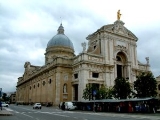
The Basilica of Santa Maria degli Angeli (Saint Mary of the Angels) is a church situated in the plain at the foot of the hill of AssisiAssisi Overview

Assisi, is a town in Italy in Perugia province, Italy, in the Umbria region, on the western flank of Mt....
, Italy, in the frazione of Santa Maria degli AngeliSanta Maria degli Angeli (Assisi)

Santa Maria degli Angeli is a frazione of the comune of Assisi, Umbria ....
.

The basilica was constructed between 1569 and 1679 enclosing the 9th century little church, the PorziuncolaPorziuncola

Porziuncola, also called Portiuncula or Porzioncula, is a town and parish situated about three-quarters of a mi...
, the most sacred place for the Franciscans. It was here that the young Francis of AssisiFrancis of Assisi

Saint Francis of Assisi founded the Franciscan Order or "Friars Minor"....
 understood his vocation and renounced the world in order to live in poverty among the poor and thus started the Franciscan movement.

History

After the death of Saint Francis in 1226, the friars built several small huts around the Porziuncola. In 1230 a refectory and some adjacent buildings were added. In the course of time little porticoes and accommodations for the friars were added around the Porziuncola. Some foundations of these were discovered during excavations under the floor of the present basilica between 1967 and 1969.

As vast numbers pilgrims came flocking to Assisi to receive the “Pardon of Assisi”, the small space of the Porziuncola became completely inadequate to house all these pilgrims. The necessity grew to build a church incorporating the Porziuncola. The buildings around the shrine were taken down by order of Pope Pius VPope Pius V

Pope St. Pius V , born Antonio Ghislieri, from 1518 called Michele Ghislieri, 1572) was Pope from 1566 to 1572 a...
 (1566-1572), except the Chapel of the Transito, the cell in which St. Francis had died. Construction of the basilica started on 25 March 1569.

This majestic church, the seventh largest Christian church, was designed in a bold Mannerist style prefiguring the BaroqueBaroque architecture

Baroque architecture, starting in the early 17th century in Italy, took the humanist Roman vocabulary of Renaissance archite...
 by two famous architects, Galeazzo AlessiGaleazzo Alessi

, and in numerous churches and palaces throughout [[Sicily]...
 and Vignola. The work progressed slowly, due to constant lack of money, as the building was financed with donations. The noteworthy dome, resting on an octagonal drum with eight windows and cornices, was finished in 1667. Construction of the church was finally completed in 1679. In 1684 a bell tower was added. It was originally intended to have a twin tower, but the second was never built.

On 15 March 1832 the central naveNave

Links to full descriptions of the elements of a Gothic floorplan are also found at the entry Cathedral diagram....
, a part of a lateral aisle and the choir collapsed during a violent earthquake. The dome escaped destruction, but was left with a wide crack. The apseApse

In architecture, the apse is a semicircular recess covered with a hemispherical vault....
 and the side chapels were left standing. Reconstruction of the basilica started in 1836 by the architect Luigi PolettiLuigi Poletti (architect)

Luigi Poletti was an Italian neoclassical architect....
 and it was finished in 1840. He remodeled the façade in a neoclassicalNeoclassical architecture

The neoclassical movement that produced Neoclassical architecture began in the mid-18th century, as a reaction against both ...
 style. Between 1924 and 1930 this façade was given back its original pre-Baroque style by Cesare Bazzani (Rome, 5 March1873 – Rome, 30 March 1939). The gold-plated statue of the Madonna degli Angeli ("Madonna of the Angels") by the sculptor Colasanti, was put on top of the façade in 1930.

On 11 April, 1909, the church was raised by pope Pius X to the status of "patriarchal basilica and papal chapel"

Description

The basilicaBasilica Summary

The Latin word basilica , was originally used to describe a Roman public building , usually located at the centre of a Roman...
 has a rectangular ground plan, divided into a central nave and two lateral aisles, flanked by ten side chapels, with at the far end a transeptTransept

Full descriptions of the elements of a Gothic floorplan are found at the entry Cathedral diagram....
, and a long choirChoir

A choir or chorus is a musical ensemble of singers....
 in a semi-circular apse, protruding from the ground plan. The Porziuncola is situated directly under the dome. The church is 126 meters long, 65 meters large and the dome is 75 meters high.

The interior is simple and yet elegant, with only a few decorations, in stark contrast with the decorations of the side chapels. The nave and the aisles were rebuilt in neoclassical Doric style by Luigi Poletti. The apse holds the precious wooden choir, carved by Franciscan brothers starting in 1689, the papal cathedraCathedra

A cathedra is the chair or throne of a bishop....
 (with bas-reliefs by E. Manfrini) and the papal altar. The Chapel of the Transito, the cell in which St. Francis died, is still preserved. It is situated under the bay of the choir, against the right columns of the dome.

The side chapels were decorated by great artists from several periods, including Antonio CircignaniAntonio Circignani

Antonio Circignani was an Italian painter of the late-Renaissance period and early Baroque....
 (all paintings in the Chapel of St Anne, 1602-1603), Francesco AppianiFrancesco Appiani

Francesco Appiani was an Italian painter of the late-Baroque period, active mainly in Rome and Perugia....
, (Chapels of St. Anthony and St. Peter in Chains, 1756–1760), Ventura SalimbeniFacts About Ventura Salimbeni

Ventura di Archangelo Salimbeni was an Italian Mannerist painter and among the last representatives of a style influenced by...
 (Chapel of the Removal of the Lord, 1602).

The Porziuncola

The chiesetta (little church) of Porziuncola (Italian for "Little portion") is the most sacred place for FranciscanFranciscan

The term Franciscan is used to refer to the Roman Catholic orders which follow the monastic rule of St....
s. Francis was given this little church, dating from the 9th century, by the BenedictineBenedictine Overview

A Benedictine is a person who follows the Rule of St Benedict....
 monks.

The church is exquisitely decorated by artists from different periods. Above the entrance is the fresco by Johann Friedrich OverbeckJohann Friedrich Overbeck

Johann Friedrich Overbeck, was a German painter and member of the Nazarene movement....
 (1829) depicting St. Francis receiving from the Christ and the Virgin the indulgence, known as the “Pardon of Assisi”. The side wall on the right side shows fragments of two frescoes by an unknown UmbriaUmbria

Umbria is a region of central Italy, bordered by Tuscany to the west, the Marche to the east and Lazio to the south....
n artists. The austere interior is decorated in a simple Gothic style with frescoes from the 14th and the 15th century. The most outstanding work is the six-part fresco in the apse of this little church, painted by Ilario da Viterbo (1393). At the back, above the entrance, is a fresco depicting the Crucifixion by Pietro Perugino.

The Transito

The Cappella del Transito is the small room where St. Francis died on 3 October 1226. It was a little hut serving as a primitive infirmary for the sick. It is decorated at the outside by the fresco of the The transito by Domenico Bruschi (1886). On the inside, above the small altar, is the rope of St. Francis. Behind the altar, there is a glazed terracotta statue of St. Francis by Andrea della RobbiaAndrea della Robbia

Andrea della Robbia was an Italian Renaissance sculptor, especially in ceramics....
 (c. 1490). On the walls there is a fresco by Giovanni Spagna (1520), depicting the earliest followers of St. Francis, with their names above each portrait (Ruffino, Leone, Masseo and Egidio).

The crypt

A new crypt was constructed behind the altar between 1965 and 1970. During the excavations foundations of the original little huts, surrounding the Porziuncola, were exposed. The crypt’s altar rests on a massive, multiple-branched tree trunk, sculpted by Francesco Prosperi. Behind the altar stands an enameled, terracotta, bas-relief tabernacle by Andrea della RobbiaAndrea della Robbia

Andrea della Robbia was an Italian Renaissance sculptor, especially in ceramics....
, expressing with an extreme finesse the emotions of the figures. The upper portion section includes St Francis receiving the Stigmata, the Coronation of Mary (with the angel musicians), St Jerome the Penitent; the lower has the The Annunciation, the Nativity and the Adoration by the Magi.

The Rose Garden and the Rose Chapel

One enters the rose garden via the sacristy. It is the last remains of the ancient wood in which St Francis and his friars lived. Here he talked to the turtle doveTurtle Dove

The Turtle Dove is a member of the bird family Columbidae, which includes the doves and pigeons....
s, inviting them to praise the Lord. Doves have been nesting since times immemorial in the hands of the statue of St. Francis in this rose garden.

According to tradition (already attested at the end of the 13th century), one night St. Francis, feeling the temptation to abandon his way of life, rolled naked in the bramble thorns in an attempt to overcome doubt and temptation. In contact with his body, the bramble bushes turned into dog roseDog Rose

The Dog Rose is a variable scrambling rose species native to Europe, northwest Africa and western Asia....
s without thorns. Since then, the dog rose cultivar Rosa canina assisiensis has been grown in the garden.

From the rose garden, one enters the Rose Chapel. This was the cell where St. Francis rested and spent the rest of the night in prayer and penance. Here St. Francis also met Saint Anthony of Padua. After his death a chapel was built in the 13th century, enlarged in the 15th century by St. Bernardine of SienaBernardino of Siena

Saint Bernardino of Siena was an Italian preacher, Franciscan missionary and Christian saint....
. It was decorated between 1506 and 1516 with a series of frescoes by several painters, among which the Umbrian Tiberio d'AssisiTiberio d'Assisi

Tiberio d'Assisi was an Italian painter of the Renaissance period, active in the early 16th century....
, depicting the early Franciscan community and the first saints of the order, the miracle of the roses and the concession of the indulgence

Museum

The little friary houses the museum of the Porziuncola with many religious objects, archaeological finds, and a noteworthy collection of paintings:
  • the Crucifix by Giunta PisanoGiunta Pisano

    Giunta Pisano was an Italian painter, he is the earliest Italian painter whose name is found inscribed on an extant work....
     (1236)
  • a wooden painting portrait of St. Francis by the (anonymous) Maestro di San Francesco (13th century); the body of the deceased saint was placed on this painting.
  • a painting on wood of St. Francis attributed to CimabueCimabue

    Cenni di Pepo Cimabue also known as Bencivieni Di Pepo or in modern Italian, Benvenuto Di Giuseppe, was a Florentine pain...
  • a Madonna with Child by the Sienese painter Sano di PietroSano di Pietro Overview

    Sano di Pietro was an early Italian Renaissance painter from Siena....
     (14th century)
  • a terracotta by Andrea della RobbiaFacts About Andrea della Robbia

    Andrea della Robbia was an Italian Renaissance sculptor, especially in ceramics....
     (c. 1490) with in the top from left to right :"St. Francis receives the Stigmata", "Coronation of Mary" and "St. Jerome the penitent"; bottom, from left to right : "the Annunciation", "the Nativity", and "the Adoration of the Magi".
  • St. Francis and St. Clare by Cesare Sermei and his workshop.
  • the Madonna of the Milk, a polychromed terracotta sculpture (end 14th, early 15th c.)
  • many frescoes of uncertain attribution.

Footnote

External links