


Antioch College

Encyclopedia
Liberal arts college
A liberal arts college is one with a primary emphasis on undergraduate study in the liberal arts and sciences.Students in the liberal arts generally major in a particular discipline while receiving exposure to a wide range of academic subjects, including sciences as well as the traditional...
in Yellow Springs, Ohio
Yellow Springs, Ohio
Yellow Springs is a village in Greene County, Ohio, United States, and is the location of Antioch College and Antioch University Midwest. The population was 3,487 at the 2010 census...
, United States
United States
The United States of America is a federal constitutional republic comprising fifty states and a federal district...
. It was the founder and the flagship institution of the six-campus Antioch University
Antioch University
Antioch University is an American university with five campuses located in four states. Campuses are located in Los Angeles, California; Santa Barbara, California; Keene, New Hampshire; Yellow Springs, Ohio; and Seattle, Washington. Additionally, Antioch University houses two institution-wide...
system. Founded in 1852 by the Christian Connection
Christian Connection
The Christian Connection or Christian Connexion was a Christian movement which began in several places during the late 18th and early 19th centuries and were secessions from three different religious denominations. The Christian Connection claimed to have no creed, instead professing to rely...
, the college began operating in 1853 with politician and education reformer Horace Mann
Horace Mann
Horace Mann was an American education reformer, and a member of the Massachusetts House of Representatives from 1827 to 1833. He served in the Massachusetts Senate from 1834 to 1837. In 1848, after serving as Secretary of the Massachusetts State Board of Education since its creation, he was...
as its first president. Between 1921 and 2008, the college's educational approach blended practical work experience with classroom learning, and participatory community governance. Students received narrative evaluations instead of academic letter grades
Academic grading in North America
Academic grading in North America varies from country to country and even within countries.-United States:The most commonly used index in the U.S. educational system uses five letter grades. Historically, the grades were A, B, C, D, and F—A being the highest and F, denoting failure, the lowest...
. In June 2007, the University’s Board of Trustees announced that Antioch College would be suspending operations as of July 2008. Antioch University transferred the assets, including the college campus, a $20 million endowment, Glen Helen and the Antioch Review, to the Antioch College Continuing Corporation in 2009 for $5 million. Since then, the Antioch College Continuing Corporation has raised nearly $17 million from alumni in its quest to reopen in fall 2011.
Antioch College was a member of the Great Lakes Colleges Association
Great Lakes Colleges Association
The Great Lakes Colleges Association , is a consortium of 13 liberal arts colleges located in the states around the Great Lakes. The 13 schools are located in Michigan, Ohio, Pennsylvania and Indiana...
, which mediated negotiations for transfer of the College from Antioch University to the ACCC, and the North American Alliance for Green Education. It was also formerly a member of the Eco League
Eco League
The Eco League is a five-college consortium consisting of Alaska Pacific University, Green Mountain College, Northland College, Prescott College and College of the Atlantic. The consortium is unique, in that each college is in a different geographic area. Alaska Pacific University is in Anchorage,...
.
History
On October 5, 1850, the General Convention of the Christian ChurchChristian Connection
The Christian Connection or Christian Connexion was a Christian movement which began in several places during the late 18th and early 19th centuries and were secessions from three different religious denominations. The Christian Connection claimed to have no creed, instead professing to rely...
passed a resolution stating "that our responsibility to the community, and the advancement of our interests as a denomination, demand of us the establishing of a College." The delegates further pledged "the sum of one hundred thousand dollars as the standard by which to measure our zeal and our effort in raising the means for establishing the contemplated College." The Committee on the Plan for a College was formed to undertake the founding of a college, and make decisions regarding the name of the school, the endowment, fundraising, faculty, and administration. Most notably, the committee decided that the college "shall afford equal privileges to students of both sexes." The Christian Connection sect wanted the new college to be sectarian, but the planning committee decided otherwise.
Despite its enthusiasm, the Christian Connection's fundraising efforts proved insufficient. The money raised before the school opened failed to cover even the cost of the three original buildings, much less create an endowment. The Unitarian Church
American Unitarian Association
The American Unitarian Association was a religious denomination in the United States and Canada, formed by associated Unitarian congregations in 1825. In 1961, it merged with the Universalist Church of America to form the Unitarian Universalist Association.According to Mortimer Rowe, the Secretary...
contributed an equal amount of funds and nearly as many students to the new school, causing denominational strife early on.
Early years
Horace MannHorace Mann
Horace Mann was an American education reformer, and a member of the Massachusetts House of Representatives from 1827 to 1833. He served in the Massachusetts Senate from 1834 to 1837. In 1848, after serving as Secretary of the Massachusetts State Board of Education since its creation, he was...
, Antioch's first president, ran the college from its founding in 1853 until his death in 1859. The young college had relatively high academic standards, and "good moral character
Moral character
Moral character or character is an evaluation of a particular individual's durable moral qualities. The concept of character can imply a variety of attributes including the existence or lack of virtues such as integrity, courage, fortitude, honesty, and loyalty, or of good behaviors or habits...
" was a requirement for graduation. The first curriculum focused on Latin
Latin
Latin is an Italic language originally spoken in Latium and Ancient Rome. It, along with most European languages, is a descendant of the ancient Proto-Indo-European language. Although it is considered a dead language, a number of scholars and members of the Christian clergy speak it fluently, and...
, Greek
Greek language
Greek is an independent branch of the Indo-European family of languages. Native to the southern Balkans, it has the longest documented history of any Indo-European language, spanning 34 centuries of written records. Its writing system has been the Greek alphabet for the majority of its history;...
, mathematics
Mathematics
Mathematics is the study of quantity, space, structure, and change. Mathematicians seek out patterns and formulate new conjectures. Mathematicians resolve the truth or falsity of conjectures by mathematical proofs, which are arguments sufficient to convince other mathematicians of their validity...
, history
History
History is the discovery, collection, organization, and presentation of information about past events. History can also mean the period of time after writing was invented. Scholars who write about history are called historians...
, philosophy
Philosophy
Philosophy is the study of general and fundamental problems, such as those connected with existence, knowledge, values, reason, mind, and language. Philosophy is distinguished from other ways of addressing such problems by its critical, generally systematic approach and its reliance on rational...
and science
Science
Science is a systematic enterprise that builds and organizes knowledge in the form of testable explanations and predictions about the universe...
, and offered electives in art
Art
Art is the product or process of deliberately arranging items in a way that influences and affects one or more of the senses, emotions, and intellect....
, botany
Botany
Botany, plant science, or plant biology is a branch of biology that involves the scientific study of plant life. Traditionally, botany also included the study of fungi, algae and viruses...
, pedagogy
Pedagogy
Pedagogy is the study of being a teacher or the process of teaching. The term generally refers to strategies of instruction, or a style of instruction....
, and modern languages. Tuition was $24 a year, and the first graduating class consisted of 28 students. Although the founders planned for approximately 1,000 students, enrollment only exceeded 500 once in the 19th century, in 1857.

Rebecca Pennell
Rebecca Mann Pennell, later Rebecca Mann Dean was an American educator, niece of prominent educator Horace Mann, and the first woman to be appointed a full faculty member at an American college. She was one of the ten founding professors of Antioch College in Yellow Springs, Ohio, where she taught...
, Mann's niece, who was one of the college's ten original faculty members. She was the first female college professor in the United States to have the same rank and pay as her male colleagues. Her home, now part of the Antioch campus and called Pennell House, served in recent years as community space for several of Antioch's student-led independent groups.
In 1859, Mann gave his final commencement speech
Commencement speech
A commencement speech or commencement address is a speech given to graduating students, generally at a university, although the term is also used for secondary education institutions. The "commencement" is a ceremony in which degrees or diplomas are conferred upon graduating students...
, including what became the college's motto: "Be ashamed to die until you have won some victory for humanity." Mann died in August and was initially interred on the Antioch College grounds. The next year, he was reinterred in Providence
Providence, Rhode Island
Providence is the capital and most populous city of Rhode Island and was one of the first cities established in the United States. Located in Providence County, it is the third largest city in the New England region...
, Rhode Island
Rhode Island
The state of Rhode Island and Providence Plantations, more commonly referred to as Rhode Island , is a state in the New England region of the United States. It is the smallest U.S. state by area...
, next to his first wife.
The original founders gave no consideration to the question of whether Antioch should admit students of color, neither forbidding nor explicitly allowing it. The associated preparatory school
University-preparatory school
A university-preparatory school or college-preparatory school is a secondary school, usually private, designed to prepare students for a college or university education...
admitted two African American
African American
African Americans are citizens or residents of the United States who have at least partial ancestry from any of the native populations of Sub-Saharan Africa and are the direct descendants of enslaved Africans within the boundaries of the present United States...
girls during the mid-1850s, an action one trustee responded to by resigning and removing his own children from the school. His opinion was apparently the minority one, though, as the African American students were not withdrawn. In 1863, Antioch trustee John Phillips proposed a resolution stating "the Trustees of Antioch College cannot, according to the Charter, reject persons on account of color." The resolution passed with nine trustees in favor and four opposed. However, the college remained nearly all white until after World War II
World War II
World War II, or the Second World War , was a global conflict lasting from 1939 to 1945, involving most of the world's nations—including all of the great powers—eventually forming two opposing military alliances: the Allies and the Axis...
, when the school undertook a minority recruitment program.
Antioch College was insolvent the day it opened and faced financial difficulties from its first years. From 1857 to 1859, Antioch ran an annual deficit of US$5,000, out of a total budget of US$13,000. In 1858, Antioch was bankrupt. Mann died in 1859 and the college was reorganized, but deficits continued. Mann's successor, Thomas Hill
Thomas Hill (clergyman)
-References:...
, took Antioch's presidency on the condition that faculty salaries be paid despite deficits. Despite this stipulation, his salary was often not paid, and he supported his family with loans. Hill and a colleague attempted to raise an endowment, but potential donors were put off by the strong sectarian leanings of some of the college's trustees. Hill resigned in 1862 due to increasing financial troubles, sectarian conflict between Christian Connection and Unitarian trustees, and his election as president of Harvard. In 1862, the college was closed until finances improved and remained closed until after the end of the Civil War
American Civil War
The American Civil War was a civil war fought in the United States of America. In response to the election of Abraham Lincoln as President of the United States, 11 southern slave states declared their secession from the United States and formed the Confederate States of America ; the other 25...
.
In 1865, the college reopened, now administered by the Unitarian Church. The financial health of the college seemed improved, as the Unitarians had raised a US$100,000 endowment in the space of two months. The endowment was originally invested in government bonds and later in real estate and timber. The investment income, while performing well, was still insufficient to maintain the college at the high level desired by the trustees. Some of the principal was lost to foreclosures during the Long Depression
Long Depression
The Long Depression was a worldwide economic crisis, felt most heavily in Europe and the United States, which had been experiencing strong economic growth fueled by the Second Industrial Revolution in the decade following the American Civil War. At the time, the episode was labeled the Great...
, which began in 1873. The college closed again from 1881–1882 to allow the endowment to recover.
In 1869, when the Cincinnati Red Stockings
Cincinnati Red Stockings
The Cincinnati Red Stockings of were baseball's first fully professional team, with ten salaried players. The Cincinnati Base Ball Club formed in 1866 and fielded competitive teams in the National Association of Base Ball Players 1867–1870, a time of a transition that ambitious Cincinnati,...
began their inaugural season as history's first professional baseball team, they played a preseason game at the site of what is now the Grand Union Terminal in Cincinnati against the Antiochs, who were regarded as one of the finest amateur clubs in Ohio. The game was played on May 15, 1869, and Cincinnati defeated Antioch 41-7. Antioch had been scheduled to host the first game of this professional tour on May 31, 1869, but pouring rain and an unplayable field kept the Red Stockings inside the Yellow Springs House until they left for Mansfield. So, while Antioch was not a part of the first professional baseball game, the college does hold claim to hosting the first ever rainout in professional baseball.
1900-1945
The turn of the century saw little improvement in the college's finances. In 1900 faculty made between US$500 and $700 a year, very low for the time, and the president was paid $1,500 a year. In contrast, Horace Mann's annual salary had been $3,000 more than forty years prior. Enrollment did increase significantly under the presidency of Simeon D. FessSimeon D. Fess
Simeon Davison Fess was a Republican politician and educator from Ohio. He served in the United States House of Representatives and U.S. Senate.-Early life:...
, who served from 1906 to 1917. In 1912 he was elected to the United States House of Representatives
United States House of Representatives
The United States House of Representatives is one of the two Houses of the United States Congress, the bicameral legislature which also includes the Senate.The composition and powers of the House are established in Article One of the Constitution...
, and served three of his five total terms while also acting as president of Antioch.
World War I
World War I
World War I , which was predominantly called the World War or the Great War from its occurrence until 1939, and the First World War or World War I thereafter, was a major war centred in Europe that began on 28 July 1914 and lasted until 11 November 1918...
had little effect, good or bad, on the college and though some people contracted influenza during the Spanish flu
Spanish flu
The 1918 flu pandemic was an influenza pandemic, and the first of the two pandemics involving H1N1 influenza virus . It was an unusually severe and deadly pandemic that spread across the world. Historical and epidemiological data are inadequate to identify the geographic origin...
epidemic, there were no deaths. In February 1919, the Young Men's Christian Association attempted a peaceful takeover of the college, offering to raise an endowment of US$500,000 if Antioch would serve as the official national college of the YMCA. The YMCA proposal was received positively by the college's trustees and enacted by a unanimous vote, and Grant Perkins, a YMCA executive, assumed the college's presidency. By May, Perkins had resigned, reporting that he was not prepared to raise the necessary funds.
In June 1919, several candidates were submitted to the trustees, including Arthur Morgan
Arthur Ernest Morgan
Arthur Ernest Morgan was a civil engineer, U.S. administrator, and educator. He was the design engineer for the Miami Conservancy District flood control system and oversaw construction. He served as the president of Antioch College between 1920 and 1936...
. Morgan was elected to the board without any prior notification of his candidacy. An engineer, he had been involved in planning a college in upstate New York
New York
New York is a state in the Northeastern region of the United States. It is the nation's third most populous state. New York is bordered by New Jersey and Pennsylvania to the south, and by Connecticut, Massachusetts and Vermont to the east...
that would have included work-study along with a more traditional curriculum. Morgan also received the right to demand the resignations of faculty and trustees. He presented his plan for "practical industrial education" to the trustees, which accepted the new plan. Antioch closed for a third time while the curriculum was reorganized and the co-op program developed. In 1920, Morgan was unanimously elected president and, in 1921, the college reopened with the cooperative education
Cooperative education
Cooperative education is a structured method of combining classroom-based education with practical work experience. A cooperative education experience, commonly known as a "co-op", provides academic credit for structured job experience...
program.
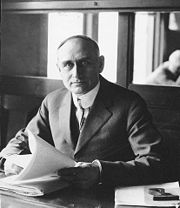
Morgan constructed a new board of trustees of prominent businessmen, replacing many of the local ministers and adding a new source of income. Charles Kettering
Charles Kettering
Charles Franklin Kettering was an American inventor, engineer, businessman, and the holder of 186 patents. He was a founder of Delco, and was head of research for General Motors for 27 years from 1920 to 1947. Among his most widely used automotive inventions were the electrical starting motor and...
alone contributed more than $500,000 to Antioch. These kinds of major donations by board members and their friends totaled more than $2 million for the decade. Kettering and other major patrons hoped to create a model institution that would create potential business administrators with students "trained for proprietorship." The college declined an offer from John Henry Patterson (NCR owner)
John Henry Patterson (NCR owner)
John Henry Patterson was an industrialist and founder of the National Cash Register Company. He was a businessperson and salesperson.-Early years:Patterson was born in 1844 on the family farm near Dayton, Ohio...
to finance the college completely if Antioch would leave rural Yellow Springs, re-establish itself on NCR grounds in Dayton, and rechristen itself the National Cash Register College.
The college enrolled no black
African American
African Americans are citizens or residents of the United States who have at least partial ancestry from any of the native populations of Sub-Saharan Africa and are the direct descendants of enslaved Africans within the boundaries of the present United States...
students from 1899–1929 and only two from 1929–1936 (neither graduated), so it is unknown how racial discrimination among employers affected the co-op program. While Antioch itself had no religious quotas (elsewhere common until the 1940s), many employers discriminated against Jews, a fact that limited the number of Jewish students at Antioch. The program suffered for available positions during the Great Depression
Great Depression
The Great Depression was a severe worldwide economic depression in the decade preceding World War II. The timing of the Great Depression varied across nations, but in most countries it started in about 1929 and lasted until the late 1930s or early 1940s...
, prompting the college to employ many students at industrial jobs on campus.
In 1926, the college's Administrative Council was formed as an advisory body to the president. It was chartered in 1930. The Administrative Council was originally a faculty-only body, though a student seat was added in 1941. Over time, the Administrative Council became the primary policy-making body of the College. The Community Council was established a short time later, to advise on and manage what at other college campuses would be considered "student concerns". At Antioch, these matters, such as campus artistic and cultural life, have been regarded as community-wide issues, affecting students, staff, faculty members and administrators.
1945-2000
Beginning in the 1940s, Antioch was considered an early bastion of student activismStudent activism
Student activism is work done by students to effect political, environmental, economic, or social change. It has often focused on making changes in schools, such as increasing student influence over curriculum or improving educational funding...
, anti-racism, and progressive thought. During World War II
World War II
World War II, or the Second World War , was a global conflict lasting from 1939 to 1945, involving most of the world's nations—including all of the great powers—eventually forming two opposing military alliances: the Allies and the Axis...
, Antioch, among other eastern colleges, with the help of Victor Goertzel, participated in a program which arranged for students of Japanese origin interned in Relocation camps to enroll in college. In 1943 the college Race Relations Committee began offering scholarships to non-white students to help diversify the campus, which had been mostly white since its founding. The first scholarship recipient was Edythe Scott, elder sister of Coretta Scott King
Coretta Scott King
Coretta Scott King was an American author, activist, and civil rights leader. The widow of Martin Luther King, Jr., Coretta Scott King helped lead the African-American Civil Rights Movement in the 1960s.Mrs...
. Coretta Scott received the scholarship and attended Antioch two years after her sister. Antioch was one of the first historically white colleges to actively recruit black students. Antioch was also the first historically white college to appoint a black person to be chair of an academic department, when Walter Anderson was appointed chair of the music department.
In the 1950s Antioch faced pressure from the powerful House Un-American Activities Committee
House Un-American Activities Committee
The House Committee on Un-American Activities or House Un-American Activities Committee was an investigative committee of the United States House of Representatives. In 1969, the House changed the committee's name to "House Committee on Internal Security"...
and faced criticism from many area newspapers because it did not expel students and faculty accused of having Communist leanings. College officials stood firm, insisting that freedom begins not in suppressing unpopular ideas but in holding all ideas up to the light. The school, including professors and administration, was also involved in the early stages of the American Civil Rights Movement and was a supporter of free speech.
In 1965, Dr. Martin Luther King Jr. gave the commencement speech.
Antioch became increasingly progressive and financially healthy during the 1960s and early 1970s under the Presidency of Dr. James P. Dixon. The student body topped out at around 2,400 students, the college owned property all over Yellow Springs and beyond, and the college grew throughout the decade. It began to appear in literary works and other media as an icon of youth culture, serving, for example, as the setting for a portion of Philip Roth
Philip Roth
Philip Milton Roth is an American novelist. He gained fame with the 1959 novella Goodbye, Columbus, an irreverent and humorous portrait of Jewish-American life that earned him a National Book Award...
's novel, Portnoy's Complaint
Portnoy's Complaint
Portnoy's Complaint is the American novel that turned its author Philip Roth into a major celebrity, sparking a storm of controversy over its explicit and candid treatment of sexuality, including detailed depictions of masturbation using various props including a piece of liver...
, and an S.J. Perelman satire, "To Yearn Is Subhuman, To Forestall Devine." At this time, Antioch became one of the primary sources of student radicalism, the New Left
New Left
The New Left was a term used mainly in the United Kingdom and United States in reference to activists, educators, agitators and others in the 1960s and 1970s who sought to implement a broad range of reforms, in contrast to earlier leftist or Marxist movements that had taken a more vanguardist...
, the anti-Vietnam War
Vietnam War
The Vietnam War was a Cold War-era military conflict that occurred in Vietnam, Laos, and Cambodia from 1 November 1955 to the fall of Saigon on 30 April 1975. This war followed the First Indochina War and was fought between North Vietnam, supported by its communist allies, and the government of...
movement, and the Black Power
Black Power
Black Power is a political slogan and a name for various associated ideologies. It is used in the movement among people of Black African descent throughout the world, though primarily by African Americans in the United States...
movement in the region. The town of Yellow Springs became an island of liberal and progressive activism in southern Ohio.
In many instances, the environment of the school spurred its students to activism. Eleanor Holmes Norton
Eleanor Holmes Norton
Eleanor Holmes Norton is a Delegate to Congress representing the District of Columbia. In her position she is able to serve on and vote with committees, as well as speak from the House floor...
, future congressional delegate for Washington, D.C.
Washington, D.C.
Washington, D.C., formally the District of Columbia and commonly referred to as Washington, "the District", or simply D.C., is the capital of the United States. On July 16, 1790, the United States Congress approved the creation of a permanent national capital as permitted by the U.S. Constitution....
, recalled her time at Antioch as one "when the first real action that could be called movement action was ignited", according to an interview now available in the National Security Archives.
The 1970s saw the college continue to develop its reputation as a source of activism and progressive political thought. Several graduate satellite schools around the country, under the Antioch University
Antioch University
Antioch University is an American university with five campuses located in four states. Campuses are located in Los Angeles, California; Santa Barbara, California; Keene, New Hampshire; Yellow Springs, Ohio; and Seattle, Washington. Additionally, Antioch University houses two institution-wide...
name (with the college as a base), were established as well, including the McGregor School
Antioch University McGregor
Antioch University Midwest ' is a private institution of higher education serving adult students in Yellow Springs, Ohio. Previously the school was named "Antioch University McGregor" after the management professor and theorist Douglas McGregor, who served as the President of Antioch College from...
(now known as Antioch University McGregor located on a new campus in Yellow Springs that opened September 2007). Antioch University New England
Antioch University New England
Antioch University New England is a private graduate school located in Keene, New Hampshire. It is part of the Antioch University system that includes campuses in Seattle, Washington; Los Angeles, California; Santa Barbara, California; and Yellow Springs, Ohio.- History :In 1964, Antioch College...
was the first graduate school offshoot in 1964. The university campuses are located in Keene, New Hampshire
Keene, New Hampshire
Keene is a city in Cheshire County, New Hampshire, United States. The population was 23,409 at the 2010 census. It is the county seat of Cheshire County.Keene is home to Keene State College and Antioch University New England, and hosts the annual Pumpkin Fest...
; Seattle, Washington; Los Angeles, California
Los Angeles, California
Los Angeles , with a population at the 2010 United States Census of 3,792,621, is the most populous city in California, USA and the second most populous in the United States, after New York City. It has an area of , and is located in Southern California...
; and Santa Barbara, California
Santa Barbara, California
Santa Barbara is the county seat of Santa Barbara County, California, United States. Situated on an east-west trending section of coastline, the longest such section on the West Coast of the United States, the city lies between the steeply-rising Santa Ynez Mountains and the Pacific Ocean...
.
After considering 337 candidates in its search, William Birenbaum
William Birenbaum
William Marvin Birenbaum was an American educator and college administrator who served in leadership positions at the New School for Social Research, Long Island University, Staten Island Community College, and received national attention for his efforts to address financial difficulties during...
was named as president of Antioch College in April 1976. The chairman of the search committee called him a "courageous and charismatic personality" who is an "experienced chief executive with a strong track record in crisis-type settings." By 1979, The New York Times
The New York Times
The New York Times is an American daily newspaper founded and continuously published in New York City since 1851. The New York Times has won 106 Pulitzer Prizes, the most of any news organization...
described tensions on campus due to the school's dire financial crisis and that Birenbaum's "pugnacious and often abrasive style had offended many Antiochians", with enrollment at the Yellow Springs, Ohio
Yellow Springs, Ohio
Yellow Springs is a village in Greene County, Ohio, United States, and is the location of Antioch College and Antioch University Midwest. The population was 3,487 at the 2010 census...
campus dropping from 2,000 to 1,000 during the 1970s. Birenbaum implemented cost-cutting measures including a reduction in the number of satellite campus programs nationwide from 30 down to under 10 and changed its name to Antioch University
Antioch University
Antioch University is an American university with five campuses located in four states. Campuses are located in Los Angeles, California; Santa Barbara, California; Keene, New Hampshire; Yellow Springs, Ohio; and Seattle, Washington. Additionally, Antioch University houses two institution-wide...
as a parent for its multiple campuses. By November 1980, The New York Times was able to report in a headline of an article about the college that "A Streamlined Antioch Appears on the Way to Survival". Birenbaum announced in June 1984 that he would be retiring and Alan E. Guskin of the University of Wisconsin–Parkside was named to succeed him as of September 1, 1985.
The college was led in the mid 1980s through the 1990s by Antioch Presidents Alan Guskin and Bob Devine. Antioch's enrollment figures never surpassed 1,000 students but the campus underwent renovations and buildings that had been boarded up were repaired and reopened, including South Hall, one of the college's three original buildings.
The Sexual Offense Prevention Policy
In 1993 Antioch became the focus of national attention with its "Sexual Offense Prevention Policy." Under this policy, consentConsent
Consent refers to the provision of approval or agreement, particularly and especially after thoughtful consideration.- Types of consent :*Implied consent is a controversial form of consent which is not expressly granted by a person, but rather inferred from a person's actions and the facts and...
for sexual behavior must be "(a) verbal, (b) mutual, and (c) reiterated for every new level of sexual behavior." This policy was initiated after two date rape
Date rape
"Date rape", often referred to as acquaintance rape, is an assault or attempted assault usually committed by a new acquaintance involving sexual intercourse without mutual consent....
s reportedly occurred on the Antioch College campus during the 1990-91 academic year. A group of students formed under the name "Womyn
Womyn
"Womyn" is one of a number of alternative spellings of the word "women" used by some feminist writers. There are many alternative spellings, including "wimmin", "womban", "wom!n"...
of Antioch" to address their concern that sexual offenses in general were not being taken seriously enough by the administration or some in the campus community. Advocates of the policy explain that the original "Sexual Offense Policy," as it was then called, was created during a couple of late-night meetings in the campus Womyn's Center, and that "this original policy was questionable. It was not legally binding, no rights were given to the accused, and it called for immediate expulsion of the accused with no formal process." The policy, both as it then stood and as revised, uniquely viewed any sexual offense as not simply a violation of the victim's rights, but as an offense against the entire campus community. It was revised to focus more on education and less on punishment and clarified in a series of community meetings during the 1991-92 academic year. Once revised, it was endorsed by the entire campus and the Board of Trustees, and thus became the official policy of the college that year.
This revised policy attracted renewed national publicity two years later, during the fall semester of the 1993-94 academic year, allegedly when a student doing a co-op on the west coast mentioned the policy to a California
California
California is a state located on the West Coast of the United States. It is by far the most populous U.S. state, and the third-largest by land area...
campus newspaper reporter. An Associated Press
Associated Press
The Associated Press is an American news agency. The AP is a cooperative owned by its contributing newspapers, radio and television stations in the United States, which both contribute stories to the AP and use material written by its staff journalists...
reporter picked up the story in the early days of the term, and a media frenzy ensued, one that arguably garnered more attention to Antioch than anything since the student strike
Student strike
A student strike occurs when students enrolled at a teaching institution such as a school, college or university refuse to go to class. This form of strike action is often used as a negotiating tactic in order to put pressure on the governing body of the university, particularly in countries where...
of 1973. The policy was often ridiculed by the mainstream American news media that fall, even becoming the butt of a Saturday Night Live
Saturday Night Live
Saturday Night Live is a live American late-night television sketch comedy and variety show developed by Lorne Michaels and Dick Ebersol. The show premiered on NBC on October 11, 1975, under the original title of NBC's Saturday Night.The show's sketches often parody contemporary American culture...
sketch, entitled "Is It Date Rape?" Some media outlets voiced support for the policy. For example, syndicated columnist Ellen Goodman
Ellen Goodman
Ellen Goodman is an American journalist and Pulitzer Prize-winning syndicated columnist.- Career :Goodman worked as a researcher and reporter for Newsweek magazine between 1963 and 1965, and has worked as an associate editor at the Boston Globe since 1967.In 1998, Goodman received the Elijah...
asserted that most "sexual policy makers write like lawyers in love," and that, likewise, "at Antioch the authors could use some poetry, and passion." But she was ultimately sympathetic to their goals of leveling the sexual playing field and making students think about what consent means, saying that the Antioch campus "has the plot line just about right."
The 21st century
In 2000, Antioch College was again subject to media attention after inviting political activist and death rowDeath row
Death row signifies the place, often a section of a prison, that houses individuals awaiting execution. The term is also used figuratively to describe the state of awaiting execution , even in places where no special facility or separate unit for condemned inmates exists.After individuals are found...
inmate Mumia Abu-Jamal
Mumia Abu-Jamal
Mumia Abu-Jamal was convicted of the 1981 murder of Philadelphia police officer Daniel Faulkner and sentenced to death. He has been described as "perhaps the world's best known death-row inmate", and his sentence is one of the most debated today...
and transgender
Transgender
Transgender is a general term applied to a variety of individuals, behaviors, and groups involving tendencies to vary from culturally conventional gender roles....
ed rights advocate and Abu-Jamal supporter Leslie Feinberg
Leslie Feinberg
Leslie Feinberg is a transgender queer and communist activist, speaker, and author. Feinberg's first novel Stone Butch Blues is widely considered a groundbreaking work about gender.- Career :...
to be commencement speakers. Graduating students had chosen Abu-Jamal and Feinberg to highlight their concerns with capital punishment
Capital punishment
Capital punishment, the death penalty, or execution is the sentence of death upon a person by the state as a punishment for an offence. Crimes that can result in a death penalty are known as capital crimes or capital offences. The term capital originates from the Latin capitalis, literally...
and the American criminal justice system. Many conservative commentators criticized the Antioch administration for allowing students to choose such controversial commencement speakers and the college administration received death threats. Antioch President Bob Devine chose not to overturn the students' choice of speakers, citing the ideals of free speech and free exchange of ideas, and likened the media reaction to the coverage of Martin Luther King, Jr.
Martin Luther King, Jr.
Martin Luther King, Jr. was an American clergyman, activist, and prominent leader in the African-American Civil Rights Movement. He is best known for being an iconic figure in the advancement of civil rights in the United States and around the world, using nonviolent methods following the...
's 1965 commencement address.
In the early 2000s enrollment declined to just over 600 students. This combined with a declining economy caused Antioch University to institute a "Renewal Plan" in 2003. The controversial plan called for restructuring Antioch's first year program into learning communities and upgrading campus facilities. Many students and faculty stated that they were shut out of planning. Antioch University's Board of Trustees committed to five years of funding for the renewal plan but discontinued this commitment to the college three years into the plan.
Simultaneously with the announcement of the renewal plan, the University's Board of Trustees announced mandated staff cuts at the college, including the elimination of the Office of Multicultural Affairs. Student anger over the mandated renewal plan and program cuts led to a student-initiated protest entitled "People of Color Takeover", which garnered negative media attention. Partially in response to this, Antioch College created the Coretta Scott King
Coretta Scott King
Coretta Scott King was an American author, activist, and civil rights leader. The widow of Martin Luther King, Jr., Coretta Scott King helped lead the African-American Civil Rights Movement in the 1960s.Mrs...
Center for Cultural and Intellectual Freedom in 2006.
With the implementation of the controversial renewal plan, enrollment dropped from 650 students to 370 in two years, a decline that many feel was a result of the curriculum change mandated by the Board of Trustees. At an Antioch University Board of Trustees meeting in June 2007 the Board stated that while the college was only in its third year of implementation of the plan they had not raised the funds needed, and that the college would be indefinitely closed at the end of the 2007-08 academic year.
Many Antioch alumni and faculty, upset at the prospect of the loss of the college's legacy, began organizing and raising funds in an effort to save the college, keep it open without interruption, and gain greater transparency in its governance. In August 2007, the college faculty filed suit against the Board of Trustees, charging that the Board was violating various contractual obligations.
Following a meeting between university and alumni representatives in August 2007, the Board of Trustees approved a resolution giving the Alumni Board until the October 2007 trustees' meeting to demonstrate the viability of an Alumni Board proposal to maintain the operations of the College. Despite initially stating he would remain until December, Antioch president Steve Lawry abruptly stepped down as president on September 1, 2007. The role of president was turned over to a three-person group, comprising the Dean of Faculty, Director of Student Services, and Director of Communications. While no reason for Lawry's immediate departure was given, it has been reported that he was forcibly ousted by the Board of Trustees. In response to this reported ousting, the faculty gave Antioch University Chancellor Toni Murdock a vote of no confidence.
A story about Antioch's closing in The Chronicle of Higher Education
The Chronicle of Higher Education
The Chronicle of Higher Education is a newspaper and website that presents news, information, and jobs for college and university faculty, staff members and administrators....
detailed the uncertain future of some faculty and staff members, along with the town of Yellow Springs, following suspended operations at the college. One professor, who got tenure 28 hours before the college announced its closing, had turned down other jobs in academia to work at Antioch. The story includes a slideshow showing outdated and crumbling buildings on campus.
On November 3, 2007, the University Board of Trustees agreed to lift the suspension of the college, which would have seen the college operate continuously rather than closing. The Alumni Board embarked on a $100 million fundraising drive to build the college's endowment, raising more than $18 million in gifts and pledges by November 2007. However, major donors balked out of concern that the deal did not make the college sufficiently autonomous from the university, and a group began meeting directly with the university, incorporating as the Antioch College Continuation Corporation (ACCC). On February 22, 2008, the university issued a press release reinstating the suspension, despite ongoing negotiations with the group. On March 28, 2008, university trustees rejected a $12.2 million offer from the ACCC, which then offered $10 million for 10 seats on the 19-member board. On May 8, 2008, university trustees rejected the ACCC's "best and final" offer -- $9.5 million for the college and another $6 million for the graduate campuses in exchange for eight board seats, with an additional four new trustees to be jointly agreed upon by the ACCC and current trustees.
The college closed as promised on June 30, 2008. In early 2011 it began recruiting faculty for the 2011-2012 academic year; likewise, it started a campaign to attract a "pioneer class" of freshmen to re-open the college, pledging to charge them no tuition and only $8600 in room, board, and fees.
Closure of Antioch College
The suspension of operations of the College led to a collaboration between the University and its College alumni association to explore a means to separate the College from the University in a manner which preserved the viability of both. The closure of Antioch College also spurred the creation of the Nonstop Liberal Arts InstituteNonstop Liberal Arts Institute
The Nonstop Liberal Arts Institute is the educational program supported by Nonstop Antioch, a movement of organized alumni, students, staff and former faculty of Antioch College to keep Antioch College alive and operating in Yellow Springs, Ohio. Nonstop is supported by the through the...
. Led by former faculty, staff, and students, and with the support of Yellow Springs residents, Nonstop aims to keep the values and mission of the College alive in the midst of its suspension
. Recognizing that any reopening of the College required the cooperation and substantial financial support of alumni, the Board of Governors of Antioch University adopted a resolution on June 8, 2008, requesting that the Alumni Association prepare a plan to bring the College back to vigor and vitality. Thereafter, the Antioch University Board of Governors and the Board of Directors of the Antioch College Alumni Association publicly announced on July 17, 2008, the creation of a new task force composed of University and Alumni representatives to develop a plan to create an independent Antioch College. The Alumni Association then delegated its role in the discussions to a limited group of alumni who had incorporated as Antioch College Continuation Corporation ("ACCC"), an Ohio non-profit corporation. The task force discussions were facilitated in part by the Great Lakes College Association. As the result of those discussions, ACCC and.
Antioch University agreed to an asset purchase agreement on June 30, 2009. That agreement called for the transfer of the College campus and the College endowment to ACCC which would operate the College as an independent corporation with its own fiduciary board of trustees. As part of the transaction, Antioch University licensed to ACCC an exclusive right to use the name "Antioch College". The parties closed on the transfer of assets on September 4, 2009, staff and an interim President have been hired to recruit an entering class for the Fall of 2011. (reference Associated Press)
Revival and Reopening
Mark RooseveltMark Roosevelt
Mark Roosevelt has been since January 2011 the President of Antioch College. He was previously the superintendent of the Pittsburgh Public Schools, the second largest school district in Pennsylvania, until December 31, 2010....
, formerly of Pittsburgh Public Schools
Pittsburgh Public Schools
Pittsburgh Public Schools is the public school district in Pittsburgh, Pennsylvania, USA and adjacent Mount Oliver.The combined land area of these municipalities is with a population of 342,503 according to the 2000 census. In August 2005, the superintendent became Mark Roosevelt. His tenure ends...
and former legislator in Massachusetts who authored a historic education reform law in 1993, was hired as the new president in October 2010.
On May 5, 2011, the chancellor of the Ohio Board of Regents approved the request by Antioch College to offer Bachelor of Arts and Bachelor of Science degrees. Antioch reopened as an independent four-year college Oct. 4, 2011.
Profiles, recognition, and criticism
Huffington Post recognized Antioch College on its list of Top Non-Traditional Colleges alongside Brown, the New School and Wesleyan University, among others. The editors wrote: "When it was up and running, Antioch provides students with smorgasbord of interdisciplinary majors founded on the basis of the school's "Three C's": classroom, co-op, and community. Though the school closed its doors in 2008, it will reopen in fall 2011."The U.S. News & World Report
U.S. News & World Report
U.S. News & World Report is an American news magazine published from Washington, D.C. Along with Time and Newsweek it was for many years a leading news weekly, focusing more than its counterparts on political, economic, health and education stories...
college and university rankings classify Antioch College as a third-tier Liberal Arts College.
Antioch has been regularly included in the guidebook "Colleges That Change Lives
Colleges That Change Lives
Colleges That Change Lives is a college educational guide by Loren Pope. It was originally published in 1996, with a second edition in 2000, and a third edition in 2006...
" which declares that "there is no college or university in the country that makes a more profound difference in a young person's life or that creates more effective adults."
Less positive opinions include that of George Will
George Will
George Frederick Will is an American newspaper columnist, journalist, and author. He is a Pulitzer Prize-winner best known for his conservative commentary on politics...
, who wrote in response to the college's announced closure that there is "a minuscule market for what Antioch sells for a tuition, room and board of $35,221 — repressive liberalism unleavened by learning."
During her remarks to the college in 2004 alumna Coretta Scott King
Coretta Scott King
Coretta Scott King was an American author, activist, and civil rights leader. The widow of Martin Luther King, Jr., Coretta Scott King helped lead the African-American Civil Rights Movement in the 1960s.Mrs...
stated that "Antioch students learn that it’s not enough to have a great career, material wealth and a fulfilling family life. We are also called to serve, to share, to give and to do what we can to lift up the lives of others. No other college emphasizes this challenge so strongly. That’s what makes Antioch so special."
The Twilight Zone TV series includes an episode titled "The Changing of the Guard
The Changing of the Guard (The Twilight Zone)
"The Changing of the Guard" is an episode of the American television anthology series The Twilight Zone.-Synopsis:Professor Ellis Fowler is an elderly teacher who is forced into retirement by his school...
" that is considered to be "the Antioch episode" for its references to Antioch that include mention of Horace Mann
Horace Mann
Horace Mann was an American education reformer, and a member of the Massachusetts House of Representatives from 1827 to 1833. He served in the Massachusetts Senate from 1834 to 1837. In 1848, after serving as Secretary of the Massachusetts State Board of Education since its creation, he was...
and the school motto.
Business
- Theodore LevittTheodore LevittTheodore Levitt was an American economist and professor at Harvard Business School. He was also editor of the Harvard Business Review and an editor who was especially noted for increasing the Review's circulation and for popularizing the term globalization...
(1949), Economist - Warren BennisWarren BennisWarren Gamaliel Bennis is an American scholar, organizational consultant and author, widely regarded as a pioneer of the contemporary field of Leadership studies....
(1951), Distinguished Professor of Business Administration at the University of Southern California, Chair of the Advisory Board of the Harvard University Kennedy School's Center for Public Leadership, author of more than thirty books on leadership - Jay Lorsch (1955), the Louis Kirstein Professor of Human Relations at the Harvard Business School, and currently Chairman of the Harvard Business School Global Corporate Governance Initiative and Faculty Chairman of the Executive Education Corporate Governance Series.
Education
- Deborah MeierDeborah MeierDeborah Meier is an American educator often considered the founder of the modern small schools movement. After spending several years as a kindergarten teacher in Chicago, Philadelphia and then New York City, in 1974, Meier became the founder and director of the alternative Central Park East...
(1954), Educator, considered the founder of the modern small schools movement - Lisa DelpitLisa DelpitLisa D. Delpit is an American educationalist and author. She is also an Eminent Scholar and Executive Director of the Center for Urban Educational Excellence at in Miami, Florida and Felton G...
(1974), author of Other People's Children, director of the Center for Urban Educational Excellence
Entertainment
- Peggy AhweshPeggy AhweshPeggy Ahwesh is an American avant-garde filmmaker and experimental video artist. She received her B.F.A. from Antioch College. Ahwesh's work has been shown at the Solomon R...
(1978), filmmaker and video artist - Wendy EwaldWendy EwaldWendy Ewald is an American photographer and educator. Her work is directed toward "helping children to see" and using the "camera as a tool for expression"...
(1974), photographer, professor at Duke UniversityDuke UniversityDuke University is a private research university located in Durham, North Carolina, United States. Founded by Methodists and Quakers in the present day town of Trinity in 1838, the school moved to Durham in 1892. In 1924, tobacco industrialist James B... - Suzanne FiolSuzanne FiolSuzanne Fiol ,"an impresario of avant-garde culture in New York" founded the performance space ISSUE Project Room in 2003 and oversaw its growth from the fringes of the New York new music scene into what The Village Voice, The Brooklyn Borough President, and Fiol herself predicted will become the...
, founder of ISSUE Project RoomISSUE Project RoomThe ISSUE Project Room is a music venue in Brooklyn, New York founded in 2003 by Suzanne Fiol. Located in The Old American Can Factory in the Gowanus section of Brooklyn, the venue supports a wide variety of contemporary performance, specializing in presenting experimental and avant-garde music... - John FlansburghJohn FlansburghJohn Conant Flansburgh is an American musician. He is half of the longstanding Brooklyn, New York-based alternative rock duo They Might Be Giants, for which he writes, sings and plays rhythm guitar...
(1983), singer/songwriter, They Might Be GiantsThey Might Be GiantsThey Might Be Giants is an American alternative rock band formed in 1982 by John Flansburgh and John Linnell. During TMBG's early years Flansburgh and Linnell were frequently accompanied by a drum machine. In the early 1990s, TMBG became a full band. Currently, the members of TMBG are... - Herb Gardner (1958), playwright
- Ken JenkinsKen JenkinsKen Jenkins is an American actor, best known for his role as Dr. Bob Kelso, the Chief of Medicine on the American comedy Scrubs....
, actor on ScrubsScrubs (TV series)Scrubs is an American medical comedy-drama television series created in 2001 by Bill Lawrence and produced by ABC Studios. The show follows the lives of several employees of the fictional Sacred Heart, a teaching hospital. It features fast-paced screenplay, slapstick, and surreal vignettes... - Nick KatzmanNick KatzmanNick Katzman is an American blues musician. Katzman was born in New York City, and lives in both Manhattan and Berlin, Germany. He plays in a variety of musical genres, including Chicago blues, Mississippi blues, Texas blues, and ragtime....
, bluesBluesBlues is the name given to both a musical form and a music genre that originated in African-American communities of primarily the "Deep South" of the United States at the end of the 19th century from spirituals, work songs, field hollers, shouts and chants, and rhymed simple narrative ballads...
musician - Jorma KaukonenJorma KaukonenJorma Ludwik Kaukonen Jr. is an American blues, folk, and rock guitarist, best known for his work with Jefferson Airplane and Hot Tuna.-Biography:...
(1962), guitarist/vocalist Jefferson AirplaneJefferson AirplaneJefferson Airplane was an American rock band formed in San Francisco in 1965. A pioneer of the psychedelic rock movement, Jefferson Airplane was the first band from the San Francisco scene to achieve mainstream commercial and critical success.... - John KortyJohn KortyJohn Korty is an American film director and animator, best known for the television film The Autobiography of Miss Jane Pittman and the documentary Who Are the DeBolts? And Where Did They Get Nineteen Kids?, as well as the theatrical animated feature Twice Upon a Time...
(1959), TV and screenwriter [Emmy for "The Autobiography of Miss Jane Pittman", Oscar for documentary of Japanese Internment Camps] - Peter Kurland, Academy Award-nominated sound mixer
- Cliff RobertsonCliff RobertsonClifford Parker "Cliff" Robertson III was an American actor with a film and television career that spanned half of a century. Robertson portrayed a young John F. Kennedy in the 1963 film PT 109, and won the 1968 Academy Award for Best Actor for his role in the movie Charly...
(1946), Academy Award-winning actor - Rod SerlingRod SerlingRodman Edward "Rod" Serling was an American screenwriter, novelist, television producer, and narrator best known for his live television dramas of the 1950s and his science fiction anthology TV series, The Twilight Zone. Serling was active in politics, both on and off the screen and helped form...
(1950), the creator of The Twilight ZoneThe Twilight Zone (1959 TV series)The Twilight Zone is an American anthology television series created by Rod Serling, which ran for five seasons on CBS from 1959 to 1964. The series consisted of unrelated episodes depicting paranormal, futuristic, dystopian, or simply disturbing events; each show typically featured a surprising...
TV series - Mia ZapataMia ZapataMia Katherine Zapata was the lead singer for the Seattle punk band The Gits.-Life and career:Zapata was born and raised in Louisville, Kentucky...
(1989), lead singer of The GitsThe GitsThe Gits were an American punk rock band, formed in Yellow Springs, Ohio in 1986. Known for their part in the burgeoning Seattle music scene of the early 1990s, their distinct punk rock sound gained a reputation for its bluesy street punk aesthetic...
Government
- Chester G. AtkinsChester G. AtkinsChester Greenough Atkins is a former member of the United States House of Representatives. He was a Democrat from Massachusetts.Atkins was born in Geneva, Switzerland on April 14, 1948 and graduated from Concord-Carlisle High School of Concord, Massachusetts in 1966 and Antioch College in 1970...
(1970), former United States Representative - Bill BradburyBill BradburyBill Bradbury is an American politician from the U.S. state of Oregon. A native of Illinois, he grew up in Chicago and Pennsylvania before moving to the West Coast where he worked in broadcast journalism before running for public office. Democrat, he served as Oregon Secretary of State from 1999...
(1960), OregonOregonOregon is a state in the Pacific Northwest region of the United States. It is located on the Pacific coast, with Washington to the north, California to the south, Nevada on the southeast and Idaho to the east. The Columbia and Snake rivers delineate much of Oregon's northern and eastern...
Secretary of StateSecretary of State (U.S. state government)Secretary of State is an official in the state governments of 47 of the 50 states of the United States, as well as Puerto Rico and other U.S. possessions. In Massachusetts, Pennsylvania, and Virginia, this official is called the Secretary of the Commonwealth... - John de JonghJohn de JonghJohn Percy de Jongh, Jr. is the current Governor of the U.S. Virgin Islands.-Life and career:de Jongh was born in Brooklyn, New York. As a child he attended Sts. Peter and Paul School on St. Thomas. After his parents' divorce, he lived with his mother in Detroit, Michigan while his mother did...
, United States Virgin IslandsUnited States Virgin IslandsThe Virgin Islands of the United States are a group of islands in the Caribbean that are an insular area of the United States. The islands are geographically part of the Virgin Islands archipelago and are located in the Leeward Islands of the Lesser Antilles.The U.S...
Governor - Hattie N. HarrisonHattie N. HarrisonHattie N. Harrison is an American politician who has served in the Maryland General Assembly since 1973. Harrison is the chairperson of the Maryland House of Delegates Rules and Executive Nominations Committee, and is the first African-American woman to chair a legislative committee in Maryland.She...
, member of the Maryland House of DelegatesMaryland House of DelegatesThe Maryland House of Delegates is the lower house of the General Assembly, the state legislature of the U.S. state of Maryland, and is composed of 141 Delegates elected from 47 districts. The House chamber is located in the state capitol building on State Circle in Annapolis... - A. Leon Higginbotham, Jr., civil rights advocate, author, United States federal judgeUnited States federal judgeIn the United States, the title of federal judge usually means a judge appointed by the President of the United States and confirmed by the United States Senate in accordance with Article II of the United States Constitution....
- Gail D. MathieuGail D. MathieuGail Dennise Thomas Mathieu is the former United States Ambassador to Namibia and former United States Ambassador to Niger.-Life and education:...
, B.A., current United States Ambassador to NamibiaUnited States Ambassador to NamibiaThe United States Ambassador to Namibia is the representative of the government of the United States in Namibia.The position was created the day Namibia became independent, which was also the day that Namibia-United States relations were established. On that same day, the U.S. Embassy in Windhoek...
and former United States Ambassador to NigerUnited States Ambassador to NigerThe day before Niger's independence on August 3, 1960, the first American Chargé d'Affaires ad interim, Donald R. Norland, presented his credentials to take effect the following day. The first United States ambassador to Niger, R. Borden Reams was appointed that October 14 and presented his... - Eleanor Holmes NortonEleanor Holmes NortonEleanor Holmes Norton is a Delegate to Congress representing the District of Columbia. In her position she is able to serve on and vote with committees, as well as speak from the House floor...
(1960) Congressional DelegateDelegate (United States Congress)A delegate to Congress is a non-voting member of the United States House of Representatives who is elected from a U.S. territory and from Washington, D.C. to a two-year term. While unable to vote in the full House, a non-voting delegate may vote in a House committee of which the delegate is a member...
, representing the District of Columbia - Americus V. RiceAmericus V. RiceAmericus Vespucius Rice was a nineteenth century politician, banker, and businessman from Ohio. He served in the Union Army during the American Civil War and was promoted to brigadier general at the end of the war....
Civil War general, U.S. Representative - E. Denise SimmonsE. Denise SimmonsE. Denise Simmons was the mayor of Cambridge, Massachusetts during the 2008-2009 term, and she was the first openly lesbian African-American mayor in the United States. The previous mayor of Cambridge, Kenneth Reeves, was the first openly gay African-American mayor in the United States...
, mayor of Cambridge, MassachusettsCambridge, MassachusettsCambridge is a city in Middlesex County, Massachusetts, United States, in the Greater Boston area. It was named in honor of the University of Cambridge in England, an important center of the Puritan theology embraced by the town's founders. Cambridge is home to two of the world's most prominent...
, and the first openly lesbian African-American mayor of an American city
Science
- Mario CapecchiMario CapecchiMario Renato Capecchi is an Italian-born American molecular geneticist and a co-winner of the 2007 Nobel Prize in Physiology or Medicine for discovering a method for introducing homologous recombination in mice employing embryonic stem cells, with Martin Evans and Oliver Smithies...
(B.S. 1961), co-recipient of the Nobel Prize in Physiology or MedicineNobel Prize in Physiology or MedicineThe Nobel Prize in Physiology or Medicine administered by the Nobel Foundation, is awarded once a year for outstanding discoveries in the field of life science and medicine. It is one of five Nobel Prizes established in 1895 by Swedish chemist Alfred Nobel, the inventor of dynamite, in his will...
in 2007 - Don Clark (1953), clinical psychologist, author
- Leland C. ClarkLeland ClarkLeland C. Clark Jr. was an American biochemist born in Rochester, New York. He is most well known as the inventor of the Clark electrode, a device used for measuring oxygen in blood, water and other liquids. Clark is considered the "Father of Biosensors", and the modern-day glucose sensor used...
, Jr. (B.S. 1941), biochemist and inventor - Jewell James EbersJewell James EbersJewell James Ebers was an American electrical engineer who is remembered for the mathematical model of the bipolar junction transistor that he published with John L. Moll in 1954. The Ebers-Moll model of the transistor views the transistor as a pair of diodes, and the model is a fusion of the...
(1946), electrical engineer - Clifford GeertzClifford GeertzClifford James Geertz was an American anthropologist who is remembered mostly for his strong support for and influence on the practice of symbolic anthropology, and who was considered "for three decades...the single most influential cultural anthropologist in the United States." He served until...
(1950), anthropologist - Stephen Jay GouldStephen Jay GouldStephen Jay Gould was an American paleontologist, evolutionary biologist, and historian of science. He was also one of the most influential and widely read writers of popular science of his generation....
(1963), biologist, author - Allan PredAllan PredAllan Richard Pred was an internationally-known American geographer and professor at the University of California at Berkeley He wrote over 20 books and monographs, translated into seven languages, and over 70 articles and book chapters....
(1957), geographer - Joan Steitz (1963), molecular biologist and Sterling Professor at Yale UniversityYale UniversityYale University is a private, Ivy League university located in New Haven, Connecticut, United States. Founded in 1701 in the Colony of Connecticut, the university is the third-oldest institution of higher education in the United States...
- Judith G. VoetJudith G. VoetJudith Greenwald Voet is a James Hammons Professor, Emerita in the Department of Chemistry and Biochemistry at Swarthmore College. Her research interests include enzyme reaction mechanisms and enzyme inhibition...
, B.S. - professor of chemistry and biochemistry at Swarthmore CollegeSwarthmore CollegeSwarthmore College is a private, independent, liberal arts college in the United States with an enrollment of about 1,500 students. The college is located in the borough of Swarthmore, Pennsylvania, 11 miles southwest of Philadelphia....
and author of several widely-used biochemistry textbooks
Writers
- Lawrence BlockLawrence BlockLawrence Block is an acclaimed contemporary American crime writer best known for two long-running New York–set series, about the recovering alcoholic P.I. Matthew Scudder and gentleman burglar Bernie Rhodenbarr, respectively...
(1960), author - James GalvinJames Galvin (poet)James Galvin is an American poet. He has published six collections of poetry, most recently As Is , "X: Poems," and Resurrection Update, Collected Poems, 1975-1997 which was a finalist for the Los Angeles Times Book Award, the Lenore Marshall Poetry Prize, and the Poet’s Prize...
(1974) poet/author - Peter Irons (1966), legal historian and author
- Laurence LeamerLaurence LeamerLaurence Leamer is a best-selling author and journalist. Leamer is a former Ford Fellow in International Development at the University of Oregon and a former International Fellow at Columbia University. He is regarded as an expert on the Kennedy family and has appeared in numerous media outlets...
(1964) - Franz LidzFranz LidzFranz Lidz is an American writer and journalist.He was a senior writer at Sports Illustrated, a contributing editor at Conde Nast Portfolio, and is a correspondent for GQ, Sports Illustrated, Men's Journal, The Wall Street Journal, The New York Observer, AARP the Magazine, Slate and has written...
(1973), journalist and author whose memoir, Unstrung Heroes, became a 1995 feature film directed by Diane KeatonDiane KeatonDiane Keaton is an American film actress, director, producer, and screenwriter. Keaton began her career on stage, and made her screen debut in 1970... - Sylvia NasarSylvia NasarSylvia Nasar is a German-born American economist and author, best known for her biography of John Forbes Nash, A Beautiful Mind.- Early life and history :...
(1970), author, A Beautiful MindA Beautiful Mind (book)A Beautiful Mind is an unauthorized biography of Nobel Prize-winning economist and mathematician John Forbes Nash, Jr. by Sylvia Nasar, professor of journalism at Columbia University... - Cary NelsonCary NelsonCary Nelson , professor of English and Jubilee Professor of Liberal Arts and Sciences at the University of Illinois at Urbana-Champaign, is the current president of the American Association of University Professors and a prominent scholar-activist....
(1967), higher education activist, author - Mark StrandMark StrandMark Strand is an American poet, essayist, and translator. He was appointed Poet Laureate Consultant in Poetry to the Library of Congress in 1990. Since 2005, he has been a professor of English at Columbia University.- Biography :...
(1957), poet - Karl GrossmanKarl GrossmanKarl Grossman is a full professor of journalism at the State University of New York College at Old Westbury. For more than 45 years he has pioneered the combination of investigative reporting and environmental journalism in a variety of media...
(1964), journalist and author - John Robbins (1976), author of Diet for a New America, pioneer environmentalist, and veganismVeganismVeganism is the practice of eliminating the use of animal products. Ethical vegans reject the commodity status of animals and the use of animal products for any purpose, while dietary vegans or strict vegetarians eliminate them from their diet only...
advocate
Others
- Olympia BrownOlympia BrownOlympia Brown was an American suffragist. She is regarded as the first woman to graduate from a theological school, as well as becoming the first full time ordained minister...
(1860), suffragist, women's rights activist, minister - Leo DreyLeo DreyLeo A. Drey is a Missouri timber magnate, conservationist, and philanthropist.Born January 19, 1917, in St. Louis, Missouri, to a wealthy manufacturer of glassware, Drey began acquiring timberland in the Missouri Ozarks for reforestation and conservation in 1950...
(1939), conservationist - Coretta Scott KingCoretta Scott KingCoretta Scott King was an American author, activist, and civil rights leader. The widow of Martin Luther King, Jr., Coretta Scott King helped lead the African-American Civil Rights Movement in the 1960s.Mrs...
(1951), human rights activist - Robert ManryRobert ManryRobert Manry was a copy editor of the Cleveland Plain Dealer who in 1965 sailed from Falmouth, Massachusetts, to Falmouth, Cornwall, England, in a tiny sailboat named Tinkerbelle...
(1949), nautical explorer - Éireann Leverett (1974), progressive systems guru
External links
Websites affiliated with Antioch:- AntiochCollege.org, the current website for Antioch College
- www.antioch-college.edu, Older .edu site will soon redirect to the above .org address until re-accredited.
- Antioch College Alumni Association, the official Antioch College alumni organization.
- Antiochiana, the department of archives and special collections at Antioch College
- The Antioch Record, the College's Newspaper
Unaffiliated websites:
- Antioch University, is no longer directly affiliated with Antioch College but has shared history
- Nonstop Liberal Arts Institute--a project of former Antioch College Faculty, Staff, Students and Alumni
- Yellow Springs News
- The Antioch Papers
- Antioch College Faculty Legal Fund
- The Blaze--An alternative campus publication
- Antioch College Action Network (ACAN)--An independent collective of students, faculty, staff, alumni, villagers and friends of the college
- Listen Up Antioch, a collection of audio and video recordings related to Antioch.
- http://www.google.com/hostednews/ap/article/ALeqM5jsYzqgNohSwzZzona8nUCgvdtW8wD9958B1G0 --Alumni group to pay $6M for Ohio's Antioch College