


Andreas Papandreou

Encyclopedia
Andreas G. Papandreou; 5 February 1919 – 23 June 1996) was a Greek
economist, a socialist politician and a dominant figure in Greek politics. The son of Georgios Papandreou, Andreas was a Harvard
-trained academic. He served two terms as Prime Minister of Greece
(21 October 1981, to 2 July 1989, and 13 October 1993, to 22 January 1996).
His assumption of power in 1981 influenced the course of Greek political history, ending an almost 50-year long system of power dominated by conservative forces; the achievements of his successive governments include the official recognition of the Greek Resistance
against the Axis
, the establishment of the National Health System and the Supreme Council for Personnel Selection (ASEP), the passage of Law 1264/1982 which secured the right to strike and greatly improved the rights of workers, the constitutional amendment of 1985–1986 which strengthened parliamentarism and reduced the powers of the unelected President
, the conduct of an assertive and independent Greek foreign policy
, the expansion in the power of local governments, many progressive reforms in Greek Law, and granting permission to the refugees of the Greek Civil War
to return home in Greece. The Panhellenic Socialist Movement
(PASOK) which he founded and led, was the first non-communist political party in Greek history with a mass-based organization, and introduced an unprecedented level of political and social participation in Greek society. In a poll conducted by Kathimerini
in 2007, 48% of those polled called Papandreou the "most important Greek Prime Minister". In the same poll, the first four years of Papandreou's government after Metapolitefsi
were voted as the best government Greece ever had.
, Greece, the son of the leading Greek liberal politician George Papandreou. His mother, born Zofia (Sofia) Mineyko, was half Polish
. Before university, he attended Athens College
a leading private school in Greece. He attended the National and Kapodistrian University of Athens
from 1937 till 1938 when, during the Fascist Metaxas
dictatorship, he was arrested for purported Trotskyism
. Following representations by his father, he was allowed to leave for the US.
In 1943, Papandreou received a PhD
in Economics
from Harvard University
. Immediately after getting his PhD, Papandreou joined America's war effort and volunteered for the US Navy where he served as a hospital corpsman at the Bethesda Naval Hospital
for war wounded, and became a United States citizen. He returned to Harvard in 1946 and served as a lecturer and associate professor until 1947. He then held professorships at the University of Minnesota
, Northwestern University
, the University of California, Berkeley
(where he was chair of the Department of Economics), Stockholm University
and York University
in Toronto
. In 1948, he entered into a relationship with University of Minnesota
journalism student Margaret Chant. After Chant obtained a divorce and after his own divorce from Christina Rasia, his first wife, Papandreou and Chant were married in 1951. They had three sons and a daughter. Papandreou also had with Swedish actress and TV presenter Ragna Nyblom a daughter out of wedlock, Emilia Nyblom, who was born in 1969 in Sweden.
. In 1963, his father George Papandreou, head of the Center Union
, became Prime Minister of Greece. Andreas became his chief economic advisor. He renounced his American citizenship and was elected to the Greek Parliament in the Greek legislative election, 1964
. He immediately became Minister to the First Ministry of State (in effect, assistant Prime Minister).
Papandreou took publicly a neutral stand on the Cold War
and wished for Greece to be more independent from the United States. He also criticized the massive presence of American military and intelligence in Greece, and sought to remove senior officers with anti-democratic tendencies from the Greek military.
In 1965, while the "Aspida
" conspiracy within the Hellenic Army
, alleged by the political opposition to involve Andreas personally, was being investigated, George Papandreou moved to fire the defense minister and assume the post himself. Constantine II of Greece
refused to endorse this move and essentially forced George Papandreou's resignation. Greece entered a period of political polarisation and instability, which ended with the coup d'état of 21 April 1967.
When the Greek Colonels led by Georgios Papadopoulos seized power in April 1967, Andreas was incarcerated while his father George Papandreou was put under house arrest. George Papandreou, already at advanced age, died in 1968. Under heavy pressure from American academics and intellectuals, such as John Kenneth Galbraith
, a friend of Andreas since their Harvard days, the military regime released Andreas on condition that he leave the country. Papandreou then moved to Sweden
with his wife, four children, and mother. There he accepted a post at Stockholm University
. In Paris, while in exile, Andreas Papandreou formed an anti-dictatorship organization, the Panhellenic Liberation Movement
(PAK), and toured the world rallying opposition to the Greek military regime. Despite his former American citizenship and academic career in the United States, Papandreou held the Central Intelligence Agency
responsible for the 1967 coup and became increasingly critical of the Federal government of the United States
.
In the early 1970s, during the latter phase of the dictatorship in Greece, Papandreou, along with most leading Greek politicians, in exile or in Greece, opposed the process of political normalisation attempted by Georgios Papadopoulos and his appointed PM, Spyros Markezinis. On 6 August 1974, Andreas Papandreou called an extraordinary meeting of the National Congress of PAK in Winterthur
, Switzerland, which decided its dissolution without announcing it publicly.
Papandreou returned to Greece after the fall of the junta in 1974, during metapolitefsi
, and formed a new "radical" party, the Panhellenic Socialist Movement
, or PASOK
. Most of his former PAK companions, as well as members of other anti-dictatorial groups such as the Democratic Defense
joined in the new party. He also testified in the first of the Greek Junta Trials
about the alleged involvement of the junta with the Central Intelligence Agency
(CIA).
In the Greek legislative election, 1974
, PASOK received only 13.5% of the vote, but in 1977
it polled 25%, and Papandreou became Leader of the Opposition. At the Greek legislative election, 1981
, PASOK won a landslide victory over the conservative New Democracy
Party, and Papandreou became Greece's first socialist Prime Minister.
In office, Papandreou backtracked from much of his campaign rhetoric and followed a more conventional approach. Greece did not withdraw from NATO, United States troops and military bases were not ordered out of Greece, and Greek membership in the European Economic Community
continued, largely because Papandreou proved very capable of securing monetary aid for Greece. In domestic affairs, Papandreou's government immediately carried out a massive programme of wealth redistribution upon coming into office that immediately increased the prosperity of the common people. Pensions, together with average wages and the minimum wage, were increased in real terms, and changes were made to labour laws which up until 1984 made it difficult for employers to make workers redundant. The impact of the PASOK Government’s social and economic policies was such that it was estimated in 1988 that two-thirds of the decrease in inequality that occurred in Greece between 1974 and 1982 took place between 1981 and 1982.
During its time in office, Papandreou's government carried through sweeping reforms of social policy by introducing a welfare state, significantly expanding welfare measures, expanding health care coverage (the "National Health System" was instituted, which made modern medical procedures available in rural areas for the first time,) promoting state-subsidized tourism for lower-income families, index-linking pensions, and funding social establishments for the elderly. Rural areas benefited from improved state services, the rights and income of low paid workers were considerably improved, and refugees from the Civil War living in exile from persecution were allowed to return with impunity.
A more progressive taxation scheme was introduced and budgetary support for artistic and cultural programmes was increased. The government also introduced a wage indexation system which helped to close the gap modestly between the highest and lowest paid workers, while the share of GNP devoted to social welfare, social insurance, and health was significantly increased.
As part of Papandreou’s "Contract with the People," new liberalising laws were introduced which decriminalised adultery, abolished (in theory) the dowry system, eased the process for obtaining a divorce, and enhanced the legal status of women.
In 1984, for instance, women were guaranteed equal pay for equal work. Papandreou also introduced various reforms in the administration and curriculum of the Greek educational system, allowing students to participate in the election process for their professors and deans in the university, and abolishing tenure.
In a move strongly opposed by the Church of Greece
, Papandreou introduced, for the first time in Greece, the process of civil marriage
. Prior to the institution of civil marriages in Greece, the only legally recognized marriages were those conducted in the Church of Greece. Couples seeking a civil marriage had to get married outside Greece, generally in Italy
. Also, under PASOK, the Greek State also appropriated real estate properties previously owned by the Church.
A major part of Papandreou's allagi (change) involved driving out the "old families" ("tzakia" literally: fireplaces using the traditional Greek expression for the genealogy of families), which dominated Greek politics and economy and belonged to the traditional Greek Right.
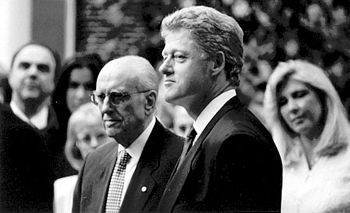 Papandreou was comfortably re-elected in the Greek legislative election, 1985
with 46% of the vote, and won still further popularity in March 1987 by his strong leadership during a Greek-Turkish crisis in the Aegean Sea
, but from the summer of 1988, his premiership became increasingly clouded by controversy, as the Bank of Crete scandal exploded. In 1989, he divorced his wife Margaret Papandreou and married Dimitra Liani
, while in the same year he was indicted by the Hellenic Parliament
in connection with a US$200 million Bank of Crete
embezzlement scandal, and was accused of facilitating the embezzlement by ordering state corporations to transfer their holdings to the Bank of Crete
, where the interest was allegedly skimmed off to benefit PASOK, and possibly some of its highest functionaries.
Following the many repercussions of the so-called Koskotas scandal
, the Greek legislative election, June 1989 elections produced a deadlock, leading to a prolonged political crisis. In the subsequent Greek legislative election, November 1989 Papandreou's PASOK's won 40% of the popular vote, compared to the rival New Democracy's 46%, and, due to changes made in electoral law one year before the elections by the then reigning PASOK administration, New Democracy was not able to form a government. The Greek legislative election, 1990
followed.
In the wake of three consecutive elections between 1989 and 1990, the New Democracy leader, Constantine Mitsotakis
, eventually received sufficient support to form a government. In January 1992, Papandreou himself was cleared of any wrongdoing in the Koskotas scandal after a 7–6 vote in the specially convened High Court trial, ordered by the Hellenic Parliament, with the support of both main parties, New Democracy and PASOK.
Papandreou confounded his critics by winning the Greek legislative election, 1993
, and returned to power; however, his fragile health kept him from exercising firm political leadership. He was hospitalized with advanced heart disease
and renal failure
on 21 November 1995 and finally retired from office on 16 January 1996. He died on 23 June 1996, with his funeral procession producing crowds, ranging from "hundreds of thousands"
to "millions" to bid farewell to Andreas. In 1999, Papandreou was posthumously awarded the Swedish Order of the Polar Star
.
increases and this led to increases in budget deficits and the public debt. Many economic indicator
s worsened during 1981–1990 and the economic policies of his government were condemned as a failure by his critics.
On the other hand, according to his supporters they were very successful, drastically increasing the purchasing power of the vast majority of Greeks, with personal incomes growing by 26% in real terms during the course of the Eighties. Papandreou's increased spending in his early years in power (1981–1985) was necessary in order to heal the deep wounds of the Greek society, a society that was still deeply divided by the brutal memories of the Civil War and the right-wing repression that followed; furthermore, the postwar government philosophy of the Greek conservatives simply saw the state as a tool of repression, with very little money spent on health and education, and little interest on the well-being of society.
, the Initiative of the Six, which included, besides the Greek PM, Mexico
's president Miguel de la Madrid
, Argentina's President Raúl Alfonsín
, Sweden's PM Olof Palme
, Tanzania's president Julius Nyerere
and India
's Prime Minister Indira Gandhi
. The movement's stated objective was the "promotion of peace and progress for all mankind". After various initiatives, mostly directed at pressuring the United States and the Soviet Union to stop nuclear testing
and reduce the level of nuclear arms, it eventually disbanded.
Papandreou's rhetoric was at times antagonistic to the United States. He was the first western prime minister to visit General Wojciech Jaruzelski
in Poland. According to the Foreign Affairs magazine Papandreou went on record as saying that since the USSR is not a capitalist country "one cannot label it an imperialist power." According to Papandreou, "the Soviet Union represent[ed] a factor that restrict[ed] the expansion of capitalism and its imperialistic aims". This antagonistic stance made him extremely popular, because the previous conservative governments were seen by the Greek people as slavishly loyal to US interests.
Papandreou's government was the first in post-war Greece that redirected the nation's defense policy to suit its own security needs, and not those of the United States
. From 1947 until 1981, the US had more influence in Greece's military policy than the indigenous Greek high command.
Papandreou supported the causes of various movements in the world, and agreed for Greece to host representatives offices of many such organisations. He supported the cause of Palestinian liberation, met repeatedly with PLO Chairman Yasser Arafat
and condemned Israeli policies in the occupied territories.
and popularity. Andreas was also famous for wearing his business suits with turtleneck sweaters (Ζιβάγκο in Greek), instead of the traditional white shirt and tie; he thus created a huge fashion, mainly but not exclusively among his political supporters. His first appearance in the Greek Parliament with a black turtleneck instead of shirt and tie caused a massive uproar in the conservative press, who considered him disrespectful of Parliament; however, the whole issue only added to his popularity.
 Papandreou exercised a more independent foreign policy elevating Greece's profile among non-aligned nations. He affirmed Greece's independence in setting her own policy agenda, both internally and externally, free from any foreign domination.
His opponents on the left, on the other hand, including the KKE
, accused him of supporting, in practice, the agenda of NATO and the United States.
Andreas Papandreou is widely acknowledged as having shifted political power from the traditional conservative Greek Right, which had dominated Greek politics for decades, to a more populist and centre-left locus. Political forces which remained the so-called pariah
s in politics as of the end of the Greek Civil War
, were given a chance to prove themselves in democratically elected governments. This shift in the Greek political landscape helped heal some of the old civil war wounds; Greece became more pluralistic, and more in line with the political system of other western European countries. Papandreou also systematically pursued inclusionist politics which ended the sociopolitical and economic exclusion of many social classes in the post-civil war era.
It is also acknowledged that Papandreou, along with Karamanlis, played a leading role in establishing Democracy in Greece during metapolitefsi. He is described as both prudent and a realist, despite his appearance as a leftist ideologue and charismatic orator. His choices to remain in the European Union
and NATO, both of which he vehemently opposed for many years, proved his pragmatical approach. Even his approach of negotiating the removal of the US bases from Greece was diplomatic, because although it was agreed to remove them, some of the bases remained. His skillful handling of these difficult policies had the effect of providing common policy goals to the political forces of Greece. Complementing this political realism, Andreas' ability to publicly say no to the Americans gave Greeks a sense of national independence and psychological self-worth.
Perhaps his most important achievement was the establishment of political equality among Greeks; during his years in power the defeated left-wingers of the Civil War were no longer treated like second-class citizen
s and a vital part of national memory was reclaimed.
Papandreou's successor in office, Costas Simitis
, broke with a number of Papandreou's approaches.
Papandreou's son, George Papandreou, was elected leader of PASOK in February 2004 and Prime Minister during the October 2009 general elections. A common slogan among PASOK followers in political rallies, invokes Andreas' legacy with the chant "Andrea, zis! Esi mas odigis!" ("Andreas, you are still alive! You're leading us!").
In two separate polls, conducted in 2007 and 2010, Andreas Papandreou was voted as the best Prime Minister of Greece since the restoration of democracy in 1974.
Greece
Greece , officially the Hellenic Republic , and historically Hellas or the Republic of Greece in English, is a country in southeastern Europe....
economist, a socialist politician and a dominant figure in Greek politics. The son of Georgios Papandreou, Andreas was a Harvard
Harvard University
Harvard University is a private Ivy League university located in Cambridge, Massachusetts, United States, established in 1636 by the Massachusetts legislature. Harvard is the oldest institution of higher learning in the United States and the first corporation chartered in the country...
-trained academic. He served two terms as Prime Minister of Greece
Prime Minister of Greece
The Prime Minister of Greece , officially the Prime Minister of the Hellenic Republic , is the head of government of the Hellenic Republic and the leader of the Greek cabinet. The current interim Prime Minister is Lucas Papademos, a former Vice President of the European Central Bank, following...
(21 October 1981, to 2 July 1989, and 13 October 1993, to 22 January 1996).
His assumption of power in 1981 influenced the course of Greek political history, ending an almost 50-year long system of power dominated by conservative forces; the achievements of his successive governments include the official recognition of the Greek Resistance
Greek Resistance
The Greek Resistance is the blanket term for a number of armed and unarmed groups from across the political spectrum that resisted the Axis Occupation of Greece in the period 1941–1944, during World War II.-Origins:...
against the Axis
Axis Powers
The Axis powers , also known as the Axis alliance, Axis nations, Axis countries, or just the Axis, was an alignment of great powers during the mid-20th century that fought World War II against the Allies. It began in 1936 with treaties of friendship between Germany and Italy and between Germany and...
, the establishment of the National Health System and the Supreme Council for Personnel Selection (ASEP), the passage of Law 1264/1982 which secured the right to strike and greatly improved the rights of workers, the constitutional amendment of 1985–1986 which strengthened parliamentarism and reduced the powers of the unelected President
President of Greece
The President of the Hellenic Republic , colloquially referred to in English as the President of Greece, is the head of state of Greece. The office of the President of the Republic was established after the Greek republic referendum, 1974 and formally by the Constitution of Greece in 1975. The...
, the conduct of an assertive and independent Greek foreign policy
Foreign policy
A country's foreign policy, also called the foreign relations policy, consists of self-interest strategies chosen by the state to safeguard its national interests and to achieve its goals within international relations milieu. The approaches are strategically employed to interact with other countries...
, the expansion in the power of local governments, many progressive reforms in Greek Law, and granting permission to the refugees of the Greek Civil War
Greek Civil War
The Greek Civil War was fought from 1946 to 1949 between the Greek governmental army, backed by the United Kingdom and United States, and the Democratic Army of Greece , the military branch of the Greek Communist Party , backed by Bulgaria, Yugoslavia and Albania...
to return home in Greece. The Panhellenic Socialist Movement
Panhellenic Socialist Movement
The Panhellenic Socialist Movement , known mostly by its acronym PASOK , is one of the two major political parties in Greece. Founded on 3 September 1974 by Andreas Papandreou, in 1981 PASOK became Greece's first social democratic party to win a majority in parliament.The party is a socialist party...
(PASOK) which he founded and led, was the first non-communist political party in Greek history with a mass-based organization, and introduced an unprecedented level of political and social participation in Greek society. In a poll conducted by Kathimerini
Kathimerini
I Kathimerini is a daily morning newspaper published in Athens. It is published in the Greek language, as well as in an abridged English-language edition. The English edition is sold separately in the United States and as a supplement to the International Herald Tribune in Greece and Cyprus. On 2...
in 2007, 48% of those polled called Papandreou the "most important Greek Prime Minister". In the same poll, the first four years of Papandreou's government after Metapolitefsi
Metapolitefsi
The Metapolitefsi was a period in Greek history after the fall of the Greek military junta of 1967–1974 that includes the transitional period from the fall of the dictatorship to the Greek legislative elections of 1974 and the democratic period immediately after these elections.The long...
were voted as the best government Greece ever had.
Early life and career
Papandreou was born on the island of ChiosChios
Chios is the fifth largest of the Greek islands, situated in the Aegean Sea, seven kilometres off the Asia Minor coast. The island is separated from Turkey by the Chios Strait. The island is noted for its strong merchant shipping community, its unique mastic gum and its medieval villages...
, Greece, the son of the leading Greek liberal politician George Papandreou. His mother, born Zofia (Sofia) Mineyko, was half Polish
Poles
thumb|right|180px|The state flag of [[Poland]] as used by Polish government and diplomatic authoritiesThe Polish people, or Poles , are a nation indigenous to Poland. They are united by the Polish language, which belongs to the historical Lechitic subgroup of West Slavic languages of Central Europe...
. Before university, he attended Athens College
Athens College
Athens College is a co-educational private independent school in Psychiko, Greece, a suburb of Athens, part of the Hellenic-American Educational Foundation which also includes Psychiko College, although both schools are usually referred to as "Athens College"...
a leading private school in Greece. He attended the National and Kapodistrian University of Athens
National and Kapodistrian University of Athens
The National and Kapodistrian University of Athens , usually referred to simply as the University of Athens, is the oldest university in Southeast Europe and has been in continuous operation since its establishment in 1837. Today, it is the second-largest institution of higher learning in Greece,...
from 1937 till 1938 when, during the Fascist Metaxas
Ioannis Metaxas
Ioannis Metaxas was a Greek general, politician, and dictator, serving as Prime Minister of Greece from 1936 until his death in 1941...
dictatorship, he was arrested for purported Trotskyism
Trotskyism
Trotskyism is the theory of Marxism as advocated by Leon Trotsky. Trotsky considered himself an orthodox Marxist and Bolshevik-Leninist, arguing for the establishment of a vanguard party of the working-class...
. Following representations by his father, he was allowed to leave for the US.
In 1943, Papandreou received a PhD
PHD
PHD may refer to:*Ph.D., a doctorate of philosophy*Ph.D. , a 1980s British group*PHD finger, a protein sequence*PHD Mountain Software, an outdoor clothing and equipment company*PhD Docbook renderer, an XML renderer...
in Economics
Economics
Economics is the social science that analyzes the production, distribution, and consumption of goods and services. The term economics comes from the Ancient Greek from + , hence "rules of the house"...
from Harvard University
Harvard University
Harvard University is a private Ivy League university located in Cambridge, Massachusetts, United States, established in 1636 by the Massachusetts legislature. Harvard is the oldest institution of higher learning in the United States and the first corporation chartered in the country...
. Immediately after getting his PhD, Papandreou joined America's war effort and volunteered for the US Navy where he served as a hospital corpsman at the Bethesda Naval Hospital
National Naval Medical Center
The National Naval Medical Center in Bethesda, Maryland, USA — commonly known as the Bethesda Naval Hospital — was for decades the flagship of the United States Navy's system of medical centers. A federal institution, it conducted medical and dental research as well as providing health care for...
for war wounded, and became a United States citizen. He returned to Harvard in 1946 and served as a lecturer and associate professor until 1947. He then held professorships at the University of Minnesota
University of Minnesota
The University of Minnesota, Twin Cities is a public research university located in Minneapolis and St. Paul, Minnesota, United States. It is the oldest and largest part of the University of Minnesota system and has the fourth-largest main campus student body in the United States, with 52,557...
, Northwestern University
Northwestern University
Northwestern University is a private research university in Evanston and Chicago, Illinois, USA. Northwestern has eleven undergraduate, graduate, and professional schools offering 124 undergraduate degrees and 145 graduate and professional degrees....
, the University of California, Berkeley
University of California, Berkeley
The University of California, Berkeley , is a teaching and research university established in 1868 and located in Berkeley, California, USA...
(where he was chair of the Department of Economics), Stockholm University
Stockholm University
Stockholm University is a state university in Stockholm, Sweden. It has over 28,000 students at four faculties, making it one of the largest universities in Scandinavia. The institution is also frequently regarded as one of the top 100 universities in the world...
and York University
York University
York University is a public research university in Toronto, Ontario, Canada. It is Canada's third-largest university, Ontario's second-largest graduate school, and Canada's leading interdisciplinary university....
in Toronto
Toronto
Toronto is the provincial capital of Ontario and the largest city in Canada. It is located in Southern Ontario on the northwestern shore of Lake Ontario. A relatively modern city, Toronto's history dates back to the late-18th century, when its land was first purchased by the British monarchy from...
. In 1948, he entered into a relationship with University of Minnesota
University of Minnesota
The University of Minnesota, Twin Cities is a public research university located in Minneapolis and St. Paul, Minnesota, United States. It is the oldest and largest part of the University of Minnesota system and has the fourth-largest main campus student body in the United States, with 52,557...
journalism student Margaret Chant. After Chant obtained a divorce and after his own divorce from Christina Rasia, his first wife, Papandreou and Chant were married in 1951. They had three sons and a daughter. Papandreou also had with Swedish actress and TV presenter Ragna Nyblom a daughter out of wedlock, Emilia Nyblom, who was born in 1969 in Sweden.
Political career
Papandreou returned to Greece in 1959, where he headed an economic development research program, by invitation of Prime Minister Konstantinos Karamanlis. In 1960, he was appointed Chairman of the Board of Directors and General Director of the Athens Economic Research Center, and Advisor to the Bank of GreeceBank of Greece
The Bank of Greece is the nationalcentral bank of Greece, located in Athens on Panepistimiou Street, with several branches across the country. Founded in 1927...
. In 1963, his father George Papandreou, head of the Center Union
Center Union
The Centre Union was a Greek political party, created in 1961 by George Papandreou, senior.The party was elected to power in 1963, with Papandreou as Prime Minister...
, became Prime Minister of Greece. Andreas became his chief economic advisor. He renounced his American citizenship and was elected to the Greek Parliament in the Greek legislative election, 1964
Greek legislative election, 1964
The Greek legislative election of the 19 February 1964 resulted in a clear victory for Georgios Papandreou and his Center Union party.Georgios Papandreou had formed an interim government just after the legislative elections of 1963, in order to carry out new elections, because no party had the...
. He immediately became Minister to the First Ministry of State (in effect, assistant Prime Minister).
Papandreou took publicly a neutral stand on the Cold War
Cold War
The Cold War was the continuing state from roughly 1946 to 1991 of political conflict, military tension, proxy wars, and economic competition between the Communist World—primarily the Soviet Union and its satellite states and allies—and the powers of the Western world, primarily the United States...
and wished for Greece to be more independent from the United States. He also criticized the massive presence of American military and intelligence in Greece, and sought to remove senior officers with anti-democratic tendencies from the Greek military.
In 1965, while the "Aspida
Apostasia of 1965
The terms Apostasia or Iouliana or the Royal Coup are used to describe the political crisis in Greece that centred around the resignation, on 15 July 1965, of Prime Minister Georgios Papandreou and the appointment, by King Constantine II, of successive Prime Ministers from Papandreou's own...
" conspiracy within the Hellenic Army
Hellenic Army
The Hellenic Army , formed in 1828, is the land force of Greece.The motto of the Hellenic Army is , "Freedom Stems from Valor", from Thucydides's History of the Peloponnesian War...
, alleged by the political opposition to involve Andreas personally, was being investigated, George Papandreou moved to fire the defense minister and assume the post himself. Constantine II of Greece
Constantine II of Greece
|align=right|Constantine II was King of Greece from 1964 until the abolition of the monarchy in 1973, the sixth and last monarch of the Greek Royal Family....
refused to endorse this move and essentially forced George Papandreou's resignation. Greece entered a period of political polarisation and instability, which ended with the coup d'état of 21 April 1967.
When the Greek Colonels led by Georgios Papadopoulos seized power in April 1967, Andreas was incarcerated while his father George Papandreou was put under house arrest. George Papandreou, already at advanced age, died in 1968. Under heavy pressure from American academics and intellectuals, such as John Kenneth Galbraith
John Kenneth Galbraith
John Kenneth "Ken" Galbraith , OC was a Canadian-American economist. He was a Keynesian and an institutionalist, a leading proponent of 20th-century American liberalism...
, a friend of Andreas since their Harvard days, the military regime released Andreas on condition that he leave the country. Papandreou then moved to Sweden
Sweden
Sweden , officially the Kingdom of Sweden , is a Nordic country on the Scandinavian Peninsula in Northern Europe. Sweden borders with Norway and Finland and is connected to Denmark by a bridge-tunnel across the Öresund....
with his wife, four children, and mother. There he accepted a post at Stockholm University
Stockholm University
Stockholm University is a state university in Stockholm, Sweden. It has over 28,000 students at four faculties, making it one of the largest universities in Scandinavia. The institution is also frequently regarded as one of the top 100 universities in the world...
. In Paris, while in exile, Andreas Papandreou formed an anti-dictatorship organization, the Panhellenic Liberation Movement
Panhellenic Liberation Movement
The Panhellenic Liberation Movement , also known by its acronym PAK, was one of the many anti-dictatorial movement organisations that campaigned against the 1967-1974 military regime of Greece...
(PAK), and toured the world rallying opposition to the Greek military regime. Despite his former American citizenship and academic career in the United States, Papandreou held the Central Intelligence Agency
Central Intelligence Agency
The Central Intelligence Agency is a civilian intelligence agency of the United States government. It is an executive agency and reports directly to the Director of National Intelligence, responsible for providing national security intelligence assessment to senior United States policymakers...
responsible for the 1967 coup and became increasingly critical of the Federal government of the United States
Federal government of the United States
The federal government of the United States is the national government of the constitutional republic of fifty states that is the United States of America. The federal government comprises three distinct branches of government: a legislative, an executive and a judiciary. These branches and...
.
In the early 1970s, during the latter phase of the dictatorship in Greece, Papandreou, along with most leading Greek politicians, in exile or in Greece, opposed the process of political normalisation attempted by Georgios Papadopoulos and his appointed PM, Spyros Markezinis. On 6 August 1974, Andreas Papandreou called an extraordinary meeting of the National Congress of PAK in Winterthur
Winterthur
Winterthur is a city in the canton of Zurich in northern Switzerland. It has the country's sixth largest population with an estimate of more than 100,000 people. In the local dialect and by its inhabitants, it is usually abbreviated to Winti...
, Switzerland, which decided its dissolution without announcing it publicly.
Papandreou returned to Greece after the fall of the junta in 1974, during metapolitefsi
Metapolitefsi
The Metapolitefsi was a period in Greek history after the fall of the Greek military junta of 1967–1974 that includes the transitional period from the fall of the dictatorship to the Greek legislative elections of 1974 and the democratic period immediately after these elections.The long...
, and formed a new "radical" party, the Panhellenic Socialist Movement
Panhellenic Socialist Movement
The Panhellenic Socialist Movement , known mostly by its acronym PASOK , is one of the two major political parties in Greece. Founded on 3 September 1974 by Andreas Papandreou, in 1981 PASOK became Greece's first social democratic party to win a majority in parliament.The party is a socialist party...
, or PASOK
Panhellenic Socialist Movement
The Panhellenic Socialist Movement , known mostly by its acronym PASOK , is one of the two major political parties in Greece. Founded on 3 September 1974 by Andreas Papandreou, in 1981 PASOK became Greece's first social democratic party to win a majority in parliament.The party is a socialist party...
. Most of his former PAK companions, as well as members of other anti-dictatorial groups such as the Democratic Defense
Democratic Defense
Democratic Defense was one of the many anti-dictatorial struggle groups that fought against the Greek military junta of 1967-1974. It evolved from the "Alexandros Papanastasiou" political research group in 1967, as a response to the regime....
joined in the new party. He also testified in the first of the Greek Junta Trials
Greek Junta Trials
The Greek Junta Trials were the trials involving members of the military junta that ruled Greece from 21 April 1967 to 23 July 1974. These trials involved the instigators of the coup as well as other junta members of various ranks who took part in the events of the Athens Polytechnic uprising and...
about the alleged involvement of the junta with the Central Intelligence Agency
Central Intelligence Agency
The Central Intelligence Agency is a civilian intelligence agency of the United States government. It is an executive agency and reports directly to the Director of National Intelligence, responsible for providing national security intelligence assessment to senior United States policymakers...
(CIA).
In the Greek legislative election, 1974
Greek legislative election, 1974
The first free elections since 1964 and after the end of the Greek military junta of 1967-1974 took place in Greece on November 17, 1974 during the metapolitefsi....
, PASOK received only 13.5% of the vote, but in 1977
Greek legislative election, 1977
In the Greek legislative election, 1977, Prime Minister, Constantine Karamanlis, called for early elections. His party, New Democracy, suffered a significant loss of power, but, nevertheless, Karamanlis managed to secure an absolute majority in the Parliament. The big surprise was the success of...
it polled 25%, and Papandreou became Leader of the Opposition. At the Greek legislative election, 1981
Greek legislative election, 1981
The Greek legislative election held on 18 October 1981 marked a new era in the modern history of Greece.Panhellenic Socialist Movement , led by Andreas Papandreou, faced New Democracy, led by Georgios Rallis. Papandreou achieved a landslide and PASOK formed the first socialistic government in the...
, PASOK won a landslide victory over the conservative New Democracy
New Democracy (Greece)
New Democracy is the main centre-right political party and one of the two major parties in Greece. It was founded in 1974 by Konstantinos Karamanlis and formed the first cabinet of the Third Hellenic Republic...
Party, and Papandreou became Greece's first socialist Prime Minister.
In office, Papandreou backtracked from much of his campaign rhetoric and followed a more conventional approach. Greece did not withdraw from NATO, United States troops and military bases were not ordered out of Greece, and Greek membership in the European Economic Community
European Economic Community
The European Economic Community The European Economic Community (EEC) The European Economic Community (EEC) (also known as the Common Market in the English-speaking world, renamed the European Community (EC) in 1993The information in this article primarily covers the EEC's time as an independent...
continued, largely because Papandreou proved very capable of securing monetary aid for Greece. In domestic affairs, Papandreou's government immediately carried out a massive programme of wealth redistribution upon coming into office that immediately increased the prosperity of the common people. Pensions, together with average wages and the minimum wage, were increased in real terms, and changes were made to labour laws which up until 1984 made it difficult for employers to make workers redundant. The impact of the PASOK Government’s social and economic policies was such that it was estimated in 1988 that two-thirds of the decrease in inequality that occurred in Greece between 1974 and 1982 took place between 1981 and 1982.
During its time in office, Papandreou's government carried through sweeping reforms of social policy by introducing a welfare state, significantly expanding welfare measures, expanding health care coverage (the "National Health System" was instituted, which made modern medical procedures available in rural areas for the first time,) promoting state-subsidized tourism for lower-income families, index-linking pensions, and funding social establishments for the elderly. Rural areas benefited from improved state services, the rights and income of low paid workers were considerably improved, and refugees from the Civil War living in exile from persecution were allowed to return with impunity.
A more progressive taxation scheme was introduced and budgetary support for artistic and cultural programmes was increased. The government also introduced a wage indexation system which helped to close the gap modestly between the highest and lowest paid workers, while the share of GNP devoted to social welfare, social insurance, and health was significantly increased.
As part of Papandreou’s "Contract with the People," new liberalising laws were introduced which decriminalised adultery, abolished (in theory) the dowry system, eased the process for obtaining a divorce, and enhanced the legal status of women.
In 1984, for instance, women were guaranteed equal pay for equal work. Papandreou also introduced various reforms in the administration and curriculum of the Greek educational system, allowing students to participate in the election process for their professors and deans in the university, and abolishing tenure.
In a move strongly opposed by the Church of Greece
Church of Greece
The Church of Greece , part of the wider Greek Orthodox Church, is one of the autocephalous churches which make up the communion of Orthodox Christianity...
, Papandreou introduced, for the first time in Greece, the process of civil marriage
Civil marriage
Civil marriage is marriage performed by a government official and not a religious organization.-History:Every country maintaining a population registry of its residents keeps track of marital status, and most countries believe that it is their responsibility to register married couples. Most...
. Prior to the institution of civil marriages in Greece, the only legally recognized marriages were those conducted in the Church of Greece. Couples seeking a civil marriage had to get married outside Greece, generally in Italy
Italy
Italy , officially the Italian Republic languages]] under the European Charter for Regional or Minority Languages. In each of these, Italy's official name is as follows:;;;;;;;;), is a unitary parliamentary republic in South-Central Europe. To the north it borders France, Switzerland, Austria and...
. Also, under PASOK, the Greek State also appropriated real estate properties previously owned by the Church.
A major part of Papandreou's allagi (change) involved driving out the "old families" ("tzakia" literally: fireplaces using the traditional Greek expression for the genealogy of families), which dominated Greek politics and economy and belonged to the traditional Greek Right.
Greek legislative election, 1985
Legislative elections were held in the Hellenic Republic on 2 June, 1985. At stake were 300 seats in the Greek parliament, the Voule.The ruling Panhellenic Socialist Movement of Andreas Papandreou, was re-elected, defeating the conservative New Democracy party of Constantine Mitsotakis ....
with 46% of the vote, and won still further popularity in March 1987 by his strong leadership during a Greek-Turkish crisis in the Aegean Sea
Aegean Sea
The Aegean Sea[p] is an elongated embayment of the Mediterranean Sea located between the southern Balkan and Anatolian peninsulas, i.e., between the mainlands of Greece and Turkey. In the north, it is connected to the Marmara Sea and Black Sea by the Dardanelles and Bosporus...
, but from the summer of 1988, his premiership became increasingly clouded by controversy, as the Bank of Crete scandal exploded. In 1989, he divorced his wife Margaret Papandreou and married Dimitra Liani
Dimitra Liani
Dimitra Liani , born is 30 April 1955, is the widow and former third wife of the former Greek Prime Minister Andreas Papandreou.Liani was born in Florina, Greece. She worked as an air hostess with Olympic Airways...
, while in the same year he was indicted by the Hellenic Parliament
Hellenic Parliament
The Hellenic Parliament , also the Parliament of the Hellenes, is the Parliament of Greece, located in the Parliament House , overlooking Syntagma Square in Athens, Greece....
in connection with a US$200 million Bank of Crete
Bank of Crete
Following the departure of the Ottoman forces in December 1898, the Cretan government under Eleftherios Venizelos established the Bank of Crete with the assistance of the National Bank of Greece. The bank received the exclusive privilege, for thirty years, of issuing banknotes in the island of...
embezzlement scandal, and was accused of facilitating the embezzlement by ordering state corporations to transfer their holdings to the Bank of Crete
Bank of Crete
Following the departure of the Ottoman forces in December 1898, the Cretan government under Eleftherios Venizelos established the Bank of Crete with the assistance of the National Bank of Greece. The bank received the exclusive privilege, for thirty years, of issuing banknotes in the island of...
, where the interest was allegedly skimmed off to benefit PASOK, and possibly some of its highest functionaries.
Following the many repercussions of the so-called Koskotas scandal
Bank of Crete
Following the departure of the Ottoman forces in December 1898, the Cretan government under Eleftherios Venizelos established the Bank of Crete with the assistance of the National Bank of Greece. The bank received the exclusive privilege, for thirty years, of issuing banknotes in the island of...
, the Greek legislative election, June 1989 elections produced a deadlock, leading to a prolonged political crisis. In the subsequent Greek legislative election, November 1989 Papandreou's PASOK's won 40% of the popular vote, compared to the rival New Democracy's 46%, and, due to changes made in electoral law one year before the elections by the then reigning PASOK administration, New Democracy was not able to form a government. The Greek legislative election, 1990
Greek legislative election, 1990
Legislative elections were held in the Hellenic Republic on 8 April 1990. At stake were 300 seats in the Greek parliament, the Voule.The conservative New Democracy party of Constantine Mitsotakis, was elected, defeating the Panhellenic Socialist Movement of Andreas Papandreou. rowspan=2 colspan=2...
followed.
In the wake of three consecutive elections between 1989 and 1990, the New Democracy leader, Constantine Mitsotakis
Constantine Mitsotakis
Constantine Mitsotakis , a Greek politician, was born in Chania, Crete. He came from a political family: his father and grandfathers were members of parliament, and the great liberal leader Eleftherios Venizelos was his uncle...
, eventually received sufficient support to form a government. In January 1992, Papandreou himself was cleared of any wrongdoing in the Koskotas scandal after a 7–6 vote in the specially convened High Court trial, ordered by the Hellenic Parliament, with the support of both main parties, New Democracy and PASOK.
Papandreou confounded his critics by winning the Greek legislative election, 1993
Greek legislative election, 1993
Legislative elections were held in the Hellenic Republic on October 10, 1993. At stake were 300 seats in the Greek parliament, the Voule.The Panhellenic Socialist Movement of Andreas Papandreou, was elected, defeating the conservative New Democracy party of Constantine Mitsotakis.-Results:...
, and returned to power; however, his fragile health kept him from exercising firm political leadership. He was hospitalized with advanced heart disease
Heart disease
Heart disease, cardiac disease or cardiopathy is an umbrella term for a variety of diseases affecting the heart. , it is the leading cause of death in the United States, England, Canada and Wales, accounting for 25.4% of the total deaths in the United States.-Types:-Coronary heart disease:Coronary...
and renal failure
Renal failure
Renal failure or kidney failure describes a medical condition in which the kidneys fail to adequately filter toxins and waste products from the blood...
on 21 November 1995 and finally retired from office on 16 January 1996. He died on 23 June 1996, with his funeral procession producing crowds, ranging from "hundreds of thousands"
to "millions" to bid farewell to Andreas. In 1999, Papandreou was posthumously awarded the Swedish Order of the Polar Star
Order of the Polar Star
The Order of the Polar Star is a Swedish order of chivalry created by King Frederick I of Sweden on 23 February 1748, together with the Order of the Sword and the Order of the Seraphim....
.
Economic policies
The expenditure programme of the Papandreou government during 1981–1990 has been described as excessive by its conservative critics. The excessive expenditures were not accompanied by corresponding revenueRevenue
In business, revenue is income that a company receives from its normal business activities, usually from the sale of goods and services to customers. In many countries, such as the United Kingdom, revenue is referred to as turnover....
increases and this led to increases in budget deficits and the public debt. Many economic indicator
Economic indicator
An economic indicator is a statistic about the economy. Economic indicators allow analysis of economic performance and predictions of future performance. One application of economic indicators is the study of business cycles....
s worsened during 1981–1990 and the economic policies of his government were condemned as a failure by his critics.
On the other hand, according to his supporters they were very successful, drastically increasing the purchasing power of the vast majority of Greeks, with personal incomes growing by 26% in real terms during the course of the Eighties. Papandreou's increased spending in his early years in power (1981–1985) was necessary in order to heal the deep wounds of the Greek society, a society that was still deeply divided by the brutal memories of the Civil War and the right-wing repression that followed; furthermore, the postwar government philosophy of the Greek conservatives simply saw the state as a tool of repression, with very little money spent on health and education, and little interest on the well-being of society.
International politics
Papandreou was praised for conducting an independent and multidimensional foreign policy, and proved to be a master of the diplomatic game, thus increasing the importance of Greece in the international system; he was co-creator in 1982 and subsequently an active participant in a movement promoted by the Parliamentarians for Global ActionParliamentarians for Global Action
Parliamentarians for Global Action is a non-profit and non-partisan international organization of more than 1,300 free elected legislators from 130 democratic countries . It was established circa 1978 as Parliamentarians for World Order engaged in a range of action-oriented initiatives that promote...
, the Initiative of the Six, which included, besides the Greek PM, Mexico
Mexico
The United Mexican States , commonly known as Mexico , is a federal constitutional republic in North America. It is bordered on the north by the United States; on the south and west by the Pacific Ocean; on the southeast by Guatemala, Belize, and the Caribbean Sea; and on the east by the Gulf of...
's president Miguel de la Madrid
Miguel de la Madrid
Miguel de la Madrid Hurtado is a Mexican politician affiliated to the Institutional Revolutionary Party who served as President of Mexico from 1982 to 1988.-Biography:...
, Argentina's President Raúl Alfonsín
Raúl Alfonsín
Raúl Ricardo Alfonsín was an Argentine lawyer, politician and statesman, who served as the President of Argentina from December 10, 1983, to July 8, 1989. Alfonsín was the first democratically-elected president of Argentina following the military government known as the National Reorganization...
, Sweden's PM Olof Palme
Olof Palme
Sven Olof Joachim Palme was a Swedish politician. A long-time protegé of Prime Minister Tage Erlander, Palme led the Swedish Social Democratic Party from 1969 to his assassination, and was a two-term Prime Minister of Sweden, heading a Privy Council Government from 1969 to 1976 and a cabinet...
, Tanzania's president Julius Nyerere
Julius Nyerere
Julius Kambarage Nyerere was a Tanzanian politician who served as the first President of Tanzania and previously Tanganyika, from the country's founding in 1961 until his retirement in 1985....
and India
India
India , officially the Republic of India , is a country in South Asia. It is the seventh-largest country by geographical area, the second-most populous country with over 1.2 billion people, and the most populous democracy in the world...
's Prime Minister Indira Gandhi
Indira Gandhi
Indira Priyadarshini Gandhara was an Indian politician who served as the third Prime Minister of India for three consecutive terms and a fourth term . She was assassinated by Sikh extremists...
. The movement's stated objective was the "promotion of peace and progress for all mankind". After various initiatives, mostly directed at pressuring the United States and the Soviet Union to stop nuclear testing
Nuclear testing
Nuclear weapons tests are experiments carried out to determine the effectiveness, yield and explosive capability of nuclear weapons. Throughout the twentieth century, most nations that have developed nuclear weapons have tested them...
and reduce the level of nuclear arms, it eventually disbanded.
Papandreou's rhetoric was at times antagonistic to the United States. He was the first western prime minister to visit General Wojciech Jaruzelski
Wojciech Jaruzelski
Wojciech Witold Jaruzelski is a retired Polish military officer and Communist politician. He was the last Communist leader of Poland from 1981 to 1989, Prime Minister from 1981 to 1985 and the country's head of state from 1985 to 1990. He was also the last commander-in-chief of the Polish People's...
in Poland. According to the Foreign Affairs magazine Papandreou went on record as saying that since the USSR is not a capitalist country "one cannot label it an imperialist power." According to Papandreou, "the Soviet Union represent[ed] a factor that restrict[ed] the expansion of capitalism and its imperialistic aims". This antagonistic stance made him extremely popular, because the previous conservative governments were seen by the Greek people as slavishly loyal to US interests.
Papandreou's government was the first in post-war Greece that redirected the nation's defense policy to suit its own security needs, and not those of the United States
United States
The United States of America is a federal constitutional republic comprising fifty states and a federal district...
. From 1947 until 1981, the US had more influence in Greece's military policy than the indigenous Greek high command.
Papandreou supported the causes of various movements in the world, and agreed for Greece to host representatives offices of many such organisations. He supported the cause of Palestinian liberation, met repeatedly with PLO Chairman Yasser Arafat
Yasser Arafat
Mohammed Yasser Abdel Rahman Abdel Raouf Arafat al-Qudwa al-Husseini , popularly known as Yasser Arafat or by his kunya Abu Ammar , was a Palestinian leader and a Laureate of the Nobel Prize. He was Chairman of the Palestine Liberation Organization , President of the Palestinian National Authority...
and condemned Israeli policies in the occupied territories.
Papandreou's image and influence in Greek popular culture
Among both his supporters and his opponents, Papandreou was referred to simply by his first name, "Andreas", a unique situation in Greek political history, and a testament to his charismaCharisma
The term charisma has two senses: 1) compelling attractiveness or charm that can inspire devotion in others, 2) a divinely conferred power or talent. For some theological usages the term is rendered charism, with a meaning the same as sense 2...
and popularity. Andreas was also famous for wearing his business suits with turtleneck sweaters (Ζιβάγκο in Greek), instead of the traditional white shirt and tie; he thus created a huge fashion, mainly but not exclusively among his political supporters. His first appearance in the Greek Parliament with a black turtleneck instead of shirt and tie caused a massive uproar in the conservative press, who considered him disrespectful of Parliament; however, the whole issue only added to his popularity.
Legacy
His opponents on the left, on the other hand, including the KKE
Communist Party of Greece
Founded in 1918, the Communist Party of Greece , better known by its acronym, ΚΚΕ , is the oldest party on the Greek political scene.- Foundation :...
, accused him of supporting, in practice, the agenda of NATO and the United States.
Andreas Papandreou is widely acknowledged as having shifted political power from the traditional conservative Greek Right, which had dominated Greek politics for decades, to a more populist and centre-left locus. Political forces which remained the so-called pariah
Pariah state
A pariah state is one whose conduct is considered to be out of line with international norms of behavior. This term is closely related to the term rogue state.-Definitions:...
s in politics as of the end of the Greek Civil War
Greek Civil War
The Greek Civil War was fought from 1946 to 1949 between the Greek governmental army, backed by the United Kingdom and United States, and the Democratic Army of Greece , the military branch of the Greek Communist Party , backed by Bulgaria, Yugoslavia and Albania...
, were given a chance to prove themselves in democratically elected governments. This shift in the Greek political landscape helped heal some of the old civil war wounds; Greece became more pluralistic, and more in line with the political system of other western European countries. Papandreou also systematically pursued inclusionist politics which ended the sociopolitical and economic exclusion of many social classes in the post-civil war era.
It is also acknowledged that Papandreou, along with Karamanlis, played a leading role in establishing Democracy in Greece during metapolitefsi. He is described as both prudent and a realist, despite his appearance as a leftist ideologue and charismatic orator. His choices to remain in the European Union
European Union
The European Union is an economic and political union of 27 independent member states which are located primarily in Europe. The EU traces its origins from the European Coal and Steel Community and the European Economic Community , formed by six countries in 1958...
and NATO, both of which he vehemently opposed for many years, proved his pragmatical approach. Even his approach of negotiating the removal of the US bases from Greece was diplomatic, because although it was agreed to remove them, some of the bases remained. His skillful handling of these difficult policies had the effect of providing common policy goals to the political forces of Greece. Complementing this political realism, Andreas' ability to publicly say no to the Americans gave Greeks a sense of national independence and psychological self-worth.
Perhaps his most important achievement was the establishment of political equality among Greeks; during his years in power the defeated left-wingers of the Civil War were no longer treated like second-class citizen
Second-class citizen
Second-class citizen is an informal term used to describe a person who is systematically discriminated against within a state or other political jurisdiction, despite their nominal status as a citizen or legal resident there...
s and a vital part of national memory was reclaimed.
Papandreou's successor in office, Costas Simitis
Costas Simitis
Konstantinos Simitis , usually referred to as Costas Simitis or Kostas Simitis, was Prime Minister of Greece and leader of the Panhellenic Socialist Movement from 1996 to 2004.- Biography :...
, broke with a number of Papandreou's approaches.
Papandreou's son, George Papandreou, was elected leader of PASOK in February 2004 and Prime Minister during the October 2009 general elections. A common slogan among PASOK followers in political rallies, invokes Andreas' legacy with the chant "Andrea, zis! Esi mas odigis!" ("Andreas, you are still alive! You're leading us!").
In two separate polls, conducted in 2007 and 2010, Andreas Papandreou was voted as the best Prime Minister of Greece since the restoration of democracy in 1974.
External links
- The Andreas Papandreou Foundation
- Biography from pasok.gr
- Tribute to Andreas Papandreou
- Clara Thomas Archives and Special Collections - Archival photographs of Andreas Papandreou from the Toronto Telegram Fonds - Clara Thomas Archives and Special Collections, York University