

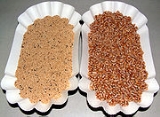
Amaranth grain

Encyclopedia

Amaranth
Amaranthus, collectively known as amaranth, is a cosmopolitan genus of herbs. Approximately 60 species are recognized, with inflorescences and foliage ranging from purple and red to gold...
has been cultivated as a grain for 8,000 years
6th millennium BC
During the 6th millennium BC, agriculture spread from the Balkans to Italy and Eastern Europe, and also from Mesopotamia to Egypt. World population was essentially stable at approximately 5 million, though some speculate up to 7 million.-Events:...
.
The yield of grain amaranth is comparable to rice
Rice
Rice is the seed of the monocot plants Oryza sativa or Oryza glaberrima . As a cereal grain, it is the most important staple food for a large part of the world's human population, especially in East Asia, Southeast Asia, South Asia, the Middle East, and the West Indies...
or maize
Maize
Maize known in many English-speaking countries as corn or mielie/mealie, is a grain domesticated by indigenous peoples in Mesoamerica in prehistoric times. The leafy stalk produces ears which contain seeds called kernels. Though technically a grain, maize kernels are used in cooking as a vegetable...
. It was a staple food
Staple food
A staple food is one that is eaten regularly and in such quantities that it constitutes a dominant portion of a diet, and that supplies a high proportion of energy and nutrient needs. Most people live on a diet based on one or more staples...
of the Aztec
Aztec
The Aztec people were certain ethnic groups of central Mexico, particularly those groups who spoke the Nahuatl language and who dominated large parts of Mesoamerica in the 14th, 15th and 16th centuries, a period referred to as the late post-classic period in Mesoamerican chronology.Aztec is the...
s, and was used as an integral part of Aztec
Aztec
The Aztec people were certain ethnic groups of central Mexico, particularly those groups who spoke the Nahuatl language and who dominated large parts of Mesoamerica in the 14th, 15th and 16th centuries, a period referred to as the late post-classic period in Mesoamerican chronology.Aztec is the...
religious ceremonies. The cultivation
Tillage
Tillage is the agricultural preparation of the soil by mechanical agitation of various types, such as digging, stirring, and overturning. Examples of human-powered tilling methods using hand tools include shovelling, picking, mattock work, hoeing, and raking...
of amaranth was banned by the conquistadores upon their conquest of the Aztec nation. Because the plant has continued to grow as a weed
Weed
A weed in a general sense is a plant that is considered by the user of the term to be a nuisance, and normally applied to unwanted plants in human-controlled settings, especially farm fields and gardens, but also lawns, parks, woods, and other areas. More specifically, the term is often used to...
since that time, its genetic
Genetics
Genetics , a discipline of biology, is the science of genes, heredity, and variation in living organisms....
base has been largely maintained. Research on grain amaranth began in the US
United States
The United States of America is a federal constitutional republic comprising fifty states and a federal district...
in the 1970s. By the end of the 1970s, a few thousand acres were being cultivated. Much of the grain currently grown is sold in health food
Health food
The term health food is generally used to describe foods that are considered to be beneficial to health, beyond a normal healthy diet required for human nutrition. However, the term is not precisely defined by national regulatory agencies such as the U.S...
shops.
Grain amaranth is also grown as a food crop in limited amounts in Mexico
Mexico
The United Mexican States , commonly known as Mexico , is a federal constitutional republic in North America. It is bordered on the north by the United States; on the south and west by the Pacific Ocean; on the southeast by Guatemala, Belize, and the Caribbean Sea; and on the east by the Gulf of...
, where it is used to make a candy
Candy
Candy, specifically sugar candy, is a confection made from a concentrated solution of sugar in water, to which flavorings and colorants are added...
called alegría (Spanish
Spanish language
Spanish , also known as Castilian , is a Romance language in the Ibero-Romance group that evolved from several languages and dialects in central-northern Iberia around the 9th century and gradually spread with the expansion of the Kingdom of Castile into central and southern Iberia during the...
for happiness) at festival
Festival
A festival or gala is an event, usually and ordinarily staged by a local community, which centers on and celebrates some unique aspect of that community and the Festival....
times. Amaranth species that are still used as a grain are: Amaranthus caudatus
Amaranthus caudatus
Amaranthus caudatus is a species of annual flowering plant. It goes by common names such as love-lies-bleeding, love-lies-a'bleeding, pendant amaranth, tassel flower, velvet flower, foxtail amaranth, and quelite...
, Amaranthus cruentus
Amaranthus cruentus
Amaranthus cruentus is a common flowering plant species that yields the nutritious staple amaranth grain. It is one of three Amaranthus species cultivated as a grain source, the other two being Amaranthus hypochondriacus and Amaranthus caudatus...
, and Amaranthus hypochondriacus
Amaranthus hypochondriacus
Amaranthus hypochondriacus is an ornamental plant commonly known as the Prince-of-Wales-feather or the Prince's feather. It is originally from Mexico where it is endemic where it is called Quelite, Blero. and Quintonil...
. The grain is popped and mixed with honey. In Maharashtra
Maharashtra
Maharashtra is a state located in India. It is the second most populous after Uttar Pradesh and third largest state by area in India...
state of India, it is called “Rajgira” (राजगीरा) in the Marathi language
Marathi language
Marathi is an Indo-Aryan language spoken by the Marathi people of western and central India. It is the official language of the state of Maharashtra. There are over 68 million fluent speakers worldwide. Marathi has the fourth largest number of native speakers in India and is the fifteenth most...
. The popped grain is mixed with melted jaggery
Jaggery
Jaggery is a traditional unrefined non-centrifugal whole cane sugar consumed in Asia, Africa, Latin America, and the Caribbean. It is a concentrated product of cane juice without separation of the molasses and crystals, and can vary from golden brown to dark brown in color...
in proper proportion to make iron and energy rich “laddus,” a popular food provided at the Mid-day Meal Program in municipal schools.
Amaranth grain can also be used to extract amaranth oil
Amaranth oil
Amaranth oil is extracted from the seeds of two species of the genus Amaranthus — A. cruentus and A. hypochondriacus — that are called, collectively, grain amaranth. A manufacturer of this unique oil writes:...
- a particularly valued pressed seed oil
Vegetable fats and oils
Vegetable fats and oils are lipid materials derived from plants. Physically, oils are liquid at room temperature, and fats are solid. Chemically, both fats and oils are composed of triglycerides, as contrasted with waxes which lack glycerin in their structure...
with many commercial uses.
Nutritional analysis
As the following table shows, in a raw form, grain amaranth has many nutrients.Raw amaranth grain, however, isn't edible and can not be digested. Amaranth grain must be prepared and cooked like other grains. Another table below suggests cooked amaranth is a competing and promising source of nutrition when compared to wheat bread, higher in some nutrients and lower in others.
Notable nutritional content attributes of raw amaranth grain include:-
- The proteinProteinProteins are biochemical compounds consisting of one or more polypeptides typically folded into a globular or fibrous form, facilitating a biological function. A polypeptide is a single linear polymer chain of amino acids bonded together by peptide bonds between the carboxyl and amino groups of...
is of an unusually high quality, according to ECHO. - The actual nutritional value of amaranth as human food is less than would be expected from raw amaranth grain data. According to ECHO, this is due to anti-nutritional factors in raw amaranth grain; examples of anti-nutritional factors present in amaranth include oxalates, nitrates, saponins and phenolic compounds. Cooking methods such as boiling amaranth in water and then discarding the water may reduce its toxic effects.
- A ¼ cup of raw amaranth grain supplies 60% of the Recommended Dietary Allowance of ironIronIron is a chemical element with the symbol Fe and atomic number 26. It is a metal in the first transition series. It is the most common element forming the planet Earth as a whole, forming much of Earth's outer and inner core. It is the fourth most common element in the Earth's crust...
. - Amaranth grain is particularly high in lysineLysineLysine is an α-amino acid with the chemical formula HO2CCH4NH2. It is an essential amino acid, which means that the human body cannot synthesize it. Its codons are AAA and AAG....
, an amino acid that is low in other grains., - Amaranth grain is deficient in essential amino acids such as leucineLeucineLeucine is a branched-chain α-amino acid with the chemical formula HO2CCHCH2CH2. Leucine is classified as a hydrophobic amino acid due to its aliphatic isobutyl side chain. It is encoded by six codons and is a major component of the subunits in ferritin, astacin and other 'buffer' proteins...
and threonineThreonineThreonine is an α-amino acid with the chemical formula HO2CCHCHCH3. Its codons are ACU, ACA, ACC, and ACG. This essential amino acid is classified as polar...
, - both of which are present in wheat germ., - Amaranth grain is free of glutenGlutenGluten is a protein composite found in foods processed from wheat and related grain species, including barley and rye...
, which is important for people with gluten allergies.
Wheat
Wheat is a cereal grain, originally from the Levant region of the Near East, but now cultivated worldwide. In 2007 world production of wheat was 607 million tons, making it the third most-produced cereal after maize and rice...
!! Rice
Rice
Rice is the seed of the monocot plants Oryza sativa or Oryza glaberrima . As a cereal grain, it is the most important staple food for a large part of the world's human population, especially in East Asia, Southeast Asia, South Asia, the Middle East, and the West Indies...
!! Sweetcorn
Maize
Maize known in many English-speaking countries as corn or mielie/mealie, is a grain domesticated by indigenous peoples in Mesoamerica in prehistoric times. The leafy stalk produces ears which contain seeds called kernels. Though technically a grain, maize kernels are used in cooking as a vegetable...
!! Potato
Potato
The potato is a starchy, tuberous crop from the perennial Solanum tuberosum of the Solanaceae family . The word potato may refer to the plant itself as well as the edible tuber. In the region of the Andes, there are some other closely related cultivated potato species...
|-
! Component (per 100g portion) !! Amount !! Amount !! Amount !! Amount !! Amount
|-
| water (g) >
>-
| energy (kJ)
| protein (g)
| fat (g)
| carbohydrates (g)
| fiber (g)
| sugars (g)
| iron (mg)
| manganese (mg)
| calcium (mg)
| magnesium (mg)
| phosphorus (mg)
| potassium (mg)
| zinc (mg)
| pantothenic acid (mg)
| vitB6 (mg)
| folate (µg)
| thiamin (mg)
| riboflavin (mg)
>-
| niacin (mg)
The table below presents nutritional values of cooked, edible form of amaranth grain to cooked, edible form of wheat grain as reported by United States Department of Agriculture's National Nutrient Database for Standard Reference, Release 23 (2010).
Bread
Bread is a staple food prepared by cooking a dough of flour and water and often additional ingredients. Doughs are usually baked, but in some cuisines breads are steamed , fried , or baked on an unoiled frying pan . It may be leavened or unleavened...
, wheat germ
|-
! Component (per 100g portion) !! Amount !! Amount
|-
| water (g) >
| energy (kJ)
>-
| protein (g)
>-
| fat (g)
>-
| carbohydrates (g)
>-
| fiber (g)
| sugars (g)
| iron (mg)
>-
| manganese (mg)
| calcium (mg)
>-
| magnesium (mg)
| phosphorus (mg)
| potassium (mg)
>-
| zinc (mg)
>-
| pantothenic acid (mg)
>-
| vitB6 (mg)
| folate (µg)
>-
| thiamin (mg)
>-
| riboflavin (mg)
>-
| niacin (mg)
Additional agricultural information
Amaranth from its start as a plant has literally a worldwide population currently where there are varieties for greens, varieties for grain, combinations and even ornamentals.The Great Plains
Great Plains
The Great Plains are a broad expanse of flat land, much of it covered in prairie, steppe and grassland, which lies west of the Mississippi River and east of the Rocky Mountains in the United States and Canada. This area covers parts of the U.S...
has seen a surge in this crop from Rodale Farms
Robert Rodale
Robert David "Bob" Rodale was an American adherent of organic farming and gardening and a publisher focused on health and wellness lifestyle magazines and books.-Early life and education:...
developed varieties.
Amaranthus retroflexus
Amaranthus retroflexus
Amaranthus retroflexus is a species of flowering plant in the Amaranthaceae family with several common names, including Red-root Amaranth, Redroot Pigweed, Red Rooted Pigweed, Common Amaranth, and common tumble weed....
, or pigweed, is a wild amaranth species in the United States
United States
The United States of America is a federal constitutional republic comprising fifty states and a federal district...
. The name derives from the plant's tendency to sprout where hogs are pasture fed. Although both the leaves and seeds are edible, pigweed has not been cultivated as a food crop.
The virtue of amaranth is in light soils, it will produce food under harsh and lackluster nutrient conditions much like grain sorghum. It is a very efficient grain crop.