


Altair 8800

Encyclopedia
Micro Instrumentation and Telemetry Systems
Micro Instrumentation and Telemetry Systems was an American electronics company founded in Albuquerque, New Mexico that began manufacturing electronic calculators in 1971 and personal computers in 1975. Ed Roberts and Forrest Mims founded MITS in December 1969 to produce miniaturized telemetry...
Altair 8800 was a microcomputer
Microcomputer
A microcomputer is a computer with a microprocessor as its central processing unit. They are physically small compared to mainframe and minicomputers...
design from 1975 based on the Intel 8080
Intel 8080
The Intel 8080 was the second 8-bit microprocessor designed and manufactured by Intel and was released in April 1974. It was an extended and enhanced variant of the earlier 8008 design, although without binary compatibility...
CPU
Central processing unit
The central processing unit is the portion of a computer system that carries out the instructions of a computer program, to perform the basic arithmetical, logical, and input/output operations of the system. The CPU plays a role somewhat analogous to the brain in the computer. The term has been in...
and sold by mail order through advertisements in Popular Electronics
Popular Electronics
Popular Electronics was an American magazine started by Ziff-Davis Publishing in October 1954 for electronics hobbyists and experimenters. It soon became the "World's Largest-Selling Electronics Magazine". The circulation was 240,151 in April 1957 and 400,000 by 1963. Ziff-Davis published Popular...
, Radio-Electronics
Radio-Electronics
Radio-Electronics was an American electronics magazine that was published under various titles from 1929 to 2003. Hugo Gernsback started it as Radio-Craft in July 1929. The title was changed to Radio-Electronics in October 1948 and again to Electronics Now in July 1992. In January 2000 it was...
and other hobbyist magazines. The designers hoped to sell only a few hundred build-it-yourself kits to hobbyists, and were surprised when they sold thousands in the first month. The Altair also appealed to individuals and businesses who just wanted a computer and purchased the assembled version. Today the Altair is widely recognized as the spark that led to the microcomputer revolution
Microcomputer revolution
The microcomputer revolution is a phrase used to describe the rapid advances of microprocessor-based computers from esoteric hobby projects to a commonplace fixture of homes in industrial societies...
of the next few years: The computer bus
Computer bus
In computer architecture, a bus is a subsystem that transfers data between components inside a computer, or between computers.Early computer buses were literally parallel electrical wires with multiple connections, but the term is now used for any physical arrangement that provides the same...
designed for the Altair was to become a de facto
De facto
De facto is a Latin expression that means "concerning fact." In law, it often means "in practice but not necessarily ordained by law" or "in practice or actuality, but not officially established." It is commonly used in contrast to de jure when referring to matters of law, governance, or...
standard in the form of the S-100 bus
S-100 bus
The S-100 bus or Altair bus, IEEE696-1983 , was an early computer bus designed in 1974 as a part of the Altair 8800, generally considered today to be the first personal computer...
, and the first programming language for the machine was Microsoft
Microsoft
Microsoft Corporation is an American public multinational corporation headquartered in Redmond, Washington, USA that develops, manufactures, licenses, and supports a wide range of products and services predominantly related to computing through its various product divisions...
's founding product, Altair BASIC
Altair BASIC
Altair BASIC was an interpreter for the BASIC programming language that ran on the MITS Altair 8800 and subsequent S-100 bus computers. It was Microsoft's first product , distributed by MITS under a contract...
.
History

Kirtland Air Force Base
Kirtland Air Force Base is a United States Air Force base located in the southeast quadrant of the Albuquerque, New Mexico urban area, adjacent to the Albuquerque International Sunport. The base was named for the early Army aviator Col. Roy C. Kirtland...
, Ed Roberts and Forrest M. Mims III
Forrest Mims
Forrest M. Mims III is an amateur scientist, magazine columnist, and author of the popular Getting Started in Electronics and Engineer's Mini-Notebook series of instructional books that was originally sold in Radio Shack electronics stores. Mims graduated from Texas A&M University in 1966 with a...
decided to use their electronics background to produce small kits for model rocket
Model rocket
A model rocket is a small rocket that is commonly advertised as being able to be launched by anybody, to, in general, low altitudes and recovered by a variety of means....
hobbyists. In 1969, Roberts and Mims, along with Stan Cagle and Robert Zaller, founded Micro Instrumentation and Telemetry Systems
Micro Instrumentation and Telemetry Systems
Micro Instrumentation and Telemetry Systems was an American electronics company founded in Albuquerque, New Mexico that began manufacturing electronic calculators in 1971 and personal computers in 1975. Ed Roberts and Forrest Mims founded MITS in December 1969 to produce miniaturized telemetry...
(MITS) in Roberts' garage in Albuquerque, New Mexico
Albuquerque, New Mexico
Albuquerque is the largest city in the state of New Mexico, United States. It is the county seat of Bernalillo County and is situated in the central part of the state, straddling the Rio Grande. The city population was 545,852 as of the 2010 Census and ranks as the 32nd-largest city in the U.S. As...
, and started selling radio
Radio
Radio is the transmission of signals through free space by modulation of electromagnetic waves with frequencies below those of visible light. Electromagnetic radiation travels by means of oscillating electromagnetic fields that pass through the air and the vacuum of space...
transmitter
Transmitter
In electronics and telecommunications a transmitter or radio transmitter is an electronic device which, with the aid of an antenna, produces radio waves. The transmitter itself generates a radio frequency alternating current, which is applied to the antenna. When excited by this alternating...
s and instruments for model rocket
Model rocket
A model rocket is a small rocket that is commonly advertised as being able to be launched by anybody, to, in general, low altitudes and recovered by a variety of means....
s.
Calculators
The model rocket kits were a modest success and MITS wanted to try a kit that would appeal to more hobbyists. The November 1970 issue of Popular Electronics featured the Opticom, a kit from MITS that would send voice over an LEDLEd
LEd is a TeX/LaTeX editing software working under Microsoft Windows. It is a freeware product....
light beam. Mims and Cagle were losing interest in the kit business so Roberts bought his partners out, then began developing a calculator kit. Electronic Arrays had just announced a set of 6 LSI ICs that would make a four function calculator. The MITS 816 calculator kit used the chip set and was featured on the November 1971 cover of Popular Electronics. This calculator kit sold for $175 ($275 assembled). Forrest Mims wrote the assembly manual for this kit and many others over the next several years. He often accepted a copy of the kit as payment.
The calculator was successful and was followed by several improved models. The MITS 1440 calculator was featured in the July 1973 issues of Radio-Electronics. It had a 14 digit display, memory, and square root. The kit sold for $200 and the assembled version was $250. MITS later developed a programmer unit that would connect to the 816 or 1440 calculator and allow programs of up to 256 steps.
Test equipment
In addition to calculators, MITS made a line of test equipment kits. These included an IC tester, a waveform generator, a digital voltmeter, and several other instruments. To keep up with the demand, MITS moved into a larger building at 6328 Linn NE in Albuquerque in 1973. They installed a wave solderingWave soldering
Wave soldering is a large-scale soldering process by which electronic components are soldered to a printed circuit board to form an electronic assembly. The name is derived from the use of waves of molten solder to attach metal components to the PCB...
machine and an assembly line at the new location. In 1972, Texas Instruments
Texas Instruments
Texas Instruments Inc. , widely known as TI, is an American company based in Dallas, Texas, United States, which develops and commercializes semiconductor and computer technology...
developed its own calculator chip and started selling complete calculators at less than half the price of other commercial models. MITS and many other companies were devastated by this, and Roberts struggled to reduce his quarter-million-dollar debt.
Popular Electronics
TV Typewriter
The TV Typewriter was a video terminal that could display 2 pages of 16 lines of 32 upper case characters on a standard television set. The Don Lancaster design appeared on the cover of Radio-Electronics magazine in September 1973. The magazine included a 6 page description of the design but...
(Radio Electronics, September 1973) article and wanted computer projects for Popular Electronics. Don Lancaster did an ASCII keyboard for Popular Electronics in April 1974. They were evaluating a computer trainer project by Jerry Ogdin when the Mark-8
Mark-8
The Mark-8 is a microcomputer design from 1974, based on the Intel 8008 CPU . The Mark-8 was designed by graduate student Jonathan Titus and announced as a 'loose kit' in the July 1974 issue of Radio-Electronics magazine.- Project kit :The Mark-8 was introduced as a 'build it yourself' project in...
8008
Intel 8008
The Intel 8008 was an early byte-oriented microprocessor designed and manufactured by Intel and introduced in April 1972. It was an 8-bit CPU with an external 14-bit address bus that could address 16KB of memory...
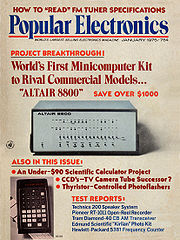
-based computer by Jonathan Titus appeared on the July 1974 cover of Radio-Electronics. The computer trainer was put on hold and the editors looked for a real computer system. (Popular Electronics gave Jerry Ogdin a column, Computer Bits, starting in June 1975.) "The break through in low-cost microprocessors occurred just before Christmas 1974, when the January issue of Popular Electronics reached readers … "
One of the editors, Les Solomon, knew MITS was working on an Intel 8080 based computer project and thought Roberts could provide the project for the always popular January issue. The TV Typewriter and the Mark-8 computer projects were just a detailed set of plans and a set of bare printed circuit boards. The hobbyist faced the daunting task of acquiring all of the integrated circuits and other components. The editors of Popular Electronics wanted a complete kit in a professional-looking enclosure.
The typical MITS product had a generic name like the "Model 1440 Calculator" or the "Model 1600 Digital Voltmeter". Ed Roberts was busy finishing the design and left the naming of the computer to the editors of Popular Electronics.
One explanation of the Altair name, which editor Les Solomon later told the audience at the first Altair Computer Convention (March 1976), is that the name was inspired by Les's 12-year-old daughter, Lauren. "She said why don't you call it Altair - that's where the Enterprise is going tonight." The Star Trek
Star Trek
Star Trek is an American science fiction entertainment franchise created by Gene Roddenberry. The core of Star Trek is its six television series: The Original Series, The Animated Series, The Next Generation, Deep Space Nine, Voyager, and Enterprise...
episode is probably Amok Time, as this is the only one from The Original Series which takes the Enterprise crew to Altair (Six).
A more probable version is that the Altair was originally going to be named the PE-8 (Popular Electronics 8-bit), but Les Solomon thought this name to be rather dull, so Les, Alexander Burawa (associate editor), and John McVeigh (technical editor) decided that: "It's a stellar event, so let's name it after a star." McVeigh suggested "Altair", the twelfth brightest star in the sky.
Ed Roberts and Bill Yates finished the first prototype in October 1974 and shipped it to Popular Electronics in New York via the Railway Express Agency
Railway Express Agency
The Railway Express Agency was a the national monopoly set up by the Untied States federal government in 1917. Rail express services provided small package and parcel transportation using the extant railroad infrastructure much as UPS functions today using the road system...
. However, it never arrived due to a strike by the shipping company. Solomon already had a number of pictures of the machine and the article was based on them. Roberts got to work on building a replacement. The computer on the magazine cover is an empty box with just switches and LEDs on the front panel. The finished Altair computer had a completely different circuit board layout than the prototype shown in the magazine. The January 1975 issues appeared on newsstands a week before Christmas of 1974 and the kit was officially (if not yet practically) available for sale.
Intel 8080
Ed Roberts had designed and manufactured programmable calculators and was familiar with the microprocessors available in 1974. The Intel 4004Intel 4004
The Intel 4004 was a 4-bit central processing unit released by Intel Corporation in 1971. It was the first complete CPU on one chip, and also the first commercially available microprocessor...
and Intel 8008
Intel 8008
The Intel 8008 was an early byte-oriented microprocessor designed and manufactured by Intel and introduced in April 1972. It was an 8-bit CPU with an external 14-bit address bus that could address 16KB of memory...
were not powerful enough, the National Semiconductor IMP-8 and IMP-16
IMP-16
The IMP-16, by National Semiconductor, was the first multi-chip 16-bit microprocessor. It consisted of five PMOS integrated circuits: four four-bit RALU chips providing the data path, and one CROM providing control sequencing and microcode storage.The IMP-16 provided four 16-bit accumulators,...
required external hardware, and the Motorola 6800
Motorola 6800
The 6800 was an 8-bit microprocessor designed and first manufactured by Motorola in 1974. The MC6800 microprocessor was part of the M6800 Microcomputer System that also included serial and parallel interface ICs, RAM, ROM and other support chips...
was still in development, so he chose the 8-bit Intel 8080
Intel 8080
The Intel 8080 was the second 8-bit microprocessor designed and manufactured by Intel and was released in April 1974. It was an extended and enhanced variant of the earlier 8008 design, although without binary compatibility...
. At that time, Intel's main business was selling memory chips by the thousands to computer companies. They had no experience in selling small quantities of microprocessors. When the 8080 was introduced in April 1974, Intel set the single unit price at $360. "That figure had a nice ring to it," recalled Intel's Dave House in 1984. "Besides, it was a computer, and they usually cost thousands of dollars, so we felt it was a reasonable price." Ed Roberts had experience in buying OEM
Original Equipment Manufacturer
An original equipment manufacturer, or OEM, manufactures products or components that are purchased by a company and retailed under that purchasing company's brand name. OEM refers to the company that originally manufactured the product. When referring to automotive parts, OEM designates a...
quantities of calculator chips and he was able to negotiate a $75 price for the 8080 microprocessor chips.
Intel made the Intellec-8 Microprocessor Development System that typically sold for a very profitable $10,000. It was functionally similar to the Altair 8800 but it was a commercial grade system with a wide selection of peripherals and development software. Customers would ask Intel why their Intellec-8 was so expensive when that Altair was only $400. Some salesmen said that MITS was getting cosmetic rejects or otherwise inferior chips. In July 1975, Intel sent a letter to its sales force stating that the MITS Altair 8800 computer used standard Intel 8080 parts. The sales force should sell the Intellec system based on its merits and that no one should make derogatory comments about valued customers like MITS. The letter was reprinted in the August 1975 issue of MITS Computer Notes. The "cosmetic defect" rumor has appeared in many accounts over the years despite the fact that both MITS and Intel issued written denials in 1975.
The launch
Fortran
Fortran is a general-purpose, procedural, imperative programming language that is especially suited to numeric computation and scientific computing...
or BASIC
BASIC
BASIC is a family of general-purpose, high-level programming languages whose design philosophy emphasizes ease of use - the name is an acronym from Beginner's All-purpose Symbolic Instruction Code....
languages. This meant there was a sizable customer base who knew about computers. In 1970, electronic calculators were not seen outside of a laboratory, but by 1974 they were a common household item. Calculators and video games like Pong
Pong
Pong is one of the earliest arcade video games, and is a tennis sports game featuring simple two-dimensional graphics. While other arcade video games such as Computer Space came before it, Pong was one of the first video games to reach mainstream popularity...
introduced computer power to the general public. Electronics hobbyists were moving on to digital projects such as digital voltmeters and frequency counters. There were Intel 8008 based computer systems available in 1974 but they were not powerful enough to run a high level language like BASIC. The Altair had enough power to be actually useful, and was designed as an expandable system that opened it up to all sorts of applications.
Ed Roberts optimistically told his banker that he could sell 800 computers and he knew they needed to sell 200 over the next year just to break even. When readers got the January issue of Popular Electronics, MITS was flooded with inquiries and orders. They had to hire extra people just to answer the phones. In February MITS received 1,000 orders for the Altair 8800. The quoted delivery time was 60 days but it was months before they could meet that. Roberts focused on delivering the computer; all of the options would wait until they could keep pace with the orders. MITS claimed to have delivered 2,500 Altair 8800s by the end of May. The number was over 5,000 by August 1975. MITS had under 20 employees in January but had grown to 90 by October 1975.
The Altair 8800 computer was a break-even sale for MITS. They needed to sell additional memory boards, I/O boards and other options to make a profit. The system came with a "1024 word" memory board populated with 256 bytes. The BASIC language was announced in July 1975 and it required one or two 4096 word memory boards and an interface board.
MITS Price List, Popular Electronics, August 1975.
| Description | Kit Price | Assembled |
|---|---|---|
| Altair 8800 Computer | $439 | $621 |
| 1024 word Memory Board | $176 | $209 |
| 4096 word Memory Board | $264 | $338 |
| Parallel Interface Board | $92 | $114 |
| Serial Interface Board (RS-232) | $119 | $138 |
| Serial Interface Board (Teletype) | $124 | $146 |
| Audio Cassette Interface Board | $128 | $174 |
| Teletype Model 33 ASR | N.A. | $1500 |
- 4K BASIC language (when purchased with Altair, 4096 words of memory and interface board) $60
- 8K BASIC language (when purchased with Altair, two 4096 word memory boards and interface board) $75
MITS had no competition for the first half of 1975. Their 4K memory board used dynamic RAM and it had several design problems. The delay in shipping optional boards and the problems with the 4K memory board created an opportunity for outside suppliers. An enterprising Altair owner, Robert Marsh, designed a 4K static memory that was plug-in compatible with the Altair 8800 and sold for $255. His company was Processor Technology
Processor Technology
Processor Technology Corporation was a microcomputer company founded by Bob Marsh and Gary Ingram in April 1975. Its best known product is the Sol-20 computer.-History:...
, one of the most successful Altair compatible board suppliers. Their advertisement in the July 1975 issue of Popular Electronics promised interface and PROM boards in addition to the 4K memory board. They would later develop a popular video display board that would plug directly into the Altair.
A consulting company in San Leandro, California, IMS Associates Inc., wanted to purchase several Altair computers but the long delivery time convinced them that they should build their own computers. In the October 1975 Popular Electronics, a small advertisement announced the IMSAI 8080
IMSAI 8080
The IMSAI 8080 was an early microcomputer released in late 1975, based on the Intel 8080 and later 8085 and S-100 bus. It was a clone of its main competitor, the earlier MITS Altair 8800. The IMSAI is largely regarded as the first "clone" computer. The IMSAI machine ran a highly modified version of...
computer. The ad noted that all boards were "plug compatible" with the Altair 8800. The computer cost $439 for a kit. The first 50 IMSAI computers shipped in December 1975. The IMSAI 8080 computer improved on the original Altair design in several areas. It was easier to assemble, the Altair required 60 wire connections between the front panel and the mother board (backplane
Backplane
A backplane is a group of connectors connected in parallel with each other, so that each pin of each connector is linked to the same relative pin of all the other connectors forming a computer bus. It is used as a backbone to connect several printed circuit boards together to make up a complete...
.) The IMSAI motherboard had 18 slots. The MITS motherboard consisted of 4 slots segments that had to be connected together with 100 wires. The IMSAI also had a larger power supply to handle the increasing number of expansion boards used in typical systems. The IMSAI advantage was short lived because MITS had recognized these shortcomings and developed the Altair 8800B which was introduced in June 1976.
Description
Motherboard
In personal computers, a motherboard is the central printed circuit board in many modern computers and holds many of the crucial components of the system, providing connectors for other peripherals. The motherboard is sometimes alternatively known as the mainboard, system board, or, on Apple...
, and the machine consisted of four boards stacked on top of each other with stand-offs. Another problem facing Roberts was that the parts needed to make a truly useful computer weren't available, or wouldn't be designed in time for the January launch date. So during the construction of the second model, he decided to build most of the machine on removable cards, reducing the motherboard
Motherboard
In personal computers, a motherboard is the central printed circuit board in many modern computers and holds many of the crucial components of the system, providing connectors for other peripherals. The motherboard is sometimes alternatively known as the mainboard, system board, or, on Apple...
to nothing more than an interconnect between the cards, a backplane
Backplane
A backplane is a group of connectors connected in parallel with each other, so that each pin of each connector is linked to the same relative pin of all the other connectors forming a computer bus. It is used as a backbone to connect several printed circuit boards together to make up a complete...
. The basic machine consisted of five cards, including the CPU
Central processing unit
The central processing unit is the portion of a computer system that carries out the instructions of a computer program, to perform the basic arithmetical, logical, and input/output operations of the system. The CPU plays a role somewhat analogous to the brain in the computer. The term has been in...
on one and memory on another. He then looked for a cheap source of connectors, and came across a supply of 100-pin edge connector
Edge connector
An edge connector is the portion of a printed circuit board consisting of traces leading to the edge of the board that are intended to plug into a matching socket. The edge connector is a money-saving device because it only requires a single discrete female connector , and they also tend to be...
s. The S-100 bus was eventually acknowledged by the professional computer community and adopted as the IEEE-696 computer bus standard.
The Altair bus consists of the pins of the Intel 8080
Intel 8080
The Intel 8080 was the second 8-bit microprocessor designed and manufactured by Intel and was released in April 1974. It was an extended and enhanced variant of the earlier 8008 design, although without binary compatibility...
run out onto the backplane. No particular level of thought went into the design, which led to such disasters as shorting
Short circuit
A short circuit in an electrical circuit that allows a current to travel along an unintended path, often where essentially no electrical impedance is encountered....
from various power lines of differing voltage
Voltage
Voltage, otherwise known as electrical potential difference or electric tension is the difference in electric potential between two points — or the difference in electric potential energy per unit charge between two points...
s being located next to each other. Another oddity was that the system included two unidirectional 8-bit
8-bit
The first widely adopted 8-bit microprocessor was the Intel 8080, being used in many hobbyist computers of the late 1970s and early 1980s, often running the CP/M operating system. The Zilog Z80 and the Motorola 6800 were also used in similar computers...
data buses, but only a single bidirectional 16-bit address bus
Address bus
An address bus is a computer bus that is used to specify a physical address. When a processor or DMA-enabled device needs to read or write to a memory location, it specifies that memory location on the address bus...
. A deal on power supplies led to the use of +8V
Volt
The volt is the SI derived unit for electric potential, electric potential difference, and electromotive force. The volt is named in honor of the Italian physicist Alessandro Volta , who invented the voltaic pile, possibly the first chemical battery.- Definition :A single volt is defined as the...
and +18V, which had to be locally regulated on the cards to TTL
Transistor-transistor logic
Transistor–transistor logic is a class of digital circuits built from bipolar junction transistors and resistors. It is called transistor–transistor logic because both the logic gating function and the amplifying function are performed by transistors .TTL is notable for being a widespread...
(+5V) or RS-232
RS-232
In telecommunications, RS-232 is the traditional name for a series of standards for serial binary single-ended data and control signals connecting between a DTE and a DCE . It is commonly used in computer serial ports...
(+12V) standard voltage levels.
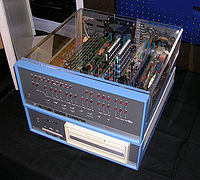
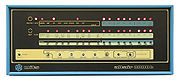
The Altair shipped in a two-piece case. The backplane and power supply were mounted on a base plate, along with the front and rear of the box. The "lid" was shaped like a C, forming the top, left and right sides of the box. The front panel
Front panel
A front panel was used on early electronic computers to display and allow the alteration of the state of the machine's internal registers and memory. The front panel usually consisted of arrays of indicator lamps, toggle switches, and push buttons mounted on a sheet metal face plate...
, which was inspired by the Data General Nova
Data General Nova
The Data General Nova was a popular 16-bit minicomputer built by the American company Data General starting in 1969. The Nova was packaged into a single rack mount case and had enough power to do most simple computing tasks. The Nova became popular in science laboratories around the world, and...
minicomputer, included a large number of toggle switches to feed binary
Binary numeral system
The binary numeral system, or base-2 number system, represents numeric values using two symbols, 0 and 1. More specifically, the usual base-2 system is a positional notation with a radix of 2...
data directly into the memory of the machine, and a number of red LED
Light-emitting diode
A light-emitting diode is a semiconductor light source. LEDs are used as indicator lamps in many devices and are increasingly used for other lighting...
s to read those values back out.
Programming the Altair was an extremely tedious process. The user toggled the switches to positions corresponding to an 8080 microprocessor instruction or opcode
Opcode
In computer science engineering, an opcode is the portion of a machine language instruction that specifies the operation to be performed. Their specification and format are laid out in the instruction set architecture of the processor in question...
in binary
Binary
- Mathematics :* Binary numeral system, a representation for numbers using only two digits * Binary function, a function in mathematics that takes two arguments- Computing :* Binary file, composed of something other than human-readable text...
, then used an 'enter' switch to load the code into the machine's memory, and then repeated this step until all the opcodes of a presumably complete and correct program were in place. When the machine first shipped the switches and lights were the only interface, and all one could do with the machine was make programs to make the lights blink. Nevertheless, many were sold in this form. Roberts was already hard at work on additional cards, including a paper tape reader for storage, additional RAM cards, and a RS-232
RS-232
In telecommunications, RS-232 is the traditional name for a series of standards for serial binary single-ended data and control signals connecting between a DTE and a DCE . It is commonly used in computer serial ports...
interface to connect to a proper Teletype terminal
Computer terminal
A computer terminal is an electronic or electromechanical hardware device that is used for entering data into, and displaying data from, a computer or a computing system...
.
Altair BASIC
Roberts received a letter from Traf-O-DataTraf-O-Data
Traf-O-Data was a partnership between Bill Gates, Paul Allen, and Paul Gilbert. The objective was to read the raw data from roadway traffic counters and create reports for traffic engineers...
asking if he would be interested in buying its BASIC programming language for the machine. He called the company and reached a private home, where no one had heard of anything like BASIC. In fact the letter had been sent by Bill Gates
Bill Gates
William Henry "Bill" Gates III is an American business magnate, investor, philanthropist, and author. Gates is the former CEO and current chairman of Microsoft, the software company he founded with Paul Allen...
and Paul Allen
Paul Allen
Paul Gardner Allen is an American business magnate, investor, and philanthropist. Allen co-founded Microsoft with Bill Gates...
from the Boston area, and they had no BASIC yet to offer. When they called Roberts to follow up on the letter he expressed his interest, and the two started work on their BASIC interpreter
Interpreter (computing)
In computer science, an interpreter normally means a computer program that executes, i.e. performs, instructions written in a programming language...
using a self-made simulator for the 8080 on a PDP-10
PDP-10
The PDP-10 was a mainframe computer family manufactured by Digital Equipment Corporation from the late 1960s on; the name stands for "Programmed Data Processor model 10". The first model was delivered in 1966...
minicomputer. They figured they had 30 days before someone else beat them to the punch, and once they had a version working on the simulator, Allen flew to Albuquerque to deliver the program, Altair BASIC
Altair BASIC
Altair BASIC was an interpreter for the BASIC programming language that ran on the MITS Altair 8800 and subsequent S-100 bus computers. It was Microsoft's first product , distributed by MITS under a contract...
(aka MITS 4K BASIC), on a paper tape. The first time it was run, it displayed "Altair Basic," then crashed, but that was enough for them to join; the next day, they brought in a new paper tape and it ran. The first program ever typed in was "10 print 2+2" and after typing "run" it typed back the correct answer: "4". Gates soon joined Allen and formed Microsoft
Microsoft
Microsoft Corporation is an American public multinational corporation headquartered in Redmond, Washington, USA that develops, manufactures, licenses, and supports a wide range of products and services predominantly related to computing through its various product divisions...
, then spelled "Micro-Soft".
Further reading
Books Chapter "Solomon's Memory" by Les Solomon Chapter 6 "Mechanics: Kits & Microcomputers"Magazines
External links
- MITS Altair 8800 exhibit at old-computers.com's virtual computer museum
- Virtual Altair Museum
- Help getting your Altair up and running - plus software
- Altair 8800 Emulator
- Altair 8800 images and information at vintage-computer.com
- Collection of old digital and analog computers at oldcomputermuseum.com
- Marcus Bennett's Altair Documentation resource