
Encyclopedia
| | Because of recent , editing of this by anonymous or newly registered users is currently . Such users may discuss changes, , or . |
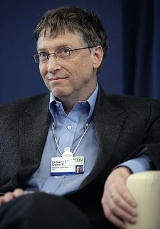
William Henry Gates III is the co-founder, chairman, former chief software architect, and former CEO of
Microsoft. He is also the founder of Corbis, a digital image archiving company.
Forbes magazine's The World's Billionaires list has ranked him as the richest person in the world for the last twelve consecutive years. In 1999, Gates' wealth briefly surpassed $100 billion making him the world's first centibillionaire .
According to the
Forbes 2006
magazine, Bill Gates's current net worth is approximately $53 billion. When family wealth is considered, his family ranks second behind the Walton family.
Gates is one of the best-known entrepreneurs of the
personal computer revolution. He is widely respected for his foresight and ambition. He is also frequently criticized as having built Microsoft through unfair or unlawful business practices. Since amassing his fortune, Gates has pursued a number of philanthropic endeavors, donating large amounts of money to various charitable organizations and scientific research programs through the
Bill & Melinda Gates Foundation, founded in 2000. On June 16, 2006, Bill Gates announced that he would move to a part-time role with Microsoft in 2008 to begin a career in philanthropy, but will remain as chairman; the announcement coincided with decisions by billionaire
Warren Buffett to double the
Gates Foundation, matching contributions $1.5 billion in stock per year for 20 years.
Time magazine has ranked Bill Gates among the
world's most influential people more times than any other man, and as one of only
four people in history to have shaped both the 20th century and the early 21st. Time also collectively named Gates, his wife
Melinda and
U2's lead singer
Bono as the 2005
Persons of the Year for their humanitarian efforts. That same year he was made an honorary
Knight Commander of the Order of the British Empire by
Queen Elizabeth II, which would entitle him to be known as Sir William Gates if he were a citizen of Britain or the Commonwealth. In 2006, Gates Foundation was awarded the
Premio Príncipe de Asturias en Cooperación Internacional. In a list compiled by the magazine
New Statesman is a British [i] left-of-centre political magazine [i] published we...
in 2006, he was voted eighth in the list of "Heroes of our time".
Early life
Bill Gates III was born in
Seattle,
Washington to William H. Gates, Sr. and Mary Maxwell Gates. His family was wealthy; his father was a prominent lawyer, his mother served on the board of directors for First Interstate Bank and The United Way, and her father, J. W. Maxwell, was a national bank president. Gates has one older sister, Kristi , and one younger sister, Libby.
According to the 1992 biography
Hard Drive, Maxwell set up a million-dollar trust fund for Gates the year he was born.
Gates vehemently denied this in a 1994 interview with
Playboy is an American [i] adult [i] entertainment [i] magazine [i], fo ...
:
The 1993 biography
Gates calls the trust fund claim one of the "fictions" surrounding Gates' fortune.
Gates excelled in elementary school, particularly in
mathematics and the
sciences. He attended the
Lakeside School, Seattle's most exclusive preparatory school where tuition in 1967 was $5,000 . Lakeside rented time on a
DEC PDP-10 owned by Computer Center Corporation. Gates and other students exploited
bugs in the system software until CCC banned them, at which point Gates says he swore off computers for a year and a half.
CCC approached the Lakeside students in 1968 because other users were continuing to exploit the flaws in their system software. The company offered them unlimited computer time in exchange for finding and fixing software problems. Gates identified this as the point at which he became devoted to computing. The arrangement with CCC continued until 1970, when it went out of business. The following year Information Sciences Inc. hired the Lakeside students to write a payroll program in COBOL, providing them not only computer time but royalties as well. Gates also formed a venture with Lakeside student
Paul Allen, called Traf-O-Data, to make traffic counters based on the
Intel 8008 processor.
According to a press inquiry, Bill Gates scored 1590 on his
SATs, which at the time corresponded to an IQ of 170 -a figure frequently reported in the popular media , and was able to enroll at
Harvard University in the fall of 1973 to pursue a Bachelors of Science in Computer Science and pre-law. It was there he met his future
business partner,
Steve Ballmer.
Microsoft
After reading the January 1975 issue of
Popular Electronics was started by Ziff-Davis [i] in October 1954 as a magazine for students and exp ...
that demonstrated the Altair 8800, Gates called
MITS , the creators of the new microcomputer, to inform them that he and others had developed a version of the
programming language BASIC for the platform. This was untrue, as Gates and Allen had never used an Altair previously nor developed any code for it. Within a period of eight weeks they developed an Altair
emulator that ran on a minicomputer, and then the BASIC interpreter. Allen and Gates flew to MITS to unveil the new BASIC system. The demonstration was a success and resulted in a deal with MITS to buy the rights to Allen and Gates's BASIC for the Altair platform. It was at this point that Gates left Harvard to found Micro-Soft, which later became Microsoft Corporation, with Allen. Gates dropped out of Harvard to work at MITS's offices in Albuquerque.
Anti-piracy efforts
In February 1976, Gates published his often-quoted "Open Letter to Hobbyists". In the letter, Gates claimed that most users were using "stolen" pirated copies of Altair BASIC and that no hobbyist could afford to produce, distribute, and maintain high-quality software without payment. This letter was unpopular with many amateur programmers, not just those few using copies of the software. In the ensuing years the letter gained significant support from Gates' business partners and allies. Eventually, the closed source, for-profit model Gates had envisioned would become the dominant model of software production and distribution, largely displacing the hobbyist model of
open source software produced and distributed for free. Despite Microsoft's reliance on closed source, Gates has said that he collected discarded program listings at
Harvard and learned programming techniques from them.
Microsoft and IBM
In 1980
IBM approached Microsoft to make the BASIC interpreter for its upcoming personal computer, the
IBM PC. When IBM's representatives mentioned that they needed an
operating system, Bill Gates referred them to
Digital Research, makers made the widely used
CP/M operating system that ran on a related type of
microprocessor. When IBM's representatives did not reach immediate agreement with DR, they went back to Gates to ask about alternatives. Gates offered to provide a CP/M compatible operating system himself; He licensed a CP/M-compatible OS called
QDOS from
Tim Paterson of
Seattle Computer Products,, had it adapted for the PC, and IBM shipped this as
PC-DOS.
Later, after
Compaq successfully cloned the IBM
BIOS, the market saw a flood of IBM PC clones. Microsoft was quick to license DOS to other manufacturers, calling it
MS-DOS . By marketing MS-DOS aggressively to manufacturers of IBM-PC clones, Microsoft went from a small player to one of the major software vendors in the home computer industry. Microsoft continued to develop operating systems as well as
software applications.
Windows
In the early 1980s Microsoft introduced its own version of the
graphical user interface , based on ideas originally pioneered by the
Xerox corporation, and further pioneered and developed by Apple. Microsoft released "
Windows" as an alternative to their DOS command line, and to compete with other systems on the market that employed a GUI. By the early 1990s, Windows had pushed other DOS-based GUIs like
GEM and GEOS out of the market. The release of
Windows 3.0 in 1990 was a tremendous success, selling around 10 million copies in the first two years and cementing Microsoft's dominance in operating systems sales.
By continuing to ensure, by various means, that most computers came with Microsoft software pre-installed, the Microsoft corporation eventually became the largest software company in the world, earning Gates enough money that
Forbes Magazine named him the wealthiest person in the world for several years. Gates served as the CEO of the company until 2000, when
Steve Ballmer took the position, and continues to serve as chairman of the board as of September 2006.
Bill Gates' role
Since Microsoft's founding in 1975 and as of 2006, Gates has had primary responsibility for Microsoft's product strategy. He has aggressively broadened the company's range of products, and wherever Microsoft has achieved a dominant position he has vigorously defended it. Many decisions that have led to antitrust litigation over Microsoft's business practices have had Gates' approval. In the 1998
United States v. Microsoft 87 F. Supp. 2d 30 [i] was a court case filed against Microsoft Corporation [i] ...
case, Gates gave deposition testimony that several journalists characterized as evasive. He argued over the definitions of words such as:
compete,
concerned,
ask, and
we. BusinessWeek reported, "early rounds of his deposition show him offering obfuscatory answers and saying 'I don't recall' so many times that even the presiding judge had to chuckle. Worse, many of the technology chief's denials and pleas of ignorance were directly refuted by prosecutors with snippets of e-mail Gates both sent and received." Despite denials by Bill Gates, the judge ruled that Microsoft had committed monopolization and tying, blocking competition, in violation of the Sherman Act.
Gates meets regularly with Microsoft's senior managers and program managers. By all accounts he can be extremely confrontational during these meetings, particularly when he believes that managers have not thought out their business strategy or have placed the company's future at risk. However, he often backs down when the targets of his outbursts respond frankly and directly. When he is not impressed with the technical hurdles managers claim to be facing, he sometimes quips, "Do you want me to do it over the weekend?"
Gates' role at Microsoft for most of its history has been primarily a management and executive role. However, he was an active software developer in the early years, particularly on the company's
programming language products. He has not officially been on a development team since working on the TRS-80 Model 100 line, but he wrote code as late as 1989 that shipped in the company's products.
On June 15 2006, Gates announced his plans to transition out of a day-to-day role with Microsoft effective July 31 2008, to allow him to devote more time to working with the
Bill and Melinda Gates Foundation. During an interview with Fortune.com published on June 26 says his recent decision to "shift priorities" his day-to-day role has changed to June 2008 instead of the original date of July 2008. After that date, Gates will continue in his role as the company's chairman and act as an advisor on key projects. His role as Chief Software Architect will be filled immediately by
Ray Ozzie who joined the company last year due to Microsoft taking over his company Groove. One of his last initiatives before announcing his departure was the creation of a
robotics software group at Microsoft.
Personal life
Bill Gates married
Melinda French of
Dallas, Texas on January 1 1994. They have three children: Jennifer Katharine Gates , Rory John Gates and Phoebe Adele Gates .
Bill Gates' house is one of the most expensive houses in the world, and is a modern 21st century
earth-sheltered home in the side of a hill overlooking
Lake Washington in
Medina, Washington. According to
King County public records,
as of 2006, the total assessed value of the property is $125 million, and the annual property tax is just under $1 million. Also among Gates' private acquisitions are the Codex Leicester, a collection of writings by
Leonardo da Vinci which Gates bought for
$30.8 million at an auction in 1994 , and a rare
Gutenberg Bible.
In 2000, Gates founded the
Bill & Melinda Gates Foundation, a charitable organization, with his wife. The foundation's grants have provided funds for college scholarships for under-represented minorities,
AIDS prevention, diseases prevalent in
third world countries, and other causes. In 2000, the Gates Foundation endowed the
University of Cambridge with $210 million for the Gates Cambridge Scholarships. The Foundation has also pledged over $7 billion to its various causes, including $1 billion to the
United Negro College Fund; and as of 2005, had an estimated endowment of $29.0 billion. He has spent about a third of his lifetime income on charity.
Gates has received three honorary doctorates, from the
Nyenrode Business Universiteit,
Breukelen,
The Netherlands in 2000, the
Royal Institute of Technology,
Stockholm,
Sweden in 2002 and
Waseda University,
Tokyo,
Japan in 2005. Gates was also given an honorary KBE from
Queen Elizabeth II of the
United Kingdom in 2005, in addition to having
entomologists name the Bill Gates flower fly,
Eristalis gatesi, in his honor.
Microsoft CEO Steve Ballmer has stated that Gates is probably the most "
spammed" person in the world, receiving as many as 4,000,000
e-mails per day in 2004, most of which were junk. Gates has almost an entire department devoted to filtering out junk emails. In an article, Gates himself has said that most of this junk mail "offers to help [him] get out of debt or get rich quick", which "would be funny if it weren't so irritating".
Influence and wealth
Gates is widely considered one of the world's most influential people.
Time Magazine named him one of the 100 people who most influenced the 20th century, as well as one of the 100 most influential people of 2004, 2005 and again in 2006. Gates and
Oprah Winfrey are the only two people in the world to make all four lists. He was listed in the
Sunday Times power list in 1999, named CEO of the year by
Chief Executive Officers magazine in 1994, ranked number one in the "Top 50 Cyber Elite" by
Time in 1998, ranked number two in the
Upside Elite 100 in 1999 and was included in
The Guardian is a British [i] newspaper [i] owned by the Guardian Media Group [i]. ...
as one of the "Top 100 influential people in media" in 2001. Gates has been number one on the "Forbes 400" list from 1993 through to 2006 and number one on
Forbes list of "The World's Richest People" from 1995-2006 with 50 billion US dollars. In 2004, he became a director of
Berkshire Hathaway, the investment company headed by
Warren Buffett, the second wealthiest person in the world according to Forbes and a long time friend of Gates.
In 1999, Gates' wealth briefly surpassed $100 billion making him America's first centibillionaire.
Since 2000, Gates' wealth has declined due to a fall in
Microsoft's share price and the multi-billion dollar donations he has made to his charitable foundations. According to a 2004
Forbes magazine article, Gates gave away over $29 billion to charities from 2000 onwards. These donations are usually cited as sparking a substantial change in attitudes towards philanthropy among the very rich, as philanthropy eventually became the norm for the very rich. The Gates received the Prince of Asturias Award for International Cooperation on May 4, 2006, in recognition of their world impact through charity giving.
Gates owns a lavish home, with gardens and art collection. Gates claimed in 2005 that he has gone to work every day since 1975, which in recent years includes both his role at Microsoft, and his leadership position at the
Gates Foundation. In May 2006, Gates said in an interview that he wished that he was not the richest man in the world, stating that he disliked the attention it brought.
Popular culture
Gates is often characterized as the quintessential example of a super-intelligent "nerd" with immense power and wealth. This has in turn led to pop culture stereotypes of Gates as a tyrant or evil genius, often resorting to ruthless business techniques. As such he has been the subject of numerous parodies in film, television, and video games.
Works
Gates has published several essays throughout the years based on his theories, predictions and visions of the computing industry. In these publications he often expresses his personal views on current topics, and discusses Microsoft's plans. His writings have been published by
BusinessWeek is a business magazine [i] published by McGraw-Hill [i]. ...
,
Newsweek is a weekly newsmagazine [i] published in New York City [i] and distributed throughout the ...
,
USA Today is a national American [i] newspaper [i] published by the Gannett Corporation [i] ...
,
The Economist is a weekly news and international affairs publication of The Economist Newspaper Ltd ...
and
Time. Some of his publications since 1997 include:
- Person of the Year, Time, December 2 2005
- The New World of Work, Executive E-mail, May 19 2005
- The PC Era Is Just Beginning, Business Week, March 22 2005
- Building Software That Is Interoperable by Design, Executive E-Mail, February 3 2005
- The Enduring Magic of Software, InformationWeek, October 18 2004
- Preserving and Enhancing the Benefits of E-mail: A Progress Report, Executive E-mail, June 28 2004
- Microsoft Progress Report: Security, Executive E-mail, March 31 2004
- Losing Ground in the Innovation Race?, CNET News.com, February 25 2004
- A Spam-Free Future, The Washington Post, November 24 2003
- Why I Hate Spam, The Wall Street Journal, June 23 2003
- Building Trust in Technology, Global Agenda 2003 , January 23 2003
- Security in a Connected World, Executive E-Mail, January 23 2003
- The Disappearing Computer, The World in 2003 , December 2002
- Slowing the Spread of AIDS in India, The New York Times, November 9 2002
- Trustworthy Computing, Executive E-Mail, July 18 2002
- Computing You Can Count on, April 2002
- Tech in a Time of Trouble, The World in 2002 , December 2001
- Moving into the Digital Decade, October 29 2001
- The PC: 20 Years Young, August 12 2001
- Why We’re Building .NET Technology, June 18 2001
- Shaping the Internet Age, Internet Policy Institute, December 2000
- Now for an Intelligent Internet, The World in 2001 , November 2000
- Will Frankenfood Feed the World?, Time, June 19 2000
- Yes, More Trade with China, Washington Post, May 23 2000
- The Case for Microsoft, Time, May 7 2000
- Enter "Generation i", Instructor, March 2000
- Product Distribution Goes Digital, IEEE Internet Computing, January 2000
- Beyond Gutenberg, The World in 2000 , November 1999
- Everyone, Anytime, Anywhere, Forbes ASAP, October 4 1999
- The Second Wave, IEEE Internet Computing Magazine, August 18, 1999
- Microprocessors Upgraded the Way We Live, USA Today, June 22 1999
- Why the PC Will Not Die, Newsweek, May 31 1999
- The Wright Brothers: The 100 Most Important People of the Century, Time, March 29 1999
- Compete, Don't Delete, The Economist, June 13 1998
- Who Decides What Innovations Go into Your PC?, 1997
See also
References and footnotes
Further reading
- Bill Gates, Business @ The Speed of Thought is a book [i] written by Bill Gates [i] in 1999 [i]. ...
ISBN 0-446-67596-2 - Bill Gates, The Road Ahead a book written by Bill Gates [i] with Nathan Myhrvold [i] and Peter Rinearson [i] an ...
ISBN 0-14-026040-4 - James Wallace, Hard Drive: Bill Gates and the Making of the Microsoft Empire Harper Business. ISBN 0-88730-629-2
- James Wallace, Overdrive: Bill Gates and the Race to Control Cyberspace, John Wiley & Sons. ISBN 0-471-18041-6
- Janet Lowe, Bill Gates Speaks: Insight from the World's Greatest Entrepreneur, John Wiley & Sons. ISBN 0-471-29353-9
- Jennifer Edstrom and Marlin Eller, Barbarians Led by Bill Gates: Microsoft from the Inside Henry Holt & Company. ISBN 0-8050-5755-2
- Jeanne M. Lesinski, Bill Gates, Lerner Publications Company. ISBN 0-8225-9689-X
- David Bank, Breaking Windows: How Bill Gates Fumbled the Future of Microsoft, Free Press. ISBN 0-7432-0315-1
External links
Profiles and BiographiesPicturesInterviews