

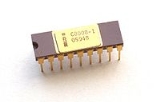
Intel 8008

Encyclopedia
Microprocessor
A microprocessor incorporates the functions of a computer's central processing unit on a single integrated circuit, or at most a few integrated circuits. It is a multipurpose, programmable device that accepts digital data as input, processes it according to instructions stored in its memory, and...
designed and manufactured by Intel and introduced in April 1972. It was an 8-bit CPU with an external 14-bit address bus that could address 16KB of memory. Originally known as the 1201, the chip was commissioned by Computer Terminal Corporation (CTC) to implement an instruction set of their design for their Datapoint 2200
Datapoint 2200
The Datapoint 2200 was a mass-produced programmable terminal, designed by Phil Ray and Gus Roche, announced by Computer Terminal Corporation in June, 1970...
programmable terminal. As the chip was delayed and did not meet CTC's performance goals, the 2200 ended up using CTC's own TTL
Transistor-transistor logic
Transistor–transistor logic is a class of digital circuits built from bipolar junction transistors and resistors. It is called transistor–transistor logic because both the logic gating function and the amplifying function are performed by transistors .TTL is notable for being a widespread...
based CPU instead. An agreement permitted Intel to market the chip to other customers after Seiko
Seiko
, more commonly known simply as Seiko , is a Japanese watch company.-History and ongoing developments:The company was founded in 1881, when Kintarō Hattori opened a watch and jewelry shop called in the Ginza area of Tokyo, Japan. Eleven years later, in 1892, he began to produce clocks under the...
expressed an interest in using it for a calculator
Calculator
An electronic calculator is a small, portable, usually inexpensive electronic device used to perform the basic operations of arithmetic. Modern calculators are more portable than most computers, though most PDAs are comparable in size to handheld calculators.The first solid-state electronic...
.
History
CTC formed in San Antonio in 1968 under the direction of Austin O. "Gus" Roche and Phil Ray, both NASANASA
The National Aeronautics and Space Administration is the agency of the United States government that is responsible for the nation's civilian space program and for aeronautics and aerospace research...
engineers. Roche, in particular, was primarily interested in producing a desktop computer. However, given the immaturity of the market, the company's business plan mentioned only a Teletype Model 33 ASR replacement, which shipped as the Datapoint 3300
Datapoint 3300
The DataPoint 3300 was the first computer terminal manufactured by the Computer Terminal Corporation , announced in 1967 and shipping in 1969...
. The case, designed by John "Jack" Frassanito, was deliberately designed to fit in the same space as an IBM Selectric typewriter, and used a video screen shaped to be the same aspect ratio
Aspect ratio
The aspect ratio of a shape is the ratio of its longer dimension to its shorter dimension. It may be applied to two characteristic dimensions of a three-dimensional shape, such as the ratio of the longest and shortest axis, or for symmetrical objects that are described by just two measurements,...
as an IBM punched card
Punched card
A punched card, punch card, IBM card, or Hollerith card is a piece of stiff paper that contains digital information represented by the presence or absence of holes in predefined positions...
. Although commercially successful, the 3300 had ongoing heat problems due to the amount of circuitry packed into such a small space.
In order to address the heating and other issues, a re-design started that featured the CPU part of the internal circuitry re-implemented on a single chip. Looking for a company able to produce their chip design, Roche turned to Intel, then primarily a vendor of memory chips. Roche met with Bob Noyce, who expressed concern with the concept; Frassanito recalls that "Noyce said it was an intriguing idea, and that Intel could do it, but it would be a dumb move. He said that if you have a computer chip, you can only sell one chip per computer, while with memory, you can sell hundreds of chips per computer." Another major concern was that Intel's existing customer base purchased their memory chips for use with their own processor designs; if Intel introduced their own processor, they might be seen as a competitor, and their customers might look elsewhere for memory. Nevertheless, Noyce agreed to a $50,000 development contract in early 1970. Texas Instruments
Texas Instruments
Texas Instruments Inc. , widely known as TI, is an American company based in Dallas, Texas, United States, which develops and commercializes semiconductor and computer technology...
(TI) was also brought in as a second supplier.
TI was able to quickly make samples of the 1201 based on Intel drawings, but these proved to be buggy and were rejected. Intel's own versions were delayed. CTC decided to re-implement the new version of the terminal using discrete TTL instead of a single CPU. The new system was released as the Datapoint 2200
Datapoint 2200
The Datapoint 2200 was a mass-produced programmable terminal, designed by Phil Ray and Gus Roche, announced by Computer Terminal Corporation in June, 1970...
in the spring 1970, with their first sale to General Mills
General Mills
General Mills, Inc. is an American Fortune 500 corporation, primarily concerned with food products, which is headquartered in Golden Valley, Minnesota, a suburb of Minneapolis. The company markets many well-known brands, such as Betty Crocker, Yoplait, Colombo, Totinos, Jeno's, Pillsbury, Green...
on May 25, 1970. CTC paused development of the 1201 after the 2200 was released, as it was no longer needed. Six months later, Seiko approached Intel expressing an interest in using the 1201 in a scientific calculator, likely after seeing the success of the simpler Intel 4004
Intel 4004
The Intel 4004 was a 4-bit central processing unit released by Intel Corporation in 1971. It was the first complete CPU on one chip, and also the first commercially available microprocessor...
used by Busicom in their business calculators. A small re-design followed, expanding from a 16-pin to 18-pin design, and the new 1210 was delivered to CTC in late 1971.
By that point CTC had once again moved on, this time to the Datapoint 2200 II, which was faster and included a hard drive. The 1201 was no longer powerful enough for the new model. CTC voted to end their involvement with the 1201, leaving the design's intellectual property to Intel instead of paying the $50,000 contract. Intel renamed it the 8008, and put it in their catalog in April 1972 priced at $120. Intel's initial worries about their existing customer base leaving them proved unfounded, and the 8008 went on to be a commercially successful design. This was followed by the Intel 8080
Intel 8080
The Intel 8080 was the second 8-bit microprocessor designed and manufactured by Intel and was released in April 1974. It was an extended and enhanced variant of the earlier 8008 design, although without binary compatibility...
, and then the hugely successful Intel x86 family.
One of the first teams to build a complete system around the 8008 was Bill Pentz' team at California State University, Sacramento
California State University, Sacramento
California State University, Sacramento, popularly known as Sacramento State, is a public university located in the city of Sacramento, California. It is part of the California State University system...
. The Sac State 8008 was possibly the first true microcomputer, with a disk operating system built with IBM Basic assembly language in PROM all driving a color display, hard drive, keyboard, modem, audio/paper tape reader and printer.http://news.cnet.com/8301-13772_3-10429544-52.html?tag=newsLeadStoriesArea.1 The project started in the spring of 1972 and with key help from Tektronix
Tektronix
Tektronix, Inc. is an American company best known for its test and measurement equipment such as oscilloscopes, logic analyzers, and video and mobile test protocol equipment. In November 2007, Tektronix became a subsidiary of Danaher Corporation....
the system was fully functional a year later. Bill assisted Intel with the MCS-8 kit and provided key input to the Intel 8080
Intel 8080
The Intel 8080 was the second 8-bit microprocessor designed and manufactured by Intel and was released in April 1974. It was an extended and enhanced variant of the earlier 8008 design, although without binary compatibility...
instruction set which helped make it useful for the industry and hobbyists.
In the UK, a team at S. E. Laboratories Engineering (EMI) led by Tom Spink in 1972 built a microcomputer based on a pre-release sample of the 8008. Joe Hardman extended the chip with an external stack. This, among other things, gave it power-fail save and recovery. Joe also developed a direct screen printer. The operating system was written using a meta-assembler developed by L. Crawford and J. Parnell for a Digital Equipment Corporation
Digital Equipment Corporation
Digital Equipment Corporation was a major American company in the computer industry and a leading vendor of computer systems, software and peripherals from the 1960s to the 1990s...
PDP-11
PDP-11
The PDP-11 was a series of 16-bit minicomputers sold by Digital Equipment Corporation from 1970 into the 1990s, one of a succession of products in the PDP series. The PDP-11 replaced the PDP-8 in many real-time applications, although both product lines lived in parallel for more than 10 years...
. The operating system was burnt into a PROM. It was interrupt-driven, queued, and based on a fixed page size for programs and data. An operational prototype was prepared for management, who decided not to continue with the project.
The 8008 was the CPU for the very first commercial personal computers, the (French non-kit) Micral
MICRAL
According to the Computer History Museum, the Micral N, produced by the French company R2E, was the earliest commercial, non-kit personal computer based on a microprocessor...
and the (US kit) SCELBI
SCELBI
SCELBI Computer Consulting was a personal-computer hardware and software manufacturer located in Milford, Connecticut. It was founded in 1973 by Nat Wadsworth and Bob Findley. Initially, they sold hardware based on the first 8-bit microprocessor from Intel, the 8008...
.
Design

Micrometre
A micrometer , is by definition 1×10⁻⁶ of a meter .In plain English, it means one-millionth of a meter . Its unit symbol in the International System of Units is μm...
silicon-gate enhancement load PMOS
PMOS logic
P-type metal-oxide-semiconductor logic uses p-type metal-oxide-semiconductor field effect transistors to implement logic gates and other digital circuits...
; initial versions of the 8008 could work at clock frequencies up to 0.5 MHz, this was later increased in the 8008-1 to a specified maximum of 0.8 MHz. Instructions took between 5 and 11 T-states where each T-state was 2 clock cycles.
Register-register loads and ALU operations took 5T (20 μs at 0.5 MHz), register-memory 8T (32 μs), while calls and jumps (when taken) took 11 T-states (44 μs).
The 8008 was a little slower in terms of instructions per second
Instructions per second
Instructions per second is a measure of a computer's processor speed. Many reported IPS values have represented "peak" execution rates on artificial instruction sequences with few branches, whereas realistic workloads typically lead to significantly lower IPS values...
(36,000 to 80,000 at 0.8 MHz) than the 4-bit Intel 4004
Intel 4004
The Intel 4004 was a 4-bit central processing unit released by Intel Corporation in 1971. It was the first complete CPU on one chip, and also the first commercially available microprocessor...
and Intel 4040
Intel 4040
The Intel 4040 microprocessor was the successor to the Intel 4004. It was introduced in 1974. The 4040 employed a 10 μm silicon gate enhancement load PMOS technology, was made up of 3,000 transistors and could execute approximately 60,000 instructions per second.- Extensions :*Instruction Set...
, but the fact that the 8008 processed data eight bits at a time and could access significantly more RAM still gave it a significant speed advantage in most applications. The 8008 had 3,500 transistor
Transistor
A transistor is a semiconductor device used to amplify and switch electronic signals and power. It is composed of a semiconductor material with at least three terminals for connection to an external circuit. A voltage or current applied to one pair of the transistor's terminals changes the current...
s.
The subsequent Intel 8080 and 8085
Intel 8085
The Intel 8085 is an 8-bit microprocessor introduced by Intel in 1977. It was binary-compatible with the more-famous Intel 8080 but required less supporting hardware, thus allowing simpler and less expensive microcomputer systems to be built....
CPUs were assembly-language (not binary) compatible with the 8008 and also heavily based on the same basic internal design. The original x86 processor, the 8086
Intel 8086
The 8086 is a 16-bit microprocessor chip designed by Intel between early 1976 and mid-1978, when it was released. The 8086 gave rise to the x86 architecture of Intel's future processors...
, was in turn a non-strict extension of the 8080
Intel 8080
The Intel 8080 was the second 8-bit microprocessor designed and manufactured by Intel and was released in April 1974. It was an extended and enhanced variant of the earlier 8008 design, although without binary compatibility...
, therefore loosely resembling the original Datapoint 2200 design as well. This means that each 8008 instruction has an equivalent not only in the larger instruction set of the 8080 (and 8085, Z80 etc.) but also, in most cases, in the large 32-bit based instruction set of a modern x86 processor (although the encodings are different in all three).
The chip (limited by its 18-pin DIP
Dual in-line package
In microelectronics, a dual in-line package is an electronic device package with a rectangular housing and two parallel rows of electrical connecting pins. The package may be through-hole mounted to a printed circuit board or inserted in a socket.A DIP is usually referred to as a DIPn, where n is...
packaging) had a single 8-bit bus and required a significant amount of external support logic. For example, the 14-bit address, which could access "16 K x 8 bits of memory", needed to be latched by some of this logic into an external Memory Address Register (MAR). The 8008 could access 8 input ports and 24 output ports.
For controller and CRT terminal
Computer terminal
A computer terminal is an electronic or electromechanical hardware device that is used for entering data into, and displaying data from, a computer or a computing system...
use, this was an acceptable design, but it was rather cumbersome to use for most other tasks, at least compared to the next generations of microprocessors. A few early computer designs were based on it, but most would use the later and greatly improved Intel 8080
Intel 8080
The Intel 8080 was the second 8-bit microprocessor designed and manufactured by Intel and was released in April 1974. It was an extended and enhanced variant of the earlier 8008 design, although without binary compatibility...
instead.
The 8008 family is also referred to as the MCS-8.
Designers
- CTC (Instruction set and architecture): Victor Poor and Harry Pyle.
- Intel (Implementation in silicon):
- Marcian "Ted" HoffMarcian HoffMarcian Edward "Ted" Hoff, Jr. , is one of the inventors of the microprocessor. Hoff joined Intel in 1967 as employee number 12, and is credited with coming up with the idea of using a "universal processor" rather than a variety of custom-designed circuits. His insight started the microprocessor...
and Stan Mazor and Larry Potter (IBM Chief Scientist of IBM) proposed a single-chip implementation of the CTC architecture, using RAM register memory rather than shift register memory, and also added a few instructions and interrupt facility - Federico FagginFederico FagginFederico Faggin , who received in 2010 the National Medal of Technology and Innovation by Barack Obama, the highest honor bestowed by the United States government on scientists, engineers, and inventors, at the White House in Washington, is an Italian-born and naturalized U.S...
became leader of the project from January 1971, after it had been suspended – without progress – for about seven months, until its successful completion in April 1972 - Hal Feeney project engineer did the detailed logic design, circuit design, and physical layout under Faggin's supervision, employing the same design methodology Faggin originally developed for the Intel 4004 microprocessor and utilizing the circuits of the 4004. Note his combined HF logo on the chip about half way between the D5 and D6 bonding pads.
- Marcian "Ted" Hoff
External links
- MCS-8 User Manual with 8008 data sheet (1972)
- Computer World Forgotten PC history: The true origins of the personal computer
- The Intel 8008 support page unofficial
- The DigiBarn Computer Museum's page on Bill Pentz' Sacramento State machine, a full microcomputer built around the 8008