


Data General Nova

Encyclopedia
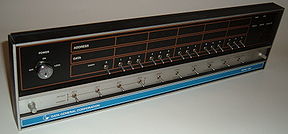
16-bit
-16-bit architecture:The HP BPC, introduced in 1975, was the world's first 16-bit microprocessor. Prominent 16-bit processors include the PDP-11, Intel 8086, Intel 80286 and the WDC 65C816. The Intel 8088 was program-compatible with the Intel 8086, and was 16-bit in that its registers were 16...
minicomputer
Minicomputer
A minicomputer is a class of multi-user computers that lies in the middle range of the computing spectrum, in between the largest multi-user systems and the smallest single-user systems...
built by the American company Data General
Data General
Data General was one of the first minicomputer firms from the late 1960s. Three of the four founders were former employees of Digital Equipment Corporation. Their first product, the Data General Nova, was a 16-bit minicomputer...
starting in 1969. The Nova was packaged into a single rack mount case and had enough power to do most simple computing tasks. The Nova became popular in science laboratories around the world, and eventually 50,000 units were sold. It was succeeded by the Data General Eclipse
Data General Eclipse
The Data General Eclipse line of computers by Data General were 16-bit minicomputers released in early 1974 and sold until 1988. The Eclipse was based on many of the same concepts as the Data General Nova, but included support for virtual memory and multitasking more suitable to the small office...
, which was similar in most ways but added virtual memory
Virtual memory
In computing, virtual memory is a memory management technique developed for multitasking kernels. This technique virtualizes a computer architecture's various forms of computer data storage , allowing a program to be designed as though there is only one kind of memory, "virtual" memory, which...
support and other features required by modern operating system
Operating system
An operating system is a set of programs that manage computer hardware resources and provide common services for application software. The operating system is the most important type of system software in a computer system...
s.
de Castro and the Nova’s origin
Edson de CastroEdson de Castro
Edson de Castro is a computer engineer perhaps best known for designing the Data General Nova series of computers.De Castro was founder and CEO of Data General Corporation throughout the 1970s, the 1980s and into the 1990s when he was replaced by Ronald L Skates, a former Price Waterhouse Coopers...
was the Product Manager at Digital Equipment Corporation (DEC)
Digital Equipment Corporation
Digital Equipment Corporation was a major American company in the computer industry and a leading vendor of computer systems, software and peripherals from the 1960s to the 1990s...
of their pioneering PDP-8
PDP-8
The 12-bit PDP-8 was the first successful commercial minicomputer, produced by Digital Equipment Corporation in the 1960s. DEC introduced it on 22 March 1965, and sold more than 50,000 systems, the most of any computer up to that date. It was the first widely sold computer in the DEC PDP series of...
, a 12-bit computer generally considered by most to be the first true minicomputer. De Castro was convinced, however, that it was possible to improve upon the PDP-8 by building a 16-bit minicomputer on a single board. Ken Olsen
Ken Olsen
Kenneth Harry Olsen was an American engineer who co-founded Digital Equipment Corporation in 1957 with colleague Harlan Anderson.-Background:...
was not supportive of this project, so de Castro left DEC along with another hardware engineer, Richard Sogge, and a software engineer, Henry Burkhardt III
Henry Burkhardt III
Henry Burkhardt III was born in Ann Arbor, Michigan, USA, grew up in South Hadley, Massachusetts, and was schooled there. He graduated from Phillips Exeter Academy and attended Princeton University. He began his career as a programmer at Digital Equipment Corporation...
, to found Data General
Data General
Data General was one of the first minicomputer firms from the late 1960s. Three of the four founders were former employees of Digital Equipment Corporation. Their first product, the Data General Nova, was a 16-bit minicomputer...
(DG) in 1968. The fourth founder, Herbert Richman, had been a salesman for Fairchild Semiconductor
Fairchild Semiconductor
Fairchild Semiconductor International, Inc. is an American semiconductor company based in San Jose, California. Founded in 1957, it was a pioneer in transistor and integrated circuit manufacturing...
and knew the others through his contacts with Digital Equipment.
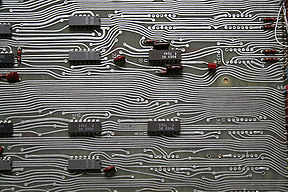
In keeping with the original concept, the Nova was based on two 15 by 15 in (38.1 by 38.1 cm) printed circuit board
Printed circuit board
A printed circuit board, or PCB, is used to mechanically support and electrically connect electronic components using conductive pathways, tracks or signal traces etched from copper sheets laminated onto a non-conductive substrate. It is also referred to as printed wiring board or etched wiring...
s, one for the CPU and another for various support systems. The design was laid out so it could be connected together with no manual wiring at all, allowing the boards to be built in a completely automated fashion. This greatly reduced costs over the rival PDP-8 and PDP-8/I, which consisted of many smaller boards that had to be wired together. The larger-board construction also made the Nova more reliable, which made it especially attractive for industrial or lab settings. Fairchild Semiconductor
Fairchild Semiconductor
Fairchild Semiconductor International, Inc. is an American semiconductor company based in San Jose, California. Founded in 1957, it was a pioneer in transistor and integrated circuit manufacturing...
provided the medium-scale integration (MSI) chips used throughout the system. The Nova was one of the first 16-bit
16-bit
-16-bit architecture:The HP BPC, introduced in 1975, was the world's first 16-bit microprocessor. Prominent 16-bit processors include the PDP-11, Intel 8086, Intel 80286 and the WDC 65C816. The Intel 8088 was program-compatible with the Intel 8086, and was 16-bit in that its registers were 16...
minicomputers and was a leader in moving to word lengths that were multiples of the 8-bit
8-bit
The first widely adopted 8-bit microprocessor was the Intel 8080, being used in many hobbyist computers of the late 1970s and early 1980s, often running the CP/M operating system. The Zilog Z80 and the Motorola 6800 were also used in similar computers...
byte
Byte
The byte is a unit of digital information in computing and telecommunications that most commonly consists of eight bits. Historically, a byte was the number of bits used to encode a single character of text in a computer and for this reason it is the basic addressable element in many computer...
.
DG released the Nova in 1969 at a base price of US$3,995, advertising it as "the best small computer in the world." The basic model was not very useful out of the box
Out of the box
Out of the box is the term used to denote items, functionalities, or features that do not require any additional installation. In addition to being used for tangible products, the phrase is often used in a less literal sense for software, which may not be distributed in an actual box but offer...
, and adding RAM in the form of core memory typically brought the price up to $7,995. In 1969, Data General
Data General
Data General was one of the first minicomputer firms from the late 1960s. Three of the four founders were former employees of Digital Equipment Corporation. Their first product, the Data General Nova, was a 16-bit minicomputer...
shipped a total of 50,000 Novas at $8000 each. The Nova’s biggest competition was from the new DEC PDP-11
PDP-11
The PDP-11 was a series of 16-bit minicomputers sold by Digital Equipment Corporation from 1970 into the 1990s, one of a succession of products in the PDP series. The PDP-11 replaced the PDP-8 in many real-time applications, although both product lines lived in parallel for more than 10 years...
computer series, and to a lesser extent the older DEC PDP-8
PDP-8
The 12-bit PDP-8 was the first successful commercial minicomputer, produced by Digital Equipment Corporation in the 1960s. DEC introduced it on 22 March 1965, and sold more than 50,000 systems, the most of any computer up to that date. It was the first widely sold computer in the DEC PDP series of...
systems. It has been said that the Nova was crude compared to its competitors; but it was quite effective and very fast for its day, at least at its low-cost end of the market.
SuperNOVA
A further improvement on the Nova design followed the next year, the SuperNOVA. The SuperNOVA included a number of improvements that dramatically improved performance over the original model. This included the use of ROMRead-only memory
Read-only memory is a class of storage medium used in computers and other electronic devices. Data stored in ROM cannot be modified, or can be modified only slowly or with difficulty, so it is mainly used to distribute firmware .In its strictest sense, ROM refers only...
for library software that could be run much faster than the same code in the normal core memory, due to the latter’s need to be written immediately after being read. Additionally the system included a new set of core with an 800 ns cycle time, faster than the original’s 1200 ns version. Finally the SuperNOVA also replaced the earlier model’s 4-bits-at-a-time math unit with a new 16-bit parallel version, speeding math by up to four times.
Soon after the introduction of the SuperNOVA, the SuperNOVA SC was introduced, featuring semiconductor (SC) memory in place of core. The much higher performance memory allowed the CPU, which was synchronous with memory, to be further increased in speed to run at a 300 ns cycle time (3.3 MHz), which made it the fastest minicomputer for over a decade following its introduction.
Later versions
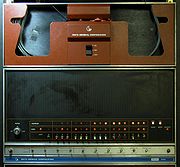
The next version was the Nova 2, with the first versions shipping in 1973. The Nova 2 was essentially a simplified version of the earlier machines as increasing chip densities allowed the CPU to be reduced in size. While the SuperNOVA used three 15×15" boards to implement the CPU and its memory, the Nova 2 fitted all of this onto a single board. ROM was used to store the boot code, which was then copied into core when the “program load” switch was flipped. Versions were available with four, seven and ten slots.
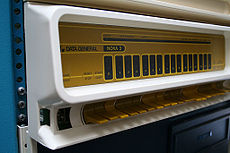
TTL
TTL may refer to:* Taiwan Tobacco and Liquor, a state-owned manufacturer of cigarettes and alcohol in Taiwan* Through-the-lens metering, a feature of cameras capable of measuring light levels in a scene through their lens...
components, further increasing the performance of the system. The Nova 3 was offered in four-slot (the Nova 3/4) and twelve-slot (the Nova 3/12) versions.
It appears that Data General originally intended the Nova 3 to be the last of its line, planning to replace the Nova with the later Eclipse machines. However, continued demand led to a Nova 4 machine, this time based on four AMD 2901 bit-slice ALU
Arithmetic logic unit
In computing, an arithmetic logic unit is a digital circuit that performs arithmetic and logical operations.The ALU is a fundamental building block of the central processing unit of a computer, and even the simplest microprocessors contain one for purposes such as maintaining timers...
s. This machine was designed from the start to be both the Nova 4 and the Eclipse S/140, with different microcode
Microcode
Microcode is a layer of hardware-level instructions and/or data structures involved in the implementation of higher level machine code instructions in many computers and other processors; it resides in special high-speed memory and translates machine instructions into sequences of detailed...
for each. A floating-point co-processor was also available, taking up a separate slot. An additional option allowed for memory mapping, allowing programs to access up to 128 kWords of memory using bank switching
Bank switching
Bank switching is a technique to increase the amount of usable memory beyond the amount directly addressable by the processor. It can be used to configure a system differently at different times; for example, a ROM required to start a system from diskette could be switched out when no longer...
. Unlike the earlier machines, the Nova 4 did not include a front panel console
Front panel
A front panel was used on early electronic computers to display and allow the alteration of the state of the machine's internal registers and memory. The front panel usually consisted of arrays of indicator lamps, toggle switches, and push buttons mounted on a sheet metal face plate...
and instead relied on the terminal
Terminal (electronics)
A terminal is the point at which a conductor from an electrical component, device or network comes to an end and provides a point of connection to external circuits. A terminal may simply be the end of a wire or it may be fitted with a connector or fastener...
to emulate a console when needed.
There were three different versions of the Nova 4, the Nova 4/C, the Nova 4/S and the Nova 4/X. The Nova 4/C was a single-board implementation that included all of the memory (16 or 32 kWords). The Nova 4/S and 4/X used separate memory boards. The Nova 4/X had the on-board memory management unit
Memory management unit
A memory management unit , sometimes called paged memory management unit , is a computer hardware component responsible for handling accesses to memory requested by the CPU...
(MMU) enabled to allow up to 128 kWords of memory to be used (the MMU was also installed in the Nova 4/S, but was disabled by firmware). Both the 4/S and the 4/X included a “prefetcher” to increase performance by fetching up to two instructions from memory before they were needed.
microNOVA
Data General also produced a series of single-chip implementations of the Nova processor as the microNOVA. Changes to the bus architecture limited speed dramatically, to the point where it was about one-half the speed of the original Nova. The original microNOVA with the “mN601” processor shipped in 1977. It was followed by the microNOVA MP/100 in 1979, which reduced the CPU to a single VLSI chip, the mN602. A larger version was also offered as the microNOVA MP/200, shipping the same year.The microNOVA was later re-packaged in a PC-style case with two floppy disk
Floppy disk
A floppy disk is a disk storage medium composed of a disk of thin and flexible magnetic storage medium, sealed in a rectangular plastic carrier lined with fabric that removes dust particles...
s as the Enterprise. Enterprise shipped in 1981, running RDOS
RDOS
RDOS was a real-time operating system released in 1972 for the popular Data General Nova and Eclipse minicomputers...
, but the introduction of the IBM PC
IBM PC
The IBM Personal Computer, commonly known as the IBM PC, is the original version and progenitor of the IBM PC compatible hardware platform. It is IBM model number 5150, and was introduced on August 12, 1981...
the same year made most other machines disappear under the radar.
Nova’s legacy
The Nova influenced the design of both the Xerox AltoXerox Alto
The Xerox Alto was one of the first computers designed for individual use , making it arguably what is now called a personal computer. It was developed at Xerox PARC in 1973...
(1973) and Apple I
Apple I
The original Apple Computer, also known retroactively as the Apple I, or Apple-1, is a personal computer released by the Apple Computer Company in 1976. They were designed and hand-built by Steve Wozniak. Wozniak's friend Steve Jobs had the idea of selling the computer...
(1976) computers, and its architecture was the basis for the Computervision
Computervision
Computervision, Inc. was an early pioneer in turnkey Computer Aided Design and Manufacturing . Computervision was founded in 1969 by Marty Allen and Philippe Villers, and headquartered in Bedford, Massachusetts, USA. Its early products were built on a Data General Nova platform...
CGP (Computervision Graphics Processor) series. Its external design has been reported to be the direct inspiration for the front panel of the MITS Altair
Altair 8800
The MITS Altair 8800 was a microcomputer design from 1975 based on the Intel 8080 CPU and sold by mail order through advertisements in Popular Electronics, Radio-Electronics and other hobbyist magazines. The designers hoped to sell only a few hundred build-it-yourself kits to hobbyists, and were...
(1975) microcomputer.
Data General followed up on the success of the original Nova with a series of faster designs. The Eclipse family of systems was later introduced with an extended upwardly compatible instruction set, and the MV-series further extended the Eclipse into a 32-bit architecture to compete with the DEC VAX
VAX
VAX was an instruction set architecture developed by Digital Equipment Corporation in the mid-1970s. A 32-bit complex instruction set computer ISA, it was designed to extend or replace DEC's various Programmed Data Processor ISAs...
. The development of the MV-series was documented in Tracy Kidder
Tracy Kidder
John Tracy Kidder is a Pulitzer Prize-winning American writer of the 1981 nonfiction narrative, The Soul of a New Machine, about the creation of a new computer at Data General Corporation...
’s popular 1981 book, The Soul of a New Machine
The Soul of a New Machine
Tracy Kidder's non-fiction book, The Soul of a New Machine, chronicles the experiences of an engineering team racing to design a next generation computer under a blistering schedule and tremendous pressure. This machine was eventually launched in 1980 as the Data General Eclipse MV/8000...
. Data General itself would later evolve into a vendor of Intel processor-based servers and storage arrays, eventually being purchased by EMC
EMC Corporation
EMC Corporation , a Financial Times Global 500, Fortune 500 and S&P 500 company, develops, delivers and supports information infrastructure and virtual infrastructure hardware, software, and services. EMC is headquartered in Hopkinton, Massachusetts, USA.Former Intel executive Richard Egan and his...
.
there are still 16-bit Novas and Eclipse
Data General Eclipse
The Data General Eclipse line of computers by Data General were 16-bit minicomputers released in early 1974 and sold until 1988. The Eclipse was based on many of the same concepts as the Data General Nova, but included support for virtual memory and multitasking more suitable to the small office...
s running in a variety of applications worldwide, including air traffic control. There is a diverse but ardent group of people worldwide who restore and preserve legacy 16-bit Data General systems.
Processor design
PDP-8
The 12-bit PDP-8 was the first successful commercial minicomputer, produced by Digital Equipment Corporation in the 1960s. DEC introduced it on 22 March 1965, and sold more than 50,000 systems, the most of any computer up to that date. It was the first widely sold computer in the DEC PDP series of...
, was a load-store architecture. It had four 16-bit accumulator
Accumulator (computing)
In a computer's central processing unit , an accumulator is a register in which intermediate arithmetic and logic results are stored. Without a register like an accumulator, it would be necessary to write the result of each calculation to main memory, perhaps only to be read right back again for...
registers, of which two (2 and 3) could be used as index register
Index register
An index registerCommonly known as a B-line in early British computers. in a computer's CPU is a processor register used for modifying operand addresses during the run of a program, typically for doing vector/array operations...
s. There was a 15-bit program counter
Program counter
The program counter , commonly called the instruction pointer in Intel x86 microprocessors, and sometimes called the instruction address register, or just part of the instruction sequencer in some computers, is a processor register that indicates where the computer is in its instruction sequence...
and a single-bit carry register. As with the PDP-8, current + zero page
Zero page
The zero page is the series of memory addresses at the absolute beginning of a computer's address space; that is, the page whose starting address is zero. The size of a "page" depends on the context, and the significance of zero-page memory versus higher addressed memory is highly dependent on...
addressing was central. There was no stack register
Stack register
A stack register is a computer central processor register whose purpose is to keep track of a call stack. On an accumulator-based architecture machine, this may be a dedicated register such as SP on an Intel x86 machine. On a general register machine, it may be a register which is reserved by...
, but later Eclipse designs would utilize a dedicated hardware memory address for this function.
The earliest models of the Nova processed math serially in 4-bit packets, using a single 74181
74181
The 74181 is a bit slice arithmetic logic unit , implemented as a 7400 series TTL integrated circuit. The first complete ALU on a single chip, it was used as the arithmetic/logic core in the CPUs of many historically significant minicomputers and other devices.The 74181 represents an evolutionary...
bitslice
Bit slicing
Bit slicing is a technique for constructing a processor from modules of smaller bit width. Each of these components processes one bit field or "slice" of an operand...
ALU
ALU
ALU, alu or Alu may refer to:*Academy of Fine Arts and Design, Ljubljana*Assisted Living Unit, care residency that usually includes the regular provision of a range of personal services*Alcatel-Lucent, a company traded on the NYSE...
. A year after its introduction this design was improved to include a full 16-bit parallel math unit using four 74181s, this design being referred to as the SuperNova. Future versions of the system added a stack unit and hardware multiply/divide.
The Nova 4 / Eclipse S/140 was based on four AMD 2901 bit-slice ALUs, with microcode
Microcode
Microcode is a layer of hardware-level instructions and/or data structures involved in the implementation of higher level machine code instructions in many computers and other processors; it resides in special high-speed memory and translates machine instructions into sequences of detailed...
in read-only memory
Read-only memory
Read-only memory is a class of storage medium used in computers and other electronic devices. Data stored in ROM cannot be modified, or can be modified only slowly or with difficulty, so it is mainly used to distribute firmware .In its strictest sense, ROM refers only...
, and was the first Nova designed for DRAM
Dram
Dram or DRAM may refer to:As a unit of measure:* Dram , an imperial unit of mass and volume* Armenian dram, a monetary unit* Dirham, a unit of currency in several Arab nationsOther uses:...
main memory only, without provision for magnetic core memory
Magnetic core memory
Magnetic-core memory was the predominant form of random-access computer memory for 20 years . It uses tiny magnetic toroids , the cores, through which wires are threaded to write and read information. Each core represents one bit of information...
.
Memory and I/O
The first models were available with 8KK
K is the eleventh letter of the English and basic modern Latin alphabet.-History and usage:In English, the letter K usually represents the voiceless velar plosive; this sound is also transcribed by in the International Phonetic Alphabet and X-SAMPA....
words of magnetic core memory
Magnetic core memory
Magnetic-core memory was the predominant form of random-access computer memory for 20 years . It uses tiny magnetic toroids , the cores, through which wires are threaded to write and read information. Each core represents one bit of information...
as an option, one that practically everyone had to buy, bringing the system cost up to $7,995.
This core memory board, Part Number 50823 D8 7504-14166, and with layout artwork copyrighted 1971 by DGC, was organized in planar fashion as four groups of four banks, each bank carrying two sets of core in a 64 by 64 matrix; thus there were 64 x 64 = 4096 bits per set, x 2 sets giving 8,192 bits, x 4 banks giving 32,768 bits, x 4 goups giving a total of 131,072 bits, and this divided by the machine word size of 16 bits gave 8,192 Words of memory.
The core on this 8K Word memory board occupied a centrally located 'board-on-a-board' 5.25" wide by 6.125" high and was covered by a protective plate. It was surrounded by the necessary support driver read-write-rewrite circuitry and epitomized the state of the art of core memory, soon to be replaced by solid state memory. Even here DG managed to innovate, packing this very small core and the corresponding support electronics onto a single standard 15 x 15 inches (381 mm) board. Up to 32K of such core RAM
Random-access memory
Random access memory is a form of computer data storage. Today, it takes the form of integrated circuits that allow stored data to be accessed in any order with a worst case performance of constant time. Strictly speaking, modern types of DRAM are therefore not random access, as data is read in...
could be supported in one external expansion box. Semiconductor
Semiconductor
A semiconductor is a material with electrical conductivity due to electron flow intermediate in magnitude between that of a conductor and an insulator. This means a conductivity roughly in the range of 103 to 10−8 siemens per centimeter...
ROM
Read-only memory
Read-only memory is a class of storage medium used in computers and other electronic devices. Data stored in ROM cannot be modified, or can be modified only slowly or with difficulty, so it is mainly used to distribute firmware .In its strictest sense, ROM refers only...
was already available at the time, and RAM-less systems (i.e. with ROM only) became popular in many industrial settings. The original Nova machines ran at approximately 200 kHz, but its SuperNova was designed to run at up to 3 MHz when used with special semiconductor main memory.
The standardized backplane
Backplane
A backplane is a group of connectors connected in parallel with each other, so that each pin of each connector is linked to the same relative pin of all the other connectors forming a computer bus. It is used as a backbone to connect several printed circuit boards together to make up a complete...
and I/O
Input/output
In computing, input/output, or I/O, refers to the communication between an information processing system , and the outside world, possibly a human, or another information processing system. Inputs are the signals or data received by the system, and outputs are the signals or data sent from it...
signals created a simple, efficient I/O design that made interfacing programmed I/O and Data Channel devices to the Nova simple compared to competing machines. In addition to its dedicated I/O bus structure, the Nova backplane had wire wrap
Wire wrap
Wire wrap is a technology used to assemble electronics. It is a method to construct circuit boards without having to make a printed circuit board. Wires can be wrapped by hand or by machine, and can be hand-modified afterwards. It was popular for large-scale manufacturing in the 60s and early 70s,...
pins that could be used for non-standard connectors or other special purposes.
Programming model
The instruction formatInstruction set
An instruction set, or instruction set architecture , is the part of the computer architecture related to programming, including the native data types, instructions, registers, addressing modes, memory architecture, interrupt and exception handling, and external I/O...
could be broadly categorized into one of three functions:
Memory management
Memory management is the act of managing computer memory. The essential requirement of memory management is to provide ways to dynamically allocate portions of memory to programs at their request, and freeing it for reuse when no longer needed. This is critical to the computer system.Several...
.
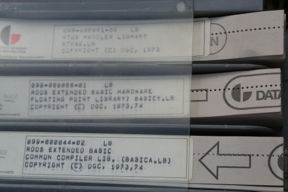
ALGOL
ALGOL is a family of imperative computer programming languages originally developed in the mid 1950s which greatly influenced many other languages and became the de facto way algorithms were described in textbooks and academic works for almost the next 30 years...
, Extended BASIC, Data General Business Basic
Data General Business Basic
Data General Business Basic was a BASIC interpreter developed by Data General for their Nova minicomputer in the 1970s, and later ported to the Data General Eclipse MV and AViiON computers...
, Interactive COBOL
COBOL
COBOL is one of the oldest programming languages. Its name is an acronym for COmmon Business-Oriented Language, defining its primary domain in business, finance, and administrative systems for companies and governments....
, and several assemblers were available from Data General. Third party vendors and the user community expanded the offerings with Forth, Lisp
Lisp programming language
Lisp is a family of computer programming languages with a long history and a distinctive, fully parenthesized syntax. Originally specified in 1958, Lisp is the second-oldest high-level programming language in widespread use today; only Fortran is older...
, BCPL
BCPL
BCPL is a procedural, imperative, and structured computer programming language designed by Martin Richards of the University of Cambridge in 1966.- Design :...
, C
C (programming language)
C is a general-purpose computer programming language developed between 1969 and 1973 by Dennis Ritchie at the Bell Telephone Laboratories for use with the Unix operating system....
, Algol
ALGOL
ALGOL is a family of imperative computer programming languages originally developed in the mid 1950s which greatly influenced many other languages and became the de facto way algorithms were described in textbooks and academic works for almost the next 30 years...
, and other proprietary versions of COBOL
COBOL
COBOL is one of the oldest programming languages. Its name is an acronym for COmmon Business-Oriented Language, defining its primary domain in business, finance, and administrative systems for companies and governments....
and BASIC.
Performance
The Nova 1200 executed core memory access instructions (LDA and STA) in 2.55 microseconds (μs). Use of read only memory saved 0.4 μs. Accumulator instructions (ADD, SUB, COM, NEG, etc.) took 1.55 μs, MUL 2.55 μs, DIV 3.75 μs, ISZ 3.15-4.5 μs. On the later Eclipse MV/6000, LDA and STA took 0.44 μs, ADD, etc. took 0.33 μs, MUL 2.2 μs, DIV 3.19 μs, ISZ 1.32 μs, FAD 5.17 μs, FMMD 11.66 μs.Hello world program
This is a minimal programming example in Nova assembly language. It is designed to run under RDOSRDOS
RDOS was a real-time operating system released in 1972 for the popular Data General Nova and Eclipse minicomputers...
and prints the string “Hello, world.
Hello world program
A "Hello world" program is a computer program that outputs "Hello world" on a display device. Because it is typically one of the simplest programs possible in most programming languages, it is by tradition often used to illustrate to beginners the most basic syntax of a programming language, or to...
” on the console.
; a "hello, world" program for Nova running RDOS, by Toby Thain
; uses PCHAR system call
.titl hello
.nrel
.ent start
start:
dochar:
lda 0,@pmsg ; load ac0 with next character,
mov# 0,0,snr ; test ac0; skip if nonzero (don't load result)
jmp done
.systm
.pchar ; print first
jmp er ; skipped if OK
movs 0,0 ; swap bytes
.systm
.pchar ; print second
jmp er ; skipped if OK
isz pmsg ; point to next character
jmp dochar ; go around again
done:
.systm ; normal exit
.rtn
er:
.systm ; error exit
.ertn
halt
pmsg:
.+1 ; pointer to first character of string
; note bytes are packed right-to-left by default
; <15><12> denotes a CR LF pair.
.txt /Hello, world.<15><12>/
0 ; flag word to end string
.end start
16-bit multiplication
Basic models of the Nova came without built-in hardware multiply and divide capability, to keep prices competitive. The following routine multiplies two 16-bit words to produce a 16-bit word result (overflow is ignored). It demonstrates combined use of ALU op, shift, and test (skip). Note that when this routine is called by jsr, AC3 holds the return addressReturn address
In postal mail, a return address is an explicit inclusion of the address of the person sending the message. It provides the recipient with a means to determine how to respond to the sender of the message if needed....
. This is used by the return instruction jmp 0,3. An idiomatic way to clear an accumulator is sub 0,0. Other single instructions can be arranged to load a specific set of useful constants (e.g. -2, -1, or +1).
mpy: ; multiply AC0 <- AC1 * AC2, by Toby Thain
sub 0,0 ; clear result
mbit: movzr 1,1,szc ; shift multiplier, test lsb
add 2,0 ; 1: add multiplicand
movzl 2,2,szr ; shift and test for zero
jmp mbit ; not zero, do another bit
jmp 0,3 ; return
Binary print accumulator
The following routine prints the value of AC1 as a 16 digit binary number, on the RDOS console. It reveals further quirks of the Nova instruction set. For instance, there is no instruction to load an arbitrary “immediate” value into an accumulator (although memory reference instructions do encode such a value to form an effective address). Accumulators must generally be loaded from initialised memory locations (e.g. n16). Other contemporary machines such as the PDP-11PDP-11
The PDP-11 was a series of 16-bit minicomputers sold by Digital Equipment Corporation from 1970 into the 1990s, one of a succession of products in the PDP series. The PDP-11 replaced the PDP-8 in many real-time applications, although both product lines lived in parallel for more than 10 years...
, and practically all modern architectures, allow for immediate loads, although many such as ARM
ARM architecture
ARM is a 32-bit reduced instruction set computer instruction set architecture developed by ARM Holdings. It was named the Advanced RISC Machine, and before that, the Acorn RISC Machine. The ARM architecture is the most widely used 32-bit ISA in numbers produced...
restrict the range of values that can be loaded immediately.
Because the RDOS .systm call macro implements a jsr, AC3 is overwritten by the return address for the .pchar function. Therefore a temporary location is needed to preserve the return address of the caller of this function. For a recursive or otherwise re-entrant routine, a stack, hardware if available, software if not, must be used instead. The return instruction becomes jmp @ retrn which exploits the Nova's indirect addressing mode to load the return PC.
The constant definitions at the end show two assembler features: the assembler radix is octal
Octal
The octal numeral system, or oct for short, is the base-8 number system, and uses the digits 0 to 7. Numerals can be made from binary numerals by grouping consecutive binary digits into groups of three...
by default (20 = sixteen), and character constants could be encoded as e.g. "0.
pbin: ; print AC1 on console as 16 binary digits, by Toby Thain
sta 3,retrn ; save return addr
lda 2,n16 ; set up bit counter
loop: lda 0,chr0 ; load ASCII '0'
movzl 1,1,szc ; get next bit in carry
inc 0,0 ; bump to '1'
.systm
.pchar ; AC0-2 preserved
jmp err ; if error
inc 2,2,szr ; bump counter
jmp loop ; loop again if not zero
lda 0,spc ; output a space
.systm
.pchar
jmp err ; if error
jmp @retrn
spc: " ;that's a space
chr0: "0
n16: -20
retrn: 0
Emulating a Data General Nova
Nova assembly language programs can be run under Bob Supnik’s SIMHSIMH
SIMH is a highly portable, multi-system emulator which runs on Windows, Linux, Mac OS X, FreeBSD, OpenBSD, NetBSD, OpenVMS, and other operating systems...
emulator, in RDOS. Of the above examples, only Hello, world is a complete program. It includes the necessary directives for a successful assembly and generation of a runnable program.
Stepwise instructions
Start the Nova emulation and boot RDOS following the instructions under “Nova and Eclipse RDOS” in the file src/simh_swre.txt of the simh distribution. After booting, RDOS’ command prompt, R, should appear on the screen.
- Before the first assembly on a newly setup RDOS system, the macro assembler’s default symbol definitions need to be configured using the following command: mac/s nbid osid nsid paru
- Create the assembly source file under RDOS: xfer/a $tti test.sr (the xfer command will accept input at the console and copy it to a disk file named test.sr; after entering the command, copy and paste (or type in) a complete assembly language program, and finish with control-ZControl-ZIn computing, is a control character in ASCII code, also known as the substitute character or a keyboard shortcut. Strictly speaking, is not a printable character at all but a code for control purposes, though it is sometimes rendered by two characters as ^Z. It is generated by pressing the key...
). - Next, run the macro assembler on test.sr to create the object file test.rb: mac/l test (the /l [slash-ell] option enables the listing file test.ls, which can be copied to the console using the command type test.ls).
- The relocatable loader, rldr, takes the object file and creates the executable test.sv : rldr test
- To run the program, type test
Before going further with serious experimentation, it can be convenient to check one’s programs at the PC using a suitable cross-assembler, such as the portable PDP-8/DG Nova cross-assembler listed in the External links section, before attempting execution in the RDOS environment.
RDOS hints
- To have a directory listing of all files with basename test, type list test.- (note the hyphen, RDOS’ wildcard characterWildcard character-Telecommunication:In telecommunications, a wildcard character is a character that may be substituted for any of a defined subset of all possible characters....
) - Delete files with delete (this might be needed because xfer won’t replace an existing file)
- A running program can usually be interrupted with Control-A
- To exit RDOS, type release %mdir%
- Quit simh at its prompt with q
Facts
The Canadian Broadcasting Corporation in Montreal used the Nova 1200 for channel playout automation up until the late 80's. It was then replaced with refurbished Nova 4 units and these were in use until the mid 90's.External links
- Bob Supnik’s SimH project – Includes a basic Nova emulator in a user-modifiable package
- The portable C compiler includes a NOVA target.
- SimuLogic’s website – Attempts to archive everything DG plus provide free and commercial products
- A portable PDP-8 and DG Nova cross-assembler
- Carl Friend’s Minicomputer Museum – Describes the Nova instruction set in detail