


Microcomputer revolution

Encyclopedia
The microcomputer revolution (or personal computer revolution or digital revolution) is a phrase used to describe the rapid advances of microprocessor
-based computers from esoteric hobby projects to a commonplace fixture of homes in industrial societies. Prior to 1977, the only contact most of the population had with computers was through utility bills, bank and payroll services, or computer-generated
junk mail
. Within a decade, computers became common consumer goods.
The advent of affordable personal computers has had lasting impact on education, business, music, games, social interaction, and entertainment.
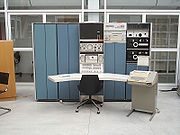 The minicomputer
ancestors of the modern personal computer used early integrated circuit
(microchip) technology, which reduced size and cost, but they contained no microprocessor
. This meant that they were still large and difficult to manufacture just like their mainframe
predecessors. After the "computer-on-a-chip" was commercialized, the cost to manufacture a computer system dropped dramatically. The arithmetic, logic, and control functions that previously occupied several costly circuit boards were now available in one integrated circuit, making it possible to produce them in high volume. Concurrently, advances in the development of solid state memory eliminated the bulky, costly, and power-hungry magnetic core memory
used in prior generations of computers.
After the 1972 introduction of the Intel 4004
, microprocessor costs declined rapidly. In 1974 the American electronics magazine Radio-Electronics
described the Mark-8
computer kit, based on the Intel 8008
processor. In January of the following year, Popular Electronics
magazine published an article describing a kit based on the Intel 8080
, a somewhat more powerful and easier to use processor. The Altair 8800
sold remarkably well even though initial memory size was limited to a few hundred bytes and there was no software available. However, the Altair kit was much less costly than an Intel development system of the time and so was purchased by hobbyists who formed users' group
s, notably the Homebrew Computer Club
, and companies interested in developing microprocessor control for their own products. Expansion memory boards and peripherals were soon listed by the original manufacturer, and later by plug-compatible manufacturers. The very first Microsoft
product was a 4 kilobyte paper tape BASIC
interpreter, which allowed users to develop programs in a higher-level language. The alternative was to hand-assemble machine code
that could be directly loaded into the microcomputer's memory using a front panel of toggle switches, pushbuttons and LED displays. While the hardware front panel
emulated those used by early mainframe and minicomputers, after a very short time interaction through a terminal was the preferred human/machine interface, and front panels became extinct.
would bring about the intelligent home of the '80s. Using Videotex
, NAPLPS
or some sort of as-yet unrealized computer technology, television would gain interactivity. The personalized newspaper was a commonly-predicted application. Morning coffee would be brewed automatically under computer control. The same computer would control the house lighting and temperature. Robot
s would take the garbage out, and be programmable to perform new tasks by the home computer. Electronics were expensive, so it was generally assumed that each home would have only one multitasking
computer for the entire family to use in a timesharing arrangement, with interfaces to the various devices it was expected to control.
All this was predicted to be commonplace sometime before the end of the decade, but virtually every aspect of the predicted revolution would be delayed or prove entirely impractical. The computers available to consumers of the time period just weren't powerful enough to perform any single task required to realize this vision, much less do them all simultaneously. The home computers of the early 1980s could not multitask. Even if they could, memory capacities were too small to hold entire databases or financial records, floppy disk-based storage was inadequate in both capacity and speed for multimedia work, and the graphics of the systems could only display blocky, unrealistic images and blurry, jagged text. Before long, a backlash set in—computer users were "geeks", "nerd
s" or worse, "hackers". The North American video game crash of 1983 soured many on home computer technology. The computers that were purchased for use in the family room were either forgotten in closets or relegated to basements and children's bedrooms to be used exclusively for games and the occasional book report. In 1977, referring to computers used in home automation at the dawn of the home computer era, Digital Equipment Corporation
CEO Ken Olsen
is quoted as saying "There is no reason for any individual to have a computer in his home"
It took another 10 years for technology to mature, for the graphical user interface
to make the computer approachable for non-technical users, and for the internet
to provide a compelling reason for most people to want a computer in their homes. Predicted aspects of the revolution were left by the wayside or modified in the face of an emerging reality. The cost of electronics dropped precipitously and today many families have a computer for each family member, or a laptop for mom's active lifestyle, a desktop for dad with the kids sharing a computer. Encyclopedias, recipe catalogs and medical databases are kept online and accessed over the world wide web
not stored locally on floppy disks or CD-ROM. TV has yet to gain substantial interactivity; instead, the web has evolved alongside television, but the HTPC and internet video sites such as YouTube
, Netflix
and Hulu
may one day replace traditional broadcast and cable television
. Our coffee may be brewed automatically every morning, but the computer is a simple one embedded in the coffee maker, not under external control. As of 2008, robots are just beginning to make an impact in the home, with Roomba
and Aibo
leading the charge.
This delay wasn't out of keeping with other technologies newly introduced to an unprepared public. Early motorists were widely derided with the cry of "Get a horse!" until the automobile
was accepted. Television
languished in research labs for decades before regular public broadcasts began. In an example of changing applications for technology, before the invention of radio, the telephone was used to distribute opera and news reports, whose subscribers were denounced as "illiterate, blind, bedridden and incurably lazy people". Likewise, the acceptance of computers into daily life today is a product of continuing refinement of both technology and perception.
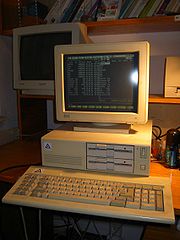 During the 1980s, while many households were buying their first computers, the dominant operating system
used by businesses was MS-DOS
running on IBM PC compatible
hardware. Impelled by increasing component standardization, such hardware dropped drastically in price towards the end of the decade, until systems with specs similar to the IBM PC XT were selling for under $1000 by 1988, when just under 20% of US households had a computer. These white box
PCs spelled the end for the microcomputer market as it had existed. Many consumers were now using DOS-based computers at work, and saw value in purchasing compatible systems for home use as well. The prior home computer
architectures from the likes of Commodore and Atari were abandoned in favor of "being compatible". Some pioneering models of low cost PCs intended for home use were the Leading Edge Model D
, Tandy 1000
and Epson Equity
series. Spurred on by low-cost powerful hardware, the advent of 3D graphics in games and the World Wide Web
, computer use would surge during the 1990s — by 1997 US computer ownership stood at 35% and household expenditure on computer equipment more than tripled The dozens of competing computer platforms and CPU architectures would be whittled down over the coming years until in 2010 the x86 architecture is the only one remaining in common use.
Microprocessor
A microprocessor incorporates the functions of a computer's central processing unit on a single integrated circuit, or at most a few integrated circuits. It is a multipurpose, programmable device that accepts digital data as input, processes it according to instructions stored in its memory, and...
-based computers from esoteric hobby projects to a commonplace fixture of homes in industrial societies. Prior to 1977, the only contact most of the population had with computers was through utility bills, bank and payroll services, or computer-generated
Mail merge
Mail merge is a software function which allows to create multiple documents from a single template form and a structured data source.-History:This technique of merging data to create gave rise to the term mail merge....
junk mail
Junk mail
Junk mail may refer to:* Junk Mail Publishing* Advertising mail* Spam , unsolicited electronic mail* Junk Mail * "The Junk Mail", an episode from the TV series Seinfeld...
. Within a decade, computers became common consumer goods.
The advent of affordable personal computers has had lasting impact on education, business, music, games, social interaction, and entertainment.
Microprocessor and cost reduction
Minicomputer
A minicomputer is a class of multi-user computers that lies in the middle range of the computing spectrum, in between the largest multi-user systems and the smallest single-user systems...
ancestors of the modern personal computer used early integrated circuit
Integrated circuit
An integrated circuit or monolithic integrated circuit is an electronic circuit manufactured by the patterned diffusion of trace elements into the surface of a thin substrate of semiconductor material...
(microchip) technology, which reduced size and cost, but they contained no microprocessor
Microprocessor
A microprocessor incorporates the functions of a computer's central processing unit on a single integrated circuit, or at most a few integrated circuits. It is a multipurpose, programmable device that accepts digital data as input, processes it according to instructions stored in its memory, and...
. This meant that they were still large and difficult to manufacture just like their mainframe
Mainframe computer
Mainframes are powerful computers used primarily by corporate and governmental organizations for critical applications, bulk data processing such as census, industry and consumer statistics, enterprise resource planning, and financial transaction processing.The term originally referred to the...
predecessors. After the "computer-on-a-chip" was commercialized, the cost to manufacture a computer system dropped dramatically. The arithmetic, logic, and control functions that previously occupied several costly circuit boards were now available in one integrated circuit, making it possible to produce them in high volume. Concurrently, advances in the development of solid state memory eliminated the bulky, costly, and power-hungry magnetic core memory
Magnetic core memory
Magnetic-core memory was the predominant form of random-access computer memory for 20 years . It uses tiny magnetic toroids , the cores, through which wires are threaded to write and read information. Each core represents one bit of information...
used in prior generations of computers.
After the 1972 introduction of the Intel 4004
Intel 4004
The Intel 4004 was a 4-bit central processing unit released by Intel Corporation in 1971. It was the first complete CPU on one chip, and also the first commercially available microprocessor...
, microprocessor costs declined rapidly. In 1974 the American electronics magazine Radio-Electronics
Radio-Electronics
Radio-Electronics was an American electronics magazine that was published under various titles from 1929 to 2003. Hugo Gernsback started it as Radio-Craft in July 1929. The title was changed to Radio-Electronics in October 1948 and again to Electronics Now in July 1992. In January 2000 it was...
described the Mark-8
Mark-8
The Mark-8 is a microcomputer design from 1974, based on the Intel 8008 CPU . The Mark-8 was designed by graduate student Jonathan Titus and announced as a 'loose kit' in the July 1974 issue of Radio-Electronics magazine.- Project kit :The Mark-8 was introduced as a 'build it yourself' project in...
computer kit, based on the Intel 8008
Intel 8008
The Intel 8008 was an early byte-oriented microprocessor designed and manufactured by Intel and introduced in April 1972. It was an 8-bit CPU with an external 14-bit address bus that could address 16KB of memory...
processor. In January of the following year, Popular Electronics
Popular Electronics
Popular Electronics was an American magazine started by Ziff-Davis Publishing in October 1954 for electronics hobbyists and experimenters. It soon became the "World's Largest-Selling Electronics Magazine". The circulation was 240,151 in April 1957 and 400,000 by 1963. Ziff-Davis published Popular...
magazine published an article describing a kit based on the Intel 8080
Intel 8080
The Intel 8080 was the second 8-bit microprocessor designed and manufactured by Intel and was released in April 1974. It was an extended and enhanced variant of the earlier 8008 design, although without binary compatibility...
, a somewhat more powerful and easier to use processor. The Altair 8800
Altair 8800
The MITS Altair 8800 was a microcomputer design from 1975 based on the Intel 8080 CPU and sold by mail order through advertisements in Popular Electronics, Radio-Electronics and other hobbyist magazines. The designers hoped to sell only a few hundred build-it-yourself kits to hobbyists, and were...
sold remarkably well even though initial memory size was limited to a few hundred bytes and there was no software available. However, the Altair kit was much less costly than an Intel development system of the time and so was purchased by hobbyists who formed users' group
Users' group
A users' group is a type of club focused on the use of a particular technology, usually computer-related....
s, notably the Homebrew Computer Club
Homebrew Computer Club
The Homebrew Computer Club was an early computer hobbyist users' group in Silicon Valley, which met from March 5, 1975 to December 1986...
, and companies interested in developing microprocessor control for their own products. Expansion memory boards and peripherals were soon listed by the original manufacturer, and later by plug-compatible manufacturers. The very first Microsoft
Microsoft
Microsoft Corporation is an American public multinational corporation headquartered in Redmond, Washington, USA that develops, manufactures, licenses, and supports a wide range of products and services predominantly related to computing through its various product divisions...
product was a 4 kilobyte paper tape BASIC
Altair BASIC
Altair BASIC was an interpreter for the BASIC programming language that ran on the MITS Altair 8800 and subsequent S-100 bus computers. It was Microsoft's first product , distributed by MITS under a contract...
interpreter, which allowed users to develop programs in a higher-level language. The alternative was to hand-assemble machine code
Machine code
Machine code or machine language is a system of impartible instructions executed directly by a computer's central processing unit. Each instruction performs a very specific task, typically either an operation on a unit of data Machine code or machine language is a system of impartible instructions...
that could be directly loaded into the microcomputer's memory using a front panel of toggle switches, pushbuttons and LED displays. While the hardware front panel
Front panel
A front panel was used on early electronic computers to display and allow the alteration of the state of the machine's internal registers and memory. The front panel usually consisted of arrays of indicator lamps, toggle switches, and push buttons mounted on a sheet metal face plate...
emulated those used by early mainframe and minicomputers, after a very short time interaction through a terminal was the preferred human/machine interface, and front panels became extinct.
The Home Computer "Revolution"
In the late 1970s and early 1980s, from about 1977 to 1983, it was widely predicted that computers would soon revolutionize many aspects of home and family life as they had business practices in the previous decades. Mothers would keep their recipe catalog in "kitchen computer" databases and turn to a medical database for help with child care, fathers would use the family's computer to manage family finances and track automobile maintenance. Children would use disk-based encyclopedias for school work and would be avid video gamers. Home automationHome automation
Home automation is the residential extension of "building automation". It is automation of the home, housework or household activity. Home automation may include centralized control of lighting, HVAC , appliances, and other systems, to provide improved convenience, comfort, energy efficiency and...
would bring about the intelligent home of the '80s. Using Videotex
Videotex
Videotex was one of the earliest implementations of an "end-user information system". From the late 1970s to mid-1980s, it was used to deliver information to a user in computer-like format, typically to be displayed on a television.In a strict definition, videotex refers to systems that provide...
, NAPLPS
NAPLPS
NAPLPS is a graphics language for use originally with videotex and teletext services. NAPLPS was developed from the Telidon system developed in Canada, with a small number of additions from AT&T...
or some sort of as-yet unrealized computer technology, television would gain interactivity. The personalized newspaper was a commonly-predicted application. Morning coffee would be brewed automatically under computer control. The same computer would control the house lighting and temperature. Robot
Robot
A robot is a mechanical or virtual intelligent agent that can perform tasks automatically or with guidance, typically by remote control. In practice a robot is usually an electro-mechanical machine that is guided by computer and electronic programming. Robots can be autonomous, semi-autonomous or...
s would take the garbage out, and be programmable to perform new tasks by the home computer. Electronics were expensive, so it was generally assumed that each home would have only one multitasking
Computer multitasking
In computing, multitasking is a method where multiple tasks, also known as processes, share common processing resources such as a CPU. In the case of a computer with a single CPU, only one task is said to be running at any point in time, meaning that the CPU is actively executing instructions for...
computer for the entire family to use in a timesharing arrangement, with interfaces to the various devices it was expected to control.
All this was predicted to be commonplace sometime before the end of the decade, but virtually every aspect of the predicted revolution would be delayed or prove entirely impractical. The computers available to consumers of the time period just weren't powerful enough to perform any single task required to realize this vision, much less do them all simultaneously. The home computers of the early 1980s could not multitask. Even if they could, memory capacities were too small to hold entire databases or financial records, floppy disk-based storage was inadequate in both capacity and speed for multimedia work, and the graphics of the systems could only display blocky, unrealistic images and blurry, jagged text. Before long, a backlash set in—computer users were "geeks", "nerd
Nerd
Nerd is a derogatory slang term for an intelligent but socially awkward and obsessive person who spends time on unpopular or obscure pursuits, to the exclusion of more mainstream activities. Nerds are considered to be awkward, shy, and unattractive...
s" or worse, "hackers". The North American video game crash of 1983 soured many on home computer technology. The computers that were purchased for use in the family room were either forgotten in closets or relegated to basements and children's bedrooms to be used exclusively for games and the occasional book report. In 1977, referring to computers used in home automation at the dawn of the home computer era, Digital Equipment Corporation
Digital Equipment Corporation
Digital Equipment Corporation was a major American company in the computer industry and a leading vendor of computer systems, software and peripherals from the 1960s to the 1990s...
CEO Ken Olsen
Ken Olsen
Kenneth Harry Olsen was an American engineer who co-founded Digital Equipment Corporation in 1957 with colleague Harlan Anderson.-Background:...
is quoted as saying "There is no reason for any individual to have a computer in his home"
It took another 10 years for technology to mature, for the graphical user interface
Graphical user interface
In computing, a graphical user interface is a type of user interface that allows users to interact with electronic devices with images rather than text commands. GUIs can be used in computers, hand-held devices such as MP3 players, portable media players or gaming devices, household appliances and...
to make the computer approachable for non-technical users, and for the internet
Internet
The Internet is a global system of interconnected computer networks that use the standard Internet protocol suite to serve billions of users worldwide...
to provide a compelling reason for most people to want a computer in their homes. Predicted aspects of the revolution were left by the wayside or modified in the face of an emerging reality. The cost of electronics dropped precipitously and today many families have a computer for each family member, or a laptop for mom's active lifestyle, a desktop for dad with the kids sharing a computer. Encyclopedias, recipe catalogs and medical databases are kept online and accessed over the world wide web
World Wide Web
The World Wide Web is a system of interlinked hypertext documents accessed via the Internet...
not stored locally on floppy disks or CD-ROM. TV has yet to gain substantial interactivity; instead, the web has evolved alongside television, but the HTPC and internet video sites such as YouTube
YouTube
YouTube is a video-sharing website, created by three former PayPal employees in February 2005, on which users can upload, view and share videos....
, Netflix
Netflix
Netflix, Inc., is an American provider of on-demand internet streaming media in the United States, Canada, and Latin America and flat rate DVD-by-mail in the United States. The company was established in 1997 and is headquartered in Los Gatos, California...
and Hulu
Hulu
Hulu is a website and over-the-top subscription service offering ad-supported on-demand streaming video of TV shows, movies, webisodes and other new media, trailers, clips, and behind-the-scenes footage from NBC, Fox, ABC, and Obstacle on October 20th 2011 Nickelodeon and CBS and many other...
may one day replace traditional broadcast and cable television
Cable television
Cable television is a system of providing television programs to consumers via radio frequency signals transmitted to televisions through coaxial cables or digital light pulses through fixed optical fibers located on the subscriber's property, much like the over-the-air method used in traditional...
. Our coffee may be brewed automatically every morning, but the computer is a simple one embedded in the coffee maker, not under external control. As of 2008, robots are just beginning to make an impact in the home, with Roomba
Roomba
The Roomba is a series of autonomous robotic vacuum cleaners sold by iRobot. Under normal operating conditions, it is able to navigate a living space and common obstacles while vacuuming the floor...
and Aibo
AIBO
AIBO was one of several types of robotic pets designed and manufactured by Sony...
leading the charge.
This delay wasn't out of keeping with other technologies newly introduced to an unprepared public. Early motorists were widely derided with the cry of "Get a horse!" until the automobile
Automobile
An automobile, autocar, motor car or car is a wheeled motor vehicle used for transporting passengers, which also carries its own engine or motor...
was accepted. Television
History of television
The history of television records the work of numerous engineers and inventors in several countries over many decades. The fundamental principles of television were initially explored using electromechanical methods to scan, transmit and reproduce an image...
languished in research labs for decades before regular public broadcasts began. In an example of changing applications for technology, before the invention of radio, the telephone was used to distribute opera and news reports, whose subscribers were denounced as "illiterate, blind, bedridden and incurably lazy people". Likewise, the acceptance of computers into daily life today is a product of continuing refinement of both technology and perception.
End of the revolution
Operating system
An operating system is a set of programs that manage computer hardware resources and provide common services for application software. The operating system is the most important type of system software in a computer system...
used by businesses was MS-DOS
MS-DOS
MS-DOS is an operating system for x86-based personal computers. It was the most commonly used member of the DOS family of operating systems, and was the main operating system for IBM PC compatible personal computers during the 1980s to the mid 1990s, until it was gradually superseded by operating...
running on IBM PC compatible
IBM PC compatible
IBM PC compatible computers are those generally similar to the original IBM PC, XT, and AT. Such computers used to be referred to as PC clones, or IBM clones since they almost exactly duplicated all the significant features of the PC architecture, facilitated by various manufacturers' ability to...
hardware. Impelled by increasing component standardization, such hardware dropped drastically in price towards the end of the decade, until systems with specs similar to the IBM PC XT were selling for under $1000 by 1988, when just under 20% of US households had a computer. These white box
White box (computer hardware)
In computer hardware, a white box is a personal computer or server without a registered brand name. For instance, the term is applied to systems assembled by small system integrators and to homebuilt computer systems assembled by end users from parts purchased separately at retail. In this latter...
PCs spelled the end for the microcomputer market as it had existed. Many consumers were now using DOS-based computers at work, and saw value in purchasing compatible systems for home use as well. The prior home computer
Home computer
Home computers were a class of microcomputers entering the market in 1977, and becoming increasingly common during the 1980s. They were marketed to consumers as affordable and accessible computers that, for the first time, were intended for the use of a single nontechnical user...
architectures from the likes of Commodore and Atari were abandoned in favor of "being compatible". Some pioneering models of low cost PCs intended for home use were the Leading Edge Model D
Leading Edge Model D
The Leading Edge Model D was an IBM clone computer first released by Leading Edge Hardware in July 1985. It was initially priced at $1,495 configured with dual 5.25" floppy drives, 256 KB of RAM, and a monochrome monitor. It was manufactured by South Korean conglomerate Daewoo and distributed by...
, Tandy 1000
Tandy 1000
The Tandy 1000 was the first in a line of more-or-less IBM PC compatible home computer systems produced by the Tandy Corporation for sale in its Radio Shack chain of stores.-Overview:...
and Epson Equity
Epson Equity
The Epson Equity series of IBM Compatible Personal Computers was manufactured from 1985 until the early '90s by Epson Inc. Epson was well known for its dot matrix printers at the time and the Equity series represents their entry into the growing PC compatible market...
series. Spurred on by low-cost powerful hardware, the advent of 3D graphics in games and the World Wide Web
World Wide Web
The World Wide Web is a system of interlinked hypertext documents accessed via the Internet...
, computer use would surge during the 1990s — by 1997 US computer ownership stood at 35% and household expenditure on computer equipment more than tripled The dozens of competing computer platforms and CPU architectures would be whittled down over the coming years until in 2010 the x86 architecture is the only one remaining in common use.
See also
- History of personal computersHistory of personal computersThe history of personal computers began in the 1970s. A personal computer is one intended for individual use, as opposed to a mainframe computer where the end user's requests are filtered through operating staff, or a time sharing system in which one large processor is shared by many individuals...
- BASICBASICBASIC is a family of general-purpose, high-level programming languages whose design philosophy emphasizes ease of use - the name is an acronym from Beginner's All-purpose Symbolic Instruction Code....
- Computer literacyComputer literacyComputer literacy is defined as the knowledge and ability to use computers and related technology efficiently, with a range of skills covering levels from elementary use to programming and advanced problem solving. Computer literacy can also refer to the comfort level someone has with using...
- People's Computer CompanyPeople's Computer CompanyPeople's Computer Company was an organization, a newsletter and, later, a quasiperiodical called the "dragonsmoke." PCC was founded and produced by Bob Albrecht & George Firedrake in Menlo Park, California in the early 1970s.The first newsletter announced itself with the following...
- The Mother of All DemosThe Mother of All DemosThe Mother of All Demos is a name given to Douglas Engelbart's December 9, 1968, demonstration of experimental computer technologies that are now commonplace...
- Computer LibComputer LibComputer Lib is a book by Ted Nelson, originally published in 1974 by Nelson himself, and packaged with Dream Machines, another book by Nelson...
- MicrosoftMicrosoftMicrosoft Corporation is an American public multinational corporation headquartered in Redmond, Washington, USA that develops, manufactures, licenses, and supports a wide range of products and services predominantly related to computing through its various product divisions...
- Open Letter to HobbyistsOpen Letter to HobbyistsThe Open Letter to Hobbyists was an open letter written by Bill Gates, the co-founder of Microsoft, to early personal computer hobbyists, in which Gates expresses dismay at the rampant copyright infringement taking place in the hobbyist community, particularly with regard to his company's...
- Home computerHome computerHome computers were a class of microcomputers entering the market in 1977, and becoming increasingly common during the 1980s. They were marketed to consumers as affordable and accessible computers that, for the first time, were intended for the use of a single nontechnical user...
- Apple IIApple IIThe Apple II is an 8-bit home computer, one of the first highly successful mass-produced microcomputer products, designed primarily by Steve Wozniak, manufactured by Apple Computer and introduced in 1977...
- Commodore PETCommodore PETThe Commodore PET was a home/personal computer produced from 1977 by Commodore International...
- TRS 80
- HypertextHypertextHypertext is text displayed on a computer or other electronic device with references to other text that the reader can immediately access, usually by a mouse click or keypress sequence. Apart from running text, hypertext may contain tables, images and other presentational devices. Hypertext is the...