


Alaric II

Encyclopedia
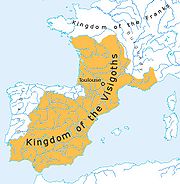
Alaric II, also known as Alarik, Alarich, and Alarico in Spanish
and Portuguese
or Alaricus in Latin
(d. 507) succeeded his father Euric
on December 28, 484, in Toulouse. He established his capital at Aire-sur-l'Adour
(Vicus Julii) in Aquitaine
. His dominions included not only the whole of Hispania
except its north-western corner but also Gallia Aquitania
and the greater part of an as-yet undivided Gallia Narbonensis
.
and the downfall of the Toulosan kingdom." One example is Isidore of Seville
's account of Alaric's reign: consisting of a single paragraph, it is primarily about Alaric's death in that battle.
The earliest documented event in Alaric's reign concerned providing refuge to Syagrius
, the former ruler of the Domain of Soissons
(in what is now north western France) who had been defeated by Clovis I
King of the Franks. According to Gregory of Tours
' account, Alaric was intimidated by Clovis into surrendering Syagrius to Clovis; Gregory then adds that "the Goths are a timorous race." The Franks then imprisoned Syagrius, and once his control over Syagrius' former kingdom was secure Clovis had him beheaded. However, Wolfram points out that at the time "Clovis got no farther than the Seine; only after several more years did the Franks succeed in occupying the rest of the Gallo-Roman buffer state north of the Loire
." Any threat of war Clovis could make would only be effective if they were neighbors; "it is nowhere written that Syagrius was handed over in 486 or 487."
Despite Frankish advances in the years that followed, Alaric was not afraid to take the military initiative when it presented itself. In 490, Alaric assisted his fellow Gothic king, Theodoric the Great
, in his conquest of Italy by dispatching an army to raise Odoacer
's siege of Pavia, where Theodoric had been trapped. Then when the Franks attacked the Burgundians
in the decade after 500, Alaric assisted the ruling house, and according to Wolfram the victorious Burgundian king Gundobad
ceded Avignon
to Alaric. By 502 Clovis and Alaric met on an island in the Loire near Amboise
for face-to-face talks, which led to a peace treaty.
In 506, the Visigoths captured the city of Dertosa in the Ebro valley. There they captured the Roman usurper
Peter
and had him executed.
 After a few years, however, Clovis violated the peace treaty negotiated in 502. Despite the diplomatic intervention of Theodoric
, king of the Ostrogoths and father-in-law of Alaric, Clovis led his followers into Visigothic territory. Alaric was forced by his magnates to meet Clovis in the Battle of Vouillé
(Summer 507) near Poitiers; there the Goths were defeated and Alaric slain, according to Gregory of Tours, by Clovis himself.
The most serious consequence of this battle was not the loss of their possessions in Gaul
to the Franks; with Ostrogothic help, much of the Gallic territory was recovered, Herwig Wolfram notes, perhaps as far as Toulouse
. Nor was it the loss of the royal treasury at Toulouse, which Gregory of Tours writes Clovis took into his possession. As Peter Heather notes, the Visigothic kingdom was thrown into disarray "by the death of its king in battle." Alaric's heirs were his eldest son, the illegitimate Gesalec
, and his younger son, the legitimate Amalaric
who was still a child. Gesalec proved incompetent, and in 511 king Theodoric assumed the throne of the kingdom ostensibly on behalf of Amalaric -- Heather uses the word "hijacked" to describe his action. Although Amalaric eventually became king in his own right, the political continuity of the Visigothic kingdom was broken; "Amalaric's succession was the result of new power structures, not old ones," as Heather describes it. And with Amalaric's death in 531, the Visigothic kingdom entered an extended period of unrest which lasted until Leovigild assumed the throne in 568.
, like all the early Visigothic nobles, but he greatly mitigated the persecution policy of his father Euric toward the Catholics
and authorized them to hold in 506 the council of Agde
. He was on uneasy terms with the Catholic bishops of Arelate (modern Arles) as epitomized in the career of the Frankish Caesarius, bishop of Arles, who was appointed bishop in 503. Caesarius was suspected of conspiring with the Burgundians
, whose king had married the sister of Clovis, to assist the Burgundians capture Arles. Alaric exiled him for a year to Bordeaux
in Aquitania, then allowed him to return unharmed when the crisis had passed.
Alaric displayed similar wisdom in political affairs by appointing a commission to prepare an abstract of the Roman laws and imperial decrees, which would form the authoritative code for his Roman subjects. This is generally known as the Breviarium Alaricianum or Breviary of Alaric
.
Spanish language
Spanish , also known as Castilian , is a Romance language in the Ibero-Romance group that evolved from several languages and dialects in central-northern Iberia around the 9th century and gradually spread with the expansion of the Kingdom of Castile into central and southern Iberia during the...
and Portuguese
Portuguese language
Portuguese is a Romance language that arose in the medieval Kingdom of Galicia, nowadays Galicia and Northern Portugal. The southern part of the Kingdom of Galicia became independent as the County of Portugal in 1095...
or Alaricus in Latin
Latin
Latin is an Italic language originally spoken in Latium and Ancient Rome. It, along with most European languages, is a descendant of the ancient Proto-Indo-European language. Although it is considered a dead language, a number of scholars and members of the Christian clergy speak it fluently, and...
(d. 507) succeeded his father Euric
Euric
Euric, also known as Evaric, Erwig, or Eurico in Spanish and Portuguese , Son of Theodoric I and the younger brother of Theodoric II and ruled as king of the Visigoths, with his capital at Toulouse, from 466 until his death in 484.He inherited a large portion of the Visigothic possessions in the...
on December 28, 484, in Toulouse. He established his capital at Aire-sur-l'Adour
Aire-sur-l'Adour
Aire-sur-l'Adour is a commune in the Landes département in Aquitaine in south-western France.It lies on the river Adour in the wine area of southwest France. It is an episcopal see of the Diocese of Aire and Dax. The nearest large towns are Mont-de-Marsan to the north and Pau to the...
(Vicus Julii) in Aquitaine
Aquitaine
Aquitaine , archaic Guyenne/Guienne , is one of the 27 regions of France, in the south-western part of metropolitan France, along the Atlantic Ocean and the Pyrenees mountain range on the border with Spain. It comprises the 5 departments of Dordogne, :Lot et Garonne, :Pyrénées-Atlantiques, Landes...
. His dominions included not only the whole of Hispania
Hispania
Another theory holds that the name derives from Ezpanna, the Basque word for "border" or "edge", thus meaning the farthest area or place. Isidore of Sevilla considered Hispania derived from Hispalis....
except its north-western corner but also Gallia Aquitania
Gallia Aquitania
Gallia Aquitania was a province of the Roman Empire, bordered by the provinces of Gallia Lugdunensis, Gallia Narbonensis, and Hispania Tarraconensis...
and the greater part of an as-yet undivided Gallia Narbonensis
Gallia Narbonensis
Gallia Narbonensis was a Roman province located in what is now Languedoc and Provence, in southern France. It was also known as Gallia Transalpina , which was originally a designation for that part of Gaul lying across the Alps from Italia and it contained a western region known as Septimania...
.
Reign
Herwig Wolfram opens his chapter on the eighth Visigothic king, "Alaric's reign gets no full treatment in the sources, and the little they do contain is overshadowed by his death in the Battle of VouilléBattle of Vouillé
The Battle of Vouillé or Vouglé was fought in the northern marches of Visigothic territory, at Vouillé, Vienne near Poitiers , in the spring of 507 between the Franks commanded by Clovis and the Visigoths of Alaric II, the conqueror of Spain.Clovis and Anastasius I of the Byzantine Empire agreed...
and the downfall of the Toulosan kingdom." One example is Isidore of Seville
Isidore of Seville
Saint Isidore of Seville served as Archbishop of Seville for more than three decades and is considered, as the historian Montalembert put it in an oft-quoted phrase, "le dernier savant du monde ancien"...
's account of Alaric's reign: consisting of a single paragraph, it is primarily about Alaric's death in that battle.
The earliest documented event in Alaric's reign concerned providing refuge to Syagrius
Syagrius
Syagrius was the last Roman official in Gaul, whose defeat by king Clovis I of the Franks is considered the end of Roman rule outside of Italy. He came to this position through inheritance, for his father was Aegidius, the last Roman magister militum per Gallias...
, the former ruler of the Domain of Soissons
Domain of Soissons
The Domain of Soissons, by later writers called the Kingdom of Soissons, Kingdom of Aegidius or the Kingdom of Syagrius, was a rump state of the Western Roman Empire in northern Gaul for some 25 years during Late Antiquity....
(in what is now north western France) who had been defeated by Clovis I
Clovis I
Clovis Leuthwig was the first King of the Franks to unite all the Frankish tribes under one ruler, changing the leadership from a group of royal chieftains, to rule by kings, ensuring that the kingship was held by his heirs. He was also the first Catholic King to rule over Gaul . He was the son...
King of the Franks. According to Gregory of Tours
Gregory of Tours
Saint Gregory of Tours was a Gallo-Roman historian and Bishop of Tours, which made him a leading prelate of Gaul. He was born Georgius Florentius, later adding the name Gregorius in honour of his maternal great-grandfather...
' account, Alaric was intimidated by Clovis into surrendering Syagrius to Clovis; Gregory then adds that "the Goths are a timorous race." The Franks then imprisoned Syagrius, and once his control over Syagrius' former kingdom was secure Clovis had him beheaded. However, Wolfram points out that at the time "Clovis got no farther than the Seine; only after several more years did the Franks succeed in occupying the rest of the Gallo-Roman buffer state north of the Loire
Loire
Loire is an administrative department in the east-central part of France occupying the River Loire's upper reaches.-History:Loire was created in 1793 when after just 3½ years the young Rhône-et-Loire department was split into two. This was a response to counter-Revolutionary activities in Lyon...
." Any threat of war Clovis could make would only be effective if they were neighbors; "it is nowhere written that Syagrius was handed over in 486 or 487."
Despite Frankish advances in the years that followed, Alaric was not afraid to take the military initiative when it presented itself. In 490, Alaric assisted his fellow Gothic king, Theodoric the Great
Theodoric the Great
Theodoric the Great was king of the Ostrogoths , ruler of Italy , regent of the Visigoths , and a viceroy of the Eastern Roman Empire...
, in his conquest of Italy by dispatching an army to raise Odoacer
Odoacer
Flavius Odoacer , also known as Flavius Odovacer, was the first King of Italy. His reign is commonly seen as marking the end of the Western Roman Empire. Though the real power in Italy was in his hands, he represented himself as the client of Julius Nepos and, after Nepos' death in 480, of the...
's siege of Pavia, where Theodoric had been trapped. Then when the Franks attacked the Burgundians
Burgundians
The Burgundians were an East Germanic tribe which may have emigrated from mainland Scandinavia to the island of Bornholm, whose old form in Old Norse still was Burgundarholmr , and from there to mainland Europe...
in the decade after 500, Alaric assisted the ruling house, and according to Wolfram the victorious Burgundian king Gundobad
Gundobad
Gundobad was King of the Burgundians , succeeding his father Gundioc of Burgundy. Previous to this, he had been a Patrician of the Western Roman Empire in 472–473, succeeding his uncle Ricimer.- Early life :...
ceded Avignon
Avignon
Avignon is a French commune in southeastern France in the départment of the Vaucluse bordered by the left bank of the Rhône river. Of the 94,787 inhabitants of the city on 1 January 2010, 12 000 live in the ancient town centre surrounded by its medieval ramparts.Often referred to as the...
to Alaric. By 502 Clovis and Alaric met on an island in the Loire near Amboise
Amboise
Amboise is a commune in the Indre-et-Loire department in central France. It lies on the banks of the Loire River, east of Tours. Today a small market town, it was once home of the French royal court...
for face-to-face talks, which led to a peace treaty.
In 506, the Visigoths captured the city of Dertosa in the Ebro valley. There they captured the Roman usurper
Roman usurper
Usurpers are individuals or groups of individuals who obtain and maintain the power or rights of another by force and without legal authority. Usurpation was endemic during roman imperial era, especially from the crisis of the third century onwards, when political instability became the rule.The...
Peter
Peter (usurper)
Peter was a Roman usurper of the early sixth century, recorded in two minor sources: the Consularia Caesaraugustana and the Victoris Tunnunnensis Chronicon. He was a "tyrant" against the Visigothic rulers of Spain. When the Visigoths captured the city of Dertosa in 506, he was arrested and...
and had him executed.
Battle of Vouillé and aftermath
Theodoric the Great
Theodoric the Great was king of the Ostrogoths , ruler of Italy , regent of the Visigoths , and a viceroy of the Eastern Roman Empire...
, king of the Ostrogoths and father-in-law of Alaric, Clovis led his followers into Visigothic territory. Alaric was forced by his magnates to meet Clovis in the Battle of Vouillé
Battle of Vouillé
The Battle of Vouillé or Vouglé was fought in the northern marches of Visigothic territory, at Vouillé, Vienne near Poitiers , in the spring of 507 between the Franks commanded by Clovis and the Visigoths of Alaric II, the conqueror of Spain.Clovis and Anastasius I of the Byzantine Empire agreed...
(Summer 507) near Poitiers; there the Goths were defeated and Alaric slain, according to Gregory of Tours, by Clovis himself.
The most serious consequence of this battle was not the loss of their possessions in Gaul
Gaul
Gaul was a region of Western Europe during the Iron Age and Roman era, encompassing present day France, Luxembourg and Belgium, most of Switzerland, the western part of Northern Italy, as well as the parts of the Netherlands and Germany on the left bank of the Rhine. The Gauls were the speakers of...
to the Franks; with Ostrogothic help, much of the Gallic territory was recovered, Herwig Wolfram notes, perhaps as far as Toulouse
Toulouse
Toulouse is a city in the Haute-Garonne department in southwestern FranceIt lies on the banks of the River Garonne, 590 km away from Paris and half-way between the Atlantic Ocean and the Mediterranean Sea...
. Nor was it the loss of the royal treasury at Toulouse, which Gregory of Tours writes Clovis took into his possession. As Peter Heather notes, the Visigothic kingdom was thrown into disarray "by the death of its king in battle." Alaric's heirs were his eldest son, the illegitimate Gesalec
Gesalec
Gesalic was a king of the Visigoths from 507 to 511, and died in 513. Although the illegitimate son of Alaric II. He had been elected king by the Visigoths after Alaric had been killed in battle by the Franks...
, and his younger son, the legitimate Amalaric
Amalaric
Amalaric, or in Spanish and Portuguese, Amalarico, was king of the Visigoths from 526 until his assassination in 531. He was a son of king Alaric II and his first wife Theodegotho, daughter of Theodoric the Great....
who was still a child. Gesalec proved incompetent, and in 511 king Theodoric assumed the throne of the kingdom ostensibly on behalf of Amalaric -- Heather uses the word "hijacked" to describe his action. Although Amalaric eventually became king in his own right, the political continuity of the Visigothic kingdom was broken; "Amalaric's succession was the result of new power structures, not old ones," as Heather describes it. And with Amalaric's death in 531, the Visigothic kingdom entered an extended period of unrest which lasted until Leovigild assumed the throne in 568.
His ability as a king
In religion Alaric was an ArianArianism
Arianism is the theological teaching attributed to Arius , a Christian presbyter from Alexandria, Egypt, concerning the relationship of the entities of the Trinity and the precise nature of the Son of God as being a subordinate entity to God the Father...
, like all the early Visigothic nobles, but he greatly mitigated the persecution policy of his father Euric toward the Catholics
Catholicism
Catholicism is a broad term for the body of the Catholic faith, its theologies and doctrines, its liturgical, ethical, spiritual, and behavioral characteristics, as well as a religious people as a whole....
and authorized them to hold in 506 the council of Agde
Agde
Agde is a commune in the Hérault department in southern France. It is the Mediterranean port of the Canal du Midi.-Location:Agde is located on the river Hérault, 4 km from the Mediterranean Sea, and 750 km from Paris...
. He was on uneasy terms with the Catholic bishops of Arelate (modern Arles) as epitomized in the career of the Frankish Caesarius, bishop of Arles, who was appointed bishop in 503. Caesarius was suspected of conspiring with the Burgundians
Burgundians
The Burgundians were an East Germanic tribe which may have emigrated from mainland Scandinavia to the island of Bornholm, whose old form in Old Norse still was Burgundarholmr , and from there to mainland Europe...
, whose king had married the sister of Clovis, to assist the Burgundians capture Arles. Alaric exiled him for a year to Bordeaux
Bordeaux
Bordeaux is a port city on the Garonne River in the Gironde department in southwestern France.The Bordeaux-Arcachon-Libourne metropolitan area, has a population of 1,010,000 and constitutes the sixth-largest urban area in France. It is the capital of the Aquitaine region, as well as the prefecture...
in Aquitania, then allowed him to return unharmed when the crisis had passed.
Alaric displayed similar wisdom in political affairs by appointing a commission to prepare an abstract of the Roman laws and imperial decrees, which would form the authoritative code for his Roman subjects. This is generally known as the Breviarium Alaricianum or Breviary of Alaric
Breviary of Alaric
The Breviary of Alaric is a collection of Roman law, compiled by order of Alaric II, King of the Visigoths, with the advice of his bishops and nobles. It was promulgated on February 2, year 506, the twenty-second year of his reign...
.
Further reading
- Edward Gibbon, History of the Decline and Fall of the Roman Empire Chapter 38