

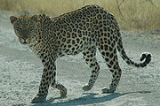
African Leopard

Encyclopedia
The African Leopard is a leopard
subspecies occurring across most of sub-Saharan Africa
. In 2008, the IUCN classified leopards as Near Threatened
, stating that they may soon qualify for the Vulnerable
status due to habitat loss and fragmentation. They are becoming increasingly rare outside protected areas. The trend of the population is decreasing.
Between 1996 and 2000, 11 adult leopards were radio-collared on Namibia
n farmlands. Males weighed 37.5 to 52.3 kg (82.7 to 115.3 lb) only, and females 24 to 33.5 kg (52.9 to 73.9 lb).
Leopards inhabiting the mountains of the Cape Province
s appear physically different from leopards further north. Their average weight may be only half that of the more northerly leopard.
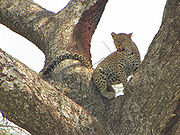 African leopards used to occur in most of sub-Saharan Africa
, occupying both rainforest
and arid desert
habitats. They were found in all habitats with annual rainfall above 50 mm (2 in), and can penetrate areas with less than this amount of rainfall along river courses. They range exceptionally up to 5700 m (18,700.8 ft), have been sighted on high slopes of the Ruwenzori and Virunga
volcanoes, and observed when drinking thermal water 37 °C (98.6 °F) in the Virunga National Park
.
They appear to be successful at adapting to altered natural habitat and settled environments in the absence of intense persecution. There were many records of their presence near major cities. But already in the 1980s, they have become rare throughout much of West Africa
. Now, they remain patchily distributed within historical limits.
In North Africa
, a tiny relict population persists in the Atlas Mountains
of Morocco
.
African leopards inhabited a wide range of habitats within Africa
, from mountainous forests to grasslands and savannahs, excluding only extremely sandy desert. They are most at risk in areas of semi-desert, where scarce resources often result in conflict with nomadic farmers and their livestock.
, male leopards and female leopards with cubs were relatively more active at night than solitary females. The highest rates of daytime activity were recorded for leopards using thorn thickets during the wet season, when impala also used them.
They have an exceptional ability to adapt to changes in prey availability, and have a very broad diet. Small prey are taken where large ungulate
s are less common. The known prey of leopards ranges from dung beetles to adult elands, which can reach 900 kg (1,984.2 lb). In sub-Saharan Africa, at least 92 prey species have been documented in their diet including rodents, birds, small and large antelopes, hyrax
es and hare
s, and arthropod
s. They generally focus their hunting activity on locally abundant medium-sized ungulate species in the 20 to 80 kg (44.1 to 176.4 lb) range, while opportunistically taking other prey. Average intervals between ungulate kills range from seven to 12–13 days.
In the Serengeti National Park
, leopards were radio-collared for the first time in the early 1970s. Their hunting at night was difficult to watch; the best time for observing them was after dawn. Of their 64 daytime hunts only three were successful. In this woodland area, they preyed mostly on impala
, both adult and young, and caught some Thomson's gazelles
in the dry season. Occasionally, they successfully hunted warthog
, dik-dik
, reedbuck
, duiker
, steenbok
, wildebeest
and topi
calves, jackal
, hare
, guinea fowl and starling
. They were less successful in hunting zebra
s, kongoni
s, giraffe
s, mongoose
s, genet
s, hyrax
and small birds. Scavenging from the carcasses of large animals made up a small proportion of their food. In tropical rainforest
in Central Africa
, their diet consists of duiker
s and small primate
s. Some individual leopards have shown a strong preference for pangolin
s and porcupine
s.
Leopards often cache large kills in trees, a behavior for which great strength is required. There have been several observations of leopards hauling carcasses of young giraffe
, estimated to weigh up to 125 kg (275.6 lb), i.e. 2–3 times the weight of the leopard, up to 5.7 m (18.7 ft) into trees.
Their diet includes reptiles, and they will occasionally take domestic livestock
when other food is scarce. Leopards are very stealthy and like to stalk close and run a relatively short distance after their prey. They kill through suffocation by grabbing their prey by the throat and biting down with their powerful jaws. They rarely fight other predators for their food.
The impact of trophy hunting
on populations is unclear, but may have impacts at the demographic and population level, especially when females are shot. In Tanzania
, only males are allowed to be hunted, but females comprised 28.6% of 77 trophies shot between 1995 and 1998. Removing an excessively high number of males may produce a cascade of deleterious effects on the population. Although male leopards provide no parental care to cubs, the presence of the sire allows mothers to raise cubs with a reduced risk of infanticide by foreign males. There are few reliable observations of infanticide in leopards but new males entering the population are likely to kill existing cubs.
Analysis of leopard scats and camera trap
ping surveys in contiguous forest landscapes in the Congo Basin
revealed a high dietary niche overlap and an exploitative competition between leopards and bushmeat
hunters. With increasing proximity to settlements and concomitant human hunting pressure, leopards exploit smaller prey and occur at considerably reduced population densities. In the presence of intensive bushmeat hunting surrounding human settlements, leopards appear entirely absent.
Leopard
The leopard , Panthera pardus, is a member of the Felidae family and the smallest of the four "big cats" in the genus Panthera, the other three being the tiger, lion, and jaguar. The leopard was once distributed across eastern and southern Asia and Africa, from Siberia to South Africa, but its...
subspecies occurring across most of sub-Saharan Africa
Sub-Saharan Africa
Sub-Saharan Africa as a geographical term refers to the area of the African continent which lies south of the Sahara. A political definition of Sub-Saharan Africa, instead, covers all African countries which are fully or partially located south of the Sahara...
. In 2008, the IUCN classified leopards as Near Threatened
Near Threatened
Near Threatened is a conservation status assigned to species or lower taxa that may be considered threatened with extinction in the near future, although it does not currently qualify for the threatened status...
, stating that they may soon qualify for the Vulnerable
Vulnerable species
On 30 January 2010, the IUCN Red List of Threatened Species identified 9694 Vulnerable species, subspecies and varieties, stocks and sub-populations.-References:...
status due to habitat loss and fragmentation. They are becoming increasingly rare outside protected areas. The trend of the population is decreasing.
Characteristics
African leopards exhibit great variation in coat color, depending on location and habitat. Coat color varies from pale yellow to deep gold or tawny, and is patterned with black rosettes while the head, lower limbs and belly are spotted with solid black. Male leopards are larger, averaging 60 kg (132.3 lb) with 91 kg (200.6 lb) being the maximum weight attained by a male. Females weigh about 35 to 40 kg (77.2 to 88.2 lb) in average.Between 1996 and 2000, 11 adult leopards were radio-collared on Namibia
Namibia
Namibia, officially the Republic of Namibia , is a country in southern Africa whose western border is the Atlantic Ocean. It shares land borders with Angola and Zambia to the north, Botswana to the east and South Africa to the south and east. It gained independence from South Africa on 21 March...
n farmlands. Males weighed 37.5 to 52.3 kg (82.7 to 115.3 lb) only, and females 24 to 33.5 kg (52.9 to 73.9 lb).
Leopards inhabiting the mountains of the Cape Province
Cape Province
The Province of the Cape of Good Hope was a province in the Union of South Africa and subsequently the Republic of South Africa...
s appear physically different from leopards further north. Their average weight may be only half that of the more northerly leopard.
Distribution and habitat
Sub-Saharan Africa
Sub-Saharan Africa as a geographical term refers to the area of the African continent which lies south of the Sahara. A political definition of Sub-Saharan Africa, instead, covers all African countries which are fully or partially located south of the Sahara...
, occupying both rainforest
Rainforest
Rainforests are forests characterized by high rainfall, with definitions based on a minimum normal annual rainfall of 1750-2000 mm...
and arid desert
Desert
A desert is a landscape or region that receives an extremely low amount of precipitation, less than enough to support growth of most plants. Most deserts have an average annual precipitation of less than...
habitats. They were found in all habitats with annual rainfall above 50 mm (2 in), and can penetrate areas with less than this amount of rainfall along river courses. They range exceptionally up to 5700 m (18,700.8 ft), have been sighted on high slopes of the Ruwenzori and Virunga
Virunga Mountains
The Virunga Mountains are a chain of volcanoes in East Africa, along the northern border of Rwanda, the Democratic Republic of the Congo and Uganda. The mountain range is a branch of the Albertine Rift, a part of the Great Rift Valley. They are located between Lake Edward and Lake Kivu...
volcanoes, and observed when drinking thermal water 37 °C (98.6 °F) in the Virunga National Park
Virunga National Park
The Virunga National Park , formerly named Albert National Park, is a 7800 square km National Park that stretches from the Virunga Mountains in the South, to the Rwenzori Mountains in the North, in the eastern Democratic Republic of Congo, bordering Volcanoes National Park in Rwanda and Rwenzori...
.
They appear to be successful at adapting to altered natural habitat and settled environments in the absence of intense persecution. There were many records of their presence near major cities. But already in the 1980s, they have become rare throughout much of West Africa
West Africa
West Africa or Western Africa is the westernmost region of the African continent. Geopolitically, the UN definition of Western Africa includes the following 16 countries and an area of approximately 5 million square km:-Flags of West Africa:...
. Now, they remain patchily distributed within historical limits.
In North Africa
North Africa
North Africa or Northern Africa is the northernmost region of the African continent, linked by the Sahara to Sub-Saharan Africa. Geopolitically, the United Nations definition of Northern Africa includes eight countries or territories; Algeria, Egypt, Libya, Morocco, South Sudan, Sudan, Tunisia, and...
, a tiny relict population persists in the Atlas Mountains
Atlas Mountains
The Atlas Mountains is a mountain range across a northern stretch of Africa extending about through Morocco, Algeria, and Tunisia. The highest peak is Toubkal, with an elevation of in southwestern Morocco. The Atlas ranges separate the Mediterranean and Atlantic coastlines from the Sahara Desert...
of Morocco
Morocco
Morocco , officially the Kingdom of Morocco , is a country located in North Africa. It has a population of more than 32 million and an area of 710,850 km², and also primarily administers the disputed region of the Western Sahara...
.
African leopards inhabited a wide range of habitats within Africa
Africa
Africa is the world's second largest and second most populous continent, after Asia. At about 30.2 million km² including adjacent islands, it covers 6% of the Earth's total surface area and 20.4% of the total land area...
, from mountainous forests to grasslands and savannahs, excluding only extremely sandy desert. They are most at risk in areas of semi-desert, where scarce resources often result in conflict with nomadic farmers and their livestock.
Ecology and behavior
Leopards are generally most active between sunset and sunrise, and kill more prey at this time. In Kruger National ParkKruger National Park
Kruger National Park is one of the largest game reserves in Africa. It covers and extends from north to south and from east to west.To the west and south of the Kruger National Park are the two South African provinces of Limpopo and Mpumalanga. In the north is Zimbabwe, and to the east is...
, male leopards and female leopards with cubs were relatively more active at night than solitary females. The highest rates of daytime activity were recorded for leopards using thorn thickets during the wet season, when impala also used them.
They have an exceptional ability to adapt to changes in prey availability, and have a very broad diet. Small prey are taken where large ungulate
Ungulate
Ungulates are several groups of mammals, most of which use the tips of their toes, usually hoofed, to sustain their whole body weight while moving. They make up several orders of mammals, of which six to eight survive...
s are less common. The known prey of leopards ranges from dung beetles to adult elands, which can reach 900 kg (1,984.2 lb). In sub-Saharan Africa, at least 92 prey species have been documented in their diet including rodents, birds, small and large antelopes, hyrax
Hyrax
A hyrax is any of four species of fairly small, thickset, herbivorous mammals in the order Hyracoidea. The rock hyrax Procavia capensis, the yellow-spotted rock hyrax Heterohyrax brucei, the western tree hyrax Dendrohyrax dorsalis, and the southern tree hyrax, Dendrohyrax arboreus live in Africa...
es and hare
Hare
Hares and jackrabbits are leporids belonging to the genus Lepus. Hares less than one year old are called leverets. Four species commonly known as types of hare are classified outside of Lepus: the hispid hare , and three species known as red rock hares .Hares are very fast-moving...
s, and arthropod
Arthropod
An arthropod is an invertebrate animal having an exoskeleton , a segmented body, and jointed appendages. Arthropods are members of the phylum Arthropoda , and include the insects, arachnids, crustaceans, and others...
s. They generally focus their hunting activity on locally abundant medium-sized ungulate species in the 20 to 80 kg (44.1 to 176.4 lb) range, while opportunistically taking other prey. Average intervals between ungulate kills range from seven to 12–13 days.
In the Serengeti National Park
Serengeti National Park
The Serengeti National Park is a large national park in Serengeti area, Tanzania. It is most famous for its annual migration of over one and a half million white bearded wildebeest and 250,000 zebra...
, leopards were radio-collared for the first time in the early 1970s. Their hunting at night was difficult to watch; the best time for observing them was after dawn. Of their 64 daytime hunts only three were successful. In this woodland area, they preyed mostly on impala
Impala
An impala is a medium-sized African antelope. The name impala comes from the Zulu language meaning "gazelle"...
, both adult and young, and caught some Thomson's gazelles
Thomson's Gazelle
The Thomson's gazelle is one of the best-known gazelles. It is named after explorer Joseph Thomson and, as a result, is sometimes referred to as a "tommie"...
in the dry season. Occasionally, they successfully hunted warthog
Warthog
The Warthog or Common Warthog is a wild member of the pig family that lives in grassland, savanna, and woodland in Sub-Saharan Africa. In the past it was commonly treated as a subspecies of P...
, dik-dik
Dik-dik
A dik-dik, pronounced "dĭk’ dĭk", is a small antelope in the Genus Madoqua that lives in the bushes of eastern and southern Africa. Dik-diks stand 30–40 cm at the shoulder, are 50–70 cm long, weigh 3–6 kg and can live for up to 10 years...
, reedbuck
Reedbuck
Reedbuck is a common name for African antelopes from the genus Redunca. These species are:* Southern Reedbuck, Redunca arundinum* Mountain Reedbuck, Redunca fulvorufula* Bohor Reedbuck, Redunca redunca...
, duiker
Duiker
A duiker is any of about 21 small to medium-sized antelope species from the subfamily Cephalophinae native to Sub-Saharan Africa.Duikers are shy and elusive creatures with a fondness for dense cover; most are forest dwellers and even the species living in more open areas are quick to disappear...
, steenbok
Steenbok
The Steenbok, Raphicerus campestris, is a common small antelope of southern and eastern Africa. It is sometimes known as the Steinbuck or Steinbok.- Description :...
, wildebeest
Wildebeest
The wildebeest , also called the gnu is an antelope of the genus Connochaetes. It is a hooved mammal...
and topi
Topi
The Tsessebe , is one of five subspecies in the binomial class D. lunatus. The other subspecies include Korrigum , Tiang , Coastal Topi , and Topi . Tesessebe are found primarily in Zambia, Namibia, Botswana, Zimbabwe, and South Africa...
calves, jackal
Jackal
Although the word jackal has been historically used to refer to many small- to medium-sized species of the wolf genus of mammals, Canis, today it most properly and commonly refers to three species: the black-backed jackal and the side-striped jackal of sub-Saharan Africa, and the golden jackal of...
, hare
Cape Hare
The Cape, Common or Brown Hare is a hare natively found throughout Africa, and has spread to many parts of the Europe, Middle East and Asia. The Cape Hare is a nocturnal herbivore.They are fast...
, guinea fowl and starling
Starling
Starlings are small to medium-sized passerine birds in the family Sturnidae. The name "Sturnidae" comes from the Latin word for starling, sturnus. Many Asian species, particularly the larger ones, are called mynas, and many African species are known as glossy starlings because of their iridescent...
. They were less successful in hunting zebra
Zebra
Zebras are several species of African equids united by their distinctive black and white stripes. Their stripes come in different patterns unique to each individual. They are generally social animals that live in small harems to large herds...
s, kongoni
Hartebeest
The hartebeest is a grassland antelope found in West Africa, East Africa and Southern Africa. It is one of the three species classified in the genus Alcelaphus....
s, giraffe
Giraffe
The giraffe is an African even-toed ungulate mammal, the tallest of all extant land-living animal species, and the largest ruminant...
s, mongoose
Mongoose
Mongoose are a family of 33 living species of small carnivorans from southern Eurasia and mainland Africa. Four additional species from Madagascar in the subfamily Galidiinae, which were previously classified in this family, are also referred to as "mongooses" or "mongoose-like"...
s, genet
Genet (animal)
Genets are Old World mammals from the order Carnivora, family Viverridae, related to civets and linsangs. All species are contained within the genus Genetta, although the Aquatic Genet is sometimes housed in its own genus Osbornictis....
s, hyrax
Hyrax
A hyrax is any of four species of fairly small, thickset, herbivorous mammals in the order Hyracoidea. The rock hyrax Procavia capensis, the yellow-spotted rock hyrax Heterohyrax brucei, the western tree hyrax Dendrohyrax dorsalis, and the southern tree hyrax, Dendrohyrax arboreus live in Africa...
and small birds. Scavenging from the carcasses of large animals made up a small proportion of their food. In tropical rainforest
Tropical rainforest
A tropical rainforest is an ecosystem type that occurs roughly within the latitudes 28 degrees north or south of the equator . This ecosystem experiences high average temperatures and a significant amount of rainfall...
in Central Africa
Central Africa
Central Africa is a core region of the African continent which includes Burundi, the Central African Republic, Chad, the Democratic Republic of the Congo, and Rwanda....
, their diet consists of duiker
Duiker
A duiker is any of about 21 small to medium-sized antelope species from the subfamily Cephalophinae native to Sub-Saharan Africa.Duikers are shy and elusive creatures with a fondness for dense cover; most are forest dwellers and even the species living in more open areas are quick to disappear...
s and small primate
Primate
A primate is a mammal of the order Primates , which contains prosimians and simians. Primates arose from ancestors that lived in the trees of tropical forests; many primate characteristics represent adaptations to life in this challenging three-dimensional environment...
s. Some individual leopards have shown a strong preference for pangolin
Pangolin
A pangolin , also scaly anteater or Trenggiling, is a mammal of the order Pholidota. There is only one extant family and one genus of pangolins, comprising eight species. There are also a number of extinct taxa. Pangolins have large keratin scales covering their skin and are the only mammals with...
s and porcupine
Porcupine
Porcupines are rodents with a coat of sharp spines, or quills, that defend or camouflage them from predators. They are indigenous to the Americas, southern Asia, and Africa. Porcupines are the third largest of the rodents, behind the capybara and the beaver. Most porcupines are about long, with...
s.
Leopards often cache large kills in trees, a behavior for which great strength is required. There have been several observations of leopards hauling carcasses of young giraffe
Giraffe
The giraffe is an African even-toed ungulate mammal, the tallest of all extant land-living animal species, and the largest ruminant...
, estimated to weigh up to 125 kg (275.6 lb), i.e. 2–3 times the weight of the leopard, up to 5.7 m (18.7 ft) into trees.
Their diet includes reptiles, and they will occasionally take domestic livestock
Livestock
Livestock refers to one or more domesticated animals raised in an agricultural setting to produce commodities such as food, fiber and labor. The term "livestock" as used in this article does not include poultry or farmed fish; however the inclusion of these, especially poultry, within the meaning...
when other food is scarce. Leopards are very stealthy and like to stalk close and run a relatively short distance after their prey. They kill through suffocation by grabbing their prey by the throat and biting down with their powerful jaws. They rarely fight other predators for their food.
Threats
Throughout Africa, the major threats to leopards are habitat conversion and intense persecution, especially in retribution for real and perceived livestock loss.The impact of trophy hunting
Trophy hunting
Trophy hunting is the selective hunting of wild game animals. Although parts of the slain animal may be kept as a hunting trophy or memorial , the carcass itself is sometimes used as food....
on populations is unclear, but may have impacts at the demographic and population level, especially when females are shot. In Tanzania
Tanzania
The United Republic of Tanzania is a country in East Africa bordered by Kenya and Uganda to the north, Rwanda, Burundi, and the Democratic Republic of the Congo to the west, and Zambia, Malawi, and Mozambique to the south. The country's eastern borders lie on the Indian Ocean.Tanzania is a state...
, only males are allowed to be hunted, but females comprised 28.6% of 77 trophies shot between 1995 and 1998. Removing an excessively high number of males may produce a cascade of deleterious effects on the population. Although male leopards provide no parental care to cubs, the presence of the sire allows mothers to raise cubs with a reduced risk of infanticide by foreign males. There are few reliable observations of infanticide in leopards but new males entering the population are likely to kill existing cubs.
Analysis of leopard scats and camera trap
Camera trap
A camera trap is a remotely activated camera that is equipped with a motion sensor or an infrared sensor, or uses a light beam as a trigger. Camera trapping is a method for capturing wild animals on film when researchers are not present, and has been used in ecological research for decades...
ping surveys in contiguous forest landscapes in the Congo Basin
Congo Basin
The Congo Basin is the sedimentary basin that is the drainage of the Congo River of west equatorial Africa. The basin begins in the highlands of the East African Rift system with input from the Chambeshi River, the Uele and Ubangi Rivers in the upper reaches and the Lualaba River draining wetlands...
revealed a high dietary niche overlap and an exploitative competition between leopards and bushmeat
Bushmeat
Bushmeat initially referred to the hunting of wild animals in West and Central Africa and is a calque from the French viande de brousse. Today the term is commonly used for meat of terrestrial wild animals, killed for subsistence or commercial purposes throughout the humid tropics of the Americas,...
hunters. With increasing proximity to settlements and concomitant human hunting pressure, leopards exploit smaller prey and occur at considerably reduced population densities. In the presence of intensive bushmeat hunting surrounding human settlements, leopards appear entirely absent.