
Encyclopedia
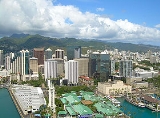
Honolulu is the
capital and largest city of the
U.S. State of
Hawaii. In the
Hawaiian language,
honolulu means "sheltered bay" or "place of shelter." The census-designated place is located along the southeast coast of the island of
Oahu. The term also refers to the District of Honolulu . As of July 1, 2004, the
United States Census Bureau estimate for Honolulu puts the
population at 377,260 and that of the city and county at 900,000. In Hawaii, local governments operate only at the county level, and the
City & County of Honolulu encompasses all of the Island of Oahu .
History
It is not known when Honolulu was first settled by the original
Polynesian migrants to the archipelago. Oral histories and artifacts indicate that there was a settlement where Honolulu now stands in the 12th century. However, after
Kamehameha I conquered
Oahu in the Battle of
Nuuanu Pali, he moved his royal court from the
Island of Hawaii to
Waikiki in 1804. His court later relocated, in 1809, to what is now
downtown Honolulu.
Captain William Brown of England was the first foreigner to sail, in 1794, into what is now Honolulu Harbor. More foreign ships would follow, making the port of Honolulu a focal point for merchant ships traveling between
North America and
Asia.
In 1845,
Kamehameha III moved the permanent capital of the Hawaiian Kingdom from
Lahaina on
Maui to Honolulu. He and the kings that followed him transformed Honolulu into a modern capital, erecting buildings such as
St. Andrew's Cathedral,
Iolani Palace, and
Aliiolani Hale. At the same time, Honolulu became the center of commerce in the Islands, with descendants of American missionaries establishing major businesses in downtown Honolulu.
Despite the turbulent history of the late 19th century and early 20th century, which saw the overthrow of the Hawaiian monarchy, Hawaii's subsequent annexation by the
United States, and the
Japanese
attack on Pearl Harbor, Honolulu would remain the capital, largest city, and main airport and seaport of the Hawaiian Islands.
An economic and tourism boom following statehood brought rapid economic growth to Honolulu and Hawaii. Modern air travel would bring thousands, eventually millions of visitors to the Islands. Today, Honolulu is a modern city with numerous high-rise buildings, and Waikiki is the center of the tourism industry in Hawaii, with thousands of hotel rooms.
Geography and climate
Honolulu is located at 21°18'32" North, 157°49'34" West . While this is clearly in the
tropics, the
climate is moderated by the mid-ocean location and some cooling achieved by the California Current that passes through the islands much of year. The average daily low and high temperatures in January are 65/80 °F and in July are 74/88 °F . Temperatures exceed 90 °F only rarely, with lows in the 50's °F occurring perhaps once or twice in a year. The hottest temperature ever recorded in Honolulu was 95 °F on September 19, 1994 and the coldest temperature ever recorded was 53 °F on January 31, 1998, 1972 and 1948 and on January 20, 1969 and on February 1 and 2, 1976 and on February 9, 1981 and on February 12, 1983.
The
Honolulu District is located on the southeast coast of O‘ahu between
Makapuu and
Halawa. The District boundary follows the Koolau crestline, so Makapuu Beach is in the Koolaupoko District. On the west, the district boundary follows Halawa Stream, then crosses
Red Hill and runs just west of
Aliamanu Crater, so that
Aloha Stadium,
Pearl Harbor , and
Hickam Air Force Base are actually all located in the island's Ewa District.
Most of the city's commercial and industrial developments are located on a narrow but relatively flat coastal plain, while numerous ridges and valleys located inland of the coastal plain divide Honolulu's residential areas into distinct neighborhoods: some spread along valley floors and others climb the interfluvial ridges. Within Honolulu proper can be found several
volcanic cones: Punchbowl,
Diamond Head,
Koko Head , Koko Crater, Salt Lake, and Aliamanu being the most conspicuous.
Honolulu and Juneau, Alaska are the only two US state capitals that cannot be reached directly by road from the contiguous 48 States. Direct connections to these capitals require a boat or a plane.
Government
Originally governed by a Board of Supervisors, the
City & County of Honolulu is administered under a mayor-council system of governance overseeing all municipal services: civil defense, driver licensing, emergency medical, fire, parks and recreation, police, sanitation, streets, vehicle registration, voter registration, water, among others. One of the largest municipal governments in the United States, the City & County of Honolulu has an annual operating budget of $1 billion.
The current mayor of Honolulu is
Mufi Hannemann .
Neighborhoods and special districts
- Downtown Honolulu is the financial, commercial, and governmental center of Hawaii. On the waterfront is Aloha Tower, which for many years was the tallest building in Hawaii. Currently the tallest building is the 438-foot-tall First Hawaiian Center
First Hawaiian Center is the tallest building in the City & County of Honolulu [i] ...
, located on King and Bishop Streets .
- The Capitol District is the eastern part of Downtown Honolulu. It is the current and historic center of Hawaii's state government, incorporating the Hawaii State Capitol, Iolani Palace, Honolulu Hale , State Library, and the statue of King Kamehameha I, along with numerous government buildings.
- Kakaako is a light-industrial district between Downtown and Waikiki that has seen a large-scale redevelopment effort in the past decade. It is home to two major shopping areas, Ward Warehouse and Ward Centre. The John A. Burns School of Medicine, part of the University of Hawaii at Manoa is also located there. A Memorial to the Ehime Maru Incident victims is built at Kakaako Waterfront Park.
- Waikiki is the world famous tourist district of Honolulu, located between the Ala Wai Canal and the Pacific Ocean next to Diamond Head. Numerous hotels, shops, and nightlife opportunities are located along Kalakaua and Kuhio Avenues. World-famous Waikiki Beach attracts millions of visitors a year. Just west of Waikiki is Ala Moana Center, the world's largest open-air shopping center. A majority of the hotel rooms on Oahu are located in Waikiki.


- Manoa and Makiki are residential neighborhoods located in adjacent valleys just inland of downtown and Waikiki. Manoa Valley is home to the main campus of the University of Hawaii.
- Nuuanu and Pauoa are middle-class to upper-middle-class residential districts located inland of downtown Honolulu. The National Memorial Cemetery of the Pacific is located in Punchbowl Crater fronting Pauoa Valley.
- Palolo and Kaimuki are neighborhoods east of Manoa and Makiki, inland from Diamond Head. Palolo Valley parallels Manoa and is a residential neighborhood. Kaimuki is primarily a residential neighborhood with a commercial strip centered on Waialae Avenue running behind Diamond Head. Chaminade University is located in Kaimuki.
- Waialae and Kahala are the upper-class districts of Honolulu located directly east of Diamond Head, where there are many high-priced homes. Also found in these neighborhoods are the Waialae Country Club and the Kahala Mandarin Oriental Hotel.
- East Honolulu includes the residential communities of Aina Haina, Niu Valley, and Hawaii Kai. These are considered upper-middle-class neighborhoods.
- Kalihi and Palama are working-class neighborhoods with a number of government housing developments. Lower Kalihi, toward the ocean, is a light-industrial district.
- Salt Lake and Aliamanu are residential areas built in extinct tuff cones along the western end of the Honolulu District, not far from the Honolulu International Airport.
- Moanalua is two neighborhoods and a valley at the western end of Honolulu, and home to Tripler Army Medical Center.
- Hawaii Kai is a large residential area in the extreme eastern end of the island. Koko Head is located here.
Demographics
As of the
census of
2000, there were 371,657 people, 140,337 households, and 87,429 families residing in the CDP. The
population density was 1,674.4/km² . There were 158,663 housing units at an average density of 714.8/km² . The racial makeup of the CDP was 19.67%
White; 1.62%
Black or
African American; 0.19%
Native American; 55.85%
Asian; 6.85% Pacific Islander; 0.89% from
other races; and 14.93% from two or more races. 4.37% of the population were
Hispanic or
Latino of any race.
Of the 140,337 households, 23.7% had children under the age of 18 living with them, 45.5% were married couples living together, 12.1% had a female householder with no husband present, and 37.7% were non-families. 29.7% of all households were made up of individuals and 10.0% had someone living alone who was 65 years of age or older. The average household size was 2.57 and the average family size is 3.23.
In Honolulu in 2000, the age distribution was 19.2% under the age of 18, 8.9% from 18 to 24, 29.9% from 25 to 44, 24.1% from 45 to 64, and 17.8% who were 65 years of age or older. The median age was 40 years. For every 100 females there were 96.6 males. For every 100 females age 18 and over, there were 94.5 males.
The median income for a household in the city proper was $45,112, and the median income for a family was $56,311. Males had a median income of $36,631 versus $29,930 for females. The per capita income for the CDP was $24,191. 11.8% of the population and 7.9% of families were below the
poverty line. Out of the total population, 14.6% of those under the age of 18 and 8.5% of those 65 and older were living below the poverty line.
Notable citizens
Transportation
Air
Located on the western end of Honolulu proper,
Honolulu International Airport is the principal aviation gateway to the state of Hawaii.
Highways
Two
freeways serve Honolulu:
- Interstate H-1, which, coming into the city from the west, passes Hickam Air Force Base and Honolulu International Airport, runs just north of Downtown and continues eastward through Makiki and Kaimuki, ending at Waialae/Kahala. West of the city proper, H-1 connects to Interstate H-2 from Wahiawa and Interstate H-3 from Kaneohe.
- Interstate H-201—also known as the Moanalua Freeway and formerly numbered Hawaii State Rte. 78—connects two points along H-1: at Aloha Stadium and Fort Shafter. Close to H-1 and Aloha Stadium, H-201 has an exchange with the western terminus of Interstate H-3 to the windward side of Oahu . This complex of connecting ramps, some directly between H-1 and H-3, is in Halawa.
Other major highways that link Honolulu proper with other parts of the Island of Oahu are:
- Pali Highway, State Rte. 61, crosses north over the Koolau range via the Pali Tunnels to connect to Kailua and Kaneohe on the windward side of the Island.
- Likelike Highway, State Rte. 63, also crosses the Koolau to Kaneohe via the Wilson Tunnels.
- Kalanianaole Highway, State Rte. 72, runs eastward from Waialae/Kahala to Hawaii Kai and around the east end of the island to Waimanalo Beach.
- Kamehameha Highway, State Rte. 99, runs westward from near Hickam Air Force Base to Aiea and beyond, eventually running through the center of the island and ending in Kane‘ohe.
Like most major American cities, the Honolulu metropolitan area experiences heavy traffic congestion during rush hours, especially to and from the western suburbs of Kapolei, Ewa,
Aiea,
Pearl City,
Waipahu, and
Mililani. Land for expanding road capacity is at a premium everywhere on Oahu.
Public transportation
Established by former Mayor
Frank F. Fasi, Honolulu's
public transit system has been twice honored by the
American Public Transportation Association bestowing the title of "America's Best Transit System" for 1994-1995 and 2000-2001. Oahu Transit Services' "
TheBus" operates 93 routes with a fleet of 525 buses.
Currently, there is no fixed-rail mass transit system in Honolulu. However, in 2004, the City & County of Honolulu and the State of Hawai‘i approved development of an action plan for a fixed rail mass transit system to be built in several phases. The initial line could link Kapolei in West O‘ahu to
UH Manoa. Several attempts had been made since the 1980s and 1990s to construct a fixed rail mass transit system but stalled during Honolulu City Council hearings.
Also in 2004, construction had started on a
bus rapid transit system using dedicated rights-of-way for buses. The system, proposed by former Mayor
Jeremy Harris, was expected to link the Iwilei neighborhood with
Waikiki. However, current Mayor
Mufi Hannemann has largely dismantled the BRT system and deployed its buses along other express bus routes.
Cultural institutions
Performing arts
Established in 1900, the
Honolulu Symphony is the oldest US symphony orchestra west of the Rocky Mountains. Other classical music ensembles include the Hawaii Opera Theatre. Honolulu is also a center for
Hawaiian music. The main music venues include the
Neal Blaisdell Center Concert Hall, the Waikiki Shell, and the
Hawaii Theatre.
Honolulu also includes several venues for live
theatre, including the Diamond Head Theatre and the Manoa Valley Theatre.
Visual arts
Located near
downtown Honolulu, the premier venue for visual arts in Hawaii is the Honolulu Academy of Arts. The Honolulu Academy of Arts features the largest collection of Western and Asian art in Hawaii and also hosts a year-round film and video program dedicated to the presentation of arthouse and world cinema in the museum's Doris Duke Theatre. The Contemporary Museum in
Makiki is the main museum of contemporary art in the state.
Gardens
Other museums, aquariums, zoos, and cultural centers
- The Bishop Museum is the largest museum in the State of Hawaii and houses millions of natural history specimens and cultural artifacts relating to Hawaii and the Pacific.
- The Honolulu Academy of Arts has steadily grown to become Hawai‘i’s largest private presenter of visual arts programs, boasting a permanent collection of over 40,000 works of art from cultures around the world.
- The Waikiki Aquarium and the Honolulu Zoo are both located at the eastern end of Waikiki in Kapiolani Park.
- The Hawaii State Art Museum is located in the downtown district in the old YMCA building and features local artists. Blessed with both a great collection and a competent house staff.
- Shangri La
Sports
Currently, Honolulu has no professional sports teams. However, Honolulu hosts the
NFL's annual
Pro Bowl each February in addition to the
NCAA football
Hawaii Bowl. Fans of spectator sports in Honolulu generally support the
football,
volleyball,
basketball, and
baseball programs of the
University of Hawaii at Manoa. High school sporting events, especially football, are especially popular. Venues for spectator sports in Honolulu include:
Honolulu's mild climate lends itself to year-round fitness activities as well. In 2004,
Men's Fitness magazine named Honolulu the
fittest city in the U.S. Honolulu is also home to three large
road races:
- The Great Aloha Run is held annually on Presidents' Day.
- The Honolulu Marathon, held annually on the second Sunday in December, draws more than 20,000 participants each year, about half to two thirds of them from Japan.
- The Honolulu Triathlon held its first race in 2004, when it hosted the US Olympic Triathlon Trials, and is billed as Hawaii's premier Olympic-distance triathlon. No sprint course is offered during the event, which is held in May.
Media
Newspapers
Honolulu is served by two daily
newspapers: the
Honolulu Advertiser is the largest newspaper [i] in the U.S. state [i] of Hawaii [i] and ...
and the
Honolulu Star-Bulletin, based in Honolulu [i], Hawaii [i], is second largest da ...
. It is one of the few cities of its size in the U.S. to have more than one daily newspaper.
Television
Full power TV channels
Low-power TV channels
- 42 K42CO
- 46 KHLU-LP
- 48 KHHI-LP
- 56 K56EX
- 64 K64FN
Digital TV channels
Radio stations
17 AM radio stations
- 590 KSSK AM Adult Contemporary
- 650 KRTR Asian
- 690 KORL Ethnic
- 760 KGU Religious
- 830 KHVH News/Talk
- 870 KAIM Country
- 940 KKNE Ethnic
- 990 KHBZ Talk
- 1040 KLHT Religious
- 1080 KWAI Talk
- 1130 KRUD New;TBA
- 1170 KHCM Country
- 1210 KZOO Japanese Pop
- 1270 KNDI Ethnic
- 1370 KUPA Ethnic
- 1420 KKEA Sports
- 1460 KHRA Asian
- 1500 KUMU Talk
- 1540 KREA Asian
20 FM radio stations
- 88.1 KHPR Classical, News
- 89.3 KIPO News, Information, Jazz
- 90.3 KTUH Modern Rock, Progressive music
- 92.3 KSSK Adult Contemporary
- 93.1 KQMQ Top 40
- 93.9 KIKI Rhythmic Top 40
- 94.7 KUMU-FM Adult Contemporary
- 95.5 KAIM-FM Contemporary Christian
- 96.3 KRTR-FM Adult Top 40
- 97.5 KHNR Talk
- 98.5 KDNN Hawaiian Contemporary
- 99.5 KHUI Hawaiian Adult Contemporary
- 100.3 KCCN Hawaiian Top 40
- 101.1 KLHI Modern Rock
- 101.1 KXRG-LP Dance
- 101.9 KUCD Modern Rock
- 102.7 KDDB Rhythmic Top 40
- 104.3 KPHW Rhythmic Top 40
- 105.1 KINE Traditional Hawaiian
- 105.9 KPOI Classic Rock
- 107.9 KGMZ Oldies
Cable and satellite television
Oceanic-Time Warner Cable is the primary cable television carrier in the Honolulu metropolitan area. Satellite television is also available as an alternative.
Tourist attractions
Colleges & universities
...
— Students: 8,500; Tuition: $10,922/yr
2...
— Students: 2,400; Tuition: $15,000/yr
Sister cities
Honolulu currently has 24
sister cities. They are:
...
,
Philippines