

Zantedeschia

Encyclopedia
Zantedeschia is a genus of herbaceous
flowering plant
s in the family Araceae
, native to southern Africa
from South Africa
north to Malawi
. The name of the genus was given as a tribute to Italian botanist Giovanni Zantedeschi
(1773–1846) by the German botanist Kurt Sprengel (1766–1833). Common names include arum lily for Z. aethiopica, calla, and calla lily for Z. elliottiana and Z. rehmannii although it is neither a true lily (Liliaceae
), nor Arum
or Calla
(related genera in Araceae
). It is also often erroneously spelled as "cala lily". It has often been used in many paintings, and is visible in many of Diego Rivera's
works of art (see The Flower Vendor, amongst others).
The Zantedeschia are rhizomatous
herbaceous
perennial plant
s growing to 1-2.5 m tall with leaves
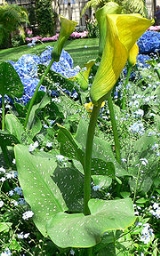
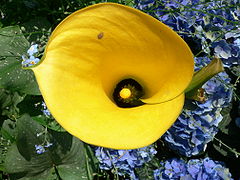
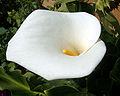
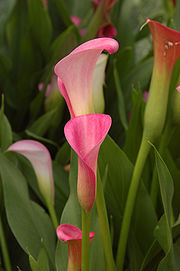
15–45 cm long. The inflorescence is a showy white, yellow or pink spathe shaped like a funnel with a yellow, central, finger-like spadix.
The Zantedeschia species are poisonous due to the presence of calcium oxalate
. "All parts of the plant are toxic, and produce irritation and swelling of the mouth and throat, acute vomiting and diarrhea." However leaves are sometimes cooked and eaten.
 Eight species are currently recognized:
when water becomes scarce. It grows continuously when watered and fed regularly and can survive periods of minor frosts. Z. aethiopica is a very strong and sturdy plant, being able to grow in many soils and habitats, multiplying by rhizome-offsets; it is naturalised and regarded as a weed throughout much of the world. Z. odorata is a rare species, resembling Z. aethiopica, but deciduous and smelling like freesia
, endemic to a few localities in South Africa. Z. albomaculata is a widespread and variable species, growing from South Africa north to Kenya
, varying in shades of white to cream and pink to orange-shades. Z. elliotiana is known from horticultural sources only and is probably of hybrid origin. Z. jucunda and Z. pentlandii are rare species with beautiful large yellow showy flowers. Z. rehmannii is a pink-flowered species with sword shaped leaves.
 All Zantedeschias produce large, showy flowers spathes
and are often grown both as ornamental plant
s and for cut flowers. Zantedeschia are hardy plants, but some are more winter-hardy than others. The white Zantedeschia aethiopica and some of its relatives can survive at minimum winter temperatures below -23 °C (USDA
Zone 6) and many others can be grown in even warmer areas where all the ground does not freeze (USDA
Zone 7). Some species are less hardy and can only survive winter temperatures to -12 °C (Zones 8). This plant must be grown as tender bulb
s or houseplant
s in cooler areas. Species and hybrids between Z. elliotiana, Z. jucunda, Z. pentlandii and Z. rehmannii appear to have an optimum temperature for growth near 25 °C, with growth being suppressed once daily average temperatures persist at 28 °C.
Extensive commercial production of Zantedeschia for cut flowers and/or planting material occurs in California, Colombia, New Zealand and Kenya. Plant breeders in California and New Zealand continue to produce an extensive range of new hybrid cultivars.
In the South-West of Western Australia
, Z. aethiopica was introduced for horticulture. It has become a widespread and conspicuous weed of watercourses, heath, and wetter pastures.
The so-called white calla is derived from Z. aethiopica. All varieties with flowers with shades of yellow, orange, red, purple are mainly derived from Z. albomaculata, Z. pentlandii, Z. elliottiana and Z. rehmanni.
Herbaceous
A herbaceous plant is a plant that has leaves and stems that die down at the end of the growing season to the soil level. They have no persistent woody stem above ground...
flowering plant
Flowering plant
The flowering plants , also known as Angiospermae or Magnoliophyta, are the most diverse group of land plants. Angiosperms are seed-producing plants like the gymnosperms and can be distinguished from the gymnosperms by a series of synapomorphies...
s in the family Araceae
Araceae
Araceae are a family of monocotyledonous flowering plants in which flowers are borne on a type of inflorescence called a spadix. The spadix is usually accompanied by, and sometimes partially enclosed in, a spathe or leaf-like bract. Also known as the Arum family, members are often colloquially...
, native to southern Africa
Africa
Africa is the world's second largest and second most populous continent, after Asia. At about 30.2 million km² including adjacent islands, it covers 6% of the Earth's total surface area and 20.4% of the total land area...
from South Africa
South Africa
The Republic of South Africa is a country in southern Africa. Located at the southern tip of Africa, it is divided into nine provinces, with of coastline on the Atlantic and Indian oceans...
north to Malawi
Malawi
The Republic of Malawi is a landlocked country in southeast Africa that was formerly known as Nyasaland. It is bordered by Zambia to the northwest, Tanzania to the northeast, and Mozambique on the east, south and west. The country is separated from Tanzania and Mozambique by Lake Malawi. Its size...
. The name of the genus was given as a tribute to Italian botanist Giovanni Zantedeschi
Giovanni Zantedeschi
Giovanni Zantedeschi was an Italian physician and an important Italian botanist.He studied in Verona and later in Padua, where he graduated with honors, in medicine and surgery...
(1773–1846) by the German botanist Kurt Sprengel (1766–1833). Common names include arum lily for Z. aethiopica, calla, and calla lily for Z. elliottiana and Z. rehmannii although it is neither a true lily (Liliaceae
Liliaceae
The Liliaceae, or the lily family, is a family of monocotyledons in the order Liliales. Plants in this family have linear leaves, mostly with parallel veins but with several having net venation , and flower arranged in threes. Several have bulbs, while others have rhizomes...
), nor Arum
Arum
Arum is a genus of about 25 species of flowering plants in the family Araceae, native to Europe, northern Africa, and western Asia, with the highest species diversity in the Mediterranean region....
or Calla
Calla
Calla is a genus of flowering plant in the family Araceae, containing the single species Calla palustris...
(related genera in Araceae
Araceae
Araceae are a family of monocotyledonous flowering plants in which flowers are borne on a type of inflorescence called a spadix. The spadix is usually accompanied by, and sometimes partially enclosed in, a spathe or leaf-like bract. Also known as the Arum family, members are often colloquially...
). It is also often erroneously spelled as "cala lily". It has often been used in many paintings, and is visible in many of Diego Rivera's
Diego Rivera
Diego María de la Concepción Juan Nepomuceno Estanislao de la Rivera y Barrientos Acosta y Rodríguez was a prominent Mexican painter born in Guanajuato, Guanajuato, an active communist, and husband of Frida Kahlo . His large wall works in fresco helped establish the Mexican Mural Movement in...
works of art (see The Flower Vendor, amongst others).
The Zantedeschia are rhizomatous
Rhizome
In botany and dendrology, a rhizome is a characteristically horizontal stem of a plant that is usually found underground, often sending out roots and shoots from its nodes...
herbaceous
Herbaceous
A herbaceous plant is a plant that has leaves and stems that die down at the end of the growing season to the soil level. They have no persistent woody stem above ground...
perennial plant
Perennial plant
A perennial plant or simply perennial is a plant that lives for more than two years. The term is often used to differentiate a plant from shorter lived annuals and biennials. The term is sometimes misused by commercial gardeners or horticulturalists to describe only herbaceous perennials...
s growing to 1-2.5 m tall with leaves
Leaf
A leaf is an organ of a vascular plant, as defined in botanical terms, and in particular in plant morphology. Foliage is a mass noun that refers to leaves as a feature of plants....
15–45 cm long. The inflorescence is a showy white, yellow or pink spathe shaped like a funnel with a yellow, central, finger-like spadix.
The Zantedeschia species are poisonous due to the presence of calcium oxalate
Calcium oxalate
Calcium oxalate is a chemical compound that forms needle-shaped crystals, known in plants as raphides. A major constituent of human kidney stones, the chemical is also found in beerstone, a scale that forms on containers used in breweries...
. "All parts of the plant are toxic, and produce irritation and swelling of the mouth and throat, acute vomiting and diarrhea." However leaves are sometimes cooked and eaten.
Species
- Zantedeschia aethiopicaZantedeschia aethiopicaZantedeschia aethiopica ; syn. Calla aethiopica L., Richardia africana Kunth, Richardia aethiopica Spreng., Colocasia aethiopica Spreng...
(L.) Spreng. – giant white arum lily or common arum lily - Zantedeschia albomaculata (Hook.) Baill. – spotted arum lily
- Zantedeschia elliottianaZantedeschia elliottianaZantedeschia elliottiana Golden Arum Lily is a herbaceous ornamental plant in the Araceae family.- Description :A summer flowering plant with a yellow spathe surrounding a yellow spadix, occasionally followed by a spike of bright yellow berries that are attractive to birds.-References:* Botanicas...
(W.Watson) Engl. – yellow or golden arum lily - Zantedeschia jucunda Letty
- Zantedeschia odorata P.L.Perry
- Zantedeschia pentlandii (R.Whyte ex W.Watson) Wittm.
- Zantedeschia rehmanniiZantedeschia rehmanniiZantedeschia rehmanii Pink Arum Lily, Pink Calla is a herbaceous ornamental plant in the Araceae family.- Description :The spathe on this summer flowering Zantedeschia is mauve to rose-purple with paler margins, enclosing a yellow spadix...
Engl. – pink arum lily - Zantedeschia valida (Letty) Y.Singh
Cultivation
All species are endemic to southern Africa. Z. aethiopica grows naturally in marshy areas and is only deciduousDeciduous
Deciduous means "falling off at maturity" or "tending to fall off", and is typically used in reference to trees or shrubs that lose their leaves seasonally, and to the shedding of other plant structures such as petals after flowering or fruit when ripe...
when water becomes scarce. It grows continuously when watered and fed regularly and can survive periods of minor frosts. Z. aethiopica is a very strong and sturdy plant, being able to grow in many soils and habitats, multiplying by rhizome-offsets; it is naturalised and regarded as a weed throughout much of the world. Z. odorata is a rare species, resembling Z. aethiopica, but deciduous and smelling like freesia
Freesia
Freesia Ecklon ex Klatt is a genus of 14–16 species of flowering plants in the family Iridaceae, native to Africa. Of the 14 species, 12 are native to Cape Province, South Africa, the remaining two to tropical Africa, one species extending north of the equator to Sudan.The genus was named in honor...
, endemic to a few localities in South Africa. Z. albomaculata is a widespread and variable species, growing from South Africa north to Kenya
Kenya
Kenya , officially known as the Republic of Kenya, is a country in East Africa that lies on the equator, with the Indian Ocean to its south-east...
, varying in shades of white to cream and pink to orange-shades. Z. elliotiana is known from horticultural sources only and is probably of hybrid origin. Z. jucunda and Z. pentlandii are rare species with beautiful large yellow showy flowers. Z. rehmannii is a pink-flowered species with sword shaped leaves.
Spadix
In botany, a spadix is a type of spike inflorescence having small flowers borne on a fleshy stem. Spadix are typical of the Family Araceae known as arums or aroids...
and are often grown both as ornamental plant
Ornamental plant
Ornamental plants are plants that are grown for decorative purposes in gardens and landscape design projects, as house plants, for cut flowers and specimen display...
s and for cut flowers. Zantedeschia are hardy plants, but some are more winter-hardy than others. The white Zantedeschia aethiopica and some of its relatives can survive at minimum winter temperatures below -23 °C (USDA
United States Department of Agriculture
The United States Department of Agriculture is the United States federal executive department responsible for developing and executing U.S. federal government policy on farming, agriculture, and food...
Zone 6) and many others can be grown in even warmer areas where all the ground does not freeze (USDA
United States Department of Agriculture
The United States Department of Agriculture is the United States federal executive department responsible for developing and executing U.S. federal government policy on farming, agriculture, and food...
Zone 7). Some species are less hardy and can only survive winter temperatures to -12 °C (Zones 8). This plant must be grown as tender bulb
Bulb
A bulb is a short stem with fleshy leaves or leaf bases. The leaves often function as food storage organs during dormancy.A bulb's leaf bases, known as scales, generally do not support leaves, but contain food reserves to enable the plant to survive adverse conditions. At the center of the bulb is...
s or houseplant
Houseplant
A houseplant is a plant that is grown indoors in places such as residences and offices. Houseplants are commonly grown for decorative purposes, positive psychological effects, or health reasons such as indoor air purification...
s in cooler areas. Species and hybrids between Z. elliotiana, Z. jucunda, Z. pentlandii and Z. rehmannii appear to have an optimum temperature for growth near 25 °C, with growth being suppressed once daily average temperatures persist at 28 °C.
Extensive commercial production of Zantedeschia for cut flowers and/or planting material occurs in California, Colombia, New Zealand and Kenya. Plant breeders in California and New Zealand continue to produce an extensive range of new hybrid cultivars.
In the South-West of Western Australia
Southwest Australia
Southwest Australia is a biodiversity hotspot that includes the Mediterranean forests, woodlands, and scrub ecoregions of Western Australia. The region has a wet-winter, dry-summer Mediterranean climate, one of five such regions in the world...
, Z. aethiopica was introduced for horticulture. It has become a widespread and conspicuous weed of watercourses, heath, and wetter pastures.
The so-called white calla is derived from Z. aethiopica. All varieties with flowers with shades of yellow, orange, red, purple are mainly derived from Z. albomaculata, Z. pentlandii, Z. elliottiana and Z. rehmanni.
External links
- Calla Lilies for Card Making
- http://www.africalla.com/products.html
- PlantZAfrica page on Zantedeschia
- http://www.botany.com/zantedeschia.html
- http://www.ext.vt.edu/departments/envirohort/factsheets/cut/callali.html
- http://florawww.eeb.uconn.edu/acc_num/198500186.html
- http://www.goldenstatebulb.com/pages/callapics1.html
- Snijder, R.C. 2004. Genetics of Erwinia resistance in Zantedeschia: impact of plastome-genome incompatibility. PhD thesis Wageningen University. ISBN 90-5808-975-4 - p. 112. full-text copy: http://www.library.wur.nl/wda/dissertations/dis3535.pdf
- http://www.zantedeschiakonst.com
- http://www.callacouncil.org.nz/default.asp
- Zantedeschia Aethiopica