

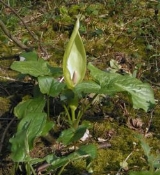
Arum

Encyclopedia
Arum is a genus of about 25 species of flowering plant
s in the family Araceae
, native to Europe
, northern Africa
, and western Asia
, with the highest species diversity in the Mediterranean region.
They are rhizomatous
, herbaceous
perennial plant
s growing to 20-60 cm tall, with sagittate (arrow
head-shaped) leaves
10-55 cm long. The flower
s are produced in a spadix
, surrounded by a 10-40 cm long, coloured spathe, which may be white, yellow, brown or purple; some species are scented, others not. The fruit
is a cluster of bright orange or red berries
.
All parts of the plants are poison
ous, containing significant amounts of calcium oxalate
as raphides
.
Flowering plant
The flowering plants , also known as Angiospermae or Magnoliophyta, are the most diverse group of land plants. Angiosperms are seed-producing plants like the gymnosperms and can be distinguished from the gymnosperms by a series of synapomorphies...
s in the family Araceae
Araceae
Araceae are a family of monocotyledonous flowering plants in which flowers are borne on a type of inflorescence called a spadix. The spadix is usually accompanied by, and sometimes partially enclosed in, a spathe or leaf-like bract. Also known as the Arum family, members are often colloquially...
, native to Europe
Europe
Europe is, by convention, one of the world's seven continents. Comprising the westernmost peninsula of Eurasia, Europe is generally 'divided' from Asia to its east by the watershed divides of the Ural and Caucasus Mountains, the Ural River, the Caspian and Black Seas, and the waterways connecting...
, northern Africa
Africa
Africa is the world's second largest and second most populous continent, after Asia. At about 30.2 million km² including adjacent islands, it covers 6% of the Earth's total surface area and 20.4% of the total land area...
, and western Asia
Asia
Asia is the world's largest and most populous continent, located primarily in the eastern and northern hemispheres. It covers 8.7% of the Earth's total surface area and with approximately 3.879 billion people, it hosts 60% of the world's current human population...
, with the highest species diversity in the Mediterranean region.
They are rhizomatous
Rhizome
In botany and dendrology, a rhizome is a characteristically horizontal stem of a plant that is usually found underground, often sending out roots and shoots from its nodes...
, herbaceous
Herbaceous
A herbaceous plant is a plant that has leaves and stems that die down at the end of the growing season to the soil level. They have no persistent woody stem above ground...
perennial plant
Perennial plant
A perennial plant or simply perennial is a plant that lives for more than two years. The term is often used to differentiate a plant from shorter lived annuals and biennials. The term is sometimes misused by commercial gardeners or horticulturalists to describe only herbaceous perennials...
s growing to 20-60 cm tall, with sagittate (arrow
Arrow
An arrow is a shafted projectile that is shot with a bow. It predates recorded history and is common to most cultures.An arrow usually consists of a shaft with an arrowhead attached to the front end, with fletchings and a nock at the other.- History:...
head-shaped) leaves
Leaf
A leaf is an organ of a vascular plant, as defined in botanical terms, and in particular in plant morphology. Foliage is a mass noun that refers to leaves as a feature of plants....
10-55 cm long. The flower
Flower
A flower, sometimes known as a bloom or blossom, is the reproductive structure found in flowering plants . The biological function of a flower is to effect reproduction, usually by providing a mechanism for the union of sperm with eggs...
s are produced in a spadix
Spadix
In botany, a spadix is a type of spike inflorescence having small flowers borne on a fleshy stem. Spadix are typical of the Family Araceae known as arums or aroids...
, surrounded by a 10-40 cm long, coloured spathe, which may be white, yellow, brown or purple; some species are scented, others not. The fruit
Fruit
In broad terms, a fruit is a structure of a plant that contains its seeds.The term has different meanings dependent on context. In non-technical usage, such as food preparation, fruit normally means the fleshy seed-associated structures of certain plants that are sweet and edible in the raw state,...
is a cluster of bright orange or red berries
Berry
The botanical definition of a berry is a fleshy fruit produced from a single ovary. Grapes are an example. The berry is the most common type of fleshy fruit in which the entire ovary wall ripens into an edible pericarp. They may have one or more carpels with a thin covering and fleshy interiors....
.
All parts of the plants are poison
Poison
In the context of biology, poisons are substances that can cause disturbances to organisms, usually by chemical reaction or other activity on the molecular scale, when a sufficient quantity is absorbed by an organism....
ous, containing significant amounts of calcium oxalate
Oxalic acid
Oxalic acid is an organic compound with the formula H2C2O4. This colourless solid is a dicarboxylic acid. In terms of acid strength, it is about 3,000 times stronger than acetic acid. Oxalic acid is a reducing agent and its conjugate base, known as oxalate , is a chelating agent for metal cations...
as raphides
Raphides
Raphides are needle-shaped crystals of calcium oxalate as the monohydrate or calcium carbonate as aragonite, found in more than 200 families of plants.Both ends are needle-like, but raphides tend to be more blunt at one end and more tapering at the other....
.
Selected species
- Arum alpinumArum alpinumArum alpinum is a member the plant family Araceae. Certain occurrences of Arum in Denmark were previously labelled asthe subspecies A. alpinum ssp. danicum, but these are now recognized as Arum cylindraceum....
- Arum balansanum
- Arum concinnatum
- Arum cornutum
- Arum creticum
- Arum cyrenaicum Fruits
- Arum dioscoridis
- Arum dracunculusDracunculus vulgarisDracunculus vulgaris is a species of aroid in the genus Dracunculus and is known variously as the Dragon Arum, the Black Arum, the Voodoo Lily, the Snake Lily, the Stink Lily, the Black Dragon, the Black Lily, Dragonwort, and Ragons...
- Arum euxinum
- Arum gratum
- Arum hygrophilum
- Arum idaeum
- Arum italicumArum italicumArum italicum is a member the plant family Araceae, also known as Italian arum and Italian Lords-and-Ladies. The plant is native to southern and western Europe...
- Italian Lords-and-Ladies (or Cuckoo Pint) - Arum korolkowii
- Arum maculatumArum maculatumArum maculatum is a common woodland plant species of the Araceae family. It is widespread across temperate northern Europe and is known by an abundance of common names including Wild arum, Lords and Ladies, Devils and Angels, Cows and Bulls, Cuckoo-Pint, Adam and Eve, Bobbins, Naked Boys,...
- Cuckoo Pint - Arum nigrum
- Arum palaestinum
- Arum pictum
- Arum polyphyllum
- Arum purpureospathum
- Arum rupicola
- Arum triphyllum