

Yixian Formation

Encyclopedia
The Yixian Formation is a geological formation in Jinzhou
, Liaoning
, People's Republic of China
, that spans 11 million years during the early Cretaceous
period. It is known for its fossil
s, and is mainly composed of basalt
s interspersed with siliciclastic
sediments.
(northern China) called "Jehol
". During the occupation of Jehol, many Japanese scientists had noticed fossil remains of extinct fish and reptiles, possibly the champsosaurs. These initial fossil discoveries made by Japanese scientists vanished once World War II
ended in 1945.
, the fossils of Yixian were studied only by Chinese scientists. It was not until the 1990s when remarkable fossils of birds and dinosaurs were excavated. Since 1996, a number of dinosaur
fossils that have revolutionized knowledge of these animals have been found at Yixian; among them are the first known non-avian
theropods
with feather
s. See Jehol Biota
.
–Early Cretaceous
boundary, some 145 mya (million years ago). Radiometric dating
has since resolved it to be younger; it is now considered to have been deposited in the Barremian
to early Aptian
, some 125–121 mya.
The Yixian Formation forms the lowest part of the Jehol group, defined by Gu (1962 and 1983) as a group of geological formations including the Jehol Coal-bearing Beds, the Jehol Oil Shale Beds, and the Jehol Volcanic Rocks. The Yixian Formation is preceded by the older Daohugou Beds
, of uncertain Jurassic or Early Cretaceous age, which are sometimes considered part of the Jehol group. The Yixian Formation (including the synonymous Jingangshan, Tuhulu, Jianchang, Lower Volcanic and Volcanic Rock formations) is followed stratigraphically by the slightly younger Jiufotang Formation
and the Fuxin Formation. Chiappe et al. argued in 1999 that the oldest beds of the Yixian (those bearing a fauna dominated by confuciusornithid birds
) were best separated as a distinct formation, called the Chaomidianzi Formation, with a type locality at the village of Sihetun, approximately 25 km south of Beipiao City. However, this classification has fallen out of favor, and the Chaomidianzi Formation is disused as a synonym for the Jianshangou Bed of the Yixian Formation.
The Dabeigou Formation
in Fengning, Hebei Province may immediately precede the Yixian, or it may be equivalent to the oldest Yixian beds. The Yixian also overlies the Tuchengzi Formation
in places.
The Yixian Formation is divided into the following subunits, from most recent to oldest:
, mainly based on changes in invertebrate
diversity. In the Yixian, ostracod
s (seed shrimp) had diversified considerably, despite a very low diversity in the earlier Dabeigou Formation
. Other major invertebrate groups in the Yixian include clam shrimp
and insect
s. Insects, as a group, experienced their largest diversification of the entire Mesozoic
era in the Yixian. On the other hand, some invertebrate groups, such as bivalves and gastropods (snails and slugs), were numerous but low in diversity, being mainly represented by one or two dominant species (Arguniella in the case of the bivalves).
Studies of vertebrate
s have shown support for the division of the Jehol into phases, and the diversity of fish
in the Yixian was distinct from older and younger formations, with Lycoptera
as the dominant species. The Yixian preserves the first Jehol dinosaur
s and pterosaur
s (which have not been found in the older Dabeigou Formation), and the first major radiation of bird
s (only one bird species is known from the Dabeigou). The Yixian also preserves the largest (and only) mammal
radiation so far known from the Jehol group. Most vertebrates showed a tendency to climb trees or become arboreal, including many tree-dwelling birds, and climbing mammals and lizards.
Plant
life reached its Jehol biota peak in the Yixian. Five species of flowering plant
were present (three of Archaefructus
, one of Archaeamphora and one of Sinocarpus), as were a variety of horsetail
s that closely resembled modern species. It is possible that increasing animal and plant diversity were linked. The Yixian is characterized by extensive forests, dominated by trees such as ginkgo
es, conifers, cycad
s, and seed fern
trees. Ground cover plants included lycopods
, horsetails, fern
s, and primitive flowering plants, which were rare compared to the others.
This plant life grew around a series of freshwater lake
s, provided with abundant minerals thanks to periodic volcanic eruptions
. Volcanic activity, along with periodic wildfire
s, and noxious gasses released from the lake bottoms
caused the ecosystem to be continually destroyed and regrown. This, along with the wide diversity of habitats in the surrounding region, may have contributed to the fast diversification of life forms present in the Yixian ecosystem.
upland forests. The presence of ferns, cycads, and horsetails indicates a generally humid climate. However, evidence from the growth rings
of petrified wood indicates that the humidity and water supply dropped regularly. This shows that the wet, humid conditions were punctuated by dry seasons, in which the environment became more arid. Evidence from the study of oxygen isotopes has shown that the average yearly temperature during this time period was 10 degrees celsius
(50 degrees Fahrenheit
), significantly colder than once thought. This indicates a temperate climate with unusually cold winters for the generally warm Mesozoic era, possibly due to northern China's high latitude during this time.
Jinzhou
Jinzhou , is a prefecture-level city of Liaoning province, China. It is a geographically strategic city located in the "Liaoxi Corridor" , which connects land transportation between North China and Northeast China. Jinzhou is China's northernmost seaport and the coastal economic center of West...
, Liaoning
Liaoning
' is a province of the People's Republic of China, located in the northeast of the country. Its one-character abbreviation is "辽" , a name taken from the Liao River that flows through the province. "Níng" means "peace"...
, People's Republic of China
People's Republic of China
China , officially the People's Republic of China , is the most populous country in the world, with over 1.3 billion citizens. Located in East Asia, the country covers approximately 9.6 million square kilometres...
, that spans 11 million years during the early Cretaceous
Early Cretaceous
The Early Cretaceous or the Lower Cretaceous , is the earlier or lower of the two major divisions of the Cretaceous...
period. It is known for its fossil
Fossil
Fossils are the preserved remains or traces of animals , plants, and other organisms from the remote past...
s, and is mainly composed of basalt
Basalt
Basalt is a common extrusive volcanic rock. It is usually grey to black and fine-grained due to rapid cooling of lava at the surface of a planet. It may be porphyritic containing larger crystals in a fine matrix, or vesicular, or frothy scoria. Unweathered basalt is black or grey...
s interspersed with siliciclastic
Siliciclastic
Siliciclastic rocks are clastic noncarbonate sedimentary rocks that are almost exclusively silica-bearing, either as forms of quartz or other silicate minerals. All siliciclastic rocks are formed by inorganic processes, or deposited through some mechanical process, such as stream deposits that are...
sediments.
Japanese occupation
The potential importance of the Yixian Formation was initially recognized during the time the Japanese Empire controlled a large chunk of ManchuriaManchuria
Manchuria is a historical name given to a large geographic region in northeast Asia. Depending on the definition of its extent, Manchuria usually falls entirely within the People's Republic of China, or is sometimes divided between China and Russia. The region is commonly referred to as Northeast...
(northern China) called "Jehol
Jehol
Jehol could mean either a province or a city:* Jehol Province, former province in northeastern China* Chengde, the capital of above provinceNamed after the province:* Jehol Biota* Jeholodens* Jeholopterus* Jeholornis* Jeholosaurus...
". During the occupation of Jehol, many Japanese scientists had noticed fossil remains of extinct fish and reptiles, possibly the champsosaurs. These initial fossil discoveries made by Japanese scientists vanished once World War II
World War II
World War II, or the Second World War , was a global conflict lasting from 1939 to 1945, involving most of the world's nations—including all of the great powers—eventually forming two opposing military alliances: the Allies and the Axis...
ended in 1945.
Chinese rediscovery
By 1949, when administration of the area passed to the Chinese Communist Party and its leader Mao ZedongMao Zedong
Mao Zedong, also transliterated as Mao Tse-tung , and commonly referred to as Chairman Mao , was a Chinese Communist revolutionary, guerrilla warfare strategist, Marxist political philosopher, and leader of the Chinese Revolution...
, the fossils of Yixian were studied only by Chinese scientists. It was not until the 1990s when remarkable fossils of birds and dinosaurs were excavated. Since 1996, a number of dinosaur
Dinosaur
Dinosaurs are a diverse group of animals of the clade and superorder Dinosauria. They were the dominant terrestrial vertebrates for over 160 million years, from the late Triassic period until the end of the Cretaceous , when the Cretaceous–Paleogene extinction event led to the extinction of...
fossils that have revolutionized knowledge of these animals have been found at Yixian; among them are the first known non-avian
Bird
Birds are feathered, winged, bipedal, endothermic , egg-laying, vertebrate animals. Around 10,000 living species and 188 families makes them the most speciose class of tetrapod vertebrates. They inhabit ecosystems across the globe, from the Arctic to the Antarctic. Extant birds range in size from...
theropods
Theropoda
Theropoda is both a suborder of bipedal saurischian dinosaurs, and a clade consisting of that suborder and its descendants . Dinosaurs belonging to the suborder theropoda were primarily carnivorous, although a number of theropod groups evolved herbivory, omnivory, and insectivory...
with feather
Feather
Feathers are one of the epidermal growths that form the distinctive outer covering, or plumage, on birds and some non-avian theropod dinosaurs. They are considered the most complex integumentary structures found in vertebrates, and indeed a premier example of a complex evolutionary novelty. They...
s. See Jehol Biota
Jehol Biota
The Jehol Biota includes all the living organisms - the ecosystem - of northeastern China between 133 to 120 million years ago. This is the Lower Cretaceous ecosystem which left fossils in the Yixian Formation and Jiufotang Formation. It is also believed to have left fossils in the Sinuiju series...
.
Dating
For some time, the formation was believed to be from the Late JurassicLate Jurassic
The Late Jurassic is the third epoch of the Jurassic Period, and it spans the geologic time from 161.2 ± 4.0 to 145.5 ± 4.0 million years ago , which is preserved in Upper Jurassic strata. In European lithostratigraphy, the name "Malm" indicates rocks of Late Jurassic age...
–Early Cretaceous
Early Cretaceous
The Early Cretaceous or the Lower Cretaceous , is the earlier or lower of the two major divisions of the Cretaceous...
boundary, some 145 mya (million years ago). Radiometric dating
Radiometric dating
Radiometric dating is a technique used to date materials such as rocks, usually based on a comparison between the observed abundance of a naturally occurring radioactive isotope and its decay products, using known decay rates...
has since resolved it to be younger; it is now considered to have been deposited in the Barremian
Barremian
The Barremian is an age in the geologic timescale between 130.0 ± 1.5 Ma and 125.0 ± 1.0 Ma). It is a subdivision of the Early Cretaceous epoch...
to early Aptian
Aptian
The Aptian is an age in the geologic timescale or a stage in the stratigraphic column. It is a subdivision of the Early or Lower Cretaceous epoch or series and encompasses the time from 125.0 ± 1.0 Ma to 112.0 ± 1.0 Ma , approximately...
, some 125–121 mya.
The Yixian Formation forms the lowest part of the Jehol group, defined by Gu (1962 and 1983) as a group of geological formations including the Jehol Coal-bearing Beds, the Jehol Oil Shale Beds, and the Jehol Volcanic Rocks. The Yixian Formation is preceded by the older Daohugou Beds
Daohugou Beds
The Daohugou Beds are a series of fossil-bearing rock deposits located in northeastern China, with the type locality around Daohugou village of Ningcheng County south of Chifeng, Inner Mongolia, but extending into southwest Liaoning. The rocks are grey, finely bedded, lacustrine, sandy mudstones...
, of uncertain Jurassic or Early Cretaceous age, which are sometimes considered part of the Jehol group. The Yixian Formation (including the synonymous Jingangshan, Tuhulu, Jianchang, Lower Volcanic and Volcanic Rock formations) is followed stratigraphically by the slightly younger Jiufotang Formation
Jiufotang Formation
The Jiufotang Formation is an Early Cretaceous geological formation in Chaoyang, Liaoning which has yielded fossils of feathered dinosaurs, primitive birds, pterosaurs, and other organisms. . It is a member of the Jehol group. The exact age of the Jiufotang has been debated for years, with...
and the Fuxin Formation. Chiappe et al. argued in 1999 that the oldest beds of the Yixian (those bearing a fauna dominated by confuciusornithid birds
Confuciusornithidae
Confuciusornithidae is a family of primitive birds from the early Cretaceous Period of China. It consists of four genera. About half of all the confuciusornithid specimens, including reprersentatives of all species, that have preserved feathers possess a pair of distinctive ribbon-like tail...
) were best separated as a distinct formation, called the Chaomidianzi Formation, with a type locality at the village of Sihetun, approximately 25 km south of Beipiao City. However, this classification has fallen out of favor, and the Chaomidianzi Formation is disused as a synonym for the Jianshangou Bed of the Yixian Formation.
The Dabeigou Formation
Dabeigou Formation
The Dabeigou Formation is a palaeontological formation located in China. It dates to the Cretaceous period....
in Fengning, Hebei Province may immediately precede the Yixian, or it may be equivalent to the oldest Yixian beds. The Yixian also overlies the Tuchengzi Formation
Tuchengzi Formation
The Tuchengzi Formation is a geological formation in China whose strata date back to the Late Jurassic. Dinosaur fossils, particularly footprints, have been found from the formation.-Vertebrate paleofauna:...
in places.
The Yixian Formation is divided into the following subunits, from most recent to oldest:
- Jingangshan Bed (121 Ma)
- Dawangzhangzi Bed (~122 Ma)
- Jianshangou Bed (124.6 Ma)
- Lujiatun Bed (~125 Ma)
Ecology
The Yixian Formation represents the second of three major faunal phases that characterize the Jehol BiotaJehol Biota
The Jehol Biota includes all the living organisms - the ecosystem - of northeastern China between 133 to 120 million years ago. This is the Lower Cretaceous ecosystem which left fossils in the Yixian Formation and Jiufotang Formation. It is also believed to have left fossils in the Sinuiju series...
, mainly based on changes in invertebrate
Invertebrate
An invertebrate is an animal without a backbone. The group includes 97% of all animal species – all animals except those in the chordate subphylum Vertebrata .Invertebrates form a paraphyletic group...
diversity. In the Yixian, ostracod
Ostracod
Ostracoda is a class of the Crustacea, sometimes known as the seed shrimp because of their appearance. Some 65,000 species have been identified, grouped into several orders....
s (seed shrimp) had diversified considerably, despite a very low diversity in the earlier Dabeigou Formation
Dabeigou Formation
The Dabeigou Formation is a palaeontological formation located in China. It dates to the Cretaceous period....
. Other major invertebrate groups in the Yixian include clam shrimp
Clam shrimp
Clam shrimp are a taxon of bivalved branchiopod crustaceans that resemble the unrelated bivalved molluscs. They are extant, and known from the fossil record, from at least the Devonian period and perhaps before...
and insect
Insect
Insects are a class of living creatures within the arthropods that have a chitinous exoskeleton, a three-part body , three pairs of jointed legs, compound eyes, and two antennae...
s. Insects, as a group, experienced their largest diversification of the entire Mesozoic
Mesozoic
The Mesozoic era is an interval of geological time from about 250 million years ago to about 65 million years ago. It is often referred to as the age of reptiles because reptiles, namely dinosaurs, were the dominant terrestrial and marine vertebrates of the time...
era in the Yixian. On the other hand, some invertebrate groups, such as bivalves and gastropods (snails and slugs), were numerous but low in diversity, being mainly represented by one or two dominant species (Arguniella in the case of the bivalves).
Studies of vertebrate
Vertebrate
Vertebrates are animals that are members of the subphylum Vertebrata . Vertebrates are the largest group of chordates, with currently about 58,000 species described. Vertebrates include the jawless fishes, bony fishes, sharks and rays, amphibians, reptiles, mammals, and birds...
s have shown support for the division of the Jehol into phases, and the diversity of fish
Fish
Fish are a paraphyletic group of organisms that consist of all gill-bearing aquatic vertebrate animals that lack limbs with digits. Included in this definition are the living hagfish, lampreys, and cartilaginous and bony fish, as well as various extinct related groups...
in the Yixian was distinct from older and younger formations, with Lycoptera
Lycoptera
Lycoptera is a genus of fish that lived from the late Jurassic to Cretaceous periods in present-day China, Korea, Mongolia and Siberia. It is known from abundant fossils representing sixteen species, and is an important index fossil used to date geologic formations in China...
as the dominant species. The Yixian preserves the first Jehol dinosaur
Dinosaur
Dinosaurs are a diverse group of animals of the clade and superorder Dinosauria. They were the dominant terrestrial vertebrates for over 160 million years, from the late Triassic period until the end of the Cretaceous , when the Cretaceous–Paleogene extinction event led to the extinction of...
s and pterosaur
Pterosaur
Pterosaurs were flying reptiles of the clade or order Pterosauria. They existed from the late Triassic to the end of the Cretaceous Period . Pterosaurs are the earliest vertebrates known to have evolved powered flight...
s (which have not been found in the older Dabeigou Formation), and the first major radiation of bird
Bird
Birds are feathered, winged, bipedal, endothermic , egg-laying, vertebrate animals. Around 10,000 living species and 188 families makes them the most speciose class of tetrapod vertebrates. They inhabit ecosystems across the globe, from the Arctic to the Antarctic. Extant birds range in size from...
s (only one bird species is known from the Dabeigou). The Yixian also preserves the largest (and only) mammal
Mammal
Mammals are members of a class of air-breathing vertebrate animals characterised by the possession of endothermy, hair, three middle ear bones, and mammary glands functional in mothers with young...
radiation so far known from the Jehol group. Most vertebrates showed a tendency to climb trees or become arboreal, including many tree-dwelling birds, and climbing mammals and lizards.
Plant
Plant
Plants are living organisms belonging to the kingdom Plantae. Precise definitions of the kingdom vary, but as the term is used here, plants include familiar organisms such as trees, flowers, herbs, bushes, grasses, vines, ferns, mosses, and green algae. The group is also called green plants or...
life reached its Jehol biota peak in the Yixian. Five species of flowering plant
Flowering plant
The flowering plants , also known as Angiospermae or Magnoliophyta, are the most diverse group of land plants. Angiosperms are seed-producing plants like the gymnosperms and can be distinguished from the gymnosperms by a series of synapomorphies...
were present (three of Archaefructus
Archaefructus
Archaefructus is an extinct genus of herbaceous aquatic seed plants with 3 known species. Fossil material assigned to this genus originates from the Yixian Formation in northeastern China, originally dated as late Jurassic but now thought to be approximately 125 million years old, or early...
, one of Archaeamphora and one of Sinocarpus), as were a variety of horsetail
Horsetail
Equisetum is the only living genus in the Equisetaceae, a family of vascular plants that reproduce by spores rather than seeds.Equisetum is a "living fossil", as it is the only living genus of the entire class Equisetopsida, which for over one hundred million years was much more diverse and...
s that closely resembled modern species. It is possible that increasing animal and plant diversity were linked. The Yixian is characterized by extensive forests, dominated by trees such as ginkgo
Ginkgo
Ginkgo , also spelled gingko and known as the Maidenhair Tree, is a unique species of tree with no close living relatives...
es, conifers, cycad
Cycad
Cycads are seed plants typically characterized by a stout and woody trunk with a crown of large, hard and stiff, evergreen leaves. They usually have pinnate leaves. The individual plants are either all male or all female . Cycads vary in size from having a trunk that is only a few centimeters...
s, and seed fern
Pteridospermatophyta
The term Pteridospermatophyta refers to several distinct groups of extinct seed-bearing plants . The oldest fossil evidence of plants of this type is of late Devonian age, and they flourished particularly during the Carboniferous and Permian periods...
trees. Ground cover plants included lycopods
Lycopodiophyta
The Division Lycopodiophyta is a tracheophyte subdivision of the Kingdom Plantae. It is the oldest extant vascular plant division at around 410 million years old, and includes some of the most "primitive" extant species...
, horsetails, fern
Fern
A fern is any one of a group of about 12,000 species of plants belonging to the botanical group known as Pteridophyta. Unlike mosses, they have xylem and phloem . They have stems, leaves, and roots like other vascular plants...
s, and primitive flowering plants, which were rare compared to the others.
This plant life grew around a series of freshwater lake
Lake
A lake is a body of relatively still fresh or salt water of considerable size, localized in a basin, that is surrounded by land. Lakes are inland and not part of the ocean and therefore are distinct from lagoons, and are larger and deeper than ponds. Lakes can be contrasted with rivers or streams,...
s, provided with abundant minerals thanks to periodic volcanic eruptions
Volcano
2. Bedrock3. Conduit 4. Base5. Sill6. Dike7. Layers of ash emitted by the volcano8. Flank| 9. Layers of lava emitted by the volcano10. Throat11. Parasitic cone12. Lava flow13. Vent14. Crater15...
. Volcanic activity, along with periodic wildfire
Wildfire
A wildfire is any uncontrolled fire in combustible vegetation that occurs in the countryside or a wilderness area. Other names such as brush fire, bushfire, forest fire, desert fire, grass fire, hill fire, squirrel fire, vegetation fire, veldfire, and wilkjjofire may be used to describe the same...
s, and noxious gasses released from the lake bottoms
Limnic eruption
A limnic eruption, also referred to as a lake overturn, is a rare type of natural disaster in which carbon dioxide suddenly erupts from deep lake water, suffocating wildlife, livestock and humans. Such an eruption may also cause tsunamis in the lake as the rising CO2 displaces water. Scientists...
caused the ecosystem to be continually destroyed and regrown. This, along with the wide diversity of habitats in the surrounding region, may have contributed to the fast diversification of life forms present in the Yixian ecosystem.
Climate
With the diversity of plant life in the Yixian well known, including examples of a variety of petrified wood and growth rings, and with the help of chemical analysis, scientists have been able to determine the climate of the formation. The Yixian flora was dominated by conifers closely related to modern species that are found mainly in subtropical and temperateTemperate
In geography, temperate or tepid latitudes of the globe lie between the tropics and the polar circles. The changes in these regions between summer and winter are generally relatively moderate, rather than extreme hot or cold...
upland forests. The presence of ferns, cycads, and horsetails indicates a generally humid climate. However, evidence from the growth rings
Dendrochronology
Dendrochronology or tree-ring dating is the scientific method of dating based on the analysis of patterns of tree-rings. Dendrochronology can date the time at which tree rings were formed, in many types of wood, to the exact calendar year...
of petrified wood indicates that the humidity and water supply dropped regularly. This shows that the wet, humid conditions were punctuated by dry seasons, in which the environment became more arid. Evidence from the study of oxygen isotopes has shown that the average yearly temperature during this time period was 10 degrees celsius
Celsius
Celsius is a scale and unit of measurement for temperature. It is named after the Swedish astronomer Anders Celsius , who developed a similar temperature scale two years before his death...
(50 degrees Fahrenheit
Fahrenheit
Fahrenheit is the temperature scale proposed in 1724 by, and named after, the German physicist Daniel Gabriel Fahrenheit . Within this scale, the freezing of water into ice is defined at 32 degrees, while the boiling point of water is defined to be 212 degrees...
), significantly colder than once thought. This indicates a temperate climate with unusually cold winters for the generally warm Mesozoic era, possibly due to northern China's high latitude during this time.
Paleobiota
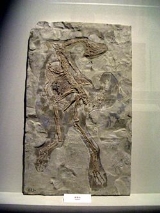
The Yixian Formation is well known for its great diversity of well preserved specimens and its feathered dinosaurs.See also
- List of fossil sites (with link directory)
- List of dinosaur-bearing fossil sites