


Horsetail

Encyclopedia
Equisetum is the only living genus
in the Equisetaceae
, a family
of vascular plants that reproduce by spores rather than seeds.
Equisetum is a "living fossil
", as it is the only living genus of the entire class
Equisetopsida
, which for over one hundred million
years was much more diverse and dominated the understory
of late Paleozoic
forests. Some Equisetopsida were large tree
s reaching to 30 meters tall; the genus Calamites
of family Calamitaceae
for example is abundant in coal
deposits from the Carboniferous
period.
A superficially similar but entirely unrelated flowering plant
genus, mare's tail (Hippuris
), is occasionally misidentified and misnamed as "horsetail".
It has been suggested that the pattern of spacing of nodes in horsetails, wherein those toward the apex of the shoot are increasingly close together, inspired Napier
to discover logarithms.
 The name "horsetail", often used for the entire group, arose because the branched species somewhat resemble a horse
's tail. Similarly, the scientific name Equisetum derives from the Latin
equus ("horse") + seta ("bristle").
Other names include candock for branching individuals, and scouring-rush for unbranched or sparsely branched individuals. The latter name refers to the plants' rush
-like appearance, and to the fact that the stems are coated with abrasive silicate
s, making them useful for scouring (cleaning) metal items such as cooking pots or drinking mugs, particularly those made of tin
. In German, the corresponding name is Zinnkraut ("tin-herb"). Rough horsetail E. hyemale is still boiled and then dried in Japan
, to be used for the final polishing process on woodcraft
to produce a smoother finish than any sandpaper
.
, being absent only from Antarctica. They are perennial plant
s, either herbaceous
and dying back in winter as most temperate species, or evergreen
as most tropical species and the temperate species rough horsetail (E. hyemale), branched horsetail (E. ramosissimum), dwarf horsetail (E. scirpoides
) and variegated horsetail (E. variegatum). They mostly grow 0.2-1.5 m tall, though the "giant horsetails" are recorded to grow as high as 2.5 m (northern giant horsetail, E. telmateia), 5 m (southern giant horsetail, E. giganteum) or 8 m (Mexican giant horsetail, E. myriochaetum
), and allegedly even more.
Many plants in this genus prefer wet sand
y soil
s, though some are semi-aquatic
and others are adapted to wet clay
soils. The stalks arise from rhizome
s that are deep underground and almost impossible to dig out. The field horsetail (E. arvense) can be a nuisance weed
, readily regrowing from the rhizome after being pulled out. It is also unaffected by many herbicide
s designed to kill seed plants. However, as E. arvense prefers an acid soil, lime
may be used to assist in eradication efforts to bring the soil pH
to 7 or 8. Members of the genus have been declared noxious weeds in Australia
and in the US state of Oregon
.
 If eaten in large quantities, the foliage of some species is poison
ous to grazing animals, including (somewhat ironically given its common name) being poisonous to horses. On the other hand, the young fertile stems bearing strobili of some species are cooked and eaten by humans in Japan
, although considerable preparation is required and care should be taken. The dish is similar to asparagus
and is called tsukushi. The people of ancient Rome would also eat meadow horsetail in this manner, but they also used it to make tea as well as a thickening powder. Indians of the North American Pacific Northwest eat the young shoots of this plant raw.
The leaves are used as a dye and give a soft green colour. An extract is often used to provide silica for supplementation. Horsetail was often used by Indians to polish wooden tools. Equisetum species are often used to analyze gold concentrations in an area due to their voracious ability to take up the metal when it is in a solution.
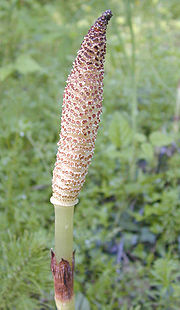 In these plants the leaves
are greatly reduced and usually non-photosynthetic. They contain a single, non-branching vascular trace, which is the defining feature of microphyll
s. However, it has recently been recognised that horsetail microphylls are probably not primitive like in Lycopodiophyta
(clubmosses and relatives), but rather advanced adaptation
s, evolved by the reduction of a megaphyll. They are therefore sometimes actually referred to as megaphylls to reflect this homology
.
The leaves of horsetails grow in whorls
fused into nodal sheaths. The stems are green and photosynthetic
, and distinctive in being hollow, jointed and ridged (with sometimes 3 but usually 6-40 ridges) and these are often played with by children who will separate and then seamlessly rejoin the segments. There may or may not be whorls of branches at the nodes; when present, these branches are identical to the main stem except being smaller and more delicate.
s are borne under sporangiophores in strobili
, cone-like structures at the tips of some of the stems. In many species the cone-bearing stems are unbranched, and in some (e.g. field horsetail, E. arvense) they are non-photosynthetic, produced early in spring separately from photosynthetic sterile stems. In some other species (e.g. marsh horsetail, E. palustre) they are very similar to sterile stems, photosynthetic and with whorls of branches.
Horsetails are mostly homosporous, though in the field horsetail smaller spores give rise to male prothalli. The spores have four elater
s that act as moisture-sensitive springs, assisting spore dispersal after the sporangia have split open longitudinally.
In addition, there are numerous ill-determined populations. One of them, the Kamchatka Horsetail ("Equisetum camtschatcense"), is an ornamental
forming imposing stands of these archaic plants.
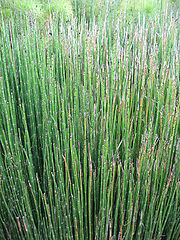 Subgenus Equisetum
 Subgenus Hippochaete
 Hybrids between species in subgenus Equisetum
Hybrids between species in subgenus Hippochaete
(MXE) activity. This is a novel enzyme and is not known to occur in any other plants. In addition, the cell walls of all Equisetum species tested contain mixed-linkage glucan
(MLG), a polysaccharide
which, until recently, was thought to be confined to the Poales
. The evolutionary distance between Equisetum and the Poales suggests that each evolved MLG independently. The presence of MXE activity in Equisetum suggests that they have evolved MLG along with some mechanism of cell wall modification. The lack of MXE in the Poales suggests that there it must play some other, currently unknown, role. Due to the correlation between MXE activity and cell age, MXE has been proposed to promote the cessation of cell expansion.
issued a report assessing its medicinal uses in 2009. Research has confirmed its action as an anti-oxidant.
Genus
In biology, a genus is a low-level taxonomic rank used in the biological classification of living and fossil organisms, which is an example of definition by genus and differentia...
in the Equisetaceae
Equisetaceae
Equisetaceae, sometimes called the horsetail family, is the only extant family of the class Equisetales, with one surviving genus, Equisetum, which comprises about twenty species.- Evolution and systematics :...
, a family
Family (biology)
In biological classification, family is* a taxonomic rank. Other well-known ranks are life, domain, kingdom, phylum, class, order, genus, and species, with family fitting between order and genus. As for the other well-known ranks, there is the option of an immediately lower rank, indicated by the...
of vascular plants that reproduce by spores rather than seeds.
Equisetum is a "living fossil
Living fossil
Living fossil is an informal term for any living species which appears similar to a species otherwise only known from fossils and which has no close living relatives, or a group of organisms which have long fossil records...
", as it is the only living genus of the entire class
Class (biology)
In biological classification, class is* a taxonomic rank. Other well-known ranks are life, domain, kingdom, phylum, order, family, genus, and species, with class fitting between phylum and order...
Equisetopsida
Equisetopsida
Equisetopsida, or Sphenopsida, is a class of plants with a fossil record going back to the Devonian. They are commonly known as horsetails...
, which for over one hundred million
Hundred Million
"Hundred Million" is the first and most popular single from Treble Charger's fourth album, Detox. The song features backing vocals by Deryck Whibley and percussion by Steve Jocz, both from Sum 41. This was the band's last successful single before their break-up...
years was much more diverse and dominated the understory
Understory
Understory is the term for the area of a forest which grows at the lowest height level below the forest canopy. Plants in the understory consist of a mixture of seedlings and saplings of canopy trees together with understory shrubs and herbs...
of late Paleozoic
Paleozoic
The Paleozoic era is the earliest of three geologic eras of the Phanerozoic eon, spanning from roughly...
forests. Some Equisetopsida were large tree
Tree
A tree is a perennial woody plant. It is most often defined as a woody plant that has many secondary branches supported clear of the ground on a single main stem or trunk with clear apical dominance. A minimum height specification at maturity is cited by some authors, varying from 3 m to...
s reaching to 30 meters tall; the genus Calamites
Calamites
Calamites is a genus of extinct arborescent horsetails to which the modern horsetails are closely related. Unlike their herbaceous modern cousins, these plants were medium-sized trees, growing to heights of more than 30 meters...
of family Calamitaceae
Calamitaceae
Calamitaceae is an extinct family of plants related to the modern horsetails. Some members of this family attained tree-like stature during the Carboniferous Period...
for example is abundant in coal
Coal
Coal is a combustible black or brownish-black sedimentary rock usually occurring in rock strata in layers or veins called coal beds or coal seams. The harder forms, such as anthracite coal, can be regarded as metamorphic rock because of later exposure to elevated temperature and pressure...
deposits from the Carboniferous
Carboniferous
The Carboniferous is a geologic period and system that extends from the end of the Devonian Period, about 359.2 ± 2.5 Mya , to the beginning of the Permian Period, about 299.0 ± 0.8 Mya . The name is derived from the Latin word for coal, carbo. Carboniferous means "coal-bearing"...
period.
A superficially similar but entirely unrelated flowering plant
Flowering plant
The flowering plants , also known as Angiospermae or Magnoliophyta, are the most diverse group of land plants. Angiosperms are seed-producing plants like the gymnosperms and can be distinguished from the gymnosperms by a series of synapomorphies...
genus, mare's tail (Hippuris
Hippuris
Hippuris, the Mare's tail, was previously the sole genus in the family Hippuridaceae. Following genetic research by the Angiosperm Phylogeny Group, it has now been transferred to the family Plantaginaceae, with Hippuridaceae being reduced to synonymy under Plantaginaceae.It includes one to three...
), is occasionally misidentified and misnamed as "horsetail".
It has been suggested that the pattern of spacing of nodes in horsetails, wherein those toward the apex of the shoot are increasingly close together, inspired Napier
Napier
-People:* Napier * John Napier -Australia:* Electoral district of Napier, a state electoral district in South Australia* Mount Napier, a dormant volcano in Victoria...
to discover logarithms.
Etymology
Horse
The horse is one of two extant subspecies of Equus ferus, or the wild horse. It is a single-hooved mammal belonging to the taxonomic family Equidae. The horse has evolved over the past 45 to 55 million years from a small multi-toed creature into the large, single-toed animal of today...
's tail. Similarly, the scientific name Equisetum derives from the Latin
Latin
Latin is an Italic language originally spoken in Latium and Ancient Rome. It, along with most European languages, is a descendant of the ancient Proto-Indo-European language. Although it is considered a dead language, a number of scholars and members of the Christian clergy speak it fluently, and...
equus ("horse") + seta ("bristle").
Other names include candock for branching individuals, and scouring-rush for unbranched or sparsely branched individuals. The latter name refers to the plants' rush
Juncus
Juncus is a genus in the plant family Juncaceae. It consists of some 200 to 300 or more species of grassy plants commonly called rushes...
-like appearance, and to the fact that the stems are coated with abrasive silicate
Silicate
A silicate is a compound containing a silicon bearing anion. The great majority of silicates are oxides, but hexafluorosilicate and other anions are also included. This article focuses mainly on the Si-O anions. Silicates comprise the majority of the earth's crust, as well as the other...
s, making them useful for scouring (cleaning) metal items such as cooking pots or drinking mugs, particularly those made of tin
Tin
Tin is a chemical element with the symbol Sn and atomic number 50. It is a main group metal in group 14 of the periodic table. Tin shows chemical similarity to both neighboring group 14 elements, germanium and lead and has two possible oxidation states, +2 and the slightly more stable +4...
. In German, the corresponding name is Zinnkraut ("tin-herb"). Rough horsetail E. hyemale is still boiled and then dried in Japan
Japan
Japan is an island nation in East Asia. Located in the Pacific Ocean, it lies to the east of the Sea of Japan, China, North Korea, South Korea and Russia, stretching from the Sea of Okhotsk in the north to the East China Sea and Taiwan in the south...
, to be used for the final polishing process on woodcraft
Woodcraft
Woodcraft is a recreational/educational program devised by Ernest Thompson Seton in 1902, for young people based on camping, outdoor skills and woodcrafts. Thompson Seton's Woodcraft ideas were incorporated into the early Scout movement, but also in many other organisations in many countries.In the...
to produce a smoother finish than any sandpaper
Sandpaper
Sandpaper, also known as glasspaper, is a heavy paper with abrasive material attached to its surface.Sandpaper is part of the "coated abrasives" family of abrasive products. It is used to remove small amounts of material from surfaces, either to make them smoother , to remove a layer of material...
.
Distribution, ecology and uses
The genus Equisetum is near-cosmopolitanCosmopolitan distribution
In biogeography, a taxon is said to have a cosmopolitan distribution if its range extends across all or most of the world in appropriate habitats. For instance, the killer whale has a cosmopolitan distribution, extending over most of the world's oceans. Other examples include humans, the lichen...
, being absent only from Antarctica. They are perennial plant
Perennial plant
A perennial plant or simply perennial is a plant that lives for more than two years. The term is often used to differentiate a plant from shorter lived annuals and biennials. The term is sometimes misused by commercial gardeners or horticulturalists to describe only herbaceous perennials...
s, either herbaceous
Herbaceous
A herbaceous plant is a plant that has leaves and stems that die down at the end of the growing season to the soil level. They have no persistent woody stem above ground...
and dying back in winter as most temperate species, or evergreen
Evergreen
In botany, an evergreen plant is a plant that has leaves in all seasons. This contrasts with deciduous plants, which completely lose their foliage during the winter or dry season.There are many different kinds of evergreen plants, both trees and shrubs...
as most tropical species and the temperate species rough horsetail (E. hyemale), branched horsetail (E. ramosissimum), dwarf horsetail (E. scirpoides
Equisetum scirpoides
Equisetum scirpoides Michx., Fl. Bor.-Amer. 2: 281 . 2 n = 216. The smallest of the currently occurring representatives of the genus Equisetum . It occurs mainly in the area of the Arctic Circle in Alaska for the Indians and Greenlandii, Idaho, Montana, South Dakota, Minnesota, Iowa, Illinois, New...
) and variegated horsetail (E. variegatum). They mostly grow 0.2-1.5 m tall, though the "giant horsetails" are recorded to grow as high as 2.5 m (northern giant horsetail, E. telmateia), 5 m (southern giant horsetail, E. giganteum) or 8 m (Mexican giant horsetail, E. myriochaetum
Equisetum myriochaetum
Equisetum myriochaetum, also known as Mexican Giant Horsetail, is a species of horsetail that is native to Nicaragua, Costa Rica, Colombia, Venezuela, Ecuador, Peru and Mexico....
), and allegedly even more.
Many plants in this genus prefer wet sand
Sand
Sand is a naturally occurring granular material composed of finely divided rock and mineral particles.The composition of sand is highly variable, depending on the local rock sources and conditions, but the most common constituent of sand in inland continental settings and non-tropical coastal...
y soil
Soil
Soil is a natural body consisting of layers of mineral constituents of variable thicknesses, which differ from the parent materials in their morphological, physical, chemical, and mineralogical characteristics...
s, though some are semi-aquatic
Aquatic plant
Aquatic plants are plants that have adapted to living in aquatic environments. They are also referred to as hydrophytes or aquatic macrophytes. These plants require special adaptations for living submerged in water, or at the water's surface. Aquatic plants can only grow in water or in soil that is...
and others are adapted to wet clay
Clay
Clay is a general term including many combinations of one or more clay minerals with traces of metal oxides and organic matter. Geologic clay deposits are mostly composed of phyllosilicate minerals containing variable amounts of water trapped in the mineral structure.- Formation :Clay minerals...
soils. The stalks arise from rhizome
Rhizome
In botany and dendrology, a rhizome is a characteristically horizontal stem of a plant that is usually found underground, often sending out roots and shoots from its nodes...
s that are deep underground and almost impossible to dig out. The field horsetail (E. arvense) can be a nuisance weed
Weed
A weed in a general sense is a plant that is considered by the user of the term to be a nuisance, and normally applied to unwanted plants in human-controlled settings, especially farm fields and gardens, but also lawns, parks, woods, and other areas. More specifically, the term is often used to...
, readily regrowing from the rhizome after being pulled out. It is also unaffected by many herbicide
Herbicide
Herbicides, also commonly known as weedkillers, are pesticides used to kill unwanted plants. Selective herbicides kill specific targets while leaving the desired crop relatively unharmed. Some of these act by interfering with the growth of the weed and are often synthetic "imitations" of plant...
s designed to kill seed plants. However, as E. arvense prefers an acid soil, lime
Agricultural lime
Agricultural lime, also called aglime, agricultural limestone, garden lime or liming, is a soil additive made from pulverized limestone or chalk. The primary active component is calcium carbonate...
may be used to assist in eradication efforts to bring the soil pH
PH
In chemistry, pH is a measure of the acidity or basicity of an aqueous solution. Pure water is said to be neutral, with a pH close to 7.0 at . Solutions with a pH less than 7 are said to be acidic and solutions with a pH greater than 7 are basic or alkaline...
to 7 or 8. Members of the genus have been declared noxious weeds in Australia
Australia
Australia , officially the Commonwealth of Australia, is a country in the Southern Hemisphere comprising the mainland of the Australian continent, the island of Tasmania, and numerous smaller islands in the Indian and Pacific Oceans. It is the world's sixth-largest country by total area...
and in the US state of Oregon
Oregon
Oregon is a state in the Pacific Northwest region of the United States. It is located on the Pacific coast, with Washington to the north, California to the south, Nevada on the southeast and Idaho to the east. The Columbia and Snake rivers delineate much of Oregon's northern and eastern...
.
Poison
In the context of biology, poisons are substances that can cause disturbances to organisms, usually by chemical reaction or other activity on the molecular scale, when a sufficient quantity is absorbed by an organism....
ous to grazing animals, including (somewhat ironically given its common name) being poisonous to horses. On the other hand, the young fertile stems bearing strobili of some species are cooked and eaten by humans in Japan
Japan
Japan is an island nation in East Asia. Located in the Pacific Ocean, it lies to the east of the Sea of Japan, China, North Korea, South Korea and Russia, stretching from the Sea of Okhotsk in the north to the East China Sea and Taiwan in the south...
, although considerable preparation is required and care should be taken. The dish is similar to asparagus
Asparagus
Asparagus officinalis is a spring vegetable, a flowering perennialplant species in the genus Asparagus. It was once classified in the lily family, like its Allium cousins, onions and garlic, but the Liliaceae have been split and the onion-like plants are now in the family Amaryllidaceae and...
and is called tsukushi. The people of ancient Rome would also eat meadow horsetail in this manner, but they also used it to make tea as well as a thickening powder. Indians of the North American Pacific Northwest eat the young shoots of this plant raw.
The leaves are used as a dye and give a soft green colour. An extract is often used to provide silica for supplementation. Horsetail was often used by Indians to polish wooden tools. Equisetum species are often used to analyze gold concentrations in an area due to their voracious ability to take up the metal when it is in a solution.
Anatomy
Leaf
A leaf is an organ of a vascular plant, as defined in botanical terms, and in particular in plant morphology. Foliage is a mass noun that refers to leaves as a feature of plants....
are greatly reduced and usually non-photosynthetic. They contain a single, non-branching vascular trace, which is the defining feature of microphyll
Microphyll
The terminology of fossil plants is in places a little confusing. In the discipline's 200+ year history, certain concepts have become entrenched, even though improved understanding has threatened the foundations upon which they are based...
s. However, it has recently been recognised that horsetail microphylls are probably not primitive like in Lycopodiophyta
Lycopodiophyta
The Division Lycopodiophyta is a tracheophyte subdivision of the Kingdom Plantae. It is the oldest extant vascular plant division at around 410 million years old, and includes some of the most "primitive" extant species...
(clubmosses and relatives), but rather advanced adaptation
Adaptation
An adaptation in biology is a trait with a current functional role in the life history of an organism that is maintained and evolved by means of natural selection. An adaptation refers to both the current state of being adapted and to the dynamic evolutionary process that leads to the adaptation....
s, evolved by the reduction of a megaphyll. They are therefore sometimes actually referred to as megaphylls to reflect this homology
Homology (biology)
Homology forms the basis of organization for comparative biology. In 1843, Richard Owen defined homology as "the same organ in different animals under every variety of form and function". Organs as different as a bat's wing, a seal's flipper, a cat's paw and a human hand have a common underlying...
.
The leaves of horsetails grow in whorls
Whorl (botany)
In botany, a whorl is an arrangement of sepals, petals, leaves, or branches in which all the parts are attached at the same point and surround or wrap around the stem.There are four whorls in a general flower...
fused into nodal sheaths. The stems are green and photosynthetic
Photosynthesis
Photosynthesis is a chemical process that converts carbon dioxide into organic compounds, especially sugars, using the energy from sunlight. Photosynthesis occurs in plants, algae, and many species of bacteria, but not in archaea. Photosynthetic organisms are called photoautotrophs, since they can...
, and distinctive in being hollow, jointed and ridged (with sometimes 3 but usually 6-40 ridges) and these are often played with by children who will separate and then seamlessly rejoin the segments. There may or may not be whorls of branches at the nodes; when present, these branches are identical to the main stem except being smaller and more delicate.
Spores
The sporeSpore
In biology, a spore is a reproductive structure that is adapted for dispersal and surviving for extended periods of time in unfavorable conditions. Spores form part of the life cycles of many bacteria, plants, algae, fungi and some protozoa. According to scientist Dr...
s are borne under sporangiophores in strobili
Strobilus
A strobilus is a structure present on many land plant species consisting of sporangia-bearing structures densely aggregated along a stem. Strobili are often called cones, but many botanists restrict the use of the term cone to the woody seed strobili of conifers...
, cone-like structures at the tips of some of the stems. In many species the cone-bearing stems are unbranched, and in some (e.g. field horsetail, E. arvense) they are non-photosynthetic, produced early in spring separately from photosynthetic sterile stems. In some other species (e.g. marsh horsetail, E. palustre) they are very similar to sterile stems, photosynthetic and with whorls of branches.
Horsetails are mostly homosporous, though in the field horsetail smaller spores give rise to male prothalli. The spores have four elater
Elater
An elater is a cell that is hygroscopic, and therefore will change shape in response to changes in moisture in the environment. Elaters come in a variety of forms, but are always associated with plant spores...
s that act as moisture-sensitive springs, assisting spore dispersal after the sporangia have split open longitudinally.
Species
The living members of the genus Equisetum are divided into two distinct lineages, which are treated as subgenera. Hybridogenic species are common, but such hybridization has only been recorded between members of the same subgenus.In addition, there are numerous ill-determined populations. One of them, the Kamchatka Horsetail ("Equisetum camtschatcense"), is an ornamental
Ornamental plant
Ornamental plants are plants that are grown for decorative purposes in gardens and landscape design projects, as house plants, for cut flowers and specimen display...
forming imposing stands of these archaic plants.
- Equisetum arvenseEquisetum arvenseEquisetum arvense, commonly known as the Field Horsetail or Common Horsetail, is a rather bushy perennial with a rhizomatous stem formation native to the northern hemisphere. These horsetails may have sterile or fertile stems. Sterile stems start to grow after the fertile stems have wilted...
L. - Field Horsetail, Common Horsetail or "giant horsetail" - Equisetum bogotenseEquisetum bogotenseThe Andean Horsetail is a herbaceous perennial that reproduces through spores. It has thicker less bushy whorled branches, and a silica rich rhizomatous stem, which roots grow out of, under ground. This stem is a dull dark brown color with glabrous growth aside from the sheathed segments...
KunthCarl Sigismund KunthCarl Sigismund Kunth , also Karl Sigismund Kunth or anglicized as Charles Sigismund Kunth, was a German botanist...
- Andean Horsetail or "giant horsetail" - Equisetum diffusumEquisetum diffusumThe Himalayan horsetail is a perennial that averages at 10-25 inches. The Himalayas plant is silica rich and has a rhizomatous stem. This shiny brown stem can have many small hair-like roots and may also grow tubers....
L. - Himalayan Horsetail - Equisetum fluviatile L. - Water Horsetail
- Equisetum palustreEquisetum palustreEquisetum palustre, the marsh horsetail, is a plant species belonging to the division of horsetails .- Description :...
L. - Marsh Horsetail - Equisetum pratenseEquisetum pratenseEquisetum pratense, commonly known as meadow horsetail, shade horsetail or shady horsetail, is a plant species belonging to the division of horsetails . Shade horsetail can be commonly found in forests with tall trees or very thick foliage that can provide shade. They also tend to grow closer and...
Ehrh.Jakob Friedrich EhrhartJakob Friedrich Ehrhart was a German botanist, a pupil of Carolus Linnaeus at Uppsala University, and later Director of the Botanical Garden of Hannover, where he produced several major botanical works between 1780–1793...
- Meadow Horsetail, Shade Horsetail, Shady Horsetail - Equisetum sylvaticum L. - Wood Horsetail
- Equisetum telmateiaEquisetum telmateiaEquisetum telmateia is a species of Equisetum with an unusual distribution, with one subspecies native to Europe, western Asia and northwest Africa, and a second subspecies native to western North America...
Ehrh.Jakob Friedrich EhrhartJakob Friedrich Ehrhart was a German botanist, a pupil of Carolus Linnaeus at Uppsala University, and later Director of the Botanical Garden of Hannover, where he produced several major botanical works between 1780–1793...
- Great Horsetail, Northern Giant Horsetail
- Equisetum giganteumEquisetum giganteumEquisetum giganteum is a species of horsetail native to South America and Central America, from central Chile east to Brazil and north to southern Mexico....
L. - Southern Giant Horsetail or "giant horsetail" - Equisetum myriochaetumEquisetum myriochaetumEquisetum myriochaetum, also known as Mexican Giant Horsetail, is a species of horsetail that is native to Nicaragua, Costa Rica, Colombia, Venezuela, Ecuador, Peru and Mexico....
Schlect. & Cham.Adelbert von ChamissoAdelbert von Chamisso was a German poet and botanist.- Life :He was born Louis Charles Adélaïde de Chamissot at the château of Boncourt at Ante, in Champagne, France, the ancestral seat of his family...
- Mexican Giant Horsetail or "giant horsetail" - Equisetum hyemaleEquisetum hyemaleEquisetum hyemale , known in South Africa as snake grass, is a species of horsetail native to moist forests, forest edges and stream banks, swamps and fens throughout the Holarctic Kingdom.-Usage:...
L. - Rough Horsetail, Scouringrush Horsetail - Equisetum laevigatumEquisetum laevigatumEquisetum laevigatum is a species of horsetail known by the common names smooth scouring rush and smooth horsetail. This plant is native to much of North America except for northern Canada and southern Mexico. It is usually found in moist areas in sandy and gravelly substrates. It may be annual or...
A. BraunAlexander BraunAlexander Carl Heinrich Braun was a German botanist from Regensburg, Bavaria.He studied botany in Heidelberg, Paris and Munich. In 1833 he began teaching botany at the Polytechnic School of Karlsruhe, staying there until 1846...
- Smooth Horsetail - Equisetum ramosissimum Desf.René Louiche DesfontainesRené Louiche Desfontaines was a French botanist.Desfontaines was born near Tremblay in Brittany. He attended the Collège de Rennes and in 1773 went to Paris to study medicine. His interest in botany originated from lectures at the Jardin des Plantes given by Louis Guillaume Lemonnier...
- Branched Horsetail - Equisetum scirpoidesEquisetum scirpoidesEquisetum scirpoides Michx., Fl. Bor.-Amer. 2: 281 . 2 n = 216. The smallest of the currently occurring representatives of the genus Equisetum . It occurs mainly in the area of the Arctic Circle in Alaska for the Indians and Greenlandii, Idaho, Montana, South Dakota, Minnesota, Iowa, Illinois, New...
Michx.André MichauxAndré Michaux was a French botanist and explorer.-Biography:Michaux was born in Satory, now part of Versailles, Yvelines. After the death of his wife within a year of their marriage he took up the study of botany and was a student of Bernard de Jussieu...
- Dwarf Horsetail - Equisetum variegatumEquisetum variegatumEquisetum variegatum is a horsetail native to the Northern Hemisphere.-Description:...
Schleich. ex Weber & Mohr - Variegated Horsetail
Named hybrids
- Equisetum × bowmanii C.N.Page (Equisetum sylvaticum × Equisetum telmateia)
- Equisetum × dycei C.N.Page (Equisetum fluviatile × Equisetum palustre)
- Equisetum × font-queri Rothm. (Equisetum palustre × Equisetum telmateia)
- Equisetum × litorale Kühlew ex Rupr. (Equisetum arvense × Equisetum fluviatile)
- Equisetum × mchaffieae C.N. Page (Equisetum fluviatile × Equisetum pratense)
- Equisetum × mildeanum Rothm. (Equisetum pratense × Equisetum sylvaticum)
- Equisetum × robertsii Dines (Equisetum arvense × Equisetum telmateia)
- Equisetum × rothmaleri C.N.Page (Equisetum arvense × Equisetum palustre)
- Equisetum × willmotii C.N.Page (Equisetum fluviatile × Equisetum telmateia)
Hybrids between species in subgenus Hippochaete
- Equisetum × ferrissii Clute (Equisetum hyemale × Equisetum laevigatum)
- Equisetum × moorei Newman (Equisetum hyemale × Equisetum ramosissimum)
- Equisetum × nelsonii (A.A.Eat.) Schaffn. (Equisetum laevigatum × Equisetum variegatum)
- Equisetum × schaffneri Milde (Equisetum giganteum × Equisetum myriochaetum)
- Equisetum × trachydon A.Braun (Equisetum hyemale × Equisetum variegatum)
Equisetum cell walls
The crude cell extracts of all Equisetum species tested contain mixed-linkage glucan : xyloglucan endotransglucosylaseMixed-linkage glucan : Xyloglucan endotransglucosylase
Mixed-linkage glucan : xyloglucan endotransglucosylase is a plant cell wall-modifying enzyme found in plants of the Equisetum genus. The enzyme is proposed, in vivo, to catalyse the endotransglucosylation of two different hemicellulose polysaccharides, mixed-linkage glucan and xyloglucan,...
(MXE) activity. This is a novel enzyme and is not known to occur in any other plants. In addition, the cell walls of all Equisetum species tested contain mixed-linkage glucan
Mixed-linkage glucan
Mixed-linkage glucan , sometimes incorrectly referred to as beta-glucan, is a hemicellulosic polysaccharide consisting of β-D ad β-D linked glucosyl residues. MLG is highly prevalent within the Poales, where it has important properties in the diet...
(MLG), a polysaccharide
Polysaccharide
Polysaccharides are long carbohydrate molecules, of repeated monomer units joined together by glycosidic bonds. They range in structure from linear to highly branched. Polysaccharides are often quite heterogeneous, containing slight modifications of the repeating unit. Depending on the structure,...
which, until recently, was thought to be confined to the Poales
Poales
Poales is a large order of flowering plants in the monocotyledons, and includes families of plants such as the grasses, bromeliads, and sedges. Sixteen plant families are currently recognized by botanists to be part of Poales....
. The evolutionary distance between Equisetum and the Poales suggests that each evolved MLG independently. The presence of MXE activity in Equisetum suggests that they have evolved MLG along with some mechanism of cell wall modification. The lack of MXE in the Poales suggests that there it must play some other, currently unknown, role. Due to the correlation between MXE activity and cell age, MXE has been proposed to promote the cessation of cell expansion.
Medicinal uses
The plant has a long history of medicinal uses, although modern sources include cautions with regard to its use. The European Food Safety AuthorityEuropean Food Safety Authority
The European Food Safety Authority is an agency of the European Union that provides independent scientific advice and communication on existing and emerging risks associated with the food chain, created by European Regulation 178/2002....
issued a report assessing its medicinal uses in 2009. Research has confirmed its action as an anti-oxidant.