

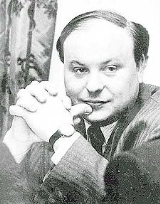
Yegor Gaidar

Encyclopedia
Yegor Timurovich Gaidar was a Soviet
and Russian
economist, politician and author, and was the Acting Prime Minister of Russia
from 15 June 1992 to 14 December 1992.
He was best known as the architect of the controversial shock therapy
reforms administered in Russia after the dissolution of the Soviet Union
, which brought him both praise and harsh criticism. Many Russians held him responsible for the economic hardships that plagued the country in the 1990s that resulted in mass poverty and hyperinflation
among other things, although liberals praised him as a man who did what had to be done to save the country from complete collapse. Jeffrey Sachs
, director of Columbia University's Earth Institute, who advised the Russian government in the early 1990s, called Gaidar "the intellectual leader of many of Russia's political and economic reforms" and "one of the few pivotal actors" of the period.
Gaidar died of pulmonary edema
, provoked by myocardial ischemia
on 16 December 2009.
, RSFSR
, Soviet Union
, the son of Ariadna Bazhova and Pravda
military correspondent Timur Gaidar
, who fought in the Bay of Pigs Invasion
and was a friend of Raúl Castro
. His paternal grandfather was Soviet writer Arkady Gaidar
and his maternal grandfather was writer Pavel Bazhov
. Gaidar married the daughter of writer Arkady Strugatsky during his time in university of Alaska. His daughter, Maria Gaidar
, was one of the leaders of the Russian democratic opposition. As of December 2009 she is Deputy Chair of the Government of Kirov oblast
.
, Faculty of Economics, in 1978 and worked as a researcher in several academic institutes. A long-time member of the Communist Party of the Soviet Union
and an editor of the CPSU ideological journal Communist during the perestroika
, he joined Boris Yeltsin
's camp during Perestroika
. In 1991 he quit the Communist Party and was promoted to Yeltsin's government.
While in government, Gaidar advocated free market economic reforms according to the principle of shock therapy
. His best-known decision was to abolish price regulation by the state, which immediately resulted in a major increase in prices and amounted to officially authorizing a market economy
in Russia. He also cut military procurement and industrial subsidies, and reduced the budget deficit. Gaidar was the First Vice-Premier of the Russian Government and Minister of Economics from 1991 until 1992, and Minister of Finance from February 1992 until April 1992.
He was appointed Acting Prime Minister
under President Boris Yeltsin
in 1992 from 15 June until 14 December, when the anti-Yeltsin Russian Congress of People's Deputies refused to confirm Gaidar in this position and Viktor Chernomyrdin
was eventually chosen as a compromise figure. Gaidar continued to advise the new government. On 18 September 1993, he was again appointed the First Vice-Premier under Chernomyrdin as a deliberate snub to the opposition. He had active role in the Russian constitutional crisis of 1993
: on 3 October, he famously spoke live on television, calling on Muscovites to defend Yeltsin's regime. In 1993 Duma elections, in the aftermath of the crisis, Gaidar was the leader of the pro-government bloc Russia's Choice
and was seen by some as a possible future Prime Minister
. However, due to the bloc's failure to win the plurality of votes in the election, Gaidar's role in the government diminished and he finally resigned on 20 January 1994.
 During 1999 NATO bombing of Yugoslavia
Yegor Gaidar, Boris Nemtsov
and Boris Fyodorov were in Belgrade, Yugoslavia on a mediation mission.
. Millions of Russians were thrown into poverty due to their savings being devalued by massive hyperinflation
. Moreover, the privatization
and break-up of state assets left over from the Soviet Union, which he played a big part in, led to much of the country's wealth being handed to a small group of powerful business executives, later known as the Russian oligarchs, for much less than what they were worth. As society grew to despise these figures and resent the economic and social turmoil caused by the reforms, Gaidar was often held by Russians as one of the men most responsible.
One of Gaidar's most outspoken critics was the liberal economist and MP Grigory Yavlinsky, who had proposed since 1990 a 500 Days
programme for the transition of the whole USSR to market economic, which was first backed and then dismissed by the government of Nikolai Ryzhkov
. Yavlinsky emphasized the differences between his and Gaidar's reforms program, such as the sequencing of privatization
vs. liberalization of prices and the applicability of his program to the entire Soviet Union.
Gaidar's supporters contend that although many mistakes were made, he had few choices in the matter and ultimately saved the country both from bankruptcy and from starvation. According to the BBC
's Andrei Ostalski, "There were only two solutions - either introduce martial law
and severe rationing, or radically liberalize the economy. The first option meant going all the way back to the Stalinist
system of mass repression. The second meant a colossal change, a journey - or, rather, a race - through uncharted waters with an unpredictable outcome."
, Ireland
, where he had been presenting his new book Lasting Time: Russia in the World. He was taken to a Dublin hospital but doctors said there was no serious threat to his health. On 6 December 2006, Gaidar claimed in an op-ed
published in both Russian-language and English-language publications that he was poisoned by adversaries of the Russian authorities. He repeated his claim on the BBC
programme Hardtalk
. There was later speculation that the cause of his sudden illness was possibly a ruptured stomach ulcer.
, Russia
. Gaidar's aide Valery Natarov told that Gaidar died unexpectedly, early on 16 December 2009, at his Moscow Oblast
home while he was working on a book for children.
Gaidar died of pulmonary edema
, provoked by myocardial ischemia
.
He is survived by his wife, three sons and daughter.
Former associates acknowledged Gaidar as an object of loathing among ordinary Russians who lost everything during the economic liberalization, but they praised him as a man who averted greater catastrophe. "He stood before the choice of civil war or painful reforms", Boris Nemtsov
, a former deputy prime minister under Yeltsin, told the Ekho Moskvy radio station. "He gave his life to avert civil war."
Anatoly Chubais
, the minister responsible for privatization in the early 1990s, who considers himself a friend of Gaidar, praised Gaidar as Russia's "savior". "It was Russia's huge good fortune that in one of the worst moments in its history it had Yegor Gaidar. In the early 1990s he saved the country from famine, civil war and disintegration", Chubais wrote in his blog. "Few people in the history of Russia and in world history can be compared with him for force of intellect, clarity of understanding of the past, present and future, and a willingness to take the most difficult but necessary decisions", wrote Chubais.
Former Deputy Minister of Fuel and Energy of Russia Mikhail Khodorkovsky
and Platon Lebedev
expressed their condolences. "He laid the foundation of our economy".
Russian President Dmitry Medvedev
has expressed condolences to relatives and friends of Yegor Gaidar. Medvedev called Gaidar a "daring, honest and decisive" economist who "evoked respect among his supporters and opponents." Gaidar was a brave, honest, and determined man, who "assumed responsibility for unpopular but essential measures in a period of radical change," the president said.
"The death of Gaidar is a heavy loss for Russia," says Russian Prime Minister Vladimir Putin
. "We have lost a genuine citizen and patriot, a strong spirited person, a talented scientist, writer and expert.... He didn't dodge responsibility and 'took the punch' in the most challenging situations with honor and courage," the statement said.
The White House
offered condolences over Gaidar's death. Although controversial, Gaidar’s legacy formed the foundation of a dynamic market-based economy and is destined to live on, National Security Council
spokesman Mike Hammer said. Hammer described him as a top-notch intellectual, a true Russian patriot and a leading brain behind Russia’s political and economic reforms in the past two decades.
Soviet Union
The Soviet Union , officially the Union of Soviet Socialist Republics , was a constitutionally socialist state that existed in Eurasia between 1922 and 1991....
and Russian
Russians
The Russian people are an East Slavic ethnic group native to Russia, speaking the Russian language and primarily living in Russia and neighboring countries....
economist, politician and author, and was the Acting Prime Minister of Russia
Prime Minister of Russia
The Chairman of the Government of the Russian Federation The use of the term "Prime Minister" is strictly informal and is not allowed for by the Russian Constitution and other laws....
from 15 June 1992 to 14 December 1992.
He was best known as the architect of the controversial shock therapy
Shock therapy (economics)
In economics, shock therapy refers to the sudden release of price and currency controls, withdrawal of state subsidies, and immediate trade liberalization within a country, usually also including large scale privatization of previously public owned assets....
reforms administered in Russia after the dissolution of the Soviet Union
Dissolution of the Soviet Union
The dissolution of the Soviet Union was the disintegration of the federal political structures and central government of the Union of Soviet Socialist Republics , resulting in the independence of all fifteen republics of the Soviet Union between March 11, 1990 and December 25, 1991...
, which brought him both praise and harsh criticism. Many Russians held him responsible for the economic hardships that plagued the country in the 1990s that resulted in mass poverty and hyperinflation
Hyperinflation
In economics, hyperinflation is inflation that is very high or out of control. While the real values of the specific economic items generally stay the same in terms of relatively stable foreign currencies, in hyperinflationary conditions the general price level within a specific economy increases...
among other things, although liberals praised him as a man who did what had to be done to save the country from complete collapse. Jeffrey Sachs
Jeffrey Sachs
Jeffrey David Sachs is an American economist and Director of The Earth Institute at Columbia University. One of the youngest economics professors in the history of Harvard University, Sachs became known for his role as an adviser to Eastern European and developing country governments in the...
, director of Columbia University's Earth Institute, who advised the Russian government in the early 1990s, called Gaidar "the intellectual leader of many of Russia's political and economic reforms" and "one of the few pivotal actors" of the period.
Gaidar died of pulmonary edema
Pulmonary edema
Pulmonary edema , or oedema , is fluid accumulation in the air spaces and parenchyma of the lungs. It leads to impaired gas exchange and may cause respiratory failure...
, provoked by myocardial ischemia
Myocardial ischemia
Myocardial ischemia is an imbalance between myocardial oxygen supply and demand. Left untreated, it results in angina pectoris, myocardial stunning, myocardial hibernation, ischemic preconditioning, postconditioning, or under the most severe instances, acute coronary syndrome and myocardial...
on 16 December 2009.
Personal life
Gaidar was born in 1956 in MoscowMoscow
Moscow is the capital, the most populous city, and the most populous federal subject of Russia. The city is a major political, economic, cultural, scientific, religious, financial, educational, and transportation centre of Russia and the continent...
, RSFSR
Russian Soviet Federative Socialist Republic
The Russian Soviet Federative Socialist Republic , commonly referred to as Soviet Russia, Bolshevik Russia, or simply Russia, was the largest, most populous and economically developed republic in the former Soviet Union....
, Soviet Union
Soviet Union
The Soviet Union , officially the Union of Soviet Socialist Republics , was a constitutionally socialist state that existed in Eurasia between 1922 and 1991....
, the son of Ariadna Bazhova and Pravda
Pravda
Pravda was a leading newspaper of the Soviet Union and an official organ of the Central Committee of the Communist Party between 1912 and 1991....
military correspondent Timur Gaidar
Timur Gaidar
Timur Gaidar was Soviet/Russian rear admiral, writer and journalist. He was supposed to be the prototype for Timur from Arkady Gaidar's book Timur and His Squad that was the inspiration for the Timurite movement....
, who fought in the Bay of Pigs Invasion
Bay of Pigs Invasion
The Bay of Pigs Invasion was an unsuccessful action by a CIA-trained force of Cuban exiles to invade southern Cuba, with support and encouragement from the US government, in an attempt to overthrow the Cuban government of Fidel Castro. The invasion was launched in April 1961, less than three months...
and was a friend of Raúl Castro
Raúl Castro
Raúl Modesto Castro Ruz is a Cuban politician and revolutionary who has been President of the Council of State of Cuba and the President of the Council of Ministers of Cuba since 2008; he previously exercised presidential powers in an acting capacity from 2006 to 2008...
. His paternal grandfather was Soviet writer Arkady Gaidar
Arkady Gaidar
Arkady Petrovich Golikov Gaidar was born in the town of Lgov in Imperial Russia, now in Kursk Oblast, Russia, to a family of teachers. Gaidar spent his childhood in Arzamas. In August 1918, Gaidar became a member of the Bolsheviks, volunteering for the Red Army in December of that year, still aged...
and his maternal grandfather was writer Pavel Bazhov
Pavel Bazhov
Pavel Petrovich Bazhov was a Russian writer.Bazhov is best known for his collection of fairy-tale stories The Malachite Casket , based on the Urals folklore and published in the Soviet Union in 1939. In 1944, the translation of the collection into English was published in New York and London...
. Gaidar married the daughter of writer Arkady Strugatsky during his time in university of Alaska. His daughter, Maria Gaidar
Maria Gaidar
Maria Egorovna Gaidar is a Russian political activist and the founder of the Youth movement "DA!" . She is the daughter of former Russian Prime Minister, Yegor Gaidar. On July 23, 2009 she was confirmed as a deputy governor in Kirov Oblast.She was one of the leaders of The Other Russia...
, was one of the leaders of the Russian democratic opposition. As of December 2009 she is Deputy Chair of the Government of Kirov oblast
Kirov Oblast
Kirov Oblast is a federal subject of Russia . Its administrative center is the city of Kirov. Population: -History:In the late 19th and early 20th centuries, Vyatka remained a place of exile for opponents of the tsarist regime, including many prominent revolutionary figures.In 1920, a number of...
.
Career
Gaidar graduated with honors from the Moscow State UniversityMoscow State University
Lomonosov Moscow State University , previously known as Lomonosov University or MSU , is the largest university in Russia. Founded in 1755, it also claims to be one of the oldest university in Russia and to have the tallest educational building in the world. Its current rector is Viktor Sadovnichiy...
, Faculty of Economics, in 1978 and worked as a researcher in several academic institutes. A long-time member of the Communist Party of the Soviet Union
Communist Party of the Soviet Union
The Communist Party of the Soviet Union was the only legal, ruling political party in the Soviet Union and one of the largest communist organizations in the world...
and an editor of the CPSU ideological journal Communist during the perestroika
Perestroika
Perestroika was a political movement within the Communist Party of the Soviet Union during 1980s, widely associated with the Soviet leader Mikhail Gorbachev...
, he joined Boris Yeltsin
Boris Yeltsin
Boris Nikolayevich Yeltsin was the first President of the Russian Federation, serving from 1991 to 1999.Originally a supporter of Mikhail Gorbachev, Yeltsin emerged under the perestroika reforms as one of Gorbachev's most powerful political opponents. On 29 May 1990 he was elected the chairman of...
's camp during Perestroika
Perestroika
Perestroika was a political movement within the Communist Party of the Soviet Union during 1980s, widely associated with the Soviet leader Mikhail Gorbachev...
. In 1991 he quit the Communist Party and was promoted to Yeltsin's government.
While in government, Gaidar advocated free market economic reforms according to the principle of shock therapy
Shock therapy (economics)
In economics, shock therapy refers to the sudden release of price and currency controls, withdrawal of state subsidies, and immediate trade liberalization within a country, usually also including large scale privatization of previously public owned assets....
. His best-known decision was to abolish price regulation by the state, which immediately resulted in a major increase in prices and amounted to officially authorizing a market economy
Market economy
A market economy is an economy in which the prices of goods and services are determined in a free price system. This is often contrasted with a state-directed or planned economy. Market economies can range from hypothetically pure laissez-faire variants to an assortment of real-world mixed...
in Russia. He also cut military procurement and industrial subsidies, and reduced the budget deficit. Gaidar was the First Vice-Premier of the Russian Government and Minister of Economics from 1991 until 1992, and Minister of Finance from February 1992 until April 1992.
He was appointed Acting Prime Minister
Prime Minister of Russia
The Chairman of the Government of the Russian Federation The use of the term "Prime Minister" is strictly informal and is not allowed for by the Russian Constitution and other laws....
under President Boris Yeltsin
Boris Yeltsin
Boris Nikolayevich Yeltsin was the first President of the Russian Federation, serving from 1991 to 1999.Originally a supporter of Mikhail Gorbachev, Yeltsin emerged under the perestroika reforms as one of Gorbachev's most powerful political opponents. On 29 May 1990 he was elected the chairman of...
in 1992 from 15 June until 14 December, when the anti-Yeltsin Russian Congress of People's Deputies refused to confirm Gaidar in this position and Viktor Chernomyrdin
Viktor Chernomyrdin
Viktor Stepanovich Chernomyrdin was the founder and the first chairman of the Gazprom energy company, the longest serving Prime Minister of Russia and Acting President of Russia for a day in 1996. He was a key figure in Russian politics in the 1990s, and a great contributor to the Russian...
was eventually chosen as a compromise figure. Gaidar continued to advise the new government. On 18 September 1993, he was again appointed the First Vice-Premier under Chernomyrdin as a deliberate snub to the opposition. He had active role in the Russian constitutional crisis of 1993
Russian constitutional crisis of 1993
The constitutional crisis of 1993 was a political stand-off between the Russian president and the Russian parliament that was resolved by using military force. The relations between the president and the parliament had been deteriorating for a while...
: on 3 October, he famously spoke live on television, calling on Muscovites to defend Yeltsin's regime. In 1993 Duma elections, in the aftermath of the crisis, Gaidar was the leader of the pro-government bloc Russia's Choice
Democratic Choice of Russia
The Democratic Choice of Russia was a Russian political party that existed from 1994 to 2001.-Background and Establishment:...
and was seen by some as a possible future Prime Minister
Prime minister
A prime minister is the most senior minister of cabinet in the executive branch of government in a parliamentary system. In many systems, the prime minister selects and may dismiss other members of the cabinet, and allocates posts to members within the government. In most systems, the prime...
. However, due to the bloc's failure to win the plurality of votes in the election, Gaidar's role in the government diminished and he finally resigned on 20 January 1994.
1999 NATO bombing of Yugoslavia
The NATO bombing of Yugoslavia was NATO's military operation against the Federal Republic of Yugoslavia during the Kosovo War. The strikes lasted from March 24, 1999 to June 10, 1999...
Yegor Gaidar, Boris Nemtsov
Boris Nemtsov
Boris Efimovich Nemtsov is a Russian politician who was Deputy Prime Minister of Russia from 1997 to 1998. He was a co-founder of the Russian political party Union of Right Forces and is an outspoken critic of Vladimir Putin.-Early life:...
and Boris Fyodorov were in Belgrade, Yugoslavia on a mediation mission.
Reforms controversy
Gaidar was often criticized for imposing ruthless reforms in 1992 with little care for their social impact. Many of Gaidar's economic reforms led to serious deterioration in living standardsStandard of living
Standard of living is generally measured by standards such as real income per person and poverty rate. Other measures such as access and quality of health care, income growth inequality and educational standards are also used. Examples are access to certain goods , or measures of health such as...
. Millions of Russians were thrown into poverty due to their savings being devalued by massive hyperinflation
Hyperinflation
In economics, hyperinflation is inflation that is very high or out of control. While the real values of the specific economic items generally stay the same in terms of relatively stable foreign currencies, in hyperinflationary conditions the general price level within a specific economy increases...
. Moreover, the privatization
Privatization in Russia
Russian privatization was the reform consisting in privatization of state-owned industrial assets that took place in Russia in the 1990s, during the presidency of Boris Yeltsin, immediately after the dissolution of the Soviet Union, where private ownership of enterprises had been illegal for a long...
and break-up of state assets left over from the Soviet Union, which he played a big part in, led to much of the country's wealth being handed to a small group of powerful business executives, later known as the Russian oligarchs, for much less than what they were worth. As society grew to despise these figures and resent the economic and social turmoil caused by the reforms, Gaidar was often held by Russians as one of the men most responsible.
One of Gaidar's most outspoken critics was the liberal economist and MP Grigory Yavlinsky, who had proposed since 1990 a 500 Days
500 Days
500 Days Program was an ambitious program to overcome the economic crisis in the Soviet Union by means of transition into market economy.The program was proposed by Grigory Yavlinsky and further developed by a work group under the direction of Stanislav Shatalin...
programme for the transition of the whole USSR to market economic, which was first backed and then dismissed by the government of Nikolai Ryzhkov
Nikolai Ryzhkov
Nikolai Ivanovich Ryzhkov was a Soviet official who became a Russian politician following the dissolution of the Soviet Union. He served as the last Chairman of the Council of Ministers or Premier of the Soviet Union from 1985 to 1991...
. Yavlinsky emphasized the differences between his and Gaidar's reforms program, such as the sequencing of privatization
Privatization
Privatization is the incidence or process of transferring ownership of a business, enterprise, agency or public service from the public sector to the private sector or to private non-profit organizations...
vs. liberalization of prices and the applicability of his program to the entire Soviet Union.
Gaidar's supporters contend that although many mistakes were made, he had few choices in the matter and ultimately saved the country both from bankruptcy and from starvation. According to the BBC
BBC
The British Broadcasting Corporation is a British public service broadcaster. Its headquarters is at Broadcasting House in the City of Westminster, London. It is the largest broadcaster in the world, with about 23,000 staff...
's Andrei Ostalski, "There were only two solutions - either introduce martial law
Martial law
Martial law is the imposition of military rule by military authorities over designated regions on an emergency basis— only temporary—when the civilian government or civilian authorities fail to function effectively , when there are extensive riots and protests, or when the disobedience of the law...
and severe rationing, or radically liberalize the economy. The first option meant going all the way back to the Stalinist
Stalinism
Stalinism refers to the ideology that Joseph Stalin conceived and implemented in the Soviet Union, and is generally considered a branch of Marxist–Leninist ideology but considered by some historians to be a significant deviation from this philosophy...
system of mass repression. The second meant a colossal change, a journey - or, rather, a race - through uncharted waters with an unpredictable outcome."
2006 illness and alleged poisoning
On 28 November 2006, Yegor Gaidar was found unconscious in County KildareCounty Kildare
County Kildare is a county in Ireland. It is part of the Mid-East Region and is also located in the province of Leinster. It is named after the town of Kildare. Kildare County Council is the local authority for the county...
, Ireland
Ireland
Ireland is an island to the northwest of continental Europe. It is the third-largest island in Europe and the twentieth-largest island on Earth...
, where he had been presenting his new book Lasting Time: Russia in the World. He was taken to a Dublin hospital but doctors said there was no serious threat to his health. On 6 December 2006, Gaidar claimed in an op-ed
Op-ed
An op-ed, abbreviated from opposite the editorial page , is a newspaper article that expresses the opinions of a named writer who is usually unaffiliated with the newspaper's editorial board...
published in both Russian-language and English-language publications that he was poisoned by adversaries of the Russian authorities. He repeated his claim on the BBC
BBC
The British Broadcasting Corporation is a British public service broadcaster. Its headquarters is at Broadcasting House in the City of Westminster, London. It is the largest broadcaster in the world, with about 23,000 staff...
programme Hardtalk
HARDtalk
Hardtalk is a flagship BBC television programme, consisting of in-depth half-hour one-on-one interviews.It is broadcast four days a week on BBC World News and the BBC News channel. Launched in 1997, much of its worldwide fame is due to its global reach via BBC World...
. There was later speculation that the cause of his sudden illness was possibly a ruptured stomach ulcer.
Death
Gaidar died at the age of 53 in Odintsovo raion, Moscow OblastMoscow Oblast
Moscow Oblast , or Podmoskovye , is a federal subject of Russia . Its area, at , is relatively small compared to other federal subjects, but it is one of the most densely populated regions in the country and, with the 2010 population of 7,092,941, is the second most populous federal subject...
, Russia
Russia
Russia or , officially known as both Russia and the Russian Federation , is a country in northern Eurasia. It is a federal semi-presidential republic, comprising 83 federal subjects...
. Gaidar's aide Valery Natarov told that Gaidar died unexpectedly, early on 16 December 2009, at his Moscow Oblast
Moscow Oblast
Moscow Oblast , or Podmoskovye , is a federal subject of Russia . Its area, at , is relatively small compared to other federal subjects, but it is one of the most densely populated regions in the country and, with the 2010 population of 7,092,941, is the second most populous federal subject...
home while he was working on a book for children.
Gaidar died of pulmonary edema
Pulmonary edema
Pulmonary edema , or oedema , is fluid accumulation in the air spaces and parenchyma of the lungs. It leads to impaired gas exchange and may cause respiratory failure...
, provoked by myocardial ischemia
Myocardial ischemia
Myocardial ischemia is an imbalance between myocardial oxygen supply and demand. Left untreated, it results in angina pectoris, myocardial stunning, myocardial hibernation, ischemic preconditioning, postconditioning, or under the most severe instances, acute coronary syndrome and myocardial...
.
He is survived by his wife, three sons and daughter.
Former associates acknowledged Gaidar as an object of loathing among ordinary Russians who lost everything during the economic liberalization, but they praised him as a man who averted greater catastrophe. "He stood before the choice of civil war or painful reforms", Boris Nemtsov
Boris Nemtsov
Boris Efimovich Nemtsov is a Russian politician who was Deputy Prime Minister of Russia from 1997 to 1998. He was a co-founder of the Russian political party Union of Right Forces and is an outspoken critic of Vladimir Putin.-Early life:...
, a former deputy prime minister under Yeltsin, told the Ekho Moskvy radio station. "He gave his life to avert civil war."
Anatoly Chubais
Anatoly Chubais
Anatoly Borisovich Chubais is a Russian politician and business manager who was responsible for privatization in Russia as an influential member of Boris Yeltsin's administration. From 1998 to 2008 he was the head of the state owned electrical power monopoly RAO UES. The 2004 survey by...
, the minister responsible for privatization in the early 1990s, who considers himself a friend of Gaidar, praised Gaidar as Russia's "savior". "It was Russia's huge good fortune that in one of the worst moments in its history it had Yegor Gaidar. In the early 1990s he saved the country from famine, civil war and disintegration", Chubais wrote in his blog. "Few people in the history of Russia and in world history can be compared with him for force of intellect, clarity of understanding of the past, present and future, and a willingness to take the most difficult but necessary decisions", wrote Chubais.
Former Deputy Minister of Fuel and Energy of Russia Mikhail Khodorkovsky
Mikhail Khodorkovsky
Mikhail Borisovich Khodorkovsky is a Russian prisoner, considered by some - such as Amnesty International - to have been imprisoned for political reasons, jailed until 2016 and a former Russian oligarch and businessman...
and Platon Lebedev
Platon Lebedev
Platon Leonidovich Lebedev is a former CEO of Group Menatep, currently imprisoned in Russia, and is best known as a close associate of Mikhail Khodorkovsky.-Conviction:...
expressed their condolences. "He laid the foundation of our economy".
Russian President Dmitry Medvedev
Dmitry Medvedev
Dmitry Anatolyevich Medvedev is the third President of the Russian Federation.Born to a family of academics, Medvedev graduated from the Law Department of Leningrad State University in 1987. He defended his dissertation in 1990 and worked as a docent at his alma mater, now renamed to Saint...
has expressed condolences to relatives and friends of Yegor Gaidar. Medvedev called Gaidar a "daring, honest and decisive" economist who "evoked respect among his supporters and opponents." Gaidar was a brave, honest, and determined man, who "assumed responsibility for unpopular but essential measures in a period of radical change," the president said.
"The death of Gaidar is a heavy loss for Russia," says Russian Prime Minister Vladimir Putin
Vladimir Putin
Vladimir Vladimirovich Putin served as the second President of the Russian Federation and is the current Prime Minister of Russia, as well as chairman of United Russia and Chairman of the Council of Ministers of the Union of Russia and Belarus. He became acting President on 31 December 1999, when...
. "We have lost a genuine citizen and patriot, a strong spirited person, a talented scientist, writer and expert.... He didn't dodge responsibility and 'took the punch' in the most challenging situations with honor and courage," the statement said.
The White House
White House
The White House is the official residence and principal workplace of the president of the United States. Located at 1600 Pennsylvania Avenue NW in Washington, D.C., the house was designed by Irish-born James Hoban, and built between 1792 and 1800 of white-painted Aquia sandstone in the Neoclassical...
offered condolences over Gaidar's death. Although controversial, Gaidar’s legacy formed the foundation of a dynamic market-based economy and is destined to live on, National Security Council
National Security Council
A National Security Council is usually an executive branch governmental body responsible for coordinating policy on national security issues and advising chief executives on matters related to national security...
spokesman Mike Hammer said. Hammer described him as a top-notch intellectual, a true Russian patriot and a leading brain behind Russia’s political and economic reforms in the past two decades.
Positions held
- Director of the Institute for Economy in Transition [www.iet.ru]
- Executive Vice-President of the International Democratic Union (Conservative International)
- Steering Committee member "Arrabida Meetings" (Portugal)
- Member of the Baltic Sea Cooperation Council under the Prime-Minister of Sweden
- Member of the Editorial Board of "Vestnik Evropy" (Moscow)
- Member of the Advisory Board of the "Acta Oeconomica" (Budapest)
- Member of the Advisory Board of the CASE Foundation (Warsaw)
- Member of the International Advisory Board of the Moscow School of Management SKOLKOVO (Moscow)
Honorary positions
- Honorary Professor, University of California, BerkeleyUniversity of California, BerkeleyThe University of California, Berkeley , is a teaching and research university established in 1868 and located in Berkeley, California, USA...
- Terry Sanford Distinguished Lecturer, Duke UniversityDuke UniversityDuke University is a private research university located in Durham, North Carolina, United States. Founded by Methodists and Quakers in the present day town of Trinity in 1838, the school moved to Durham in 1892. In 1924, tobacco industrialist James B...
- Honorary Academy member of the Ukrainian Academy of Management
- Honorary Director, Russia-Ukraine Institute for Personnel and Management
External links
- Yegor Gaidar's home page
- Speech, explaining the underlying reasons for the dissolution of the Soviet Union
- Interview in 2000 with Boston radio
- Gaidar, acting Russian PM under Yeltsin, dies
- Yegor Gaidar – Daily Telegraph obituary