

Charles Lock Eastlake

Encyclopedia
Royal Academy
The Royal Academy of Arts is an art institution based in Burlington House on Piccadilly, London. The Royal Academy of Arts has a unique position in being an independent, privately funded institution led by eminent artists and architects whose purpose is to promote the creation, enjoyment and...
(17 November 1793 – 24 December 1865) was an English
England
England is a country that is part of the United Kingdom. It shares land borders with Scotland to the north and Wales to the west; the Irish Sea is to the north west, the Celtic Sea to the south west, with the North Sea to the east and the English Channel to the south separating it from continental...
painter
Painting
Painting is the practice of applying paint, pigment, color or other medium to a surface . The application of the medium is commonly applied to the base with a brush but other objects can be used. In art, the term painting describes both the act and the result of the action. However, painting is...
, gallery director, collector and writer of the early 19th century.
Early life
Born in PlymouthPlymouth
Plymouth is a city and unitary authority area on the coast of Devon, England, about south-west of London. It is built between the mouths of the rivers Plym to the east and Tamar to the west, where they join Plymouth Sound...
, Devon
Devon
Devon is a large county in southwestern England. The county is sometimes referred to as Devonshire, although the term is rarely used inside the county itself as the county has never been officially "shired", it often indicates a traditional or historical context.The county shares borders with...
, southwest England
England
England is a country that is part of the United Kingdom. It shares land borders with Scotland to the north and Wales to the west; the Irish Sea is to the north west, the Celtic Sea to the south west, with the North Sea to the east and the English Channel to the south separating it from continental...
, the fourth son of an Admiralty
Admiralty
The Admiralty was formerly the authority in the Kingdom of England, and later in the United Kingdom, responsible for the command of the Royal Navy...
lawyer
Lawyer
A lawyer, according to Black's Law Dictionary, is "a person learned in the law; as an attorney, counsel or solicitor; a person who is practicing law." Law is the system of rules of conduct established by the sovereign government of a society to correct wrongs, maintain the stability of political...
, Eastlake was educated at local grammar schools in Plymouth and, briefly, at Charterhouse
Charterhouse School
Charterhouse School, originally The Hospital of King James and Thomas Sutton in Charterhouse, or more simply Charterhouse or House, is an English collegiate independent boarding school situated at Godalming in Surrey.Founded by Thomas Sutton in London in 1611 on the site of the old Carthusian...
, Surrey
Surrey
Surrey is a county in the South East of England and is one of the Home Counties. The county borders Greater London, Kent, East Sussex, West Sussex, Hampshire and Berkshire. The historic county town is Guildford. Surrey County Council sits at Kingston upon Thames, although this has been part of...
.
Career
Benjamin Haydon
Benjamin Robert Haydon was an English historical painter and writer.-Biography:Haydon was born in Plymouth. His mother was the daughter of the Rev. Benjamin Cobley, rector of Dodbrooke, near Kingsbridge, Devon. Her brother, General Sir Thomas Cobley, was renowned for his part in the siege of Ismail...
and a student at the Royal Academy
Royal Academy
The Royal Academy of Arts is an art institution based in Burlington House on Piccadilly, London. The Royal Academy of Arts has a unique position in being an independent, privately funded institution led by eminent artists and architects whose purpose is to promote the creation, enjoyment and...
schools in London
London
London is the capital city of :England and the :United Kingdom, the largest metropolitan area in the United Kingdom, and the largest urban zone in the European Union by most measures. Located on the River Thames, London has been a major settlement for two millennia, its history going back to its...
— where he later exhibited.
However his first exhibited work was shown at the British Institution in 1815, a year in which he also visited Paris
Paris
Paris is the capital and largest city in France, situated on the river Seine, in northern France, at the heart of the Île-de-France region...
and studied works in the Louvre
Louvre
The Musée du Louvre – in English, the Louvre Museum or simply the Louvre – is one of the world's largest museums, the most visited art museum in the world and a historic monument. A central landmark of Paris, it is located on the Right Bank of the Seine in the 1st arrondissement...
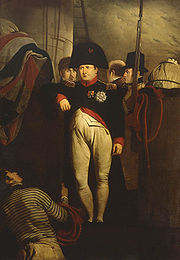
(then known as the Musée Napoléon). His first notable success was a painting Napoleon on Board the Bellerophon
HMS Bellerophon (1786)
The first HMS Bellerophon of the Royal Navy was a 74-gun third-rate ship of the line launched on 6 October 1786 at Frindsbury on the River Medway, near Chatham. She was built at the shipyard of Edward Greaves to the specifications of the Arrogant, designed by Sir Thomas Slade in 1758, the lead ship...
in Plymouth Sound (1815; now in the National Maritime Museum
National Maritime Museum
The National Maritime Museum in Greenwich, England is the leading maritime museum of the United Kingdom and may be the largest museum of its kind in the world. The historic buildings forming part of the Maritime Greenwich World Heritage Site, it also incorporates the Royal Observatory, Greenwich,...
, London). Like many other people at the time, Eastlake had hired a boat to take him to the ship on which Napoleon was held captive in Plymouth harbour. He sketched him from the boat.
In 1816, he travelled to Rome
Rome
Rome is the capital of Italy and the country's largest and most populated city and comune, with over 2.7 million residents in . The city is located in the central-western portion of the Italian Peninsula, on the Tiber River within the Lazio region of Italy.Rome's history spans two and a half...
where he painted members of the British elite staying in Italy
Italy
Italy , officially the Italian Republic languages]] under the European Charter for Regional or Minority Languages. In each of these, Italy's official name is as follows:;;;;;;;;), is a unitary parliamentary republic in South-Central Europe. To the north it borders France, Switzerland, Austria and...
including fellow artists Sir Thomas Lawrence
Thomas Lawrence (painter)
Sir Thomas Lawrence RA FRS was a leading English portrait painter and president of the Royal Academy.Lawrence was a child prodigy. He was born in Bristol and began drawing in Devizes, where his father was an innkeeper. At the age of ten, having moved to Bath, he was supporting his family with his...
and J. M. W. Turner
J. M. W. Turner
Joseph Mallord William Turner RA was an English Romantic landscape painter, watercolourist and printmaker. Turner was considered a controversial figure in his day, but is now regarded as the artist who elevated landscape painting to an eminence rivalling history painting...
. He also travelled to Naples
Naples
Naples is a city in Southern Italy, situated on the country's west coast by the Gulf of Naples. Lying between two notable volcanic regions, Mount Vesuvius and the Phlegraean Fields, it is the capital of the region of Campania and of the province of Naples...
and Athens
Athens
Athens , is the capital and largest city of Greece. Athens dominates the Attica region and is one of the world's oldest cities, as its recorded history spans around 3,400 years. Classical Athens was a powerful city-state...
.
Despite being based predominantly in mainland Europe, Eastlake regularly sent works back to London for exhibition and in 1827 he was elected a member of the Royal Academy. Three years later, he returned to England permanently where he continued to paint historic and biblical paintings set in Mediterranean landscapes.
As an art scholar, he translated Goethe
Johann Wolfgang von Goethe
Johann Wolfgang von Goethe was a German writer, pictorial artist, biologist, theoretical physicist, and polymath. He is considered the supreme genius of modern German literature. His works span the fields of poetry, drama, prose, philosophy, and science. His Faust has been called the greatest long...
's Zur Farbenlehre (Theory of Colours
Theory of Colours
Theory of Colours is a work by Johann Wolfgang von Goethe about the poet's views on the nature of colours and how these are perceived by man, published in 1810...
, 1840) and the Handbuch der Geschichte der Malerei (Handbook of the History of Painting) by Franz Kugler
Franz Kugler
Franz Theodor Kugler was a cultural administrator for the Prussian state and art historian...
. These publications and his reputation as an artist led to his nomination in 1841 to become secretary of the Fine Arts Commission, the body in charge of government art patronage. In his On Vision and Colors
On Vision and Colors
On Vision and Colors is a treatise by Arthur Schopenhauer that was published in May 1816 when the author was 28 years old. Schopenhauer had extensively discussed with Johann Wolfgang von Goethe about the poet's Theory of Colours of 1810, in the months around the turn of the years 1813 and 1814,...
, § 14, Schopenhauer
Arthur Schopenhauer
Arthur Schopenhauer was a German philosopher known for his pessimism and philosophical clarity. At age 25, he published his doctoral dissertation, On the Fourfold Root of the Principle of Sufficient Reason, which examined the four separate manifestations of reason in the phenomenal...
praised Eastlake's translation of Goethe. "Eastlake, the painter and gallery inspector, furnished his countrymen, in 1840, with such an excellent translation of Goethe's theory of color that it is a perfect reproduction of the original and reads more easily; in fact, it is understood more easily than the original."
Having already advised the National Gallery, London
National Gallery, London
The National Gallery is an art museum on Trafalgar Square, London, United Kingdom. Founded in 1824, it houses a collection of over 2,300 paintings dating from the mid-13th century to 1900. The gallery is an exempt charity, and a non-departmental public body of the Department for Culture, Media...
on acquisitions, he was appointed the Gallery's first Keeper in 1843, a post he later resigned to resume writing and painting.
In 1849 he married Elizabeth Rigby, an art historian and translator of German art histories, forming a formidable art history writing partnership.
Elected President of the Royal Academy and knighted in 1850, he became a notable figure in the British art establishment, being appointed the first President of the Photographic Society in 1853 and, in 1855, the first Director of the National Gallery. His directorship was marred by the signal failure of the National Gallery to fulfil the terms of the bequest of J.M.W.Turner, his erstwhile friend. Cambridge University
University of Cambridge
The University of Cambridge is a public research university located in Cambridge, United Kingdom. It is the second-oldest university in both the United Kingdom and the English-speaking world , and the seventh-oldest globally...
awarded him an honorary degree in 1864.

Legacy
Eastlake died in PisaPisa
Pisa is a city in Tuscany, Central Italy, on the right bank of the mouth of the River Arno on the Tyrrhenian Sea. It is the capital city of the Province of Pisa...
, Italy
Italy
Italy , officially the Italian Republic languages]] under the European Charter for Regional or Minority Languages. In each of these, Italy's official name is as follows:;;;;;;;;), is a unitary parliamentary republic in South-Central Europe. To the north it borders France, Switzerland, Austria and...
, on Christmas Eve
Christmas Eve
Christmas Eve refers to the evening or entire day preceding Christmas Day, a widely celebrated festival commemorating the birth of Jesus of Nazareth that takes place on December 25...
, 1865, and is buried at Kensal Green Cemetery
Kensal Green Cemetery
Kensal Green Cemetery is a cemetery in Kensal Green, in the west of London, England. It was immortalised in the lines of G. K. Chesterton's poem The Rolling English Road from his book The Flying Inn: "For there is good news yet to hear and fine things to be seen; Before we go to Paradise by way of...
, London. His will provided for the Gallery to purchase his own collection of paintings. Lady Eastlake also sold her husband's art history book collection to the Gallery's library.
Publications
- Materials for a History of Oil Painting (1847).
- Contributions to the Literature of the Fine Arts (1848).