

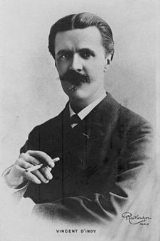
Vincent d'Indy

Encyclopedia
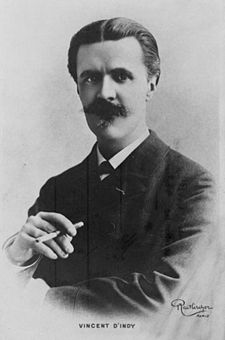
Vincent d'Indy (27 March 18512 December 1931) was a French composer
and teacher.
into an aristocratic family of royalist
and Catholic
persuasion. He had piano
lessons from an early age from his paternal grandmother, who passed him on to Antoine François Marmontel
and Louis Diémer
. From the age of 14 he studied harmony with Albert Lavignac
. At age 19, during the Franco-Prussian War
, he enlisted in the National Guard, but returned to musical life as soon as the hostilities were over. The first of his works he heard performed was a Symphonie italienne, at an orchestral rehearsal under Jules Pasdeloup; the work was admired by Georges Bizet
and Jules Massenet
, with whom he had already become acquainted. On the advice of Henri Duparc, he became a devoted student of César Franck
at the Conservatoire de Paris
. As a follower of Franck, d'Indy came to admire what he considered the standards of German symphonism.
In the summer of 1873 he visited Germany, where he met Franz Liszt
and Johannes Brahms
. On 25 January 1874 his overture Les Piccolomini was performed at a Pasdeloup concert, sandwiched between works by Bach
and Beethoven
. Around this time he married one of his cousins. In 1875 his symphony dedicated to János Hunyadi
was performed. That same year he played a minor role – the prompter – at the premiere of Bizet's opera Carmen
. In 1876 he was present at the first production of Richard Wagner
's Ring Cycle
at Bayreuth. This made a great impression on him and he became a fervent Wagnerite. In 1878 d'Indy's symphonic ballad La Forêt enchantée was performed. In 1882 he heard Wagner's Parsifal
. In 1883 his choral work Le Chant de la cloche appeared. In 1884 his symphonic poem Saugefleurie was premiered. His piano suite ("symphonic poem for piano") called Poème des montagnes came from around this time. In 1887 appeared his Suite in D for trumpet, 2 flutes and string quartet. That same year he was involved in Lamoureux's production of Wagner's Lohengrin
as choirmaster. His music drama Fervaal
occupied him between 1889 and 1895.
Inspired by his own studies with Franck and dissatisfied with the standard of teaching at the Conservatoire de Paris
, d'Indy, together with Charles Bordes
and Alexandre Guilmant
, founded the Schola Cantorum de Paris in 1894. D'Indy taught there and later at the Paris Conservatoire until his death. Among his many students were Isaac Albéniz
, Leo Arnaud
, Joseph Canteloube
(who later wrote d'Indy's biography), Pierre Capdevielle
, Jean Daetwyler
, Arthur Honegger
, Eugène Lapierre
, Albéric Magnard
, Rodolphe Mathieu
, Darius Milhaud
, Cole Porter
, Albert Roussel
, Erik Satie
, Georges-Émile Tanguay
, Otto Albert Tichý
, and Xian Xinghai
. Xian was one of the earliest Chinese composers of western classical music.
Few of d'Indy's works are performed regularly today. His best known pieces are probably the Symphony on a French Mountain Air (Symphonie sur un chant montagnard français, also known as Symphonie cévenole) for piano and orchestra
(1886), and Istar (1896), a symphonic poem
in the form of a set of variations
in which the theme appears only at the end.
Among d'Indy's other works are other orchestral music (including a Symphony in B, a vast symphonic poem, Jour d'été à la montagne, and another, Souvenirs, written on the death of his first wife; he later remarried), chamber music
, including two of the finest string quartets of the latter 19th century (No. 2 in E major, Op. 45, and No. 3 in B-flat, Op. 96), piano music (including a Sonata in E minor), songs and a number of opera
s, including Fervaal
(1897) and L'Étranger (1902). His music drama Le Légende de Saint Christophe, based on themes from Gregorian chant
, was performed for the first, and possibly last, time, on 6 June 1920. His comédie musicale had its premiere in paris on 10 June 1927. His Lied for cello and orchestra, Op. 19, was recorded by Julian Lloyd Webber
and the English Chamber Orchestra
conducted by Yan Pascal Tortelier
in 1991. As well as Franck, d'Indy's works show the influence of Berlioz and especially of Wagner.
D'Indy helped revive a number of then largely forgotten early works, for example, making his own edition of Claudio Monteverdi
's opera L'incoronazione di Poppea
.
His musical writings include the co-written three-volume Cours de composition musicale (1903–1905), as well as studies of Franck and Beethoven
.
D'Indy died where he was born, in Paris.
. He was anti-Semitic, but did not extend this bias to his Jewish colleagues.
In a post-Wagner age under "the artistic domination of Bayreuth," Elson describes two "paths" in contemporary opera, one path being more conservative,
In Elson's opinion, those following the more conservative path are Cornelius, Goetz, Humperdinck, and Goldmark, as well as Saint-Saëns and Massenet.
in Montreal
, Canada is named after the composer.
Composer
A composer is a person who creates music, either by musical notation or oral tradition, for interpretation and performance, or through direct manipulation of sonic material through electronic media...
and teacher.
Life
Paul Marie Théodore Vincent d'Indy was born in ParisParis
Paris is the capital and largest city in France, situated on the river Seine, in northern France, at the heart of the Île-de-France region...
into an aristocratic family of royalist
Monarchism
Monarchism is the advocacy of the establishment, preservation, or restoration of a monarchy as a form of government in a nation. A monarchist is an individual who supports this form of government out of principle, independent from the person, the Monarch.In this system, the Monarch may be the...
and Catholic
Roman Catholic Church
The Catholic Church, also known as the Roman Catholic Church, is the world's largest Christian church, with over a billion members. Led by the Pope, it defines its mission as spreading the gospel of Jesus Christ, administering the sacraments and exercising charity...
persuasion. He had piano
Piano
The piano is a musical instrument played by means of a keyboard. It is one of the most popular instruments in the world. Widely used in classical and jazz music for solo performances, ensemble use, chamber music and accompaniment, the piano is also very popular as an aid to composing and rehearsal...
lessons from an early age from his paternal grandmother, who passed him on to Antoine François Marmontel
Antoine François Marmontel
Antoine François Marmontel was a French pianist, teacher and musicographer.Marmontel entered the Paris Conservatory in 1827. His teachers were Pierre Zimmerman in pianoforte, Victor Dourlen in harmony, Jacques Fromental Halévy in fugue and Jean-François Le Sueur in composition...
and Louis Diémer
Louis Diémer
Louis-Joseph Diémer was a French pianist and composer.- Life :Diémer studied at the Paris Conservatoire, winning premiers prix in piano, harmony and accompaniment, counterpoint and fugue, and solfège, and a second prix in organ...
. From the age of 14 he studied harmony with Albert Lavignac
Albert Lavignac
Albert Lavignac was a French music scholar, known for his essays on theory, and a minor composer.-Biography:Lavignac was borin in Paris and studied with Antoine François Marmontel, François Benoist and Ambroise Thomas at the Conservatoire de Paris, where later he taught harmony...
. At age 19, during the Franco-Prussian War
Franco-Prussian War
The Franco-Prussian War or Franco-German War, often referred to in France as the 1870 War was a conflict between the Second French Empire and the Kingdom of Prussia. Prussia was aided by the North German Confederation, of which it was a member, and the South German states of Baden, Württemberg and...
, he enlisted in the National Guard, but returned to musical life as soon as the hostilities were over. The first of his works he heard performed was a Symphonie italienne, at an orchestral rehearsal under Jules Pasdeloup; the work was admired by Georges Bizet
Georges Bizet
Georges Bizet formally Alexandre César Léopold Bizet, was a French composer, mainly of operas. In a career cut short by his early death, he achieved few successes before his final work, Carmen, became one of the most popular and frequently performed works in the entire opera repertory.During a...
and Jules Massenet
Jules Massenet
Jules Émile Frédéric Massenet was a French composer best known for his operas. His compositions were very popular in the late 19th and early 20th centuries, and he ranks as one of the greatest melodists of his era. Soon after his death, Massenet's style went out of fashion, and many of his operas...
, with whom he had already become acquainted. On the advice of Henri Duparc, he became a devoted student of César Franck
César Franck
César-Auguste-Jean-Guillaume-Hubert Franck was a composer, pianist, organist, and music teacher who worked in Paris during his adult life....
at the Conservatoire de Paris
Conservatoire de Paris
The Conservatoire de Paris is a college of music and dance founded in 1795, now situated in the avenue Jean Jaurès in the 19th arrondissement of Paris, France...
. As a follower of Franck, d'Indy came to admire what he considered the standards of German symphonism.
In the summer of 1873 he visited Germany, where he met Franz Liszt
Franz Liszt
Franz Liszt ; ), was a 19th-century Hungarian composer, pianist, conductor, and teacher.Liszt became renowned in Europe during the nineteenth century for his virtuosic skill as a pianist. He was said by his contemporaries to have been the most technically advanced pianist of his age...
and Johannes Brahms
Johannes Brahms
Johannes Brahms was a German composer and pianist, and one of the leading musicians of the Romantic period. Born in Hamburg, Brahms spent much of his professional life in Vienna, Austria, where he was a leader of the musical scene...
. On 25 January 1874 his overture Les Piccolomini was performed at a Pasdeloup concert, sandwiched between works by Bach
Johann Sebastian Bach
Johann Sebastian Bach was a German composer, organist, harpsichordist, violist, and violinist whose sacred and secular works for choir, orchestra, and solo instruments drew together the strands of the Baroque period and brought it to its ultimate maturity...
and Beethoven
Ludwig van Beethoven
Ludwig van Beethoven was a German composer and pianist. A crucial figure in the transition between the Classical and Romantic eras in Western art music, he remains one of the most famous and influential composers of all time.Born in Bonn, then the capital of the Electorate of Cologne and part of...
. Around this time he married one of his cousins. In 1875 his symphony dedicated to János Hunyadi
John Hunyadi
John Hunyadi John Hunyadi (Hungarian: Hunyadi János , Medieval Latin: Ioannes Corvinus or Ioannes de Hunyad, Romanian: Iancu (Ioan) de Hunedoara, Croatian: Janko Hunjadi, Serbian: Сибињанин Јанко / Sibinjanin Janko, Slovak: Ján Huňady) John Hunyadi (Hungarian: Hunyadi János , Medieval Latin: ...
was performed. That same year he played a minor role – the prompter – at the premiere of Bizet's opera Carmen
Carmen
Carmen is a French opéra comique by Georges Bizet. The libretto is by Henri Meilhac and Ludovic Halévy, based on the novella of the same title by Prosper Mérimée, first published in 1845, itself possibly influenced by the narrative poem The Gypsies by Alexander Pushkin...
. In 1876 he was present at the first production of Richard Wagner
Richard Wagner
Wilhelm Richard Wagner was a German composer, conductor, theatre director, philosopher, music theorist, poet, essayist and writer primarily known for his operas...
's Ring Cycle
Der Ring des Nibelungen
Der Ring des Nibelungen is a cycle of four epic operas by the German composer Richard Wagner . The works are based loosely on characters from the Norse sagas and the Nibelungenlied...
at Bayreuth. This made a great impression on him and he became a fervent Wagnerite. In 1878 d'Indy's symphonic ballad La Forêt enchantée was performed. In 1882 he heard Wagner's Parsifal
Parsifal
Parsifal is an opera in three acts by Richard Wagner. It is loosely based on Wolfram von Eschenbach's Parzival, the 13th century epic poem of the Arthurian knight Parzival and his quest for the Holy Grail, and on Chrétien de Troyes' Perceval, the Story of the Grail.Wagner first conceived the work...
. In 1883 his choral work Le Chant de la cloche appeared. In 1884 his symphonic poem Saugefleurie was premiered. His piano suite ("symphonic poem for piano") called Poème des montagnes came from around this time. In 1887 appeared his Suite in D for trumpet, 2 flutes and string quartet. That same year he was involved in Lamoureux's production of Wagner's Lohengrin
Lohengrin (opera)
Lohengrin is a romantic opera in three acts composed and written by Richard Wagner, first performed in 1850. The story of the eponymous character is taken from medieval German romance, notably the Parzival of Wolfram von Eschenbach and its sequel, Lohengrin, written by a different author, itself...
as choirmaster. His music drama Fervaal
Fervaal
Fervaal is an opera in three acts with a prologue by the French composer Vincent d'Indy, his opus 40. The composer wrote his own libretto, based in part on the lyric poem Axel by the Swedish author Esaias Tegnér...
occupied him between 1889 and 1895.
Inspired by his own studies with Franck and dissatisfied with the standard of teaching at the Conservatoire de Paris
Conservatoire de Paris
The Conservatoire de Paris is a college of music and dance founded in 1795, now situated in the avenue Jean Jaurès in the 19th arrondissement of Paris, France...
, d'Indy, together with Charles Bordes
Charles Bordes
Charles Bordes was a French music teacher and composer.-Timeline:Bordes studied pianoforte with Antoine François Marmontel and composition with César Franck. He was organist and maître de chapelle at Nogent-sur-Marne from 1887 to 1890...
and Alexandre Guilmant
Alexandre Guilmant
Félix-Alexandre Guilmant was a French organist and composer.- Short biography :Guilmant was born in Boulogne-sur-Mer...
, founded the Schola Cantorum de Paris in 1894. D'Indy taught there and later at the Paris Conservatoire until his death. Among his many students were Isaac Albéniz
Isaac Albéniz
Isaac Manuel Francisco Albéniz y Pascual was a Spanish Catalan pianist and composer best known for his piano works based on folk music idioms .-Life:Born in Camprodon, province of Girona, to Ángel Albéniz and his wife Dolors Pascual, Albéniz...
, Leo Arnaud
Leo Arnaud
Leo Arnaud or Léo Arnaud was a French-American composer of film scores, best known for Bugler's Dream, which is used as the theme by television networks presenting the Olympic Games in the United States....
, Joseph Canteloube
Joseph Canteloube
Marie-Joseph Canteloube de Malaret was a French composer, musicologist, and author best known for his collections of orchestrated folksongs from the Auvergne region.-Biography:...
(who later wrote d'Indy's biography), Pierre Capdevielle
Pierre Capdevielle (musician)
Pierre Capdevielle was a French conductor, composer, and music critic. In 1938 he was awarded the Prix Blumenthal and in 1948 he founded the Centre de documentation de musique internationale. For many years he was President of France's chapter of the International Society for Contemporary Music....
, Jean Daetwyler
Jean Daetwyler
Jean Daetwyler was a Swiss composer and musician. He is remembered mostly for his largely forgotten works for alphorn inspired by Jozsef Molnar beginning in 1970. Also inspired by trombonist Branimir Slokar an other aspects of Swiss culture.Daetwyler was a pupil of Vincent d'Indy at the Paris...
, Arthur Honegger
Arthur Honegger
Arthur Honegger was a Swiss composer, who was born in France and lived a large part of his life in Paris. He was a member of Les six. His most frequently performed work is probably the orchestral work Pacific 231, which is interpreted as imitating the sound of a steam locomotive.-Biography:Born...
, Eugène Lapierre
Eugène Lapierre
Eugène Lapierre was a Canadian organist, composer, journalist, writer on music, arts administrator, and music educator. He was awarded the King George V Silver Jubilee Medal in 1935 and the King George VI Coronation Medal in 1937...
, Albéric Magnard
Albéric Magnard
Lucien Denis Gabriel Albéric Magnard was a French composer, sometimes referred to as the "French Bruckner", though there are significant differences between the two composers...
, Rodolphe Mathieu
Rodolphe Mathieu
Joseph Rodolphe Mathieu was a Canadian composer, pianist, writer on music, and music educator. The Canadian Encyclopedia states, "Considered too avant-garde for his time because of Debussy's influence on his music, Mathieu gained recognition too late to inspire the generation that followed." The...
, Darius Milhaud
Darius Milhaud
Darius Milhaud was a French composer and teacher. He was a member of Les Six—also known as The Group of Six—and one of the most prolific composers of the 20th century. His compositions are influenced by jazz and make use of polytonality...
, Cole Porter
Cole Porter
Cole Albert Porter was an American composer and songwriter. Born to a wealthy family in Indiana, he defied the wishes of his domineering grandfather and took up music as a profession. Classically trained, he was drawn towards musical theatre...
, Albert Roussel
Albert Roussel
Albert Charles Paul Marie Roussel was a French composer. He spent seven years as a midshipman, turned to music as an adult, and became one of the most prominent French composers of the interwar period...
, Erik Satie
Erik Satie
Éric Alfred Leslie Satie was a French composer and pianist. Satie was a colourful figure in the early 20th century Parisian avant-garde...
, Georges-Émile Tanguay
Georges-Émile Tanguay
Georges-Émile Tanguay was a Canadian composer, organist, pianist, and music educator. An associate of the Canadian Music Centre, his compositional output is relatively small; consisting of 4 orchestral works, 4 chamber music pieces, 9 works for solo piano, 2 works for solo organ, and 4 choral works...
, Otto Albert Tichý
Otto Albert Tichý
Otto Albert Tichý was a Czech composer, teacher and organist.-Life:Otto Albert Tichý was born in Martínkov, Moravia, in a typical family of a provincial teacher and Catholic persuasion. He had studied different instruments and playing organ too from his early age...
, and Xian Xinghai
Xian Xinghai
Xian Xinghai was one of the earliest generation of Chinese composers influenced by western classical music and has influenced generations of Chinese musicians...
. Xian was one of the earliest Chinese composers of western classical music.
Few of d'Indy's works are performed regularly today. His best known pieces are probably the Symphony on a French Mountain Air (Symphonie sur un chant montagnard français, also known as Symphonie cévenole) for piano and orchestra
Orchestra
An orchestra is a sizable instrumental ensemble that contains sections of string, brass, woodwind, and percussion instruments. The term orchestra derives from the Greek ορχήστρα, the name for the area in front of an ancient Greek stage reserved for the Greek chorus...
(1886), and Istar (1896), a symphonic poem
Symphonic poem
A symphonic poem or tone poem is a piece of orchestral music in a single continuous section in which the content of a poem, a story or novel, a painting, a landscape or another source is illustrated or evoked. The term was first applied by Hungarian composer Franz Liszt to his 13 works in this vein...
in the form of a set of variations
Variation (music)
In music, variation is a formal technique where material is repeated in an altered form. The changes may involve harmony, melody, counterpoint, rhythm, timbre, orchestration or any combination of these.-Variation form:...
in which the theme appears only at the end.
Among d'Indy's other works are other orchestral music (including a Symphony in B, a vast symphonic poem, Jour d'été à la montagne, and another, Souvenirs, written on the death of his first wife; he later remarried), chamber music
Chamber music
Chamber music is a form of classical music, written for a small group of instruments which traditionally could be accommodated in a palace chamber. Most broadly, it includes any art music that is performed by a small number of performers with one performer to a part...
, including two of the finest string quartets of the latter 19th century (No. 2 in E major, Op. 45, and No. 3 in B-flat, Op. 96), piano music (including a Sonata in E minor), songs and a number of opera
Opera
Opera is an art form in which singers and musicians perform a dramatic work combining text and musical score, usually in a theatrical setting. Opera incorporates many of the elements of spoken theatre, such as acting, scenery, and costumes and sometimes includes dance...
s, including Fervaal
Fervaal
Fervaal is an opera in three acts with a prologue by the French composer Vincent d'Indy, his opus 40. The composer wrote his own libretto, based in part on the lyric poem Axel by the Swedish author Esaias Tegnér...
(1897) and L'Étranger (1902). His music drama Le Légende de Saint Christophe, based on themes from Gregorian chant
Gregorian chant
Gregorian chant is the central tradition of Western plainchant, a form of monophonic liturgical music within Western Christianity that accompanied the celebration of Mass and other ritual services...
, was performed for the first, and possibly last, time, on 6 June 1920. His comédie musicale had its premiere in paris on 10 June 1927. His Lied for cello and orchestra, Op. 19, was recorded by Julian Lloyd Webber
Julian Lloyd Webber
Julian Lloyd Webber is a British solo cellist who has been described as the "doyen of British cellists".-Early life:Julian Lloyd Webber is the second son of the composer William Lloyd Webber and his wife Jean Johnstone . He is the younger brother of the composer Andrew Lloyd Webber...
and the English Chamber Orchestra
English Chamber Orchestra
The English Chamber Orchestra is a British chamber orchestra based in London. The full orchestra regularly plays concerts at Cadogan Hall, and the ECO Ensemble performs at Wigmore Hall...
conducted by Yan Pascal Tortelier
Yan Pascal Tortelier
Yan Pascal Tortelier is an internationally renowned French conductor and violinist and is the son of the late cellist Paul Tortelier.-Biography:...
in 1991. As well as Franck, d'Indy's works show the influence of Berlioz and especially of Wagner.
D'Indy helped revive a number of then largely forgotten early works, for example, making his own edition of Claudio Monteverdi
Claudio Monteverdi
Claudio Giovanni Antonio Monteverdi – 29 November 1643) was an Italian composer, gambist, and singer.Monteverdi's work, often regarded as revolutionary, marked the transition from the Renaissance style of music to that of the Baroque period. He developed two individual styles of composition – the...
's opera L'incoronazione di Poppea
L'incoronazione di Poppea
L'incoronazione di Poppea is an Italian baroque opera comprising a prologue and three acts, first performed in Venice during the 1642–43 carnival season. The music, attributed to Claudio Monteverdi, is a setting of a libretto by Giovanni Francesco Busenello...
.
His musical writings include the co-written three-volume Cours de composition musicale (1903–1905), as well as studies of Franck and Beethoven
Ludwig van Beethoven
Ludwig van Beethoven was a German composer and pianist. A crucial figure in the transition between the Classical and Romantic eras in Western art music, he remains one of the most famous and influential composers of all time.Born in Bonn, then the capital of the Electorate of Cologne and part of...
.
D'Indy died where he was born, in Paris.
Political views
D'Indy was a committed monarchist, joining the League of la Patrie française during the Dreyfus affairDreyfus Affair
The Dreyfus affair was a political scandal that divided France in the 1890s and the early 1900s. It involved the conviction for treason in November 1894 of Captain Alfred Dreyfus, a young French artillery officer of Alsatian Jewish descent...
. He was anti-Semitic, but did not extend this bias to his Jewish colleagues.
Critical reaction
Opera critic Arthur Elson, writing in 1901, while appreciating d'Indy, prefers another composer.
Of the younger men, Vincent d'Indy (1851– ) has shown himself abreast of the times, and his FervaalFervaalFervaal is an opera in three acts with a prologue by the French composer Vincent d'Indy, his opus 40. The composer wrote his own libretto, based in part on the lyric poem Axel by the Swedish author Esaias Tegnér...
, with a libretto of "rhythmic prose," is a worthy example of the school of operatic realism and musical complexity. [...] But the most prominent composer for the Paris stage at present is Alfred BruneauAlfred BruneauLouis-Charles-Bonaventure-Alfred Bruneau was a French composer who played a key role in the introduction of realism in French opera....
. [...] [I]n Le Réve (1891), on a libretto from ZolaÉmile ZolaÉmile François Zola was a French writer, the most important exemplar of the literary school of naturalism and an important contributor to the development of theatrical naturalism...
's novelLe Rêve (novel)Le rêve is the sixteenth novel in the Rougon-Macquart series by Émile Zola.The novel was published by Charpentier in October 1888 and translated into English by Eliza E. Chase as The Dream in 1893...
, he began the career that has won him his present position.
In a post-Wagner age under "the artistic domination of Bayreuth," Elson describes two "paths" in contemporary opera, one path being more conservative,
while the other has led to the uttermost regions of modern polyphony and dissonance. [...] Among the more radical group, corresponding to Bruneau, D'Indy, and Franck, the most daring work has been done by Richard StraussRichard StraussRichard Georg Strauss was a leading German composer of the late Romantic and early modern eras. He is known for his operas, which include Der Rosenkavalier and Salome; his Lieder, especially his Four Last Songs; and his tone poems and orchestral works, such as Death and Transfiguration, Till...
.
In Elson's opinion, those following the more conservative path are Cornelius, Goetz, Humperdinck, and Goldmark, as well as Saint-Saëns and Massenet.
Works
Legacy
The private music college École de musique Vincent-d'IndyÉcole de musique Vincent-d'Indy
Lécole de musique Vincent-d'Indy is a subsidized private music college situated in Montreal in the Outremont district, that specializes in music education.-Programs:...
in Montreal
Montreal
Montreal is a city in Canada. It is the largest city in the province of Quebec, the second-largest city in Canada and the seventh largest in North America...
, Canada is named after the composer.
Further reading
- Norman Demuth, Vincent d'Indy: Champion of Classicism (London, 1951)
- Steven Huebner, Vincent d'Indy and Moral Order' and 'Fervaal': French Opera at the Fin de Siecle (Oxford, 1999), pp. 301–08 and 317–50
- Vincent d'Indy (Marie d'Indy, ed.), (Paris, 2001). ISBN 2-84049-240-7
- James RossJames Ross (conductor)James Ross MA, MSt, DPhil, is a British conductor and author.-Career:Ross studied at Harrow School, and later at Christ Church, Oxford from where he received an MA in Modern History , an MSt in Music , and a DPhil in French opera...
, 'D’Indy’s "Fervaal": Reconstructing French Identity at the Fin-de-Siècle', Music and Letters 84/2 (May 2003), pp. 209–40 - Manuela Schwartz (ed.), Vincent d'Indy et son temps (Sprimont, 2006). ISBN 2-87009-888-X
- Andrew Thomson, Vincent d'Indy and his World (Oxford, 1996)
- Robert TrumbleRobert TrumbleRobert William Trumble was an Australian musician and author. Son of international cricketer Hugh Trumble, Robert dedicated his first book, The Golden Age of Cricket, to his father. It was published in Melbourne in 1968.Trumble's musical career was also noted by the Australian media...
, Vincent d'Indy: His Greatness and Integrity (Melbourne, 1994)
External links
- D'Indy Trio for Clarinet, Cello & Piano, Op. 29, Piano Quartet Op. 7, String Quartet No. 1 and String Sextet, Op. 92 soundbites and discussion of works
- http://www.youtube.com/watch?v=Fta27sFjegMPerformance of Lied for cello and orchestra by Julian Lloyd WebberJulian Lloyd WebberJulian Lloyd Webber is a British solo cellist who has been described as the "doyen of British cellists".-Early life:Julian Lloyd Webber is the second son of the composer William Lloyd Webber and his wife Jean Johnstone . He is the younger brother of the composer Andrew Lloyd Webber...
and the Academy of St Martin in the Fields conducted by Neville MarrinerNeville MarrinerSir Neville Marriner is an English conductor and violinist.-Biography:Marriner was born in Lincoln and studied at the Royal College of Music and the Paris Conservatoire. He played the violin in the Philharmonia Orchestra, the Martin String Quartet and London Symphony Orchestra, playing with the...
]