


Vilvoorde

Encyclopedia
Vilvoorde is a Belgian
municipality in the Flemish
province
of Flemish Brabant
. The municipality comprises the city of Vilvoorde proper with its two outlying quarters of Koningslo and Houtem and the small town of Peutie. The nickname for inhabitants of Vilvoorde is Pjeirrefretters (horse eaters) because horse meat (specially steak) is a beloved food in Vilvoorde.
The official language of Vilvoorde is Dutch
. There is a French-speaking minority of about 20%, concentrated especially in the Koningslo quarter bordering Brussels
. The French-speaking minority is represented by 3 members on the 33-seat local council. The city is also home to a large Spanish
minority. In the center of the city, 1 out of 10 inhabitants have Spanish nationality and the proportion of Belgians with Spanish roots is even greater. Most immigrated after World War II
, from Peñarroya-Pueblonuevo
in Andalusia
. There is also a large Moroccan community, and many smaller communities of more recent immigrants including Turks
, Macedonians
and Portuguese
.
From 2000 until August 1, 2007, the mayor of Vilvoorde was former Belgian prime minister Jean-Luc Dehaene
. The present mayor is Marc Van Asch.
, and later the Romans
, probably already settled in this strategic place near the river Zenne
. The name Filfurdo was first mentioned in a 779 document whereby Pippin of Herstal
ceased this territory to the Abbey of Chèvremont, near Liège
. This name presumably derived from the word equivalents villa
at the ford
or river crossing.
and Lords of Grimbergen
. Henry I, Duke of Brabant
granted the city its charter
of rights as soon as 1192, mainly to ensure the support of the inhabitants against powerful neighbouring Flanders
. The rights to build defensive walls and to export its products gave Vilvoorde a great economic boost, driven mostly by the cloth industry. In the 14th century, thanks to its position on the Zenne, Vilvoorde became an important military centre and could compete against Leuven
and Brussels
for the title of most important city in Brabant.
industry, and the result of epidemics and wars, both political and religious.
The advent of the Industrial Revolution
in the late 18th century was a godsend to Vilvoorde, which could quickly capitalize on its proximity to Brussels and its good transportation infrastructure: the deepening of the canals around 1830 and the advent of the railways in 1835. Soon, the medieval buildings gave way to newer and better constructions. The 1489 city hall was replaced by the neo-classical building we see today.
In the 1920s, the canal was broadened and deepened again, lined with new industrial zones, and an inland port was built to receive the freightliners. Following its liberation by the British in 1944, Vilvoorde was administered by a joint British and Belgian municipality, with temporary British and Belgian Mayors, Lt Col (then Major) JME Howarth Esq and (Later Prof.) Robert Senelle, before transferring back to a civilian administration. Vilvoorde became (and still is) one of the largest industrial areas around Brussels, with a population that grew to five times what it was 150 years earlier. The recent economic crises have hit the city hard, especially when Renault
closed its doors in 1997. The service industry is now taking the lead as Vilvoorde enters the 21st century.
: Maubeuge
: Middelburg
: Peñarroya-Pueblonuevo
, Córdoba: Komatsu, Ishikawa
Belgium
Belgium , officially the Kingdom of Belgium, is a federal state in Western Europe. It is a founding member of the European Union and hosts the EU's headquarters, and those of several other major international organisations such as NATO.Belgium is also a member of, or affiliated to, many...
municipality in the Flemish
Flemish Region
The Flemish Region is one of the three official regions of the Kingdom of Belgium—alongside the Walloon Region and the Brussels-Capital Region. Colloquially, it is usually simply referred to as Flanders, of which it is the institutional iteration within the context of the Belgian political system...
province
Provinces of Belgium
Belgium is divided into three regions, two of them are subdivided into five provinces each.The division into provinces is fixed by Article 5 of the Belgian Constitution...
of Flemish Brabant
Flemish Brabant
Flemish Brabant is a province of Flanders, one of the three regions of Belgium. It borders on the Belgian provinces of Antwerp, Limburg, Liège, Walloon Brabant, Hainaut and East Flanders. Flemish Brabant also completely surrounds the Brussels-Capital Region. Its capital is Leuven...
. The municipality comprises the city of Vilvoorde proper with its two outlying quarters of Koningslo and Houtem and the small town of Peutie. The nickname for inhabitants of Vilvoorde is Pjeirrefretters (horse eaters) because horse meat (specially steak) is a beloved food in Vilvoorde.
The official language of Vilvoorde is Dutch
Dutch language
Dutch is a West Germanic language and the native language of the majority of the population of the Netherlands, Belgium, and Suriname, the three member states of the Dutch Language Union. Most speakers live in the European Union, where it is a first language for about 23 million and a second...
. There is a French-speaking minority of about 20%, concentrated especially in the Koningslo quarter bordering Brussels
Brussels
Brussels , officially the Brussels Region or Brussels-Capital Region , is the capital of Belgium and the de facto capital of the European Union...
. The French-speaking minority is represented by 3 members on the 33-seat local council. The city is also home to a large Spanish
Spanish people
The Spanish are citizens of the Kingdom of Spain. Within Spain, there are also a number of vigorous nationalisms and regionalisms, reflecting the country's complex history....
minority. In the center of the city, 1 out of 10 inhabitants have Spanish nationality and the proportion of Belgians with Spanish roots is even greater. Most immigrated after World War II
World War II
World War II, or the Second World War , was a global conflict lasting from 1939 to 1945, involving most of the world's nations—including all of the great powers—eventually forming two opposing military alliances: the Allies and the Axis...
, from Peñarroya-Pueblonuevo
Peñarroya-Pueblonuevo
Peñarroya-Pueblonuevo is a city located in the province of Córdoba, Spain. According to the 2006 census , the city has a population of 12050 inhabitants.-External links:* - Sistema de Información Multiterritorial de Andalucía...
in Andalusia
Andalusia
Andalusia is the most populous and the second largest in area of the autonomous communities of Spain. The Andalusian autonomous community is officially recognised as a nationality of Spain. The territory is divided into eight provinces: Huelva, Seville, Cádiz, Córdoba, Málaga, Jaén, Granada and...
. There is also a large Moroccan community, and many smaller communities of more recent immigrants including Turks
Turkish people
Turkish people, also known as the "Turks" , are an ethnic group primarily living in Turkey and in the former lands of the Ottoman Empire where Turkish minorities had been established in Bulgaria, Cyprus, Bosnia and Herzegovina, Georgia, Greece, Kosovo, Macedonia, and Romania...
, Macedonians
Macedonians (ethnic group)
The Macedonians also referred to as Macedonian Slavs: "... the term Slavomacedonian was introduced and was accepted by the community itself, which at the time had a much more widespread non-Greek Macedonian ethnic consciousness...
and Portuguese
Portuguese people
The Portuguese are a nation and ethnic group native to the country of Portugal, in the west of the Iberian peninsula of south-west Europe. Their language is Portuguese, and Roman Catholicism is the predominant religion....
.
From 2000 until August 1, 2007, the mayor of Vilvoorde was former Belgian prime minister Jean-Luc Dehaene
Jean-Luc Dehaene
-Early life and political career:He was born in Montpellier, France, when his parents were fleeing German troops. He got into politics through the Algemeen Christelijk Werknemersverbond , a trade union which was closely linked to the Christelijke Volkspartij .In 1981, he became Minister of Social...
. The present mayor is Marc Van Asch.
Origins
The NerviiNervii
The Nervii were an ancient Germanic tribe, and one of the most powerful Belgic tribes; living in the northeastern hinterlands of Gaul, they were known to trek long distances to engage in various wars and functions...
, and later the Romans
Ancient Rome
Ancient Rome was a thriving civilization that grew on the Italian Peninsula as early as the 8th century BC. Located along the Mediterranean Sea and centered on the city of Rome, it expanded to one of the largest empires in the ancient world....
, probably already settled in this strategic place near the river Zenne
Zenne
The Zenne or Senne is a small river that flows through Brussels, left tributary of the Dijle/Dyle. Its source is in the municipality of Soignies. It is an indirect tributary of the Scheldt, through the Dijle and the Rupel...
. The name Filfurdo was first mentioned in a 779 document whereby Pippin of Herstal
Pippin of Herstal
Pepin of Herstal, or Heristal, was the Mayor of the Palace of Austrasia from 680 to his death and of Neustria and Burgundy from 687 to 695...
ceased this territory to the Abbey of Chèvremont, near Liège
Liège
Liège is a major city and municipality of Belgium located in the province of Liège, of which it is the economic capital, in Wallonia, the French-speaking region of Belgium....
. This name presumably derived from the word equivalents villa
Villa
A villa was originally an ancient Roman upper-class country house. Since its origins in the Roman villa, the idea and function of a villa have evolved considerably. After the fall of the Roman Republic, villas became small farming compounds, which were increasingly fortified in Late Antiquity,...
at the ford
Ford (crossing)
A ford is a shallow place with good footing where a river or stream may be crossed by wading or in a vehicle. A ford is mostly a natural phenomenon, in contrast to a low water crossing, which is an artificial bridge that allows crossing a river or stream when water is low.The names of many towns...
or river crossing.
Middle Ages
In the 12th century, a small town started to grow, which quickly became a target for the ambitions of the Dukes of BrabantDuchy of Brabant
The Duchy of Brabant was a historical region in the Low Countries. Its territory consisted essentially of the three modern-day Belgian provinces of Flemish Brabant, Walloon Brabant and Antwerp, the Brussels-Capital Region and most of the present-day Dutch province of North Brabant.The Flag of...
and Lords of Grimbergen
Grimbergen
Grimbergen is a municipality in the province of Flemish Brabant, in Flanders, one of the three regions of Belgium. The municipality comprises the towns of Beigem, Grimbergen, Humbeek and Strombeek-Bever. On January 1, 2006 Grimbergen had a total population of 33,965. The total area is...
. Henry I, Duke of Brabant
Henry I, Duke of Brabant
Henry I of Brabant , named "The Courageous" Duke of Brabant and Duke of Lower Lotharingia until his death.-Biography:...
granted the city its charter
Charter
A charter is the grant of authority or rights, stating that the granter formally recognizes the prerogative of the recipient to exercise the rights specified...
of rights as soon as 1192, mainly to ensure the support of the inhabitants against powerful neighbouring Flanders
Flanders
Flanders is the community of the Flemings but also one of the institutions in Belgium, and a geographical region located in parts of present-day Belgium, France and the Netherlands. "Flanders" can also refer to the northern part of Belgium that contains Brussels, Bruges, Ghent and Antwerp...
. The rights to build defensive walls and to export its products gave Vilvoorde a great economic boost, driven mostly by the cloth industry. In the 14th century, thanks to its position on the Zenne, Vilvoorde became an important military centre and could compete against Leuven
Leuven
Leuven is the capital of the province of Flemish Brabant in the Flemish Region, Belgium...
and Brussels
Brussels
Brussels , officially the Brussels Region or Brussels-Capital Region , is the capital of Belgium and the de facto capital of the European Union...
for the title of most important city in Brabant.
15th century until now
From the 15th to the 19th century, however, Vilvoorde suffered a prolonged decline, mainly because of the competition from Brussels, a general malaise in the textileTextile
A textile or cloth is a flexible woven material consisting of a network of natural or artificial fibres often referred to as thread or yarn. Yarn is produced by spinning raw fibres of wool, flax, cotton, or other material to produce long strands...
industry, and the result of epidemics and wars, both political and religious.
The advent of the Industrial Revolution
Industrial Revolution
The Industrial Revolution was a period from the 18th to the 19th century where major changes in agriculture, manufacturing, mining, transportation, and technology had a profound effect on the social, economic and cultural conditions of the times...
in the late 18th century was a godsend to Vilvoorde, which could quickly capitalize on its proximity to Brussels and its good transportation infrastructure: the deepening of the canals around 1830 and the advent of the railways in 1835. Soon, the medieval buildings gave way to newer and better constructions. The 1489 city hall was replaced by the neo-classical building we see today.
In the 1920s, the canal was broadened and deepened again, lined with new industrial zones, and an inland port was built to receive the freightliners. Following its liberation by the British in 1944, Vilvoorde was administered by a joint British and Belgian municipality, with temporary British and Belgian Mayors, Lt Col (then Major) JME Howarth Esq and (Later Prof.) Robert Senelle, before transferring back to a civilian administration. Vilvoorde became (and still is) one of the largest industrial areas around Brussels, with a population that grew to five times what it was 150 years earlier. The recent economic crises have hit the city hard, especially when Renault
Renault
Renault S.A. is a French automaker producing cars, vans, and in the past, autorail vehicles, trucks, tractors, vans and also buses/coaches. Its alliance with Nissan makes it the world's third largest automaker...
closed its doors in 1997. The service industry is now taking the lead as Vilvoorde enters the 21st century.
Sights
- The neo-classical city hall and a covered market hall can be found on the main city square.
- The statue of a Brabant horseBelgian (horse)The Belgian Draft horse or Belgian, also known as Belgian Heavy Horse, Brabançon, or Brabant, is a draft horse breed from the Brabant region of modern Belgium, where it is called the or Flemish: . It is one of the strongest of the heavy breeds...
can be found nearby, commemorating the long tradition of horse tradingHorse tradingIn the original sense, Horse trading is the buying and selling of horses, also called "Horse Dealing". Due to the difficulties in evaluating the merits of a horse offered for sale, the selling of horses offered great opportunities for dishonesty...
in Vilvoorde. - The Kijk-Uit house dates from the 15th or 16th century.
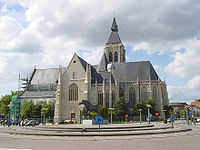
- The city also has interesting churches, including the Onze-Lieve-Vrouwekerk (Church of Our Lady) that was started in the 14th century, and the basilica of Onze-Lieve-Vrouw-ten-TroostOnze-Lieve-Vrouw ten TroostThe Onze-Lieve-Vrouw ten Troost Kerk , simply known as the Troostkerk, is a basilica in Vilvoorde, Belgium. The history of the church and its Carmelite monastery go back 800 years...
(Our Lady of Consolation), built in the 17th-century BaroqueBaroqueThe Baroque is a period and the style that used exaggerated motion and clear, easily interpreted detail to produce drama, tension, exuberance, and grandeur in sculpture, painting, literature, dance, and music...
style and adjoining the cloister of the CarmelitesCarmelitesThe Order of the Brothers of Our Lady of Mount Carmel or Carmelites is a Catholic religious order perhaps founded in the 12th century on Mount Carmel, hence its name. However, historical records about its origin remain uncertain...
. - Vilvoorde also has its fair share of parks, such as the Hanssenspark with English gardenEnglish gardenThe English garden, also called English landscape park , is a style of Landscape garden which emerged in England in the early 18th century, and spread across Europe, replacing the more formal, symmetrical Garden à la française of the 17th century as the principal gardening style of Europe. The...
s and the Domein Drie Fonteinen (the "Domain of the Three Fountains"), which boasts both English and French gardens. - The Vilvoorde ViaductVilvoorde ViaductThe Vilvoorde viaduct is part of the R0 Brussels beltway.Built as the last piece to close the Brussels beltway in 1977, it allowed the beltway to be opened for traffic on December 29 the same year...
, part of the BrusselsBrusselsBrussels , officially the Brussels Region or Brussels-Capital Region , is the capital of Belgium and the de facto capital of the European Union...
beltway.
Events
- Like many other Belgian cities, Vilvoorde has a week-long carnivalCarnivalCarnaval is a festive season which occurs immediately before Lent; the main events are usually during February. Carnaval typically involves a public celebration or parade combining some elements of a circus, mask and public street party...
, which takes place every year in the week of Shrove TuesdayShrove TuesdayShrove Tuesday is a term used in English-speaking countries, especially in Ireland, United Kingdom, Canada, Australia, New Zealand, Philippines, Germany, and parts of the United States for the day preceding Ash Wednesday, the first day of the season of fasting and prayer called Lent.The...
(end of February - beginning of March) - Every year, on the Monday three weeks after Easter, a very popular yearly market ("jaarmarkt") is held which features several competitions and exhibitions of farm animals (horses, cows, poultry, ...), and which coincides with the start of the yearly, week-long fairFairA fair or fayre is a gathering of people to display or trade produce or other goods, to parade or display animals and often to enjoy associated carnival or funfair entertainment. It is normally of the essence of a fair that it is temporary; some last only an afternoon while others may ten weeks. ...
featuring plenty of attractions for children.
Famous inhabitants
- Jancko DouwamaJancko DouwamaJancko Douwama was a Frisian nobleman who fought to free Friesland from foreign rule.He was born in 1482 into a Vetkoper 'hoofdelingen' or 'untitled noble' family near Oldeboorn, Friesland. He was the son of the chieftain Douwe Douwama and his wife Riem Eesckes...
a Frisian nobleman that fought to free Friesland from Saxon rule was imprisoned by the Emperor Charles V in Vilvoorde castle from 1523 until his death in 1533. - William TyndaleWilliam TyndaleWilliam Tyndale was an English scholar and translator who became a leading figure in Protestant reformism towards the end of his life. He was influenced by the work of Desiderius Erasmus, who made the Greek New Testament available in Europe, and by Martin Luther...
(1494–1536), EnglishEnglandEngland is a country that is part of the United Kingdom. It shares land borders with Scotland to the north and Wales to the west; the Irish Sea is to the north west, the Celtic Sea to the south west, with the North Sea to the east and the English Channel to the south separating it from continental...
scholar and BibleBibleThe Bible refers to any one of the collections of the primary religious texts of Judaism and Christianity. There is no common version of the Bible, as the individual books , their contents and their order vary among denominations...
translator was strangled and burnt in Vilvoorde, on October 6, 1536, the traditional date, after having been charged with heresyHeresyHeresy is a controversial or novel change to a system of beliefs, especially a religion, that conflicts with established dogma. It is distinct from apostasy, which is the formal denunciation of one's religion, principles or cause, and blasphemy, which is irreverence toward religion...
. - Jean-François PortaelsJean-François PortaelsJean-François Portaels was a Belgian orientalist painter and director of the Académie Royale des Beaux-Arts in Brussels.- Life :...
, orientalistOrientalismOrientalism is a term used for the imitation or depiction of aspects of Eastern cultures in the West by writers, designers and artists, as well as having other meanings...
painterPaintingPainting is the practice of applying paint, pigment, color or other medium to a surface . The application of the medium is commonly applied to the base with a brush but other objects can be used. In art, the term painting describes both the act and the result of the action. However, painting is...
(1818–1895) - Jean-Luc DehaeneJean-Luc Dehaene-Early life and political career:He was born in Montpellier, France, when his parents were fleeing German troops. He got into politics through the Algemeen Christelijk Werknemersverbond , a trade union which was closely linked to the Christelijke Volkspartij .In 1981, he became Minister of Social...
, (b. 1940) former Belgian Prime Minister and vice-chair of the Convention on the Future of Europe - Danny DevosDanny DevosDanny Devos also known as DDV is a Belgian artist whose work involves body art and performance art and a fascination with true crime....
, artist working in body artBody artBody art is art made on, with, or consisting of, the human body. The most common forms of body art are tattoos and body piercings, but other types include scarification, branding, scalpelling, shaping , full body tattoo and body painting.More extreme body art can involve things such as mutilation...
and performance artPerformance artIn art, performance art is a performance presented to an audience, traditionally interdisciplinary. Performance may be either scripted or unscripted, random or carefully orchestrated; spontaneous or otherwise carefully planned with or without audience participation. The performance can be live or...
(b. 1959) - Francis HeylighenFrancis HeylighenFrancis Paul Heylighen is a Belgian cyberneticist, and research professor at the Vrije Universiteit Brussel, the Dutch-speaking Free University of Brussels, where he directs the transdisciplinary research group on "Evolution, Complexity and Cognition".-Biography:Francis Heylighen was born on...
, scientist researching complex systems (b. 1960) - Pascal DuquennePascal DuquennePascal Duquenne is a Belgian actor. He shared the prize for a male role in 1996 Cannes Film Festival for his performance as Georges in the movie The Eighth Day, with Daniel Auteuil, who played Harry. He currently lives in Brussels...
, actor (b. 1970)
Twin cities
: EnnepetalEnnepetal
Ennepetal is a town in the district of Ennepe-Ruhr-Kreis, in North Rhine-Westphalia, Germany.The town was featured in the headlines when on April 12, 2005, a hostage taker snatched several school children from a school bus and took them as hostages, see Ennepetal hostage taking.- Division of the...
: Maubeuge
Maubeuge
Maubeuge is a commune in the Nord department in northern France.It is situated on both banks of the Sambre , east of Valenciennes and about from the Belgian border.-History:...
: Middelburg
Middelburg
Middelburg is a municipality and a city in the south-western Netherlands and the capital of the province of Zeeland. It is situated in the Midden-Zeeland region. It has a population of about 48,000.- History of Middelburg :...
: Peñarroya-Pueblonuevo
Peñarroya-Pueblonuevo
Peñarroya-Pueblonuevo is a city located in the province of Córdoba, Spain. According to the 2006 census , the city has a population of 12050 inhabitants.-External links:* - Sistema de Información Multiterritorial de Andalucía...
, Córdoba: Komatsu, Ishikawa
Komatsu, Ishikawa
is a city located in Ishikawa Prefecture in the Hokuriku region of Japan.As of 2008, the city has an estimated population of 109,285 with a density of 294 persons per km². The total area is 371.13 km²....
External links
- Official website - Only available in DutchDutch languageDutch is a West Germanic language and the native language of the majority of the population of the Netherlands, Belgium, and Suriname, the three member states of the Dutch Language Union. Most speakers live in the European Union, where it is a first language for about 23 million and a second...