

Variometer

Encyclopedia
The term variometer also refers to a type of variable transformer or an instrument for measuring the magnitude and direction of a Magnetic field
.
A variometer (also known as a rate of climb and descent Indicator (RCDI), rate-of-climb indicator, vertical speed indicator (VSI), or vertical velocity indicator (VVI)) is one of the flight instruments
in an aircraft
used to inform the pilot
of the near instantaneous (rather than averaged) rate of descent or climb. It can be calibrated in knots, feet per minute (101.333 ft/min = 1 kn) or metres per second, depending on country and type of aircraft.
In powered flight
the pilot makes frequent use of the VSI to ascertain that level flight is being maintained, especially during turning manoeuvres. In gliding
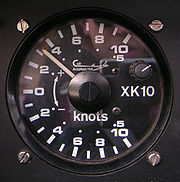
, the instrument is used almost continuously during normal flight, often with an audible output, to inform the pilot of rising or sinking air. It is usual for gliders to be equipped with more than one type of variometer. The simpler type does not need an external source of power and can therefore be relied upon to function regardless of whether a battery or power source has been fitted. The electronic type with audio needs a power source to be operative during the flight. The instrument is of little interest during launching and landing, with the exception of aerotow, where the pilot will usually want to avoid releasing in sink.
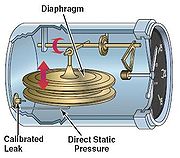 Variometers measure the rate of change of altitude by detecting the change in air pressure (static pressure) as altitude changes. A simple variometer can be constructed by adding a large reservoir (a thermos bottle) to augment the storage capacity of a common aircraft rate-of-climb instrument. In its simplest electronic form, the instrument consists of an air bottle connected to the external atmosphere through a sensitive air flow meter. As the aircraft changes altitude, the atmospheric pressure outside the aircraft changes and air flows into or out of the air bottle to equalise the pressure inside the bottle and outside the aircraft. The rate and direction of flowing air is measured by the cooling of one of two self-heating thermistor
s and the difference between the thermistor resistances will cause a voltage difference; this is amplified and displayed to the pilot. The faster the aircraft is ascending (or descending), the faster the air flows. Air flowing out of the bottle indicates that the altitude of the aircraft is increasing. Air flowing into the bottle indicates that the aircraft is descending.
Newer variometer designs directly measure the static pressure of the atmosphere using a pressure sensor and detect changes in altitude directly from the change in air pressure instead of by measuring air flow. These designs tend to be smaller as they do not need the air bottle. They are more reliable as there is no bottle to be affected by changes in temperature and less chances for leaks to occur in the connecting tubes.
The designs described above, which measure the rate of change of altitude by automatically detecting the change in static pressure as the aircraft changes altitude are referred to as "uncompensated" variometers. The term "vertical speed indicator" or "VSI" is most often used for the instrument when it is installed in a powered aircraft. The term "variometer" is most often used when the instrument is installed in a glider or sailplane.
An "Inertia lead" VSI or ILVSI compensates for relative "g" forces
experienced in a turn (powered aircraft) and provides appropriate mechanical compensation to remove otherwise erroneous indications of climb or descent.
. Although they could readily detect abrupt changes in vertical speed ("in the seat of the pants"), their senses did not allow them to distinguish lift from sink, or strong lift from weak lift. The actual climb/sink rate could not even be guessed at, unless there was some clear fixed visual reference nearby. Being near a fixed reference means being near to a hillside, or to the ground. Except when hill-soaring (exploiting the lift close to the up-wind side of a hill), these are generally very unprofitable positions for glider pilots to be in. The most useful forms of lift (thermal
and wave
lift) are found at higher altitudes and it is very hard for a pilot to detect or exploit them without the use of a variometer. After the variometer was invented in 1929 by Alexander Lippisch
and Robert Kronfeld
, the sport of gliding
moved into a new realm.

s, i.e., in isolation of changes in altitude due exclusively to changes in speed.
When the pilot chooses to pull up to enter a thermal
or to dive to exit a sink area, an uncompensated variometer will include the change in altitude due to the change in velocity in its read-out, thus marring the airmass' climb or sink rate. Therefore an uncompensated variometer can only accurately indicate the vertical speed of the airmass when flying at constant speed.
The action of diving or pulling up affects the speed of the sailplane. A sailplane can exchange height for speed or speed for height, i.e. potential energy
for kinetic energy
or kinetic energy for potential energy. In fact, in still air, the sum of potential energy and kinetic energy, i.e., the Total Energy, remains constant (neglecting energy loss due to drag), hence the name Total Energy compensation.
Most modern sailplanes are equipped with Total Energy compensated variometers.
1. Potential Energy + Kinetic Energy = Total Energy
the compensation to cancel stick thermals is:
2. Potential Energy Gained = Kinetic Energy Lost (stick thermal)
i.e.:
3.
or
4.
Since
5. Potential Energy is proportional to Height ( )
)
and
6. Kinetic Energy is proportional to Velocity squared ( ),
),
then from (3):
7.
where
8. Δh is the compensation to apply to the uncompensated variometer reading.
Very few powered aircraft have total energy variometers. The pilot of a powered aircraft is more interested in the true rate of change of altitude, as he often wants to hold a constant altitude or maintain a steady climb or descent.
The total energy probe used to be shaped as a classical venturi
(two small funnels connected back-to-back by their narrow ends), or nowadays the Irving
Tube - a slot or pair of holes on the back side of a quarter inch vertical tube. The geometry of the total energy probe is such that air flow generates suction (reduced pressure).
To maximise the precision of this compensation effect, the total energy probe needs to be in undisturbed airflow ahead of the aircraft nose or tail fin (the "Braunschweig tube", the long cantilevered tube with a kink in the end that can be seen projecting from the leading edge of the tail fin on most modern sailplanes.)
) adjusted for the wing loading
due to water ballast. The Netto variometer will always read zero in still air. This provides the pilot with the accurate measurement of air mass vertical movement critical for final glides.
The Relative Netto Variometer indicates the vertical speed the glider would achieve IF it flies at thermalling speed - independent of current air speed and attitude. This reading is calculated as the Netto reading minus the glider's minimum sink.
When the glider circles to thermal, the pilot needs to know the glider's vertical speed instead of that of the air mass. The Relative Netto Variometer (or sometimes the super Netto) includes a g-sensor to detect thermalling.
When thermalling, the sensor will detect acceleration (gravity plus centrifugal) above 1 g and tell the relative netto variometer to stop subtracting the sailplane's wing load-adjusted polar sink rate for the duration. Some earlier nettos used a manual switch instead of the g sensor.
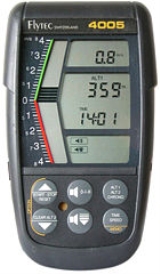
. This audio signal allows the pilot to concentrate on the external view instead of having to watch the instruments, thus improving safety and also giving the pilot more opportunity to search for promising looking clouds and other signs of lift. A variometer that produces this type of audible tone is known as an "audio variometer".
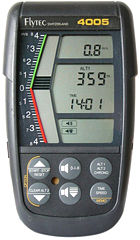
Advanced electronic variometers in gliders can present other information to the pilot from GPS
receivers. The display can thus show the bearing, distance and height required to reach an objective. In cruise mode (used in straight flight), the vario can also give an audible indication of the correct speed to fly depending on whether the air is rising or sinking. The pilot merely has to input the estimated MacCready
setting, which is the expected rate of climb in the next acceptable thermal.
There is an increasing trend for advanced variometers in gliders which tend towards flight computers and present other information such as controlled airspace, lists of turnpoints and even collision warnings. Some will also store positional GPS data during the flight for later analysis.
led gliders. Typically it takes the form of a radio transmitter
in the plane, and a receiver
held by the pilot on the ground. Depending on the design, the receiver may give the pilot the current altitude of the plane (an altimeter
) and some sort of display that indicates if the plane is gaining or losing altitude—often via a tone just like in full scale gliders. Other forms of telemetry
may also be provided by the system, giving things such as airspeed and battery voltage. Varios used in radio controlled planes may or may not feature total energy compensation (the better/more expensive ones generally do.)
Variometers are strictly optional for R/C glider use—a skilled pilot can generally determine if their plane is going up or down via visual cues alone, and so the use of a variometer is often seen as a `crutch', as a replacement for skill, and many pilots prefer not to use them at all, as the tone can be distracting, and the (usually small) amount of weight added to the plane does affect performance. The use of variometers is permitted in some R/C soaring contests
and prohibited in others.
Perhaps the most popular brands of R/C variometers are the Picolario and the WsTech CS Voice.
Magnetic field
A magnetic field is a mathematical description of the magnetic influence of electric currents and magnetic materials. The magnetic field at any given point is specified by both a direction and a magnitude ; as such it is a vector field.Technically, a magnetic field is a pseudo vector;...
.
A variometer (also known as a rate of climb and descent Indicator (RCDI), rate-of-climb indicator, vertical speed indicator (VSI), or vertical velocity indicator (VVI)) is one of the flight instruments
Flight instruments
Flight instruments are the instruments in the cockpit of an aircraft that provide the pilot with information about the flight situation of that aircraft, such as height, speed and altitude...
in an aircraft
Aircraft
An aircraft is a vehicle that is able to fly by gaining support from the air, or, in general, the atmosphere of a planet. An aircraft counters the force of gravity by using either static lift or by using the dynamic lift of an airfoil, or in a few cases the downward thrust from jet engines.Although...
used to inform the pilot
Aviator
An aviator is a person who flies an aircraft. The first recorded use of the term was in 1887, as a variation of 'aviation', from the Latin avis , coined in 1863 by G. de la Landelle in Aviation Ou Navigation Aérienne...
of the near instantaneous (rather than averaged) rate of descent or climb. It can be calibrated in knots, feet per minute (101.333 ft/min = 1 kn) or metres per second, depending on country and type of aircraft.
In powered flight
Flight
Flight is the process by which an object moves either through an atmosphere or beyond it by generating lift or propulsive thrust, or aerostatically using buoyancy, or by simple ballistic movement....
the pilot makes frequent use of the VSI to ascertain that level flight is being maintained, especially during turning manoeuvres. In gliding
Gliding
Gliding is a recreational activity and competitive air sport in which pilots fly unpowered aircraft known as gliders or sailplanes using naturally occurring currents of rising air in the atmosphere to remain airborne. The word soaring is also used for the sport.Gliding as a sport began in the 1920s...
, the instrument is used almost continuously during normal flight, often with an audible output, to inform the pilot of rising or sinking air. It is usual for gliders to be equipped with more than one type of variometer. The simpler type does not need an external source of power and can therefore be relied upon to function regardless of whether a battery or power source has been fitted. The electronic type with audio needs a power source to be operative during the flight. The instrument is of little interest during launching and landing, with the exception of aerotow, where the pilot will usually want to avoid releasing in sink.
Description
Thermistor
A thermistor is a type of resistor whose resistance varies significantly with temperature, more so than in standard resistors. The word is a portmanteau of thermal and resistor...
s and the difference between the thermistor resistances will cause a voltage difference; this is amplified and displayed to the pilot. The faster the aircraft is ascending (or descending), the faster the air flows. Air flowing out of the bottle indicates that the altitude of the aircraft is increasing. Air flowing into the bottle indicates that the aircraft is descending.
Newer variometer designs directly measure the static pressure of the atmosphere using a pressure sensor and detect changes in altitude directly from the change in air pressure instead of by measuring air flow. These designs tend to be smaller as they do not need the air bottle. They are more reliable as there is no bottle to be affected by changes in temperature and less chances for leaks to occur in the connecting tubes.
The designs described above, which measure the rate of change of altitude by automatically detecting the change in static pressure as the aircraft changes altitude are referred to as "uncompensated" variometers. The term "vertical speed indicator" or "VSI" is most often used for the instrument when it is installed in a powered aircraft. The term "variometer" is most often used when the instrument is installed in a glider or sailplane.
An "Inertia lead" VSI or ILVSI compensates for relative "g" forces
G-force
The g-force associated with an object is its acceleration relative to free-fall. This acceleration experienced by an object is due to the vector sum of non-gravitational forces acting on an object free to move. The accelerations that are not produced by gravity are termed proper accelerations, and...
experienced in a turn (powered aircraft) and provides appropriate mechanical compensation to remove otherwise erroneous indications of climb or descent.
Purpose
Human beings, unlike birds and other flying animals, are not able directly to sense climb and sink rates. Before the invention of the variometer, sailplane pilots found it very hard to soarGliding
Gliding is a recreational activity and competitive air sport in which pilots fly unpowered aircraft known as gliders or sailplanes using naturally occurring currents of rising air in the atmosphere to remain airborne. The word soaring is also used for the sport.Gliding as a sport began in the 1920s...
. Although they could readily detect abrupt changes in vertical speed ("in the seat of the pants"), their senses did not allow them to distinguish lift from sink, or strong lift from weak lift. The actual climb/sink rate could not even be guessed at, unless there was some clear fixed visual reference nearby. Being near a fixed reference means being near to a hillside, or to the ground. Except when hill-soaring (exploiting the lift close to the up-wind side of a hill), these are generally very unprofitable positions for glider pilots to be in. The most useful forms of lift (thermal
Thermal
A thermal column is a column of rising air in the lower altitudes of the Earth's atmosphere. Thermals are created by the uneven heating of the Earth's surface from solar radiation, and are an example of convection. The sun warms the ground, which in turn warms the air directly above it...
and wave
Lee waves
In meteorology, lee waves are atmospheric standing waves. The most common form is mountain waves, which are atmospheric internal gravity waves...
lift) are found at higher altitudes and it is very hard for a pilot to detect or exploit them without the use of a variometer. After the variometer was invented in 1929 by Alexander Lippisch
Alexander Lippisch
Alexander Martin Lippisch was a German pioneer of aerodynamics. He made important contributions to the understanding of flying wings, delta wings and the ground effect. His most famous design is the Messerschmitt Me 163 rocket-powered interceptor.Lippisch was born in Munich, Kingdom of Bavaria...
and Robert Kronfeld
Robert Kronfeld
Squadron Leader Robert Kronfeld, AFC, was an Austrian-born gliding champion and sailplane designer of the 1920s and 30s. He became a British subject and an RAF test pilot...
, the sport of gliding
Gliding
Gliding is a recreational activity and competitive air sport in which pilots fly unpowered aircraft known as gliders or sailplanes using naturally occurring currents of rising air in the atmosphere to remain airborne. The word soaring is also used for the sport.Gliding as a sport began in the 1920s...
moved into a new realm.
Total energy compensation
As the sport developed, however, it was found that these very simple "uncompensated" instruments had their limitations. The information that glider pilots really need to soar is the vertical speed of the glider in isolation of stick thermalStick thermal
Stick thermal is terminology used in aviation, and particularly in the sport of gliding. It refers to the illusion that the glider is climbing in a thermal when, in fact, the upward movement of the glider is caused by nothing more than the pilot pulling backwards on the control stick.It is useful...
s, i.e., in isolation of changes in altitude due exclusively to changes in speed.
When the pilot chooses to pull up to enter a thermal
Thermal
A thermal column is a column of rising air in the lower altitudes of the Earth's atmosphere. Thermals are created by the uneven heating of the Earth's surface from solar radiation, and are an example of convection. The sun warms the ground, which in turn warms the air directly above it...
or to dive to exit a sink area, an uncompensated variometer will include the change in altitude due to the change in velocity in its read-out, thus marring the airmass' climb or sink rate. Therefore an uncompensated variometer can only accurately indicate the vertical speed of the airmass when flying at constant speed.
The action of diving or pulling up affects the speed of the sailplane. A sailplane can exchange height for speed or speed for height, i.e. potential energy
Potential energy
In physics, potential energy is the energy stored in a body or in a system due to its position in a force field or due to its configuration. The SI unit of measure for energy and work is the Joule...
for kinetic energy
Kinetic energy
The kinetic energy of an object is the energy which it possesses due to its motion.It is defined as the work needed to accelerate a body of a given mass from rest to its stated velocity. Having gained this energy during its acceleration, the body maintains this kinetic energy unless its speed changes...
or kinetic energy for potential energy. In fact, in still air, the sum of potential energy and kinetic energy, i.e., the Total Energy, remains constant (neglecting energy loss due to drag), hence the name Total Energy compensation.
Most modern sailplanes are equipped with Total Energy compensated variometers.
Total energy compensation in theory
While the driving principle is:1. Potential Energy + Kinetic Energy = Total Energy
the compensation to cancel stick thermals is:
2. Potential Energy Gained = Kinetic Energy Lost (stick thermal)
i.e.:
3.
or
4.
Since
5. Potential Energy is proportional to Height (
)and
6. Kinetic Energy is proportional to Velocity squared (
),then from (3):
7.
where
8. Δh is the compensation to apply to the uncompensated variometer reading.
Total energy compensation in practice
In most sailplanes, total energy compensation is achieved by connecting the variometer to the atmosphere via a "total energy probe", that produces vacuum proportional to the square of the glider's air speed - in effect, a negative pitot. Alternatively, the subtraction may be done electronically by the flight computer based on indicated airspeed (pitot).Very few powered aircraft have total energy variometers. The pilot of a powered aircraft is more interested in the true rate of change of altitude, as he often wants to hold a constant altitude or maintain a steady climb or descent.
The total energy probe used to be shaped as a classical venturi
Venturi effect
The Venturi effect is the reduction in fluid pressure that results when a fluid flows through a constricted section of pipe. The Venturi effect is named after Giovanni Battista Venturi , an Italian physicist.-Background:...
(two small funnels connected back-to-back by their narrow ends), or nowadays the Irving
Frank Irving
Frank Irving was a British aeronautical engineer, glider pilot, author and university Senior Lecturer.- Early life and education :...
Tube - a slot or pair of holes on the back side of a quarter inch vertical tube. The geometry of the total energy probe is such that air flow generates suction (reduced pressure).
To maximise the precision of this compensation effect, the total energy probe needs to be in undisturbed airflow ahead of the aircraft nose or tail fin (the "Braunschweig tube", the long cantilevered tube with a kink in the end that can be seen projecting from the leading edge of the tail fin on most modern sailplanes.)
Netto variometer
A second type of compensated variometer is the Netto or airmass variometer. In addition to TE compensation, the Netto variometer adjusts for the intrinsic sink rate of the glider at a given speed (the polar curvePolar curve (aviation)
A polar curve is a graph which contrasts the sink rate of an aircraft with its horizontal speed.-Measuring a glider's performance:...
) adjusted for the wing loading
Wing loading
In aerodynamics, wing loading is the loaded weight of the aircraft divided by the area of the wing. The faster an aircraft flies, the more lift is produced by each unit area of wing, so a smaller wing can carry the same weight in level flight, operating at a higher wing loading. Correspondingly,...
due to water ballast. The Netto variometer will always read zero in still air. This provides the pilot with the accurate measurement of air mass vertical movement critical for final glides.
The Relative Netto Variometer indicates the vertical speed the glider would achieve IF it flies at thermalling speed - independent of current air speed and attitude. This reading is calculated as the Netto reading minus the glider's minimum sink.
When the glider circles to thermal, the pilot needs to know the glider's vertical speed instead of that of the air mass. The Relative Netto Variometer (or sometimes the super Netto) includes a g-sensor to detect thermalling.
When thermalling, the sensor will detect acceleration (gravity plus centrifugal) above 1 g and tell the relative netto variometer to stop subtracting the sailplane's wing load-adjusted polar sink rate for the duration. Some earlier nettos used a manual switch instead of the g sensor.
Electronic variometers
In modern gliders, most electronic variometers generate a sound whose pitch and rhythm depends on the instrument reading. Typically the audio tone increases in frequency as the variometer shows a higher rate of climb and decreases in frequency towards a deep groan as the variometer shows a faster rate of descent. When the variometer is showing a climb, the tone is often chopped, while during a descent the tone is not chopped and the rate of chopping may be increased as the climb rate increases. The vario is typically silent in still air or in lift which is weaker than the typical sink rate of the glider at minimum sinkPolar curve (aviation)
A polar curve is a graph which contrasts the sink rate of an aircraft with its horizontal speed.-Measuring a glider's performance:...
. This audio signal allows the pilot to concentrate on the external view instead of having to watch the instruments, thus improving safety and also giving the pilot more opportunity to search for promising looking clouds and other signs of lift. A variometer that produces this type of audible tone is known as an "audio variometer".
Advanced electronic variometers in gliders can present other information to the pilot from GPS
Global Positioning System
The Global Positioning System is a space-based global navigation satellite system that provides location and time information in all weather, anywhere on or near the Earth, where there is an unobstructed line of sight to four or more GPS satellites...
receivers. The display can thus show the bearing, distance and height required to reach an objective. In cruise mode (used in straight flight), the vario can also give an audible indication of the correct speed to fly depending on whether the air is rising or sinking. The pilot merely has to input the estimated MacCready
Paul MacCready
Paul B. MacCready, Jr. was an American aeronautical engineer. He was the founder of AeroVironment and the designer of the human-powered aircraft that won the Kremer prize...
setting, which is the expected rate of climb in the next acceptable thermal.
There is an increasing trend for advanced variometers in gliders which tend towards flight computers and present other information such as controlled airspace, lists of turnpoints and even collision warnings. Some will also store positional GPS data during the flight for later analysis.
Radio controlled soaring
Variometers are also used in radio controlRadio control
Radio control is the use of radio signals to remotely control a device. The term is used frequently to refer to the control of model vehicles from a hand-held radio transmitter...
led gliders. Typically it takes the form of a radio transmitter
Transmitter
In electronics and telecommunications a transmitter or radio transmitter is an electronic device which, with the aid of an antenna, produces radio waves. The transmitter itself generates a radio frequency alternating current, which is applied to the antenna. When excited by this alternating...
in the plane, and a receiver
Receiver (radio)
A radio receiver converts signals from a radio antenna to a usable form. It uses electronic filters to separate a wanted radio frequency signal from all other signals, the electronic amplifier increases the level suitable for further processing, and finally recovers the desired information through...
held by the pilot on the ground. Depending on the design, the receiver may give the pilot the current altitude of the plane (an altimeter
Altimeter
An altimeter is an instrument used to measure the altitude of an object above a fixed level. The measurement of altitude is called altimetry, which is related to the term bathymetry, the measurement of depth underwater.-Pressure altimeter:...
) and some sort of display that indicates if the plane is gaining or losing altitude—often via a tone just like in full scale gliders. Other forms of telemetry
Telemetry
Telemetry is a technology that allows measurements to be made at a distance, usually via radio wave transmission and reception of the information. The word is derived from Greek roots: tele = remote, and metron = measure...
may also be provided by the system, giving things such as airspeed and battery voltage. Varios used in radio controlled planes may or may not feature total energy compensation (the better/more expensive ones generally do.)
Variometers are strictly optional for R/C glider use—a skilled pilot can generally determine if their plane is going up or down via visual cues alone, and so the use of a variometer is often seen as a `crutch', as a replacement for skill, and many pilots prefer not to use them at all, as the tone can be distracting, and the (usually small) amount of weight added to the plane does affect performance. The use of variometers is permitted in some R/C soaring contests
Competition
Competition is a contest between individuals, groups, animals, etc. for territory, a niche, or a location of resources. It arises whenever two and only two strive for a goal which cannot be shared. Competition occurs naturally between living organisms which co-exist in the same environment. For...
and prohibited in others.
Perhaps the most popular brands of R/C variometers are the Picolario and the WsTech CS Voice.
See also
- Hang glidingHang glidingHang gliding is an air sport in which a pilot flies a light and unmotorized foot-launchable aircraft called a hang glider ....
- ParaglidingParaglidingParagliding is the recreational and competitive adventure sport of flying paragliders: lightweight, free-flying, foot-launched glider aircraft with no rigid primary structure...
- Rate of Climb and Descent Indicator
- Speed to flySpeed to flySpeed to fly is a principle used by soaring pilots when flying between sources of lift, usually thermals, ridge lift and wave. The aim is to maximize the average cross-country speed by optimizing the airspeed in both rising and sinking air...