


United States Bureau of Reclamation

Encyclopedia
The United States Bureau of Reclamation (USBR), and formerly the United States Reclamation Service (not to be confused with the Office of Surface Mining Reclamation and Enforcement
), is an agency under the U.S. Department of the Interior
, which oversees water resource management, specifically as it applies to the oversight and/or operation of numerous diversion, delivery, and storage projects it built throughout the western United States
for irrigation
, water supply
, and attendant hydroelectric power generation. Currently USBR is the largest wholesaler of water in the country, bringing water to more than 31 million people, and providing one in five Western farmers with irrigation water for 10 million acres of farmland, which produce 60% of the nation's vegetables and 25% of its fruits and nuts. USBR is also the second largest producer of hydroelectric power in the western United States.
In July 1902, in accordance with the Reclamation Act, Secretary of the Interior
Ethan Allen Hitchcock
established the U.S. Reclamation Service within the U.S. Geologic Survey
(USGS). The new Reclamation Service studied potential water development projects in each western state with federal lands—revenue from sale of federal lands was the initial source of the program's funding. Because Texas
had no federal lands, it did not become a Reclamation state until 1906, when Congress passed a special Act including it in the provisions of the Reclamation Act.
 From 1902 to 1907, Reclamation began about 30 projects in Western states. Then, in 1907, the Secretary of the Interior separated the Reclamation Service from the USGS and created an independent bureau within the Department of the Interior. Frederick Haynes Newell
was appointed the first director of the new bureau.
In the early years, many projects encountered problems: lands or soils included in projects were unsuitable for irrigation
; land speculation sometimes resulted in poor settlement patterns; proposed repayment schedules could not be met by irrigators who had high land-preparation and facilities-construction costs; settlers were inexperienced in irrigation farming; waterlogging of irrigable lands required expensive drainage projects; and projects were built in areas which could only grow low-value crops. In 1923 the agency was renamed the "Bureau of Reclamation". Then, in the face of increasing settler unrest and financial problems for the reclamation program, in 1924 the "Fact Finder's Report" spotlighted the issues. The Fact Finders Act in late 1924 sought to resolve some of the financial and other problems.
In 1928 Congress authorized the Boulder Canyon (Hoover Dam
) Project, and large appropriations began, for the first time, to flow to Reclamation from the general funds of the U.S. The authorization came only after a hard-fought debate about the pros and cons of public power versus private power.
The heyday of Reclamation construction of water facilities occurred during the Depression
and the 35 years after World War II
. From 1941–47, Civilian Public Service
labor was used to carry on projects otherwise interrupted by the war effort. The last major authorization for construction projects occurred in the late 1960s, while a parallel evolution and development of the American environmental movement began to result in strong opposition to water development projects. Even the 1976 failure of Teton Dam
as it filled for the first time did not diminish Reclamation's strong international reputation in water development circles. However, this first and only failure of a major Reclamation dam did shake the Bureau, which subsequently strengthened its dam-safety program to avoid similar problems in the future. Even so, the failure of Teton Dam, the environmental movement, and the announcement of the President Carter
's "hit list" on water projects profoundly affected the direction of Reclamation's programs and activities in the United States.
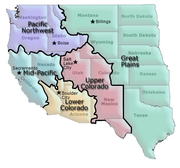
Reclamation operates about 180 projects in the 17 western states. The total Reclamation investment for completed project facilities in September 1992 was about $11.0 billion. Reclamation projects provide agricultural, household, and industrial water to about one-third of the population of the American West. About 5% of the land area of the West is irrigated, and Reclamation provides water to about one-fifth of that area, some 9,120,000 acres (37,000 km²) in 1992. Reclamation is a major American generator of electricity
. , Reclamation had 58 power plants on-line and generated 125,000 GJ of electricity.
From 1988–94, Reclamation underwent major reorganization as construction on projects authorized in the 1960s and earlier drew to an end. Reclamation wrote that "The arid West essentially has been reclaimed. The major rivers have been harnessed and facilities are in place or are being completed to meet the most pressing current water demands and those of the immediate future". Emphasis in Reclamation programs shifted from construction to operation and maintenance of existing facilities. Reclamation's redefined official mission is to "manage, develop, and protect water and related resources in an environmentally and economically sound manner in the interest of the American public". In redirecting its programs and responsibilities, Reclamation substantially reduced its staff levels and budgets but remains a significant federal agency in the West.
Reclamation commissioners that have had a strong impact and molding of the Bureau have included Elwood Mead
, Michael W. Straus
, and Floyd Dominy
, the latter two public-power boosters who ran the Bureau during its heyday years. Mead, of course, guided the bureau during the development, planning and construction of the first multiple-purpose dam—Hoover Dam.
John W. Keys, the 16th Commissioner of the Bureau of Reclamation, who served in that capacity from July 17, 2001, to April 15, 2006, was killed only 2 years after his retirement, on May 30, 2008, when the airplane he was piloting crashed in Canyonlands National Park
, Utah
, with one passenger aboard http://www.usbr.gov/history/CommissBios/keys.html.
Michael L. Connor is the current commissioner of the Bureau of Reclamation.
Office of Surface Mining
The Office of Surface Mining Reclamation and Enforcement is a branch of the United States Department of the Interior...
), is an agency under the U.S. Department of the Interior
United States Department of the Interior
The United States Department of the Interior is the United States federal executive department of the U.S. government responsible for the management and conservation of most federal land and natural resources, and the administration of programs relating to Native Americans, Alaska Natives, Native...
, which oversees water resource management, specifically as it applies to the oversight and/or operation of numerous diversion, delivery, and storage projects it built throughout the western United States
United States
The United States of America is a federal constitutional republic comprising fifty states and a federal district...
for irrigation
Irrigation
Irrigation may be defined as the science of artificial application of water to the land or soil. It is used to assist in the growing of agricultural crops, maintenance of landscapes, and revegetation of disturbed soils in dry areas and during periods of inadequate rainfall...
, water supply
Water supply
Water supply is the provision of water by public utilities, commercial organisations, community endeavours or by individuals, usually via a system of pumps and pipes...
, and attendant hydroelectric power generation. Currently USBR is the largest wholesaler of water in the country, bringing water to more than 31 million people, and providing one in five Western farmers with irrigation water for 10 million acres of farmland, which produce 60% of the nation's vegetables and 25% of its fruits and nuts. USBR is also the second largest producer of hydroelectric power in the western United States.
In July 1902, in accordance with the Reclamation Act, Secretary of the Interior
United States Secretary of the Interior
The United States Secretary of the Interior is the head of the United States Department of the Interior.The US Department of the Interior should not be confused with the concept of Ministries of the Interior as used in other countries...
Ethan Allen Hitchcock
Ethan A. Hitchcock (Interior)
Ethan Allen Hitchcock served under Presidents William McKinley and Theodore Roosevelt as U.S. Secretary of the Interior.-Early life:...
established the U.S. Reclamation Service within the U.S. Geologic Survey
United States Geological Survey
The United States Geological Survey is a scientific agency of the United States government. The scientists of the USGS study the landscape of the United States, its natural resources, and the natural hazards that threaten it. The organization has four major science disciplines, concerning biology,...
(USGS). The new Reclamation Service studied potential water development projects in each western state with federal lands—revenue from sale of federal lands was the initial source of the program's funding. Because Texas
Texas
Texas is the second largest U.S. state by both area and population, and the largest state by area in the contiguous United States.The name, based on the Caddo word "Tejas" meaning "friends" or "allies", was applied by the Spanish to the Caddo themselves and to the region of their settlement in...
had no federal lands, it did not become a Reclamation state until 1906, when Congress passed a special Act including it in the provisions of the Reclamation Act.
History
Frederick Haynes Newell
Frederick Haynes Newell , First Director of the United States Reclamation Service, was born in Bradford, Pennsylvania...
was appointed the first director of the new bureau.
In the early years, many projects encountered problems: lands or soils included in projects were unsuitable for irrigation
Irrigation
Irrigation may be defined as the science of artificial application of water to the land or soil. It is used to assist in the growing of agricultural crops, maintenance of landscapes, and revegetation of disturbed soils in dry areas and during periods of inadequate rainfall...
; land speculation sometimes resulted in poor settlement patterns; proposed repayment schedules could not be met by irrigators who had high land-preparation and facilities-construction costs; settlers were inexperienced in irrigation farming; waterlogging of irrigable lands required expensive drainage projects; and projects were built in areas which could only grow low-value crops. In 1923 the agency was renamed the "Bureau of Reclamation". Then, in the face of increasing settler unrest and financial problems for the reclamation program, in 1924 the "Fact Finder's Report" spotlighted the issues. The Fact Finders Act in late 1924 sought to resolve some of the financial and other problems.
In 1928 Congress authorized the Boulder Canyon (Hoover Dam
Hoover Dam
Hoover Dam, once known as Boulder Dam, is a concrete arch-gravity dam in the Black Canyon of the Colorado River, on the border between the US states of Arizona and Nevada. It was constructed between 1931 and 1936 during the Great Depression and was dedicated on September 30, 1935, by President...
) Project, and large appropriations began, for the first time, to flow to Reclamation from the general funds of the U.S. The authorization came only after a hard-fought debate about the pros and cons of public power versus private power.
The heyday of Reclamation construction of water facilities occurred during the Depression
Great Depression
The Great Depression was a severe worldwide economic depression in the decade preceding World War II. The timing of the Great Depression varied across nations, but in most countries it started in about 1929 and lasted until the late 1930s or early 1940s...
and the 35 years after World War II
World War II
World War II, or the Second World War , was a global conflict lasting from 1939 to 1945, involving most of the world's nations—including all of the great powers—eventually forming two opposing military alliances: the Allies and the Axis...
. From 1941–47, Civilian Public Service
Civilian Public Service
The Civilian Public Service provided conscientious objectors in the United States an alternative to military service during World War II...
labor was used to carry on projects otherwise interrupted by the war effort. The last major authorization for construction projects occurred in the late 1960s, while a parallel evolution and development of the American environmental movement began to result in strong opposition to water development projects. Even the 1976 failure of Teton Dam
Teton Dam
The Teton Dam was a federally built earthen dam on the Teton River in southeastern Idaho, set between Fremont and Madison counties, USA, which when filling for the first time suffered a catastrophic failure on June 5, 1976. The collapse of the dam resulted in the deaths of 11 peopleand 13,000 head...
as it filled for the first time did not diminish Reclamation's strong international reputation in water development circles. However, this first and only failure of a major Reclamation dam did shake the Bureau, which subsequently strengthened its dam-safety program to avoid similar problems in the future. Even so, the failure of Teton Dam, the environmental movement, and the announcement of the President Carter
Jimmy Carter
James Earl "Jimmy" Carter, Jr. is an American politician who served as the 39th President of the United States and was the recipient of the 2002 Nobel Peace Prize, the only U.S. President to have received the Prize after leaving office...
's "hit list" on water projects profoundly affected the direction of Reclamation's programs and activities in the United States.
Reclamation operates about 180 projects in the 17 western states. The total Reclamation investment for completed project facilities in September 1992 was about $11.0 billion. Reclamation projects provide agricultural, household, and industrial water to about one-third of the population of the American West. About 5% of the land area of the West is irrigated, and Reclamation provides water to about one-fifth of that area, some 9,120,000 acres (37,000 km²) in 1992. Reclamation is a major American generator of electricity
Electricity
Electricity is a general term encompassing a variety of phenomena resulting from the presence and flow of electric charge. These include many easily recognizable phenomena, such as lightning, static electricity, and the flow of electrical current in an electrical wire...
. , Reclamation had 58 power plants on-line and generated 125,000 GJ of electricity.
From 1988–94, Reclamation underwent major reorganization as construction on projects authorized in the 1960s and earlier drew to an end. Reclamation wrote that "The arid West essentially has been reclaimed. The major rivers have been harnessed and facilities are in place or are being completed to meet the most pressing current water demands and those of the immediate future". Emphasis in Reclamation programs shifted from construction to operation and maintenance of existing facilities. Reclamation's redefined official mission is to "manage, develop, and protect water and related resources in an environmentally and economically sound manner in the interest of the American public". In redirecting its programs and responsibilities, Reclamation substantially reduced its staff levels and budgets but remains a significant federal agency in the West.
Reclamation commissioners that have had a strong impact and molding of the Bureau have included Elwood Mead
Elwood Mead
Elwood Mead was a professor, politician and engineer, known for heading the Bureau of Reclamation from 1924 until his death in 1936. During his tenure, he oversaw some of the most complex projects the Bureau of Reclamation has undertaken...
, Michael W. Straus
Michael W. Straus
Michael Wolf Straus was the Commissioner of the United States Bureau of Reclamation from 1945 until 1953.-Biography:Straus was born in Chicago in 1897. He pursued a career as a newspaperman, serving as managing editor of the Chicago Evening Post and rising to the position of Washington, D.C....
, and Floyd Dominy
Floyd Dominy
Floyd E. Dominy was the Nebraska-born Bureau of Reclamation Commissioner from May 1, 1959 to December 1, 1969. Dominy joined the Bureau in 1946. He was the Assistant Commissioner from 1957 to 1958.- References :*...
, the latter two public-power boosters who ran the Bureau during its heyday years. Mead, of course, guided the bureau during the development, planning and construction of the first multiple-purpose dam—Hoover Dam.
John W. Keys, the 16th Commissioner of the Bureau of Reclamation, who served in that capacity from July 17, 2001, to April 15, 2006, was killed only 2 years after his retirement, on May 30, 2008, when the airplane he was piloting crashed in Canyonlands National Park
Canyonlands National Park
Canyonlands National Park is a U.S. National Park located in southeastern Utah near the town of Moab and preserves a colorful landscape eroded into countless canyons, mesas and buttes by the Colorado River, the Green River, and their respective tributaries. The park is divided into four districts:...
, Utah
Utah
Utah is a state in the Western United States. It was the 45th state to join the Union, on January 4, 1896. Approximately 80% of Utah's 2,763,885 people live along the Wasatch Front, centering on Salt Lake City. This leaves vast expanses of the state nearly uninhabited, making the population the...
, with one passenger aboard http://www.usbr.gov/history/CommissBios/keys.html.
Michael L. Connor is the current commissioner of the Bureau of Reclamation.
List of Reclamation Projects
- Animas-La Plata Water ProjectAnimas-La Plata Water ProjectThe Animas-La Plata water project is a water project under construction designed to fulfill the water rights settlement of the Ute Mountain and the Southern Ute tribes of the Ute Nation in Colorado, USA....
- Central Arizona Project AqueductCentral Arizona Project AqueductThe Central Arizona Project is a 336 mi diversion canal in Arizona in the United States. The aqueduct diverts water from the Colorado River from Lake Havasu City near Parker into central and southern Arizona. The CAP is the largest and most expensive aqueduct system ever constructed in the...
- Central Utah ProjectCentral Utah ProjectThe Central Utah Project is a United States federal water project. It was authorized for construction under the Colorado River Storage Project Act of April 11, 1956 as a participating project...
- Central Valley ProjectCentral Valley ProjectThe Central Valley Project is a Bureau of Reclamation federal water project in the U.S. state of California. It was devised in 1933 in order to provide irrigation and municipal water to much of California's Central Valley—by regulating and storing water in reservoirs in the water-rich northern...
- Colorado-Big Thompson ProjectColorado-Big Thompson projectThe Colorado-Big Thompson Project is a water diversion project in Colorado designed to collect West Slope mountain water from the headwaters of the Colorado River and divert it to Colorado's Front Range and plains...
- Columbia Basin ProjectColumbia Basin ProjectThe Columbia Basin Project in Central Washington, USA, is the irrigation network that the Grand Coulee Dam makes possible. It is the largest water reclamation project in the United States, supplying irrigation water to over of the large project area, all of which was originally intended to be...
- Fryingpan-Arkansas ProjectFryingpan-Arkansas ProjectThe Fryingpan-Arkansas Project, or "Fry-Ark," is a water diversion, storage and delivery project serving southeastern Colorado. The project was authorized in 1962 by President Kennedy, construction began that same year, and was completed in 1981...
- Huntley ProjectHuntley ProjectThe Huntley Project is an irrigation project in southern Montana that was established by the United States Bureau of Reclamation in 1907. The district includes the towns of Huntley, Worden, Ballantine, and Pompeys Pillar....
- Klamath ProjectKlamath ProjectThe Klamath Project was developed by the United States Bureau of Reclamation to supply farmers with irrigation water and farmland in the Klamath Basin.The two main sources supply water for the project are Upper Klamath Lake and the Klamath River...
- Moon Lake ProjectMoon Lake ProjectIn the 1930s, the United States Bureau of Reclamation designed and constructed the Moon Lake Project on the Lake Fork River. The Moon Lake Water Users Association, a private irrigation company, operates and maintains the Moon Lake Project on behalf of the Bureau of Reclamation.-External links:*...
- North Platte ProjectNorth Platte ProjectThe North Platte Project is an irrigation project in the U.S. states of Wyoming and Nebraska. The project provides irrigation service to about . The primary water storage for the project is in Pathfinder Reservoir in Wyoming. Downstream, Guernsey Dam manages river flow and provides secondary...
- Shoshone ProjectShoshone projectThe Shoshone Project is an irrigation project in the U.S. state of Wyoming. The project provides irrigation for approximately of crops in the Big Horn Basin, fulfilling the vision of local resident and developer Buffalo Bill Cody, who hoped to make the semi-arid basin into agricultural land...
- Strawberry Valley Project
- Elwha River Dam Removal ProjectElwha Ecosystem RestorationThe Elwha Ecosystem Restoration Project in the United States is the largest dam removal project in history and the second largest ecosystem restoration project in the history of the National Park Service, after the Restoration of the Everglades...
- Rio Grande ProjectRio Grande ProjectThe Rio Grande Project is a United States Bureau of Reclamation irrigation, hydroelectricity, flood control, and water diversion project, begun in 1905, that taps the Rio Grande in the states of New Mexico and Texas, in the United States. of irrigated land, in a strip of land along the river no...
- Yuma ProjectYuma ProjectThe Yuma Project is a U.S. Bureau of Reclamation project built to irrigate over of land in Yuma County, Arizona and parts of Imperial County, California. The project is designed to exploit year-round farming conditions and water from the Colorado River. It consists of the Laguna Diversion Dam,...
See also
- Colorado River AqueductColorado River AqueductThe Colorado River Aqueduct, or CRA, is a water conveyance in Southern California in the United States, operated by the Metropolitan Water District of Southern California . The aqueduct impounds water from the Colorado River at Lake Havasu on the California-Arizona border west across the Mojave...
- Yuma Valley Railway – A predecessor of the Yuma Valley Railroad that was owned by USG along Colorado River in Yuma, Arizona.
- Riverside Canal (El Paso)Riverside Canal (El Paso)The Riverside Canal is an irrigation canal in El Paso County beginning southeast of El Paso, Texas. The canal acquires water from the Riverside Diversion Dam on the Rio Grande River southeast of El Paso. The canal is managed by the US Bureau of Reclamation. The canal extends for with a capacity...
- Grand Coulee DamGrand Coulee DamGrand Coulee Dam is a gravity dam on the Columbia River in the U.S. state of Washington built to produce hydroelectric power and provide irrigation. It was constructed between 1933 and 1942, originally with two power plants. A third power station was completed in 1974 to increase its energy...
Further reading
- Marc ReisnerMarc ReisnerMarc Reisner was an American environmentalist and writer best known for his book Cadillac Desert, a history of water management in the American West....
, Cadillac DesertCadillac DesertCadillac Desert, by Marc Reisner, is a 1986 book published by Viking about land development and water policy in the western United States. Subtitled The American West and its Disappearing Water, it gives the history of the Bureau of Reclamation and U.S. Army Corps of Engineers, and their struggle...
: The American West and Its Disappearing Water. Revised edition (Penguin, 1993). ISBN 0-14-017824-4