
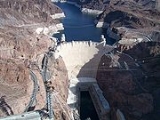
Hoover Dam, once known as
Boulder Dam, is a
concreteConcrete is a construction material composed of cement as well as other cementitious materials such as fly ash and slag cement, aggregate , water, and chemical admixtures...
arch-gravity damAn arch-gravity dam, such as the Hoover Dam, is a dam with the characteristics of both an arch dam and a gravity dam. It is a dam that curves upstream in a narrowing curve that directs most of the water against the canyon rock walls, providing the force to compress the dam. It combines the...
in the
Black CanyonThe Black Canyon is the canyon where Hoover Dam was built. It is located on the Colorado River in the United States. The Nevada and Arizona border is right in the middle of the Colorado River. Black Canyon is surrounded by the El Dorado Mountains, which were formed about 15 million years ago...
of the Colorado River, on the
borderBorders define geographic boundaries of political entities or legal jurisdictions, such as governments, states or subnational administrative divisions. They may foster the setting up of buffer zones...
between the
U.S.The United States of America is a federal constitutional republic comprising fifty states and a federal district...
states of
ArizonaThe State of Arizona is a state located in the southwestern region of the United States. The capital and largest city is Phoenix. The second largest city is Tucson, followed in size by the four Phoenix metropolitan area cities of Mesa, Glendale, Chandler, and Scottsdale.Arizona was the 48th and...
and
NevadaNevada is a state located in the western region of the United States. The capital is Carson City and the largest city is Las Vegas. The state's nickname is Silver State, due to the large number of silver deposits that were discovered and mined there...
. When completed in 1936, it was both the world's largest electric-power generating station and the world's largest concrete structure. It was surpassed in both these respects by the
Grand Coulee DamGrand Coulee Dam is a hydroelectric gravity dam on the Columbia River in the U.S. state of Washington. In the United States, it is the largest electric power-producing facility and the largest concrete structure...
in 1945. It is currently the world's 35th-largest hydroelectric generating station.
This dam, located southeast of
Las Vegas, NevadaLas Vegas is the most populous city in the U.S. state of Nevada, the seat of Clark County, and an internationally renowned major resort city for gambling, shopping, fine dining, and entertainment. Las Vegas, which bills itself as The Entertainment Capital of the World, is famous for the number of...
, is named after
Herbert HooverHerbert Clark Hoover was the 31st President of the United States . Hoover was a professional mining engineer and author. As the United States Secretary of Commerce in the 1920s under Presidents Warren Harding and Calvin Coolidge, he promoted government intervention under the rubric "economic...
, who played an instrumental role in its construction, first as the Secretary of Commerce, and then later, as the
President of the United StatesThe President of the United States is the head of state and head of government of the United States and is the highest political official in the United States by influence and recognition...
. Construction began in 1931, and was completed in 1936, more than two years ahead of schedule. The dam and the power plant are operated by the Bureau of Reclamation of the U.S. Department of the Interior. Listed on the
National Register of Historic PlacesThe National Register of Historic Places is the United States government's official list of districts, sites, buildings, structures, and objects deemed worthy of preservation...
in 1981, Hoover Dam was designated a
National Historic LandmarkA National Historic Landmark is a building, site, structure, object, or district, that is officially recognized by the United States government for its historical significance. All NHLs are listed in the National Register of Historic Places...
in 1985.
Lake MeadLake Mead is the largest reservoir in the United States. It is located on the Colorado River about 30 miles southeast of Las Vegas, Nevada, in the states of Nevada and Arizona. Formed by water impounded by Hoover Dam, it extends 112 mi behind the dam, holding approximately 28.5 million acre feet...
is the reservoir created by the dam, named after
Elwood MeadElwood Mead was a professor, politician and engineer who headed the Bureau of Reclamation from 1924 until his death in 1936....
, who oversaw the construction of the dam.
Planning and agreements
A commission was formed in 1922 with a representative from each of the Basin states and one from the Federal Government. The federal representative was
Herbert HooverHerbert Clark Hoover was the 31st President of the United States . Hoover was a professional mining engineer and author. As the United States Secretary of Commerce in the 1920s under Presidents Warren Harding and Calvin Coolidge, he promoted government intervention under the rubric "economic...
, then Secretary of Commerce under President Warren Harding. In January 1922, Hoover met with the state governors of Arizona, California, Colorado, Nevada, New Mexico, Utah, and Wyoming to work out an equitable arrangement for apportioning the waters of the Colorado River for their states' use. The resulting
Colorado River CompactThe Colorado River Compact is a 1922 agreement among seven U.S. states in the basin of the Colorado River in the American Southwest governing the allocation of the water rights to the river's water among the parties of the interstate compact. The agreement was signed at a meeting at Bishop's Lodge,...
, signed on November 24, 1922, split the river basin into upper and lower halves with the states within each region deciding how the water would be divided. This agreement, known as the Hoover Compromise, paved the way for the Boulder Dam Project. This huge dam was built to provide irrigation water flow, for flood control, and for hydroelectric-power generation.
The first attempt to gain Congressional approval for construction of Boulder Dam came in 1922 with the introduction of two bills in the House of Representatives and the Senate. The bills were introduced by Congressman
Phil D. SwingPhilip David "Phil" Swing is a former American Republican politician from Imperial County, California.-Biography:...
and Senator Hiram W. Johnson and were known as the Swing-Johnson bills. The bills failed to come up for a vote and were subsequently reintroduced several times. In December 1928, both the House and the Senate finally approved the bill and sent it to the President for approval. On December 21, 1928, President
Calvin CoolidgeJohn Calvin Coolidge, Jr. was the 30th President of the United States . A Republican lawyer from Vermont, Coolidge worked his way up the ladder of Massachusetts state politics, eventually becoming governor of that state. His actions during the Boston Police Strike of 1919 thrust him into the...
signed the bill approving the
Boulder Canyon Project. The initial appropriation for construction was made in July 1930, by which time
Herbert HooverHerbert Clark Hoover was the 31st President of the United States . Hoover was a professional mining engineer and author. As the United States Secretary of Commerce in the 1920s under Presidents Warren Harding and Calvin Coolidge, he promoted government intervention under the rubric "economic...
had become President.
Early plans called for the dam to be built in Boulder Canyon, so the project was known as the Boulder Canyon Project. The dam site was eventually moved downstream eight miles (13 km) to Black Canyon, but the project name remained the same. A major motive for relocating to Black Canyon was that a dam at Boulder Canyon would not have provided sufficient physical control of the river below the damsite -- the area of what is called the Boulder basin. Black Canyon provided a better total control of the river that far downstream.
Contractors
The contract to build the Boulder Dam was awarded to
Six Companies, Inc.Six Companies, Inc. was a joint venture of construction companies that was formed to build Hoover Dam and later went on to build Grand Coulee Dam and other large projects. It was a consortium formed by six smaller general contractors in order to submit a bid for the Hoover Dam contract...
on March 11, 1931, a joint venture of Morrison-Knudsen Company of
Boise, IdahoBoise is a city located in the Northwestern United States in the state of Idaho. Boise is the capital and most populous city of the U.S. state of Idaho as well as the county seat of Ada County...
;
Utah Construction CompanyThe Utah Construction Company was a construction company founded by Edmund Orson Wattis, Jr, Warren L. Wattis and William. H. Wattis in 1900.-History:...
of
Ogden, UtahOgden is a city in and the county seat of Weber County, Utah, United States. The population was 81,605 according to 2005 Census Bureau estimates. The city served as a major railway hub through much of its history, and still handles a great deal of freight rail traffic which makes it a convenient...
; Pacific Bridge Company of
Portland, OregonPortland is a city located in the Northwestern United States, near the confluence of the Willamette and Columbia rivers in the state of Oregon. As of July 2008, it has an estimated population of 575,930, making it the 29th most populous in the United States. It has been referred to as the most...
;
Henry J. KaiserHenry John Kaiser was an American industrialist who became known as the father of modern American shipbuilding. He established the Kaiser Shipyard which built Liberty ships during World War II, after which he formed Kaiser Aluminum and Kaiser Steel...
& W. A. Bechtel Company of
Oakland, CaliforniaOakland is the eighth-largest city in the U.S. state of California and a major West Coast port city, located on San Francisco Bay about eight miles east of the City of San Francisco. Oakland is a major hub city for the Bay Area subregion collectively called the East Bay, and it is the county seat...
; MacDonald & Kahn Ltd. of
Los AngelesLos Angeles is the largest city in the state of California and the second largest in the United States. Often abbreviated as L.A. and nicknamed The City of Angels, Los Angeles has an estimated population of 3.8 million and spans over in Southern California...
; and the J.F. Shea Company of Portland, Oregon. The chief executive of
Six CompaniesSix Companies, Inc. was a joint venture of construction companies that was formed to build Hoover Dam and later went on to build Grand Coulee Dam and other large projects. It was a consortium formed by six smaller general contractors in order to submit a bid for the Hoover Dam contract...
,
Frank CroweFrancis Trenholm Crowe was the chief engineer of the Hoover Dam. During that time, he was the superintendent of Six Companies, the construction company that oversaw the construction project....
, had previously invented many of the techniques used to build the dam.
During the concrete-pouring and curing portion of construction, it was necessary to circulate refrigerated water through tubes in the concrete. This was to remove the heat generated by the chemical reactions that solidify the concrete, since the setting and curing of the concrete was calculated to take about 125 years if cooling was not done. Six Companies, Inc., did much of this work, but it discovered that such a large refrigeration project was beyond its expertise. Hence, the Union Carbide Corporation was contracted to assist with the refrigeration needs.
Six Companies, Inc. was contracted to build a new town called
Boulder CityBoulder City is a city in Clark County, Nevada, United States. It is approximately from the City of Las Vegas. As of the 2000 census the population was 14,966, with a 2006 estimated population of 15,005....
for workers, but the construction schedule for the dam was accelerated in order to create more jobs in response to the onset of the
Great DepressionThe Great Depression was a severe worldwide economic depression in the decade preceding World War II. The timing of the Great Depression varied across nations, but in most countries it started in about 1929 and lasted until the late 1930s or early 1940s...
, and the town was not ready when the first dam workers arrived at the site in early 1931. During the first summer of construction, workers and their families were housed in temporary camps like Ragtown while work on the town progressed. Discontent with Ragtown and dangerous working conditions at the dam site led to a strike on August 8, 1931. Six Companies responded by sending in strike-breakers with guns and clubs, and the strike was soon quelled. But the discontent prompted the authorities to speed up the construction of Boulder City, and by the spring of 1932 Ragtown had been deserted. Gambling, drinking alcohol, and prostitution were not permitted in Boulder City during the period of construction. To this day Boulder City is one of only two locations in Nevada not to allow gambling, and the sale of alcohol was illegal until 1969.
While working in the tunnels, many workers suffered from the
carbon monoxideCarbon monoxide is a colorless, odorless and tasteless gas, yet very toxic to humans. It consists of one carbon atom and one oxygen atom, connected by a covalent double bond and a dative covalent bond...
generated by the machinery there. The contractors claimed that the sickness was
pneumoniaPneumonia is an inflammatory illness of the lung. Frequently, it is described as lung parenchyma/alveolar inflammation and abnormal alveolar filling with fluid ....
and was not their responsibility. When Nevada officials tried to enforce state mining air-quality laws, the contractors took them to court. Officially, only 96 workers died constructing Hoover Dam. Some of the workers sickened and died because of the so-called "pneumonia". Most are uncounted on the official death list. "The Bureau of Reclamations fatality statistics show that 42 deaths were attributed to pneumonia during the construction period, more than any other cause." In January, 1936, the Six Companies made out-of-court settlements, in undisclosed amounts, with fifty gas-suit plaintiffs.
Groundworks


To protect the construction site from flooding, two cofferdams were constructed. Construction of the upper cofferdam began in September 1932, even though the river had not yet been diverted. A temporary horseshoe-shaped dike protected the cofferdam on the Nevada side of the river. After the Arizona tunnels were completed, and the river diverted, the work was completed much faster. Once the cofferdams were in place and the construction site dewatered, excavation for the dam foundation began. For the dam to rest on solid rock, it was necessary to remove all the riverbed's accumulated erosion soils and other loose materials until sound bedrock was reached. Work on the foundation excavations was completed in June 1933. During excavations for the foundation, approximately 1,500,000 yd³ (1,150,000 m³) of material was removed. Since the dam would be a gravity-arch type, the side-walls of the canyon would also bear the force of the impounded lake. Therefore the side-walls were excavated too, to reach virgin (un-weathered) rock which had not experienced the weathering of centuries of water seepage, wintertime freeze cracking, and the heating/cooling cycles of the Arizona/Nevada desert.
River diversion
To divert the river's flow around the construction site, four diversion tunnels were driven through the canyon walls, two on the Nevada side and two on the Arizona side. These tunnels were in diameter. Their combined length was nearly or more than . Tunneling began at the lower portals of the Nevada tunnels in May 1931. Shortly afterwards, work began on two similar tunnels in the Arizona canyon wall. In March 1932, work began on lining the tunnels with concrete. First the base, or invert, was poured.
Gantry craneBoth overhead travelling cranes and gantry cranes are types of crane which lift objects by a hoist which is fitted in a trolley and can move horizontally on a rail or pair of rails fitted under a beam...
s, running on rails through the entire length of each tunnel were used to place the
concreteConcrete is a construction material composed of cement as well as other cementitious materials such as fly ash and slag cement, aggregate , water, and chemical admixtures...
. The sidewalls were poured next. Movable sections of steel forms were used for the sidewalls. Finally, using pneumatic guns, the overheads were filled in. The concrete lining is thick, reducing the finished tunnel diameter to .
Following the completion of the dam, the entrances to the two outer diversion tunnels were sealed at the opening and half way through the tunnels with large concrete plugs. The downstream halves of the tunnels following the inner plugs are now the main bodies of the spillway tunnels. The spillways can be seen directly above the outer diversion tunnels. They drop sharply from their entrance point and merge directly into the old diversion tunnels.
The two inner diversion tunnels have two concrete plugs in them. One is roughly half way along their length, and the other is around 75% of the way along their length. The section sandwiched between two concrete plugs is used as part of the tunnel which water travels along, to journey from the outermost intake towers and the generators. The two innermost intake towers have separate tunnels.
The large spillway tunnels have only been used three times in the history of the dam. The first one was during the second half of 1941 for testing. The second one was for about six weeks during the summer of 1983, when record precipitation and snow-melt in the
Colorado RiverThe Colorado River , or the Red River, is a river in the southwestern United States and northwestern Mexico, approximately long, draining a part of the arid regions on the western slope of the Rocky Mountains...
basin drained into
Lake MeadLake Mead is the largest reservoir in the United States. It is located on the Colorado River about 30 miles southeast of Las Vegas, Nevada, in the states of Nevada and Arizona. Formed by water impounded by Hoover Dam, it extends 112 mi behind the dam, holding approximately 28.5 million acre feet...
, and the third one in 1999, again with heavy precipitation that filled Lake Mead.
Rock clearance
The two vertical foundations for each of the arch walls (the Nevada side and Arizona side) had to be founded on sound virgin rock; free of cracks and the weathering that the surface rock of the canyon walls had from thousands of years of weathering and exposure.
The men who removed this rock were called high-scalers. While suspended from the top of the canyon with ropes high-scalers climbed down the canyon walls and removed the loose rock with jackhammers and
dynamiteDynamite is an explosive material based on the explosive potential of nitroglycerin, initially using diatomaceous earth or another absorbent substance such as sawdust as an absorbent...
.
Concrete

The first concrete was placed into the dam on June 6, 1933. Since no structure of the magnitude of the Hoover Dam had been constructed, many of the procedures used in construction of the dam were untried. Since concrete heats up and contracts as it cures, uneven cooling and contraction of the concrete posed a serious problem. The Bureau of Reclamation engineers calculated that if the dam were built in a single continuous pour, the concrete would have taken 125 years to cool to ambient temperature. The resulting stresses would have caused the dam to crack and crumble. To solve this problem the dam was built in a series of interlocking trapezoidal concrete pours. To further cool the concrete each form contained cooling coils of 1 inch (25 mm) thin-walled steel pipe. River water was circulated through these pipes to help dissipate the heat from the curing concrete. After this, chilled water from a refrigeration plant on the lower cofferdam was circulated through the coils to further cool the concrete. After each layer had sufficiently cooled, the cooling coils were cut off and pressure grouted by pneumatic
groutGrout is a construction material used to embed rebars in masonry walls, connect sections of pre-cast concrete, fill voids, and seal joints . Grout is generally composed of a mixture of water, cement, sand and sometimes fine gravel...
guns. The concrete is still curing and gaining in strength as time goes on.
There is enough concrete in the dam to pave a two-lane highway from San Francisco to
New YorkNew York is a state in the Mid-Atlantic and Northeastern regions of the United States and is the nation's third most populous. The state is bordered by New Jersey and Pennsylvania to the south, and Connecticut, Massachusetts and Vermont to the east...
.
Construction deaths
There were 112 deaths associated with the construction of the dam. There are different accounts as to how many people died while working on the dam and who was the first and last to die. A popular story holds that the first person to die in the construction of Hoover Dam was J. G. Tierney, a surveyor who drowned while looking for an ideal spot for the dam. Coincidentally, his son, Patrick W. Tierney, was the last man to die working on the dam, 13 years to the day later. Ninety-six of the deaths occurred during construction at the site. However, another surveyor died prior to construction, while surveying a potential location for the dam, and these statistics do not include other incidental and coincidental (heat stroke, heart failure, etc.) deaths during construction.
Power plant
Following an uprating project from 1986 to 1993, the total gross power rating for the plant, including two 2.4 megawatt electric generators that power the plant's operations, is about 2080 megawatts.
Excavation for the powerhouse was carried out simultaneously with the excavation for the dam foundation and abutments. Excavation for the U-shaped structure located at the downstream toe of the dam was completed in late 1933 with the first concrete placed in November 1933.
Generators at the Dam's
Hoover Powerplant began transmission of
electricityElectricity is a general term that encompasses a variety of phenomena resulting from the presence and flow of electric charge...
from the Colorado River to
Los Angeles, CaliforniaLos Angeles is the largest city in the state of California and the second largest in the United States. Often abbreviated as L.A. and nicknamed The City of Angels, Los Angeles has an estimated population of 3.8 million and spans over in Southern California...
266 miles (428 km) away on October 26, 1936. Additional generating units were added through 1961. Original plans called for 16 large generators, 8 on each side of the river (see architectural illustrations) but two smaller generators were installed instead of one of the large ones on the Arizona side, for a total of 17. The smaller generators were used to serve smaller municipalities at a time when the output of each generator was dedicated to a municipality, before the dam's total power output was placed on the grid and made arbitrarily distributable.
Water flowing from Lake Mead through the gradually-narrowing
penstockA penstock is a sluice or gate or intake structure that controls water flow, or an enclosed pipe that delivers water to hydraulic turbines and sewerage systems. It is a term that has been inherited from the technology of wooden watermills....
s to the powerhouse reaches a speed of about by the time it reaches the turbines. The entire flow of the Colorado River passes through the
turbineA water turbine is a rotary engine that takes energy from moving water.Water turbines were developed in the nineteenth century and were widely used for industrial power prior to electrical grids. Now they are mostly used for electric power generation...
s (except for seepage around the edges of the dam through the semi-porous volcanic rock it rests against). The spillways are rarely used.
Hydroelectric power plants have the ability to
vary the amount of power generatedA load following power plant is a power plant that adjusts its power output as demand for electricity fluctuates throughout the day. Load following plants are in between base load and peaking power plants in efficiency, speed of startup and shutdown, construction cost, cost of electricity and...
, depending on the demand.
Steam turbineA steam turbine is a mechanical device that extracts thermal energy from pressurized steam, and converts it into rotary motion. Its modern manifestation was invented by Sir Charles Parsons in 1884....
power plants are not as easily throttled because of the amount of thermodynamic inertia contained in their systems.
Control of water was the primary concern in the building of the dam. Power generation allowed the dam project to be self sustaining: repaying the 50-year construction loan, and continuing to pay for the multi-million dollar yearly maintenance budget. Power is generated in step with and only with the release of water in response to downstream water demands.
Environmental impact
Hoover Dam and its associated changes in water use had devastating impact on the
Colorado River DeltaThe Colorado River Delta is the region where the Colorado River flows into the Gulf of California, . The delta is part of a larger geologic region called the Salton Trough. Historically, the interaction of the river’s flow and the ocean’s tide created a dynamic environment, supporting freshwater,...
at the mouth of the Colorado River. The construction of the dam has been pointed to as the beginning of an era of decline of this estuarine
ecosystemAn ecosystem is a system of interdependent organisms which share the same habitat, in an area functioning together with all of the physical factors of the environment. Ecosystems can be permanent or temporary. Ecosystems usually form a number of food webs...
. For six years in the late 1930s, after the construction of the dam and while Lake Mead filled, virtually no flow of water reached the mouth of the river. The delta's estuary, which once had a freshwater-saltwater mixing zone stretching south of the river's mouth, was turned into an inverse estuary where the level of salinity was actually higher closer to the river's mouth.
The Colorado River had experienced natural flooding before the construction of the Hoover Dam. The dam eliminated the natural flooding, which imperiled many species adapted to the flooding, including both plants and animals.
The construction of the dam decimated the populations of native
fishA fish is any aquatic vertebrate animal that is typically ectothermic , covered with scales, and equipped with two sets of paired fins and several unpaired fins...
in the river downstream from the dam. Four species of fish native to the Colorado River, the
Bonytail chubThe bonytail chub or bonytail, Gila elegans, is a cyprinid freshwater fish native to the Colorado River of Arizona, California, Colorado, Nevada and Utah in the southwestern United States...
,
Colorado pikeminnowThe Colorado pikeminnow Ptychocheilus lucius is the largest cyprinid fish of North America and one of the largest in the world, with reports of individuals up to 6 ft long and weighing over 100 pounds...
,
Humpback chubThe humpback chub Gila cypha, is a federally protected fish that lived originally in fast waters of the Colorado River system in the United States. It takes its name from the prominent hump between the head and dorsal fin, which directs the flow of water over its body in such a way as to help it...
, and
Razorback suckerThe razorback sucker, Xyrauchen texanus, is an endangered fish of rivers in the Colorado River drainage of western North America.This large sucker is most notable for the sharp-edged bulge on the anterior part of its back, between the head and dorsal fin, giving rise to its common name, as well as...
, are currently listed as endangered by the U.S. federal government.
Architectural style
The initial plans for the finished
facadeA facade or façade is generally one side of the exterior of a building, especially the front, but also sometimes the sides and rear. The word comes from the French language, literally meaning "frontage" or "face"....
of both the dam and the power plant consisted of a simple, unadorned wall of concrete topped with a
GothicGothic architecture is a style of architecture which flourished during the high and late medieval period. It evolved from Romanesque architecture and was succeeded by Renaissance architecture....
-inspired
balustradeA baluster is a moulded shaft, square or of lathe-turned form, in stone or wood and sometimes in metal, standing on a unifying footing and...
and a powerhouse that looked like little more than an industrial warehouse. This initial design was criticized by many as being too plain and unremarkable for a project of such immense scale, so
Los AngelesLos Ángeles is the capital of the province of Biobío, in the municipality of the same name, in Region VIII , in the center-south of Chile. It is located between the Laja and Biobío rivers. The population is 123.445 inhabitants...
-based architect
Gordon B. KaufmannGordon Kaufmann was an English born American architect mostly known for his work on the Hoover Dam. He arrived in California in 1914 and during his early career he did much work in the Mediterranean Revival Style which had become popular at that time.He was also the initial architect for Scripps...
was brought in to redesign the exteriors. Kaufmann greatly streamlined the buildings, and applied an elegant
Art DecoArt Deco was a popular international art design movement from 1925 until the 1940s, affecting the decorative arts such as architecture, interior design, and industrial design, as well as the visual arts such as fashion, painting, the graphic arts, and film...
style to the entire project, with sculptured turrets rising seamlessly from the dam face and clock faces on the intake towers set for the time in Nevada and Arizona, in the
Pacific Standard Time Zone or Pacific Daylight Time ZoneThe Pacific Time Zone observes standard time by subtracting eight hours from Coordinated Universal Time . The clock time in this zone is based on the mean solar time of the 120th meridian west of the Greenwich Observatory. During daylight saving time, its time offset is UTC-7.In the United States...
and
Mountain Standard Time ZoneThe Mountain Time Zone of North America keeps time by subtracting seven hours from Coordinated Universal Time, sometimes called Greenwich Mean Time during the shortest days of autumn and winter, and by subtracting six hours during daylight saving time in the spring, summer, and early autumn...
time zones respectively (although because Arizona does not observe
daylight saving timeDaylight saving time is the convention of advancing clocks so that afternoons have more daylight and mornings have less. Typically clocks are adjusted forward one hour near the start of spring and are adjusted backward in autumn...
, the two clocks show the same time during the half of the year around the northern summer).
Use for road transport
There are two lanes for automobile traffic across the top of the dam. It serves as the
Colorado RiverThe Colorado River , or the Red River, is a river in the southwestern United States and northwestern Mexico, approximately long, draining a part of the arid regions on the western slope of the Rocky Mountains...
crossing for the highway
U.S. Route 93U.S. Route 93 is a major north-south United States highway in the Western United States. The southern terminus is at U.S. Route 60 in Wickenburg, Arizona. The northern terminus is at the Canadian border north of Eureka in Lincoln County, Montana, where the roadway continues into Roosville, British...
. The two-lane section of road approaching the dam is narrow, has several dangerous hairpin turns, and is subject to
rock slidesA landslide is a geological phenomenon which includes a wide range of ground movement, such as rock falls, deep failure of slopes and shallow debris flows, which can occur in offshore, coastal and onshore environments...
.
To provide much more highway capacity, and better safety, the new
Hoover Dam BypassMike O'Callaghan-Pat Tillman Memorial Bridge , known as the Hoover Dam Bypass during planning and early constuction, provides a bridge connecting roads for a new route across the Colorado River for U.S. Route 93. The project links the U.S. states of Nevada and Arizona by spanning the Colorado...
is scheduled to be completed in 2010 and it will divert the U.S. 93 traffic downstream from the dam. The bypass will include a composite
steelSteel is an alloy consisting mostly of iron, with a carbon content between 0.2% and 2.1% by weight, depending on the grade. Carbon is the most cost-effective alloying material for iron, but various other alloying elements are used such as manganese, chromium, vanadium, and tungsten...
and
concreteConcrete is a construction material composed of cement as well as other cementitious materials such as fly ash and slag cement, aggregate , water, and chemical admixtures...
arch bridgeAn arch bridge is a bridge with abutments at each end shaped as a curved arch. Arch bridges work by transferring the weight of the bridge and its loads partially into a horizontal thrust restrained by the abutments at either side...
, tentatively named the Mike O'Callaghan-Pat Tillman Memorial Bridge.
Additionally, in the wake of the
September 11, 2001 terrorist attacksThe September 11 attacks were a series of coordinated suicide attacks by Al-Qaeda upon the United States on September 11, 2001. On that morning, 19 Al-Qaeda terrorists hijacked four commercial passenger jet airliners...
there are significant security concerns. Because of the attack, the Hoover Dam Bypass project was expedited. Traffic across Hoover Dam is presently restricted. Some types of vehicles are inspected prior to crossing the dam while
semi-trailer truckA semi-trailer truck, also known as tractor-trailer or articulated truck or articulated lorry, often abbreviated to artic, is an articulated vehicle consisting of a towing engine ,...
s,
busA bus is a road vehicle designed to carry passengers. A bus seats a maximum of 8 to 300 passengers...
es carrying luggage, and enclosed-box trucks over long are not allowed on the dam at all. That traffic is diverted south to a Colorado River bridge at
Laughlin, NevadaLaughlin is a census-designated place in Clark County, Nevada, United States. As of the 2000 census, the population was 7,076. Laughlin is a port located on the Colorado River 94 miles south of Las Vegas...
.
Power distribution
The Bureau of Reclamation reports that the energy generated is allocated as follows:
| Area | Percentage |
| Metropolitan Water District of Southern California The Metropolitan Water District of Southern California is the largest supplier of treated water in the US. The name is usually shortened to the "Metropolitan Water District" or simply "MWD". It is a cooperative of 14 cities and 12 municipal water districts that indirectly provides water to 18...
|
28.5393% |
| State of Nevada |
23.3706% |
| State of Arizona |
18.9527% |
Los Angeles, CaliforniaLos Angeles is the largest city in the state of California and the second largest in the United States. Often abbreviated as L.A. and nicknamed The City of Angels, Los Angeles has an estimated population of 3.8 million and spans over in Southern California...
|
15.4229% |
| Southern California Edison Company |
5.5377% |
Boulder City, NevadaBoulder City is a city in Clark County, Nevada, United States. It is approximately from the City of Las Vegas. As of the 2000 census the population was 14,966, with a 2006 estimated population of 15,005....
|
1.7672% |
Glendale, CaliforniaGlendale is a city in Los Angeles County, California, United States. It lies at the eastern end of the San Fernando Valley, is bisected by the Verdugo Mountains, and is a suburb in the Greater Los Angeles Area...
|
1.5874% |
Pasadena, CaliforniaPasadena is a city in Los Angeles County, California, United States; and is a satellite city of Los Angeles. Famous for hosting the annual Rose Bowl football game and the Tournament of Roses Parade, Pasadena is the home of many leading scientific and cultural institutions, including the...
|
1.3629% |
Anaheim, CaliforniaAnaheim is a city in Orange County, California. As of January 1, 2009, the city population was about 348,467, making it the 10th most-populated city in California and ranked 54th in the United States. The city anticipates that the population will surpass 400,000 by 2014 due to rapid development...
|
1.1487% |
Riverside, CaliforniaRiverside is the largest city in the Inland Empire Metropolitan Area of Southern California, and is approximately 60 miles east of Los Angeles, and 12 miles southwest of San Bernardino. Riverside is the county seat of Riverside County, and is named for its location beside the Santa Ana River...
|
0.8615% |
| Vernon, California Vernon is a city in Los Angeles County, California, United States. The resident population was 91 at the 2000 census. It has the smallest population of any incorporated city in Southern California; most of the city's land area is occupied by industrial facilities...
|
0.6185% |
Burbank, CaliforniaBurbank is a city in Los Angeles County, California, United States. The estimated population in 2007 was 107,921.Burbank is located in two distinct areas, with its downtown, civic center and key neighborhoods nestled on the slopes and foothills that rise to the Verdugo Mountains, and other areas...
|
0.5876% |
| Azusa, California Azusa is a city in Los Angeles County, California, United States. The population was 44,712 at the 2000 census. Though sometimes assumed to be a compaction of the phrase "everything from A to Z in the USA" from an old Jack Benny joke, the place name "Azusa" traces back to at least the eighteenth...
|
0.1104% |
Colton, CaliforniaColton is a city in San Bernardino County, California, United States. The population was 47,662 at the 2000 census.Colton is the site of Colton Crossing, one of the busiest at-grade railroad crossings in the United States. The main transcontinental trunk lines of Union Pacific and Burlington...
|
0.0884% |
| Banning, California Banning is a city in Riverside County, California, United States. The population was 23,562 at the 2000 census. It is situated in the San Gorgonio Pass, also known as Banning Pass. It is named for Phineas Banning, stagecoach line owner and the "Father of the Port of Los Angeles."Banning has a...
|
0.0442% |
Statistics


- Construction period: April 20, 1931 – March 1, 1936
- Construction cost: $49 million ($736 million adjusted for inflation
In economics, inflation is a rise in the general level of prices of goods and services in an economy over a period of time.When the price level rises, each unit of currency buys fewer goods and services; consequently, inflation is also an erosion in the purchasing power of money – a loss of real...
from 1936 to 2008 )
- Deaths attributed to construction: 112; 96 of them at the construction site
- Dam height: , second highest dam in the United States. (Only the Oroville Dam
Oroville Dam is on the Feather River above the city of Oroville in Butte County, California, United States. It creates Lake Oroville, generates electricity, and provides drinking and irrigation water for Central and Southern California...
is taller)
- Dam length:
- Dam thickness: at its base; thick at its crest.
- Average flow release: 22,000 cfs
- Concrete
Concrete is a construction material composed of cement as well as other cementitious materials such as fly ash and slag cement, aggregate , water, and chemical admixtures...
:
- Maximum electric power produced by the water turbine
A water turbine is a rotary engine that takes energy from moving water.Water turbines were developed in the nineteenth century and were widely used for industrial power prior to electrical grids. Now they are mostly used for electric power generation...
s: 2.08 gigawatts
- Approximate power output: per year (i.e. $200 million at $0.05 per kWh)
- Traffic across the dam: 13,000 to 16,000 people each day, according to the Federal Highway Administration
The Federal Highway Administration is a division of the United States Department of Transportation that specializes in highway transportation...
- Lake Mead
Lake Mead is the largest reservoir in the United States. It is located on the Colorado River about 30 miles southeast of Las Vegas, Nevada, in the states of Nevada and Arizona. Formed by water impounded by Hoover Dam, it extends 112 mi behind the dam, holding approximately 28.5 million acre feet...
(full pool)
- area: , backing up behind the dam.
- volume: 28,537,000 acre feet (35.200 km³) at an elevation of .
- With 8 to 10 million visitors each year, including visitors to Hoover Dam but not all traffic across the dam, the Lake Mead National Recreation Area
Lake Mead National Recreation Area is located in southern Nevada and northwestern Arizona. The centerpieces of the National Recreation Area are its two large reservoirs: Lake Mead and Lake Mohave. These lakes cater to boaters, swimmers, sunbathers, and fishermen while the surrounding desert rewards...
is the fifth busiest National Park ServiceThe National Park Service is the U.S. federal agency that manages all national parks, many national monuments, and other conservation and historical properties with various title designations...
area.
Naming controversy
The dam, originally planned for a location in Boulder Canyon, was relocated to Black Canyon for better impoundment, but was still known as the
Boulder Dam project. The Boulder Canyon Project Act of 1928 (BCPA) never mentions a proposed name or title for the dam. The BCPA merely allows the government to "...construct, operate, and maintain a dam and incidental works in the main stream of the Colorado River at Black Canyon or Boulder Canyon..." Work on the project started on July 7, 1930.
At the official beginning of the project on September 17, 1930, President Hoover's
Secretary of the InteriorThe United States Secretary of the Interior is the head of the United States Department of the Interior.The US Department of the Interior should not be confused with the concept of Ministries of the Interior as used in other countries...
Ray Lyman WilburRay Lyman Wilbur was a medical doctor, the third president of Stanford University, and the 31st United States Secretary of the Interior....
, announced that the new dam on the Colorado River would be named Hoover Dam to honor the then President of the United States. Wilbur followed a standing tradition of naming important dams after the President who was in office when they were constructed, such as the
Theodore Roosevelt Damthumb|right|Roosevelt Dam shortly after completion in 1911Theodore Roosevelt Dam is a dam on the Salt River located northeast of Phoenix, Arizona. The dam is high and was built between 1905 and 1911, and renovated 1989 - 1996. The Dam is named after Theodore Roosevelt. The dam has a hydroelectric...
, the
Wilson DamWilson Dam is a dam spanning the Tennessee River between Lauderdale County and Colbert County in the U.S. state of Alabama. It impounds Wilson Lake. It is one of nine Tennessee Valley Authority dams on the Tennessee River. The dam was declared a National Historic Landmark on November 13th,...
, and the
Coolidge DamThe Coolidge Dam is a reinforced concrete multiple dome and buttress dam southeast of Globe, Arizona on the Gila River. Built between 1924 and 1928, the Coolidge Dam was part of the San Carlos Irrigation Project. Coolidge Dam was named after the 30th US President, Calvin Coolidge and was dedicated...
. However, these dams were not named after sitting presidents, as they were completed after the presidents had left office. More tellingly, Hoover was already campaigning for re-election in the face of the Depression and he sought credit for creating jobs. A Congressional Act of February 14, 1931, made the name "Hoover Dam" official.
However, in 1932,
Herbert HooverHerbert Clark Hoover was the 31st President of the United States . Hoover was a professional mining engineer and author. As the United States Secretary of Commerce in the 1920s under Presidents Warren Harding and Calvin Coolidge, he promoted government intervention under the rubric "economic...
lost
his bid for reelectionThe United States presidential election of 1932 took place as the effects of the 1929 Wall Street Crash and the Great Depression were being felt intensely across the country. President Herbert Hoover's popularity was falling as voters felt he was unable to reverse the economic collapse, or deal...
to Franklin Delano Roosevelt. In his memoirs, Hoover wrote of stopping to inspect progress on the dam, by night, on November 12, 1932, on his way back to Washington from his Palo Alto, California, home after his defeat. He commented, "It does give me extraordinary pleasure to see the great dream I have so long held taking form in actual reality of stone and cement. It is now ten years since I became chairman of the Colorado River Commission.... This dam is the greatest engineering work of its character ever attempted by the hand of man." He went on to list its purposes, concluding, "I hope to be present at its final completion as a bystander. Even so I shall feel a special personal satisfaction." (Hoover adds a footnote to this, see below.)
When Roosevelt took office on March 4, 1933, he brought
Harold IckesHarold LeClair Ickes was a United States administrator and politician. He served as Secretary of the Interior for 13 years, from 1933 to 1946, the longest tenure of anyone to hold the office. Ickes was responsible for implementing much of President Franklin D. Roosevelt's "New Deal" and is the...
with him to replace Ray Lyman Wilbur as Secretary of the Interior. Ickes wasted no time removing Hoover’s name from the Boulder Canyon Project. On May 8, 1933, Ickes issued a memorandum to the Bureau of Reclamation, which was in charge of the dam, stating, "I have your reference to the text for the pamphlet descriptive of the Boulder Canyon Project for use at the Century of Progress Exposition. I would be glad if you will refer to the dam as 'Boulder Dam' in this pamphlet as well as in correspondence and other references to the dam as you may have occasion to make in the future."
This did not happen immediately, but over the following several years all references to Hoover Dam in official sources, as well as tourist and other promotional materials, vanished in favor of Boulder Dam.
Roosevelt died in 1945 and Harold Ickes retired in 1946. On March 4, 1947 California Republican Congressman
Jack AndersonJohn Zuinglius Anderson was a U.S. Representative from California.Born in Oakland, California, Anderson moved with his parents to Santa Cruz, California, the same year, and to San Jose, California, in 1913, attended the public schools.He was graduated from San Jose High School in 1923.He moved to...
submitted House Resolution 140 to restore the name Hoover Dam. Anderson’s resolution passed the House on March 6; a companion resolution passed the Senate on April 23, and on April 30, 1947, President
Harry S. TrumanHarry S. Truman was the 33rd President of the United States . As President Franklin D. Roosevelt's third vice-president and the 34th Vice President of the United States, he succeeded to the presidency on April 12, 1945, when President Roosevelt died less than three months after beginning his...
signed Public Law 43 which read: "Resolved … that the name of Hoover Dam is hereby restored to the dam on the Colorado River in Black Canyon constructed under the authority of the Boulder Canyon Project Act … . Any law, regulation, document, or record of the United States in which such dam is designated or referred to under the name of Boulder Dam shall be held to refer to such dam under and by the name of Hoover Dam."
Hoover writes this footnote to his comments of November 12, 1932: "Responding to a suggestion from Hiram Johnson, and with his characteristic attitude, Secretary Ickes changed the name of the dam. The hint in the above address that I should like to be present did not secure me an invitation to the dedication ceremonies conducted by President Roosevelt. I have never regarded the name as important. The important thing is a gigantic engineering accomplishment that will bring happiness to millions of people." In 1947, the Congress, by practically unanimous action, restored the name Hoover Dam — to Mr. Ickes' intense indignation."
Construction artifacts
A fleet of special dump cars were built by Six Companies for use on the railroad that aided construction. Today, one of these cars survives at the
Western Pacific Railroad MuseumThe Western Pacific Railroad Museum in Portola, California, formerly known as the Portola Railroad Museum before , is a heritage railroad that preserves and operates historic American railroad equipment. The museum's mission is to preserve the history of the Western Pacific Railroad and is...
at
Portola, CaliforniaPortola is a city in Plumas County, California, United States. The population was 2,227 at the 2000 census. Portola is located on the Middle Fork of the Feather River, and was named for Spanish explorer Gaspar de Portola .Portola is a crew change site on the Western Pacific Railroad Feather River...
. The
Western Pacific RailroadThe Western Pacific Railroad was a Class I railroad in the United States. It is now part of the Union Pacific Railroad . It was the second railroad company to use this name...
acquired several of the cars following the end of construction and used them in company service.
External links