


Trial of the Sixteen

Encyclopedia
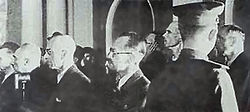
The Trial of the Sixteen was a staged trial of 16 leaders of the Polish Underground State held by the Soviet Union
in Moscow
in 1945.
, together with most members of the Council of National Unity
and the Commander-in-chief
of the Armia Krajowa
, were invited by Soviet general Ivan Serov
with agreement of Joseph Stalin
to a conference on their eventual entry to the Soviet-backed Provisional Government. They were presented with a warrant of safety, but were instead arrested in Pruszków
by the NKVD
on 27 and 28 March. Leopold Okulicki, Jan Stanisław Jankowski and Kazimierz Pużak were arrested on the 27th with 12 more the next day. Alexander Zwierzynski had been arrested earlier. They were brought to Moscow
for interrogation in the Lubyanka
.
After several months of brutal interrogation and torture they were presented with the forged accusations of:
The trial took place between 18–21 June 1945 with foreign press and observers from the United Kingdom
and USA
present. The date was chosen carefully to be at the same time a conference on creation of the Soviet-backed Polish puppet government was organized.
Immediately after the kidnapping of all the leaders, the Polish government in exile
sent a protest note to Washington
and London
demanding their release. At first the Soviets declared that the whole case was a bluff by the “Fascist Polish government”. When they finally admitted that the leaders had been arrested (on 5 May), the American envoy of Harry S. Truman
, Harry Lloyd Hopkins, was told by Joseph Stalin that “there is no point in linking the case of the Trial of the Sixteen with the support for the Soviet-backed government of Poland because the sentences will not be high.” Both British and American governments shared this view.
All but one of the defendants were forced to admit to the alleged crimes, and on 21 June the verdict was issued. According to international law
the trial should not have taken place. The Soviet Union
kidnapped
and sentenced a group of citizens of a foreign country whose alleged crimes were committed on a foreign land. They were deprived of basic human rights
and tortured. General Okulicki
's witness
es were not allowed to enter the court, which was a violation of Soviet law. Only two of the kidnapees survived the next six years.
described it obscene that there was no official protest abroad. As a result of the trial, the Polish Secret State
was deprived of most of its leaders. Its structures were soon rebuilt, but were never able to fully recover. On 6 July 1945 the United Kingdom and the USA withdrew support for the legitimate Polish government in exile
, and all its agendas in Poland. Soviet and Polish Communist repressions
aimed at former members of the Polish Secret State
and the Armia Krajowa
lasted well into the 1960s, corporal Józef Franczak
being shot dead by paramilitary-police
in 1963.
Soviet Union
The Soviet Union , officially the Union of Soviet Socialist Republics , was a constitutionally socialist state that existed in Eurasia between 1922 and 1991....
in Moscow
Moscow
Moscow is the capital, the most populous city, and the most populous federal subject of Russia. The city is a major political, economic, cultural, scientific, religious, financial, educational, and transportation centre of Russia and the continent...
in 1945.
History
Some accounts say approaches were made in February with others saying March 1945. The Government DelegateGovernment Delegate's Office at Home
The Government Delegation for Poland was an agency of the Polish Government in Exile during World War II. It was the highest authority of the Polish Secret State in occupied Poland and was headed by the Government Delegate for Poland, a de facto deputy Polish Prime Minister.The Government...
, together with most members of the Council of National Unity
Council of National Unity
Rada Jedności Narodowej was the quasi-parliament of the Polish Underground State during World War II...
and the Commander-in-chief
Commander-in-Chief
A commander-in-chief is the commander of a nation's military forces or significant element of those forces. In the latter case, the force element may be defined as those forces within a particular region or those forces which are associated by function. As a practical term it refers to the military...
of the Armia Krajowa
Armia Krajowa
The Armia Krajowa , or Home Army, was the dominant Polish resistance movement in World War II German-occupied Poland. It was formed in February 1942 from the Związek Walki Zbrojnej . Over the next two years, it absorbed most other Polish underground forces...
, were invited by Soviet general Ivan Serov
Ivan Serov
State Security General Ivan Aleksandrovich Serov was a prominent leader of Soviet security and intelligence agencies, head of the KGB between March 1954 and December 1958, as well as head of the GRU between 1958 and 1963. He was Deputy Commissar of the NKVD under Lavrentiy Beria, and was to play a...
with agreement of Joseph Stalin
Joseph Stalin
Joseph Vissarionovich Stalin was the Premier of the Soviet Union from 6 May 1941 to 5 March 1953. He was among the Bolshevik revolutionaries who brought about the October Revolution and had held the position of first General Secretary of the Communist Party of the Soviet Union's Central Committee...
to a conference on their eventual entry to the Soviet-backed Provisional Government. They were presented with a warrant of safety, but were instead arrested in Pruszków
Pruszków
Pruszków is a town in central Poland, situated in the Masovian Voivodeship since 1999. It was previously in Warszawa Voivodeship . Pruszków is the capital of Pruszków County, located along the western edge of the Warsaw urban area...
by the NKVD
NKVD
The People's Commissariat for Internal Affairs was the public and secret police organization of the Soviet Union that directly executed the rule of power of the Soviets, including political repression, during the era of Joseph Stalin....
on 27 and 28 March. Leopold Okulicki, Jan Stanisław Jankowski and Kazimierz Pużak were arrested on the 27th with 12 more the next day. Alexander Zwierzynski had been arrested earlier. They were brought to Moscow
Moscow
Moscow is the capital, the most populous city, and the most populous federal subject of Russia. The city is a major political, economic, cultural, scientific, religious, financial, educational, and transportation centre of Russia and the continent...
for interrogation in the Lubyanka
Lubyanka (KGB)
The Lubyanka is the popular name for the headquarters of the KGB and affiliated prison on Lubyanka Square in Moscow. It is a large building with a facade of yellow brick, designed by Alexander V...
.
After several months of brutal interrogation and torture they were presented with the forged accusations of:
- collaborationCollaborationCollaboration is working together to achieve a goal. It is a recursive process where two or more people or organizations work together to realize shared goals, — for example, an intriguing endeavor that is creative in nature—by sharing...
with Nazi GermanyNazi GermanyNazi Germany , also known as the Third Reich , but officially called German Reich from 1933 to 1943 and Greater German Reich from 26 June 1943 onward, is the name commonly used to refer to the state of Germany from 1933 to 1945, when it was a totalitarian dictatorship ruled by... - carrying-over intelligenceIntelligence (information gathering)Intelligence assessment is the development of forecasts of behaviour or recommended courses of action to the leadership of an organization, based on a wide range of available information sources both overt and covert. Assessments are developed in response to requirements declared by the leadership...
and sabotageSabotageSabotage is a deliberate action aimed at weakening another entity through subversion, obstruction, disruption, or destruction. In a workplace setting, sabotage is the conscious withdrawal of efficiency generally directed at causing some change in workplace conditions. One who engages in sabotage is...
at the rear of the Red ArmyRed ArmyThe Workers' and Peasants' Red Army started out as the Soviet Union's revolutionary communist combat groups during the Russian Civil War of 1918-1922. It grew into the national army of the Soviet Union. By the 1930s the Red Army was among the largest armies in history.The "Red Army" name refers to... - terrorismTerrorismTerrorism is the systematic use of terror, especially as a means of coercion. In the international community, however, terrorism has no universally agreed, legally binding, criminal law definition...
- planning a military alliance with Nazi Germany
- owning a radio transmitter, printing machines and weapons
- propaganda against the Soviet Union
- membership of underground organisation
The trial took place between 18–21 June 1945 with foreign press and observers from the United Kingdom
United Kingdom
The United Kingdom of Great Britain and Northern IrelandIn the United Kingdom and Dependencies, other languages have been officially recognised as legitimate autochthonous languages under the European Charter for Regional or Minority Languages...
and USA
United States
The United States of America is a federal constitutional republic comprising fifty states and a federal district...
present. The date was chosen carefully to be at the same time a conference on creation of the Soviet-backed Polish puppet government was organized.
Immediately after the kidnapping of all the leaders, the Polish government in exile
Polish government in Exile
The Polish government-in-exile, formally known as the Government of the Republic of Poland in Exile , was the government in exile of Poland formed in the aftermath of the Invasion of Poland of September 1939, and the subsequent occupation of Poland by Nazi Germany and the Soviet Union, which...
sent a protest note to Washington
Washington, D.C.
Washington, D.C., formally the District of Columbia and commonly referred to as Washington, "the District", or simply D.C., is the capital of the United States. On July 16, 1790, the United States Congress approved the creation of a permanent national capital as permitted by the U.S. Constitution....
and London
London
London is the capital city of :England and the :United Kingdom, the largest metropolitan area in the United Kingdom, and the largest urban zone in the European Union by most measures. Located on the River Thames, London has been a major settlement for two millennia, its history going back to its...
demanding their release. At first the Soviets declared that the whole case was a bluff by the “Fascist Polish government”. When they finally admitted that the leaders had been arrested (on 5 May), the American envoy of Harry S. Truman
Harry S. Truman
Harry S. Truman was the 33rd President of the United States . As President Franklin D. Roosevelt's third vice president and the 34th Vice President of the United States , he succeeded to the presidency on April 12, 1945, when President Roosevelt died less than three months after beginning his...
, Harry Lloyd Hopkins, was told by Joseph Stalin that “there is no point in linking the case of the Trial of the Sixteen with the support for the Soviet-backed government of Poland because the sentences will not be high.” Both British and American governments shared this view.
All but one of the defendants were forced to admit to the alleged crimes, and on 21 June the verdict was issued. According to international law
International law
Public international law concerns the structure and conduct of sovereign states; analogous entities, such as the Holy See; and intergovernmental organizations. To a lesser degree, international law also may affect multinational corporations and individuals, an impact increasingly evolving beyond...
the trial should not have taken place. The Soviet Union
Soviet Union
The Soviet Union , officially the Union of Soviet Socialist Republics , was a constitutionally socialist state that existed in Eurasia between 1922 and 1991....
kidnapped
Kidnapping
In criminal law, kidnapping is the taking away or transportation of a person against that person's will, usually to hold the person in false imprisonment, a confinement without legal authority...
and sentenced a group of citizens of a foreign country whose alleged crimes were committed on a foreign land. They were deprived of basic human rights
Human rights
Human rights are "commonly understood as inalienable fundamental rights to which a person is inherently entitled simply because she or he is a human being." Human rights are thus conceived as universal and egalitarian . These rights may exist as natural rights or as legal rights, in both national...
and tortured. General Okulicki
Leopold Okulicki
General Leopold Okulicki was a General of the Polish Army and the last commander of the anti-German underground Home Army during World War II. He was murdered after the war by the Soviet NKVD....
's witness
Witness
A witness is someone who has firsthand knowledge about an event, or in the criminal justice systems usually a crime, through his or her senses and can help certify important considerations about the crime or event. A witness who has seen the event first hand is known as an eyewitness...
es were not allowed to enter the court, which was a violation of Soviet law. Only two of the kidnapees survived the next six years.
People involved
- Lt. General Vasili UlrikhVasili UlrikhVasiliy Vasilievich Ulrikh was a senior judge of the Soviet Union during most of the regime of Joseph Stalin. In this capacity, Ulrikh served as the presiding judge at many of the major show trials of the Great Purges in the Soviet Union.-Early life:Vasili Ulrikh was born in Riga, Latvia, then a...
- the main judgeJudgeA judge is a person who presides over court proceedings, either alone or as part of a panel of judges. The powers, functions, method of appointment, discipline, and training of judges vary widely across different jurisdictions. The judge is supposed to conduct the trial impartially and in an open...
, famous for playing a major role in the Great PurgeGreat PurgeThe Great Purge was a series of campaigns of political repression and persecution in the Soviet Union orchestrated by Joseph Stalin from 1936 to 1938...
- Commander in Chief of the Armia KrajowaArmia KrajowaThe Armia Krajowa , or Home Army, was the dominant Polish resistance movement in World War II German-occupied Poland. It was formed in February 1942 from the Związek Walki Zbrojnej . Over the next two years, it absorbed most other Polish underground forces...
- Leopold OkulickiLeopold OkulickiGeneral Leopold Okulicki was a General of the Polish Army and the last commander of the anti-German underground Home Army during World War II. He was murdered after the war by the Soviet NKVD....
(Niedźwiadek) - 10 years in prison, may have been murdered on Christmas Eve of 1946 but may have died due to complications caused by hunger strike. - Deputy Prime Minister of Poland and the Government DelegateGovernment Delegate's Office at HomeThe Government Delegation for Poland was an agency of the Polish Government in Exile during World War II. It was the highest authority of the Polish Secret State in occupied Poland and was headed by the Government Delegate for Poland, a de facto deputy Polish Prime Minister.The Government...
- Jan Stanisław Jankowski - 8 years in prison, never released, died in a Soviet prison on 13 March 1953, two weeks before the end of his sentence; probably murdered. - Minister of Internal Affairs - Adam Bień - 5 years
- Deputy Minister of Internal Affairs - Stanislaw Jasiukowicz - 5 years
- Head of the Council of National UnityCouncil of National UnityRada Jedności Narodowej was the quasi-parliament of the Polish Underground State during World War II...
and PPS-WRN socialist party - Kazimierz PużakKazimierz PuzakKazimierz Pużak was a Polish politician of the interwar period. Active in the Polish Socialist Party, he was one of the leaders of the Polish Secret State and Polish resistance, sentenced by the Soviets in the infamous Trial of the Sixteen in 1945.-Biography:Born on 26 August 1883 in a family of...
- 1.5 years, released in November 1945 and returned to Poland. Refused to emigrate, Pużak was again arrested by the Urząd Bezpieczeństwa in 1947 and sentenced to 10 years in prison; died 30 April 1950 - Deputy head of the Council of National Unity and head of the Stronnictwo Narodowe party - Aleksander Zwierzyński - 8 months
- Member of the Council of National Unity, - Kazimierz Bagiński - 1 year, later released and forced to emigrate to the USA
- Member of the Council of National Unity, Head of Zjednoczenie Demokratyczne- Eugeniusz Czarnowski - 6 months
- Member of the Council of National Unity, Head of Stronnictwo PracyStronnictwo PracyStronnictwo Pracy was a Polish Christian democratic political party, active from 1937 in the Second Polish Republic and later part of the Polish government in exile. Its founder and main activist was Karol Popiel....
- Józef ChacińskiJózef ChacinskiJózef Chaciński was a Polish lawyer and politician.Chaciński was member of the Sejm from 1922 until 1930. During the Second World War, he was imprisoned in the German concentration camp Auschwitz. In 1945 he was arrested by the NKVD....
- 4 months - Member of the Council of National Unity, - Stanisław Mierzwa - 4 months
- Member of the Council of National Unity, - Zbigniew Stypułkowski - 4 months, later released and forced to emigrate to the United KingdomUnited KingdomThe United Kingdom of Great Britain and Northern IrelandIn the United Kingdom and Dependencies, other languages have been officially recognised as legitimate autochthonous languages under the European Charter for Regional or Minority Languages...
- Member of the Council of National Unity,- Franciszek Urbański - 4 months
- Member of the Council of National Unity, - Stanisław Michałowski - acquitted of all the charges
- Member of the Council of National Unity, - Kazimierz Kobylański - acquitted of all the charges
- Member of the Council of National Unity, interpreter for the group, -Józef Stemler - acquitted of all the charges
- Deputy Government Delegate -Antoni Pajdak was sentenced to 5 years in prison in a secret trialSecret trialA secret trial is a trial that is not open to the public, nor generally reported in the news, especially any in-trial proceedings. Generally no official record of the case or the judge's verdict is made available. Often there is no indictment...
in November; he was not released until 1955.
Aftermath
In his book, Europe at War, Norman DaviesNorman Davies
Professor Ivor Norman Richard Davies FBA, FRHistS is a leading English historian of Welsh descent, noted for his publications on the history of Europe, Poland, and the United Kingdom.- Academic career :...
described it obscene that there was no official protest abroad. As a result of the trial, the Polish Secret State
Polish Secret State
The Polish Underground State is a collective term for the World War II underground resistance organizations in Poland, both military and civilian, that remained loyal to the Polish Government in Exile in London. The first elements of the Underground State were put in place in the final days of the...
was deprived of most of its leaders. Its structures were soon rebuilt, but were never able to fully recover. On 6 July 1945 the United Kingdom and the USA withdrew support for the legitimate Polish government in exile
Polish government in Exile
The Polish government-in-exile, formally known as the Government of the Republic of Poland in Exile , was the government in exile of Poland formed in the aftermath of the Invasion of Poland of September 1939, and the subsequent occupation of Poland by Nazi Germany and the Soviet Union, which...
, and all its agendas in Poland. Soviet and Polish Communist repressions
History of Poland (1945–1989)
The history of Poland from 1945 to 1989 spans the period of Soviet Communist dominance imposed after the end of World War II over the People's Republic of Poland...
aimed at former members of the Polish Secret State
Polish Secret State
The Polish Underground State is a collective term for the World War II underground resistance organizations in Poland, both military and civilian, that remained loyal to the Polish Government in Exile in London. The first elements of the Underground State were put in place in the final days of the...
and the Armia Krajowa
Armia Krajowa
The Armia Krajowa , or Home Army, was the dominant Polish resistance movement in World War II German-occupied Poland. It was formed in February 1942 from the Związek Walki Zbrojnej . Over the next two years, it absorbed most other Polish underground forces...
lasted well into the 1960s, corporal Józef Franczak
Józef Franczak
Józef Franczak was a soldier of the Polish Army, Armia Krajowa World War II resistance, and last of the cursed soldiers - members of the militant anti-communist resistance in Poland. He used codenames Lalek , Laluś, Laleczka, Guściowa, and fake name Józef Babiński...
being shot dead by paramilitary-police
ZOMO
Zmotoryzowane Odwody Milicji Obywatelskiej , were paramilitary-police formations during the Communist Era, in the People's Republic of Poland...
in 1963.
English language
- Norman DaviesNorman DaviesProfessor Ivor Norman Richard Davies FBA, FRHistS is a leading English historian of Welsh descent, noted for his publications on the history of Europe, Poland, and the United Kingdom.- Academic career :...
, Rising '44: The Battle for Warsaw. Viking Books, 2004. ISBN 0-670-03284-0. Hardcover, 784 pages. - Jan KarskiJan KarskiJan Karski was a Polish World War II resistance movement fighter and later scholar at Georgetown University. In 1942 and 1943 Karski reported to the Polish government in exile and the Western Allies on the situation in German-occupied Poland, especially the destruction of the Warsaw Ghetto, and...
, Story of a Secret State. Simon Publications, 2001. ISBN 1-931541-39-6. Paperback, 391 pages. - Edward Raczynski, In allied London, Weidenfeld and Nicolson, 1962 Page 284-285, 295
- Zbigniew Stypulkowski, "Invitation to Moscow", 1950,1951.
Polish language
- Waldemar Strzałkowski, Andrzej Krzysztof Kunert, Andrzej Chmielarz, Proces Szesnastu. Dokumenty NKWD. Oficyna Wydawnicza RYTM, WarsawWarsawWarsaw is the capital and largest city of Poland. It is located on the Vistula River, roughly from the Baltic Sea and from the Carpathian Mountains. Its population in 2010 was estimated at 1,716,855 residents with a greater metropolitan area of 2,631,902 residents, making Warsaw the 10th most...
, 1995. ISBN 83-86678-07-0. Paperback, 543 pages. - Eugeniusz Duraczyński, Generał Iwanow zaprasza. Przywódcy podziemnego państwa polskiego przed sądem moskiewskim. Warsaw, Wydawnictwo ALFA, 1989. ISBN 83-7001-305-8
External links
- The Moscow Trial of the 16 Polish Leaders, Liberty Publications, LondonLondonLondon is the capital city of :England and the :United Kingdom, the largest metropolitan area in the United Kingdom, and the largest urban zone in the European Union by most measures. Located on the River Thames, London has been a major settlement for two millennia, its history going back to its...
, 1945, 24 pages, 2 ill.