


Traditional Chinese musical instruments

Encyclopedia
The Eight Sounds or Eight Tones (八音)
The eight categories are: silkSilk
Silk is a natural protein fiber, some forms of which can be woven into textiles. The best-known type of silk is obtained from the cocoons of the larvae of the mulberry silkworm Bombyx mori reared in captivity...
, bamboo
Bamboo
Bamboo is a group of perennial evergreens in the true grass family Poaceae, subfamily Bambusoideae, tribe Bambuseae. Giant bamboos are the largest members of the grass family....
, wood
Wood
Wood is a hard, fibrous tissue found in many trees. It has been used for hundreds of thousands of years for both fuel and as a construction material. It is an organic material, a natural composite of cellulose fibers embedded in a matrix of lignin which resists compression...
, stone
Rock (geology)
In geology, rock or stone is a naturally occurring solid aggregate of minerals and/or mineraloids.The Earth's outer solid layer, the lithosphere, is made of rock. In general rocks are of three types, namely, igneous, sedimentary, and metamorphic...
, metal
Metal
A metal , is an element, compound, or alloy that is a good conductor of both electricity and heat. Metals are usually malleable and shiny, that is they reflect most of incident light...
, clay
Clay
Clay is a general term including many combinations of one or more clay minerals with traces of metal oxides and organic matter. Geologic clay deposits are mostly composed of phyllosilicate minerals containing variable amounts of water trapped in the mineral structure.- Formation :Clay minerals...
, gourd
Gourd
A gourd is a plant of the family Cucurbitaceae. Gourd is occasionally used to describe crops like cucumbers, squash, luffas, and melons. The term 'gourd' however, can more specifically, refer to the plants of the two Cucurbitaceae genera Lagenaria and Cucurbita or also to their hollow dried out shell...
and hide. There are other instruments which may not fit these classifications. This is one of the first musical classifications ever.
Silk (絲)
Silk instruments are mostly stringed instruments (including those that are plucked, bowed, and struck). Since ancient times the Chinese have used twisted silk for strings, though today metal or nylon are more frequently used. Instruments in the silk category include:Plucked
- GuqinGuqinThe guqin is the modern name for a plucked seven-string Chinese musical instrument of the zither family...
- 7-stringed zither - SeSe (instrument)The se is an ancient Chinese plucked zither . It is the ancestor of many Asian zithers, including the Chinese guzheng, the Korean gayageum and the Japanese koto. It has 25 strings with moveable bridges and has a range of up to five octaves.-History:The history of the se extends back to early...
- 25-stringed zither with moveable bridges (ancient sources say 13, 25 or 50 strings) - GuzhengGuzhengThe guzheng or "gu zheng", also called zheng is a Chinese plucked zither. It has 18-23 or more strings and movable bridges....
(古箏) - 16-26 stringed zither with movable bridges - KonghouKonghouThe konghou is an ancient Chinese harp. The konghou, also known as kanhou, went extinct sometime in the Ming Dynasty, but was revived in the 20th century...
(箜篌) - harp - PipaPipaThe pipa is a four-stringed Chinese musical instrument, belonging to the plucked category of instruments . Sometimes called the Chinese lute, the instrument has a pear-shaped wooden body with a varying number of frets ranging from 12–26...
(琵琶) - pear-shaped fretted lute with 4 or 5 strings - SanxianSanxianThe sanxian is a Chinese lute — a three-stringed fretless plucked musical instrument. It has a long fingerboard, and the body is traditionally made from snakeskin stretched over a rounded rectangular resonator. It is made in several sizes for different purposes and in the late 20th century a...
(三弦) - plucked lute with body covered with snakeskin and long fretless neck - RuanRuanThe ruan is a Chinese plucked string instrument. It is a lute with a fretted neck, a circular body, and four strings. Its strings were formerly made of silk but since the 20th century they have been made of steel...
- moon-shaped lute in five sizes: gaoyin-, xiao-, zhong-, da-, and diyin-; sometimes called ruanqin (阮琴) - LiuqinLiuqinThe liuqin is a four-stringed Chinese mandolin with a pear-shaped body. It is small in size, almost a miniature copy of another Chinese plucked musical instrument, the pipa. The range of its voice is much higher than the pipa, and it has its own special place in Chinese music, whether in...
(柳琴) - small plucked, fretted lute with a pear-shaped body and four strings - YueqinYueqinThis article is about the Chinese Yuequin. The Vietnamese Đàn nguyệt is also often referred to as a 'moon guitar'.The yueqin is a traditional Chinese string instrument...
(月琴) - plucked lute with a wooden body, a short fretted neck, and four strings tuned in pairs - QinqinQinqinThe qinqin is a plucked Chinese lute. It was originally manufactured with a wooden body, a slender fretted neck, and three strings. Its body can be either round, hexagonal , or octagonal. Often, only two strings were used, as in certain regional silk-and-bamboo ensembles...
(秦琴) - plucked lute with a wooden body and fretted neck; also called meihuaqin (梅花琴, literally "plum blossom instrument," on account of its flower-shaped body) - DuxianqinDuxianqinThe duxianqin , also yixianqin , is a Chinese plucked string instrument with only one string...
- plucked either with only one string.
Bowed
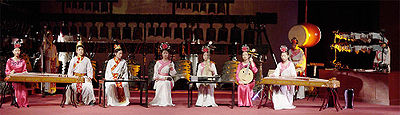
- HuqinHuqinHuqin is a family of bowed string instruments, more specifically, a spike fiddle popularly used in Chinese music. The instruments consist of a round, hexagonal, or octagonal sound box at the bottom with a neck attached that protrudes upwards...
(胡琴) - family of vertical fiddles - ErhuErhuThe erhu is a two-stringed bowed musical instrument, more specifically a spike fiddle, which may also be called a "southern fiddle", and sometimes known in the Western world as the "Chinese violin" or a "Chinese two-stringed fiddle". It is used as a solo instrument as well as in small ensembles...
(二胡) - two-stringed fiddle - ZhonghuZhonghuThe zhonghu is a low-pitched Chinese bowed string instrument. Together with the erhu and gaohu, it is a member of the huqin family, and was developed in the 20th century as the alto member of the huqin family .The zhonghu is analogous with the erhu, but is slightly larger and...
(中胡) - two-stringed fiddle, lower pitch than erhu - GaohuGaohuThe gaohu is a Chinese bowed string instrument developed from the erhu in the 1920s by the musician and composer Lü Wencheng and used in Cantonese music and Cantonese opera...
(高胡) - two-stringed fiddle, higher pitch than erhu; also called yuehu (粤胡) - BanhuBanhuThe banhu is a Chinese traditional bowed string instrument in the huqin family of instruments. It is used primarily in northern China. Ban means a piece of wood and hu is short for huqin....
(板胡) - two-stringed fiddle with a coconut resonator and wooden face, used primarily in northern China - Jinghu (京胡) - two-stringed fiddle, very high pitched, used mainly for Beijing opera
- Jing erhuJing erhuThe jing erhu is a Chinese two-stringed bowed musical instrument in the huqin family of instruments, similar to the erhu. It is so named because it is used in jing xi, or Beijing opera...
(京二胡) - erhu used in Beijing opera - ErxianErxianThe erxian is a Chinese bowed string instrument in the huqin family of instruments. It has two strings and is used primarily in Cantonese music, most often in "hard string" chamber ensembles...
(二弦) - two-stringed fiddle, used in Cantonese, Chaozhou, and nanguan music - TiqinTiqinThe tiqin is a name applied to several two-stringed Chinese bowed string musical instruments in the huqin family of instruments.-Types:There are several types of tiqin:*The tiqin used for kunqu opera...
(提琴) - two-stringed fiddle, used in kunqu, Chaozhou, Cantonese, Fujian, and Taiwanese music - YehuYehuThe instrument comes in various sizes. In Chaozhou music it is a leading instrument, and is tuned quite high. In Cantonese music it can be quite large and is often tuned to a relatively low pitch, lower than the erhu...
(椰胡) - two-stringed fiddle with coconut body, used primarily in Cantonese and Chaozhou music - DaguangxianDaguangxianThe daguangxian is a Chinese bowed two-stringed musical instrument in the huqin family of instruments, held on the lap and played upright. It is used primarily in Taiwan and Fujian, among the Hakka and Min Nan peoples....
(大广弦) - two-stringed fiddle used in Taiwan and Fujian, primarily by Min Nan and Hakka people; also called datongxian (大筒弦), guangxian (广弦), and daguanxian (大管弦) - DatongDatong (instrument)The datong is a bowed string instrument in the huqin family, and is used as an accompanying instrument in the huaguxi opera tradition of Hunan, China. Referring to this role, the instrument is also referred to huagu datong ....
(大筒) - two-stringed fiddle used in the traditional music of Hunan - Kezaixian (壳仔弦) - two-stringed fiddle with coconut body, used in Taiwan opera
- Liujiaoxian (六角弦) - two-stringed fiddle with hexagonal body, similar to the jing erhu; used primarily in Taiwan
- Tiexianzai (鐵弦仔) - a two-stringed fiddle with metal amplifying horn at the end of its neck, used in Taiwan; also called guchuixian (鼓吹弦)
- Hexian (和弦) - large fiddle used primarily among the Hakka of Taiwan
- Huluqin (葫芦琴) - two-stringed fiddle with gourd body used by the Naxi of YunnanYunnanYunnan is a province of the People's Republic of China, located in the far southwest of the country spanning approximately and with a population of 45.7 million . The capital of the province is Kunming. The province borders Burma, Laos, and Vietnam.Yunnan is situated in a mountainous area, with...
- HuluhuHuluhuThe huluhu is a Chinese bowed string instrument in the huqin family of instruments. It has two strings, and its sound box is made from a gourd, with a face made of thin wood...
- two-stringed fiddle with gourd body used by the Zhuang of Guangxi - MaguhuMaguhuThe maguhu is a Chinese bowed string instrument in the huqin family of musical instruments. It has two strings and its sound box is made from the femur bone of a horse...
- two-stringed fiddle with horse bone body used by the Zhuang and Buyei peoples of southern China - TuhuTuhuThe tuhu is a Chinese bowed string instrument in the huqin family of instruments. It is used primarily by non-Han ethnic groups of southern China, particularly the Zhuang, who live in the Guangxi province and use it in their bayin ensemble...
(土胡) - two-stringed fiddle used by the Zhuang people of Guangxi - JiaohuJiaohuThe jiaohu is a Chinese bowed string instrument in the huqin family of musical instruments. Although very similar to the Jinghu and Ehru in physical structure, the Jiaohu is a traditional Chinese instrument. It is a small two-stringed fiddle-like instrument that requires a bow in order to produce...
(角胡) - two-stringed fiddle used by the Gelao people of Guangxi, as well as the Miao and Dong - Sihu (四胡) - four-stringed fiddle with strings tuned in pairs
- SanhuSanhuThe sanhu proper is a Chinese bowed musical instrument with three strings. It was developed in the 1970s and is essentially a three-stringed version of the two-stringed erhu, with an additional bass string....
(三胡) - 3-stringed erhu with an additional bass string; developed in the 1970s http://www.soomal.com/gb/002/001/00000012.htm - ZhuihuZhuihuThe zhuihu is a two-stringed bowed string instrument from China. In construction, it resembles the sanxian, and likely evolved as a bowed version of that musical instrument...
- two-stringed fiddle with fingerboard - Zhuiqin (traditional: 墜琴; simplified: 坠琴) - two-stringed fiddle with fingerboard
- LeiqinLeiqinThe leiqin is a Chinese bowed string musical instrument.-Construction:It has a metal soundbox covered with snakeskin and a long fretless fingerboard...
(雷琴) - two-stringed fiddle with fingerboard - DihuDihuThe dihu is a large bowed string instrument from China. It has a large soundbox covered on one end with snakeskin. Like most other members of the huqin family of instruments, it has two strings and is held vertically...
(低胡) - low pitched two-stringed fiddles in the erhu family, in three sizes:- Xiaodihu (小低胡) - small dihu, tuned one octave below the erhu
- Zhongdihu (中低胡) - medium dihu, tuned one octave below the zhonghu
- Dadihu (大低胡) - large dihu, tuned two octaves below the erhu
- DahuDahu (instrument)The dahu is a large bowed string instrument from China. It has a large soundbox covered on one end with python skin. Like most other members of the huqin family of instruments, it has two strings and is held vertically. The instrument is generally pitched one octave below the erhu, and is...
(大胡) - another name for the xiaodihu - Cizhonghu - another name for the xiaodihu
- GehuGehuThe gehu is a Chinese instrument developed in the 20th century by the Chinese musician Yang Yusen . It is a fusion of the Chinese huqin family and the cello. Its four strings are also tuned C-G-D-A, exactly like the cello's...
(革胡) - four-stringed bass instrument, tuned and played like cello - DiyingehuDiyingehuThe diyingehu is a Chinese bowed string instrument in the huqin family. It was developed by Yang Yusen along with the gehu in the 20th century...
(低音革胡) - four stringed contrabass instrument, tuned and played like double bass - LaruanLaruanThe lāruǎn is a relatively new Chinese string instrument blending the acoustics of the ruan with that of the Western cello...
(拉阮) - four-stringed bowed instrument modeled on the cello - Paqin (琶琴) - modern bowed instrument
- Dapaqin (大琶琴) - bass paqin
- Dixianqin (低絃琴)
- Niutuiqin or niubatui (牛腿琴 or 牛巴腿) - two-stringed fiddle used by the Dong people of Guizhou
- MatouqinMorin khuurThe morin khuur is a traditional Mongolian bowed stringed instrument. It is one of the most important musical instruments of the Mongol people, and is considered a symbol of the Mongolian nation. The morin khuur is one of the Masterpieces of the Oral and Intangible Heritage of Humanity identified...
(馬頭琴) - (Mongolian: morin khuurMorin khuurThe morin khuur is a traditional Mongolian bowed stringed instrument. It is one of the most important musical instruments of the Mongol people, and is considered a symbol of the Mongolian nation. The morin khuur is one of the Masterpieces of the Oral and Intangible Heritage of Humanity identified...
) - Mongolian two-stringed "horsehead fiddle" - XiqinXiqinThe xiqin was a bowed string musical instrument adopted by the Chinese from the Xi, a Central Asian people, in ancient times. It is perhaps the original member of the huqin family of Chinese and Mongolian bowed string instruments; thus, the Erhu and Morin khuur and all similar fiddle instruments...
(奚琴) - ancient prototype of huqin family of instruments - YazhengYazhengThe yazheng is a Chinese string instrument. It is a long zither similar to the guzheng but bowed by scraping with a sorghum stem dusted with resin, a bamboo stick, or a piece of forsythia wood...
(simplified: 轧筝; traditional: 軋箏) - bowed zither; also called yaqin (simplified: 轧琴; traditional: 軋琴) - Zhengni (筝尼) - bowed zither; used by the Zhuang people of GuangxiGuangxiGuangxi, formerly romanized Kwangsi, is a province of southern China along its border with Vietnam. In 1958, it became the Guangxi Zhuang Autonomous Region of the People's Republic of China, a region with special privileges created specifically for the Zhuang people.Guangxi's location, in...
- Aijieke (艾捷克) - four-stringed bowed instrument used in Xinjiang; similar to kamanchehKamanchehThe kamānche or kamāncha is a Persian bowed string instrument related to the bowed rebab, the historical ancestor of the kamancheh and also to the bowed lira of the Byzantine Empire, ancestor of the European violin family. The strings are played with a variable-tension bow: the word "kamancheh"...
http://www.chinamedley.com/langyuan/aijieke/ - Sataer (萨它尔) - long-necked bowed lute used in Xinjiang
Struck
- YangqinYangqinThe trapezoidal yangqin is a Chinese hammered dulcimer, originally from Middle East and Persia . It used to be written with the characters 洋琴 , but over time the first character changed to 揚 , which means "acclaimed". It is also spelled yang quin or yang ch'in...
(揚琴) - hammered dulcimer of varying strings struck using two bamboo hammers - Zhu (筑) - ancient zither, struck or plucked with a stick
- Jiaoweiqin (焦尾琴)
Bamboo (竹)

Bamboo mainly refers to woodwind instruments, which includes;
Flutes
- Dizi (笛子) - transverse bamboo flute with buzzing membrane
- Bangdi (梆笛)
- XiaoXiao (flute)The xiao is a Chinese vertical end-blown flute. It is generally made of dark brown bamboo . It is also sometimes called dòngxiāo , dòng meaning "hole." An ancient name for the xiāo is shùdí The xiao is a Chinese vertical end-blown flute. It is generally made of dark brown bamboo (called...
- end-blown flute; also called dongxiao - PaixiaoPaixiaoThe paixiao is an ancient Chinese wind instrument, a form of pan pipes. It is no longer used, having died out in ancient times, although in the 20th century it was reconstructed...
- pan pipes - Chi (篪; pinyin: chí) - ancient transverse bamboo flute
- Yue (籥; pinyin: yuè) - ancient notched vertical bamboo flute with three finger holes; used in Confucian ritual music and dance
- XindiXindi (Chinese instrument)The xindi is a Chinese musical instrument. A 20th-century derivative of the ancient dizi , the xindi is fully chromatic, and usually lacks the dizi's distinctive di mo, or buzzing membrane....
(新笛) - modern transverse flute with as many as 21 holes - Dongdi (侗笛) - wind instrument of the Dong peopleDong peopleThe Dong , a Kam–Sui people of southern China, are one of the 56 ethnic groups officially recognized by the People's Republic of China. They are famed for their native-bred Kam Sweet Rice , carpentry skills, and unique architecture, in particular a form of covered bridge known as the "wind and rain...
of southern China - KoudiKoudiThe koudi is a very small Chinese flute made from bamboo. It was invented in 1971 by the late dizi master Yu Xunfa .-Overview:The instrument comes in two sizes...
(口笛; pinyin: kǒudí) - very small transverse bamboo flute
Oboes
- GuanGuan (instrument)The guan is a Chinese double reed wind instrument. The northern Chinese version is called guanzi or bili and the Cantonese version is called houguan . It is classified as a bamboo instrument in the Ba Yin system...
- cylindrical double reedDouble reedA double reed is a type of reed used to produce sound in various wind instruments. The term double reed comes from the fact that there are two pieces of cane vibrating against each other. A single reed consists of one piece of cane which vibrates against a mouthpiece made of metal, hardened...
wind instrument made of either hardwood (Northern China) or bamboo (Cantonese); the northern version is also called guanzi (管子) or bili (traditional: 篳篥; simplified: 筚篥), the Cantonese version is also called houguan (喉管), and the Taiwanese version is called 鸭母哒仔, 鴨母笛, or Taiwan guan (台湾管) - SuonaSuonaThe suona ; also called laba or haidi is a Han Chinese shawm . It has a distinctively loud and high-pitched sound, and is used frequently in Chinese traditional music ensembles, particularly those that perform outdoors...
- double-reed wind instrument with a flaring metal bell; also called haidi (海笛)
Free reed pipes
- BawuBawuThe bawu is a Chinese wind instrument. Although shaped like a flute, it is actually a free reed instrument, with a single metal reed. It is played in a transverse manner...
- side-blown free reed pipe with finger holes - MangtongMangtongThe mangtong is a Chinese end-blown free reed wind instrument. It is used primarily by the Miao and Dong ethnic groups of the southern Chinese provinces of Guizhou and Guangxi, although it is sometimes used in contemporary Chinese compositions for the traditional instrument orchestra.The...
(芒筒; pinyin: mángtǒng) - end-blown free reed pipe producing a single pitch
Single reed pipes
- Mabu (马布) - single-reed bamboo pipe played by the Yi peopleYi peopleThe Yi or Lolo people are an ethnic group in China, Vietnam, and Thailand. Numbering 8 million, they are the seventh largest of the 55 ethnic minority groups officially recognized by the People's Republic of China...
Wood (木)
Most wood instruments are of the ancient variety:- ZhuZhu (percussion instrument)The zhu was a percussion instrument used in the Confucian court ritual music of ancient China. It consisted of a wooden box that tapered from the top to the bottom, and was played by grasping a vertical wooden stick and striking it on the bottom face...
- a wooden box that tapers from the top to the bottom, played by hitting a stick on the inside, used to mark the beginning of music in ancient ritual music - YuYu (percussion instrument)The yu was a wooden percussion instrument carved in the shape of a tiger with a serrated back comprising 27 "teeth," used since ancient times in China for Confucian court ritual music...
- a wooden percussion instrument carved in the shape of a tiger with a serrated back, played by hitting a stick with an end made of approximately 15 stalks of bamboo on its head three times and across the serrated back once to mark the end of the music - Muyu - a rounded woodblock carved in the shape of a fish, struck with a wooden stick; often used in Buddhist chanting
- PaibanPaibanThe paiban is a clapper made from several flat pieces of hardwood or bamboo, which is used in many different forms of Chinese music. There are many different types of paiban, and the instrument is also referred to as bǎn , tánbǎn , mùbǎn , or shūbǎn...
(拍板) - a clapper made from several flat pieces of wood; also called bǎn (板), tánbǎn (檀板), mùbǎn (木板), or shūbǎn (书板); when used together with a drum the two instruments are referred to collectively as gubanGuban (instrument)The term guban refers collectively to a small drum and paiban , which are played simultaneously, by a single player, in traditional Chinese music....
(鼓板)- Zhuban (竹板, a clapper made from two pieces of bamboo)
- Chiban (尺板)
- BangziBangziJaguar/Sandbox/3 is a township-level division situated in Tangshan, Hebei, China....
(梆子) - small, high-pitched woodblockWood blockA woodblock is essentially a small piece of slit drum made from a single piece of wood and used as a percussion instrument. It is struck with a stick, making a characteristically percussive sound....
; called qiaozi (敲子) or qiaoziban (敲子板) in Taiwan- Nan bangzi (南梆子)
- Hebei bangzi (河北梆子)
- Zhui bangzi (墜梆子)
- Qin bangzi (秦梆子)
Stone (石)
The "stone" category comprises various forms of stone chimes.- BianqingBianqingThe bianqing is an ancient Chinese musical instrument consisting of a set of L-shaped flat stone chimes, played melodically. The chimes were hung in a wooden frame and struck with a mallet...
- a rack of stone tablets that are hung by ropes from a wooden frame and struck using a mallet - Teqing (特鐘) - a single large stone tablet hung by a rope in a wooden frame and struck using a mallet
Metal (金)
- BianzhongBianzhongBianzhong is an ancient Chinese musical instrument consisting of a set of bronze bells, played melodically. These sets of chime bells were used as polyphonic musical instruments and some of these bells have been dated at between 2,000 to 3,600 years old. They were hung in a wooden frame and...
(編鐘) - 65 to 100 bronze bells hung on a rack, struck using poles - FangxiangFangxiangThe fangxiang is an ancient Chinese metallophone. The instrument consists of 16 tuned rectangular iron slabs laid in a frame in two rows. The slabs are struck with a hammer and played melodically...
- set of tuned metal slabs (metallophoneMetallophoneA metallophone is any musical instrument consisting of tuned metal bars which are struck to make sound, usually with a mallet.Metallophones have been used in music for hundreds of years. There are several different types used in Balinese and Javanese gamelan ensembles, including the gendér, gangsa...
) - NaoNAONAO can refer to:* National Applications Office, an agent of the United States Department of Homeland Security* National Audit Office in several nations* Nautical Almanac Office in several nations...
(鐃) - may refer to either an ancient bell or large cymbals- Shangnao (商鐃) - ancient bellphoto
- Bo (鈸; also called chazi, 镲子) - cymbals
- Xiaobo (小鈸, small cymbals)
- Zhongbo (中鈸, medium cymbals; also called naobo (鐃鈸) or zhongcuo
- Shuibo (水鈸, literally "water cymbals")
- Dabo (大鈸, large cymbals)
- Jingbo (京鈸)
- Shenbo (深波) - deep, flat gong used in Chaozhou music; also called gaobian daluo (高边大锣)
- Luo - gongGongA gong is an East and South East Asian musical percussion instrument that takes the form of a flat metal disc which is hit with a mallet....
- Daluo (大锣) - a large flat gong whose pitch drops when struck with a padded mallet
- Fengluo (风锣) - literally "wind gong," a large flat gong played by rolling or striking with a large padded mallet
- Xiaoluo (小锣) - a small flat gong whose pitch rises when struck with the side of a flat wooden stick
- Yueluo (月锣) - small pitched gong held by a string in the palm of the hand and struck with a small stick; used in Chaozhou music
- Jingluo (镜锣) - a small flat gong used in the traditional music of Fujian http://www.fj.xinhuanet.com/jlzx/2007-09/13/content_11135856.htm
- Pingluo (平锣) - a flat gong
- Kailuluo (开路锣)
- YunluoYunluoThe yunluo is a traditional Chinese musical instrument. It was also called yún'áo in ancient times....
- literally "cloud gongs"; 10 or more small tuned gongs in a frame - Shimianluo (十面锣) - 10 small tuned gongs in a frame
- Qing (磬) - a cup-shaped bell used in Buddhist and Daoist ritual music
- Daqing (大磬) - large qing
- Pengling (碰铃; pinyin: pènglíng) - a pair of small bowl-shaped finger cymbals or bells connected by a length of cord, which are struck together
- Dangzi (铛子) - a small, round, flat, tuned gong suspended by being tied with silk string in a round metal frame that is mounted on a thin wooden handlephoto; also called dangdang (铛铛)
- Dianqing (引磬) - an inverted small bell affixed to the end of a thin wooden handlephoto
- Yunzheng (云铮) - a small flat gong used in the traditional music of Fujian http://www.fj.xinhuanet.com/jlzx/2007-09/13/content_11135856.htm
- Chun (錞; pinyin: chún) - ancient bellphoto
- Weichun (帷錞) - ancient hanging bell
- Bronze drum (铜鼓)
- Laba (喇叭) - A long, straight, valveless brass trumpet


Clay (土)
- Xun (埙) - ocarinaOcarinaThe ocarina is an ancient flute-like wind instrument. Variations do exist, but a typical ocarina is an enclosed space with four to twelve finger holes and a mouthpiece that projects from the body...
made of baked clay - FouFouThe fou is an ancient Chinese percussion instrument consisting of a pottery or bronzeware crock, jar, pot, or similar vessel, which was struck with a stick. Its origin dates back to the Xia or Shang dynasties, where it was used in ritual music...
- clay pot played as a percussion instrument
Gourd (匏)
- ShengSheng (instrument)The Chinese sheng is a mouth-blown free reed instrument consisting of vertical pipes.Traditionally, the sheng has been used as an accompaniment instrument for solo suona or dizi performances. It is one of the main instruments in kunqu and some other forms of Chinese opera...
- free reed mouth organ consisting of varying number of bamboo pipes inserted into a metal (formerly gourd or hardwood) chamber with finger holes- Baosheng (抱笙) - larger version of the Sheng
- YuYu (wind instrument)The yu was a free reed wind instrument used in ancient China. It was similar to the sheng, with multiple bamboo pipes fixed in a wind chest which may have been made of bamboo, wood, or gourd. Each pipe contained a free reed, which was also made of bamboo. Whereas the sheng was used to provide...
- ancient free reed mouth organ similar to the sheng but generally larger - He - ancient free reed mouth organ similar to the sheng but smaller
- HulusiHulusiThe hulusi or cucurbit flute is a free reed wind instrument from China. It is held vertically and has three bamboo pipes which pass through a gourd wind chest; the center pipe has finger holes and the outer two are typically drone pipes...
- free-reed wind instrument with three bamboo pipes which pass through a gourd wind chest; one pipe has finger holes and the other two are drone pipes; used primarily in YunnanYunnanYunnan is a province of the People's Republic of China, located in the far southwest of the country spanning approximately and with a population of 45.7 million . The capital of the province is Kunming. The province borders Burma, Laos, and Vietnam.Yunnan is situated in a mountainous area, with...
province - Hulusheng - free-reed mouth organ with a gourd wind chest; used primarily in YunnanYunnanYunnan is a province of the People's Republic of China, located in the far southwest of the country spanning approximately and with a population of 45.7 million . The capital of the province is Kunming. The province borders Burma, Laos, and Vietnam.Yunnan is situated in a mountainous area, with...
province
Hide (革)
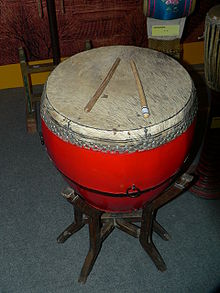
- Dagu - (大鼓) - large drum played with two sticks
- Huapengu (花盆鼓) - flowerpotFlowerpotA flower pot or plant pot is a container in which flowers and other plants are cultivated. Historically, and still to a significant extent today, they are made from terracotta. Flower pots are now often made from plastic, wood, stone, or sometimes biodegradable material. An example of...
-shaped large drum played with two sticks; also called ganggu (缸鼓)
- Huapengu (花盆鼓) - flowerpot
- Huzuo Dagu (虎座大鼓)
- Huzuo Wujia Gu (虎座鳥架鼓)
- Jian'gu (建鼓)
- BanguBangu (drum)The bangu , often simply gu, is a Chinese frame drum that, when struck by one or two small bamboo sticks, creates a sharp dry sound essential to the aesthetics of Chinese opera. Striking the drum in different places produces different sounds. It is also used in many Chinese chamber music ensembles...
(板鼓) - small, high pitched drum used in Beijing opera - Biangu (扁鼓) - flat drum, played with sticks
- PaiguPaiguThe Chinese paigu is a set of three to seven tuned drums , traditionally made of wood with animal skin heads. It is played by beating the heads with sticks. Most drums are double-sided and turnable. Both sides have different tunings...
(排鼓) - set of three to seven tuned drums played with sticks - TangguTanggu (drum)The tanggu is a traditional Chinese drum from the 19th century...
(堂鼓) - medium-sized barrel drum played with two sticks; also called tonggu (同鼓) or xiaogu (小鼓) - Biqigu (荸荠鼓) - a very small drum played with one stick, used in Jiangnan sizhuJiangnan sizhuJiangnan sizhu is a style of traditional Chinese instrumental music from the Jiangnan region of China.-Name:The name Jiangnan sizhu is made up of two parts. Jiangnan is the traditional name for the area south of the lower reaches of the Yangtze river in southern Jiangsu, Shanghai, and northern...
- Diangu (点鼓; also called huaigu, 怀鼓) - a double-headed frame drumFrame drumA frame drum is a drum that has a drumhead width greater than its depth. Usually the single drumhead is made of rawhide or man-made materials. Shells are traditionally constructed of bent wood scarf jointed together; plywood and man-made materials are also used. Some frame drums have mechanical...
played with a single wooden beater; used in the Shifangu ensemble music of Jiangsu province and to accompany to kunquKunquKunqu , also known as Kunju , Kun opera or Kunqu Opera, is one of the oldest extant forms of Chinese opera. It evolved from the Kunshan melody, and dominated Chinese theatre from the 16th to the 18th centuries. The style originated in the Wu cultural area...
opera - Huagu (花鼓) - flower drum
- Yaogu (腰鼓) - waist drum
- Taipinggu (太平鼓) - flat drum with a handle; also called dangu (单鼓)
- ZhanguZhanguZhangu, or war drum, is a Chinese musical instrument. It is similar to the Tanggu in appearance, but is lower in pitch. Also known as the Biangu...
(战鼓 or 戰鼓) - war drum; played with two sticks - Bajiao gu (八角鼓) - octagonal tambourine used primarily in narrative singing from northern China :zh:八角鼓
- Yanggegu (秧歌鼓) - rice planting drum
- BofuBofuBofu , sometimes referred to as Bopan , was the son of Chinese Zhou Dynasty monarch King You of Zhou and his concubine Baosi . After Baosi entered the royal palace, King You deposed Queen Shen and her son Crown Prince Yijiu , replacing them with Baosi and Bofu...
(搏拊) - ancient drum used to set tempo - JieguJieguJiegu is an alternative spelling of Gyêgu the town in Qinghai provinceThe jiegu was a drum used in ancient China...
(羯鼓) - hourglass-shaped drum used during the Tang Dynasty - Tao (鼗; pinyin: táo) or taogu (鼗鼓) - a pellet drumPellet drumPellet drums are a class of membranophone, or drum, characterized by their construction and manner of playing. They have two heads , and two pellets, each connected by a cord to the drum...
used in ritual music - Bolang Gu (拨浪鼓;pinyin: bo lang gu)-a traditional Chinese pellet drumPellet drumPellet drums are a class of membranophone, or drum, characterized by their construction and manner of playing. They have two heads , and two pellets, each connected by a cord to the drum...
and toyToyA toy is any object that can be used for play. Toys are associated commonly with children and pets. Playing with toys is often thought to be an enjoyable means of training the young for life in human society. Different materials are used to make toys enjoyable and cuddly to both young and old...
Others
- GudiGudi (instrument)The Jiahu gǔdí is the oldest known musical instrument from China, dating back to around 6000 BC. Gudi literally means "bone flute".- History :...
(骨笛) - an ancient flute made of bone - Hailuo (海螺) - conch shell http://2007jzj.gzwh.gov.cn/yyzs/2005zgyq/zgyq.asp?id=21
- Lilie (唎咧) - reed wind instrument with a conical bore played by the Li peopleLi peopleThe Li or Hlai are a minority ethnic group, the vast majority of whom live off the southern coast of mainland China on Hainan Island, where they are the largest minority ethnic group...
of HainanHainanHainan is the smallest province of the People's Republic of China . Although the province comprises some two hundred islands scattered among three archipelagos off the southern coast, of its land mass is Hainan Island , from which the province takes its name... - LushengLushengThe lusheng is a Chinese musical instrument with multiple bamboo pipes, each fitted with a free reed, which are fitted into a long blowing tube made of hardwood. It most often has five or six pipes of different pitches, and is thus a polyphonic instrument...
- free-reed mouth organ with five or six pipes, played by various ethnic groups in southwest China and neighboring countries - KouxianKouxianKouxian is the Chinese generic term for the jaw harp, and as such is used to refer to all such instruments originating in China...
(口弦) - jaw harp, made of bamboo or metal - Muye (木叶) - tree leaf used as a wind instrument
Playing contexts
Chinese instruments are either played solo, collectively in large orchestras (as in the former imperial court) or in smaller ensembles (in teahouses or public gatherings). Normally, there is no conductor in traditional Chinese music, nor any use of musical scores or tablature in performance. Music was generally learned aurally and memorized by the musician(s) beforehand, then played without aid. As of the 20th century, musical scores have become more common, as has the use of conductors in larger orchestral-type ensembles.Musical instruments in use in the 1800s
These watercolour illustrations, made in China in the 1800s, show several types of musical instruments being played:External links
- Chinese musical instruments
- Chinese Musical Instruments Leisure and Cultural Services Department, Hong Kong
- Chime A look at ancient Chinese instruments
- Chinese musical instruments (Chinese)
- Chinese Instruments Website (English)
- Chinese musical instruments
- The Musical Instruments E-book
- World of Instrumental Music
- The Grand Chinese New Year Concert
- Chinese Instrument
- Chinese Musical Instruments (The Modern Appearance)
See also
- Music of ChinaMusic of ChinaChinese Music has been made since the dawn of Chinese civilization with documents and artifacts providing evidence of a well-developed musical culture as early as the Zhou Dynasty...
- Traditional Korean musical instrumentsTraditional Korean musical instrumentsTraditional Korean musical instruments comprise a wide range of string, wind, and percussion instruments.-String:Korean string instruments include those that are plucked, bowed, and struck...
- Chinese artChinese artChinese art is visual art that, whether ancient or modern, originated in or is practiced in China or by Chinese artists or performers. Early so-called "stone age art" dates back to 10,000 BC, mostly consisting of simple pottery and sculptures. This early period was followed by a series of art...
- Chinese instrument classificationChinese instrument classificationChinese musical instruments were traditionally classified according to the materials used in their construction. The eight classifications are silk, bamboo, wood, stone, metal, clay, gourd, and hide. There are other instruments that may not fit these classifications.Silk instruments are mostly...
- List of ensemble formations in traditional Chinese music