

Huqin

Encyclopedia
String instrument
A string instrument is a musical instrument that produces sound by means of vibrating strings. In the Hornbostel-Sachs scheme of musical instrument classification, used in organology, they are called chordophones...
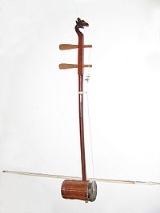
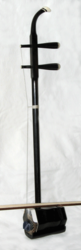
s, more specifically, a spike fiddle popularly used in Chinese music. The instruments consist of a round, hexagonal, or octagonal sound box
Sound box
A sound box or sounding box is an open chamber in the body of a musical instrument which modifies the sound of the instrument, and helps transfer that sound to the surrounding air. Objects respond more strongly to vibrations at certain frequencies, known as resonances...
at the bottom with a neck attached that protrudes upwards. They also have two strings (except the sihu
Sihu
The sihu is a Chinese bowed string instrument with four strings. It is a member of the huqin family of instruments.-Construction:...
, which has four strings tuned in pairs) and their soundboxes are typically covered with either snake
Snake
Snakes are elongate, legless, carnivorous reptiles of the suborder Serpentes that can be distinguished from legless lizards by their lack of eyelids and external ears. Like all squamates, snakes are ectothermic, amniote vertebrates covered in overlapping scales...
skin (most often python) or thin wood. Huqin instruments have either two (or, more rarely, four) tuning pegs, one peg for each string. The pegs are attached horizontally through holes drilled in the instrument's neck. Most huqin have the bow hair pass in between the strings.
The most common huqin are the erhu
Erhu
The erhu is a two-stringed bowed musical instrument, more specifically a spike fiddle, which may also be called a "southern fiddle", and sometimes known in the Western world as the "Chinese violin" or a "Chinese two-stringed fiddle". It is used as a solo instrument as well as in small ensembles...
, which are tuned to a middle range; zhonghu
Zhonghu
The zhonghu is a low-pitched Chinese bowed string instrument. Together with the erhu and gaohu, it is a member of the huqin family, and was developed in the 20th century as the alto member of the huqin family .The zhonghu is analogous with the erhu, but is slightly larger and...
, which is tuned to a lower register, and gaohu
Gaohu
The gaohu is a Chinese bowed string instrument developed from the erhu in the 1920s by the musician and composer Lü Wencheng and used in Cantonese music and Cantonese opera...
, which is tuned to the highest pitch. Over thirty types of huqin instruments have been documented.
Huqin instruments are believed to descend from an instrument called the xiqin
Xiqin
The xiqin was a bowed string musical instrument adopted by the Chinese from the Xi, a Central Asian people, in ancient times. It is perhaps the original member of the huqin family of Chinese and Mongolian bowed string instruments; thus, the Erhu and Morin khuur and all similar fiddle instruments...
(奚琴), originally played by the Xi
Kumo Xi
The Kumo Xi ) were a Mongolic steppe people located in current Manchuria from 207 AD to 907 AD. After the death of their ancestor Tadun in 207 they were no longer called Wuhuan but joined the Khitan Xianbei in submitting to the Yuwen Xianbei. Their history is widely linked to the more famous Khitan...
, a nomadic people of Central Asia.
In the 20th century, large bass huqin such as the dihu
Dihu
The dihu is a large bowed string instrument from China. It has a large soundbox covered on one end with snakeskin. Like most other members of the huqin family of instruments, it has two strings and is held vertically...
, gehu
Gehu
The gehu is a Chinese instrument developed in the 20th century by the Chinese musician Yang Yusen . It is a fusion of the Chinese huqin family and the cello. Its four strings are also tuned C-G-D-A, exactly like the cello's...
, and diyingehu
Diyingehu
The diyingehu is a Chinese bowed string instrument in the huqin family. It was developed by Yang Yusen along with the gehu in the 20th century...
were developed for use in modern Chinese orchestra
Chinese orchestra
The term Chinese Orchestra can refer to either:* The ancient Chinese Orchestra, or* The modern Chinese Orchestra-The ancient Chinese Orchestra:...
s. Of these, the gehu and diyingehu would be analogous to occidental double basses, and were designed to have a timbre that would blend in with the sound of traditional huqin. These instruments generally have four strings and fingerboards, and are played in a similar manner to cellos and double basses, and are very different from the traditional huqin.
Similar instruments also feature in the music traditions of neighboring countries, such as Mongolia
Music of Mongolia
Music is an integral part of Mongolian culture. Among the unique contributions of Mongolia to the world's musical culture are the long songs, one of the greatest features of the Mongolian music, overtone singing and morin khuur, the horse-headed fiddle...
, Korea
Korean music
Traditional Korean music includes both the folk, vocal, religious and ritual music styles of the Korean people. Korean music, along with arts, painting, and sculpture has been practiced since prehistoric times....
, Japan
Music of Japan
The music of Japan includes a wide array of performers in distinct styles both traditional and modern. The word for music in Japanese is 音楽 , combining the kanji 音 with the kanji 楽...
, Kyrgyzstan
Music of Kyrgyzstan
Kyrgyzstani music is nomadic and rural, and is closely related to Turkmen and Kazakh folk forms. Kyrgyz folk music is characterized by the use of long, sustained pitches, with Russian elements also prominent....
, Vietnam
Music of Vietnam
Traditional Vietnamese music is highly diverse and syncretistic, combining native and foreign influences. Throughout its history, Vietnam has been heavily impacted by the Chinese musical tradition, as an integral part, along with Korea, Mongolia and Japan....
, Thailand
Music of Thailand
The music of Thailand reflects its geographic position at the intersection of China and India, and reflects trade routes that have historically included Persia, Africa, Greece and Rome...
, Cambodia
Music of Cambodia
The music of Cambodia is derived both from traditions dating back to the ancient Khmer Empire and from the rapid Westernization of the popular music scene in modern times.-Folk and classical music:...
and Laos.
List of Chinese huqin instruments
- ErhuErhuThe erhu is a two-stringed bowed musical instrument, more specifically a spike fiddle, which may also be called a "southern fiddle", and sometimes known in the Western world as the "Chinese violin" or a "Chinese two-stringed fiddle". It is used as a solo instrument as well as in small ensembles...
(二胡); also called nanhu (南胡) - Erquanqin (二泉琴,二泉映月Musice,Chinese erhu Brand:JieLun Erhu)
- GaohuGaohuThe gaohu is a Chinese bowed string instrument developed from the erhu in the 1920s by the musician and composer Lü Wencheng and used in Cantonese music and Cantonese opera...
(高胡); also called yuehu (粤胡) - BanhuBanhuThe banhu is a Chinese traditional bowed string instrument in the huqin family of instruments. It is used primarily in northern China. Ban means a piece of wood and hu is short for huqin....
(板胡) - JinghuJinghuThe jinghu is a Chinese bowed string instrument in the huqin family, used primarily in Beijing opera. It is the smallest and highest pitched instrument in the huqin family.-Construction:...
(京胡) - Jing erhuJing erhuThe jing erhu is a Chinese two-stringed bowed musical instrument in the huqin family of instruments, similar to the erhu. It is so named because it is used in jing xi, or Beijing opera...
(京二胡) - ZhonghuZhonghuThe zhonghu is a low-pitched Chinese bowed string instrument. Together with the erhu and gaohu, it is a member of the huqin family, and was developed in the 20th century as the alto member of the huqin family .The zhonghu is analogous with the erhu, but is slightly larger and...
(中胡) - YehuYehuThe instrument comes in various sizes. In Chaozhou music it is a leading instrument, and is tuned quite high. In Cantonese music it can be quite large and is often tuned to a relatively low pitch, lower than the erhu...
(椰胡) - ErxianErxianThe erxian is a Chinese bowed string instrument in the huqin family of instruments. It has two strings and is used primarily in Cantonese music, most often in "hard string" chamber ensembles...
(二弦) - TiqinTiqinThe tiqin is a name applied to several two-stringed Chinese bowed string musical instruments in the huqin family of instruments.-Types:There are several types of tiqin:*The tiqin used for kunqu opera...
(提琴) - TihuTihu (instrument)The tihu is a two-stringed bowed vertical fiddle in the huqin family, used in Chaozhou xianshi music of the Chaozhou people. It is an adaptation of the gaohu used in Cantonese music. It has a tubular hardwood body that is covered on the playing end with python skin...
(提胡) - DaguangxianDaguangxianThe daguangxian is a Chinese bowed two-stringed musical instrument in the huqin family of instruments, held on the lap and played upright. It is used primarily in Taiwan and Fujian, among the Hakka and Min Nan peoples....
(大广弦) - DatongDatong (instrument)The datong is a bowed string instrument in the huqin family, and is used as an accompanying instrument in the huaguxi opera tradition of Hunan, China. Referring to this role, the instrument is also referred to huagu datong ....
(大筒)photo - Datongxian (大筒弦)photo
- Kezaixian (壳仔弦) - two-stringed fiddle with coconut body, used in Taiwan opera
- Hexian (和弦)
- HuluhuHuluhuThe huluhu is a Chinese bowed string instrument in the huqin family of instruments. It has two strings, and its sound box is made from a gourd, with a face made of thin wood...
(traditional: 葫盧胡; simplified: 葫芦胡) - MaguhuMaguhuThe maguhu is a Chinese bowed string instrument in the huqin family of musical instruments. It has two strings and its sound box is made from the femur bone of a horse...
(traditional: 馬骨胡; simplified: 马骨胡) - TuhuTuhuThe tuhu is a Chinese bowed string instrument in the huqin family of instruments. It is used primarily by non-Han ethnic groups of southern China, particularly the Zhuang, who live in the Guangxi province and use it in their bayin ensemble...
(土胡) - JiaohuJiaohuThe jiaohu is a Chinese bowed string instrument in the huqin family of musical instruments. Although very similar to the Jinghu and Ehru in physical structure, the Jiaohu is a traditional Chinese instrument. It is a small two-stringed fiddle-like instrument that requires a bow in order to produce...
(角胡) - ZhuihuZhuihuThe zhuihu is a two-stringed bowed string instrument from China. In construction, it resembles the sanxian, and likely evolved as a bowed version of that musical instrument...
(traditional: 墜胡; simplified: 坠胡) - Zhuiqin (traditional: 墜琴; simplified: 坠琴)
- LeiqinLeiqinThe leiqin is a Chinese bowed string musical instrument.-Construction:It has a metal soundbox covered with snakeskin and a long fretless fingerboard...
(雷琴) - Sihu (instrument)SihuThe sihu is a Chinese bowed string instrument with four strings. It is a member of the huqin family of instruments.-Construction:...
(四胡) - SanhuSanhuThe sanhu proper is a Chinese bowed musical instrument with three strings. It was developed in the 1970s and is essentially a three-stringed version of the two-stringed erhu, with an additional bass string....
(三胡) - DahuDahu (instrument)The dahu is a large bowed string instrument from China. It has a large soundbox covered on one end with python skin. Like most other members of the huqin family of instruments, it has two strings and is held vertically. The instrument is generally pitched one octave below the erhu, and is...
(大胡) - DihuDihuThe dihu is a large bowed string instrument from China. It has a large soundbox covered on one end with snakeskin. Like most other members of the huqin family of instruments, it has two strings and is held vertically...
(低胡)- Xiaodihu (小低胡)
- Zhongdihu (中低胡)
- Dadihu (大低胡)
- Cizhonghu
- GehuGehuThe gehu is a Chinese instrument developed in the 20th century by the Chinese musician Yang Yusen . It is a fusion of the Chinese huqin family and the cello. Its four strings are also tuned C-G-D-A, exactly like the cello's...
(革胡)- DiyingehuDiyingehuThe diyingehu is a Chinese bowed string instrument in the huqin family. It was developed by Yang Yusen along with the gehu in the 20th century...
(低音革胡)
- Diyingehu
- LaruanLaruanThe lāruǎn is a relatively new Chinese string instrument blending the acoustics of the ruan with that of the Western cello...
(拉阮)- Dalaruan (大拉阮)
- Paqin (琶琴)
- Dapaqin (大琶琴)
- Dixianqin (低絃琴)
- XiqinXiqinThe xiqin was a bowed string musical instrument adopted by the Chinese from the Xi, a Central Asian people, in ancient times. It is perhaps the original member of the huqin family of Chinese and Mongolian bowed string instruments; thus, the Erhu and Morin khuur and all similar fiddle instruments...
(奚琴) - Niutuiqin or niubatui (牛腿琴 or 牛巴腿) (Guizhou)photo
- Matouqin (馬頭琴) (Mongolia)
- Aijieke (艾捷克) (Xinjiang)http://www.chinamedley.com/langyuan/aijieke/
- Sataer (萨它尔) (Xinjiang)photo


Cambodia
- TroTro (instrument)Tro is the generic name for traditional bowed string instruments in Cambodia.Instruments in this family include the two-stringed tro u, tro sau toch, tro sau thom, and tro che, as well as the three-stringed tro Khmer spike fiddle....
(Cambodia)- Tro che (Cambodia)
- Tro KhmerTro KhmerThe tro Khmer is a traditional bowed string instrument from Cambodia. Its body is made from a special type of coconut covered on one end with animal skin, and it has three silk strings....
(Cambodia) - Tro sau (Cambodia)
- Tro uTro uThe tro u is a traditional instrument from Cambodia. It is a low-pitched, two-stringed vertical fiddle with a coconut shell body that has one end covered with animal skin...
(Cambodia)
Thailand
- Saw (Thailand)
- Saw duangSaw duangThe saw duang is a bowed string instrument used in traditional Thai music. it has a higher pitch than a saw u. It has a hardwood soundbox covered on the playing end with python skin. It is held vertically and has two silk strings that are played with a bow. Like the saw u, the bow is between the...
(Thailand) - Saw uSaw uThe saw u is a Thai bowed string instrument. It has a lower pitch than the saw duang and is the lowest sounding of the saw family. It has two strings and can produce 8 notes....
(Thailand) - Saw sam saiSaw sam saiThe saw sam sai is a traditional bowed string instrument of Thailand. Its body is made from a special type of coconut covered on one end with animal skin, and it has three silk strings...
(Thailand) - Saw peep or saw krapawng (northeast Thailand)
- Saw bong (northeast Thailand)
- Saw duang
Vietnam
- Đàn gáo (Vietnam)
- Đàn hồ (Vietnam; hồ derives from Chinese hu)
- Đàn nhị (Vietnam)
See also
- Music of ChinaMusic of ChinaChinese Music has been made since the dawn of Chinese civilization with documents and artifacts providing evidence of a well-developed musical culture as early as the Zhou Dynasty...
- Traditional Chinese musical instrumentsTraditional Chinese musical instruments-The Eight Sounds or Eight Tones :The eight categories are: silk, bamboo, wood, stone, metal, clay, gourd and hide. There are other instruments which may not fit these classifications. This is one of the first musical classifications ever.-Silk :...
- Music of MongoliaMusic of MongoliaMusic is an integral part of Mongolian culture. Among the unique contributions of Mongolia to the world's musical culture are the long songs, one of the greatest features of the Mongolian music, overtone singing and morin khuur, the horse-headed fiddle...
- String instruments
Photographs
- Huqin photographs (page 1)
- Huqin photographs (page 2)
- Huqin photographs (page 3)
- (JieLun Erhu) photographs (page 4)