
All Topics  
Ocarina

 
Ocarina

   Email Print
   Bookmark   Link


Ocarina


The ocarina is an ancient flute
Flute

The flute is a musical instrument of the woodwind family. Unlike other woodwind instruments, a flute is a reedless wind instrument that produces its sound from the flow of air against an edge....
-like wind instrument
Wind instrument

A wind instrument is a musical instrument that contains some type of resonator , in which a column of air is set into vibration by the player blowing into a mouthpiece set at the end of the resonator....
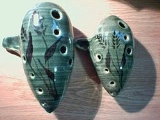
. While several variations exist, an ocarina is typified by an oval-shaped enclosed space with four to twelve finger holes and a mouth tube projecting out from the body. It is often ceramic
Ceramic

File:Bridge from dental porcelain.jpgFile:Qing vase p1070256.jpgA ceramic is an inorganic, nonmetal solid prepared by the action of heat and subsequent cooling....
, but many other materials, such as plastic, wood, glass and metal may also be used.

ocarina is a very old family of instruments, believed to date back some 12,000 years
10th millennium BC

The 10th millennium BC marks the beginning of the Mesolithic and Epipaleolithic period, which is the first part of the Holocene epoch. Agriculture, based on the cultivation of primitive forms of millet and rice, occurred in Southwest Asia....
.


Discussion
Ask a question about 'Ocarina'
Start a new discussion about 'Ocarina'
Answer questions from other users
Full Discussion Forum


Encyclopedia


The ocarina is an ancient flute
Flute

The flute is a musical instrument of the woodwind family. Unlike other woodwind instruments, a flute is a reedless wind instrument that produces its sound from the flow of air against an edge....
-like wind instrument
Wind instrument

A wind instrument is a musical instrument that contains some type of resonator , in which a column of air is set into vibration by the player blowing into a mouthpiece set at the end of the resonator....
. While several variations exist, an ocarina is typified by an oval-shaped enclosed space with four to twelve finger holes and a mouth tube projecting out from the body. It is often ceramic
Ceramic

File:Bridge from dental porcelain.jpgFile:Qing vase p1070256.jpgA ceramic is an inorganic, nonmetal solid prepared by the action of heat and subsequent cooling....
, but many other materials, such as plastic, wood, glass and metal may also be used.

History

Donati
The ocarina is a very old family of instruments, believed to date back some 12,000 years
10th millennium BC

The 10th millennium BC marks the beginning of the Mesolithic and Epipaleolithic period, which is the first part of the Holocene epoch. Agriculture, based on the cultivation of primitive forms of millet and rice, occurred in Southwest Asia....
. Ocarina-type instruments have been of particular importance in Chinese
China

China is a Culture of China, an ancient civilization, and, depending on perspective, a national or multinational entity extending over a large area in East Asia....
 and Mesoamerica
Mesoamerica

Mesoamerica or Meso-America is a region and cultural area in the Americas, extending approximately from central Mexico to Honduras and Nicaragua, within which a number of pre-Columbian society flourished before the Spanish colonization of the Americas in the 15th and 16th centuries....
n cultures. For the Chinese, the instrument played an important role in their long history of song and dance. The ocarina has similar features to the Xun
Xun

File:Xunfront.jpgFile:Xunback.jpgThe xun is a Chinese Ocarina#Classification made of clay or ceramic, similar to an ocarina but without a fipple....
, another important Chinese instrument. Different expeditions to Mesoamerica, including the one conducted by Cortés
Hernán Cortés

Hern?n Cort?s de Monroy y Pizarro, 1st Marqu?s del Valle de Oaxaca was a Spain conquistador who led an expedition that caused the conquest of the Aztec Empire and brought large portions of mainland Mexico under the Crown of Castile, in the early 16th century....
, resulted in the introduction of the ocarina to the courts of Europe. Both the Mayans and Aztecs had produced versions of the ocarina, but it was the Aztecs who brought the song and dance that accompanied the ocarina to Europe. The ocarina went on to become popular in European communities as a toy instrument.

Its common use in Western countries dates back to the 19th century in Budrio
Budrio

Budrio is a town and commune in the province of Bologna, in Emilia-Romagna, Italy; it is located 15 km E of Bologna.Budrio has two high schools, including a lyceum, a post office, banks, a communal theatre, a swimming pool and several squares ....
, a town near Bologna
Bologna

Bologna is the capital city of Emilia-Romagna in northern Italy, in the Po Valley , between the Po River and the Apennine Mountains, exactly between the Reno River and the S?vena River....
, Italy
Italy

Italy , officially the Italian Republic , is a country located on the Italian Peninsula in Southern Europe and on the two largest islands in the Mediterranean Sea, Sicily and Sardinia....
, where Giuseppe Donati
Giuseppe Donati

Giuseppe Donati was the inventor of the classical ocarina, a ceramic wind instrument based on the principle of a Helmholtz resonator.Legend has it that a 17 year-old Giuseppe created his first "little goose" in 1853 whilst still working as a brickmaker....
 transformed the ocarina from a toy, which only played a few notes, into a more comprehensive instrument (known as the first "classical" ocarinas). The word ocarina is derived from Italian
Italian language

Italian is a Romance languages spoken by about 63 million people as a first language, primarily in Italy. In Switzerland, Italian is one of four Linguistic geography of Switzerlands....
 meaning "little goose
Goose

Goose is the English-language name for a considerable number of birds, belonging to the family Anatidae. This family also includes swans, most of which are larger than geese, and ducks, which are smaller....
." The earlier form was known in Europe as a gemshorn
Gemshorn

The gemshorn is an instrument of the ocarina family that was historically made from the horn of the chamois, goat, or other suitable animal. The gemshorn receives its name from the German language, and means a chamois horn....
; which was made from animal horns
Horn (anatomy)

A horn is a pointed projection of the skin on the head of various mammals, consisting of a covering of horn surrounding a core of living bone....
 of the Gemsbok
Gemsbok

The gemsbok or gemsbuck is a large African antelope, of the Oryx genus. The name is derived from the Dutch Language name of the male chamois, Gemsbok....
. After featuring in the Nintendo
Nintendo

is a global company located in Kyoto, Japan founded on September 23, 1889 by Fusajiro Yamauchi to produce handmade hanafuda cards. By 1963, the company had tried several small niche businesses, such as a cab company and a love hotel....
 Legend of Zelda games, the ocarina attracted a marked increase in interest, and a dramatic rise in sales.

Musical performance


Tone production/acoustics

How an ocarina works:
  1. Air enters through the windway
  2. Air strikes the labium
    Fipple

    Fipple Flute or Tubular Ducted Flute mouthpiece are commonly found on end-blown woodwind instruments such as the tin whistle and the recorder....
    , producing sound
  3. Air vibrates throughout the inside of the ocarina
  4. Covering and uncovering holes lowers and raises the pitch


The ocarina, unlike other vessel flutes, has the unusual quality of not relying on the pipe length to produce a particular tone. Instead the tone is dependent on the ratio of the total surface area of opened holes to the total cubic volume enclosed by the instrument. This means that, unlike a flute
Flute

The flute is a musical instrument of the woodwind family. Unlike other woodwind instruments, a flute is a reedless wind instrument that produces its sound from the flow of air against an edge....
 or recorder
Recorder

The recorder is a woodwind instrument musical instrument of the family known as fipple flutes or internal duct flutes — whistle-like instruments which include the tin whistle and ocarina....
, sound is created by resonance of the entire cavity and the placement of the holes on an ocarina is largely irrelevant — their size is the most important factor. Instruments that have toneholes close to the voicing/embouchure should be avoided, however, because this weakens tonal production. Since an ocarina is a Helmholtz resonator
Helmholtz resonance

Helmholtz resonance is the phenomenon of air resonance in a cavity. The name comes from a device created in the 1850s by Hermann von Helmholtz to show the height of the various tones....
, the frequency of the tone played is:

Where is the speed of sound
Speed of sound

Sound is a vibration that travels through an elasticity medium as a wave. The speed of sound describes how much distance such a wave travels in a certain amount of time....
, is the total uncovered area, is the enclosed volume and is the thickness of the material enclosing the holes.

The resonator
Resonator

A resonator is a device or system that exhibits resonance or resonant behavior, that is, it naturally Oscillation at some frequency, called its Resonance frequency, with greater amplitude than at others....
 in the ocarina can create overtone
Overtone

An overtone is a natural resonance of a system. Systems described by overtones are often sound systems, for example, blown pipes or plucked strings....
s, but because of the common "egg" shape, these overtones are many octaves above the keynote scale. In similar Helmholtz resonator instruments with a narrow cone shape, like the Gemshorn
Gemshorn

The gemshorn is an instrument of the ocarina family that was historically made from the horn of the chamois, goat, or other suitable animal. The gemshorn receives its name from the German language, and means a chamois horn....
 or Tonette
Tonette

The Tonette is a small, end-blown flute made of plastic, which was once popular in American elementary music education. It has largely been superseded by the recorder....
, some partial overtones are available. The technique of overblowing
Overblowing

Overblowing is a technique used in playing a wind instrument to produce a different Pitch by changing the direction and/or force of the air stream....
 to get a range of higher pitched notes is not possible with the ocarina because of its vessel shape, so the range of pitches available is limited to a 12th. Some Ocarina makers increase the range by designing double- or triple-chambered ocarinas tuned 1 octave apart.

Different notes are produced by covering the holes, and by opening and closing more or less of the total hole area. The tone is then produced through the sound hole/embouchure. The tone can also be varied by changing the strength with which one blows through the instrument (pitch bending).

Musical notation/tabulature

There are three main ways that music is written for the ocarina.

The most apparent, and recommended form of notation is the use of sheet music. There are archives of sheet music
Sheet music

Sheet music is a hand-written or printed form of musical notation; like its analogs?books, pamphlets, etc.?the medium of sheet music typically is paper , although the access to musical notation in recent years includes also presentation on computer screens....
 which are either specifically written for ocarinas, or have been adapted from piano sheet music, and have been transposed or arranged to fit within the ocarina's range. Since the ocarina is a fully chromatic instrument that can be played at the professional
Professional

A professional is a person who has completed a doctoral or law program or equivalent .A professional is someone who has a professional degree - a number one on the Hollingshead scale....
 level in many musical backgrounds, including classical
Classical music

Classical music is a broad term that usually refers to mainstream music produced in, or rooted in the traditions of Western art history Religious music and secular music, encompassing a broad period from roughly the 9th century to present times....
 and folk
Folk

English Folk "people" is derived from a Germanic languages noun *fulka meaning "people" or "army" . The English word folk has cognates in most of the other Germanic languages....
, sheet music
Sheet music

Sheet music is a hand-written or printed form of musical notation; like its analogs?books, pamphlets, etc.?the medium of sheet music typically is paper , although the access to musical notation in recent years includes also presentation on computer screens....
 is the ideal notation to use for ocarinas.

Secondly is the use of numerical tablature, which expresses the musical notes as numbers. Some makers have developed their own system of numerical tablature
Tablature

Tablature is a form of musical notation, which tells players where to place their fingers on a particular instrument rather than which pitches to play....
 for their ocarinas while others follow a more universal system where numbers correspond to different notes on the scale. This method is often used by beginners who have not learned to read sheet music
Sheet music

Sheet music is a hand-written or printed form of musical notation; like its analogs?books, pamphlets, etc.?the medium of sheet music typically is paper , although the access to musical notation in recent years includes also presentation on computer screens....
.

Thirdly, some beginners make use of a pictorial tablature similar to the ocarina's finger hole pattern with blackened holes representing which holes should be covered. The tablature
Tablature

Tablature is a form of musical notation, which tells players where to place their fingers on a particular instrument rather than which pitches to play....
 represents the holes on the top of the ocarina, and, where necessary, the holes on the underside. This enables easy playing, particularly for beginners. The most popular tabulature systems are 1) The John Taylor 4 hole system (Invented in 1964 by British mathematician John Taylor) and 2) The 10 hole sweet potato system (credited to inventor Giuseppe Donati
Giuseppe Donati

Giuseppe Donati was the inventor of the classical ocarina, a ceramic wind instrument based on the principle of a Helmholtz resonator.Legend has it that a 17 year-old Giuseppe created his first "little goose" in 1853 whilst still working as a brickmaker....
 of Budrio Italy). Depending on the artist, some may write a number or figure over the picture to depict how many beats to hold the note.

Types of ocarina

There are many different styles of ocarinas varying in shape and the number of holes.

  • Transverse (Sweet potato) - This is the best known style of ocarina. It has a rounded shape and is held with two hands horizontally. Depending on the number of holes, one just needs to open one more hole than the previous in order to ascend in pitch. The two most common Transverse ocarinas are the 10-holes (originated by Giuseppe Donati
    Giuseppe Donati

    Giuseppe Donati was the inventor of the classical ocarina, a ceramic wind instrument based on the principle of a Helmholtz resonator.Legend has it that a 17 year-old Giuseppe created his first "little goose" in 1853 whilst still working as a brickmaker....
     in Italy) and the 12-holes.


  • Pendant - These are usually very small and very portable. Two kinds exist. One being the "English" Pendant, which uses an English fingering system (4-6 holes). The other being the "Peruvian" Pendant, which uses a Peruvian fingering system (8-10 holes). English Pendants are more common.
  • Inline - These are often called a "fusion" of the Pendant and the Transverse. This style is known for being very small and compact, yet there are more holes than the pendant. This allows one to ascend in pitch with the linear finger pattern rather than finger combinations


  • Multi chambered ocarinas - Better known as "Double" and "Triple" ocarinas, this type exists within the three broad categories of ocarina. These ocarinas overcome the disadvantage of ocarinas of having a limited range of notes. A Transverse Double ocarina typically plays 2 octaves + 2 notes, and a Transverse Triple ocarina plays with a range about 2 octaves + 7 notes. Double ocarinas for Pendant and Inline ocarinas also exist. Double Inline ocarinas are specially designed to be able to play chords, for harmonic playing.


Ocarinas with keys have been produced by several makers, mostly experimentally, beginning in the late 19th century. Keys and slides may be added with the intention of either expanding the instrument's range, or to enable the fingers to reach holes that are widely spaced.

Gallery


Similar instruments

Other vessel flutes include the Chinese xun
Xun

File:Xunfront.jpgFile:Xunback.jpgThe xun is a Chinese Ocarina#Classification made of clay or ceramic, similar to an ocarina but without a fipple....
 and African globe flutes. The xun (simplified Chinese: ?; traditional: ?; pinyin: xun) is a Chinese vessel flute made of clay or ceramic. It is one of the oldest Chinese instruments. Shaped like an egg, it differs from the ocarina in being side-blown, like the Western concert flute, rather than having a recorder
Recorder

The recorder is a woodwind instrument musical instrument of the family known as fipple flutes or internal duct flutes — whistle-like instruments which include the tin whistle and ocarina....
-like mouthpiece (a fipple
Fipple

Fipple Flute or Tubular Ducted Flute mouthpiece are commonly found on end-blown woodwind instruments such as the tin whistle and the recorder....
 or beak). Similar instruments exist in Korea (the hun
Hun (instrument)

The hun is a Korean ocarina made of baked clay or ceramic. It is globular shape, with a blowing hole on top and several finger holes. It is used primarily in Korean court music ensembles, although in the late 20th century some contemporary Korean composers began to use it in their compositions and film scores....
) and Japan (the tsuchibue).

A related family of instruments is the closed-pipe family, which includes the panpipes
Pan flute

The pan flute or pan pipe is an ancient musical instrument based on the principle of the Closed tube, consisting usually of five or more pipes of gradually increasing length ....
 and other instruments which produce their tone by vibrating a column of air within a stopped cylinder
Cylinder (geometry)

A cylinder is one of the most curvilinear basic geometric shapes: the surface formed by the points at a fixed distance from a given straight line, the axis of the cylinder....
.

The old fashioned jugband jug
Jug (musical instrument)

File:Jugplayer.jpgThe jug as a musical instrument reached its height of popularity in the 1920s, when jug bands, such as Cannon's Jug Stompers were popular....
 also has similar properties.

See also

  • Flute
    Flute

    The flute is a musical instrument of the woodwind family. Unlike other woodwind instruments, a flute is a reedless wind instrument that produces its sound from the flow of air against an edge....
  • Native American flute
    Native American flute

    The Native American flute has achieved some measure of fame for its distinctive sound, used in a variety of New Age music and world music recordings....
  • Pan flute
    Pan flute

    The pan flute or pan pipe is an ancient musical instrument based on the principle of the Closed tube, consisting usually of five or more pipes of gradually increasing length ....
  • The Legend Of Zelda: Ocarina of Time
    The Legend of Zelda: Ocarina of Time

    is an Action-adventure game video game developed by Nintendo's Nintendo Entertainment Analysis and Development division for the Nintendo 64 video game console....


External links

  • - Broad range of ocarina information