

Toyota War

Encyclopedia
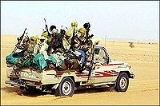
The Toyota War is the name commonly given to the last phase of the Chadian–Libyan conflict, which took place in 1987 in Northern Chad and on the Libyan-Chadian border. It takes its name from the Toyota pickup truck
s used as technicals
to provide mobility for the Chad
ian troops as they fought against the Libya
ns. The 1987 war resulted in a heavy defeat for Libya
, which, according to American sources, lost one tenth of its army, with 7,500 troops killed and 1.5 billion dollars worth of military equipment destroyed or captured. Chadian losses were 1,000 troops killed.
The war began with the Libyan occupation of northern Chad in 1983, when Libya's leader Muammar Gaddafi
, refusing to recognize the legitimacy of the Chadian President Hissène Habré
, militarily supported the attempt by the opposition Transitional Government of National Unity (GUNT) to overthrow Habré. The plan was foiled by the intervention of France that, first with Operation Manta
and later with Operation Epervier, limited Libyan expansion to north of the 16th parallel
, in the most arid and sparsely inhabited part of Chad.
In 1986 the GUNT rebelled against Gaddafi, stripping Libya of its main cover of legitimacy for its military presence in Chad. Seeing an occasion to unify Chad behind him, Habré ordered his forces to pass the 16th parallel so as to link with the GUNT rebels (who were fighting the Libyans in Tibesti
) in December. A few weeks later a bigger force struck at Fada, destroying the local Libyan garrison. In three months, combining the methods of guerilla and conventional warfare in a common strategy, Habré was able to retake almost all of northern Chad, and in the following months, inflicted new heavy defeats on the Libyans, until a ceasefire
putting an end to the conflict was signed in September. The ceasefire left open the issue of the disputed Aouzou Strip, which was eventually assigned to Chad by the International Court of Justice
in 1994.
was de facto partitioned, with the northern half controlled by the rebel Transitional Government of National Unity (GUNT) headed by Goukouni Oueddei
and supported on the ground by Libyan forces
, while the south was held by the Western-backed Chadian government guided by Hissène Habré
. This partition on 16th parallel (the so-called Red Line) into Libyan and French zones of influence was informally recognised by France in 1984, following an accord between France and Libya
to withdraw their forces from Chad. The accord was not respected by Libya, which maintained at least 3,000 men stationed in northern Chad.
During the period between 1984 and 1986, in which no major clash took place, Habré greatly strengthened his position thanks to western support and Libya's failure to respect the Franco-Libyan 1984 agreement. Decisive was also the increasing factional bickering that started plaguing the GUNT since 1984, centered around the fight between Goukouni and Acheikh ibn Oumar
over the leadership of the organization. Taking advantage of the GUNT's difficulties, Habré struck a series of accords with smaller rebel factions, which left the GUNT at the beginning of 1986 with only three of the eleven factions that had originally signed the Lagos Accord
in 1979. The remaining factions were Goukouni's People's Armed Forces
(FAP), Acheikh's armed branch of the Democratic Revolutionary Council
(CDR) and that part of the Chadian Armed Forces
(FAT) which had maintained its loyalty to Wadel Abdelkader Kamougué
.
) and regular artillery pieces, Mi-24
helicopters and sixty combat aircraft. These forces did not have a unified command, but were divided into an Operational Group South, active in the Tibesti with 2,500 men, and an Operational Group East, centered in Faya-Largeau
.
Apparently formidable, the Libyan military disposition in Chad was marred by serious flaws. The Libyans were prepared for a war in which they would provide ground and air support to their Chadian allies, act as assault infantry, and provide reconnaissance. By 1987, however, Muammar Gaddafi
had lost his allies, exposing Libya's inadequate knowledge of the area. Libyan garrisons came to resemble isolated and vulnerable islands in the Chadian Sahara
. Also important was the low morale among the troops, who were fighting in a foreign country, and the structural disorganization of the Libyan army
, which was in part induced by Gaddafi's fear of a military coup against him. This fear led him to avoid the professionalization of the armed forces.
The Libyans had also to deal with the greatly strengthened Chadian National Armed Forces
(FANT), which was composed of 10,000 highly motivated troops, led by experienced and able commanders, such as Idriss Déby
, Hassan Djamous
and President
Hissène Habré
himself. And while FANT previously had no air power, limited mobility and few anti-tank and anti-aircraft weapons, by 1987 it could count on the French Air Force
to keep Libyan aircraft grounded and, more importantly, to provide 400 highly mobile Toyota pickup
s equipped with MILAN
anti-tank guided missile
s. It is these trucks that gave the name "Toyota War" to this last phase of the Chadian-Libyan conflict.
(CDR) militia (Gaddafi's closest Chadian allies), well-provided with armour and artillery. Hassan Djamous, the thirty-year-old FANT commander-in-chief, pitched about 4,000–5,000 troops against Fada's Libyan garrison. Taking advantage of his army's superior knowledge of the terrain, which apparently included unknown access points to the base, Djamous avoided a frontal assault and used his forces' high mobility to surround the Libyan positions and then unleashed his troops, destroying the defending garrison. In the battle
, 784 Libyans were killed and 100 tanks destroyed, while only 50 FANT soldiers died.
The unexpected defeat stunned Gaddafi, who then reacted on January 4 by recalling to service all of the army reservists
. In an act of defiance towards France, he also ordered the bombing of Arada, well south of the 16th parallel. France retaliated with a new airstrike on Ouadi Doum and destroyed their radar system, effectively blinding the Libyan Air Force in Chad for several months. Gaddafi attempted to contain the FANT threat by rushing several new battalions into Chad (especially to Faya-Largeau
and Ouadi Doum), including units of the elite Revolutionary Guard. This brought the amount of Libyan forces in the country to a total of 11,000 by March.
In March 1987, the main Libyan air base of Ouadi Doum was captured by Chadian forces. Although strongly defended by minefields
, 5,000 troops, tanks, armored vehicles, and aircraft, the Libyans' base fell to a smaller Chadian attacking force led by Djamous equipped with trucks mounted with machine guns and antitank weapons. Observers estimated that, in the Chadian victories in the first three months of 1987, more than 3,000 Libyan soldiers had been killed, captured, or deserted. Large numbers of tanks, armored personnel carriers, artillery, fixed-wing aircraft, and helicopters were captured or destroyed. In some cases, Libya sent its own aircraft to bomb abandoned Libyan equipment to deny its use to the Chadians. It was reported that, in many cases, Libyan soldiers had been killed while fleeing to avoid battle. At Ouadi Doum, panicked Libyans had suffered high casualties running through their own minefields.
The fall of Ouadi Doum was a severe setback for Libya. Deserted by most of their Chadian allies, Libyan forces found themselves isolated in foreign territory, and the loss of the main Libyan air base in Chad prevented Libya from providing close air cover to its troops. In general, the offensive against FANT had exposed the vulnerability of Libya's heavy armor to a more mobile enemy. On Gaddafi's orders, a general withdrawal was undertaken from Borkou-Ennedi-Tibesti Prefecture, beginning with Faya-Largeau
. The town had served as the main Libyan base during the preceding four years, but was in danger of being encircled. Its garrison of 3,000 troops, together with the survivors of Ouadi Doum, retired toward the Libyan base at Maatan-as-Sarra, north of the Chadian border. In an attempt to reduce the damage inflicted to his international standing, Gaddafi announced that Libya had won the confrontation, and was now leaving Chad so that the opposition could play its part in fighting Habré.
These military actions left Habré in control of Chad and in a position to threaten the expulsion of Libya from the Aouzou Strip, affected the international perception of Libya as a significant regional military power, and cast renewed doubt on the competence and determination of Libyan soldiers, especially in engagements beyond the country's borders to which they evidently felt no personal commitment.
The Toyota War attracted considerable interest in the United States, where the possibility of using Habré to overthrow Gaddafi was given serious consideration. As part of the Reagan Administration
's support for his government, Habré, during a visit to Washington
, received a pledge of $32 million United States dollar
s worth of aid, including Stinger
anti-aircraft missiles
.
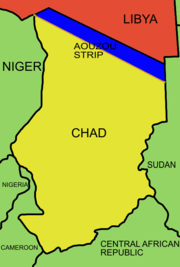 In August 1987, the encouraged Chadians carried their offensive into the disputed Aouzou Strip, occupying the town of Aouzou following another battle in which the Libyans suffered severe losses in troops and abandoned equipment. In retaliation, Libya intensified its air bombardments of towns in the north, usually from altitudes beyond the range of FANT's shoulder-fired missiles. Appeals by Habré for French air missions to defend the area against the bombing were rejected, as Aouzou had been retaken against the wishes of French President
François Mitterrand
. Instead, Mitterrand called for international mediation to settle competing claims to the disputed territory
.
After a succession of counterattacks, toward the end of August the Libyans finally drove the 400 Chadian troops out of the town. This victory–the first by Libyan ground forces since the start of the Toyota War–was apparently achieved through close-range air strikes, which were followed by ground troops advancing cross-country in jeeps, Toyota all-terrain trucks, and light armored vehicles. For the Libyans, who had previously relied on ponderous tracked armour, the assault represented a conversion to the desert warfare tactics developed by FANT. To highlight the victory, Gaddafi flew foreign journalists to the region, so the news of his victory could reach the headlines.
Habré quickly reacted to this setback and to the continued bombing of FANT concentrations in northern Chad. On September 5, 1987 he mounted a surprise raid against the key Libyan air base at Maaten al-Sarra
. Reportedly, 1,000 Libyans were killed, 300 were captured, and hundreds of others were forced to flee into the surrounding desert. Chad claimed that its troops destroyed about 32 aircraft–including MiG-21
and MiG-23
fighters
, Su-22
fighter-bombers
, and Mi-24
helicopters–before the FANT column withdrew to Chadian soil.
The attack had been opposed by France, who refused to provide FANT with intelligence and logistical support, causing FANT to suffer considerable losses. The French Defence Minister
André Giraud let it be known that "France was not implicated in any way" in the attack and "had not been informed of it". The American reaction was markedly different, as it had previously supported the attempted reconquest of the Aouzou Strip; it now welcomed the Chadian raid.
on Maatan as-Sarrah
was only the first stage of a general offensive into Libya proper, a possibility that France was not disposed to tolerate. As a result, Mitterrand forced Habré to accept the mediation efforts of the Organization of African Unity's Zambia
n Chairman, Kenneth Kaunda
, which resulted in a ceasefire on September 11.
It was assumed that war would, sooner or later, resume, but in the end the ceasefire violations were relatively minor. Gaddafi announced in May 1988 that he would recognize Habré as President of Chad "as a gift to Africa", even if Libya refused to leave the disputed Aouzou Strip. On October 3 the two countries resumed diplomatic relations, and another important step was made when the two countries agreed in September 1990 to refer the dispute to the International Court of Justice
. On February 3, 1994 the court ruled in favour of Chad, thus definitively solving the Aouzou controversy by assigning the territory to the southern country.
Pickup truck
A pickup truck is a light motor vehicle with an open-top rear cargo area .-Definition:...
s used as technicals
Technical (fighting vehicle)
A technical is a type of improvised fighting vehicle, typically a civilian or military non-combat vehicle, modified to provide an offensive capability similar to a military gun truck...
to provide mobility for the Chad
Chad
Chad , officially known as the Republic of Chad, is a landlocked country in Central Africa. It is bordered by Libya to the north, Sudan to the east, the Central African Republic to the south, Cameroon and Nigeria to the southwest, and Niger to the west...
ian troops as they fought against the Libya
Libya
Libya is an African country in the Maghreb region of North Africa bordered by the Mediterranean Sea to the north, Egypt to the east, Sudan to the southeast, Chad and Niger to the south, and Algeria and Tunisia to the west....
ns. The 1987 war resulted in a heavy defeat for Libya
Libya
Libya is an African country in the Maghreb region of North Africa bordered by the Mediterranean Sea to the north, Egypt to the east, Sudan to the southeast, Chad and Niger to the south, and Algeria and Tunisia to the west....
, which, according to American sources, lost one tenth of its army, with 7,500 troops killed and 1.5 billion dollars worth of military equipment destroyed or captured. Chadian losses were 1,000 troops killed.
The war began with the Libyan occupation of northern Chad in 1983, when Libya's leader Muammar Gaddafi
Muammar Gaddafi
Muammar Muhammad Abu Minyar Gaddafi or "September 1942" 20 October 2011), commonly known as Muammar Gaddafi or Colonel Gaddafi, was the official ruler of the Libyan Arab Republic from 1969 to 1977 and then the "Brother Leader" of the Libyan Arab Jamahiriya from 1977 to 2011.He seized power in a...
, refusing to recognize the legitimacy of the Chadian President Hissène Habré
Hissène Habré
Hissène Habré , also spelled Hissen Habré, was the leader of Chad from 1982 until he was deposed in 1990.-Early life:...
, militarily supported the attempt by the opposition Transitional Government of National Unity (GUNT) to overthrow Habré. The plan was foiled by the intervention of France that, first with Operation Manta
Operation Manta
Operation Manta is the code name for the French military intervention in Chad between 1983 and 1984, during the Chadian-Libyan conflict. The operation was prompted by the invasion of Chad by a joint force of Libyan units and Chadian Transitional Government of National Unity rebels in June 1983...
and later with Operation Epervier, limited Libyan expansion to north of the 16th parallel
16th parallel north
The 16th parallel north is a circle of latitude that is 16 degrees north of the Earth's equatorial plane. It crosses Africa, Asia, the Indian Ocean, the Pacific Ocean, Central America, the Caribbean and the Atlantic Ocean....
, in the most arid and sparsely inhabited part of Chad.
In 1986 the GUNT rebelled against Gaddafi, stripping Libya of its main cover of legitimacy for its military presence in Chad. Seeing an occasion to unify Chad behind him, Habré ordered his forces to pass the 16th parallel so as to link with the GUNT rebels (who were fighting the Libyans in Tibesti
Tibesti Mountains
The Tibesti Mountains are a range of inactive volcanoes located on the northern edge of the Chad Basin in the Borkou- and Tibesti Region of northern Chad. The massif is one of the most prominent features of the Central-Sahara desert and covers an area of approximately 100,000 km². The northern...
) in December. A few weeks later a bigger force struck at Fada, destroying the local Libyan garrison. In three months, combining the methods of guerilla and conventional warfare in a common strategy, Habré was able to retake almost all of northern Chad, and in the following months, inflicted new heavy defeats on the Libyans, until a ceasefire
Ceasefire
A ceasefire is a temporary stoppage of a war in which each side agrees with the other to suspend aggressive actions. Ceasefires may be declared as part of a formal treaty, but they have also been called as part of an informal understanding between opposing forces...
putting an end to the conflict was signed in September. The ceasefire left open the issue of the disputed Aouzou Strip, which was eventually assigned to Chad by the International Court of Justice
International Court of Justice
The International Court of Justice is the primary judicial organ of the United Nations. It is based in the Peace Palace in The Hague, Netherlands...
in 1994.
Background
Since 1983 ChadChad
Chad , officially known as the Republic of Chad, is a landlocked country in Central Africa. It is bordered by Libya to the north, Sudan to the east, the Central African Republic to the south, Cameroon and Nigeria to the southwest, and Niger to the west...
was de facto partitioned, with the northern half controlled by the rebel Transitional Government of National Unity (GUNT) headed by Goukouni Oueddei
Goukouni Oueddei
Goukouni Oueddei is a Chadian political figure. He was Head of State of Chad from 1979 to 1982. He is currently in exile.-Biography:...
and supported on the ground by Libyan forces
Military of Libya
The Libyan Armed Forces constituted the state defence organisation of the Libyan Arab Jamahiriya before they were destroyed, and are being replaced by a new national army. A Major General, Suleiman Mahmoud al-Obeidi, was named interim chief of staff of the rebellion's armed forces in mid July...
, while the south was held by the Western-backed Chadian government guided by Hissène Habré
Hissène Habré
Hissène Habré , also spelled Hissen Habré, was the leader of Chad from 1982 until he was deposed in 1990.-Early life:...
. This partition on 16th parallel (the so-called Red Line) into Libyan and French zones of influence was informally recognised by France in 1984, following an accord between France and Libya
Libya
Libya is an African country in the Maghreb region of North Africa bordered by the Mediterranean Sea to the north, Egypt to the east, Sudan to the southeast, Chad and Niger to the south, and Algeria and Tunisia to the west....
to withdraw their forces from Chad. The accord was not respected by Libya, which maintained at least 3,000 men stationed in northern Chad.
During the period between 1984 and 1986, in which no major clash took place, Habré greatly strengthened his position thanks to western support and Libya's failure to respect the Franco-Libyan 1984 agreement. Decisive was also the increasing factional bickering that started plaguing the GUNT since 1984, centered around the fight between Goukouni and Acheikh ibn Oumar
Acheikh ibn Oumar
Acheikh ibn Oumar is a Chadian politician and military leader. In the 1980s he led the Democratic Revolutionary Council , a military-political group opposing the government of President Hissène Habré....
over the leadership of the organization. Taking advantage of the GUNT's difficulties, Habré struck a series of accords with smaller rebel factions, which left the GUNT at the beginning of 1986 with only three of the eleven factions that had originally signed the Lagos Accord
Lagos Accord
The Lagos Accord was a peace agreement signed on August 21, 1979 by representatives of eleven warring factions of the Chadian Civil War, after a conference in Lagos, Nigeria. The accord established the procedures for setting up the Transitional Government of National Unity , which was sworn into...
in 1979. The remaining factions were Goukouni's People's Armed Forces
People's Armed Forces
The People's Armed Forces was a Chadian insurgent group composed of followers of Goukouni Oueddei after the schism with Hissène Habré in 1976...
(FAP), Acheikh's armed branch of the Democratic Revolutionary Council
Democratic Revolutionary Council
The Democratic Revolutionary Council was a faction of FROLINAT founded by Ahmat Acyl and later headed by Acheikh ibn Oumar and was also known as the New Vulcan Army....
(CDR) and that part of the Chadian Armed Forces
Chadian Armed Forces
The Chadian Armed Forces were the army of the central government of Chad from 1960 to 1979, under the southern presidents François Tombalbaye and Félix Malloum, until the downfall of the latter in 1979, when the head of the gendarmerie, Wadel Abdelkader Kamougué, assumed command...
(FAT) which had maintained its loyalty to Wadel Abdelkader Kamougué
Wadel Abdelkader Kamougué
Wadel Abdelkader Kamougué was a Chadian politician and former army officer. Kamougué was a leading figure in the 1975 coup d'état and since then he has held several positions in the Chadian government and legislature. He was Vice-President from 1979 to 1982 and was President of the National...
.
Forces on the ground
At the opening of 1987, the last year of the war, the Libyan expeditionary force was still impressive, comprising 8,000 troops, 300 tanks, many multiple rocket launchers (rocket artilleryRocket artillery
Rocket artillery is a type of artillery equipped with rocket launchers instead of conventional guns or mortars.Types of rocket artillery pieces include multiple rocket launchers.-History:...
) and regular artillery pieces, Mi-24
Mil Mi-24
The Mil Mi-24 is a large helicopter gunship and attack helicopter and low-capacity troop transport with room for 8 passengers. It is produced by Mil Moscow Helicopter Plant and operated since 1972 by the Soviet Air Force, its successors, and by over thirty other nations.In NATO circles the export...
helicopters and sixty combat aircraft. These forces did not have a unified command, but were divided into an Operational Group South, active in the Tibesti with 2,500 men, and an Operational Group East, centered in Faya-Largeau
Faya-Largeau
Located in the Sahara, Faya's climate is classed as hot desert on the Köppen climate classification. It experiences hot winters and very hot summers with the peak average maximum temperature reaching in May and the average minimum reaching its lowest in January at . Rainfall averages out at about...
.
Apparently formidable, the Libyan military disposition in Chad was marred by serious flaws. The Libyans were prepared for a war in which they would provide ground and air support to their Chadian allies, act as assault infantry, and provide reconnaissance. By 1987, however, Muammar Gaddafi
Muammar Gaddafi
Muammar Muhammad Abu Minyar Gaddafi or "September 1942" 20 October 2011), commonly known as Muammar Gaddafi or Colonel Gaddafi, was the official ruler of the Libyan Arab Republic from 1969 to 1977 and then the "Brother Leader" of the Libyan Arab Jamahiriya from 1977 to 2011.He seized power in a...
had lost his allies, exposing Libya's inadequate knowledge of the area. Libyan garrisons came to resemble isolated and vulnerable islands in the Chadian Sahara
Sahara
The Sahara is the world's second largest desert, after Antarctica. At over , it covers most of Northern Africa, making it almost as large as Europe or the United States. The Sahara stretches from the Red Sea, including parts of the Mediterranean coasts, to the outskirts of the Atlantic Ocean...
. Also important was the low morale among the troops, who were fighting in a foreign country, and the structural disorganization of the Libyan army
Military of Libya
The Libyan Armed Forces constituted the state defence organisation of the Libyan Arab Jamahiriya before they were destroyed, and are being replaced by a new national army. A Major General, Suleiman Mahmoud al-Obeidi, was named interim chief of staff of the rebellion's armed forces in mid July...
, which was in part induced by Gaddafi's fear of a military coup against him. This fear led him to avoid the professionalization of the armed forces.
The Libyans had also to deal with the greatly strengthened Chadian National Armed Forces
Chadian National Armed Forces
The Chadian National Armed Forces was the army of the central government of Chad from January 1983, when the President Hissène Habré's forces, in first place his personal Armed Forces of the North , were merged...
(FANT), which was composed of 10,000 highly motivated troops, led by experienced and able commanders, such as Idriss Déby
Idriss Déby
General Idriss Déby Itno is the President of Chad and the head of the Patriotic Salvation Movement. Déby is of the Bidyat clan of the Zaghawa ethnic group. He added "Itno" to his surname in January 2006.-Rise to power:...
, Hassan Djamous
Hassan Djamous
Hassan Djamous was a Commander in Chief of the Chadian Army and a cousin of current Chadian President Idriss Déby. The Hassan Djamous International Airport is named after him....
and President
Heads of state of Chad
-List of Heads of State of Chad:-Affiliations:-External links:**...
Hissène Habré
Hissène Habré
Hissène Habré , also spelled Hissen Habré, was the leader of Chad from 1982 until he was deposed in 1990.-Early life:...
himself. And while FANT previously had no air power, limited mobility and few anti-tank and anti-aircraft weapons, by 1987 it could count on the French Air Force
French Air Force
The French Air Force , literally Army of the Air) is the air force of the French Armed Forces. It was formed in 1909 as the Service Aéronautique, a service arm of the French Army, then was made an independent military arm in 1933...
to keep Libyan aircraft grounded and, more importantly, to provide 400 highly mobile Toyota pickup
Pickup truck
A pickup truck is a light motor vehicle with an open-top rear cargo area .-Definition:...
s equipped with MILAN
MILAN
MILAN " is French and German for "kite bird") is a European anti-tank guided missile. Design of the MILAN started in 1962. It was ready for trials in 1971, and was accepted for service in 1972. It is a wire guided SACLOS missile, which means the sight of the launch unit has to be aimed at the...
anti-tank guided missile
Anti-tank guided missile
An anti-tank missile , anti-tank guided missile , anti-tank guided weapon or anti-armor guided weapon is a guided missile primarily designed to hit and destroy heavily-armored military vehicles....
s. It is these trucks that gave the name "Toyota War" to this last phase of the Chadian-Libyan conflict.
Libyan expulsion
Habré selected as the first target for his reconquest of northern Chad the well-fortified Libyan communications base of Fada. It was defended by 2,000 Libyans and the bulk of the Democratic Revolutionary CouncilDemocratic Revolutionary Council
The Democratic Revolutionary Council was a faction of FROLINAT founded by Ahmat Acyl and later headed by Acheikh ibn Oumar and was also known as the New Vulcan Army....
(CDR) militia (Gaddafi's closest Chadian allies), well-provided with armour and artillery. Hassan Djamous, the thirty-year-old FANT commander-in-chief, pitched about 4,000–5,000 troops against Fada's Libyan garrison. Taking advantage of his army's superior knowledge of the terrain, which apparently included unknown access points to the base, Djamous avoided a frontal assault and used his forces' high mobility to surround the Libyan positions and then unleashed his troops, destroying the defending garrison. In the battle
Battle of Fada
The battle of Fada took place in northern Chad in 1987, and was a turning point of the Libyan-Chadian War.- Prelude :At the beginning of 1986 the Libyans controlled all Chad north of the 16th parallel...
, 784 Libyans were killed and 100 tanks destroyed, while only 50 FANT soldiers died.
The unexpected defeat stunned Gaddafi, who then reacted on January 4 by recalling to service all of the army reservists
Military reserve force
A military reserve force is a military organization composed of citizens of a country who combine a military role or career with a civilian career. They are not normally kept under arms and their main role is to be available to fight when a nation mobilizes for total war or to defend against invasion...
. In an act of defiance towards France, he also ordered the bombing of Arada, well south of the 16th parallel. France retaliated with a new airstrike on Ouadi Doum and destroyed their radar system, effectively blinding the Libyan Air Force in Chad for several months. Gaddafi attempted to contain the FANT threat by rushing several new battalions into Chad (especially to Faya-Largeau
Faya-Largeau
Located in the Sahara, Faya's climate is classed as hot desert on the Köppen climate classification. It experiences hot winters and very hot summers with the peak average maximum temperature reaching in May and the average minimum reaching its lowest in January at . Rainfall averages out at about...
and Ouadi Doum), including units of the elite Revolutionary Guard. This brought the amount of Libyan forces in the country to a total of 11,000 by March.
In March 1987, the main Libyan air base of Ouadi Doum was captured by Chadian forces. Although strongly defended by minefields
Land mine
A land mine is usually a weight-triggered explosive device which is intended to damage a target—either human or inanimate—by means of a blast and/or fragment impact....
, 5,000 troops, tanks, armored vehicles, and aircraft, the Libyans' base fell to a smaller Chadian attacking force led by Djamous equipped with trucks mounted with machine guns and antitank weapons. Observers estimated that, in the Chadian victories in the first three months of 1987, more than 3,000 Libyan soldiers had been killed, captured, or deserted. Large numbers of tanks, armored personnel carriers, artillery, fixed-wing aircraft, and helicopters were captured or destroyed. In some cases, Libya sent its own aircraft to bomb abandoned Libyan equipment to deny its use to the Chadians. It was reported that, in many cases, Libyan soldiers had been killed while fleeing to avoid battle. At Ouadi Doum, panicked Libyans had suffered high casualties running through their own minefields.
The fall of Ouadi Doum was a severe setback for Libya. Deserted by most of their Chadian allies, Libyan forces found themselves isolated in foreign territory, and the loss of the main Libyan air base in Chad prevented Libya from providing close air cover to its troops. In general, the offensive against FANT had exposed the vulnerability of Libya's heavy armor to a more mobile enemy. On Gaddafi's orders, a general withdrawal was undertaken from Borkou-Ennedi-Tibesti Prefecture, beginning with Faya-Largeau
Faya-Largeau
Located in the Sahara, Faya's climate is classed as hot desert on the Köppen climate classification. It experiences hot winters and very hot summers with the peak average maximum temperature reaching in May and the average minimum reaching its lowest in January at . Rainfall averages out at about...
. The town had served as the main Libyan base during the preceding four years, but was in danger of being encircled. Its garrison of 3,000 troops, together with the survivors of Ouadi Doum, retired toward the Libyan base at Maatan-as-Sarra, north of the Chadian border. In an attempt to reduce the damage inflicted to his international standing, Gaddafi announced that Libya had won the confrontation, and was now leaving Chad so that the opposition could play its part in fighting Habré.
These military actions left Habré in control of Chad and in a position to threaten the expulsion of Libya from the Aouzou Strip, affected the international perception of Libya as a significant regional military power, and cast renewed doubt on the competence and determination of Libyan soldiers, especially in engagements beyond the country's borders to which they evidently felt no personal commitment.
The Toyota War attracted considerable interest in the United States, where the possibility of using Habré to overthrow Gaddafi was given serious consideration. As part of the Reagan Administration
Reagan Administration
The United States presidency of Ronald Reagan, also known as the Reagan administration, was a Republican administration headed by Ronald Reagan from January 20, 1981, to January 20, 1989....
's support for his government, Habré, during a visit to Washington
Washington, D.C.
Washington, D.C., formally the District of Columbia and commonly referred to as Washington, "the District", or simply D.C., is the capital of the United States. On July 16, 1790, the United States Congress approved the creation of a permanent national capital as permitted by the U.S. Constitution....
, received a pledge of $32 million United States dollar
United States dollar
The United States dollar , also referred to as the American dollar, is the official currency of the United States of America. It is divided into 100 smaller units called cents or pennies....
s worth of aid, including Stinger
FIM-92 Stinger
The FIM-92 Stinger is a personal portable infrared homing surface-to-air missile , which can be adapted to fire from ground vehicles and helicopters , developed in the United States and entered into service in 1981. Used by the militaries of the U.S...
anti-aircraft missiles
Surface-to-air missile
A surface-to-air missile or ground-to-air missile is a missile designed to be launched from the ground to destroy aircraft or other missiles...
.
Renewed Chadian offensive
President of the French Republic
The President of the French Republic colloquially referred to in English as the President of France, is France's elected Head of State....
François Mitterrand
François Mitterrand
François Maurice Adrien Marie Mitterrand was the 21st President of the French Republic and ex officio Co-Prince of Andorra, serving from 1981 until 1995. He is the longest-serving President of France and, as leader of the Socialist Party, the only figure from the left so far elected President...
. Instead, Mitterrand called for international mediation to settle competing claims to the disputed territory
Territorial dispute
A territorial dispute is a disagreement over the possession/control of land between two or more states or over the possession or control of land by a new state and occupying power after it has conquered the land from a former state no longer currently recognized by the new state.-Context and...
.
After a succession of counterattacks, toward the end of August the Libyans finally drove the 400 Chadian troops out of the town. This victory–the first by Libyan ground forces since the start of the Toyota War–was apparently achieved through close-range air strikes, which were followed by ground troops advancing cross-country in jeeps, Toyota all-terrain trucks, and light armored vehicles. For the Libyans, who had previously relied on ponderous tracked armour, the assault represented a conversion to the desert warfare tactics developed by FANT. To highlight the victory, Gaddafi flew foreign journalists to the region, so the news of his victory could reach the headlines.
Habré quickly reacted to this setback and to the continued bombing of FANT concentrations in northern Chad. On September 5, 1987 he mounted a surprise raid against the key Libyan air base at Maaten al-Sarra
Battle of Maaten al-Sarra
The battle of Maaten al-Sarra was a battle fought between Chad and Libya on September 5, 1987 during the Toyota War. The battle took the form of a surprise Chadian raid against the Libyan Maaten al-Sarra Air Base, meant to remove the threat of Libyan airpower, that had already thwarted the Chadian...
. Reportedly, 1,000 Libyans were killed, 300 were captured, and hundreds of others were forced to flee into the surrounding desert. Chad claimed that its troops destroyed about 32 aircraft–including MiG-21
Mikoyan-Gurevich MiG-21
The Mikoyan-Gurevich MiG-21 is a supersonic jet fighter aircraft, designed by the Mikoyan-Gurevich Design Bureau in the Soviet Union. It was popularly nicknamed "balalaika", from the aircraft's planform-view resemblance to the Russian stringed musical instrument or ołówek by Polish pilots due to...
and MiG-23
Mikoyan-Gurevich MiG-23
The Mikoyan-Gurevich MiG-23 is a variable-geometry fighter aircraft, designed by the Mikoyan-Gurevich design bureau in the Soviet Union. It is considered to belong to the Soviet third generation jet fighter category, along with similarly aged Soviet fighters such as the MiG-25 "Foxbat"...
fighters
Fighter aircraft
A fighter aircraft is a military aircraft designed primarily for air-to-air combat with other aircraft, as opposed to a bomber, which is designed primarily to attack ground targets...
, Su-22
Sukhoi Su-17
The Sukhoi Su-17 is a Soviet attack aircraft developed from the Sukhoi Su-7 fighter-bomber. It enjoyed a long career in Soviet, later Russian, service and was widely exported to communist and Middle Eastern air forces, under names Su-20 and Su-22.-Development:Seeking to improve low-speed and...
fighter-bombers
Ground attack aircraft
Ground-attack aircraft are military aircraft with primary role of attacking targets on the ground with greater precision than bombers and prepared to face stronger low-level air defense...
, and Mi-24
Mil Mi-24
The Mil Mi-24 is a large helicopter gunship and attack helicopter and low-capacity troop transport with room for 8 passengers. It is produced by Mil Moscow Helicopter Plant and operated since 1972 by the Soviet Air Force, its successors, and by over thirty other nations.In NATO circles the export...
helicopters–before the FANT column withdrew to Chadian soil.
The attack had been opposed by France, who refused to provide FANT with intelligence and logistical support, causing FANT to suffer considerable losses. The French Defence Minister
Minister of Defence (France)
The Minister of Defense and Veterans Affairs is the French government cabinet member charged with running the military of France....
André Giraud let it be known that "France was not implicated in any way" in the attack and "had not been informed of it". The American reaction was markedly different, as it had previously supported the attempted reconquest of the Aouzou Strip; it now welcomed the Chadian raid.
Ceasefire
Because of domestic opposition, internal demoralization, and international hostility, Gaddafi assumed a more conciliatory attitude following his defeat. On the other side, Habré also found himself vulnerable, as the French feared that the attackBattle of Maaten al-Sarra
The battle of Maaten al-Sarra was a battle fought between Chad and Libya on September 5, 1987 during the Toyota War. The battle took the form of a surprise Chadian raid against the Libyan Maaten al-Sarra Air Base, meant to remove the threat of Libyan airpower, that had already thwarted the Chadian...
on Maatan as-Sarrah
Maaten al-Sarra Air Base
The Maaten al-Sarra Libyan Air Force Base is an airbase in southernmost Libya located near the Ma'tan as-Sarra oasis in the Kufra district. It is one of the 13 military airbases in Libya....
was only the first stage of a general offensive into Libya proper, a possibility that France was not disposed to tolerate. As a result, Mitterrand forced Habré to accept the mediation efforts of the Organization of African Unity's Zambia
Zambia
Zambia , officially the Republic of Zambia, is a landlocked country in Southern Africa. The neighbouring countries are the Democratic Republic of the Congo to the north, Tanzania to the north-east, Malawi to the east, Mozambique, Zimbabwe, Botswana and Namibia to the south, and Angola to the west....
n Chairman, Kenneth Kaunda
Kenneth Kaunda
Kenneth David Kaunda, known as KK, served as the first President of Zambia, from 1964 to 1991.-Early life:Kaunda was the youngest of eight children. He was born at Lubwa Mission in Chinsali, Northern Province of Northern Rhodesia, now Zambia...
, which resulted in a ceasefire on September 11.
It was assumed that war would, sooner or later, resume, but in the end the ceasefire violations were relatively minor. Gaddafi announced in May 1988 that he would recognize Habré as President of Chad "as a gift to Africa", even if Libya refused to leave the disputed Aouzou Strip. On October 3 the two countries resumed diplomatic relations, and another important step was made when the two countries agreed in September 1990 to refer the dispute to the International Court of Justice
International Court of Justice
The International Court of Justice is the primary judicial organ of the United Nations. It is based in the Peace Palace in The Hague, Netherlands...
. On February 3, 1994 the court ruled in favour of Chad, thus definitively solving the Aouzou controversy by assigning the territory to the southern country.