

Tetraclinis

Encyclopedia
Tetraclinis is a genus
of evergreen
coniferous
tree
in the cypress
family Cupressaceae
, containing only one species, Tetraclinis articulata, also known as Sandarac or the Barbary thuja, endemic to the western Mediterranean region. It is native to northwestern Africa
in the Atlas Mountains
of Morocco
, Algeria
and Tunisia
, with two small outlying populations on Malta
, and near Cartagena
in southeast Spain
. It grows at relatively low altitudes in a hot, dry subtropical Mediterranean climate
.
Its closest relatives are Platycladus
, Microbiota
and Calocedrus
, with the closest resemblance to the latter. In older texts, it was sometimes treated in Thuja
or Callitris
, but it is less closely related to those genera.
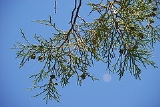
It is a small, slow-growing tree, to 6–15 m (rarely 20 m) tall and 0.5 m (rarely 1 m) trunk diameter, often with two or more trunks from the base. The foliage forms in open sprays with scale-like leaves
1–8 mm long and 1–1.5 mm broad; the leaves are arranged in opposite decussate pairs, with the successive pairs closely then distantly spaced, so forming apparent whorls of four. The cones
are 10–15 mm long, green ripening brown in about 8 months from pollination, and have four thick scales arranged in two opposite pairs. The seed
s are 5–7 mm long and 2 mm broad, with a 3–4 mm broad papery wing on each side.
It is one of only a small number of conifers able to coppice (re-grow by sprouting from stumps), an adaptation to survive wildfire
and moderate levels of browsing by animals. Old trees that have sprouted repeatedly over a long period form large burrs at the base, known as lupias.
, where it is known as Għargħar (derived from the Arabic name Araar). It is now being used locally in afforestation projects.
The resin
(sandarac
) is used to make varnish
and lacquer
; it is particularly valued for preserving painting
s.
The wood
, particularly from burrs at the base of the trunk, is used for decorative woodwork. Use of the burr wood kills the tree. The market in Morocco is unsustainable, focussing as it does on the burr, and has resulted in mass deforestation of the species. The species is also threatened by overgrazing, which can kill the coppice regrowth before it gets tall enough to be out of the reach of livestock.
Cultivation
The species is cultivated to be grown as an ornamental tree, valued in hot, dry climates. It is also pruned in a hedge form, for privacy and security. The plant can be trained for use as Bonsai
specimans.
Genus
In biology, a genus is a low-level taxonomic rank used in the biological classification of living and fossil organisms, which is an example of definition by genus and differentia...
of evergreen
Evergreen
In botany, an evergreen plant is a plant that has leaves in all seasons. This contrasts with deciduous plants, which completely lose their foliage during the winter or dry season.There are many different kinds of evergreen plants, both trees and shrubs...
coniferous
Pinophyta
The conifers, division Pinophyta, also known as division Coniferophyta or Coniferae, are one of 13 or 14 division level taxa within the Kingdom Plantae. Pinophytes are gymnosperms. They are cone-bearing seed plants with vascular tissue; all extant conifers are woody plants, the great majority being...
tree
Tree
A tree is a perennial woody plant. It is most often defined as a woody plant that has many secondary branches supported clear of the ground on a single main stem or trunk with clear apical dominance. A minimum height specification at maturity is cited by some authors, varying from 3 m to...
in the cypress
Cupressaceae
The Cupressaceae or cypress family is a conifer family with worldwide distribution. The family includes 27 to 30 genera , which include the junipers and redwoods, with about 130-140 species in total. They are monoecious, subdioecious or dioecious trees and shrubs from 1-116 m tall...
family Cupressaceae
Cupressaceae
The Cupressaceae or cypress family is a conifer family with worldwide distribution. The family includes 27 to 30 genera , which include the junipers and redwoods, with about 130-140 species in total. They are monoecious, subdioecious or dioecious trees and shrubs from 1-116 m tall...
, containing only one species, Tetraclinis articulata, also known as Sandarac or the Barbary thuja, endemic to the western Mediterranean region. It is native to northwestern Africa
Africa
Africa is the world's second largest and second most populous continent, after Asia. At about 30.2 million km² including adjacent islands, it covers 6% of the Earth's total surface area and 20.4% of the total land area...
in the Atlas Mountains
Atlas Mountains
The Atlas Mountains is a mountain range across a northern stretch of Africa extending about through Morocco, Algeria, and Tunisia. The highest peak is Toubkal, with an elevation of in southwestern Morocco. The Atlas ranges separate the Mediterranean and Atlantic coastlines from the Sahara Desert...
of Morocco
Morocco
Morocco , officially the Kingdom of Morocco , is a country located in North Africa. It has a population of more than 32 million and an area of 710,850 km², and also primarily administers the disputed region of the Western Sahara...
, Algeria
Algeria
Algeria , officially the People's Democratic Republic of Algeria , also formally referred to as the Democratic and Popular Republic of Algeria, is a country in the Maghreb region of Northwest Africa with Algiers as its capital.In terms of land area, it is the largest country in Africa and the Arab...
and Tunisia
Tunisia
Tunisia , officially the Tunisian RepublicThe long name of Tunisia in other languages used in the country is: , is the northernmost country in Africa. It is a Maghreb country and is bordered by Algeria to the west, Libya to the southeast, and the Mediterranean Sea to the north and east. Its area...
, with two small outlying populations on Malta
Malta
Malta , officially known as the Republic of Malta , is a Southern European country consisting of an archipelago situated in the centre of the Mediterranean, south of Sicily, east of Tunisia and north of Libya, with Gibraltar to the west and Alexandria to the east.Malta covers just over in...
, and near Cartagena
Cartagena, Spain
Cartagena is a Spanish city and a major naval station located in the Region of Murcia, by the Mediterranean coast, south-eastern Spain. As of January 2011, it has a population of 218,210 inhabitants being the Region’s second largest municipality and the country’s 6th non-Province capital...
in southeast Spain
Spain
Spain , officially the Kingdom of Spain languages]] under the European Charter for Regional or Minority Languages. In each of these, Spain's official name is as follows:;;;;;;), is a country and member state of the European Union located in southwestern Europe on the Iberian Peninsula...
. It grows at relatively low altitudes in a hot, dry subtropical Mediterranean climate
Mediterranean climate
A Mediterranean climate is the climate typical of most of the lands in the Mediterranean Basin, and is a particular variety of subtropical climate...
.
Its closest relatives are Platycladus
Platycladus
Platycladus is a distinct genus of evergreen coniferous tree in the cypress family Cupressaceae, containing only one species, Platycladus orientalis, also known as Chinese Arborvitae or Biota. It is endemic to Northwestern China...
, Microbiota
Microbiota
Microbiota is a monotypic] genus of evergreen coniferous shrub in the cypress family Cupressaceae, containing only one species, Microbiota decussata...
and Calocedrus
Calocedrus
Calocedrus is a genus of three species of coniferous trees in the cypress family Cupressaceae.The generic name means "beautiful cedar".-Description:...
, with the closest resemblance to the latter. In older texts, it was sometimes treated in Thuja
Thuja
Thuja is a genus of coniferous trees in the Cupressaceae . There are five species in the genus, two native to North America and three native to eastern Asia...
or Callitris
Callitris
Callitris is a genus of coniferous trees in the Cupressaceae . There are 15 species in the genus, of which 13 are native to Australia and the other two native to New Caledonia. Traditionally the most widely used common name is cypress-pine, a name shared by the closely related genus Actinostrobus...
, but it is less closely related to those genera.
It is a small, slow-growing tree, to 6–15 m (rarely 20 m) tall and 0.5 m (rarely 1 m) trunk diameter, often with two or more trunks from the base. The foliage forms in open sprays with scale-like leaves
Leaf
A leaf is an organ of a vascular plant, as defined in botanical terms, and in particular in plant morphology. Foliage is a mass noun that refers to leaves as a feature of plants....
1–8 mm long and 1–1.5 mm broad; the leaves are arranged in opposite decussate pairs, with the successive pairs closely then distantly spaced, so forming apparent whorls of four. The cones
Conifer cone
A cone is an organ on plants in the division Pinophyta that contains the reproductive structures. The familiar woody cone is the female cone, which produces seeds. The male cones, which produce pollen, are usually herbaceous and much less conspicuous even at full maturity...
are 10–15 mm long, green ripening brown in about 8 months from pollination, and have four thick scales arranged in two opposite pairs. The seed
Seed
A seed is a small embryonic plant enclosed in a covering called the seed coat, usually with some stored food. It is the product of the ripened ovule of gymnosperm and angiosperm plants which occurs after fertilization and some growth within the mother plant...
s are 5–7 mm long and 2 mm broad, with a 3–4 mm broad papery wing on each side.
It is one of only a small number of conifers able to coppice (re-grow by sprouting from stumps), an adaptation to survive wildfire
Wildfire
A wildfire is any uncontrolled fire in combustible vegetation that occurs in the countryside or a wilderness area. Other names such as brush fire, bushfire, forest fire, desert fire, grass fire, hill fire, squirrel fire, vegetation fire, veldfire, and wilkjjofire may be used to describe the same...
and moderate levels of browsing by animals. Old trees that have sprouted repeatedly over a long period form large burrs at the base, known as lupias.
Uses and symbolism
It is the national tree of MaltaMalta
Malta , officially known as the Republic of Malta , is a Southern European country consisting of an archipelago situated in the centre of the Mediterranean, south of Sicily, east of Tunisia and north of Libya, with Gibraltar to the west and Alexandria to the east.Malta covers just over in...
, where it is known as Għargħar (derived from the Arabic name Araar). It is now being used locally in afforestation projects.
The resin
Resin
Resin in the most specific use of the term is a hydrocarbon secretion of many plants, particularly coniferous trees. Resins are valued for their chemical properties and associated uses, such as the production of varnishes, adhesives, and food glazing agents; as an important source of raw materials...
(sandarac
Sandarac
Sandarac is a resin obtained from the small cypress-like tree Tetraclinis articulata. The tree is native to the northwest of Africa with a notable presence in the Southern Morocco part of the Atlas mountains. The resin exudes naturally on the stems of the tree. It is also gotten by making cuts on...
) is used to make varnish
Varnish
Varnish is a transparent, hard, protective finish or film primarily used in wood finishing but also for other materials. Varnish is traditionally a combination of a drying oil, a resin, and a thinner or solvent. Varnish finishes are usually glossy but may be designed to produce satin or semi-gloss...
and lacquer
Lacquer
In a general sense, lacquer is a somewhat imprecise term for a clear or coloured varnish that dries by solvent evaporation and often a curing process as well that produces a hard, durable finish, in any sheen level from ultra matte to high gloss and that can be further polished as required...
; it is particularly valued for preserving painting
Painting
Painting is the practice of applying paint, pigment, color or other medium to a surface . The application of the medium is commonly applied to the base with a brush but other objects can be used. In art, the term painting describes both the act and the result of the action. However, painting is...
s.
The wood
Wood
Wood is a hard, fibrous tissue found in many trees. It has been used for hundreds of thousands of years for both fuel and as a construction material. It is an organic material, a natural composite of cellulose fibers embedded in a matrix of lignin which resists compression...
, particularly from burrs at the base of the trunk, is used for decorative woodwork. Use of the burr wood kills the tree. The market in Morocco is unsustainable, focussing as it does on the burr, and has resulted in mass deforestation of the species. The species is also threatened by overgrazing, which can kill the coppice regrowth before it gets tall enough to be out of the reach of livestock.
Cultivation
The species is cultivated to be grown as an ornamental tree, valued in hot, dry climates. It is also pruned in a hedge form, for privacy and security. The plant can be trained for use as Bonsai
Bonsai
is a Japanese art form using miniature trees grown in containers. Similar practices exist in other cultures, including the Chinese tradition of penjing from which the art originated, and the miniature living landscapes of Vietnamese hòn non bộ...
specimans.