
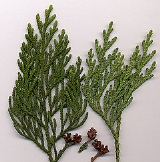
Thuja ( or ) is a genus of coniferous
treeA tree is a perennial woody plant. It is most often defined as a woody plant that has many secondary branches supported clear of the ground on a single main stem or trunk with clear apical dominance. A minimum height specification at maturity is cited by some authors, varying from 3 m to...
s in the
CupressaceaeThe Cupressaceae or cypress family is a conifer family with worldwide distribution. The family includes 27 to 30 genera with about 130-140 species. They are monoecious, subdioecious or dioecious trees and shrubs from 1-116 m tall...
(cypress family). There are five species in the genus, two native to
North AmericaNorth America is the northern continent of the Americas, situated in the Earth's northern hemisphere and in the western hemisphere. It is bordered on the north by the Arctic Ocean, on the east by the North Atlantic Ocean, on the southeast by the Caribbean Sea, and on the west by the North Pacific...
and three native to eastern
AsiaAsia is the world's largest and most populous continent, located in the eastern and northern hemispheres. It covers 8.6% of the earth's total surface area and with approximately 4 billion people, it hosts 60% of the world's current human population.Asia is traditionally defined as part of the...
.
They are commonly known as
arborvitae (from
LatinLatin is an Italic language originally spoken in Latium and Ancient Rome. Through the Roman conquest, Latin spread throughout the Mediterranean and a large part of Europe...
for
tree of life) or
thujas; several species are widely known as
cedar but because they are not true
cedarCedar is a genus of coniferous trees in the plant family Pinaceae. They are most closely related to the Firs , and share a very similar cone structure...
s (
Cedrus) it has been recommended to call them redcedars or whitecedars.
They are
evergreenIn botany, an evergreen plant is a plant having leaves all year round. This contrasts with deciduous plants, which completely lose their foliage for part of the year....
treeA tree is a perennial woody plant. It is most often defined as a woody plant that has many secondary branches supported clear of the ground on a single main stem or trunk with clear apical dominance. A minimum height specification at maturity is cited by some authors, varying from 3 m to...
s growing from eters) tall, with stringy-textured reddish-brown
barkBark is the outermost layers of stems and roots of woody plants. Plants with bark include trees, woody vines and shrubs. Bark refers to all the tissues outside of the vascular cambium and is a nontechnical term. It overlays the wood and consists of the inner bark and the outer bark. The inner...
.
Thuja ( or ) is a genus of coniferous
treeA tree is a perennial woody plant. It is most often defined as a woody plant that has many secondary branches supported clear of the ground on a single main stem or trunk with clear apical dominance. A minimum height specification at maturity is cited by some authors, varying from 3 m to...
s in the
CupressaceaeThe Cupressaceae or cypress family is a conifer family with worldwide distribution. The family includes 27 to 30 genera with about 130-140 species. They are monoecious, subdioecious or dioecious trees and shrubs from 1-116 m tall...
(cypress family). There are five species in the genus, two native to
North AmericaNorth America is the northern continent of the Americas, situated in the Earth's northern hemisphere and in the western hemisphere. It is bordered on the north by the Arctic Ocean, on the east by the North Atlantic Ocean, on the southeast by the Caribbean Sea, and on the west by the North Pacific...
and three native to eastern
AsiaAsia is the world's largest and most populous continent, located in the eastern and northern hemispheres. It covers 8.6% of the earth's total surface area and with approximately 4 billion people, it hosts 60% of the world's current human population.Asia is traditionally defined as part of the...
.
They are commonly known as
arborvitae (from
LatinLatin is an Italic language originally spoken in Latium and Ancient Rome. Through the Roman conquest, Latin spread throughout the Mediterranean and a large part of Europe...
for
tree of life) or
thujas; several species are widely known as
cedar but because they are not true
cedarCedar is a genus of coniferous trees in the plant family Pinaceae. They are most closely related to the Firs , and share a very similar cone structure...
s (
Cedrus) it has been recommended to call them redcedars or whitecedars.
They are
evergreenIn botany, an evergreen plant is a plant having leaves all year round. This contrasts with deciduous plants, which completely lose their foliage for part of the year....
treeA tree is a perennial woody plant. It is most often defined as a woody plant that has many secondary branches supported clear of the ground on a single main stem or trunk with clear apical dominance. A minimum height specification at maturity is cited by some authors, varying from 3 m to...
s growing from eters) tall, with stringy-textured reddish-brown
barkBark is the outermost layers of stems and roots of woody plants. Plants with bark include trees, woody vines and shrubs. Bark refers to all the tissues outside of the vascular cambium and is a nontechnical term. It overlays the wood and consists of the inner bark and the outer bark. The inner...
. The shoots are flat, with side shoots only in a single plane. The leaves are scale-like 1–10 mm long, except young seedlings in their first year, which have needle-like leaves. The scale leaves are arranged in alternating decussate pairs in four rows along the twigs. The male cones are small, inconspicuous, and are located at the tips of the twigs. The female
conesA cone is an organ on plants in the division Pinophyta that contains the reproductive structures. The familiar woody cone is the female cone, which produces seeds. The male cones, which produce pollen, are usually herbaceous and much less conspicuous even at full maturity...
start out similarly inconspicuous, but grow to about 1-2 cm long at maturity when 6–8 months old; they have 6-12 overlapping, thin, leathery scales, each scale bearing 1–2 small
seedA seed , referred to as a kernel in some plants, is a small embryonic plant enclosed in a covering called the seed coat, usually with some stored food. It is the product of the ripened ovule of gymnosperm and angiosperm plants which occurs after fertilization and some growth within the mother plant...
s with a pair of narrow lateral wings.
Species
- Thuja koraiensis
Thuja koraiensis is a species of Thuja, native to Korea and the extreme northeast of China . Its current status is poorly known; the small population in China is protected in the Changbaishan Nature Reserve, as is the small population in Soraksan Nature Reserve in northern South Korea, but most of...
- Korean Thuja
- Thuja occidentalis
Thuja occidentalis is an evergreen coniferous tree, in the cypress family Cupressaceae, which is widely cultivated for use as an ornamental plant. The endemic occurrence of this species is a north-eastern distribution in North America...
- Eastern Arborvitae, Northern Whitecedar
- Thuja plicata
Western red cedar , also Western redcedar, is a species of Thuja, an evergreen coniferous tree in the cypress family Cupressaceae. In the American horticultural trade, it is also known as the Giant Arborvitae, Arborvitae being another name for its genus...
- Western Redcedar
- Thuja standishii
Thuja standishii is a species of thuja, an evergreen coniferous tree in the cypress family Cupressaceae. It is native to southern Japan, where it occurs on the islands of Honshū and Shikoku...
- Japanese Thuja
- Thuja sutchuenensis
Thuja sutchuenensis is a species of thuja, an evergreen coniferous tree in the cypress family Cupressaceae. It is native to China, where it is a critically endangered local endemic in Chongqing Municipality in eastern Sichuan....
- Sichuan Thuja
Description
The five species in the genus
Thuja are small to large evergreen trees with flattened branchlets. The leaves are arranged in flattened fan shaped groupings with resin-glands, and oppositely grouped in 4 ranks. The mature leaves are different from younger leaves, with those on larger branchlets having sharp, erect, free apices. The leaves on flattened lateral branchlets are crowded into appressed groups and scale-like and the lateral pairs are keeled. The solitary flowers are produced terminally. Pollen cones with 2-6 pairs of 2-4 pollen sacked sporophylls. Seed cones ellipsoid, typically 9-14mm long, they mature and open the first year. The thin woody cone scales number from 4-6 pairs and are persistent and overlapping, with an oblong shape, they are also basifixed. The central 2-3 pairs of cone scales are fertile. The seed cones produce 1 to 3 seeds per scale, the seeds are lenticular in shape and equally 2 winged. Seedlings produce 2 cotyledons.
A hybrid between
T. standishi and
T. plicata has been named as the
cultivarA cultivar is a cultivated plant that has been selected and given a unique name because of desired characteristics; it is usually distinct from similar plants and when propagated it retains those characteristics....
Thuja 'Green Giant'.
Another very distinct and only distantly related species, formerly treated as
Thuja orientalis, is now treated in a genus of its own, as
Platycladus orientalisPlatycladus is a distinct genus of evergreen coniferous tree in the cypress family Cupressaceae, containing only one species, Platycladus orientalis, also known as Chinese Arborvitae or Biota...
. The closest relatives of
Thuja are
Thujopsis dolabrataThujopsis is a conifer in the cypress family , the sole member of the genus being Thujopsis dolabrata. It is endemic to Japan, where it is named Asunaro . It is similar to the closely related genus Thuja , differing in the broader, thicker leaves and thick cones...
, distinct in its thicker foliage and stouter cones, and
Tetraclinis articulataTetraclinis is a genus of evergreen coniferous tree in the cypress family Cupressaceae, containing only one species, Tetraclinis articulata, also known as Sandarac or the Barbary thuja, endemic to the western Mediterranean region...
(Greek
θύια, θύα, formerly classed in the genus and after which
Thuja is named), distinct in its quadrangular foliage (not flattened) and cones with four thick, woody scales.
Ecology
Thuja species are used as food plants by the
larvaA larva is a young form of animal with indirect development, going through or undergoing metamorphosis ....
e of some
LepidopteraLepidoptera is an order of insects that includes moths and butterflies. It is one of the most speciose orders in the class Insecta, encompassing moths and the three superfamilies of butterflies, skipper butterflies, and moth-butterflies...
species including
Autumnal MothThe Autumnal Moth is a moth of the family Geometridae. It is found throughout the Palearctic region and the Near East and has a much wider distribution than its two close relatives...
,
The EngrailedThe Engrailed is a moth of the family Geometridae. Some authors split this moth into two species: E. bistortata The Engrailed and E. crepuscularia Small Engrailed. It is distributed across most of Europe....
and
Juniper PugThe Juniper Pug is a moth of the family Geometridae. It is found throughout the Palearctic and Nearctic regions and the Near East.The forewings are greyish brown with two distinctive black bands. The wingspan is 17-21 mm...
. The foliage is also readily eaten by
deerDeer are the ruminant mammals forming the family Cervidae. They include for example Moose, Red Deer, Reindeer, Roe and Chital. Animals from related families within the order Artiodactyla are often also considered to be deer – these include muntjac and water deer...
, and where deer population density is high, can adversely affect the growth of young trees and the establishment of seedlings.
Uses
They are widely grown as ornamental trees, and extensively used for hedges. A number of cultivars are grown and used in landscapes. Usually, homeowners will plant them as privacy trees between them and their neighbors. The cultivar 'Green Giant' is popular as a very vigorous hedging plant, growing up to 80 cm/year when young.
The
woodWood is an organic material; in the strict sense wood is produced as secondary xylem in the stems of trees . In a living tree it transfers water and nutrients to the leaves and other growing tissues, and has a support function, enabling woody plants to reach large sizes or to stand up for themselves...
is light, soft and aromatic. It can be easily split and resists decay. The wood has been used for many applications from making chests that repel moths to shingles. Thuja poles are also often used to make fence posts and rails. The wood of
Thuja plicata is commonly used for
guitarThe guitar is a musical instrument with ancient roots that adapts readily to a wide variety of musical styles. It typically has six strings, but four-, seven-, eight-, ten-, eleven-, twelve-, thirteen- and eighteen-string guitars also exist. The size and shape of the neck and the base of the guitar...
sounding boards.
Oil of thuja contains the
terpeneTerpenes are a large and varied class of hydrocarbons, produced primarily by a wide variety of plants, particularly conifers, though also by some insects such as termites or swallowtail butterflies, which emit terpenes from their osmeterium....
thujoneThujone is a ketone and a monoterpene that exists in two stereoisomeric forms: -3-thujone or α-thujone and -3-thujone or β-thujone. It has a menthol odor. Even though it is best known for being a chemical in absinthe, recent tests show absinthe contains only small quantities of thujone, and may or...
which has been studied for its
GABAGabâ or gabaa, for the Cebuano people , is the concept of a non-human and non-divine, imminent retribution. A sort of negative karma, it is generally seen as an evil effect on a person because of their wrongdoings or transgressions...
receptor antagonistic, with potentially lethal properties.
The natives of Canada used the needles of the Thuja occidentalis (Eastern White Cedar) to make a tea that has been shown to contain 50 mg of vitamin C per 100 grams. This helped fight off
scurvyScurvy is a disease resulting from a deficiency of vitamin C, which is required for the synthesis of collagen in humans. The chemical name for vitamin C, ascorbic acid, is derived from the Latin name of scurvy, scorbutus. Scurvy leads to the formation of spots on the skin, spongy gums, and bleeding...
.