


Taylor's theorem

Encyclopedia
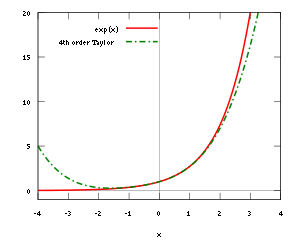
In calculus
Calculus
Calculus is a branch of mathematics focused on limits, functions, derivatives, integrals, and infinite series. This subject constitutes a major part of modern mathematics education. It has two major branches, differential calculus and integral calculus, which are related by the fundamental theorem...
, Taylor's theorem gives an approximation of a k times differentiable function
Function (mathematics)
In mathematics, a function associates one quantity, the argument of the function, also known as the input, with another quantity, the value of the function, also known as the output. A function assigns exactly one output to each input. The argument and the value may be real numbers, but they can...
around a given point by a k-th order Taylor-polynomial
Polynomial
In mathematics, a polynomial is an expression of finite length constructed from variables and constants, using only the operations of addition, subtraction, multiplication, and non-negative integer exponents...
. For analytic functions the Taylor polynomials at a given point are finite order truncations of its Taylor's series, which completely determines the function in some neighborhood of the point. The exact content of "Taylor's theorem" is not universally agreed upon. Indeed, there are several versions of it applicable in different situations, and some of them contain explicit estimates on the approximation error of the function by its Taylor-polynomial.
Taylor's theorem is named after the mathematician Brook Taylor
Brook Taylor
Brook Taylor FRS was an English mathematician who is best known for Taylor's theorem and the Taylor series.- Life and work :...
, who stated a version of it in 1712. Yet, an explicit expression of the error was provided much later on by Joseph-Louis Lagrange. An earlier version of the result is already mentioned in 1671 by James Gregory
James Gregory (astronomer and mathematician)
James Gregory FRS was a Scottish mathematician and astronomer. He described an early practical design for the reflecting telescope – the Gregorian telescope – and made advances in trigonometry, discovering infinite series representations for several trigonometric functions.- Biography :The...
.
Taylor's theorem is taught on introductory level calculus courses and it is one of the central elementary tools in mathematical analysis
Mathematical analysis
Mathematical analysis, which mathematicians refer to simply as analysis, has its beginnings in the rigorous formulation of infinitesimal calculus. It is a branch of pure mathematics that includes the theories of differentiation, integration and measure, limits, infinite series, and analytic functions...
. Within pure mathematics it is the starting point of more advanced asymptotic analysis
Asymptotic analysis
In mathematical analysis, asymptotic analysis is a method of describing limiting behavior. The methodology has applications across science. Examples are...
, and it is commonly used in more applied fields of numerics as well as in mathematical physics
Mathematical physics
Mathematical physics refers to development of mathematical methods for application to problems in physics. The Journal of Mathematical Physics defines this area as: "the application of mathematics to problems in physics and the development of mathematical methods suitable for such applications and...
. Taylor's theorem also generalizes to multivariate and vector valued functions on any dimension
Dimension
In physics and mathematics, the dimension of a space or object is informally defined as the minimum number of coordinates needed to specify any point within it. Thus a line has a dimension of one because only one coordinate is needed to specify a point on it...
s n and m. This generalization of Taylor's theorem is the basis for the definition of so-called jets
Jet (mathematics)
In mathematics, the jet is an operation which takes a differentiable function f and produces a polynomial, the truncated Taylor polynomial of f, at each point of its domain...
which appear in differential geometry and partial differential equations.
Motivation
If a real-valued functionFunction (mathematics)
In mathematics, a function associates one quantity, the argument of the function, also known as the input, with another quantity, the value of the function, also known as the output. A function assigns exactly one output to each input. The argument and the value may be real numbers, but they can...
f is differentiable
Derivative
In calculus, a branch of mathematics, the derivative is a measure of how a function changes as its input changes. Loosely speaking, a derivative can be thought of as how much one quantity is changing in response to changes in some other quantity; for example, the derivative of the position of a...
at the point a then it has a linear approximation
Linear approximation
In mathematics, a linear approximation is an approximation of a general function using a linear function . They are widely used in the method of finite differences to produce first order methods for solving or approximating solutions to equations.-Definition:Given a twice continuously...
at the point a. This means that there exists a function h1 such that

Here

is the linear approximation of f at the point a. The graph of is the tangent line to the graph of f at . The error in the approximation is

Note that this goes to zero a little bit faster than as x tends to a.
If we wanted a better approximation to f, we might instead try a quadratic polynomial
Quadratic polynomial
In mathematics, a quadratic polynomial or quadratic is a polynomial of degree two, also called second-order polynomial. That means the exponents of the polynomial's variables are no larger than 2...
instead of a linear function. Instead of just matching one derivative of f at a, we can match two derivatives, thus producing a polynomial that has the same slope and concavity as f at a. The quadratic polynomial in question is

Taylor's theorem ensures that the quadratic approximation is, in a sufficiently small neighborhood of the point a, a better approximation than the linear approximation. Specifically,

Here the error in the approximation is

which, given the limiting behavior of h2, goes to zero faster than as x tends to a.
Similarly, we get still better approximations to f if we use polynomial
Polynomial
In mathematics, a polynomial is an expression of finite length constructed from variables and constants, using only the operations of addition, subtraction, multiplication, and non-negative integer exponents...
s of higher degree, since then we can match even more derivatives with f at the selected base point. In general, the error in approximating a function by a polynomial of degree k will go to zero a little bit faster than as x tends to a.
This result is of asymptotic nature: it only tells us that the error Rk in an approximation
Approximation
An approximation is a representation of something that is not exact, but still close enough to be useful. Although approximation is most often applied to numbers, it is also frequently applied to such things as mathematical functions, shapes, and physical laws.Approximations may be used because...
by a k-th order Taylor polynomial Pk tends to zero faster than any nonzero k-th degree polynomial
Polynomial
In mathematics, a polynomial is an expression of finite length constructed from variables and constants, using only the operations of addition, subtraction, multiplication, and non-negative integer exponents...
as x → a. It does not tell us how large the error is in any concrete neighborhood of the center of expansion, but for this purpose there are explicit formulae for the remainder term (given below) which are valid under some additional regularity assumptions on f. These enhanced versions of Taylor's theorem typically lead to uniform estimates for the approximation error in a small neighborhood of the center of expansion, but the estimates do not necessarily hold for neighborhoods which are too large, even if the function f is analytic
Analytic function
In mathematics, an analytic function is a function that is locally given by a convergent power series. There exist both real analytic functions and complex analytic functions, categories that are similar in some ways, but different in others...
. In that situation one may have to select several Taylor polynomials with different centers of expansion to have reliable Taylor-approximations of the original function (see animation on the right.)
It is also possible that increasing the degree of the approximating polynomial
Polynomial
In mathematics, a polynomial is an expression of finite length constructed from variables and constants, using only the operations of addition, subtraction, multiplication, and non-negative integer exponents...
does not increase the quality of approximation at all even if the function f to be approximated is infinitely many times differentiable. An example of this behavior is given below, and it is related to the fact that unlike analytic functions, more general functions are not (locally) determined by the values of their derivatives at a single point.
Statement of the theorem
The precise statement of the most basic version of Taylor's theorem is as follows.The polynomial appearing in Taylor's theorem is the k-th order Taylor polynomial

of the function f at the point a. The Taylor polynomial is the unique "asymptotic best fit" polynomial in the sense that if there exists a function and a k-th order polynomial p such that

then p = Pk. Taylor's theorem describes the asymptotic behavior of the remainder term

which is the approximation error
Approximation error
The approximation error in some data is the discrepancy between an exact value and some approximation to it. An approximation error can occur because#the measurement of the data is not precise due to the instruments...
when approximating f with its Taylor polynomial. Using the little-o notation the statement in Taylor's theorem reads as

Explicit formulae for the remainder
Under stronger regularity assumptions on f there are several precise formulae for the remainder term Rk of the Taylor polynomial, the most common ones being the following.These refinements of Taylor's theorem are usually proved using the mean value theorem
Mean value theorem
In calculus, the mean value theorem states, roughly, that given an arc of a differentiable curve, there is at least one point on that arc at which the derivative of the curve is equal to the "average" derivative of the arc. Briefly, a suitable infinitesimal element of the arc is parallel to the...
, whence the name. Also other similar expressions can be found. For example, if G(t) is continuous on the closed interval and differentiable with a non-vanishing derivative on the open interval between a and x, then

for some number ξ between a and x. This version covers the Lagrange and Cauchy forms of the remainder as special cases, and is proved below using Cauchy's mean value theorem.
The statement for the integral form of the remainder is more advanced than the previous ones, and requires understanding of Lebesgue integration theory for the full generality. However, it holds also in the sense of Riemann integral
Riemann integral
In the branch of mathematics known as real analysis, the Riemann integral, created by Bernhard Riemann, was the first rigorous definition of the integral of a function on an interval. The Riemann integral is unsuitable for many theoretical purposes...
provided the (k+1)-st derivative of f is continuous on the closed interval [a,x].
Due to absolute continuity of f(k) on the closed interval between a and x its derivative f(k+1) exists as an L1-function, and the result can be proven by a formal calculation using fundamental theorem of calculus
Fundamental theorem of calculus
The first part of the theorem, sometimes called the first fundamental theorem of calculus, shows that an indefinite integration can be reversed by a differentiation...
and integration by parts
Integration by parts
In calculus, and more generally in mathematical analysis, integration by parts is a rule that transforms the integral of products of functions into other integrals...
.
Estimates for the remainder
It is often useful in practice to be able to estimate the remainder term appearing in the Taylor approximation, rather than having a specific form of it. Suppose that f is (k+1)-times continuously differentiable in an interval I containing a. Suppose that there are real constants q and Q such that
throughout I. Then the remainder term satisfies the inequality

if , and a similar estimate if . This is a simple consequence of the Lagrange form of the remainder. In particular, if

on an interval with some r>0, then

for all The second inequality is called a uniform estimate, because it holds uniformly for all x on the interval
Example
Suppose that we wish to approximateApproximation
An approximation is a representation of something that is not exact, but still close enough to be useful. Although approximation is most often applied to numbers, it is also frequently applied to such things as mathematical functions, shapes, and physical laws.Approximations may be used because...
the function on the interval while ensuring that the error in the approximation is no more than 10−5. In this example we pretend that we only know the following properties of the exponential function:

From these properties it follows that for all k, and in particular, . Hence the k-th order Taylor polynomial of f at 0 and its remainder term in the Lagrange form are given by

where ξ is some number between 0 and x. Since ex is increasing by (*), we can simply use ex ≤ 1 for x ∈ [−1, 0] to estimate the remainder on the subinterval [−1, 0]. To obtain an upper bound for the remainder on [0,1], we use the property for 0<ξ

using the second order Taylor expansion. Then we solve for ex to deduce that

simply by maximizing the numerator and minimizing the denominator. Combining these estimates for ex we see that

so the required precision is certainly reached, when

(See factorial
Factorial
In mathematics, the factorial of a non-negative integer n, denoted by n!, is the product of all positive integers less than or equal to n...
or compute by hand the values 9!=362 880 and 10!=3 628 800.) As a conclusion, Taylor's theorem leads to the approximation

For instance, this approximation provides a decimal expression e≈2.71828, correct up to five decimal places.
Taylor expansions of real analytic functions
Let I⊂R be an open interval. By definition, a function f:I→R is real analyticAnalytic function
In mathematics, an analytic function is a function that is locally given by a convergent power series. There exist both real analytic functions and complex analytic functions, categories that are similar in some ways, but different in others...
if it is locally defined by a convergent power series. This means that for every a ∈ I there exists some r > 0 and a sequence of coefficients ck ∈ R such that and

In general, the radius of convergence of a power series can be computed from the Cauchy–Hadamard formula
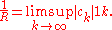
This result is based on comparison with a geometric series, and the same method shows that if the power series based on a converges for some b∈R, it must converge uniformly on the closed interval , where rb = |b − a|. Here only the convergence of the power series is considered, and it might well be that extends beyond the domain I of f.
The Taylor polynomials of the real analytic function f at a are simply the finite truncations

of its locally defining power series, and the corresponding remainder terms are locally given by the analytic functions

Here the functions

are also analytic, since their defining power series have the same radius of convergence as the original series.
Assuming that ⊂ I and r < R, all these series converge uniformly on . Naturally, in the case of analytic functions one can estimate the remainder term Rk(x) by the tail of the sequence of the derivatives f′(a) at the center of the expansion, but using complex analysis
Complex analysis
Complex analysis, traditionally known as the theory of functions of a complex variable, is the branch of mathematical analysis that investigates functions of complex numbers. It is useful in many branches of mathematics, including number theory and applied mathematics; as well as in physics,...
also another possibility arises, which is described below.
Taylor's theorem and convergence of Taylor series
There is a source of confusion on the relationship between Taylor polynomials of smooth functions and the Taylor seriesTaylor series
In mathematics, a Taylor series is a representation of a function as an infinite sum of terms that are calculated from the values of the function's derivatives at a single point....
of analytic function
Analytic function
In mathematics, an analytic function is a function that is locally given by a convergent power series. There exist both real analytic functions and complex analytic functions, categories that are similar in some ways, but different in others...
s. One can (rightfully) see the Taylor series

of an infinitely many times differentiable function f:R→R as its "infinite order Taylor polynomial" at a. Now the estimates for the remainder of a Taylor polynomial implies that for any order k and for any r>0 there exists a constant such that

for every x∈(a-r,a+r). Sometimes these constants can be chosen in such way that when and stays fixed. Then the Taylor series of f converges uniformly to some analytic function

Here comes the subtle point. It may well be that an infinitely many times differentiable function f has a Taylor series at a which converges on some open neighborhood of a, but the limit function Tf is different from f. An important example of this phenomenon is provided by

Using the chain rule
Chain rule
In calculus, the chain rule is a formula for computing the derivative of the composition of two or more functions. That is, if f is a function and g is a function, then the chain rule expresses the derivative of the composite function in terms of the derivatives of f and g.In integration, the...
one can show inductively
Mathematical induction
Mathematical induction is a method of mathematical proof typically used to establish that a given statement is true of all natural numbers...
that for any order k,
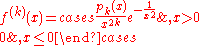
for some polynomial pk. The function
 tends to zero faster than any polynomial as , so f is infinitely many times differentiable and for every positive integer k. Now the estimates for the remainder for the Taylor polynomials show that the Taylor series of f converges uniformly to the zero function on the whole real axis. Nothing is wrong in here:
- The Taylor series of f converges uniformly to the zero function Tf(x)=0.
- The zero function is analytic and every coefficient in its Taylor series is zero.
- The function f is infinitely many times differentiable, but not analytic.
- For any k∈N and r>0 there exists Mk,r>0 such that the remainder term for the k-th order Taylor polynomial of f satisfies (*).
Taylor's theorem in complex analysis
Taylor's theorem generalizes to functions which are complex differentiable in an open subset U ⊂ C of the complex plane
Complex plane
In mathematics, the complex plane or z-plane is a geometric representation of the complex numbers established by the real axis and the orthogonal imaginary axis...
. However, its usefulness is diminished by other general theorems in complex analysis
Complex analysis
Complex analysis, traditionally known as the theory of functions of a complex variable, is the branch of mathematical analysis that investigates functions of complex numbers. It is useful in many branches of mathematics, including number theory and applied mathematics; as well as in physics,...
. Namely, stronger versions of related results can be deduced for complex differentiable functions f : U → C using Cauchy's integral formula
Cauchy's integral formula
In mathematics, Cauchy's integral formula, named after Augustin-Louis Cauchy, is a central statement in complex analysis. It expresses the fact that a holomorphic function defined on a disk is completely determined by its values on the boundary of the disk, and it provides integral formulas for all...
as follows.
Let r > 0 such that the closed disk B(z, r) ∪ S(z, r) is contained in U. Then Cauchy's integral formula with a positive parametrization of the circle S(z,r) with gives

Here all the integrands are continuous on the circle
Circle
A circle is a simple shape of Euclidean geometry consisting of those points in a plane that are a given distance from a given point, the centre. The distance between any of the points and the centre is called the radius....
S(z, r), which justifies differentiation under the integral sign. In particular, if f is once complex differentiable on the open set U, then it is actually infinitely many times complex differentiable on U. One also obtains the Cauchy's estimates

for any z ∈ U and r > 0 such that B(z, r) ∪ S(c, r) ⊂ U. These estimates imply that the complex
Complex number
A complex number is a number consisting of a real part and an imaginary part. Complex numbers extend the idea of the one-dimensional number line to the two-dimensional complex plane by using the number line for the real part and adding a vertical axis to plot the imaginary part...
Taylor series
Taylor series
In mathematics, a Taylor series is a representation of a function as an infinite sum of terms that are calculated from the values of the function's derivatives at a single point....
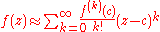
of f converges uniformly on any open disk B(c, r) ⊂ U with S(c, r) ⊂ U into some function Tf. Furthermore, using the contour integral formulae for the derivatives f(k)(c),

so any complex differentiable function f in an open set U ⊂ C is in fact complex analytic. All that is said for real analytic functions here holds also for complex analytic functions with the open interval I replaced by an open subset U ∈ C and a-centered intervals (a − r, a + r) replaced by c-centered disks B(c, r). In particular, the Taylor expansion holds in the form

where the remainder term Rk is complex analytic. Methods of complex analysis provide some powerful results regarding Taylor expansions. For example, using Cauchy's integral formula for any positively oriented Jordan curve γ which parametrizes the boundary ∂W ⊂ U of a region W ⊂ U, one obtains expressions for the derivatives as above, and modifying slightly the computation for , one arrives at the exact formula

The important feature here is that the quality of the approximation by a Taylor polynomial on the region W ⊂ U is dominated by the values of the function f itself on the boundary ∂W ⊂ U. Similarly, applying Cauchy's estimates to the series expression for the remainder, one obtains the uniform estimates

Example
The function f:R→R defined by
is real analytic
Analytic function
In mathematics, an analytic function is a function that is locally given by a convergent power series. There exist both real analytic functions and complex analytic functions, categories that are similar in some ways, but different in others...
, that is, locally determined by its Taylor series. This function was plotted above to illustrate the fact that some very concretely defined and nice functions cannot be approximated by Taylor polynomials in neighborhoods of the center of expansion which are too large. This kind of behavior is easily understood in the framework of complex analysis. Namely, the function f extends into a meromorphic function
Meromorphic function
In complex analysis, a meromorphic function on an open subset D of the complex plane is a function that is holomorphic on all D except a set of isolated points, which are poles for the function...

on the compactified complex plane. It has simple poles at z=i and z=−i, and it is analytic elsewhere. Now its Taylor series centered at z0 coverges on any disc B(z0,r) with r<|z-z0|, where the same Taylor series converges at z∈C. Therefore Taylor series of f centered at 0 converges on B(0,1) and it does not converge for any z∈C with |z|>1 due to the poles at i and −i. For the same reason the Taylor series of f centered at 1 converges on B(1,√2) and does not converge for any z∈C with |z-1|>√2.
Higher order differentiability
A function f:Rn → R is differentiableDerivative
In calculus, a branch of mathematics, the derivative is a measure of how a function changes as its input changes. Loosely speaking, a derivative can be thought of as how much one quantity is changing in response to changes in some other quantity; for example, the derivative of the position of a...
at a ∈ Rn if and only if
If and only if
In logic and related fields such as mathematics and philosophy, if and only if is a biconditional logical connective between statements....
there exists a linear functional
Linear functional
In linear algebra, a linear functional or linear form is a linear map from a vector space to its field of scalars. In Rn, if vectors are represented as column vectors, then linear functionals are represented as row vectors, and their action on vectors is given by the dot product, or the...
L : Rn → R and a function h : Rn → R such that

If this is the case, then L = df(a) is the (uniquely defined) differential
Differential of a function
In calculus, the differential represents the principal part of the change in a function y = ƒ with respect to changes in the independent variable. The differential dy is defined bydy = f'\,dx,...
of f at the point a. Furthermore, then the partial derivatives of f exist at a and the differential of f at a is given by

Introduce the multi-index notation
Multi-index notation
The mathematical notation of multi-indices simplifies formulae used in multivariable calculus, partial differential equations and the theory of distributions, by generalising the concept of an integer index to an ordered tuple of indices....

for α ∈ Nn and x ∈ Rn. If all the k-th order partial derivatives of are continuous at , then by Clairaut's theorem
Symmetry of second derivatives
In mathematics, the symmetry of second derivatives refers to the possibility of interchanging the order of taking partial derivatives of a functionfof n variables...
, one can change the order of mixed derivatives at a, so the notation
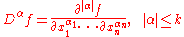
for the higher order partial derivatives is justified in this situation. The same is true if all the (k − 1)-th order partial derivatives of f exist in some neighborhood of a and are differentiable at a. Then we say that f is k times differentiable at the point a .
Taylor's theorem for multivariate functions
If the function is k+1 times continuously differentiable in the closed ball B, then one can derive an exact formula for the remainder in terms of order partial derivatives of f in this neighborhood. Namely,
In this case, due to the continuity
Continuous function
In mathematics, a continuous function is a function for which, intuitively, "small" changes in the input result in "small" changes in the output. Otherwise, a function is said to be "discontinuous". A continuous function with a continuous inverse function is called "bicontinuous".Continuity of...
of (k+1)-th order partial derivative
Partial derivative
In mathematics, a partial derivative of a function of several variables is its derivative with respect to one of those variables, with the others held constant...
s in the compact set B, one immediately obtains the uniform estimates

Proof for Taylor's theorem in one real variable
Let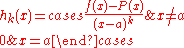
where, as in the statement of Taylor's theorem,

It is sufficient to show that

The proof here is based on repeated application of L'Hôpital's rule
L'Hôpital's rule
In calculus, l'Hôpital's rule uses derivatives to help evaluate limits involving indeterminate forms. Application of the rule often converts an indeterminate form to a determinate form, allowing easy evaluation of the limit...
. Note that, for each ,
 . Hence each of the first k−1 derivatives of the numerator in
  vanishes at
  , and the same is true of the denominator. So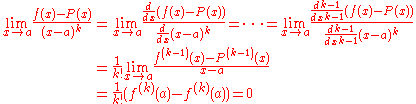
where the second to last equality follows by the definition of the derivative at x = a.
Derivation for the mean value forms of the remainder
Let G be any real-valued function, continuous on the closed interval between a and x and differentiable with a non-vanishing derivative on the open interval between a and x, and define
Then, by Cauchy's mean value theorem,
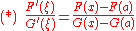
for some ξ on the open interval between a and x. Note that here the numerator is exactly the remainder of the Taylor polynomial for f(x). Compute

plug it into (*) and rearrange terms to find that

This is the form of the remainder term mentioned after the actual statement of Taylor's theorem with remainder in the mean value form.
The Lagrange form of the remainder is found by choosing
 and the Cauchy form by choosing
  .
.Remark. Using this method one can also recover the integral form of the remainder by choosing

but the requirements for f needed for the use of mean value theorem are too strong, if one aims to prove the claim in the case that f(k) is only absolutely continuous. However, if one uses Riemann integral
Riemann integral
In the branch of mathematics known as real analysis, the Riemann integral, created by Bernhard Riemann, was the first rigorous definition of the integral of a function on an interval. The Riemann integral is unsuitable for many theoretical purposes...
instead of Lebesgue integral, the assumptions cannot be weakened.
Derivation for the integral form of the remainder
Due to absolute continuity of f(k) on the closed interval between a and x its derivative f(k+1) exists as an L1-function, and we can use fundamental theorem of calculusFundamental theorem of calculus
The first part of the theorem, sometimes called the first fundamental theorem of calculus, shows that an indefinite integration can be reversed by a differentiation...
and integration by parts
Integration by parts
In calculus, and more generally in mathematical analysis, integration by parts is a rule that transforms the integral of products of functions into other integrals...
. This same proof applies for the Riemann integral
Riemann integral
In the branch of mathematics known as real analysis, the Riemann integral, created by Bernhard Riemann, was the first rigorous definition of the integral of a function on an interval. The Riemann integral is unsuitable for many theoretical purposes...
assuming that f(k) is continuous
Continuous function
In mathematics, a continuous function is a function for which, intuitively, "small" changes in the input result in "small" changes in the output. Otherwise, a function is said to be "discontinuous". A continuous function with a continuous inverse function is called "bicontinuous".Continuity of...
on the closed interval and differentiable on the open interval between a and x, and this leads to the same result than using the mean value theorem.
The fundamental theorem of calculus
Fundamental theorem of calculus
The first part of the theorem, sometimes called the first fundamental theorem of calculus, shows that an indefinite integration can be reversed by a differentiation...
states that

Now we can integrate by parts
Integration by parts
In calculus, and more generally in mathematical analysis, integration by parts is a rule that transforms the integral of products of functions into other integrals...
and use the fundamental theorem of calculus again to see that
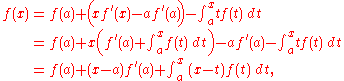
which is exactly Taylor's theorem with remainder in the integral form in the case k=1.
The general statement is proved using induction
Mathematical induction
Mathematical induction is a method of mathematical proof typically used to establish that a given statement is true of all natural numbers...
. Suppose that

Integrating the remainder term by parts we arrive at

Substituting this into the formula shows that if it holds for the value k, it must also hold for the value k + 1.
Therefore, since it holds for k = 1, it must hold for every positive integer k.
Derivation for the remainder of multivariate Taylor polynomials
We prove the special case, where f : Rn → R has continuous partial derivatives up to the order k+1 in some closed ball B with center a. The strategy of the proof is to apply the one-variable case of Taylor's theorem to the restriction of f to the line segment adjoining x and a. Parametrize the line segment between a and x by u(t) = We apply the one-variable version of Taylor's theorem to the function :
Applying the chain rule
Chain rule
In calculus, the chain rule is a formula for computing the derivative of the composition of two or more functions. That is, if f is a function and g is a function, then the chain rule expresses the derivative of the composite function in terms of the derivatives of f and g.In integration, the...
for several variables gives

where
 is the multinomial coefficient. Since
  , we get
External links
- Proofs for a few forms of the remainder in one-variable case at ProofWiki
- Taylor Series Approximation to Cosine at cut-the-knotCut-the-knotCut-the-knot is a free, advertisement-funded educational website maintained by Alexander Bogomolny and devoted to popular exposition of many topics in mathematics. The site has won more than 20 awards from scientific and educational publications, including a Scientific American Web Award in 2003,...
- Trigonometric Taylor Expansion interactive demonstrative applet
- Taylor Series Revisited at Holistic Numerical Methods Institute