
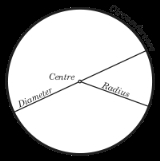
A
circle is a simple
shapeThe shape of an object located in some space is the part of that space occupied by the object, as determined by its external boundary – abstracting from other properties such as colour, content, and material composition, as well as from the object's other spatial properties The shape (from...
of
Euclidean geometryEuclidean geometry is a mathematical system attributed to the Greek mathematician Euclid of Alexandria. Euclid's Elements is the earliest known systematic discussion of geometry. It has been one of the most influential books in history, as much for its method as for its mathematical content...
consisting of those
pointsIn geometry, topology and related branches of mathematics a spatial point describes a specific object within a given space that consists of neither volume, area, length, nor any other higher dimensional analogue. Thus, a point is a 0-dimensional object...
in a
planeIn mathematics, a plane is a flat surface. Planes can arise as subspaces of some higher dimensional space, as with the walls of a room, or they may enjoy an independent existence in their own right, as in the setting of Euclidean geometry....
which are equidistant from a given point called the
centreIn geometry, the centre of an object is a point in some sense in the middle of the object. If geometry is regarded as the study of isometry groups then the centre is a fixed point of the isometries.-Circles:...
. The common distance of the points of a circle from its center is called its
radiusIn classical geometry, a radius of a circle or sphere is any line segment from its center to its perimeter. By extension, the radius of a circle or sphere is the length of any such segment, which is half the diameter....
.
Circles are simple closed
curveIn mathematics, a curve consists of the points through which a continuously moving point passes. This notion captures the intuitive idea of a geometrical one-dimensional object, which furthermore is connected in the sense of having no discontinuities or gaps. Simple examples include the sine wave...
s which divide the
planeIn mathematics, a plane is a flat surface. Planes can arise as subspaces of some higher dimensional space, as with the walls of a room, or they may enjoy an independent existence in their own right, as in the setting of Euclidean geometry....
into two regions, an
interiorIn mathematics, the interior of a set S consists of all points of S that are intuitively "not on the edge of S". A point that is in the interior of S is an interior point of S....
and an exterior. In everyday use, the term "circle" may be used interchangeably to refer to either the boundary of the figure (known as the
perimeterA perimeter is a path that surrounds an area. The word comes from the Greek peri and meter . The term may be used either for the path or its length - it can be thought of as the length of the outline of a shape. The perimeter of a circular area is called circumference.- Practical uses :Calculating...
) or to the whole figure including its interior. However, in strict technical usage, "circle" refers to the perimeter while the interior of the circle is called a
diskIn geometry, a disk is the region in a plane bounded by a circle.A disk is said to be closed or open according to whether or not it contains the circle that constitutes its boundary...
. The
circumferenceThe circumference is the distance around a closed curve. Circumference is a special perimeter.-Circumference of a circle:The circumference of a circle is the length around it....
of a circle is the perimeter of the circle (especially when referring to its length).
A circle is a special
ellipseIn mathematics, an ellipse is the bounded case of a conic section, the geometric shape that results from cutting a circular conical or cylindrical surface with an oblique plane...
in which the two
fociIn geometry, the foci, , are a pair of special points used in describing conic sections. The four types of conic sections are the circle, ellipse, parabola, and hyperbola....
are coincident. Circles are
conic sectionIn mathematics, a conic section is a curve obtained by intersecting a cone with a plane. In analytic geometry, a conic may be defined as a plane algebraic curve of degree 2...
s attained when a
right circular coneIn geometry, a conical surface is the unbounded surface formed by the union of all the straight lines that pass through a fixed point — the apex or vertex — and any point of some fixed space curve — the directrix — that does not contain the apex...
is intersected with a plane perpendicular to the axis of the cone.
Further terminology
The
diameterIn geometry, a diameter of a circle is any straight line segment that passes through the center of the circle and whose endpoints are on the circle. The diameters are the longest chords of the circle...
of a circle is the length of a line segment whose
endpointAn endpoint or end point is a mark of termination or completion.* Endpoint , the conclusion of a chemical reaction, particularly for titration* Endpoint , a hardcore punk band from Louisville, Kentucky...
s lie on the circle and which passes through the centre of the circle. This is the largest distance between any two points on the circle. The diameter of a circle is twice its radius.
The term " radius" can also refer to a line segment from the centre of a circle to its perimeter, and similarly the term "diameter" can refer to a line segment between two points on the perimeter which passes through the centre. In this sense, the midpoint of a diameter is the centre and so it is composed of two radii.
A
chordA chord of a curve is a geometric line segment whose endpoints both lie on the curve.A secant or a secant line is the line extension of a chord.- Chords of a circle :Among properties of chords of a circle are the following:...
of a circle is a line segment whose two endpoints lie on the circle. The diameter, passing through the circle's centre, is the largest chord in a circle. A
tangentIn geometry, the tangent line to a curve at a given point is the straight line that "just touches" the curve at that point...
to a circle is a straight line that touches the circle at a single point. A
secantA secant line of a curve is a line that sometimes intersects two points on the curve. The word secant comes from the Latin secare, to cut.It can be used to approximate the tangent to a curve, at some point f...
is an extended chord: a straight line cutting the circle at two points.
An
arcIn geometry, an arc is a closed segment of a differentiable curve in the two-dimensional plane; for example, a circular arc is a segment of the circumference of a circle...
of a circle is any
connectedIn topology and related branches of mathematics, a connected space is a topological space which cannot be represented as the union of two or more disjoint nonempty open subsets. Connectedness is one of the principal topological properties that is used to distinguish topological spaces...
part of the circle's circumference. A
sectorA circular sector or circle sector, is the portion of a circle enclosed by two radii and an arc, where the smaller area is known as the minor sector and the larger being the major sector. Its area can be calculated as described below....
is a region bounded by two radii and an arc lying between the radii, and a
segmentIn geometry, a circular segment is an area of a circle informally defined as an area which is "cut off" from the rest of the circle by a secant or a chord...
is a region bounded by a chord and an arc lying between the chord's endpoints.
History
The circle has been known since before the beginning of recorded history. It is the basis for the
wheelA wheel is a circular device that is capable of rotating on its axis, facilitating movement or transportation whilst supporting a load , or performing labour in machines. Common examples are found in transport applications. A wheel, together with an axle overcomes friction by facilitating motion by...
, which, with related inventions such as
gearA gear is a component within a transmission device that transmits rotational torque by applying a force to the teeth of another gear or device. A gear is different from a pulley in that a gear is a round wheel that has linkages that mesh with other gear teeth, allowing force to be fully...
s, makes much of modern civilization possible. In mathematics, the study of the circle has helped inspire the development of geometry and calculus.
Early
scienceScience is in its broadest sense to any systematic knowledge-base or prescriptive practice that is capable of resulting in a prediction or predictable type of outcome...
, particularly
geometryGeometry arose as the field of knowledge dealing with spatial relationships. Geometry was one of the two fields of pre-modern mathematics, the other being the study of numbers....
and
Astrology and astronomyAstrology and astronomy were archaically one and the same discipline , and were only gradually recognized as separate in western 17th century philosophy ....
, was connected to the divine for most
medieval scholarsIn the Middle Ages, science progressed dramatically from the time of antiquity in areas as diverse as astronomy, medicine, and mathematics. Whereas the ancient cultures of the world In the Middle Ages, science progressed dramatically from the time of antiquity in areas as diverse as astronomy,...
, and many believed that there was something intrinsically "divine" or "perfect" that could be found in circles.
Some highlights in the history of the circle are:
- 1700 BC – The Rhind papyrus gives a method to find the area of a circular field. The result corresponds to 256/81 as an approximate value of .
- 300 BC – Book 3 of Euclid's Elements
Euclid's Elements is a mathematical and geometric treatise consisting of 13 books written by the Greek mathematician Euclid in Alexandria circa 300 BC. It comprises a collection of definitions, postulates , propositions , and mathematical proofs of the propositions...
deals with the properties of circles.
- 1880 – Lindemann
Carl Louis Ferdinand von Lindemann was a German mathematician, noted for his proof, published in 1882, that π is a transcendental number, i.e., it is not a zero of any polynomial with rational coefficients....
proves that is transcendental, effectively settling the millennia-old problem of squaring the circleSquaring the circle is a problem proposed by ancient geometers. It is the challenge of constructing a square with the same area as a given circle by using only a finite number of steps with compass and straightedge...
.
Length of circumference
The ratio of a circle's
circumferenceThe circumference is the distance around a closed curve. Circumference is a special perimeter.-Circumference of a circle:The circumference of a circle is the length around it....
to its
diameterIn geometry, a diameter of a circle is any straight line segment that passes through the center of the circle and whose endpoints are on the circle. The diameters are the longest chords of the circle...
is
πPi or π is a mathematical constant whose value is the ratio of any circle's circumference to its diameter in Euclidean space; this is the same value as the ratio of a circle's area to the square of its radius. The symbol π was first proposed by the Welsh mathematician William Jones in 1706...
(pi), a
constantA mathematical constant is a number, usually a real number, that arises naturally in mathematics. Unlike physical constants, mathematical constants are defined independently of physical measurement....
that takes the same value (approximately 3.1416) for all circles. Thus the length of the circumference (
c) is related to the radius (
r) by
or equivalently to the diameter (
d) by
Area enclosed
The area enclosed by a circle is multiplied by the radius squared:
Equivalently, denoting diameter by
d,
that is, approximately 79% of the circumscribing square (whose side is of length
d).
The circle is the plane curve enclosing the maximum area for a given arc length. This relates the circle to a problem in the
calculus of variationsCalculus of variations is a field of mathematics that deals with functionals, as opposed to ordinary calculus which deals with functions. Such functionals can for example be formed as integrals involving an unknown function and its derivatives...
, namely the isoperimetric inequality.
Cartesian coordinates
In an
x-
y Cartesian coordinate systemA Cartesian coordinate system specifies each point uniquely in a plane by a pair of numerical coordinates, which are the signed distances from the point to two fixed perpendicular directed lines, measured in the same unit of length....
, the circle with center (
a,
b) and radius
r is the set of all points (
x,
y) such that
This
equationAn equation is a mathematical statement, in symbols, that two things are exactly the same . Equations are written with an equal sign, as in...
of the circle follows from the
Pythagorean theoremIn mathematics, the Pythagorean theorem or Pythagoras' theorem is a relation in Euclidean geometry among the three sides of a right triangle...
applied to any point on the circle: as shown in the diagram to the right, the radius is the hypotenuse of a right-angled triangle whose other sides are of length
x −
a and
y −
b. If the circle is centered at the origin (0, 0), then the equation simplifies to
The equation can be written in parametric form using the
trigonometric functionIn mathematics, the trigonometric functions are functions of an angle. They are used to relate the angles of a triangle to the lengths of the sides of a triangle...
s sine and cosine as
where
t is a parametric variable, interpreted geometrically as the angle that the ray from the origin to (
x,
y) makes with the
x-axis. Alternatively, a rational parametrization of the circle is:
In
homogeneous coordinatesIn mathematics, homogeneous coordinates, introduced by August Ferdinand Möbius in his 1827 work Der barycentrische Calcül, make calculations possible in projective space just as Cartesian coordinates do in Euclidean space...
each
conic sectionIn mathematics, a conic section is a curve obtained by intersecting a cone with a plane. In analytic geometry, a conic may be defined as a plane algebraic curve of degree 2...
with equation of a circle is of the form
It can be proven that a conic section is a circle if and only if the point I(1: i: 0) and J(1: −i: 0) lie on the conic section. These points are called the
circular points at infinityIn projective geometry, the circular points at infinity in the complex projective plane are and ....
.
Polar coordinates
In polar coordinates the equation of a circle is:
where
a is the radius of the circle,
r0 is the distance from the origin to the centre of the circle, and φ is the anticlockwise angle from the positive
x-axis to the line connecting the origin to the centre of the circle. For a circle centred at the origin, i.e.
r0 = 0, this reduces to simply
r =
a. When
r0 =
a, or when the origin lies on the circle, the equation becomes.
In the general case, the equation can be solved for r, giving,
the solution with a minus sign in front of the square root giving the same curve.
Complex plane
In the
complex planeIn mathematics, the complex plane or z-plane is a geometric representation of the complex numbersestablished by the real axis and the orthogonal imaginary axis...
, a circle with a center at
c and radius (
r) has the equation . In parametric form this can be written .
The slightly generalized equation for real
p,
q and complex
g is sometimes called a
generalised circleA generalized circle is a straight line or a circle. The concept is mainly used in inversive geometry, because straight lines and circles have very similar properties in that geometry and are best treated together....
. This becomes the above equation for a circle with , since . Not all generalised circles are actually circles: a generalized circle is either a (true) circle or a line.
Tangent lines
The tangent line through a point
P on the circle is perpendicular to the diameter passing through
P. If
P = (
x1,
y1) and the circle has center (
a,
b) and radius
r, then the tangent line is perpendicular to the line from (
a,
b) to (
x1,
y1), so it has the form (
x1−
a)x+(
y1−
b)y =
c. Evaluating at (
x1,
y1) determines the value of
c and the result is that the equation of the tangent is
or.
If
y1≠b then slope of this line is.
This can also be found using implicit differentiation.
When the center of the circle is at the origin then the equation of the tangent line becomes,
and its slope is.
Properties
- The circle is the shape with the largest area for a given length of perimeter. (See Isoperimetric inequality.)
- The circle is a highly symmetric shape: every line through the center forms a line of reflection symmetry
Reflection symmetry, line symmetry, mirror symmetry, mirror-image symmetry, or bilateral symmetry is symmetry with respect to reflection....
and it has rotational symmetryGenerally speaking, an object with rotational symmetry is an object that looks the same after a certain amount of rotation. An object may have more than one rotational symmetry; for instance, if reflections or turning it over are not counted, the triskelion appearing on the Isle of Man's flag has...
around the center for every angle. Its symmetry groupThe symmetry group of an object is the group of all isometries under which it is invariant with composition as the operation...
is the orthogonal groupIn mathematics, the orthogonal group of degree n over a field F is the group of n-by-n orthogonal matrices with entries from F, with the group operation that of matrix multiplication. This is a subgroup of the general linear group GL given bywhere QT is the transpose of Q...
O(2,R). The group of rotations alone is the circle groupIn mathematics, the circle group, denoted by T , is the multiplicative group of all complex numbers with absolute value 1, i.e., the unit circle in the complex plane....
T.
- All circles are similar
Two geometrical objects are called similar if they both have the same shape. More precisely, one is congruent to the result of a uniform scaling of the other. Corresponding sides of similar polygons are in proportion, and corresponding angles of similar polygons have the same measure...
.
- A circle's circumference and radius are proportional
In mathematics, two quantities are said to be proportional if they vary in such a way that one of the quantities is a constant multiple of the other, or equivalently if they have a constant ratio.Proportion also refers to the equality of two ratios....
.
- The area enclosed and the square of its radius are proportional
In mathematics, two quantities are said to be proportional if they vary in such a way that one of the quantities is a constant multiple of the other, or equivalently if they have a constant ratio.Proportion also refers to the equality of two ratios....
.
- The constants
A mathematical constant is a number, usually a real number, that arises naturally in mathematics. Unlike physical constants, mathematical constants are defined independently of physical measurement....
of proportionality are 2πPi or π is a mathematical constant whose value is the ratio of any circle's circumference to its diameter in Euclidean space; this is the same value as the ratio of a circle's area to the square of its radius. The symbol π was first proposed by the Welsh mathematician William Jones in 1706...
and π, respectively.
- The circle centered at the origin with radius 1 is called the unit circle
In mathematics, a unit circle is a circle with a unit radius, i.e., a circle whose radius is 1. Frequently, especially in trigonometry, "the" unit circle is the circle of radius 1 centered at the origin in the Cartesian coordinate system in the Euclidean plane...
.
- Thought of as a great circle
A great circle of a sphere is a circle that runs along the surface of that sphere so as to cut it into two equal halves, as distinct from a small circle. The great circle therefore has both the same circumference and the same center as the sphere...
of the unit sphere, it becomes the Riemannian circleIn metric space theory and Riemannian geometry, the term Riemannian circle refers to a great circle equipped with its great-circle distance. In more detail, the term refers to the circle equipped with its intrinsic Riemannian metric of a compact 1-dimensional manifold of total length 2π, as...
.
- Through any three points, not all on the same line, there lies a unique circle. In Cartesian coordinates, it is possible to give explicit formulae for the coordinates of the center of the circle and the radius in terms of the coordinates of the three given points. See circumcircle.
Chord
- Chords are equidistant from the center of a circle if and only if they are equal in length.
- The perpendicular bisector of a chord passes through the center of a circle; equivalent statements stemming from the uniqueness of the perpendicular bisector:
- A perpendicular line from the center of a circle bisects the chord.
- The line segment
In geometry, a line segment is a part of a line that is bounded by two end points, and contains every point on the line between its end points. Examples of line segments include the sides of a triangle or square. More generally, when the end points are both vertices of a polygon, the line segment...
(circular segmentIn geometry, a circular segment is an area of a circle informally defined as an area which is "cut off" from the rest of the circle by a secant or a chord...
) through the center bisecting a chord is perpendicular to the chord.
- If a central angle and an inscribed angle
In geometry, an inscribed angle is formed when two secant lines of a circle intersect on the circle....
of a circle are subtended by the same chord and on the same side of the chord, then the central angle is twice the inscribed angle.
- If two angles are inscribed on the same chord and on the same side of the chord, then they are equal.
- If two angles are inscribed on the same chord and on opposite sides of the chord, then they are supplemental.
- For a cyclic quadrilateral, the exterior angle is equal to the interior opposite angle.
- An inscribed angle subtended by a diameter is a right angle.
- The diameter is the longest chord of the circle.
Sagitta
- The sagitta (also known as the versine
The versed sine, also called the versine and, in Latin, the sinus versus or the sagitta , is a trigonometric function versin....
) is a line segment drawn perpendicular to a chord, between the midpoint of that chord and the circumference of the circle.
- Given the length y of a chord, and the length x of the sagitta, the Pythagorean theorem
In mathematics, the Pythagorean theorem or Pythagoras' theorem is a relation in Euclidean geometry among the three sides of a right triangle...
can be used to calculate the radius of the unique circle which will fit around the two lines:
Another proof of this result which relies only on two chord properties given above is as follows. Given a chord of length
y and with sagitta of length
x, since the sagitta intersects the midpoint of the chord, we know it is part of a diameter of the circle. Since the diameter is twice the radius, the “missing” part of the diameter is (2
r −
x) in length. Using the fact that one part of one chord times the other part is equal to the same product taken along a chord intersecting the first chord, we find that (2
r −
x)
x = (
y/2)². Solving for
r, we find the required result.
Tangent
- The line drawn perpendicular to a radius through the end point of the radius is a tangent to the circle.
- A line drawn perpendicular to a tangent through the point of contact with a circle passes through the center of the circle.
- Two tangents can always be drawn to a circle from any point outside the circle, and these tangents are equal in length.
Theorems

- The chord theorem states that if two chords, CD and EB, intersect at A, then CA×DA = EA×BA.
- If a tangent
In geometry, the tangent line to a curve at a given point is the straight line that "just touches" the curve at that point...
from an external point D meets the circle at C and a secantA secant line of a curve is a line that sometimes intersects two points on the curve. The word secant comes from the Latin secare, to cut.It can be used to approximate the tangent to a curve, at some point f...
from the external point D meets the circle at G and E respectively, then DC2 = DG×DE. (Tangent-secant theorem.)
- If two secants, DG and DE, also cut the circle at H and F respectively, then DH×DG = DF×DE. (Corollary of the tangent-secant theorem.)
- The angle between a tangent and chord is equal to the subtended angle on the opposite side of the chord. (Tangent chord property.)
- If the angle subtended by the chord at the center is 90 degrees
A degree , usually denoted by ° , is a measurement of plane angle, representing 1⁄360 of a full rotation; one degree is equivalent to π/180 radians...
then l = √2 × r, where l is the length of the chord and r is the radius of the circle.
- If two secants are inscribed in the circle as shown at right, then the measurement of angle A is equal to one half the difference of the measurements of the enclosed arcs (DE and BC). This is the secant-secant theorem.
Inscribed angles
An
inscribed angleIn geometry, an inscribed angle is formed when two secant lines of a circle intersect on the circle....
(examples are the blue and green angles in the figure) is exactly half the corresponding
central angleA central angle is an angle whose vertex is the center of a circle, and whose sides pass through a pair of points on the circle, thereby subtending an arc between those two points whose angle is equal to the central angle itself...
(red). Hence, all inscribed angles that subtend the same arc (pink) are equal. Angles inscribed on the arc (brown) are supplementary. In particular, every inscribed angle that subtends a
diameterIn geometry, a diameter of a circle is any straight line segment that passes through the center of the circle and whose endpoints are on the circle. The diameters are the longest chords of the circle...
is a
right angleIn geometry and trigonometry, a right angle is an angle of 90 degrees, corresponding to a quarter turn . It can be defined as the angle such that twice that angle amounts to a half turn, or 180°....
(since the central angle is 180 degrees).
Apollonius circle
Apollonius of PergaApollonius of Perga [Pergaeus] was a Greek geometer and astronomer noted for his writings on conic sections. His innovative methodology and terminology, especially in the field of conics, influenced many later scholars including Ptolemy, Francesco Maurolico, Isaac Newton, and René Descartes...
showed that a circle may also be defined as the set of points in plane having a constant
ratio (other than 1) of distances to two fixed foci, A and B. (The set of points where the distances are equal is the perpendicular bisector of A and B, a line.) That circle is sometimes said to be drawn
about two points.
The proof is as follows. A line segment PC bisects the interior angle APB, since the segments are similar:
Analogously, a line segment PD bisects the corresponding exterior angle. Since the interior and exterior angles sum to , the angle CPD is exactly , i.e., a
right angleIn geometry and trigonometry, a right angle is an angle of 90 degrees, corresponding to a quarter turn . It can be defined as the angle such that twice that angle amounts to a half turn, or 180°....
. The set of points P that form a right angle with a given line segment CD form a circle, of which CD is the diameter.
Cross-ratios
A closely related property of circles involves the geometry of the
cross-ratioIn mathematics, the cross-ratio, also called double ratio and anharmonic ratio, is a numerical invariant of an ordered 4-tupleof distinct points on a line and of an ordered 4-tuple of concurrent lines in a plane. It had been defined in deep antiquity, possibly already by Euclid, and was considered...
of points in the
complex planeIn mathematics, the complex plane or z-plane is a geometric representation of the complex numbersestablished by the real axis and the orthogonal imaginary axis...
. If
A,
B, and
C are as above, then the Apollonius circle for these three points is the collection of points
P for which the absolute value of the cross-ratio is equal to one:
Stated another way,
P is a point on the Apollonius circle if and only if the cross-ratio [
A,
B;
C,
P] is on the
unit circleIn mathematics, a unit circle is a circle with a unit radius, i.e., a circle whose radius is 1. Frequently, especially in trigonometry, "the" unit circle is the circle of radius 1 centered at the origin in the Cartesian coordinate system in the Euclidean plane...
in the complex plane.
Generalized circles
If
C is the
midpointThe midpoint is the middle point of a line segment. It is equidistant from both endpoints.-Formulas:...
of the segment
AB, then the collection of points
P satisfying the Apollonius condition
(1)
is not a circle, but rather a line.
Thus, if
A,
B, and
C are given distinct points in the plane, then the locus of points
P satisfying (1) is called a
generalized circle. It may either be a true circle or a line. In this sense a line is generalized circle of infinite radius.
External links