

Integration by parts

Encyclopedia
In calculus
, and more generally in mathematical analysis
, integration by parts is a rule that transforms the integral
of products of functions into other (ideally simpler) integrals. The rule can be derived in one line by simply integrating the product rule
of differentiation
.
If u = f(x), v = g(x), and the differentials du = f' (x) dx and dv = g' (x) dx, then integration by parts states that
or simply:

. The product rule
states

Integrating both sides gives

Rearranging terms

From the above one can derive the integration by parts rule, which states that, given an interval
with endpoints a and b,

with the common notation

The rule is shown to be true by using the product rule
for derivatives and the fundamental theorem of calculus
. Thus
Calculus
Calculus is a branch of mathematics focused on limits, functions, derivatives, integrals, and infinite series. This subject constitutes a major part of modern mathematics education. It has two major branches, differential calculus and integral calculus, which are related by the fundamental theorem...
, and more generally in mathematical analysis
Mathematical analysis
Mathematical analysis, which mathematicians refer to simply as analysis, has its beginnings in the rigorous formulation of infinitesimal calculus. It is a branch of pure mathematics that includes the theories of differentiation, integration and measure, limits, infinite series, and analytic functions...
, integration by parts is a rule that transforms the integral
Integral
Integration is an important concept in mathematics and, together with its inverse, differentiation, is one of the two main operations in calculus...
of products of functions into other (ideally simpler) integrals. The rule can be derived in one line by simply integrating the product rule
Product rule
In calculus, the product rule is a formula used to find the derivatives of products of two or more functions. It may be stated thus:'=f'\cdot g+f\cdot g' \,\! or in the Leibniz notation thus:...
of differentiation
Derivative
In calculus, a branch of mathematics, the derivative is a measure of how a function changes as its input changes. Loosely speaking, a derivative can be thought of as how much one quantity is changing in response to changes in some other quantity; for example, the derivative of the position of a...
.
If u = f(x), v = g(x), and the differentials du = f

or simply:
Rule
Suppose f(x) and g(x) are two continuously differentiable functionsFunction (mathematics)
In mathematics, a function associates one quantity, the argument of the function, also known as the input, with another quantity, the value of the function, also known as the output. A function assigns exactly one output to each input. The argument and the value may be real numbers, but they can...
. The product rule
Product rule
In calculus, the product rule is a formula used to find the derivatives of products of two or more functions. It may be stated thus:'=f'\cdot g+f\cdot g' \,\! or in the Leibniz notation thus:...
states
Integrating both sides gives
Rearranging terms
From the above one can derive the integration by parts rule, which states that, given an interval
Interval (mathematics)
In mathematics, a interval is a set of real numbers with the property that any number that lies between two numbers in the set is also included in the set. For example, the set of all numbers satisfying is an interval which contains and , as well as all numbers between them...
with endpoints a and b,
with the common notation
The rule is shown to be true by using the product rule
Product rule
In calculus, the product rule is a formula used to find the derivatives of products of two or more functions. It may be stated thus:'=f'\cdot g+f\cdot g' \,\! or in the Leibniz notation thus:...
for derivatives and the fundamental theorem of calculus
Fundamental theorem of calculus
The first part of the theorem, sometimes called the first fundamental theorem of calculus, shows that an indefinite integration can be reversed by a differentiation...
. Thus
-

In the traditional calculus curriculum, the rule is often stated using indefinite integrals in the form

or, if u = f(x), v = g(x) and the differentials du = f ′(x) dx and dv = g′(x) dx, then it is in the form most often seen:

This formula can be interpreted to mean that the area under the graph of a function u(v) is the same as the area of the rectangle u v minus the area above the graph.
The original integral contains the derivative of g; in order to be able to apply the rule, the antiderivativeAntiderivativeIn calculus, an "anti-derivative", antiderivative, primitive integral or indefinite integralof a function f is a function F whose derivative is equal to f, i.e., F ′ = f...
g must be found, and then the resulting integral ∫g f ′ dx must be evaluated.
One can also formulate a discrete analogue for sequences, called summation by parts.
An alternative notation has the advantage that the factors of the original expression are identified as f(x) and g(x):

This formula is valid whenever f(x) is continuously differentiable and g(x) is continuous.
More general formulations of integration by parts exist for the Riemann–Stieltjes integral and Lebesgue–Stieltjes integral.
More complicated forms of the rule are also valid:
Strategy
Integration by parts is a heuristicHeuristicHeuristic refers to experience-based techniques for problem solving, learning, and discovery. Heuristic methods are used to speed up the process of finding a satisfactory solution, where an exhaustive search is impractical...
rather than a purely mechanical process for solving integrals; given a single function to integrate, the typical strategy is to carefully separate it into a product of two functions ƒ(x)g(x) such that the integral produced by the integration by parts formula is easier to evaluate than the original one. The following form is useful in illustrating the best strategy to take:

Note that on the right-hand side, ƒ is differentiated and g is integrated; consequently it is useful to choose ƒ as a function that simplifies when differentiated, and/or to choose g as a function that simplifies when integrated. As a simple example, consider:

Since the derivative of ln x is 1/x, we make this part of ƒ; since the anti-derivative of 1/x2 is −1/x, we make this part of g. The formula now yields:

The remaining integral of −1/x2 can be completed with the power rule and is 1/x.
Alternatively, we may choose ƒ and g such that the product simplifies due to cancellation. For example, suppose we wish to integrate:

If we choose ƒ(x) = ln(sin x) and g(x) = 1/(cos x)2, then ƒ differentiates to 1/tan x using the chain ruleChain ruleIn calculus, the chain rule is a formula for computing the derivative of the composition of two or more functions. That is, if f is a function and g is a function, then the chain rule expresses the derivative of the composite function in terms of the derivatives of f and g.In integration, the...
and g integrates to tan x; so the formula gives:

The integrand simplifies to 1, so the antiderivative is x. Finding a simplifying combination frequently involves experimentation.
In some applications, it may not be necessary to ensure that the integral produced by integration by parts has a simple form; for example, in numerical analysisNumerical analysisNumerical analysis is the study of algorithms that use numerical approximation for the problems of mathematical analysis ....
, it may suffice that it has small magnitude and so contributes only a small error term. Some other special techniques are demonstrated in the examples below.
Integrals with powers of x or ex
In order to calculate:

Let:
Then:

where C is an arbitrary constant of integrationArbitrary constant of integrationIn calculus, the indefinite integral of a given function is only defined up to an additive constant, the constant of integration. This constant expresses an ambiguity inherent in the construction of antiderivatives...
.
By repeatedly using integration by parts, integrals such as

can be computed in the same fashion: each application of the rule lowers the power of x by one.
An unusual example commonly used to examine the workings of integration by parts is

Here, integration by parts is performed twice. First let
and
Then:

Now, to evaluate the remaining integral, we use integration by parts again, with:
Then:
Putting these together,

The same integral shows up on both sides of this equation. The integral can simply be added to both sides to get


where, again, C (and C' = C/2) is an arbitrary constant of integrationArbitrary constant of integrationIn calculus, the indefinite integral of a given function is only defined up to an additive constant, the constant of integration. This constant expresses an ambiguity inherent in the construction of antiderivatives...
.
A similar method is used to find the integral of secant cubed.
Interchange of the order of integration
For an example of the following type of notation see Multiple integral#Formulae of reduction.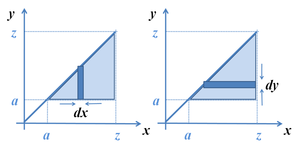
The above formulation includes the technique of interchange of the order of integration, which is not usually viewed in this manner. Consider the iterated integral:
In the order written above, the strip of width dx is integrated first over the y-direction (a strip of width dx in the x direction is integrated with respect to the y variable across the y direction) as shown in the left panel of the figure, which is inconvenient especially when function h(y) is not easily integrated. The integral can be reduced to a single integration by reversing the order of integration as shown in the right panel of the figure. To accomplish this interchange of variables, the strip of width dy is first integrated from the line x = y to the limit x = z, and then the result is integrated from y = a to y = z, resulting in:
This result can be seen to be an example of the above formula for integration by parts, repeated below:
Substitute:

Which gives the result.
More examples
Two other well-known examples are when integration by parts is applied to a function expressed as a product of 1 and itself. This works if the derivative of the function is known, and the integral of this derivative times x is also known.
The first example is ∫ ln(x) dx. We write this as:

Let:
Then:
-

where, again, C is the constant of integration.
The second example is ∫ arctan(x) dx, where arctan(x) is the inverse tangent function. Rewrite this as

Now let:
Then
-

using a combination of the inverse chain rule method and the natural logarithm integral condition.
Here is an example:
Liate rule
A rule of thumbRule of thumbA rule of thumb is a principle with broad application that is not intended to be strictly accurate or reliable for every situation. It is an easily learned and easily applied procedure for approximately calculating or recalling some value, or for making some determination...
proposed by Herbert Kasube of Bradley University advises that whichever function comes first in the following list should be u:
- L: Logarithmic functions: ln x, logb x, etc.
- I: Inverse trigonometric functionInverse trigonometric functionIn mathematics, the inverse trigonometric functions are the inverse functions of the trigonometric functions with suitably restricted domains .The notations sin−1, cos−1, etc...
s: arctan x, arcsec x, etc. - A: Algebraic functionsPolynomialIn mathematics, a polynomial is an expression of finite length constructed from variables and constants, using only the operations of addition, subtraction, multiplication, and non-negative integer exponents...
: x2, 3x50, etc. - T: Trigonometric functions: sin x, tan x, etc.
- E: Exponential functionExponential functionIn mathematics, the exponential function is the function ex, where e is the number such that the function ex is its own derivative. The exponential function is used to model a relationship in which a constant change in the independent variable gives the same proportional change In mathematics,...
s: ex, 19x, etc.
The function which is to be dv is whichever comes last in the list: functions lower on the list have easier antiderivativeAntiderivativeIn calculus, an "anti-derivative", antiderivative, primitive integral or indefinite integralof a function f is a function F whose derivative is equal to f, i.e., F ′ = f...
s than the functions above them. The rule is sometimes written as "DETAIL" where D stands for dv.
To demonstrate the LIATE rule, consider the integral

Following the LIATE rule, u = x and dv = cos x dx , hence du = dx and v = sin x , which makes the integral become
which equals
In general, one tries to choose u and dv such that du is simpler than u and dv is easy to integrate. If instead cos x was chosen as u and x as dv, we would have the integral

which, after recursive application of the integration by parts formula, would clearly result in an infinite recursion and lead nowhere.
Although a useful rule of thumb, there are exceptions to the LIATE rule. A common alternative is to consider the rules in the "ILATE" order instead. Also, in some cases, polynomial terms need to be split in non-trivial ways. For example, to integrate

one would set

so that
Then
Finally, this results in
Recursive integration by parts
Integration by parts can often be applied recursiveRecursionRecursion is the process of repeating items in a self-similar way. For instance, when the surfaces of two mirrors are exactly parallel with each other the nested images that occur are a form of infinite recursion. The term has a variety of meanings specific to a variety of disciplines ranging from...
ly on the term to provide the following formula

Here, is the first derivative of
  and
and  is the second derivative. Further,
  is a notation to describe its nth derivative with respect to the independent variable. Another notation approved in the calculus theory has been adopted:

There are n + 1 integrals.
Note that the integrand above (uv) differs from the previous equation. The dv factor has been written as v purely for convenience.
The above mentioned form is convenient because it can be evaluated by differentiating the first term and integrating the second (with a sign reversal each time), starting out with uv1. It is very useful especially in cases when u(k+1) becomes zero for some k + 1. Hence, the integral evaluation can stop once the u(k) term has been reached.
Tabular integration by parts
While the aforementioned recursiveRecursionRecursion is the process of repeating items in a self-similar way. For instance, when the surfaces of two mirrors are exactly parallel with each other the nested images that occur are a form of infinite recursion. The term has a variety of meanings specific to a variety of disciplines ranging from...
definition is correct, it is often tedious to remember and implement. A much easier visual representation of this process is often taught to students and is dubbed either "the tabular method", "the Stand and DeliverStand and DeliverStand and Deliver is a 1988 American drama film, based on the true story of high school mathematics teacher Jaime Escalante. Edward James Olmos portrayed Escalante in the film and received an Academy Award nomination for Best Actor.-Plot:...
method", "rapid repeated integration" or "the tic-tac-toe method". This method works best when one of the two functions in the product is a polynomial, that is, after differentiating it several times one obtains zero. It may also be extended to work for functions that will repeat themselves.
For example, consider the integral

Let u = x3. Begin with this function and list in a column all the subsequent derivatives until zero is reached. Secondly, begin with the function v (in this case cos(x)) and list each integral of v until the size of the column is the same as that of u. The result should appear as follows.
Derivatives of u (Column A) Integrals of v (Column B) 


Now simply pair the 1st entry of column A with the 2nd entry of column B, the 2nd entry of column A with the 3rd entry of column B, etc... with alternating signs (beginning with the positive sign). Do so until further pairing is impossible. The result is the following (notice the alternating signs in each term):

Which, with simplification, leads to the result

With proper understanding of the tabular method, it can be extended. Consider

Derivatives of u (Column A) Integrals of v (Column B) 


In this case in the last step it is necessary to integrate the product of the two bottom cells obtaining:

which leads to

and yields the result:

Higher dimensions
The formula for integration by parts can be extended to functions of several variables. Instead of an interval one needs to integrate over an n-dimensional set. Also, one replaces the derivative with a partial derivativePartial derivativeIn mathematics, a partial derivative of a function of several variables is its derivative with respect to one of those variables, with the others held constant...
.
More specifically, suppose Ω is an openOpen setThe concept of an open set is fundamental to many areas of mathematics, especially point-set topology and metric topology. Intuitively speaking, a set U is open if any point x in U can be "moved" a small amount in any direction and still be in the set U...
bounded subsetBounded setIn mathematical analysis and related areas of mathematics, a set is called bounded, if it is, in a certain sense, of finite size. Conversely, a set which is not bounded is called unbounded...
of with a piecewise smooth boundaryBoundary (topology)In topology and mathematics in general, the boundary of a subset S of a topological space X is the set of points which can be approached both from S and from the outside of S. More precisely, it is the set of points in the closure of S, not belonging to the interior of S. An element of the boundary...
 . If u and v are two continuously differentiableSmooth functionIn mathematical analysis, a differentiability class is a classification of functions according to the properties of their derivatives. Higher order differentiability classes correspond to the existence of more derivatives. Functions that have derivatives of all orders are called smooth.Most of...
functions on the closureClosure (topology)In mathematics, the closure of a subset S in a topological space consists of all points in S plus the limit points of S. Intuitively, these are all the points that are "near" S. A point which is in the closure of S is a point of closure of S...
of Ω, then the formula for integration by parts is
where is the outward unit surface normalSurface normalA surface normal, or simply normal, to a flat surface is a vector that is perpendicular to that surface. A normal to a non-flat surface at a point P on the surface is a vector perpendicular to the tangent plane to that surface at P. The word "normal" is also used as an adjective: a line normal to a...
to ,
,  is its i-th component, and i ranges from 1 to n.
We can obtain a more general form of the integration by parts by replacing v in the above formula with vi and summing over i gives the vector formula
where v is a vector-valued function with components v1, ..., vn.
Setting u equal to the constant function 1 in the above formula gives the divergence theoremDivergence theoremIn vector calculus, the divergence theorem, also known as Gauss' theorem , Ostrogradsky's theorem , or Gauss–Ostrogradsky theorem is a result that relates the flow of a vector field through a surface to the behavior of the vector field inside the surface.More precisely, the divergence theorem...
. For where
where  , one gets
which is the first Green's identityGreen's identitiesIn mathematics, Green's identities are a set of three identities in vector calculus. They are named after the mathematician George Green, who discovered Green's theorem.-Green's first identity:...
.
The regularity requirements of the theorem can be relaxed. For instance, the boundary need only be Lipschitz continuous. In the first formula above, only
  is necessary (where H1 is a Sobolev spaceSobolev spaceIn mathematics, a Sobolev space is a vector space of functions equipped with a norm that is a combination of Lp-norms of the function itself as well as its derivatives up to a given order. The derivatives are understood in a suitable weak sense to make the space complete, thus a Banach space...
); the other formulas have similarly relaxed requirements.
See also
- Integration by parts for the Lebesgue–Stieltjes integral
- Integration by parts for semimartingaleSemimartingaleIn probability theory, a real valued process X is called a semimartingale if it can be decomposed as the sum of a local martingale and an adapted finite-variation process....
s, involving their quadratic covariation. - Integration by substitutionIntegration by substitutionIn calculus, integration by substitution is a method for finding antiderivatives and integrals. Using the fundamental theorem of calculus often requires finding an antiderivative. For this and other reasons, integration by substitution is an important tool for mathematicians...
External links
- Integration by Parts – From MathWorld
- Methods of integration -- section from an online textbook
- Tabular Integration by Parts
- Tabular Integration by Parts Demonstrated
-
-
-















