
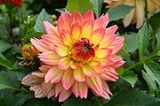
Dahlia is a
genusIn biology, a genus is a low-level taxonomic rank used in the biological classification of living and fossil organisms, which is an example of definition by genus and differentia...
of bushy, tuberous,
perennial plantA perennial plant or simply perennial is a plant that lives for more than two years. The term is often used to differentiate a plant from shorter lived annuals and biennials. The term is sometimes misused by commercial gardeners or horticulturalists to describe only herbaceous perennials...
s native to
MexicoThe United Mexican States , commonly known as Mexico , is a federal constitutional republic in North America. It is bordered on the north by the United States; on the south and west by the Pacific Ocean; on the southeast by Guatemala, Belize, and the Caribbean Sea; and on the east by the Gulf of...
,
Central AmericaCentral America is the central geographic region of the Americas. It is the southernmost, isthmian portion of the North American continent, which connects with South America on the southeast. When considered part of the unified continental model, it is considered a subcontinent...
, and
ColombiaColombia, officially the Republic of Colombia , is a unitary constitutional republic comprising thirty-two departments. The country is located in northwestern South America, bordered to the east by Venezuela and Brazil; to the south by Ecuador and Peru; to the north by the Caribbean Sea; to the...
. There are at least 36
speciesIn biology, a species is one of the basic units of biological classification and a taxonomic rank. A species is often defined as a group of organisms capable of interbreeding and producing fertile offspring. While in many cases this definition is adequate, more precise or differing measures are...
of dahlia, some like
D. imperialis up to 10 metres tall. Dahlia hybrids are commonly grown as
gardenA garden is a planned space, usually outdoors, set aside for the display, cultivation, and enjoyment of plants and other forms of nature. The garden can incorporate both natural and man-made materials. The most common form today is known as a residential garden, but the term garden has...
plants. The
AztecThe Aztec people were certain ethnic groups of central Mexico, particularly those groups who spoke the Nahuatl language and who dominated large parts of Mesoamerica in the 14th, 15th and 16th centuries, a period referred to as the late post-classic period in Mesoamerican chronology.Aztec is the...
s gathered and cultivated the dahlia for food, ceremonies, as well as decorative purposes, and the long woody stem of one variety was used for small pipes.
Dahlias are used as food plants by the
larvaA larva is a distinct juvenile form many animals undergo before metamorphosis into adults. Animals with indirect development such as insects, amphibians, or cnidarians typically have a larval phase of their life cycle...
e of some
LepidopteraLepidoptera is a large order of insects that includes moths and butterflies . It is one of the most widespread and widely recognizable insect orders in the world, encompassing moths and the three superfamilies of butterflies, skipper butterflies, and moth-butterflies...
species including
Angle ShadesThe Angle Shades is a moth of the family Noctuidae. It is a common and familiar European species and is often strongly migratory....
,
Common SwiftThe Common Swift is a moth of the family Hepialidae. It was previously placed in the genus Hepialus. It is a common, often abundant European species....
,
Ghost MothThe Ghost Moth , also known as the Ghost Swift, is a moth of the family Hepialidae. It is common throughout Europe except for the far south-east...
and
Large Yellow UnderwingThe Large Yellow Underwing is a moth, the type species for the family Noctuidae. It is an abundant species throughout Europe, one of the most common and most familiar moths of the region. In some years the species is highly migratory with large numbers appearing suddenly in marginal parts of the...
.
The dahlia is named after
SwedishSweden , officially the Kingdom of Sweden , is a Nordic country on the Scandinavian Peninsula in Northern Europe. Sweden borders with Norway and Finland and is connected to Denmark by a bridge-tunnel across the Öresund....
18th-century botanist
Anders DahlAnders Dahl was a Swedish botanist and student of Carolus Linnaeus. The dahlia flower is named after him.In 1770, Dahl entered Uppsala University as a freshman ....
. In
GermanGerman is a West Germanic language, related to and classified alongside English and Dutch. With an estimated 90 – 98 million native speakers, German is one of the world's major languages and is the most widely-spoken first language in the European Union....
the dahlia was known during most of the 19th century as
Georgia, being named after the naturalist
Johann Gottlieb GeorgiJohann Gottlieb Georgi was a German geographer and chemist.Georgi was professor of chemistry at St Petersburg. He accompanied both Johann Peter Falck and Peter Simon Pallas on their respective journeys through Siberia. Gergi was particularly interested in Lake Baikal...
of St. Petersburg,
RussiaRussia or , officially known as both Russia and the Russian Federation , is a country in northern Eurasia. It is a federal semi-presidential republic, comprising 83 federal subjects...
.
History
Francisco HernándezFrancisco Hernández de Toledo was a naturalist and court physician to the King of Spain....
visited Mexico in 1615 and noticed two spectacular varieties of dahlias, which he mentioned in his account of medicinal plants of
New SpainNew Spain, formally called the Viceroyalty of New Spain , was a viceroyalty of the Spanish colonial empire, comprising primarily territories in what was known then as 'América Septentrional' or North America. Its capital was Mexico City, formerly Tenochtitlan, capital of the Aztec Empire...
, not published until 1651. The French botanist
Nicolas-Joseph Thiéry de MenonvilleNicolas-Joseph Thiéry de Menonville , avocat at the Parlement of Paris, was a French botanist who volunteered to be sent to Mexico in 1776 to steal the cochineal insect valued for its scarlet dye...
, sent to Mexico to steal the
cochineal insectThe cochineal is a scale insect in the suborder Sternorrhyncha, from which the crimson-colour dye carmine is derived. A primarily sessile parasite native to tropical and subtropical South America and Mexico, this insect lives on cacti from the genus Opuntia, feeding on plant moisture and...
valued for its scarlet dye, noted the strangely beautiful flowers he had seen in his official report, published in 1787. Seeds sent from the botanical garden of Mexico City to Madrid flowered for the first time in the botanical garden in October 1789, and were named
Dahlia coccinea by
Antonio José CavanillesAntonio José Cavanilles was a leading Spanish taxonomic botanist of the 18th century. He named many plants, particularly from Oceania, his name is abbreviated as Cav...
, the head of the Madrid Botanical Garden, in his
Icones plantarum, 1791. A few seeds were secured by
Lord ButeJohn Stuart, 3rd Earl of Bute KG, PC , styled Lord Mount Stuart before 1723, was a Scottish nobleman who served as Prime Minister of Great Britain under George III, and was arguably the last important favourite in British politics...
and sent to England, where they flowered but were lost.
The introduction of the dahlia to the florists of the Netherlands was effected about the same time, when a box of dahlia roots was sent from Mexico to the
NetherlandsThe Netherlands is a constituent country of the Kingdom of the Netherlands, located mainly in North-West Europe and with several islands in the Caribbean. Mainland Netherlands borders the North Sea to the north and west, Belgium to the south, and Germany to the east, and shares maritime borders...
. Only one plant survived the trip, but produced spectacular red flowers with pointed petals. Nurserymen in Europe crossbred from this plant, which was named
Dahlia juarezii, with parents of dahlias discovered earlier: these are the progenitors of all modern dahlia hybrids. The
Jardin des plantesThe Jardin des Plantes is the main botanical garden in France. It is one of seven departments of the Muséum national d'histoire naturelle. It is situated in the 5ème arrondissement, Paris, on the left bank of the river Seine and covers 28 hectares .- Garden plan :The grounds of the Jardin des...
in Paris received dahlias in 1802, again from Madrid. A second species,
D. variabilis, was at last successfully grown in 1804 by the gardener at Holland House, Kensington, of
Lady HollandElizabeth Vassall Fox, Baroness Holland was an English political hostess and the wife of Whig politician Henry Vassall-Fox, 3rd Baron Holland...
, who sent the seeds from Madrid. An early breeder of dahlias was comte Léon-Charles LeLieur de Ville-sur-Arce,
intendant of the
château de Saint-CloudThe Château de Saint-Cloud was a Palace in France, built on a magnificent site overlooking the Seine at Saint-Cloud in Hauts-de-Seine, about 10 kilometres west of Paris. Today it is a large park on the outskirts of the capital and is owned by the state, but the area as a whole has had a large...
, its glasshouses and gardens, who had four varieties to work with, and by 1806 had produced three double-flowered dahlias.
Since 1813, commercial plant breeders have been breeding dahlias to produce thousands of
cultivarA cultivar'Cultivar has two meanings as explained under Formal definition. When used in reference to a taxon, the word does not apply to an individual plant but to all those plants sharing the unique characteristics that define the cultivar. is a plant or group of plants selected for desirable...
s, usually chosen for their stunning and brightly coloured waxy flowers. Dahlia was named the
national flowerIn a number of countries, plants have been chosen as symbols to represent specific geographic areas. Some countries have a country-wide floral emblem; others in addition have symbols representing subdivisions. Different processes have been used to adopt these symbols - some are conferred by...
of
MexicoThe United Mexican States , commonly known as Mexico , is a federal constitutional republic in North America. It is bordered on the north by the United States; on the south and west by the Pacific Ocean; on the southeast by Guatemala, Belize, and the Caribbean Sea; and on the east by the Gulf of...
in 1963. Dahlia plants range in height from as low as 12 in (30.5 cm) to as tall as 6–8 ft (1.8–2.4 m). The flower heads can be as small as 2 in (5.1 cm) in diameter or up to 1 ft (30.5 cm) ("dinner plate"). The great variety results from dahlias being octoploids (they have eight sets of homologous
chromosomeA chromosome is an organized structure of DNA and protein found in cells. It is a single piece of coiled DNA containing many genes, regulatory elements and other nucleotide sequences. Chromosomes also contain DNA-bound proteins, which serve to package the DNA and control its functions.Chromosomes...
s, whereas most plants have only two).
Species
- D. apiculata
- D. atropurpurea
- D. australis
- D. barkeriae
- D. brevis
- D. campanulata
- D. cardiophylla
- D. coccinea
- D. cuspidata
- D. dissecta
- D. excelsa
- D. foeniculifolia
- D. hjertingii
- D. hybrid cultivar
- D. imperialis
Dahlia imperialis or Bell tree dahlia is an 8-10 metre tall member of the Dahlia genus native to Mexico, Central America and Colombia...
- D. linearis
- D. macdougallii
- D. merckii
- D. mollis
- D. neglecta
- D. parvibracteata
- D. pinnata
- D. pteropoda
- D. rudis
- D. rupicola
- D. scapigera
- D. scapigeroides
- D. sherffii
- D. sorensenii
- D. spectabilis
- D. sublignosa
- D. tenuicaulis
- D. tenuis
- D. tubulata
- D. variabilis
Cultivation
Dahlias grow naturally in climates which do not experience
frostFrost is the solid deposition of water vapor from saturated air. It is formed when solid surfaces are cooled to below the dew point of the adjacent air as well as below the freezing point of water. Frost crystals' size differ depending on time and water vapour available. Frost is also usually...
, consequently they are not adapted to withstand sub-zero temperatures. However their tuberous nature enables them to survive periods of
dormancyDormancy is a period in an organism's life cycle when growth, development, and physical activity are temporarily stopped. This minimizes metabolic activity and therefore helps an organism to conserve energy. Dormancy tends to be closely associated with environmental conditions...
, and this characteristic means that gardeners in temperate climates with frosts can grow dahlias successfully, provided the tubers are lifted from the ground and stored in cool yet frost-free conditions during the winter. Planting the tubers quite deep (10 – 15 cm) also provides some protection. When in active growth, modern dahlia hybrids perform most successfully in well-watered yet free-draining soils, in situations receiving plenty of sunlight. Taller cultivars usually require some form of staking as they grow, and all garden dahlias need deadheading regularly, once flowering commences. Slugs and snails are serious pests in some parts of the world, particularly in spring when new growth is emerging through the soil. Earwigs can also disfigure the blooms. The other main pests likely to be encountered are aphids (usually on young stems and immature flower buds), red spider mite (cause foliage mottling and discolouration, worse in hot and dry conditions) and capsid bugs (result in contortion and holes at growing tips). Diseases which may be found affecting dahlias include
powdery mildewPowdery mildew is a fungal disease that affects a wide range of plants. Powdery mildew diseases are caused by many different species of fungi in the order Erysiphales. It is one of the easier diseases to spot, as its symptoms are quite distinctive. Infected plants display white powdery spots on the...
, grey mould (
Botrytis cinereaBotrytis cinerea is a necrotrophic fungus that affects many plant species, although its most notable hosts may be wine grapes. In viticulture, it is commonly known as botrytis bunch rot; in horticulture, it is usually called grey mould or gray mold.The fungus gives rise to two different kinds of...
),
verticilliumVerticillium is a genus of fungi in the division Ascomycota, and are an anamorphic form of the Plectosphaerellaceae family. The genus used to include diverse groups comprising saprobes and parasites of higher plants, insects, nematodes, mollusc eggs and other fungi thus it can be seen that the...
wilt, dahlia
smutThe smuts are multicellular fungi, that are characterized by their large numbers of teliospores. The smuts get their name from a Germanic word for dirt because of their dark, thick-walled and dust-like teliospores. They are mostly Ustilaginomycetes and can cause plant disease...
(
Entyloma calendulae f. dahliae),
phytophthoraPhytophthora is a genus of plant-damaging Oomycetes , whose member species are capable of causing enormous economic losses on crops worldwide, as well as environmental damage in natural ecosystems. The genus was first described by Heinrich Anton de Bary in 1875...
and some plant viruses.
Judged shows
Dahlias are often grown for judged shows. Awards are given for best in class and best in show. Traditionally, dahlias grown for shows have used intensive application of pesticides and inorganic fertilizers. More recently, however, competitive dahlia growers have used organic methods with equally good results.
Other names
The dahlia is also known as
Tenjikubotan (天竺牡丹) in
Japaneseis a language spoken by over 130 million people in Japan and in Japanese emigrant communities. It is a member of the Japonic language family, which has a number of proposed relationships with other languages, none of which has gained wide acceptance among historical linguists .Japanese is an...
, which literally means '
PeonyPeony or paeony is a name for plants in the genus Paeonia, the only genus in the flowering plant family Paeoniaceae. They are native to Asia, southern Europe and western North America...
of
IndiaIndia , officially the Republic of India , is a country in South Asia. It is the seventh-largest country by geographical area, the second-most populous country with over 1.2 billion people, and the most populous democracy in the world...
'. According to the
Japanese language of flowersHanakotoba . In this practice plants were given codes and passwords. Physiological effects and action under the color of the flowers, put into words the impressions of nature and the presence of thorns with the height of tall plants, flowers and garlands of flowers through the various types...
, it means 'good taste'.
In Hindi (हिंदी) or Urdu (اردو), Deri in Tamil, Dahlia flowers are also referred to as Belia ( बेलिया ) ( بیلیا )
External links