

Japanese festivals

Encyclopedia
Japanese festivals are traditional festive occasions. Some festival
s have their roots in Chinese festival
s but have undergone dramatic changes as they mixed with local customs.
Some are so different that they do not even remotely resemble the original festival despite sharing the same name and date. There are also various local festivals (e.g. Tobata Gion) that are mostly unknown outside a given prefecture. It is commonly said that you will always find a festival somewhere in Japan.
Unlike most people in East Asia, Japanese people generally do not celebrate Chinese New Year
(it having been supplanted by the Western New Year's Day
in the late 19th century); although Chinese residents in Japan still do. In Yokohama Chinatown
, Japan's biggest Chinatown
, tourists from all over Japan come to enjoy the festival. And similarly the Nagasaki Lantern Festival
is based in Nagasaki's Chinatown. See: Japanese New Year
.
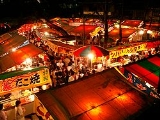
games to keep people entertained. Some are based around temples or shrines, others hanabi (Fireworks
), and still others around contests where the participants sport loin cloths (see: Hadaka Matsuri
).
.jpg)
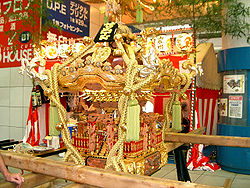
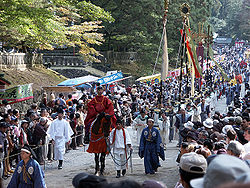 is the Japanese word for a festival
or holiday
. In Japan, festivals are usually sponsored by a local shrine or temple, though they can be secular.
There are no specific matsuri days for all of Japan; dates vary from area to area, and even within a specific area, but festival days do tend to cluster around traditional holidays such as Setsubun
or Obon
. Almost every locale has at least one matsuri in late summer/early autumn, usually related to the rice
harvest
.
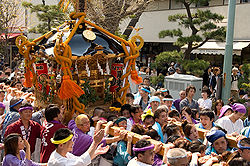
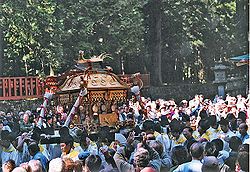
Notable matsuri often feature processions which may include elaborate floats. Preparation for these processions is usually organized at the level of neighborhoods, or machi. Prior to these, the local kami
may be ritually installed in mikoshi
and paraded through the streets.
One can always find in the vicinity of a matsuri booths selling souvenirs and food such as takoyaki
, and games, such as Goldfish scooping
. Karaoke
contests, sumo
matches, and other forms of entertainment are often organized in conjunction with matsuri. If the festival is next to a lake, renting a boat is also an attraction.
Favorite elements of the most popular matsuri, such as the Nada Kenka Matsuri of Himeji
or the Neputa Matsuri of Hirosaki, are often broadcast on television for the entire nation to enjoy.
s. Several concerts and other events are also held.
An interesting fact concerning cherry blossoms:
Some locations of cherry blossom festivals include:
date back 500 years when worshippers competed to receive paper talismans called Go-o thrown by the priest. These paper talismans were tokens of the completion of New Year ascetic training by the priests. As those people receiving these paper talismans had good things happen to them, the number of people requesting them increased year by year. However, as paper was easily torn, the talismans were changed to the wooden ofuda that we know today.
Naoi-shinji, also known as "Hadaka Matsuri (naked festival)", started in the year 767 AD, the Nara Period. This rite was founded on the fact that the governor of Owari Province (presently Aichi Pref.) visited the Owari Shosha Shrine ( Konomiya shrine ) to drive away evil spirits and calamities, because Emperor Shotoku ordered all the kokubun-ji* to offer invocations to dispel plagues.
It is said that the form of the festival, a struggle to touch the Naoinin or Shin-otoko (man of god), is reminiscent of the struggle in old times between the assemblage of lower-ranking shinto priests called shanin and contributors tried to catch and set up a man for naoinin (shin-otoko), an unlucky poor man, who was unwilling to take the role.
Date: 1–3 of January (related celebrations take place throughout January)
Other Names: Oshōgatsu (O is an honorific prefix)
Information: New Year observances are the most elaborate of Japan's annual events. Before the New Year, homes are cleaned, debts are paid off, and osechi (food in lacquered trays for the New Year) is prepared or bought. Osechi foods are traditional foods which are chosen for their lucky colors, shapes, or lucky-sounding names in hopes of obtaining good luck in various areas of life during the new year. Homes are decorated and the holidays are celebrated by family gatherings, visits to temples or shrines, and formal calls on relatives and friends. The first day of the year (ganjitsu) is usually spent with members of the family.
People try to stay awake and eat toshikoshisoba
, noodles to be eaten at midnight. People also visit Buddhist temples and Shinto shrines. Traditionally three are visited. This is called sansha-mairi. In the Imperial Palace
at dawn on the 1st, the Emperor performs the rite
of shihōhai (worship of the four quarters), in which he offers prayers for the well-being of the nation. On January 2 the public is allowed to enter the inner palace grounds; the only other day this is possible is the Emperor's birthday (December 23). On the 2nd and 3rd days acquaintances visit one another to extend greetings (nenshi) and sip otoso (a spiced rice wine
). Some games played at New Year's are karuta
(a card game), hanetsuki
(similar to badminton), tako age (kiteflying), and komamawashi (spinning tops). These games are played to bring more luck for the year. Exchanging New Year's greeting cards (similar to Christmas Card
s ) is another important Japanese custom. Also special allowances are given to children, which are called otoshidama. They also decorate their entrances with kagami mochi
(two mochi rice balls placed one on top of the other, with a tangerine on top), and kadomatsu
(pine tree decorations).
A later New Year's celebration, Koshōgatsu, literally means "Small New Year" and starts with the first full moon of the year (around January 15). The main events of Koshōgatsu are rites and practices praying for a bountiful harvest.
Date: March 3
Other Names: Sangatsu Sekku (3rd month Festival), Momo Sekku (Peach Festival), Joshi no Sekku (Girls' Festival)
Information: This is the day families pray for the happiness and prosperity of their girls and to help ensure that they grow up healthy and beautiful. The celebration takes place both inside the home and at the seashore. Both parts are meant to ward off evil spirits from girls. Young girls put on their best kimonos and visit their friends' homes. Tiered platforms for hina ningyō (hina dolls; a set of dolls representing the emperor, empress, attendants, and musicians in ancient court dress) are set up in the home, and the family celebrates with a special meal of hishimochi (diamond-shaped rice cakes) and shirozake (rice malt with sake).
 Date: April
Other Names: Hanami (flower viewing), Cherry Blossom Festival
Information: Various flower festivals are held at Shinto shrines during the month of April. Excursions and picnics for enjoying flowers, particularly cherry blossoms are also common, as well as many drinking parties often to be seen in and around auspicious parks and buildings. In some areas the peach blossom, the traditional flower of Japan (the Cherry being a symbol from the Edo period symbolising the Samurai culture), is viewed as well though this flowers earlier than the Cherry. In some places flower viewing parties are held on traditionally fixed dates. This is one of the most popular events during spring. The subject of flower viewing has long held an important place in literature, dance and the fine arts. Ikebana
(flower arrangement) is also a popular part of Japanese culture and is still practiced by many people today. Some main things people do during this event are: games, folk songs, folk dance, flower displays, rides, parades, concerts, kimono shows, booths with food and other things, beauty pageant, and religious ceremonies. Families go out during weekends to see the cherry blossoms, and participate in the many festivals and activities.
Date: May 5
Other Names: ,
Information: May is the month of the Iris Festival. The tall-stemmed Japanese iris is a symbolic flower. Its long, narrow leaves resemble the sharp blades off a sword, and for many centuries it has been the custom to place iris leaves in a boy's bath to give him a martial spirit. Originally May 5 was a festival for boys corresponding to the Doll Festival, for girls, but in 1948 it was renamed Children's Day, and made a national holiday. However, this might be a misnomer; the symbols of courage and strength mainly honor boys. It is customary on this day for families with male children to fly koinobori (carp streamers, a symbol of success) outside the house, display warrior dolls (musha ningyō) inside, and eat chimaki (rice cakes wrapped in cogan grass or bamboo leaves) and kashiwamochi (rice cakes filled with bean paste and wrapped in oak leaves).
Date: July 7
Other Names: The Star Festival
Information: It originated from a Chinese folk legend concerning two stars-the Weaver Star (Vega) and the Cowherd Star (Altair)-who were said to be lovers who could meet only once a year on the 7th night of the 7th month provided it didn't rain and flood the Milky Way. It was named Tanabata after a weaving maiden from a Japanese legend, named Orihime who was believed to make clothes for the gods. People often write wishes and romantic aspirations on long, narrow strips of coloured paper and hang them on bamboo branches along with other small ornaments.
Date: 13–15 August
Other Names:
Information: A Buddhist observance honoring the spirits of ancestors. Usually a "spirit altar" (shōryōdana) is set up in front of the Butsudan (buddhist family altar) to welcome the ancestors' souls. A priest is usually asked to come and read a sutra (tanagyō). Among the traditional preparations for the ancestors' return are the cleaning of grave sites and preparing a path from them to the house and the provision of straw horses or oxen for the ancestors' transportation. The welcoming fire (mukaebi) built on the 13th and the send-off fire (okuribi) built on the 16th are intended to light the path.
Date: 15th or 16 July (August)
Information: The customary practice to mark the end of the Bon Festival. Small paper lanterns containing lit candles are set afloat on rivers or the sea light the way for the ancestral spirits as they depart. Usually a message is written on the outside of the paper lantern.
Date: November 15
Information: Five-year-old boys and seven- or three-year-old girls are taken to the local shrine to pray for their safe and healthy future. This festival started because of the belief that children of certain ages were especially prone to bad luck and hence in need of divine protection. Children are usually dressed in traditional clothing for the occasion and after visiting the shrine many people buy chitose-ame ("thousand-year candy") sold at the shrine.
Other Names: ,
Information: Preparations for seeing in the new year were originally undertaken to greet the toshigami
, or deity of the incoming year. These began on the 13th of December, when the house was given a thorough cleaning; the date is usually nearer the end of the month now. The house is then decorated in the traditional fashion: A sacred rope of straw (shimenawa) with dangling white paper strips (shide) is hung over the front door to prevent evil spirits from entering and to show the presence of the toshigami. It is also customary to place kadomatsu, an arrangement of tree sprigs, beside the entrance way. A special altar, known as toshidana ("year shelf"), is piled high with kagamimochi (flat, round rice cakes), sake (rice wine), persimmons, and other foods in honor of the toshigami. A fair is traditionally held in late December at shrines, temples or in local neighborhoods. This is in preparation for the new year holidays. Decorations and sundry goods are sold at the fair. Originally these year-end fairs provided opportunities for farmers, fisherfolk and mountain dwellers to exchange goods and buy clothes and other necessities for the coming year.
Date: December 31
Information: People do the general house cleaning (Ōsōji) to welcome coming year and not to keep having impure influences. Many people visit Buddhist temples to hear the temple bells rung 108 times at midnight (joya no kane). This is to announce the passing of the old year and the coming of the new. The reason they are rung 108 times is because of the Buddhist belief that human beings are plagued by 108 earthly desires or passions (bonnō). With each ring one desire is dispelled. It is also a custom to eat toshikoshi-soba in the hope that one's family fortunes will extend like the long noodles.
Festival
A festival or gala is an event, usually and ordinarily staged by a local community, which centers on and celebrates some unique aspect of that community and the Festival....
s have their roots in Chinese festival
Traditional Chinese holidays
The traditional Chinese holidays are an essential part of Chinese culture. Many holidays are associated with Chinese mythology and folklore tales, but more realistically, they probably originated from ancient farmer rituals for celebrating harvests or prayer offerings...
s but have undergone dramatic changes as they mixed with local customs.
Some are so different that they do not even remotely resemble the original festival despite sharing the same name and date. There are also various local festivals (e.g. Tobata Gion) that are mostly unknown outside a given prefecture. It is commonly said that you will always find a festival somewhere in Japan.
Unlike most people in East Asia, Japanese people generally do not celebrate Chinese New Year
Chinese New Year
Chinese New Year – often called Chinese Lunar New Year although it actually is lunisolar – is the most important of the traditional Chinese holidays. It is an all East and South-East-Asia celebration...
(it having been supplanted by the Western New Year's Day
New Year's Day
New Year's Day is observed on January 1, the first day of the year on the modern Gregorian calendar as well as the Julian calendar used in ancient Rome...
in the late 19th century); although Chinese residents in Japan still do. In Yokohama Chinatown
Yokohama Chinatown
Yokohama Chinatown is located in Yokohama, Japan, which is located just south of Tokyo. Its history is about 150 years long...
, Japan's biggest Chinatown
Chinatown
A Chinatown is an ethnic enclave of overseas Chinese people, although it is often generalized to include various Southeast Asian people. Chinatowns exist throughout the world, including East Asia, Southeast Asia, the Americas, Australasia, and Europe. Binondo's Chinatown located in Manila,...
, tourists from all over Japan come to enjoy the festival. And similarly the Nagasaki Lantern Festival
Lantern Festival
The Lantern Festival ; is a festival celebrated on the fifteenth day of the first month in the lunisolar year in the Chinese calendar, the last day...
is based in Nagasaki's Chinatown. See: Japanese New Year
Japanese New Year
The is one of the most important annual festivals, with its own unique customs, and has been celebrated for centuries. Due to the importance of the holiday and the preparations required, the preceding days are quite busy, particularly the day before, known as Ōmisoka.The Japanese New Year has been...
.
Events within festivals
Festivals are often based around one or two main events, with food stalls, entertainment, and carnivalCarnival
Carnaval is a festive season which occurs immediately before Lent; the main events are usually during February. Carnaval typically involves a public celebration or parade combining some elements of a circus, mask and public street party...
games to keep people entertained. Some are based around temples or shrines, others hanabi (Fireworks
Fireworks
Fireworks are a class of explosive pyrotechnic devices used for aesthetic and entertainment purposes. The most common use of a firework is as part of a fireworks display. A fireworks event is a display of the effects produced by firework devices...
), and still others around contests where the participants sport loin cloths (see: Hadaka Matsuri
Hadaka Matsuri
A is a type of Japanese festival, or matsuri, in which participants wear a minimum amount of clothing; usually just a Japanese loincloth , sometimes with a short happi coat, and rarely completely naked. Whatever the clothing, it is considered to be above vulgar, or everyday, undergarments, and on...
).
Local festivals (matsuri)
Festival
A festival or gala is an event, usually and ordinarily staged by a local community, which centers on and celebrates some unique aspect of that community and the Festival....
or holiday
Holiday
A Holiday is a day designated as having special significance for which individuals, a government, or a religious group have deemed that observance is warranted. It is generally an official or unofficial observance of religious, national, or cultural significance, often accompanied by celebrations...
. In Japan, festivals are usually sponsored by a local shrine or temple, though they can be secular.
There are no specific matsuri days for all of Japan; dates vary from area to area, and even within a specific area, but festival days do tend to cluster around traditional holidays such as Setsubun
Setsubun
is the day before the beginning of spring in Japan. The name literally means "seasonal division", but usually the term refers to the spring Setsubun, properly called Risshun celebrated yearly on February 3 as part of the...
or Obon
Bon Festival
or just is a Japanese Buddhist custom to honor the spirits of one's ancestors. This Buddhist-Confucian custom has evolved into a family reunion holiday during which people return to ancestral family places and visit and clean their ancestors' graves, and when the spirits of ancestors are supposed...
. Almost every locale has at least one matsuri in late summer/early autumn, usually related to the rice
Rice
Rice is the seed of the monocot plants Oryza sativa or Oryza glaberrima . As a cereal grain, it is the most important staple food for a large part of the world's human population, especially in East Asia, Southeast Asia, South Asia, the Middle East, and the West Indies...
harvest
Harvest
Harvest is the process of gathering mature crops from the fields. Reaping is the cutting of grain or pulse for harvest, typically using a scythe, sickle, or reaper...
.
Notable matsuri often feature processions which may include elaborate floats. Preparation for these processions is usually organized at the level of neighborhoods, or machi. Prior to these, the local kami
Kami
is the Japanese word for the spirits, natural forces, or essence in the Shinto faith. Although the word is sometimes translated as "god" or "deity", some Shinto scholars argue that such a translation can cause a misunderstanding of the term...
may be ritually installed in mikoshi
Mikoshi
A is a divine palanquin . Shinto followers believe that it serves as the vehicle to transport a deity in Japan while moving between main shrine and temporary shrine during a festival or when moving to a new shrine...
and paraded through the streets.
One can always find in the vicinity of a matsuri booths selling souvenirs and food such as takoyaki
Takoyaki
is a popular ball-shaped Japanese dumpling or more like a savory pancake made of batter and cooked in a special takoyaki pan...
, and games, such as Goldfish scooping
Goldfish scooping
is a Japanese traditional game in which a player scoops goldfish with a special scooper. It is also called, "Scooping Goldfish", "Dipping for Goldfish" or "Snatching Goldfish". "Kingyo" means goldfish and "sukui" means scooping. Sometimes bouncy balls are substituted for goldfish. Japanese summer...
. Karaoke
Karaoke
is a form of interactive entertainment or video game in which amateur singers sing along with recorded music using a microphone and public address system. The music is typically a well-known pop song minus the lead vocal. Lyrics are usually displayed on a video screen, along with a moving symbol,...
contests, sumo
Sumo
is a competitive full-contact sport where a wrestler attempts to force another wrestler out of a circular ring or to touch the ground with anything other than the soles of the feet. The sport originated in Japan, the only country where it is practiced professionally...
matches, and other forms of entertainment are often organized in conjunction with matsuri. If the festival is next to a lake, renting a boat is also an attraction.
Favorite elements of the most popular matsuri, such as the Nada Kenka Matsuri of Himeji
Himeji, Hyogo
is a city located in Hyōgo Prefecture in the Kansai region of Japan. As of April 1, 2011, the city has an estimated population of 535,945, with 206,409 households. The total area is 534.43 km².- History :...
or the Neputa Matsuri of Hirosaki, are often broadcast on television for the entire nation to enjoy.
List of famous matsuri
| Name Matsuri | Note | Place |
|---|---|---|
| Atsuta | held at Atsuta Shrine Atsuta Shrine is a Shinto shrine traditionally believed to have been established during the reign of Emperor Keikō located in Atsuta-ku, Nagoya, Aichi Prefecture in Japan. The shrine is familiarly known as Atsuta-Sama or simply as Miya... in June |
Nagoya |
| Aoi Aoi Matsuri The , or "Hollyhock Festival," is one of the three main annual festivals held in Kyoto, Japan, the other two being the Festival of the Ages and the Gion Festival. It is a festival of the two Kamo shrines in the north of the city, Shimogamo Shrine and Kamigamo Shrine... |
Kyoto | |
| Gion Gion Matsuri The takes place annually in Kyoto and is one of the most famous festivals in Japan. It spans the entire month of July and is crowned by a parade, the on July 17. It takes its name from Kyoto's Gion district.... |
Kyoto Kyoto is a city in the central part of the island of Honshū, Japan. It has a population close to 1.5 million. Formerly the imperial capital of Japan, it is now the capital of Kyoto Prefecture, as well as a major part of the Osaka-Kobe-Kyoto metropolitan area.-History:... |
|
| Hadaka Hadaka Matsuri A is a type of Japanese festival, or matsuri, in which participants wear a minimum amount of clothing; usually just a Japanese loincloth , sometimes with a short happi coat, and rarely completely naked. Whatever the clothing, it is considered to be above vulgar, or everyday, undergarments, and on... |
Okayama | |
| Hōnen Honen Matsuri is a fertility festival celebrated every year on March 15 in Japan. Hōnen means prosperous year in Japanese, implying a rich harvest, while a matsuri is a festival... |
held at Tagata Shrine in March | Komaki Komaki, Aichi is a city located in Aichi, Japan. It is commonly associated with the former Nagoya Airport, which is partly located in the city. The other part is in the city of Kasugai. As of January 1, 2008, the city has an estimated population of 149,060 and the density of 2,370 persons per km²... |
| Jidai Jidai Matsuri The is a traditional Japanese festival held on October 22 annually in Kyoto, Japan. It is one of Kyoto's renowned three great festivals, with the other two being the Aoi Matsuri, held annually on May 15, and the Gion Matsuri, which is held annually from 17 to July 24... |
Kyoto | |
| Kanamara Kanamara Matsuri The Shinto is held each spring at the Kanayama shrine in Kawasaki, Japan. The exact dates vary: the main festivities fall on the first Sunday in April... |
Kawasaki | |
| Kanda Kanda Matsuri or the Kanda Festival, is one of the three great Shinto festivals of Tokyo, along with the Sanja Matsuri and Sannō Matsuri. The festival started in the early 17th century as a celebration of Tokugawa Ieyasu's decisive victory at the battle of Sekigahara and was continued as a display of the... |
Tokyo | |
| Kanto | held in 3 to 7 August | Akita Akita, Akita is the capital city of Akita Prefecture in the Tohoku region of Japan.As of June 11, 2005, with the merger of the former Kawabe District , the city has an estimated population of 323,310 and density of... |
| Nagoya | held in Hisaya Ōdori Park in Sakae, Nagoya Sakae, Nagoya is an area in Naka-ku, Nagoya, Aichi, Japan. It refers to the areas around Sakae intersection, Sakae Station on the Nagoya Municipal Subway, and Sakae Station on the Meitetsu Seto Line... |
Nagoya |
| Sanja Sanja Matsuri , or Sanja Festival, is one of the three great Shinto festivals in Tokyo, along with the Kanda Matsuri and Sannō Matsuri. It is considered one of the wildest and largest. The festival is held in honor of Hinokuma Hamanari, Hinokuma Takenari and Hajino Nakatomo, the three men who established and... |
Tokyo | |
| Sannō Sannō Matsuri or the Sannō Festival, is one of the three great Shinto festivals of Tokyo, along with the Sanja Matsuri and Kanda Matsuri, and is a celebration of the city's rulers and divine protectors. It takes place in mid-June of even-numbered years, alternating with the Kanda Matsuri which takes place in the... |
Tokyo | |
| Tenjin | Osaka Osaka is a city in the Kansai region of Japan's main island of Honshu, a designated city under the Local Autonomy Law, the capital city of Osaka Prefecture and also the biggest part of Keihanshin area, which is represented by three major cities of Japan, Kyoto, Osaka and Kobe... |
|
Sapporo Snow Festival (Hokkaido)
Sapporo Yuki Matsuri is one of the largest festivals of the year in Sapporo, held in February for one week. It began in 1950 when high school students built snow statues in Odori Park, central Sapporo. The event is now very large and commercialized. About a dozen large sculptures are built for the festival along with around 100 smaller snow and ice sculptureIce sculpture
Ice sculpture is a form of sculpture that uses ice as the raw material. Sculptures from ice can be abstract or realistic and can be functional or purely decorative...
s. Several concerts and other events are also held.
Lake Shikotsu Ice Festival
Lake Shikotsu is the northernmost ice-free lake which is 363 meters deep. This festival features a moss-covered cave, which has evergreen draped on the inside and is covered in ice (Gianola, 2008). This festival is held from late January to mid February. This festival features ice sculptures, small and large. At night the sculptures are illuminated by different colored lights. There is a fireworks show during the festival as well. Admission is free. Amasake (hot sake) is available for purchase to enjoy (2008 Ministry of Land).Lake Towada Snow Festival
This lake festival is held in the beginning of February. Held in the town of Yasumiya, this festival is on the south side of lake Towada (near the wooden statues). This festival is open all day, but at 5pm one can enjoy activities such as going through a snow maze, exploring a Japanese igloo, and eat foods from Aomori and Akita prefectures. There is a fireworks show and events held on an ice stage.Aomori Nebuta Festival
This festival is held annually and features colorful lantern floats called nebuta which are pulled through the streets of Central Aomori. This festival is held from about August 2-7 every year. This event attracts millions of visitors. During this festival, 20 large nebuta floats are paraded through the streets near Aomori JR rail station. These floats are constructed of wooden bases and metal frames. Japanese papers, called washi, are painted onto the frames. These amazing floats are finished off with the historical figures or kabuki being painted on the paper. These floats can take up to a year to complete. There is a dance portion of this festival. There are haneto dancers and they wear special costumes for this dance. Everyone is welcome to purchase their own haneto costume that they may too join in on the fun (Mishima, Aomori Nebuta Festival).Nango Summer Jazz Festival
This event is held every year. Thousands of artists from all over Tohoku and even further regions come to Nango to perform. This is the largest open-air jazz concert held in Tohoku region. This festival began in 1989, in a small venue indoors. There was such a large response from the fans that is was expanded into a large annual festival. One must purchase tickets for this event (Bernard, 2007). This summer jazz festival doesn't cost anything but you still need to receive a ticket to enter.Cherry blossom festivals
Japan celebrates the entire season of the cherry blossoms. All over Japan festivals are held and include food and at night beautiful lanterns.An interesting fact concerning cherry blossoms:
- According to a study, plants in urban areas have plants that bloom are blooming faster. From evidence at a cherry arboretum at Mt. Takao, early flowering of the cherry blossoms is happening due to the larger response to temperature variation (Primack, Higuchi, & Miller-Rushing, 2009).
Some locations of cherry blossom festivals include:
- Yaedake Cherry Blossom Festival in Okinawa. This festival takes place from late January – mid February
- Matsuyama Shiroyama Koen Cherry Blossom Festival in Matsuyama-city, Ehime. This festival takes place early April.
- Matsue Jozan Koen Festival in Matsue-city, Shimane. This festival has a feature of illuminating the cherry blossom trees at night. This festival takes place late March-early April.
- Tsuyama Kakuzan Koen Cherry Blossom Festival in Tsuyama-city, Okayama. Japanese tea ceremonies and music performers are held at these festivals. This festival is held early-mid April.
- Takato Joshi Koen Cherry Blossom Festival in Takato-machi Ina-city, Nagano prefecture. The trees in this region have pink blossoms. This festival is held early April.
- Takada Koen Cherry Blossom Festival in Joetsu-city, Niigata prefecture. This festival is held early-mid April.
- Kitakami Tenshochi Cherry Blossom Festival in Kitakami-city, Iwate. This festival is held mid April-early May.
- Hirosaki Cherry Blossom Festival held in Hirosaki Koen Hirosaki-city, Aomori prefecture. This festival is held late April-early May (Mishima, Cherry Blossom Festivals 2010).
Hadaka Matsuri
The origins of Hadaka MatsuriHadaka Matsuri
A is a type of Japanese festival, or matsuri, in which participants wear a minimum amount of clothing; usually just a Japanese loincloth , sometimes with a short happi coat, and rarely completely naked. Whatever the clothing, it is considered to be above vulgar, or everyday, undergarments, and on...
date back 500 years when worshippers competed to receive paper talismans called Go-o thrown by the priest. These paper talismans were tokens of the completion of New Year ascetic training by the priests. As those people receiving these paper talismans had good things happen to them, the number of people requesting them increased year by year. However, as paper was easily torn, the talismans were changed to the wooden ofuda that we know today.
Naoi-shinji, also known as "Hadaka Matsuri (naked festival)", started in the year 767 AD, the Nara Period. This rite was founded on the fact that the governor of Owari Province (presently Aichi Pref.) visited the Owari Shosha Shrine ( Konomiya shrine ) to drive away evil spirits and calamities, because Emperor Shotoku ordered all the kokubun-ji* to offer invocations to dispel plagues.
It is said that the form of the festival, a struggle to touch the Naoinin or Shin-otoko (man of god), is reminiscent of the struggle in old times between the assemblage of lower-ranking shinto priests called shanin and contributors tried to catch and set up a man for naoinin (shin-otoko), an unlucky poor man, who was unwilling to take the role.
Fixed days
- Seijin ShikiSeijin shikiis a Japanese holiday held annually on the second Monday of January. It is held in order to congratulate and encourage all those who have reached the age of majority over the past year, and to help them realize that they have become adults...
: Coming of Age Day (second Monday of January) - HinamatsuriHinamatsuriThe Japanese , or Girls' Day, is held on March 3. Platforms covered with a red carpet are used to display a set of representing the Emperor, Empress, attendants, and musicians in traditional court dress of the Heian period.- Origin and customs :...
: Doll Festival (March 3) - HanamiHanamiis the Japanese traditional custom of enjoying the beauty of flowers, "flower" in this case almost always meaning cherry blossoms or ume blossoms. From the end of March to early May, sakura bloom all over Japan, and around the first of February on the island of Okinawa...
: Flower Viewing (late March to early April) - TanabataTanabatais a Japanese star festival, originating from the Chinese Qixi Festival. It celebrates the meeting of the deities Orihime and Hikoboshi . According to legend, the Milky Way separates these lovers, and they are allowed to meet only once a year on the seventh day of the seventh lunar month of the...
: star festival (July 7) - Shichi-Go-SanShichi-Go-Sanis a traditional rite of passage and festival day in Japan for three- and seven-year-old girls and three- and five-year-old boys, held annually on November 15...
: festival day for children aged three, five and seven (November 15) - ŌmisokaOmisoka, New Year's Eve, is the second-most important day in Japanese tradition because it is the final day of the old year and the eve of New Year's Day, which is the most important day of the year....
: New Year's Eve (December 31)
Multiple days
- SetsubunSetsubunis the day before the beginning of spring in Japan. The name literally means "seasonal division", but usually the term refers to the spring Setsubun, properly called Risshun celebrated yearly on February 3 as part of the...
: division of season (beginning of each of the four seasons) (Feb. 3 ) - EnnichiEnnichiEnnichi is a day believed to have a special relation with a particular Japanese deity. Often, it is a day when a deity is believed to have been born or left the world. In Shinto, this day is encouraged to be embraced as it is in the "four affirmations" of their religious code...
: temple fair (holy days related to Kami and/or Buddha)
Date: 1–3 of January (related celebrations take place throughout January)
Other Names: Oshōgatsu (O is an honorific prefix)
Information: New Year observances are the most elaborate of Japan's annual events. Before the New Year, homes are cleaned, debts are paid off, and osechi (food in lacquered trays for the New Year) is prepared or bought. Osechi foods are traditional foods which are chosen for their lucky colors, shapes, or lucky-sounding names in hopes of obtaining good luck in various areas of life during the new year. Homes are decorated and the holidays are celebrated by family gatherings, visits to temples or shrines, and formal calls on relatives and friends. The first day of the year (ganjitsu) is usually spent with members of the family.
People try to stay awake and eat toshikoshisoba
Soba
is the Japanese name for buckwheat. It is synonymous with a type of thin noodle made from buckwheat flour, and in Japan can refer to any thin noodle . Soba noodles are served either chilled with a dipping sauce, or in hot broth as a noodle soup...
, noodles to be eaten at midnight. People also visit Buddhist temples and Shinto shrines. Traditionally three are visited. This is called sansha-mairi. In the Imperial Palace
Imperial Palace
Imperial Palace may refer to:Institutions*Kaiserpfalz in the Holy Roman EmpirePlaces:*Forbidden City, Beijing, China*Tokyo Imperial Palace , Tokyo, Japan*Heijō Palace, Nara Japan*Heian Palace, Japan...
at dawn on the 1st, the Emperor performs the rite
Rite
A rite is an established, ceremonious, usually religious act. Rites in this sense fall into three major categories:* rites of passage, generally changing an individual's social status, such as marriage, baptism, or graduation....
of shihōhai (worship of the four quarters), in which he offers prayers for the well-being of the nation. On January 2 the public is allowed to enter the inner palace grounds; the only other day this is possible is the Emperor's birthday (December 23). On the 2nd and 3rd days acquaintances visit one another to extend greetings (nenshi) and sip otoso (a spiced rice wine
Rice wine
Rice wine is an alcoholic beverage made from rice. Unlike wine, which is made by fermentation of naturally sweet grapes and other fruit, rice "wine" results from the fermentation of rice starch converted to sugars...
). Some games played at New Year's are karuta
Karuta
is a Japanese card game.The basic idea of any karuta game is to be able to quickly determine which card out of an array of cards is required and then to grab the card before it is grabbed by an opponent. There are various types of cards which can be used to play karuta...
(a card game), hanetsuki
Hanetsuki
Hanetsuki is a Japanese traditional game, similar to badminton without a net, played with a rectangular wooden paddle called a hagoita and a brightly-coloured shuttlecock. Often played by girls at the New Year, the game can be played in two fashions: by one person attempting to keep the...
(similar to badminton), tako age (kiteflying), and komamawashi (spinning tops). These games are played to bring more luck for the year. Exchanging New Year's greeting cards (similar to Christmas Card
Christmas card
A Christmas card is a greeting card sent as part of the traditional celebration of Christmas in order to convey between people a range of sentiments related to the Christmas and holiday season. Christmas cards are usually exchanged during the weeks preceding Christmas Day by many people in Western...
s ) is another important Japanese custom. Also special allowances are given to children, which are called otoshidama. They also decorate their entrances with kagami mochi
Kagami mochi
, literally mirror rice cake, is a traditional Japanese New Year decoration. It usually consists of two round mochi , the smaller placed atop the larger, and a daidai with an attached leaf on top. In addition, it may have a sheet of konbu and a skewer of dried persimmons under the mochi...
(two mochi rice balls placed one on top of the other, with a tangerine on top), and kadomatsu
Kadomatsu
A is a traditional Japanese decoration of the New Year placed in pairs in front of homes to welcome ancestral spirits or kami of the harvest. They are placed after Christmas until January 7 and are considered temporary housing for kami...
(pine tree decorations).
A later New Year's celebration, Koshōgatsu, literally means "Small New Year" and starts with the first full moon of the year (around January 15). The main events of Koshōgatsu are rites and practices praying for a bountiful harvest.
Date: March 3
Other Names: Sangatsu Sekku (3rd month Festival), Momo Sekku (Peach Festival), Joshi no Sekku (Girls' Festival)
Information: This is the day families pray for the happiness and prosperity of their girls and to help ensure that they grow up healthy and beautiful. The celebration takes place both inside the home and at the seashore. Both parts are meant to ward off evil spirits from girls. Young girls put on their best kimonos and visit their friends' homes. Tiered platforms for hina ningyō (hina dolls; a set of dolls representing the emperor, empress, attendants, and musicians in ancient court dress) are set up in the home, and the family celebrates with a special meal of hishimochi (diamond-shaped rice cakes) and shirozake (rice malt with sake).
Other Names: Hanami (flower viewing), Cherry Blossom Festival
Information: Various flower festivals are held at Shinto shrines during the month of April. Excursions and picnics for enjoying flowers, particularly cherry blossoms are also common, as well as many drinking parties often to be seen in and around auspicious parks and buildings. In some areas the peach blossom, the traditional flower of Japan (the Cherry being a symbol from the Edo period symbolising the Samurai culture), is viewed as well though this flowers earlier than the Cherry. In some places flower viewing parties are held on traditionally fixed dates. This is one of the most popular events during spring. The subject of flower viewing has long held an important place in literature, dance and the fine arts. Ikebana
Ikebana
is the Japanese art of flower arrangement, also known as .-Etymology:"Ikebana" is from the Japanese and . Possible translations include "giving life to flowers" and "arranging flowers".- Approach :...
(flower arrangement) is also a popular part of Japanese culture and is still practiced by many people today. Some main things people do during this event are: games, folk songs, folk dance, flower displays, rides, parades, concerts, kimono shows, booths with food and other things, beauty pageant, and religious ceremonies. Families go out during weekends to see the cherry blossoms, and participate in the many festivals and activities.
Date: May 5
Other Names: ,
Information: May is the month of the Iris Festival. The tall-stemmed Japanese iris is a symbolic flower. Its long, narrow leaves resemble the sharp blades off a sword, and for many centuries it has been the custom to place iris leaves in a boy's bath to give him a martial spirit. Originally May 5 was a festival for boys corresponding to the Doll Festival, for girls, but in 1948 it was renamed Children's Day, and made a national holiday. However, this might be a misnomer; the symbols of courage and strength mainly honor boys. It is customary on this day for families with male children to fly koinobori (carp streamers, a symbol of success) outside the house, display warrior dolls (musha ningyō) inside, and eat chimaki (rice cakes wrapped in cogan grass or bamboo leaves) and kashiwamochi (rice cakes filled with bean paste and wrapped in oak leaves).
Date: July 7
Other Names: The Star Festival
Information: It originated from a Chinese folk legend concerning two stars-the Weaver Star (Vega) and the Cowherd Star (Altair)-who were said to be lovers who could meet only once a year on the 7th night of the 7th month provided it didn't rain and flood the Milky Way. It was named Tanabata after a weaving maiden from a Japanese legend, named Orihime who was believed to make clothes for the gods. People often write wishes and romantic aspirations on long, narrow strips of coloured paper and hang them on bamboo branches along with other small ornaments.
Date: 13–15 August
Other Names:
Information: A Buddhist observance honoring the spirits of ancestors. Usually a "spirit altar" (shōryōdana) is set up in front of the Butsudan (buddhist family altar) to welcome the ancestors' souls. A priest is usually asked to come and read a sutra (tanagyō). Among the traditional preparations for the ancestors' return are the cleaning of grave sites and preparing a path from them to the house and the provision of straw horses or oxen for the ancestors' transportation. The welcoming fire (mukaebi) built on the 13th and the send-off fire (okuribi) built on the 16th are intended to light the path.
Date: 15th or 16 July (August)
Information: The customary practice to mark the end of the Bon Festival. Small paper lanterns containing lit candles are set afloat on rivers or the sea light the way for the ancestral spirits as they depart. Usually a message is written on the outside of the paper lantern.
Date: November 15
Information: Five-year-old boys and seven- or three-year-old girls are taken to the local shrine to pray for their safe and healthy future. This festival started because of the belief that children of certain ages were especially prone to bad luck and hence in need of divine protection. Children are usually dressed in traditional clothing for the occasion and after visiting the shrine many people buy chitose-ame ("thousand-year candy") sold at the shrine.
Preparation for the New Year and Year-end fair
Date: late DecemberOther Names: ,
Information: Preparations for seeing in the new year were originally undertaken to greet the toshigami
Toshigami
is a Kami of the Shinto religion in Japan. The term consists of from two Chinese characters, and , meaning a deity or spirit. Toshigami are thought to be deities of the year believed to bring with each New Year. Toshigami are also thought to be the spirits of ancestors....
, or deity of the incoming year. These began on the 13th of December, when the house was given a thorough cleaning; the date is usually nearer the end of the month now. The house is then decorated in the traditional fashion: A sacred rope of straw (shimenawa) with dangling white paper strips (shide) is hung over the front door to prevent evil spirits from entering and to show the presence of the toshigami. It is also customary to place kadomatsu, an arrangement of tree sprigs, beside the entrance way. A special altar, known as toshidana ("year shelf"), is piled high with kagamimochi (flat, round rice cakes), sake (rice wine), persimmons, and other foods in honor of the toshigami. A fair is traditionally held in late December at shrines, temples or in local neighborhoods. This is in preparation for the new year holidays. Decorations and sundry goods are sold at the fair. Originally these year-end fairs provided opportunities for farmers, fisherfolk and mountain dwellers to exchange goods and buy clothes and other necessities for the coming year.
Date: December 31
Information: People do the general house cleaning (Ōsōji) to welcome coming year and not to keep having impure influences. Many people visit Buddhist temples to hear the temple bells rung 108 times at midnight (joya no kane). This is to announce the passing of the old year and the coming of the new. The reason they are rung 108 times is because of the Buddhist belief that human beings are plagued by 108 earthly desires or passions (bonnō). With each ring one desire is dispelled. It is also a custom to eat toshikoshi-soba in the hope that one's family fortunes will extend like the long noodles.
See also
- List of festivals in Japan
- Culture of JapanCulture of JapanThe culture of Japan has evolved greatly over the millennia, from the country's prehistoric Jōmon period to its contemporary hybrid culture, which combines influences from Asia, Europe and North America...
- Naked festival
- Japanese calendarJapanese calendarOn January 1, 1873, Japan adopted the Gregorian calendar. Before 1873, the Chinese style lunisolar calendar had been in use since 7th century. Japanese eras are still in use.-System:...
- Subaru Cherry Blossom Festival of Greater PhiladelphiaSubaru Cherry Blossom Festival of Greater PhiladelphiaThe annual Subaru Cherry Blossom Festival of Greater Philadelphia is a spring celebration commemorating Japan’s 1926 gift of 1,600 flowering trees to the City of Philadelphia as a gesture of goodwill...
- National Cherry Blossom FestivalNational Cherry Blossom FestivalThe National Cherry Blossom Festival is a spring celebration in Washington, D.C., commemorating the March 27, 1912, gift of Japanese cherry trees from Mayor Yukio Ozaki of Tokyo to the city of Washington...
, Washington, D.C.Washington, D.C.Washington, D.C., formally the District of Columbia and commonly referred to as Washington, "the District", or simply D.C., is the capital of the United States. On July 16, 1790, the United States Congress approved the creation of a permanent national capital as permitted by the U.S. Constitution....
External links
- Official sites
- Festivals all over Japan—Japan Atlas
- Japan National Tourist Organization (photo library)
- Matsuri sites
- Private initiative sites/galleries
- JCITI.COM about Nagoya, see festivals section.
- Reggie.net—photographs of Neputa floats in Hirosaki.
- Description of the Odawara Omatsuri festival—archived.
- The Digital Matsuri Project—Japanese festival videos