


Superalloy

Encyclopedia
Alloy
An alloy is a mixture or metallic solid solution composed of two or more elements. Complete solid solution alloys give single solid phase microstructure, while partial solutions give two or more phases that may or may not be homogeneous in distribution, depending on thermal history...
that exhibits excellent mechanical strength and creep
Creep (deformation)
In materials science, creep is the tendency of a solid material to slowly move or deform permanently under the influence of stresses. It occurs as a result of long term exposure to high levels of stress that are below the yield strength of the material....
resistance at high temperatures, good surface stability, and corrosion and oxidation resistance. Superalloys typically have a matrix with an austenitic face-centered cubic crystal structure. A superalloy's base alloying element is usually nickel
Nickel
Nickel is a chemical element with the chemical symbol Ni and atomic number 28. It is a silvery-white lustrous metal with a slight golden tinge. Nickel belongs to the transition metals and is hard and ductile...
, cobalt
Cobalt
Cobalt is a chemical element with symbol Co and atomic number 27. It is found naturally only in chemically combined form. The free element, produced by reductive smelting, is a hard, lustrous, silver-gray metal....
, or nickel-iron
Iron
Iron is a chemical element with the symbol Fe and atomic number 26. It is a metal in the first transition series. It is the most common element forming the planet Earth as a whole, forming much of Earth's outer and inner core. It is the fourth most common element in the Earth's crust...
. Superalloy development has relied heavily on both chemical and process innovations and has been driven primarily by the aerospace and power industries. Typical applications are in the aerospace
Aerospace
Aerospace comprises the atmosphere of Earth and surrounding space. Typically the term is used to refer to the industry that researches, designs, manufactures, operates, and maintains vehicles moving through air and space...
, industrial gas turbine and marine turbine industry, e.g. for turbine
Turbine
A turbine is a rotary engine that extracts energy from a fluid flow and converts it into useful work.The simplest turbines have one moving part, a rotor assembly, which is a shaft or drum with blades attached. Moving fluid acts on the blades, or the blades react to the flow, so that they move and...
blades for hot sections of jet engines, and bi-metallic engine valves for use in diesel and automotive applications.
Examples of superalloys are Hastelloy
Hastelloy
Hastelloy is the registered trademark name of Haynes International, Inc. The trademark is applied as the prefix name of a range of twenty two different highly corrosion-resistant metal alloys loosely grouped by the metallurgical industry under the material term “superalloys” or “high-performance...
, Inconel
Inconel
Inconel is a registered trademark of Special Metals Corporation that refers to a family of austenitic nickel-chromium-based superalloys. Inconel alloys are typically used in high temperature applications. It is often referred to in English as "Inco"...
, Waspaloy
Waspaloy
Waspaloy is a registered trademark of United Technologies Corp that refers to an age hardening austenitic nickel-based superalloy. Waspaloy alloy is typically used in high temperature applications, particularly in gas turbines.-Nominal composition:...
, Rene alloys
René 41
René 41 is a nickel-based high temperature alloy developed by General Electric which retains high strength in the 1200/1800°F temperature range...
(e.g. Rene 41, Rene 80, Rene 95, Rene 104), Haynes alloys, Incoloy, MP98T, TMS alloys, and CMSX single crystal alloys.
Introduction
Superalloys are metalMetal
A metal , is an element, compound, or alloy that is a good conductor of both electricity and heat. Metals are usually malleable and shiny, that is they reflect most of incident light...
lic materials for service at high temperatures, particularly in the hot zones of gas turbine
Gas turbine
A gas turbine, also called a combustion turbine, is a type of internal combustion engine. It has an upstream rotating compressor coupled to a downstream turbine, and a combustion chamber in-between....
s. Such materials allow the turbine to operate more efficiently by withstanding higher temperatures. Turbine Inlet Temperature (TIT), which is a direct indicator of the efficiency of a gas turbine engine, depends on the temperature capability of 1st stage high pressure turbine blade made of Ni base superalloys exclusively.
One of the most important superalloy properties is high temperature creep
Creep (deformation)
In materials science, creep is the tendency of a solid material to slowly move or deform permanently under the influence of stresses. It occurs as a result of long term exposure to high levels of stress that are below the yield strength of the material....
resistance. Other crucial material properties are fatigue life
Fracture
A fracture is the separation of an object or material into two, or more, pieces under the action of stress.The word fracture is often applied to bones of living creatures , or to crystals or crystalline materials, such as gemstones or metal...
, phase stability, as well as oxidation and corrosion
Corrosion
Corrosion is the disintegration of an engineered material into its constituent atoms due to chemical reactions with its surroundings. In the most common use of the word, this means electrochemical oxidation of metals in reaction with an oxidant such as oxygen...
resistance.
Superalloys develop high temperature strength through solid solution strengthening
Solid solution strengthening
Solid solution strengthening is a type of alloying that can be used to improve the strength of a pure metal. The technique works by adding atoms of one element to the crystalline lattice of another element . The alloying element diffuses into the matrix, forming a solid solution...
. Oxidation and corrosion resistance is provided by the formation of a protective oxide layer which is formed when the metal is exposed to oxygen and encapsulates the material, and thus protecting the rest of the component. Oxidation or corrosion resistance is provided by elements such as aluminium
Aluminium
Aluminium or aluminum is a silvery white member of the boron group of chemical elements. It has the symbol Al, and its atomic number is 13. It is not soluble in water under normal circumstances....
and chromium
Chromium
Chromium is a chemical element which has the symbol Cr and atomic number 24. It is the first element in Group 6. It is a steely-gray, lustrous, hard metal that takes a high polish and has a high melting point. It is also odorless, tasteless, and malleable...
. By far the most important strengthening mechanism is through the formation of secondary phase precipitates such as gamma prime and carbides through precipitation strengthening
Precipitation strengthening
Precipitation hardening, also called age hardening, is a heat treatment technique used to increase the yield strength of malleable materials, including most structural alloys of aluminium, magnesium, nickel and titanium, and some stainless steels...
.
Chemical development
Creep resistance is dependent on slowing the speed of dislocationDislocation
In materials science, a dislocation is a crystallographic defect, or irregularity, within a crystal structure. The presence of dislocations strongly influences many of the properties of materials...
s within the crystal structure. In Ni-base superalloys the gamma prime phase [Ni3(Al,Ti)] present acts as a coherent barrier to dislocation motion and is a precipitate strengthener. Chemical additions such as aluminum and titanium
Titanium
Titanium is a chemical element with the symbol Ti and atomic number 22. It has a low density and is a strong, lustrous, corrosion-resistant transition metal with a silver color....
promote the creation of the gamma prime phase. The gamma prime phase size can be precisely controlled by careful precipitation hardening heat treatments. Many superalloys have a two phase heat treatment which creates a dispersion of square gamma prime particles known as the primary phase with a fine dispersion between these known as secondary gamma prime. Many other elements, both common and exotic, (including not only metals, but also metalloid
Metalloid
Metalloid is a term used in chemistry when classifying the chemical elements. On the basis of their general physical and chemical properties, each element can usually be classified as a metal or a nonmetal. However, some elements with intermediate or mixed properties can be harder to characterize...
s and nonmetal
Nonmetal
Nonmetal, or non-metal, is a term used in chemistry when classifying the chemical elements. On the basis of their general physical and chemical properties, every element in the periodic table can be termed either a metal or a nonmetal...
s) can be present; chromium
Chromium
Chromium is a chemical element which has the symbol Cr and atomic number 24. It is the first element in Group 6. It is a steely-gray, lustrous, hard metal that takes a high polish and has a high melting point. It is also odorless, tasteless, and malleable...
, cobalt
Cobalt
Cobalt is a chemical element with symbol Co and atomic number 27. It is found naturally only in chemically combined form. The free element, produced by reductive smelting, is a hard, lustrous, silver-gray metal....
, molybdenum
Molybdenum
Molybdenum , is a Group 6 chemical element with the symbol Mo and atomic number 42. The name is from Neo-Latin Molybdaenum, from Ancient Greek , meaning lead, itself proposed as a loanword from Anatolian Luvian and Lydian languages, since its ores were confused with lead ores...
, tungsten
Tungsten
Tungsten , also known as wolfram , is a chemical element with the chemical symbol W and atomic number 74.A hard, rare metal under standard conditions when uncombined, tungsten is found naturally on Earth only in chemical compounds. It was identified as a new element in 1781, and first isolated as...
, tantalum
Tantalum
Tantalum is a chemical element with the symbol Ta and atomic number 73. Previously known as tantalium, the name comes from Tantalus, a character in Greek mythology. Tantalum is a rare, hard, blue-gray, lustrous transition metal that is highly corrosion resistant. It is part of the refractory...
, aluminium
Aluminium
Aluminium or aluminum is a silvery white member of the boron group of chemical elements. It has the symbol Al, and its atomic number is 13. It is not soluble in water under normal circumstances....
, titanium
Titanium
Titanium is a chemical element with the symbol Ti and atomic number 22. It has a low density and is a strong, lustrous, corrosion-resistant transition metal with a silver color....
, zirconium
Zirconium
Zirconium is a chemical element with the symbol Zr and atomic number 40. The name of zirconium is taken from the mineral zircon. Its atomic mass is 91.224. It is a lustrous, grey-white, strong transition metal that resembles titanium...
, niobium
Niobium
Niobium or columbium , is a chemical element with the symbol Nb and atomic number 41. It's a soft, grey, ductile transition metal, which is often found in the pyrochlore mineral, the main commercial source for niobium, and columbite...
, rhenium
Rhenium
Rhenium is a chemical element with the symbol Re and atomic number 75. It is a silvery-white, heavy, third-row transition metal in group 7 of the periodic table. With an average concentration of 1 part per billion , rhenium is one of the rarest elements in the Earth's crust. The free element has...
, carbon
Carbon
Carbon is the chemical element with symbol C and atomic number 6. As a member of group 14 on the periodic table, it is nonmetallic and tetravalent—making four electrons available to form covalent chemical bonds...
, boron
Boron
Boron is the chemical element with atomic number 5 and the chemical symbol B. Boron is a metalloid. Because boron is not produced by stellar nucleosynthesis, it is a low-abundance element in both the solar system and the Earth's crust. However, boron is concentrated on Earth by the...
or hafnium
Hafnium
Hafnium is a chemical element with the symbol Hf and atomic number 72. A lustrous, silvery gray, tetravalent transition metal, hafnium chemically resembles zirconium and is found in zirconium minerals. Its existence was predicted by Dmitri Mendeleev in 1869. Hafnium was the penultimate stable...
are just a few examples. Cobalt base superalloys do not have a strengthening secondary phase like gamma prime.
Process development
The historical developments in superalloy processing have brought about considerable increases in superalloy operating temperatureOperating temperature
An operating temperature is the temperature at which an electrical or mechanical device operates. The device will operate effectively within a specified temperature range which varies based on the device function and application context, and ranges from the minimum operating temperature to the...
s. Superalloys were originally iron based and cold wrought prior to the 1940s. In the 1940s investment casting
Investment casting
Investment casting is an industrial process based on and also called lost-wax casting, one of the oldest known metal-forming techniques. From 5,000 years ago, when beeswax formed the pattern, to today’s high-technology waxes, refractory materials and specialist alloys, the castings allow the...
of cobalt base alloys significantly raised operating temperatures. The development of vacuum melting in the 1950s allowed for very fine control of the chemical composition of superalloys and reduction in contamination and in turn led to a revolution in processing techniques such as directional solidification
Directional solidification
Directional solidification and progressive solidification describe types of solidification within castings. Directional solidification describes solidification that occurs from farthest end of the casting and works its way towards the sprue...
of alloys and single crystal superalloys.
Within gas turbine engines many forms of superalloys are present. Polycrystalline Ni-base superalloys are used for the disks of the high pressure turbine which can be created using powder metallurgy
Powder metallurgy
Powder metallurgy is the process of blending fine powdered materials, pressing them into a desired shape , and then heating the compressed material in a controlled atmosphere to bond the material . The powder metallurgy process generally consists of four basic steps: powder manufacture, powder...
or casting technology. Turbine blades can be polycrystalline, have a columnar grain structure, or be a single crystal. Polycrystalline blades are formed using casting technology into a ceramic mold. Columnar grain structured blades are created using directional solidification techniques and have grains parallel to the major stress axes.
Single-crystal superalloys (SC superalloys) are formed as a single crystal
Single crystal
A single crystal or monocrystalline solid is a material in which the crystal lattice of the entire sample is continuous and unbroken to the edges of the sample, with no grain boundaries...
using a modified version of the directional solidification technique, so there are no grain boundaries
Crystallite
Crystallites are small, often microscopic crystals that, held together through highly defective boundaries, constitute a polycrystalline solid. Metallurgists often refer to crystallites as grains.- Details :...
in the material. The mechanical properties of most other alloys depend on the presence of grain boundaries, but at high temperatures, they would participate in creep
Creep (deformation)
In materials science, creep is the tendency of a solid material to slowly move or deform permanently under the influence of stresses. It occurs as a result of long term exposure to high levels of stress that are below the yield strength of the material....
and must be replaced by other mechanisms. In many such alloys, islands of an ordered intermetallic
Intermetallics
Intermetallics or intermetallic compounds is a term that is used in a number of different ways. Most commonly it refers to solid-state phases involving metals. There is a "research definition" adhered to generally in scientific publications, and a wider "common use" term...
phase sit in a matrix of disordered phase, all with the same crystalline lattice. This approximates the dislocation
Dislocation
In materials science, a dislocation is a crystallographic defect, or irregularity, within a crystal structure. The presence of dislocations strongly influences many of the properties of materials...
-pinning behavior of grain boundaries, without introducing any amorphous solid
Amorphous solid
In condensed matter physics, an amorphous or non-crystalline solid is a solid that lacks the long-range order characteristic of a crystal....
into the structure.
Applications
Superalloys are commonly used in gas turbineGas turbine
A gas turbine, also called a combustion turbine, is a type of internal combustion engine. It has an upstream rotating compressor coupled to a downstream turbine, and a combustion chamber in-between....
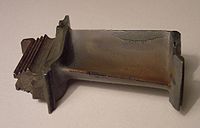
engines in regions that are subject to high temperatures which require high strength, excellent creep resistance, as well as corrosion and oxidation resistance. In most turbine engines this is in the high-pressure turbine, where air-cooled blades can face temperatures 200 °C above the melting temperature of the superalloy used. Air cooling (such as the air cooling holes seen in the picture above) and thermal barrier coatings (TBCs) play an important role in blades, allowing them to operate under such conditions, protecting the base material from the thermal effects as well as corrosion and oxidation.
Turbocharger turbines also use superalloys, typically electron beam welded
Electron beam welding
Electron beam welding is a fusion welding process in which a beam of high-velocity electrons is applied to the materials being joined. The workpieces melt as the kinetic energy of the electrons is transformed into heat upon impact, and the filler metal, if used, also melts to form part of the weld...
to a steel shaft. Common superalloys in this application are for instance Inconel 713 and Mar-M 247. The latter is particularly useful for gasoline engines as it reduce the need for fuel enrichment at high loads which improve engine efficiency.
They are also used where corrosion by media would rule-out other metal materials (e.g.) instead of stainless steel
Stainless steel
In metallurgy, stainless steel, also known as inox steel or inox from French "inoxydable", is defined as a steel alloy with a minimum of 10.5 or 11% chromium content by mass....
in acidic or saltwater environments.
Superalloys (such as Nimonic 80A) are also used in the poppet valves of piston engines, both for diesel and gasoline engines. This is either in the form of a single solid valve or as a bi-metallic valve. The corrosions resistance is particularly useful when dealing with the high temperatures and pressures found in a diesel engine. The superalloys resist pitting and degradation allowing operating conditions that would not be possible with a regular stainless steel.
Additional applications of superalloys include: gas turbines (commercial and military aircraft, power generation, and marine propulsion); space vehicles; submarines; nuclear reactors; military electric motors; racing and high-performance vehicles, chemical processing vessels, bomb casings and heat exchanger
Heat exchanger
A heat exchanger is a piece of equipment built for efficient heat transfer from one medium to another. The media may be separated by a solid wall, so that they never mix, or they may be in direct contact...
tubing.
Costs and substitutes
Superalloys have high contents of nickel, which is more expensive than iron. Moreover, sometimes even very expensive elements are used, such as rheniumRhenium
Rhenium is a chemical element with the symbol Re and atomic number 75. It is a silvery-white, heavy, third-row transition metal in group 7 of the periodic table. With an average concentration of 1 part per billion , rhenium is one of the rarest elements in the Earth's crust. The free element has...
or ruthenium
Ruthenium
Ruthenium is a chemical element with symbol Ru and atomic number 44. It is a rare transition metal belonging to the platinum group of the periodic table. Like the other metals of the platinum group, ruthenium is inert to most chemicals. The Russian scientist Karl Ernst Claus discovered the element...
. The alloying elements and heat-treatments also often make superalloys difficult to machine and weld, increasing fabrication costs, part reject rates, and rework.
A possible remedy to this is Eglin steel
Eglin Steel
Eglin steel is a high-strength, high-performance, low-alloy, low-cost steel, developed for new generation of bunker buster type bombs, eg. the Massive Ordnance Penetrator and the improved version of the GBU-28 bomb known as EGBU-28...
, a budget material with compromised temperature range and chemical resistance. It does not contain rhenium or ruthenium and its nickel content is limited. To reduce fabrication costs, it was chemically designed to melt in a ladle (though with improved properties in a vacuum crucible). Also, conventional welding and casting is possible before heat-treatment. The original purpose was to produce high-performance, inexpensive bomb casings, but the material has proven widely applicable to structural applications, including armor.
Metallurgy of superalloys
The superalloys of the first generation were intended for operation up to 700 °C (973 K). The modern superalloys of the fourth generation are made and used as single crystals (monocrystals) and are extra alloyed, especially with rutheniumRuthenium
Ruthenium is a chemical element with symbol Ru and atomic number 44. It is a rare transition metal belonging to the platinum group of the periodic table. Like the other metals of the platinum group, ruthenium is inert to most chemicals. The Russian scientist Karl Ernst Claus discovered the element...
. They can operate up to 1100 °C (1373 K).
The structure of most precipitation strengthened
Precipitation strengthening
Precipitation hardening, also called age hardening, is a heat treatment technique used to increase the yield strength of malleable materials, including most structural alloys of aluminium, magnesium, nickel and titanium, and some stainless steels...
nickel-base superalloys consists of the gamma matrix, and of intermetallic γ' precipitates. The γ-phase is a solid solution with a face-centered crystal (fcc) lattice and randomly distributed different species of atoms.
By contrast, the γ'-phase has an ordered crystalline lattice of type LI2. In pure Ni3Al phase atoms of aluminium are placed at the vertices of the cubic cell and form the sublattice A. Atoms of nickel are located at centers of the faces and form the sublattice B. The phase is not strictly stoichiometric. There may exist an excess of vacancies in one of the sublattices, which leads to deviations from stoichiometry. Sublattices A and B of the γ'-phase can solute a considerable proportion of other elements. The alloying elements are dissolved in the γ-phase as well. The γ'-phase hardens the alloy through an unusual mechanism called the yield stress anomaly. Dislocation
Dislocation
In materials science, a dislocation is a crystallographic defect, or irregularity, within a crystal structure. The presence of dislocations strongly influences many of the properties of materials...
s dissociate in the γ'-phase, leading to the formation of an anti-phase boundary
Crystallographic defect
Crystalline solids exhibit a periodic crystal structure. The positions of atoms or molecules occur on repeating fixed distances, determined by the unit cell parameters. However, the arrangement of atom or molecules in most crystalline materials is not perfect...
. It turns out that at elevated temperature, the free energy associated with the anti-phase boundary (APB) is considerably reduced if it lies on a particular plane, which by coincidence is not a permitted slip plane. One set of partial dislocations bounding the APB cross-slips so that the APB lies on the low-energy plane, and, since this low-energy plane is not a permitted slip plane, the dissociated dislocation is now effectively locked. By this mechanism, the yield strength of γ'-phase Ni3Al actually increases with temperature up to about 1000 °C, giving superalloys their currently unrivalled high-temperature strength.
In addition, it is often beneficial for a grain boundary containing nickel-base alloy to contain carbides for improvements in creep strength. Where the carbides (e.g. MC where M is a metal and C is a carbon atom) are precipitated at the grain boundaries, they act to pin the grain boundaries and improve the resistance to sliding and migration that would occur during creep diffusion. However if they precipitate as a continuous grain boundary film, the fracture toughness of the alloy may be reduced, together with the ductility and rupture strength.
Coating of superalloys
Superalloy products that are subjected to high working temperatures and corrosive atmosphere (such as high pressure turbine region of jet engines) are coated with various kinds of coatingCoating
Coating is a covering that is applied to the surface of an object, usually referred to as the substrate. In many cases coatings are applied to improve surface properties of the substrate, such as appearance, adhesion, wetability, corrosion resistance, wear resistance, and scratch resistance...
. Mainly two kinds of coating process are applied: pack cementation process and gas phase coating. Both are a type of CVD. In most cases, after the coating process near-surface regions of parts are enriched with aluminium, the matrix of the coating being nickel aluminide
Nickel aluminide
Nickel aluminide is an intermetallic material with properties similar to both a ceramic and a metal.There are three materials called nickel aluminide:* NiAl, CAS number 12003-78-0 * NiAl3, CAS number 12004-71-6* Ni3Al-Ni3Al:...
.
Pack cementation process
The pack cementation process is carried out at lower temperatures, about 750 °C. The parts are loaded into boxes that contain a mixture of powders: active coating material, containing aluminium, activatorActivator
Activator may mean:* Activator , a DNA-binding protein that regulates one or more genes by increasing the rate of transcription* Activator , a type of effector that increases the rate of enzyme mediated reactions...
(chloride
Chloride
The chloride ion is formed when the element chlorine, a halogen, picks up one electron to form an anion Cl−. The salts of hydrochloric acid HCl contain chloride ions and can also be called chlorides. The chloride ion, and its salts such as sodium chloride, are very soluble in water...
or fluoride
Fluoride
Fluoride is the anion F−, the reduced form of fluorine when as an ion and when bonded to another element. Both organofluorine compounds and inorganic fluorine containing compounds are called fluorides. Fluoride, like other halides, is a monovalent ion . Its compounds often have properties that are...
), and thermal ballast, like aluminum oxide. At high temperatures the gaseous aluminium halide
Halide
A halide is a binary compound, of which one part is a halogen atom and the other part is an element or radical that is less electronegative than the halogen, to make a fluoride, chloride, bromide, iodide, or astatide compound. Many salts are halides...
is transferred to the surface of the part and diffuses inside (mostly inward diffusion). After the end of the process the so-called "green coating" is produced, which is too thin and brittle for direct use. A subsequent diffusion heat treatment (several hours at temperatures about 1080 °C) leads to further inward diffusion and formation of the desired coating.
Gas phase coating
This process is carried out at higher temperatures, about 1080 °C. The coating material is usually loaded onto special trays without physical contact with the parts to be coated. The coating mixture contains active coating material and activator, but usually does not contain thermal ballast. As in the pack cementation process, the gaseous aluminium chloride (or fluoride) is transferred to the surface of the part. However, in this case the diffusion is outwards. This kind of coating also requires diffusion heat treatment.Bond coat
The bond coat adheres the thermal barrier coating to the superalloy substrate. Additionally, the bond coat provides oxidation protection and functions as a diffusion barrier against the motion of substrate atoms towards the environment.There are three major types of bond coats, the aluminides, the platinum-aluminides, and MCrAlY.
For the aluminide bond coatings, the final composition and structure of the coating depends on the composition of the substrate. Aluminides also lacks ductility below 750 °C, and exhibit a limited by thermomechanical fatigue strength.
The Pt-aluminides are very similar to the aluminide bond coats except for a layer of Pt (5-10 μm) deposited to the blade. The Pt is believed to aid in oxide adhesion and contributes to hot corrosion. The cost of Pt plating is justified by the increased blade life span.
The MCrAlY is the latest generation of bond coat and does not strongly interact with the substrate.
The Chromium provides oxidation and hot-corrosion resistance. The aluminum controls oxidation
mechanisms by limiting oxide growth. The yttrium enhances the oxide adherence to the substrate. Investigation have shown additions of rhenium and tantalum to increase the oxidation resistance.
Research and development of new superalloys
The availability of superalloys during past decades has led to a steady increase in the turbine entry temperatures and the trend is expected to continue. Sandia National LaboratoriesSandia National Laboratories
The Sandia National Laboratories, managed and operated by the Sandia Corporation , are two major United States Department of Energy research and development national laboratories....
is studying a new method for making superalloys, known as radiolysis
Radiolysis
Radiolysis is the dissociation of molecules by nuclear radiation. It is the cleavage of one or several chemical bonds resulting from exposure to high-energy flux...
. It introduces an entirely new area of research into creating alloys and superalloys through nanoparticle
Nanoparticle
In nanotechnology, a particle is defined as a small object that behaves as a whole unit in terms of its transport and properties. Particles are further classified according to size : in terms of diameter, coarse particles cover a range between 10,000 and 2,500 nanometers. Fine particles are sized...
synthesis. This process holds promise as a universal method of nanoparticle
Nanoparticle
In nanotechnology, a particle is defined as a small object that behaves as a whole unit in terms of its transport and properties. Particles are further classified according to size : in terms of diameter, coarse particles cover a range between 10,000 and 2,500 nanometers. Fine particles are sized...
formation. By developing an understanding of the basic material science behind these nanoparticle formations, there is speculation that it might be possible to expand research into other aspects of superalloys.
There may be considerable disadvantages in making alloys by this method. About half of the use of superalloys is in applications where the service temperature is close to the melting temperature of the alloy. It is common therefore to use single crystals. The above method produces polycrystalline alloys which will suffer from an unacceptable level of creep.
Future paradigm in alloy development focus on reduction of weight, improving oxidation and corrosion resistance while maintaining the strength of the alloy. Furthermore, with the increasing demand for turbine blade for power generation, another focus of alloy design is to reduce the cost of super alloys.