


Submarine sandwich

Encyclopedia
A submarine sandwich, also known as a sub among other names, is a sandwich
that consists of a long roll
of Italian or French bread, split lengthwise either into two pieces or opened in a "V" on one side, and filled with various varieties of meat, cheese, vegetables, seasonings, and sauces. The sandwich has no standardized name, and many U.S. regions have their own names for it; one study found 13 different names for the sandwich in the United States. The usage of the several terms varies regionally but not in any pattern, as they have been used variously by the people and enterprises who make and sell them. The terms submarine
and sub are widespread and not assignable to any certain region, though many of the localized terms are clustered in the northeast United States, where the most Italian Americans live.
from the late 19th to mid 20th centuries. The popularity of this Italian-American cuisine
has grown from its origins in Connecticut
, Pennsylvania
, Delaware
, New York
, New Jersey
, and Massachusetts
to spread to most parts of the United States
, and with the advent of chain restaurants, is now available in many parts of the world. In Europe it would simply be known as a baguette
, or a ciabatta
, named after the type of bread being used. Both types of bread are traditional breads in use in France and Italy for centuries.
.jpg) The use of the term submarine or sub is widespread. One theory is that it originated in a restaurant in Scollay Square
The use of the term submarine or sub is widespread. One theory is that it originated in a restaurant in Scollay Square
in Boston
, Massachusetts
at the beginning of World War I
. The sandwich was created to entice the large numbers of navy servicemen stationed at the Charlestown Navy Yard. The bread was a smaller specially baked baguette
intended to resemble the hull of the submarine
s it was named after.
Another theory suggests the submarine was brought to the US by Dominic Conti (1874–1954), an Italian
immigrant who came to New York in the early 1900s. In 1910 he started Dominic Conti's Grocery Store on Mill Street in Paterson, New Jersey
and named the sandwich after seeing the recovered 1901 submarine called Fenian Ram
in the local Paterson Museum
in 1918. His granddaughter has stated the following: "My grandfather came to this country circa 1895 from Montella
, Italy. Around 1910, he started his grocery store, called Dominic Conti's Grocery Store, on Mill Street in Paterson, New Jersey where he was selling the traditional Italian sandwiches. His sandwiches were made from a recipe he brought with him from Italy which consisted of a long crust roll, filled with cold cuts, topped with lettuce, tomatoes, peppers, onions, oil, vinegar, Italian herbs and spices, salt, and pepper. The sandwich started with a layer of cheese and ended with a layer of cheese (this was so the bread wouldn’t get soggy)."
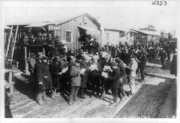 The term hoagie originated in the Philadelphia area. Domenic Vitiello, professor of Urban Studies at the University of Pennsylvania
asserts that Italians working at the World War I
era shipyard in Philadelphia, known as Hog Island
where emergency shipping
was produced for the war effort, introduced the sandwich, by putting various meats, cheeses, and lettuce between two slices of bread. This became known as the "Hog Island" sandwich; hence, the "hoagie".
The Philadelphia Almanac and Citizen's Manual offers a different explanation, that the sandwich was created by early twentieth century street vendors called "hokey-pokey men", who sold antipasto
salad, along with meats and cookies. When Gilbert and Sullivan’s operetta H.M.S. Pinafore
opened in Philadelphia in 1879, bakeries produced a long loaf called the pinafore. Entrepreneurial "hokey-pokey men" sliced the loaf in half, stuffed it with antipasto salad, and sold the world's first "hoagie".
Another explanation is that the word "hoagie" arose in the late 19th-early 20th century, among the Italian community in South Philadelphia, when "on the hoke" was a slang used to describe a destitute person. Deli owners would give away scraps of cheeses and meats in an Italian bread-roll known as a "hokie", but the Italian immigrants pronounced it "hoagie".
Other less likely explanations involve "Hogan" (a nickname for Irish workers at the Hog Island shipyard), a reference to the pork or "hog" meat used in hoagies, "honky sandwich" (using a racial slur
for white people seen eating them) or "hooky sandwich" (derived from "hookie" for truant kids seen eating them). Shortly after World War II, there were numerous varieties of the term in use throughout Philadelphia. By the 1940s, the spellings "hoagie" and, to a lesser extent, "hoagy" had come to dominate lesser user variations like "hoogie" and "hoggie". By 1955, restaurants throughout the area were using the term "hoagie", with many selling hoagies and subs or hoagies and pizza. Listings in Pittsburgh show hoagies arriving in 1961 and becoming widespread in that city by 1966.
Former Philadelphia mayor (and later Pennsylvania
governor) Ed Rendell
declared the hoagie the "Official Sandwich of Philadelphia". However, there are claims that the hoagie was actually a product of nearby Chester, Pennsylvania
. DiCostanza's in Boothwyn, Pennsylvania
claims that the mother of DiConstanza's owner originated the hoagie in 1925 in Chester
. DiCostanza relates the story that a customer came into the family deli and through the series of the customers' requests and the deli's offerings, the hoagie was created.
A local Philadelphia variation on the hoagie is the zep made in Norristown, Pennsylvania
. It is a variation on the traditional hoagie, with no lettuce and only one meat. It is made on a round roll, with provolone cheese covering meat, chunks of raw onion, and slabs of tomato. It is dressed with oregano, salt, pepper, olive oil, and hot pepper relish.
food writer Clementine Paddleford
in the 1930s, but there is no good evidence for this. It is also sometimes claimed that it is related to the gyro, but this is unlikely: heros are invariably associated with Italians, not Greeks, and gyro was unknown in the United States until the 1960s.
"Hero" (plural usually heros) remains the prevailing New York City term for most sandwiches on an oblong roll with a generally Italian flavor, in addition to the original described above. Pizzeria menus often include eggplant parmigiana, chicken parmigiana, and meatball heros, each served with tomato sauce. Pepper and egg heros and potato and egg heros are also popular.
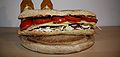 All varieties of this sandwich use an oblong bread roll
as opposed to sliced bread
. The traditional sandwich usually includes a variety of Italian luncheon meats such as dry Genoa salami
, mortadella
, thin sliced pepperoni
, capocollo or prosciutto
, and provolone
cheese served with lettuce, tomato and onions seasoned with salt, pepper, oregano and olive oil
. American bologna
is sometimes used in place of mortadella and ham
is often substituted for capicola, with prosciutto frequently omitted.
Many locations that provide catering
services also offer very large 3-foot and 6-foot "Giant" sandwiches. Crusty Italian breads are preferred for the hearty sandwiches.
Vegetarian and vegan versions stuffed with soy-based ersatz meats are also popular.
Hero
Hoagie
Zep
labor force in the Northeastern United States, the sub began to show up on menus of local pizzerias. As time went on and popularity grew, small restaurants, called Hoagie shops and Sub shops, that specialized in the sandwich began to open.
After World War II Italian food grew in popularity in the US and started to become assimilated. This brought the use of other meats to the sandwich including turkey, roast beef, American and Swiss cheese, as well as spreads such as mayonnaise and mustard.
By the late 20th century, due to the rise of large franchisee chain restaurants and fast food
, the sandwich became available worldwide. Many outlets offer non-traditional ingredient combinations.
Major multi-national chains that serve subs including the largest restaurant chain in the world, Subway
, as well as Quiznos and Mr. Sub
, with other regional American chains including Capriotti's
, Submarina
, Jersey Mike's Subs
, Charley's Grilled Subs
, Blimpie
, Jimmy John's
, Lenny's Sub Shop
, Port of Subs
, Eegee's
, Firehouse Subs
, Planet Sub
, Potbelly
, Tubby's
, Schlotzsky's
and D'Angelo Sandwich Shops
. The sandwich is also available from several supermarket
s and convenience store
s.
Sandwich
A sandwich is a food item, typically consisting of two or more slices of :bread with one or more fillings between them, or one slice of bread with a topping or toppings, commonly called an open sandwich. Sandwiches are a widely popular type of lunch food, typically taken to work or school, or...
that consists of a long roll
Bread roll
A bread roll is a piece of bread, usually small and round and is commonly considered a side dish. Bread rolls are often used in the same way as sandwiches are—cut transversely, with fillings placed between the two halves.-Various forms:...
of Italian or French bread, split lengthwise either into two pieces or opened in a "V" on one side, and filled with various varieties of meat, cheese, vegetables, seasonings, and sauces. The sandwich has no standardized name, and many U.S. regions have their own names for it; one study found 13 different names for the sandwich in the United States. The usage of the several terms varies regionally but not in any pattern, as they have been used variously by the people and enterprises who make and sell them. The terms submarine
Submarine
A submarine is a watercraft capable of independent operation below the surface of the water. It differs from a submersible, which has more limited underwater capability...
and sub are widespread and not assignable to any certain region, though many of the localized terms are clustered in the northeast United States, where the most Italian Americans live.
History and etymology
The sandwich originated in several different Italian American communities in the Northeastern United StatesNortheastern United States
The Northeastern United States is a region of the United States as defined by the United States Census Bureau.-Composition:The region comprises nine states: the New England states of Connecticut, Maine, Massachusetts, New Hampshire, Rhode Island and Vermont; and the Mid-Atlantic states of New...
from the late 19th to mid 20th centuries. The popularity of this Italian-American cuisine
Italian-American cuisine
Italian American cuisine is the cuisine of Italian American immigrants and their descendents, who have modified Italian cuisine under the influence of American culture and immigration patterns of Italians to the United States...
has grown from its origins in Connecticut
Connecticut
Connecticut is a state in the New England region of the northeastern United States. It is bordered by Rhode Island to the east, Massachusetts to the north, and the state of New York to the west and the south .Connecticut is named for the Connecticut River, the major U.S. river that approximately...
, Pennsylvania
Pennsylvania
The Commonwealth of Pennsylvania is a U.S. state that is located in the Northeastern and Mid-Atlantic regions of the United States. The state borders Delaware and Maryland to the south, West Virginia to the southwest, Ohio to the west, New York and Ontario, Canada, to the north, and New Jersey to...
, Delaware
Delaware
Delaware is a U.S. state located on the Atlantic Coast in the Mid-Atlantic region of the United States. It is bordered to the south and west by Maryland, and to the north by Pennsylvania...
, New York
New York
New York is a state in the Northeastern region of the United States. It is the nation's third most populous state. New York is bordered by New Jersey and Pennsylvania to the south, and by Connecticut, Massachusetts and Vermont to the east...
, New Jersey
New Jersey
New Jersey is a state in the Northeastern and Middle Atlantic regions of the United States. , its population was 8,791,894. It is bordered on the north and east by the state of New York, on the southeast and south by the Atlantic Ocean, on the west by Pennsylvania and on the southwest by Delaware...
, and Massachusetts
Massachusetts
The Commonwealth of Massachusetts is a state in the New England region of the northeastern United States of America. It is bordered by Rhode Island and Connecticut to the south, New York to the west, and Vermont and New Hampshire to the north; at its east lies the Atlantic Ocean. As of the 2010...
to spread to most parts of the United States
United States
The United States of America is a federal constitutional republic comprising fifty states and a federal district...
, and with the advent of chain restaurants, is now available in many parts of the world. In Europe it would simply be known as a baguette
Baguette
A baguette is "a long thin loaf of French bread" that is commonly made from basic lean dough...
, or a ciabatta
Ciabatta
Ciabatta is an Italian white bread made with wheat flour and yeast. The loaf is somewhat elongated, broad and flattish. There are many variations of ciabatta.Ciabatta in its modern form was developed in 1982...
, named after the type of bread being used. Both types of bread are traditional breads in use in France and Italy for centuries.
Submarine
Scollay Square
Scollay Square was a vibrant city square in downtown Boston, Massachusetts. It was named for William Scollay, a prominent local developer and militia officer who bought a landmark four-story merchant building at the intersection of Cambridge and Court Streets in 1795...
in Boston
Boston
Boston is the capital of and largest city in Massachusetts, and is one of the oldest cities in the United States. The largest city in New England, Boston is regarded as the unofficial "Capital of New England" for its economic and cultural impact on the entire New England region. The city proper had...
, Massachusetts
Massachusetts
The Commonwealth of Massachusetts is a state in the New England region of the northeastern United States of America. It is bordered by Rhode Island and Connecticut to the south, New York to the west, and Vermont and New Hampshire to the north; at its east lies the Atlantic Ocean. As of the 2010...
at the beginning of World War I
World War I
World War I , which was predominantly called the World War or the Great War from its occurrence until 1939, and the First World War or World War I thereafter, was a major war centred in Europe that began on 28 July 1914 and lasted until 11 November 1918...
. The sandwich was created to entice the large numbers of navy servicemen stationed at the Charlestown Navy Yard. The bread was a smaller specially baked baguette
Baguette
A baguette is "a long thin loaf of French bread" that is commonly made from basic lean dough...
intended to resemble the hull of the submarine
Submarine
A submarine is a watercraft capable of independent operation below the surface of the water. It differs from a submersible, which has more limited underwater capability...
s it was named after.
Another theory suggests the submarine was brought to the US by Dominic Conti (1874–1954), an Italian
Italian people
The Italian people are an ethnic group that share a common Italian culture, ancestry and speak the Italian language as a mother tongue. Within Italy, Italians are defined by citizenship, regardless of ancestry or country of residence , and are distinguished from people...
immigrant who came to New York in the early 1900s. In 1910 he started Dominic Conti's Grocery Store on Mill Street in Paterson, New Jersey
Paterson, New Jersey
Paterson is a city serving as the county seat of Passaic County, New Jersey, United States. As of the 2010 United States Census, its population was 146,199, rendering it New Jersey's third largest city and one of the largest cities in the New York City Metropolitan Area, despite a decrease of 3,023...
and named the sandwich after seeing the recovered 1901 submarine called Fenian Ram
Fenian Ram
Fenian Ram is a submarine designed by John Philip Holland for use by the Fenian Brotherhood, American counterpart to the Irish Republican Brotherhood, against the British...
in the local Paterson Museum
Paterson Museum
Paterson Museum is a museum in Paterson, in Passaic County, New Jersey, in the United States. Founded in 1925, it is owned and run by the city of Paterson and its mission is to preserve and display the industrial history of Paterson...
in 1918. His granddaughter has stated the following: "My grandfather came to this country circa 1895 from Montella
Montella
Montella is a town with 7,979 inhabitants, comune in the province of Avellino, Campania, Italy. The zone was inhabited already in the neolithic period. The town was born like Sannites' village in the I millennium a.C., to become a Municipality of Roman empire and town under the...
, Italy. Around 1910, he started his grocery store, called Dominic Conti's Grocery Store, on Mill Street in Paterson, New Jersey where he was selling the traditional Italian sandwiches. His sandwiches were made from a recipe he brought with him from Italy which consisted of a long crust roll, filled with cold cuts, topped with lettuce, tomatoes, peppers, onions, oil, vinegar, Italian herbs and spices, salt, and pepper. The sandwich started with a layer of cheese and ended with a layer of cheese (this was so the bread wouldn’t get soggy)."
Hoagie
University of Pennsylvania
The University of Pennsylvania is a private, Ivy League university located in Philadelphia, Pennsylvania, United States. Penn is the fourth-oldest institution of higher education in the United States,Penn is the fourth-oldest using the founding dates claimed by each institution...
asserts that Italians working at the World War I
World War I
World War I , which was predominantly called the World War or the Great War from its occurrence until 1939, and the First World War or World War I thereafter, was a major war centred in Europe that began on 28 July 1914 and lasted until 11 November 1918...
era shipyard in Philadelphia, known as Hog Island
Hog Island, Philadelphia, Pennsylvania
Hog Island is the historic name of an area southwest of the central part of Philadelphia, Pennsylvania along the Delaware River, to the west of the mouth of the Schuylkill River. Philadelphia International Airport now sits on the land that was once Hog Island....
where emergency shipping
Hog Islander
Hog Islanders is the slang for ships built to Emergency Fleet Corporation designs number 1022 and 1024. These vessels were cargo and transport ships, respectively, built under government direction and subsidy to address a shortage of ships in the United States Merchant Marine during World War...
was produced for the war effort, introduced the sandwich, by putting various meats, cheeses, and lettuce between two slices of bread. This became known as the "Hog Island" sandwich; hence, the "hoagie".
The Philadelphia Almanac and Citizen's Manual offers a different explanation, that the sandwich was created by early twentieth century street vendors called "hokey-pokey men", who sold antipasto
Antipasto
Antipasto , means "before the meal" and is the traditional first course of a formal Italian meal. Traditional antipasto includes cured meats, olives, roasted garlic, peperoncini, mushrooms, anchovies, artichoke hearts, various cheeses...
salad, along with meats and cookies. When Gilbert and Sullivan’s operetta H.M.S. Pinafore
H.M.S. Pinafore
H.M.S. Pinafore; or, The Lass That Loved a Sailor is a comic opera in two acts, with music by Arthur Sullivan and a libretto by W. S. Gilbert. It opened at the Opera Comique in London, England, on 25 May 1878 and ran for 571 performances, which was the second-longest run of any musical...
opened in Philadelphia in 1879, bakeries produced a long loaf called the pinafore. Entrepreneurial "hokey-pokey men" sliced the loaf in half, stuffed it with antipasto salad, and sold the world's first "hoagie".
Another explanation is that the word "hoagie" arose in the late 19th-early 20th century, among the Italian community in South Philadelphia, when "on the hoke" was a slang used to describe a destitute person. Deli owners would give away scraps of cheeses and meats in an Italian bread-roll known as a "hokie", but the Italian immigrants pronounced it "hoagie".
Other less likely explanations involve "Hogan" (a nickname for Irish workers at the Hog Island shipyard), a reference to the pork or "hog" meat used in hoagies, "honky sandwich" (using a racial slur
Honky
Honky is a racial slur for white people, predominantly heard in the United States...
for white people seen eating them) or "hooky sandwich" (derived from "hookie" for truant kids seen eating them). Shortly after World War II, there were numerous varieties of the term in use throughout Philadelphia. By the 1940s, the spellings "hoagie" and, to a lesser extent, "hoagy" had come to dominate lesser user variations like "hoogie" and "hoggie". By 1955, restaurants throughout the area were using the term "hoagie", with many selling hoagies and subs or hoagies and pizza. Listings in Pittsburgh show hoagies arriving in 1961 and becoming widespread in that city by 1966.
Former Philadelphia mayor (and later Pennsylvania
Pennsylvania
The Commonwealth of Pennsylvania is a U.S. state that is located in the Northeastern and Mid-Atlantic regions of the United States. The state borders Delaware and Maryland to the south, West Virginia to the southwest, Ohio to the west, New York and Ontario, Canada, to the north, and New Jersey to...
governor) Ed Rendell
Ed Rendell
Edward Gene "Ed" Rendell is an American politician who served as the 45th Governor of Pennsylvania. Rendell, a member of the Democratic Party, was elected Governor of Pennsylvania in 2002, and his term of office began January 21, 2003...
declared the hoagie the "Official Sandwich of Philadelphia". However, there are claims that the hoagie was actually a product of nearby Chester, Pennsylvania
Chester, Pennsylvania
Chester is a city in Delaware County, Pennsylvania, United States, with a population of 33,972 at the 2010 census. Chester is situated on the Delaware River, between the cities of Philadelphia and Wilmington, Delaware.- History :...
. DiCostanza's in Boothwyn, Pennsylvania
Boothwyn, Pennsylvania
Boothwyn is a census-designated place in Delaware County, Pennsylvania, United States. The population was 5,206 at the 2000 census.-Geography:Boothwyn is located at ....
claims that the mother of DiConstanza's owner originated the hoagie in 1925 in Chester
Chester, Pennsylvania
Chester is a city in Delaware County, Pennsylvania, United States, with a population of 33,972 at the 2010 census. Chester is situated on the Delaware River, between the cities of Philadelphia and Wilmington, Delaware.- History :...
. DiCostanza relates the story that a customer came into the family deli and through the series of the customers' requests and the deli's offerings, the hoagie was created.
A local Philadelphia variation on the hoagie is the zep made in Norristown, Pennsylvania
Norristown, Pennsylvania
Norristown is a municipality in Montgomery County, Pennsylvania, northwest of the city limits of Philadelphia, on the Schuylkill River. The population was 34,324 as of the 2010 census. It is the county seat of Montgomery County...
. It is a variation on the traditional hoagie, with no lettuce and only one meat. It is made on a round roll, with provolone cheese covering meat, chunks of raw onion, and slabs of tomato. It is dressed with oregano, salt, pepper, olive oil, and hot pepper relish.
Hero
The New York term hero is first attested in 1937. The name is sometimes credited to the New York Herald TribuneNew York Herald Tribune
The New York Herald Tribune was a daily newspaper created in 1924 when the New York Tribune acquired the New York Herald.Other predecessors, which had earlier merged into the New York Tribune, included the original The New Yorker newsweekly , and the Whig Party's Log Cabin.The paper was home to...
food writer Clementine Paddleford
Clementine Paddleford
Clementine Paddleford was an American food writer active from the 1920s through the 1960s, writing for several publications, including the New York Herald Tribune, the New York Sun, The New York Telegram, Farm and Fireside, and This Week magazine...
in the 1930s, but there is no good evidence for this. It is also sometimes claimed that it is related to the gyro, but this is unlikely: heros are invariably associated with Italians, not Greeks, and gyro was unknown in the United States until the 1960s.
"Hero" (plural usually heros) remains the prevailing New York City term for most sandwiches on an oblong roll with a generally Italian flavor, in addition to the original described above. Pizzeria menus often include eggplant parmigiana, chicken parmigiana, and meatball heros, each served with tomato sauce. Pepper and egg heros and potato and egg heros are also popular.
Other names
- Barb Mills (ham and provolone cheese, baked)—North Central Pennsylvania, Jersey Shore, Pennsylvania in the 50's and 60's
- Blimpie (shaped like a blimpBlimpA blimp, or non-rigid airship, is a floating airship without an internal supporting framework or keel. A non-rigid airship differs from a semi-rigid airship and a rigid airship in that it does not have any rigid structure, neither a complete framework nor a partial keel, to help the airbag...
)—From the Hoboken, New JerseyHoboken, New JerseyHoboken is a city in Hudson County, New Jersey, United States. As of the 2010 United States Census, the city's population was 50,005. The city is part of the New York metropolitan area and contains Hoboken Terminal, a major transportation hub for the region...
–founded chain, BlimpieBlimpieBlimpie is a submarine sandwich chain in the United States. The company is based in Scottsdale, Arizona.The first Blimpie store was opened in Hoboken, New Jersey, in 1964. . By mid-2002, there were about 2,000 Blimpie outlets in operation, located in 47 U.S...
. - Bomber (shaped like a bomberBomberA bomber is a military aircraft designed to attack ground and sea targets, by dropping bombs on them, or – in recent years – by launching cruise missiles at them.-Classifications of bombers:...
plane)—Upstate New York - Continental Roll—Australia
- Cosmo (cosmopolitan)—North Central Pennsylvania near WilliamsportWilliamsport, PennsylvaniaWilliamsport is a city in and the county seat of Lycoming County, Pennsylvania in the United States. In 2009, the population was estimated at 29,304...
: a hot hoagie or a grinder - Filled Roll—New ZealandNew ZealandNew Zealand is an island country in the south-western Pacific Ocean comprising two main landmasses and numerous smaller islands. The country is situated some east of Australia across the Tasman Sea, and roughly south of the Pacific island nations of New Caledonia, Fiji, and Tonga...
- Grinder (Italian-American slang for a dock worker)—New EnglandNew EnglandNew England is a region in the northeastern corner of the United States consisting of the six states of Maine, New Hampshire, Vermont, Massachusetts, Rhode Island, and Connecticut...
, Inland EmpireInland Empire (California)The Inland Empire is a region in Southern California. The region sits directly east of the Los Angeles metropolitan area. The Inland Empire most commonly is used in reference to the U.S. Census Bureau's federally-defined Riverside-San Bernardino-Ontario metropolitan area, which covers more than...
of Southern California. Called grinder because it took a lot of chewing to eat the hard crust of the bread used. In Pennsylvania, the term grinder refers to a sandwich that has been heated. In eastern Massachusetts a grinder is a toasted sub, for example the sub is toasted in a pizza oven. - Hoagie—Southern New JerseyNew JerseyNew Jersey is a state in the Northeastern and Middle Atlantic regions of the United States. , its population was 8,791,894. It is bordered on the north and east by the state of New York, on the southeast and south by the Atlantic Ocean, on the west by Pennsylvania and on the southwest by Delaware...
, and South-East and Central PennsylvaniaPennsylvaniaThe Commonwealth of Pennsylvania is a U.S. state that is located in the Northeastern and Mid-Atlantic regions of the United States. The state borders Delaware and Maryland to the south, West Virginia to the southwest, Ohio to the west, New York and Ontario, Canada, to the north, and New Jersey to...
—usually denotes lettuce, tomato and onions included. - Italian Sandwich—MaineMaineMaine is a state in the New England region of the northeastern United States, bordered by the Atlantic Ocean to the east and south, New Hampshire to the west, and the Canadian provinces of Quebec to the northwest and New Brunswick to the northeast. Maine is both the northernmost and easternmost...
and other parts of New England. - Poor boy—St. LouisSt. Louis, MissouriSt. Louis is an independent city on the eastern border of Missouri, United States. With a population of 319,294, it was the 58th-largest U.S. city at the 2010 U.S. Census. The Greater St...
- Po' Boy—LouisianaLouisianaLouisiana is a state located in the southern region of the United States of America. Its capital is Baton Rouge and largest city is New Orleans. Louisiana is the only state in the U.S. with political subdivisions termed parishes, which are local governments equivalent to counties...
- Rocket (shaped like a rocketRocketA rocket is a missile, spacecraft, aircraft or other vehicle which obtains thrust from a rocket engine. In all rockets, the exhaust is formed entirely from propellants carried within the rocket before use. Rocket engines work by action and reaction...
)—various areas. - Sous-marin—a variety popular in Montreal (also a literal translation of "submarine" into French)
- Spuckie (Italian-American slang for a long roll)—BostonBostonBoston is the capital of and largest city in Massachusetts, and is one of the oldest cities in the United States. The largest city in New England, Boston is regarded as the unofficial "Capital of New England" for its economic and cultural impact on the entire New England region. The city proper had...
, MassachusettsMassachusettsThe Commonwealth of Massachusetts is a state in the New England region of the northeastern United States of America. It is bordered by Rhode Island and Connecticut to the south, New York to the west, and Vermont and New Hampshire to the north; at its east lies the Atlantic Ocean. As of the 2010...
(used particularly in ItalianItalian peopleThe Italian people are an ethnic group that share a common Italian culture, ancestry and speak the Italian language as a mother tongue. Within Italy, Italians are defined by citizenship, regardless of ancestry or country of residence , and are distinguished from people...
immigrant neighborhoods) - Sub—New JerseyNew JerseyNew Jersey is a state in the Northeastern and Middle Atlantic regions of the United States. , its population was 8,791,894. It is bordered on the north and east by the state of New York, on the southeast and south by the Atlantic Ocean, on the west by Pennsylvania and on the southwest by Delaware...
, MassachusettsMassachusettsThe Commonwealth of Massachusetts is a state in the New England region of the northeastern United States of America. It is bordered by Rhode Island and Connecticut to the south, New York to the west, and Vermont and New Hampshire to the north; at its east lies the Atlantic Ocean. As of the 2010... - Torpedo (shaped like a torpedoTorpedoThe modern torpedo is a self-propelled missile weapon with an explosive warhead, launched above or below the water surface, propelled underwater towards a target, and designed to detonate either on contact with it or in proximity to it.The term torpedo was originally employed for...
)—New York, New Jersey, other areas. - Tunnel—Various New England areas.
- Wedge (served between two wedges of bread)—Prevalent in Yonkers, New YorkYonkers, New YorkYonkers is the fourth most populous city in the state of New York , and the most populous city in Westchester County, with a population of 195,976...
and other parts of Westchester County, New YorkWestchester County, New YorkWestchester County is a county located in the U.S. state of New York. Westchester covers an area of and has a population of 949,113 according to the 2010 Census, residing in 45 municipalities...
, The BronxThe BronxThe Bronx is the northernmost of the five boroughs of New York City. It is also known as Bronx County, the last of the 62 counties of New York State to be incorporated...
, lower Fairfield County, ConnecticutFairfield County, ConnecticutFairfield County is a county located in the southwestern corner of the U.S. state of Connecticut. The county population is 916,829 according to the 2010 Census. There are currently 1,465 people per square mile in the county. It is the most populous county in the State of Connecticut and contains...
, and portions of Upstate New YorkUpstate New YorkUpstate New York is the region of the U.S. state of New York that is located north of the core of the New York metropolitan area.-Definition:There is no clear or official boundary between Upstate New York and Downstate New York...
.
Ingredients and preparation
Bread roll
A bread roll is a piece of bread, usually small and round and is commonly considered a side dish. Bread rolls are often used in the same way as sandwiches are—cut transversely, with fillings placed between the two halves.-Various forms:...
as opposed to sliced bread
Sliced bread
Sliced bread is a loaf of bread which has been pre-sliced and packaged for convenience. It was first sold in 1928, advertised as "the greatest forward step in the baking industry since bread was wrapped." This led to the popular phrase, "the greatest thing since sliced bread".- History :Otto...
. The traditional sandwich usually includes a variety of Italian luncheon meats such as dry Genoa salami
Genoa salami
The original Genoese sausage is the salame genovese di Sant'Olcese, which is a "prodotto agroalimentare tradizionale" , and originates in the hilly interior of its province where pigs could be easily maintained on acorns, chestnuts, and hazelnuts of the local Mediterranean woodlands.Genoa salami is...
, mortadella
Mortadella
Mortadella is a large Italian sausage or cold cut made of finely hashed or ground, heat-cured pork sausage, which incorporates at least 15% small cubes of pork fat . Mortadella is a staple product of Bologna, Italy...
, thin sliced pepperoni
Pepperoni
Pepperoni is a spicy Italian-American variety of salami usually made from cured pork and beef, but poultry may be added, if labeled correctly, for less expensive versions. Pepperoni is characteristically soft, slightly smoky, and bright red in color...
, capocollo or prosciutto
Prosciutto
Prosciutto |ham]]) or Parma ham is a dry-cured ham that is usually thinly sliced and served uncooked; this style is called prosciutto crudo in Italian and is distinguished from cooked ham, prosciutto cotto....
, and provolone
Provolone
Provolone is an Italian cheese that originated in Southern Italy, where it is still produced in various shapes as in 10 to 15 cm long pear, sausage, or cone shapes. A variant of Provolone is also produced in North America and Japan...
cheese served with lettuce, tomato and onions seasoned with salt, pepper, oregano and olive oil
Olive oil
Olive oil is an oil obtained from the olive , a traditional tree crop of the Mediterranean Basin. It is commonly used in cooking, cosmetics, pharmaceuticals, and soaps and as a fuel for traditional oil lamps...
. American bologna
Bologna sausage
Bologna sausage is an American sausage derived from and definitely not similar to the Italian mortadella . It is commonly called boloney, baloney or, more formally, bologna...
is sometimes used in place of mortadella and ham
Ham
Ham is a cut of meat from the thigh of the hind leg of certain animals, especiallypigs. Nearly all hams sold today are fully cooked or cured.-Etymology:...
is often substituted for capicola, with prosciutto frequently omitted.
Many locations that provide catering
Catering
Catering is the business of providing foodservice at a remote site or a site such as a hotel, public house , or other location.-Mobile catering:A mobile caterer serves food directly from a vehicle or cart that is designed for the purpose...
services also offer very large 3-foot and 6-foot "Giant" sandwiches. Crusty Italian breads are preferred for the hearty sandwiches.
Vegetarian and vegan versions stuffed with soy-based ersatz meats are also popular.
Regional variations
Grinder- Grinders are sometimes made with toasted focacciaFocacciaFocaccia is a flat oven-baked Italian bread, which may be topped with herbs or other ingredients. It is related to pizza, but not considered to be the same....
bread and melted mozzarellaMozzarellaMozzarella is an Italian Traditional Speciality Guaranteed food product. The term is used for several kinds of Italian cheeses that are made using spinning and then cutting :...
cheese. - Both hot and cold sandwiches have been called "grinders", though the term usually refers to a baked or toasted sandwich with sauce.
Hero
- Tomatoes were not a historical ingredient of the hero, but are often included in today's heros. Baltimore has usually preferred the term Hero, to nearby Philadelphia's Hoagie and Washington DC's Gryo. Italian communities existed in these cities.
Hoagie
- Philadelphia-style hoagies should have bread that is crusty on the outside and soft on the inside.
- Quite often, much of the roll's inside will be removed to allow for the ingredients to fit.
- Hoagies often have more than one deli meat (never fish or chicken).
- Mustard and vinegar were not traditionally used in hoagies. The traditional dressing was olive oil.
Zep
- A standard zep contains only cooked salami and provolone as the meat and cheese, and includes no lettuce.
Other variations
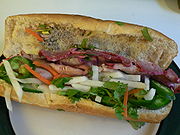
- Bacon—bacon and provolone cheese, topped with lettuce, tomatoes, raw onions, and sometimes sweet peppers
- Bánh mìBánh mìBánh mì or bánh mỳ is a Vietnamese term for all kinds of bread. Bread, or more specifically the baguette, was introduced by the French during its colonial period. The bread most commonly found in Vietnam is single serve and resembles a torpedo, therefore the term bánh mì is synonymous with this...
—Vietnamese baguette with pickled carrots and daikon, onions, cucumbers, cilantro, jalapeño peppers and meat or tofu - Breakfast—generally consists of bacon, eggs and cheese
- Cheese—white American or provolone or both (mixed), sometimes also Swiss cheeseSwiss cheeseSwiss cheese is a generic name in North America for several related varieties of cheese which resemble the Swiss Emmental. Some types of Swiss cheese have a distinctive appearance, as the blocks of the cheese are riddled with holes known as "eyes". Swiss cheese has a piquant, but not very sharp,...
- Cheeseburger—hot, with cut hamburger patties and melted yellow American cheese. Additional common burger toppings, such as lettuce, onions, tomatoes, and mustard, are optional.
- CheesesteakCheesesteakA cheesesteak, also known as a Philadelphia cheesesteak, Philly cheesesteak, cheese steak, or steak and cheese, is a sandwich made from thinly-sliced pieces of steak and melted cheese in a long roll...
—thinly sliced pieces of steak and melted cheese (AmericanAmerican cheeseAmerican cheese is a processed cheese. It is orange, yellow, or white in color and mild in flavor, with a medium-firm consistency, and melts easily. American cheese was originally only white, but is usually now modified to yellow. In the past it was made from a blend of cheeses, most often Colby...
, Provolone or, as is common in the Philadelphia region, processed cheese such as Cheez WhizCheez WhizCheez Whiz is a thick processed cheese sauce or spread sold by Kraft Foods. It was developed by a team led by food scientist Edwin Traisman and was first marketed in 1953....
) on a long roll - Chicken—depending on the deli, this can be a cold cut of sliced chicken, a fried chicken finger or breast, chicken saladChicken saladChicken salad is any salad that comprises chicken as a main ingredient. Other common ingredients include mayonnaise, hard-boiled egg, celery, pepper, peas and a variety of mustards....
, or a variation on a local speciality as in the below "chicken cheesesteak". In recent years, the expansion of buffalo sauce–flavored chicken has drastically increased the number of chicken variants available, and many restaurants and delis offer a variety of chicken sandwiches. - Chicken Cheesesteak—thinly sliced pieces of chicken and melted cheese on a long roll
- "Corned Beef" served hot (with or without cabbage) or cold (as a sliced deli meat)
- Fish—some variety of whitingMerlangius merlangusMerlangius merlangus, commonly known as whiting is an important food fish in the eastern North Atlantic, northern Mediterranean, western Baltic, and Black Sea...
, breaded and lightly fried, typically with tartar sauceTartar sauceTartare sauce is a creamy white sauce frequently used to season fried seafood dishes.-Composition:... - Gyro with the traditional pita being replaced with a sandwich roll.
- Ham and cheese—hot or cold with provolone cheese, lettuce, tomatoes, onions, mayonnaise or oil, hot peppers and ground pepper
- Italian beefItalian beefAn Italian beef is a sandwich of thin slices of seasoned roast beef, dripping with meat juices, on a dense, long Italian-style roll, believed to have originated in Chicago, where its history dates back at least to the 1930s...
, or simply "beef sandwich"—Italian beef, au jusAu jusAu jus is French for "with [its own] juice"; jus is the juice itself.In American cuisine, the term is mostly used to refer to a light sauce for beef recipes, which may be served with the food or placed on the side for dipping...
, sweet peppers and often cheese and marinara. Popular mostly in the Chicago area. Also available as a "combo", which is an Italian beef and an Italian sausage combined. - MeatballMeatballA meatball is made from an amount of ground meat rolled into a small ball, sometimes along with other ingredients, such as breadcrumbs, minced onion, spices, and possibly eggs...
—meatballs in marinara sauce often with green peppers and onions and covered with AmericanAmerican cheeseAmerican cheese is a processed cheese. It is orange, yellow, or white in color and mild in flavor, with a medium-firm consistency, and melts easily. American cheese was originally only white, but is usually now modified to yellow. In the past it was made from a blend of cheeses, most often Colby...
or provolone cheese - Po' boyPo' boyA po' boy is a traditional submarine sandwich from Louisiana. It almost always consists of meat, usually roast, or seafood, usually fried, served on baguette-like New Orleans French bread, known for its crisp crust yet fluffy center.-Preparation:A key ingredient that differentiates po' boys from...
—Louisiana creoleLouisiana Creole cuisineLouisiana Creole cuisine is a style of cooking originating in Louisiana which blends French, Spanish, Portuguese, Italian, Greek, Asian Indian, Native American, and African influences, as well as general Southern cuisine...
style usually containing fried seafood on baguette-like Louisiana French bread. - Puritan or Pilgrim—turkey, stuffing and cranberry sauce. Mostly found in sub shops around New England. Also known as a Christmas Sandwich in the United KingdomUnited KingdomThe United Kingdom of Great Britain and Northern IrelandIn the United Kingdom and Dependencies, other languages have been officially recognised as legitimate autochthonous languages under the European Charter for Regional or Minority Languages...
. Also known as a "Bobbie" in some localities. - Roast beefRoast beefRoast beef is a dish of beef which is roasted in an oven. Essentially prepared as a main meal, the leftovers can be and are often served within sandwiches and sometimes is used to make hash...
—as lunchmeat, with Swiss cheese, lettuce, tomatoes, raw onions, and mayonnaise or a vinegar and oil sauce - Roast pork—hot or cold
- Sausage sandwichSausage sandwichA sausage sandwich is a sandwich containing cooked sausage. It generally consists of an oblong bread roll such as a baguette or ciabatta roll, and sliced or whole links of sausage, such as hot or sweet Italian sausage, Polish sausage, German sausage , Mediterranean merguez, American andouille or...
—German, ItalianItalian sausageIn the United States, Italian sausage most often refers to a style of pork sausage noted for being seasoned with fennel and/or anise as the primary seasoning...
, Polish, or AndouilleAndouilleAndouille is defined as a coarse-grained smoked sausage made using pork, pepper, onions, wine, and seasonings. Andouille is French in origin, and was later brought to the United States through Louisiana by French immigrants. In the United States, the sausage is most often associated with Cajun...
sausage with peppers, onions, sauerkraut or marinara. Popular at carnivals and fairs. - Tofu—Tofu, often lightly fried, with cilantro, cucumber, jalapeño, onion, and carrot.
- Tuna—either tuna salad or (especially in more ethnically Italian shops) Italian (canned) tuna in olive oil
- Turkey—hot or cold with provolone cheese
- Veal Parm or Chicken Parm—filled with deep fried veal or chicken cutlet, marinara sauce, mozzarella and occasionally onions and peppers. Almost always served hot.
- VeggieVegetableThe noun vegetable usually means an edible plant or part of a plant other than a sweet fruit or seed. This typically means the leaf, stem, or root of a plant....
—vegetables such as peppers, mushrooms, and broccoli rabe, or even vegan versions with no meat or dairy products
Popularity and availability
From its origins with the Italian AmericanItalian American
An Italian American , is an American of Italian ancestry. The designation may also refer to someone possessing Italian and American dual citizenship...
labor force in the Northeastern United States, the sub began to show up on menus of local pizzerias. As time went on and popularity grew, small restaurants, called Hoagie shops and Sub shops, that specialized in the sandwich began to open.
After World War II Italian food grew in popularity in the US and started to become assimilated. This brought the use of other meats to the sandwich including turkey, roast beef, American and Swiss cheese, as well as spreads such as mayonnaise and mustard.
By the late 20th century, due to the rise of large franchisee chain restaurants and fast food
Fast food
Fast food is the term given to food that can be prepared and served very quickly. While any meal with low preparation time can be considered to be fast food, typically the term refers to food sold in a restaurant or store with preheated or precooked ingredients, and served to the customer in a...
, the sandwich became available worldwide. Many outlets offer non-traditional ingredient combinations.
Major multi-national chains that serve subs including the largest restaurant chain in the world, Subway
Subway (restaurant)
Subway is an American restaurant franchise that primarily sells submarine sandwiches and salads. It is owned and operated by Doctor's Associates, Inc. . Subway is one of the fastest growing franchises in the world with 35,519 restaurants in 98 countries and territories as of October 25th, 2011...
, as well as Quiznos and Mr. Sub
Mr. Sub
Mr. Sub, originally called Mr. Submarine before the 1990s, is a chain of 335 submarine sandwich shops in Canada. The first store was opened in 1968 in Toronto's Yorkville neighbourhood, which was then known for its "hippie" culture....
, with other regional American chains including Capriotti's
Capriotti's
Capriotti’s Sandwich Shop is a Las Vegas-based group of submarine sandwich restaurants located throughout the United States. It was founded in Wilmington, Delaware in 1976. The chain has more than 60 stores in 11 states...
, Submarina
Submarina
Submarina is an American chain of fast-food restaurants. Founded in 1977, the chain specializes in sub sandwiches.-History:Submarina was founded by Ron Vickers and Les Warfield of Reno, Nevada. They opened their first shop in Poway, California and later opened the first official franchise shop in...
, Jersey Mike's Subs
Jersey Mike's Subs
Jersey Mike's Subs is a submarine sandwich, or "sub", chain headquartered in Manasquan, New Jersey. The Jersey Mike's franchise has more than 400 stores across the United States.-History:...
, Charley's Grilled Subs
Charley's Grilled Subs
Charley's Grilled Subs is a sandwich chain headquartered in Columbus, Ohio.The chain has 400 locations in 46 states and Puerto Rico in the United States and in 15 other countries, including Canada, Dubai, Germany, Guam, Italy, Iraq, Japan, Korea, Kuwait, Panama, Qatar, Saudi Arabia, United Kingdom,...
, Blimpie
Blimpie
Blimpie is a submarine sandwich chain in the United States. The company is based in Scottsdale, Arizona.The first Blimpie store was opened in Hoboken, New Jersey, in 1964. . By mid-2002, there were about 2,000 Blimpie outlets in operation, located in 47 U.S...
, Jimmy John's
Jimmy John's
Jimmy John's is a franchised sandwich restaurant founded by Jimmy John Liautaud in 1983 and headquartered in Champaign, Illinois. The franchise has over 1000 locations in 39 states and has opened approximately 200 units per year for the last three years...
, Lenny's Sub Shop
Lenny's Sub Shop
Lenny's Sub Shop is a Philadelphia-style sub shop which has franchises located across the United States.-History:Lenny's was founded in Bartlett, Tennessee in 1998 by Len and Shelia Moore. There are about 200 locations across North America in 20 states...
, Port of Subs
Port of Subs
Port of Subs is a franchise submarine sandwich shop located exclusively in the western United States and headquartered in Reno, Nevada. It was founded in Sparks, Nevada under the name "Sub Shop" by two brothers from New Jersey...
, Eegee's
Eegee's
eegee's is a chain of 23 fast food restaurants in the greater areas of Tucson, Arizona, as well as 1 in Casa Grande. It specializes in submarine sandwiches known as grinders, but it is most famous for its frozen slush drinks, officially called "eegee's drinks" but colloquially known simply as...
, Firehouse Subs
Firehouse Subs
Firehouse Subs, is a US-based, fast casual restaurant chain that specializes in hot subs. Founded in 1994 in Jacksonville, Florida by former firefighter brothers Robin and Chris Sorensen, Firehouse Subs serves sandwiches with meats and cheeses, "steamed" hot and placed on produce on a toasted sub...
, Planet Sub
Planet Sub
Planet Sub is a chain of sandwich shops found in the Midwestern United States and popular in college towns. They feature sandwiches that are made from whole wheat bread and a variety of meats, cheeses and vegetables...
, Potbelly
Potbelly Sandwich Works
Potbelly Sandwich Works is a privately held restaurant chain that sells submarine sandwiches in the United States. Its name is derived from potbelly stoves common in the late 19th century. The company is headquartered in the tower of the Merchandise Mart in the Near North Side, Chicago,...
, Tubby's
Tubby's
Tubby's is the name of an American restaurant chain based in Clinton Charter Township, Michigan, a suburb of Detroit, Michigan. Founded in 1968 in nearby St. Clair Shores, the chain operates more than 70 stores throughout Michigan, primarily in the Detroit metropolitan area...
, Schlotzsky's
Schlotzsky's
Schlotzsky's is a privately held franchise chain of restaurants, specializing in sandwiches, headquartered in Downtown Austin, Texas. Schlotzsky's has more than 350 franchised and company-owned locations worldwide...
and D'Angelo Sandwich Shops
D'Angelo Sandwich Shops
D'Angelo Sandwich Shops is a chain of sandwich shops located throughout New England. It serves various kinds of hot and cold subs, wraps, and salads.- History :...
. The sandwich is also available from several supermarket
Supermarket
A supermarket, a form of grocery store, is a self-service store offering a wide variety of food and household merchandise, organized into departments...
s and convenience store
Convenience store
A convenience store, corner store, corner shop, commonly called a bodega in Spanish-speaking areas of the United States, is a small store or shop in a built up area that stocks a range of everyday items such as groceries, toiletries, alcoholic and soft drinks, and may also offer money order and...
s.
See also
- Panini
- Cuban sandwichCuban sandwichA Cuban sandwich is a variation of a ham and cheese originally created in cafes catering to Cuban workers in Cuba and in the early Cuban immigrant communities of Florida: Key West and Ybor City, Tampa. Later on, Cuban exiles and expatriates brought it to Miami where it is also still very popular...
- French dip sandwichFrench dip sandwichA French dip sandwich, also known as a beef dip, is a hot sandwich consisting of thinly sliced roast beef on a "French roll" or baguette. It is usually served au jus , that is, with beef juice from the cooking process...
- MuffulettaMuffulettaThe muffuletta is a type of round Sicilian sesame bread, as well as a submarine sandwich made with that bread that originated from New Orleans, Louisiana.-Bread:...
- Sandwiches That You Will LikeSandwiches That You Will LikeSandwiches That You Will Like is a 2002 PBS documentary by Rick Sebak of WQED. The unique sandwich offerings of cities across the United States are shown, from those that are often found outside of their city of origin to the...
- List of sandwiches