


Yonkers, New York

Encyclopedia
Yonkers is the fourth most populous city in the state of New York
(behind New York City
, Buffalo
and Rochester
), and the most populous city in Westchester County
, with a population of 195,976 (according to the 2010 Census). Yonkers borders the New York City
borough of The Bronx
and is 2 miles (3 km) north of Manhattan
at the cities' closest points.
The city is home to several attractions: the Hudson River Museum
, the Sherwood House, the Science Barge
, Cross County Shopping Center
, Ridge Hill Shopping Center, and Yonkers Raceway
, a harness racing
track that has renovated its grounds and clubhouse and added legalized video slot machine gambling
in 2006 in a "racino
" called Empire City. There are also many large shopping areas along Central Park Avenue (NY 100
), informally called "Central Ave" by area residents, a name it takes officially a few miles north in White Plains, New York
.
to 416 feet (126 m) at Sacred Heart Church, whose spire can be seen from Long Island
, New York City
, and New Jersey
. Its landscape has been compared to San Francisco, Sarajevo
, and Rome
.
The city occupies 20.3 square miles (52.6 km²), including 18.1 square miles (46.8 km²) of land and 2.2 square miles (5.8 km²) (11.02%) of water, according to the United States Census Bureau
.
The Bronx River
separates Yonkers from Mount Vernon
, Tuckahoe
, Eastchester, Bronxville, and Scarsdale
to the east. The town of Greenburgh
is to the north, and on the western border is the Hudson River
.
On the south, Yonkers borders the Riverdale
, Woodlawn
, and Wakefield
sections of The Bronx
. In addition, the southernmost point of Yonkers is only 2 miles (3 km) north of the northernmost point of Manhattan
when measured from Broadway & Caryl Avenue in Yonkers to Broadway & West 228th Street in the Marble Hill
section of Manhattan.
The gentilic for residents is alternately Yonkersonian or Yonkersite
Climate: Yonkers has cold winter
s and warm summers. Temperature ranges average lows of 27 degrees F in January, and average highs of 84 degrees F in July.
of 2010, there are 195,976 people in the city. The population density
is 10,827.4 people per square mile (4,187.5/km²). There are 80,839 housing units at an average density of 4,466.2 per square mile (1,727.3/km²). The cultural makeup of the city is 55.8% White, 18.7% African American, 0.7% Native American, 5.9% Asian, 0.1% Pacific Islander, 14.7% from other races, and 4.1% from two or more ethnicities. 34.7% of the population are Hispanic or Latino of any ethnic background.
According to the 2000 Census, 19.9% were of Italian
and 11.6% Irish
. 61.3% spoke English
, 22.7% Spanish
, 3.9% Italian
, 5% Arabic
and 1.3% Portuguese
as their first language.
There were 74,351 households out of which 30.9% have children under the age of 18 living with them in 2000, 44.2% are married couples
living together, 17.2% have a female householder with no husband present, and 33.7% are non-families. 29.2% of all households are made up of individuals and 11.9% have someone living alone who is 65 years of age or older. The average household size is 2.61 and the average family size is 3.23.
In 2000, the city the population is spread out with 24.3% under the age of 18, 8.8% from 18 to 25, 30.6% from 25 to 45, 21.2% from 45 to 65, and 15.0% who are 65 years of age or older. The median age is 36 years. For every 100 females there are 88.6 males. For every 100 females age 18 and over, there are 84.2 males.
The median income for a household in the city was $44,663 in 2000, and the median income for a family is $53,233. Males have a median income of $41,598 versus $34,756 for females. The per capita income
for the city is $22,793. 15.5% of the population and 13.0% of families are below the poverty line. Out of the total population, 24.8% of those under the age of 18 and 9.9% of those 65 and older are living below the poverty line.
eastwards to the Bronx River
. This grant was given in July 1645 by New Netherland
Director-General Willem Kieft
to Adriaen van der Donck
, originally named Colen Donck
. Van der Donck was known locally as the Jonkheer
or Jonker (etymologically, "young gentleman"; in effect, "Esquire
"), a word from which the name "Yonkers" is directly derived. Van der Donck built a saw mill
near where the Nepperhan Creek met the Hudson; the Nepperhan is now also known as the Saw Mill River
.
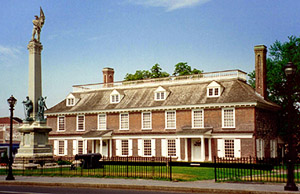 Near the site of van der Donck's mill is Philipse Manor Hall, a Colonial-era manor house which today serves as a museum and archive, offering many glimpses into life before the American Revolution. The original structure (later enlarged) was built around 1682 by Frederick Philipse and his wife Margaret Hardenbroeck. Frederick (wealthy Dutchman) who, by the time of his death, had amassed an enormous estate which encompassed the entire modern City of Yonkers, as well as several other Hudson River towns. Philipse's great-grandson, Frederick Philipse III, was a prominent Loyalist
during the American Revolution
, who, because of his political leanings, was forced to flee to England. All the lands that belonged to the Philipse family were confiscated and sold.
For its first two hundred years, Yonkers was a small farming town with an active industrial waterfront. Yonkers's later growth rested largely on developing industry. In 1853, Elisha Otis
invented the first safety elevator and the Otis Elevator Company
, opened the first elevator factory in the world on the banks of the Hudson near what is now Vark Street. It relocated to larger quarters (now the Yonkers Public Library) in the 1880s. Around the same time, the Alexander Smith and Sons Carpet Company
(in the Saw Mill River Valley) expanded to 45 buildings, 800 looms, and over 4,000 workers and was known as one of the premier carpet producing centers in the world. In 1892, Smith carpets were sent to Moscow for the tsar's coronation. Bakelite, the first completely synthetic plastic, was invented in Yonkers circa 1906 by Leo Baekeland, and manufactured there until the late 1920s.
 The community was incorporated as a village in the northern part of the Town of Yonkers in 1854, and as a city in 1872. The southern part of the Township became the South Bronx
. The city, having declined to join the City of Greater New York
, plans were dropped to extend the new subway
to Getty Square.
Early in the 20th Century, Yonkers also hosted a brass era automobile
maker, Colt Runabout Company; despite the car's seemingly glowing performance, the company went under.
Yonkers was also the headquarters of the Waring Hat Company, at the time the nation's largest hat manufacturer. World War II
saw the city's factories manufacture such items as tents and blankets in the Alexander Smith and Sons Carpet Factory and tanks in the Otis Elevator factory.
After World War II
, however, with increased competition from less expensive imports, Yonkers lost much of its manufacturing activity. The Alexander Smith Carpet mill fell on hard times and ceased operation on June 24, 1954. In 1983, the Otis Elevator Factory finally closed its doors. With the loss of jobs in the city itself, Yonkers (predominantly the east side) became primarily a residential city and some neighborhoods of the city, such as Crestwood
, became popular with wealthy New Yorkers wishing to live outside the city but not in an entirely suburban environment. Yonkers' excellent transportation infrastructure, including three commuter railroad lines (now two, the Harlem and Hudson Lines) and five parkways and thruways, as well as its 15-minute drive from Manhattan and picturesque "period" homes and apartments, made it a desirable city in which to live. Yonkers' manufacturing sector has recently shown a resurgence. A Kawasaki
railroad cars assembly plant opened in 1986 in the former Otis plant, producing the new R142A
, R143
and R160B cars for the New York City Subway
, and the PA4 and upcoming PA5 series for PATH
.
Aside from being a manufacturing center, Yonkers also played a key role in the development of entertainment in the United States. In 1888, Scottish immigrant John Reid
founded the first golf course
in the United States, St. Andrew's Golf Club, in Yonkers. On January 4, 1940, Yonkers resident Edwin Howard Armstrong transmitted the first FM
radio broadcast (on station W2XCR
) from the Yonkers home of C.R. Runyon, a co-experimenter. Yonkers also had the longest running pirate radio
station, owned by Allan Weiner
during the 1970s through the 1980s.
The city's struggles with racial discrimination and segregation were highlighted in a decades-long federal lawsuit. After a 1985 decision and an unsuccessful appeal, Yonkers' schools were integrated in 1988. The federal judge, Leonard B. Sand
, ruled that Yonkers had engaged in institutional segregation in housing and school policies for over 40 years and tied the illegal concentration of public housing and private housing discrimination to the city's resistance to ending racial isolation in its public schools.
Yonkers moved to the center of national/international attention during the summer of 1988, when the city was found in contempt of the federal courts, after it refused to build promised municipal public housing in the eastern portions of the city. It had earlier agreed to do so in a consent decree, after losing the appeal in 1987. Being fined one dollar, doubling every day until the council passed the ordinance set out in the consent decree, Yonkers remained in contempt of the courts until September 9, 1988. On that date, the City Council relented, in the wake of library closures, sanitation cutbacks, while looking at massive city layoffs, which would have been required to continue its resistance to desegregation.
Mayor Nicholas Wasicsko, in his first term, fought to save the city from financial disaster and bring about unity. He was a lonely figure in city politics at the time, which was scarred with the stigma of the "Balkanization of Yonkers." He succeeded in helping to end the city's contempt of the courts, but was voted out of office as a result. Yonkers still suffers the stigma of having bitterly opposed desegregation.
The Irish-American community is prominent in Yonkers, and the city hosts one of the nation's oldest St. Patrick's Day parades. There is also home to a large Italian-American community, and the city hosts a large Columbus Day
festival with a Miss Italian-American pageant.Yonkers also has a significant Portuguese
population.
Another large community is the Slavic
community. In the early and mid 20th Century a large amount of people emigrated from Poland
, Ukraine
, Czechoslovakia
, Russia
, and Croatia
. Recently a large number of immigrants from the former Yugoslavia
have called Yonkers home. The Slavic community is centered around St. Casimir's Roman Catholic Church, Most Holy Trinity Roman Catholic Church, Holy Trinity Russian Orthodox Church, and St. Michael's Ukrainian Catholic Church. Yonkers still has a large Slavic community. The city also has a "stanytsia" (branch) of Plast
.
There also once was a significant Jewish population (the Broadway
plays Hello Dolly!
and Lost in Yonkers
both take place within the Yonkers Jewish community). However, it has dwindled. In the 2000s, some areas bordering similar neighborhoods in Riverdale
began seeing an influx of Orthodox Jews. Subsequently, Riverdale Hatzalah Volunteer Ambulance Service began serving some neighborhoods in the southwest section of the city.
(born Steven Tallarico) of the rock band Aerosmith
, whose childhood home was just off Central Avenue on Pembrook Drive. Northeastern Yonkers contains the desirable Crestwood
, Colonial Heights, and Beech Hill sections of the city, as well as several other wealthy enclaves. Landmarks include St Vladimir's Seminary, as well as Sarah Lawrence College
, and the Tanglewood Shopping Center (one-time home of the The Tanglewood Boys gang). The northeast section of Yonkers consists of more upscale housing than the rest of the city, and, due to the proximity of several Metro-North commuter railroad stations, its residents tend to be employed in corporate positions in Manhattan
.
to around the New York State Thruway
/I-87 and from Ashburton Avenue north to the Hastings-on-Hudson
border. With the Hudson River bordering it to the west, this area has many beautiful Victorian-era homes
with panoramic views of the Palisades
. An interest in historic preservation has taken hold in this neighborhood in recent years, as demonstrated on streets like Shonnard Terrace, Delavan Terrace and Hudson Terrace. The population of northwestern Yonkers is probably the most ethnically diverse in the city.
Landmarks include the Hudson River Museum
, Untermyer Park
and the Lenoir Nature Preserve. The significant amount of surviving Victorian architecture and 19th century estates in northwest Yonkers has attracted many filmmakers in recent years.
The two block section of Palisade Ave between Chase and Roberts Ave in northwest Yonkers is colloquially known as "the north end" or "the end". It was and still is the only retail and food shopping area in the neighborhood, and was well known by the local kids for an original soda fountain store, "Urich's" and Robbins Pharmacy. It was once the end of the # 2 trolley line. The # 2 bus replaced the trolley line. One part of Yonkers that is sometimes overlooked is Nepera Park. This is a small section at the northern part of Nepperhan Avenue on the Hastings-on-Hudson border.
 Southeast Yonkers is mostly Irish-American (many of the Irish being native born) and Italian-American. Many of the businesses and type of architecture in southeast Yonkers bear a greater resemblance to certain parts of the Bronx
, Brooklyn
, Queens
, or Staten Island
than to points north. This is not surprising as southeastern Yonkers is largely within walking distance of the Riverdale
, Woodlawn, and Wakefield sections of the Bronx. Many residents regard eastern McLean Avenue, home to a vibrant Irish community shared with the Woodlawn section of the Bronx, to be the true hub of Yonkers.
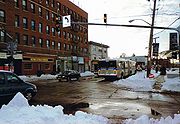 Similarly, a portion of Midland Avenue in the Dunwoodie
section has been called the "Little Italy" of Yonkers. Landmarks of southeastern Yonkers include the Cross County Shopping Center
, Yonkers Raceway, and St. Joseph's Seminary
in the Dunwoodie neighborhood, which was visited by Pope John Paul II
in October 1995 and later by Pope Benedict XVI
in April 2008.
neighborhoods of New York City's Harlem
and Brooklyn. Off South Broadway (a major thoroughfare) one can find residential neighborhoods, such as Nodine Hill, Park Hill
, and Hudson Park (off the Hudson River) with residential streets of turn-of-the-century mansions, and upscale luxury rentals and condominiums. Other upscale neighborhoods are Ludlow Park, Hudson Park & Van Cortlandt Crest, off Riverdale Avenue, right over the Riverdale
border - the former alongside the Hudson River
.
 The area is also home to significant historical and educational institutions including the historic Philipse Manor Hall
(a New York State Historic Site that houses one of three papier mache ceilings in the United States), The Science Barge
, Beczak Environmental Education Center, and a 2003 Yonkers Public Library
.
Many southwesterners are of African
, Caribbean
, Italian, or Hispanic
descent while an influx those from other cultural backgrounds has continued to shape a culturally diverse community. Some neighborhoods right on the Riverdale
border are increasingly becoming home to Orthodox Jews. The revitalization of the downtown Yonkers/Getty Square
area has helped to nurture growth for Southwest Yonkers.
In the early 2000s several new luxury apartment buildings were built along the Hudson. There is also a new "Sculpture Meadow on the Hudson," renovation of a Victorian-era pier, and a new public library housed in the remodeled Otis elevator factory. Peter Kelly
's award-winning fine dining restaurant X20 - Xaviars on Hudson is located at the renovated pier with much success.
There are new proposals along with the current projects which are intended to revitalize downtown Yonkers.
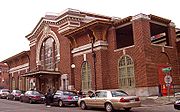 Yonkers has the eighth-highest rate of public transit ridership among cities in the United States. It has four Hudson Line
Metro-North Railroad
stations providing commuter service to New York City: Ludlow, Yonkers, Glenwood and Greystone. The Yonkers station is also served by Amtrak
. Several Harlem Line stations are on or very near the city's eastern border. These include Wakefield
, Mt. Vernon West
, Fleetwood
, Bronxville
, Tuckahoe
and Crestwood.
Bus service is provided by the Westchester County Bee-Line Bus System
, and an MTA Bus Company
express route to Manhattan.
New York Water Taxi
formerly operated a ferry
service from downtown Yonkers to Manhattan's Financial District
, but it ceased in December 2009.
(the New York State Thruway
), the Saw Mill
, Bronx River
, Sprain Brook
and Cross County
parkway
s. US 9, NY 9A
and 100
are important surface streets.
The former New York and Putnam Railroad running through the middle of Yonkers has been converted into bicycling and walking paths going north along the Saw Mill River
to Elmsford and south to Van Cortlandt Park
.
In the 1980s and 1990s, Yonkers developed a national reputation for racial tension, based on a long-term battle between the City of Yonkers and the NAACP over the building of subsidized low-rent housing. The City wanted to use federal funds to create or expand high-rise housing projects in southwest Yonkers; other groups, led by the NAACP, felt that concentrating subsidized housing in traditionally poor neighborhoods perpetuated poverty. The climax of the battle came when United States district court
Judge Leonard Sand imposed a fine on Yonkers which started at $1 and doubled every day until the City capitulated to the federally mandated plan.
.
Libraries are operated by the Yonkers Public Library
.
state, but until recently it had a Republican lean. In 1992, Yonkers voted for George H. W. Bush
over Bill Clinton
and Ross Perot
for president, but has voted solidly Democratic ever since. That said, recent mayors of Yonkers have included Republicans Phil Amicone
and John Spencer
, while the Yonkers City Council
was also mostly controlled by Republicans until recent years. In the State Assembly, Yonkers is represented by Democrats J. Gary Pretlow
and Mike Spano
, and in the New York State Senate
, by Democrats Andrea Stewart-Cousins
and Jeffrey Klein
. At the federal level, Democrats hold both congressional districts that include parts of Yonkers, with representatives Eliot Engel and Nita Lowey
holding the seats as of 2011.
and retail
space, has been designed for the city. With hopes of increasing the city's tourism
and economic importance in the state
and county, the project is one of the largest revitalization projects ever proposed for any locality within the New York Metropolitan Area
, totaling more than $
3 billion
.
The project is headed by Westchester County's Louis R. Cappelli
, Struever Bros. of Baltimore, and New Jersey
's Fidelco Realty. The project is expected to include a Minor League Baseball
stadium, and an expansive retail and residential project, adding approximately 800 residential units throughout the downtown area and the waterfront.
: Mr. Vincent, a 1997 Sundance Film Festival
entrant in the non-competition Spectrum section, and Yonkers Joe, a scheduled 2009 release by Magnolia Pictures
, starring Chazz Palminteri
and Christine Lahti
. Yonkers' locations also provide the setting for A Tale of Two Pizzas, a "Romeo and Juliet" theme played out among two rival pizza owners.
Yonkers' decades-long struggle with racial discrimination and housing segregation was described in a documentary, "Brick by Brick: A Civil Rights Story," seen on PBS stations in 2007.
The film "Doubt", starring Meryl Streep as Sister Aloysius Beauvier, filmed scenes for this movie at St. Marks Lutheran Church's school.
Yonkers is also the location for many major filming projects: Catch Me if You Can, with Tom Hanks and Leonardo DiCaprio; Eternal Sunshine of the Spotless Mind, with Jim Carrey and Kate Winslet; Mona Lisa Smile, with Julia Roberts; A Beautiful Mind, with Russell Crowe, Big Daddy, with Adam Sandler, The Preacher's Wife (a remake of "The Bishop's Wife), with Denzel Washington and Whitney Houston; and Kate and Leopold, with Meg Ryan and Hugh Jackman. Some episodes of the new TV series Fringe were taped in the downtown. The City Hall Courtroom is also the setting for many film and commercial scenes.
The starting scene from Eternal Sunshine of the Spotless Mind
where Joel Barish played by Jim Carrey
drives his car up Riverdale Ave. and then turns right on Valentine Lane to his apartment.
In Max Brooks's
novel, World War Z
, the US armed forces are defeated in the Battle of Yonkers by an army of zombies.
Steve Meretzky created several Infocom games, such as Sorcerer
. One of the spells in that game, "Yonk", is named after Yonkers.
Dunder Mifflin, the fictional paper supply company from NBC
's The Office at one time had a branch in Yonkers, but the branch was closed during the course of the show.
Yonkers is one of the settings in the musical Hello Dolly!
A character in the musical Gypsy: A Musical Fable
is named after Yonkers.
Neil Simon
wrote a play entitled Lost In Yonkers
, set in the city. The story is about two young boys during World War II
, whose father leaves them with their grandmother in Yonkers so he can earn money for the family.
In the episode "The One With Ross' Tan" of Friends
, Yonkers is mentioned as the town where Monica and Phoebe's old friend, Amanda Bouvamonteezi, is from.
In the episode "The Handcuffs" of I Love Lucy
, Mr Walters, the locksmith, has to return to his house in Yonkers.
In the Twilight Zone episode "What's In The Box" a philandering cab driver, played by William Demarest, tells his wife he was late coming home because he had to take a "fare" up to Yonkers.
Yonkers was shown on A Shot at Love 2 with Tila Tequila as it was contestant Kristy's hometown.
Yonkers is mentioned in Bon Jovi
's song Raise Your Hands
.
Yonkers was mentioned in the Family Guy Episode:"Stew-Roids" in a cutaway about a Charles Paumpert Movie: Distracting Trumpet.
Yonkers is mentioned in an episode of the show Grounded for Life, where character Lily Finnerty is supposedly going for a party.
In the 2010 film "Bounty Hunter," Gerard Butler's character Milo Boyd tells Jennifer Aniston's character Nicole Houston of a "great pizza place on Yonkers."
In the 2011 film "MIB III (Men In Black 3) Will take place in Radio Shack in Cross County.
American Idol Season 10 Contestant Melinda Ademi lives in Yonkers.
In the White Collar
episode "Book of Hours" the character "Burrelli" mentions his vet in Yonkers.
In 2011, rapper Tyler, The Creator
released a rap song and video titled "Yonkers"http://rapfix.mtv.com/2011/02/11/tyler-the-creator-gets-odd-in-yonkers/.
In October 21st 2011, filming was done for the movie Disconnect (2012) at the Cross County Shopping Center in Yonkers.
with:
Kamëz
in Albania
Ternopil
in Ukraine
(since 1991)
New York
New York is a state in the Northeastern region of the United States. It is the nation's third most populous state. New York is bordered by New Jersey and Pennsylvania to the south, and by Connecticut, Massachusetts and Vermont to the east...
(behind New York City
New York City
New York is the most populous city in the United States and the center of the New York Metropolitan Area, one of the most populous metropolitan areas in the world. New York exerts a significant impact upon global commerce, finance, media, art, fashion, research, technology, education, and...
, Buffalo
Buffalo, New York
Buffalo is the second most populous city in the state of New York, after New York City. Located in Western New York on the eastern shores of Lake Erie and at the head of the Niagara River across from Fort Erie, Ontario, Buffalo is the seat of Erie County and the principal city of the...
and Rochester
Rochester, New York
Rochester is a city in Monroe County, New York, south of Lake Ontario in the United States. Known as The World's Image Centre, it was also once known as The Flour City, and more recently as The Flower City...
), and the most populous city in Westchester County
Westchester County, New York
Westchester County is a county located in the U.S. state of New York. Westchester covers an area of and has a population of 949,113 according to the 2010 Census, residing in 45 municipalities...
, with a population of 195,976 (according to the 2010 Census). Yonkers borders the New York City
New York City
New York is the most populous city in the United States and the center of the New York Metropolitan Area, one of the most populous metropolitan areas in the world. New York exerts a significant impact upon global commerce, finance, media, art, fashion, research, technology, education, and...
borough of The Bronx
The Bronx
The Bronx is the northernmost of the five boroughs of New York City. It is also known as Bronx County, the last of the 62 counties of New York State to be incorporated...
and is 2 miles (3 km) north of Manhattan
Manhattan
Manhattan is the oldest and the most densely populated of the five boroughs of New York City. Located primarily on the island of Manhattan at the mouth of the Hudson River, the boundaries of the borough are identical to those of New York County, an original county of the state of New York...
at the cities' closest points.
The city is home to several attractions: the Hudson River Museum
Hudson River Museum
The Hudson River Museum, located in Trevor Park in Yonkers, New York, is the largest museum in Westchester County. The Yonkers Museum, founded in 1919 at City Hall, became the Hudson River Museum in 1948...
, the Sherwood House, the Science Barge
Science Barge
The Science Barge is an itinerant floating science museum now docked in Yonkers, New York, USA. It is also a working urban farm operated by the sustainable development organization , and designed by the . The Science Barge grows crops using a hydroponic greenhouse powered by solar panels, wind...
, Cross County Shopping Center
Cross County Shopping Center
Cross County Shopping Center, also known as Cross County Center is an open-air shopping mall located in Yonkers, New York, United States. Over 100 stores and restaurants are featured in the mall, including anchor stores Macy's, Old Navy and Sears. The mall is managed by Macerich.-History:Cross...
, Ridge Hill Shopping Center, and Yonkers Raceway
Yonkers Raceway
Yonkers Raceway, founded in 1899 as the Empire City Race Track, is a one-half-mile standardbred harness racing dirt track and New York state-approved slots racino located at the intersection of Central Park Avenue and Yonkers Avenue in Yonkers, New York near the New York City border...
, a harness racing
Harness racing
Harness racing is a form of horse racing in which the horses race at a specific gait . They usually pull a two-wheeled cart called a sulky, although racing under saddle is also conducted in Europe.-Breeds:...
track that has renovated its grounds and clubhouse and added legalized video slot machine gambling
Gambling
Gambling is the wagering of money or something of material value on an event with an uncertain outcome with the primary intent of winning additional money and/or material goods...
in 2006 in a "racino
Racino
A racino is a combined race track and casino. In some cases, the gambling is limited to slot machines, but many locations are beginning to include table games such as blackjack, poker, and roulette....
" called Empire City. There are also many large shopping areas along Central Park Avenue (NY 100
New York State Route 100
New York State Route 100 is a major north–south state highway in Westchester County, New York, in the United States. It begins parallel to Interstate 87 at a junction with the Cross County Parkway in the city of Yonkers and runs through most of the length of the county via the city of...
), informally called "Central Ave" by area residents, a name it takes officially a few miles north in White Plains, New York
White Plains, New York
White Plains is a city and the county seat of Westchester County, New York, United States. It is located in south-central Westchester, about east of the Hudson River and northwest of Long Island Sound...
.
Geography
The city is spread out over hills rising from near sea level at the eastern bank of the Hudson RiverHudson River
The Hudson is a river that flows from north to south through eastern New York. The highest official source is at Lake Tear of the Clouds, on the slopes of Mount Marcy in the Adirondack Mountains. The river itself officially begins in Henderson Lake in Newcomb, New York...
to 416 feet (126 m) at Sacred Heart Church, whose spire can be seen from Long Island
Long Island
Long Island is an island located in the southeast part of the U.S. state of New York, just east of Manhattan. Stretching northeast into the Atlantic Ocean, Long Island contains four counties, two of which are boroughs of New York City , and two of which are mainly suburban...
, New York City
New York City
New York is the most populous city in the United States and the center of the New York Metropolitan Area, one of the most populous metropolitan areas in the world. New York exerts a significant impact upon global commerce, finance, media, art, fashion, research, technology, education, and...
, and New Jersey
New Jersey
New Jersey is a state in the Northeastern and Middle Atlantic regions of the United States. , its population was 8,791,894. It is bordered on the north and east by the state of New York, on the southeast and south by the Atlantic Ocean, on the west by Pennsylvania and on the southwest by Delaware...
. Its landscape has been compared to San Francisco, Sarajevo
Sarajevo
Sarajevo |Bosnia]], surrounded by the Dinaric Alps and situated along the Miljacka River in the heart of Southeastern Europe and the Balkans....
, and Rome
Rome
Rome is the capital of Italy and the country's largest and most populated city and comune, with over 2.7 million residents in . The city is located in the central-western portion of the Italian Peninsula, on the Tiber River within the Lazio region of Italy.Rome's history spans two and a half...
.
The city occupies 20.3 square miles (52.6 km²), including 18.1 square miles (46.8 km²) of land and 2.2 square miles (5.8 km²) (11.02%) of water, according to the United States Census Bureau
United States Census Bureau
The United States Census Bureau is the government agency that is responsible for the United States Census. It also gathers other national demographic and economic data...
.
The Bronx River
Bronx River
The Bronx River, approximately long, flows through southeast New York in the United States. It is named after colonial settler Jonas Bronck. The Bronx River is the only fresh water river in New York City....
separates Yonkers from Mount Vernon
Mount Vernon, New York
Mount Vernon is a city in Westchester County, New York, United States. It lies on the border of the New York City borough of The Bronx.-Overview:...
, Tuckahoe
Tuckahoe, New York
Tuckahoe is the name of some places in the U.S. state of New York:*Tuckahoe, Suffolk County, New York*Tuckahoe, Westchester County, New York...
, Eastchester, Bronxville, and Scarsdale
Scarsdale
Scarsdale could be*Scarsdale, New York, a village and town in Westchester County, New York, United States, for which The Complete Scarsdale Medical Diet is named...
to the east. The town of Greenburgh
Greenburgh, New York
Greenburgh is a town in the western part of Westchester County, New York, United States. The population was 88,400 at the 2010 census. Paul J. Feiner has been the Town Supervisor since 1991.-History:...
is to the north, and on the western border is the Hudson River
Hudson River
The Hudson is a river that flows from north to south through eastern New York. The highest official source is at Lake Tear of the Clouds, on the slopes of Mount Marcy in the Adirondack Mountains. The river itself officially begins in Henderson Lake in Newcomb, New York...
.
On the south, Yonkers borders the Riverdale
Riverdale, Bronx
Riverdale is an affluent residential neighborhood in the northwest portion of the Bronx in New York City. Riverdale contains the northernmost point in New York City.-History:...
, Woodlawn
Woodlawn, Bronx
Woodlawn is a neighborhood at the very north end of the borough of the Bronx in New York City. Unlike some neighborhoods in New York City, its boundaries are fairly well-defined, as it is bounded by McLean Avenue to the north, which is approximately the New York City / Westchester County line, the...
, and Wakefield
Wakefield, Bronx
Wakefield is a working-class section of the northern borough of the Bronx in New York City, bounded by the New York city line with Westchester County or 243rd street to the north,and 222nd Street to the south, and the Bronx River, Bronx River Parkway and Metro-North Railroad tracks to the west...
sections of The Bronx
The Bronx
The Bronx is the northernmost of the five boroughs of New York City. It is also known as Bronx County, the last of the 62 counties of New York State to be incorporated...
. In addition, the southernmost point of Yonkers is only 2 miles (3 km) north of the northernmost point of Manhattan
Manhattan
Manhattan is the oldest and the most densely populated of the five boroughs of New York City. Located primarily on the island of Manhattan at the mouth of the Hudson River, the boundaries of the borough are identical to those of New York County, an original county of the state of New York...
when measured from Broadway & Caryl Avenue in Yonkers to Broadway & West 228th Street in the Marble Hill
Marble Hill, Manhattan
Marble Hill is the neighborhood which makes up the northernmost part of the Borough of Manhattan in New York City, United States. Although it is politically part of Manhattan and New York County, because of the re-routing of the Harlem River, it is located on the North American mainland contiguous...
section of Manhattan.
The gentilic for residents is alternately Yonkersonian or Yonkersite
Climate: Yonkers has cold winter
Winter
Winter is the coldest season of the year in temperate climates, between autumn and spring. At the winter solstice, the days are shortest and the nights are longest, with days lengthening as the season progresses after the solstice.-Meteorology:...
s and warm summers. Temperature ranges average lows of 27 degrees F in January, and average highs of 84 degrees F in July.
Demographics
As of the censusCensus
A census is the procedure of systematically acquiring and recording information about the members of a given population. It is a regularly occurring and official count of a particular population. The term is used mostly in connection with national population and housing censuses; other common...
of 2010, there are 195,976 people in the city. The population density
Population density
Population density is a measurement of population per unit area or unit volume. It is frequently applied to living organisms, and particularly to humans...
is 10,827.4 people per square mile (4,187.5/km²). There are 80,839 housing units at an average density of 4,466.2 per square mile (1,727.3/km²). The cultural makeup of the city is 55.8% White, 18.7% African American, 0.7% Native American, 5.9% Asian, 0.1% Pacific Islander, 14.7% from other races, and 4.1% from two or more ethnicities. 34.7% of the population are Hispanic or Latino of any ethnic background.
According to the 2000 Census, 19.9% were of Italian
Italian people
The Italian people are an ethnic group that share a common Italian culture, ancestry and speak the Italian language as a mother tongue. Within Italy, Italians are defined by citizenship, regardless of ancestry or country of residence , and are distinguished from people...
and 11.6% Irish
Irish people
The Irish people are an ethnic group who originate in Ireland, an island in northwestern Europe. Ireland has been populated for around 9,000 years , with the Irish people's earliest ancestors recorded having legends of being descended from groups such as the Nemedians, Fomorians, Fir Bolg, Tuatha...
. 61.3% spoke English
English language
English is a West Germanic language that arose in the Anglo-Saxon kingdoms of England and spread into what was to become south-east Scotland under the influence of the Anglian medieval kingdom of Northumbria...
, 22.7% Spanish
Spanish language
Spanish , also known as Castilian , is a Romance language in the Ibero-Romance group that evolved from several languages and dialects in central-northern Iberia around the 9th century and gradually spread with the expansion of the Kingdom of Castile into central and southern Iberia during the...
, 3.9% Italian
Italian language
Italian is a Romance language spoken mainly in Europe: Italy, Switzerland, San Marino, Vatican City, by minorities in Malta, Monaco, Croatia, Slovenia, France, Libya, Eritrea, and Somalia, and by immigrant communities in the Americas and Australia...
, 5% Arabic
Arabic language
Arabic is a name applied to the descendants of the Classical Arabic language of the 6th century AD, used most prominently in the Quran, the Islamic Holy Book...
and 1.3% Portuguese
Portuguese language
Portuguese is a Romance language that arose in the medieval Kingdom of Galicia, nowadays Galicia and Northern Portugal. The southern part of the Kingdom of Galicia became independent as the County of Portugal in 1095...
as their first language.
There were 74,351 households out of which 30.9% have children under the age of 18 living with them in 2000, 44.2% are married couples
Marriage
Marriage is a social union or legal contract between people that creates kinship. It is an institution in which interpersonal relationships, usually intimate and sexual, are acknowledged in a variety of ways, depending on the culture or subculture in which it is found...
living together, 17.2% have a female householder with no husband present, and 33.7% are non-families. 29.2% of all households are made up of individuals and 11.9% have someone living alone who is 65 years of age or older. The average household size is 2.61 and the average family size is 3.23.
In 2000, the city the population is spread out with 24.3% under the age of 18, 8.8% from 18 to 25, 30.6% from 25 to 45, 21.2% from 45 to 65, and 15.0% who are 65 years of age or older. The median age is 36 years. For every 100 females there are 88.6 males. For every 100 females age 18 and over, there are 84.2 males.
The median income for a household in the city was $44,663 in 2000, and the median income for a family is $53,233. Males have a median income of $41,598 versus $34,756 for females. The per capita income
Per capita income
Per capita income or income per person is a measure of mean income within an economic aggregate, such as a country or city. It is calculated by taking a measure of all sources of income in the aggregate and dividing it by the total population...
for the city is $22,793. 15.5% of the population and 13.0% of families are below the poverty line. Out of the total population, 24.8% of those under the age of 18 and 9.9% of those 65 and older are living below the poverty line.
History
The land on which the city is built was once part of a 24,000 acre (97 km²) land grant that ran from the current Manhattan/Bronx border at Marble Hill northwards for 12 miles (19 km), and from the Hudson RiverHudson River
The Hudson is a river that flows from north to south through eastern New York. The highest official source is at Lake Tear of the Clouds, on the slopes of Mount Marcy in the Adirondack Mountains. The river itself officially begins in Henderson Lake in Newcomb, New York...
eastwards to the Bronx River
Bronx River
The Bronx River, approximately long, flows through southeast New York in the United States. It is named after colonial settler Jonas Bronck. The Bronx River is the only fresh water river in New York City....
. This grant was given in July 1645 by New Netherland
New Netherland
New Netherland, or Nieuw-Nederland in Dutch, was the 17th-century colonial province of the Republic of the Seven United Netherlands on the East Coast of North America. The claimed territories were the lands from the Delmarva Peninsula to extreme southwestern Cape Cod...
Director-General Willem Kieft
Willem Kieft
Willem Kieft was a Dutch merchant and director-general of New Netherland , from 1638 until 1647. He formed the council of twelve men, the first representative body in New Netherland, but ignored its advice...
to Adriaen van der Donck
Adriaen van der Donck
Adriaen Cornelissen van der Donck was a lawyer and landowner in New Netherland after whose honorific Jonkheer the city of Yonkers, New York is named...
, originally named Colen Donck
Colen Donck
Colen Donck was the title of a large Dutch-American owned estate of 24,000 acres originally owned by Adriaen van der Donck in New Netherland, along what was then known as the North River ....
. Van der Donck was known locally as the Jonkheer
Jonkheer
Jonkheer is a Dutch honorific of nobility.-Honorific of nobility:"Jonkheer" or "Jonkvrouw" is literally translated as "young lord" or "young lady". In medieval times such a person was a young and unmarried son or daughter of a high ranking knight or nobleman...
or Jonker (etymologically, "young gentleman"; in effect, "Esquire
Esquire
Esquire is a term of West European origin . Depending on the country, the term has different meanings...
"), a word from which the name "Yonkers" is directly derived. Van der Donck built a saw mill
Sawmill
A sawmill is a facility where logs are cut into boards.-Sawmill process:A sawmill's basic operation is much like those of hundreds of years ago; a log enters on one end and dimensional lumber exits on the other end....
near where the Nepperhan Creek met the Hudson; the Nepperhan is now also known as the Saw Mill River
Saw Mill River
The Saw Mill River is a 20 mile long tributary of the Hudson River in the United States, flowing from a marsh in Chappaqua to Yonkers, New York, where it empties into the Hudson. Its starting point in Chappaqua is presumed to be a spring. In the 17th century, the Saw Mill River was known as...
.
Loyalist (American Revolution)
Loyalists were American colonists who remained loyal to the Kingdom of Great Britain during the American Revolutionary War. At the time they were often called Tories, Royalists, or King's Men. They were opposed by the Patriots, those who supported the revolution...
during the American Revolution
American Revolution
The American Revolution was the political upheaval during the last half of the 18th century in which thirteen colonies in North America joined together to break free from the British Empire, combining to become the United States of America...
, who, because of his political leanings, was forced to flee to England. All the lands that belonged to the Philipse family were confiscated and sold.
For its first two hundred years, Yonkers was a small farming town with an active industrial waterfront. Yonkers's later growth rested largely on developing industry. In 1853, Elisha Otis
Elisha Otis
Elisha Graves Otis was an American industrialist, founder of the Otis Elevator Company, and inventor of a safety device that prevents elevators from falling if the hoisting cable fails. He worked on this device while living in Yonkers, New York in 1852, and had a finished product in...
invented the first safety elevator and the Otis Elevator Company
Otis Elevator Company
The Otis Elevator Company is the world's largest manufacturer of vertical transportation systems today, principally focusing on elevators and escalators...
, opened the first elevator factory in the world on the banks of the Hudson near what is now Vark Street. It relocated to larger quarters (now the Yonkers Public Library) in the 1880s. Around the same time, the Alexander Smith and Sons Carpet Company
Alexander Smith Carpet Mills Historic District
Alexander Smith Carpet Mills Historic District is a national historic district located at Yonkers, Westchester County, New York. It includes 85 contributing buildings. It encompasses 19 stylistically varied mill buildings and six rows of workers' housing. They were developed between 1871 and 1930...
(in the Saw Mill River Valley) expanded to 45 buildings, 800 looms, and over 4,000 workers and was known as one of the premier carpet producing centers in the world. In 1892, Smith carpets were sent to Moscow for the tsar's coronation. Bakelite, the first completely synthetic plastic, was invented in Yonkers circa 1906 by Leo Baekeland, and manufactured there until the late 1920s.
South Bronx
The South Bronx is an area of the New York City borough of The Bronx. The neighborhoods of Tremont, University Heights, Highbridge, Morrisania, Soundview, Hunts Point, and Castle Hill are sometimes considered part of the South Bronx....
. The city, having declined to join the City of Greater New York
City of Greater New York
The City of Greater New York was a term commonly used originally to refer to the expanded city created on January 1, 1898 by the incorporation into the city of Richmond County, Kings County, Queens County, and the eastern part of what is now called The Bronx...
, plans were dropped to extend the new subway
History of the IRT subway before 1918
The first regularly operated subway in New York City was built by the city and leased to the Interborough Rapid Transit Company for operation under Contracts 1 and 2. Until 1918, when the new "H" system that is still operated - with separate East Side and West Side lines - was placed in service, it...
to Getty Square.
Early in the 20th Century, Yonkers also hosted a brass era automobile
Automobile
An automobile, autocar, motor car or car is a wheeled motor vehicle used for transporting passengers, which also carries its own engine or motor...
maker, Colt Runabout Company; despite the car's seemingly glowing performance, the company went under.
Yonkers was also the headquarters of the Waring Hat Company, at the time the nation's largest hat manufacturer. World War II
World War II
World War II, or the Second World War , was a global conflict lasting from 1939 to 1945, involving most of the world's nations—including all of the great powers—eventually forming two opposing military alliances: the Allies and the Axis...
saw the city's factories manufacture such items as tents and blankets in the Alexander Smith and Sons Carpet Factory and tanks in the Otis Elevator factory.
After World War II
World War II
World War II, or the Second World War , was a global conflict lasting from 1939 to 1945, involving most of the world's nations—including all of the great powers—eventually forming two opposing military alliances: the Allies and the Axis...
, however, with increased competition from less expensive imports, Yonkers lost much of its manufacturing activity. The Alexander Smith Carpet mill fell on hard times and ceased operation on June 24, 1954. In 1983, the Otis Elevator Factory finally closed its doors. With the loss of jobs in the city itself, Yonkers (predominantly the east side) became primarily a residential city and some neighborhoods of the city, such as Crestwood
Crestwood, Yonkers, New York
Crestwood is a neighborhood in Yonkers, New York. Located in northeastern Yonkers, Crestwood borders the Bronx River where it meets the Village of Tuckahoe...
, became popular with wealthy New Yorkers wishing to live outside the city but not in an entirely suburban environment. Yonkers' excellent transportation infrastructure, including three commuter railroad lines (now two, the Harlem and Hudson Lines) and five parkways and thruways, as well as its 15-minute drive from Manhattan and picturesque "period" homes and apartments, made it a desirable city in which to live. Yonkers' manufacturing sector has recently shown a resurgence. A Kawasaki
Kawasaki Heavy Industries Rolling Stock Company
is the rolling stock production division of Kawasaki Heavy Industries. Since beginning operations in 1906, the company has produced more than 90,000 railroad vehicles.- Products :...
railroad cars assembly plant opened in 1986 in the former Otis plant, producing the new R142A
R142A (New York City Subway car)
The R142A, along with the R142 is the newest generation of cars for the A Division of the New York City Subway.-Background:The R142A is built by Kawasaki and has many of the same features as the R142, built by Bombardier. The main order of 400 R142A cars are numbered 7211-7610; the 120 option cars...
, R143
R143 (New York City Subway car)
The R143 is a standard gauge subway car design used on the B Division of the New York City Subway in the United States. The cars are primarily used on the L service. The New York City Transit Authority owns 212 R143 cars, numbered 8101 to 8312, and built for an average cost of about $1.5 million...
and R160B cars for the New York City Subway
New York City Subway
The New York City Subway is a rapid transit system owned by the City of New York and leased to the New York City Transit Authority, a subsidiary agency of the Metropolitan Transportation Authority and also known as MTA New York City Transit...
, and the PA4 and upcoming PA5 series for PATH
Port Authority Trans-Hudson
PATH, derived from Port Authority Trans-Hudson, is a rapid transit railroad linking Manhattan, New York City with Newark, Harrison, Hoboken and Jersey City in metropolitan northern New Jersey...
.
Aside from being a manufacturing center, Yonkers also played a key role in the development of entertainment in the United States. In 1888, Scottish immigrant John Reid
John Reid
-Politics:* John Reid, Baron Reid of Cardowan , Former British Home Secretary and former Chairman of Celtic F.C.* John William Reid , U.S. Representative from Missouri...
founded the first golf course
Golf course
A golf course comprises a series of holes, each consisting of a teeing ground, fairway, rough and other hazards, and a green with a flagstick and cup, all designed for the game of golf. A standard round of golf consists of playing 18 holes, thus most golf courses have this number of holes...
in the United States, St. Andrew's Golf Club, in Yonkers. On January 4, 1940, Yonkers resident Edwin Howard Armstrong transmitted the first FM
FM broadcasting
FM broadcasting is a broadcasting technology pioneered by Edwin Howard Armstrong which uses frequency modulation to provide high-fidelity sound over broadcast radio. The term "FM band" describes the "frequency band in which FM is used for broadcasting"...
radio broadcast (on station W2XCR
W2XCR
W2XCR was founded in 1931 in Long Island City, NY by the radio station WGBS . During the period early part of 1931, but before the call letters were changed to WINS, the station began experimenting with mechanical television broadcasting, operating a Jenkins mechanical scanner through the...
) from the Yonkers home of C.R. Runyon, a co-experimenter. Yonkers also had the longest running pirate radio
Pirate radio
Pirate radio is illegal or unregulated radio transmission. The term is most commonly used to describe illegal broadcasting for entertainment or political purposes, but is also sometimes used for illegal two-way radio operation...
station, owned by Allan Weiner
Allan Weiner
Allan H. Weiner is a long-time pirate radio operator and activist. Weiner is currently the owner/operator of WBCQ, a licensed shortwave station broadcasting from Monticello, Maine, and also owns AM radio station WXME and FM radio station WBCQ-FM in Monticello.- The Falling Star Radio Network...
during the 1970s through the 1980s.
The city's struggles with racial discrimination and segregation were highlighted in a decades-long federal lawsuit. After a 1985 decision and an unsuccessful appeal, Yonkers' schools were integrated in 1988. The federal judge, Leonard B. Sand
Leonard B. Sand
Leonard Burke Sand is a federal judge for the United States District Court for the Southern District of New York. Judge Sand received a B.S. from the New York University School of Commerce in 1947 and an LL.B. from Harvard Law School in 1951. He was a delegate to the New York State Constitutional...
, ruled that Yonkers had engaged in institutional segregation in housing and school policies for over 40 years and tied the illegal concentration of public housing and private housing discrimination to the city's resistance to ending racial isolation in its public schools.
Yonkers moved to the center of national/international attention during the summer of 1988, when the city was found in contempt of the federal courts, after it refused to build promised municipal public housing in the eastern portions of the city. It had earlier agreed to do so in a consent decree, after losing the appeal in 1987. Being fined one dollar, doubling every day until the council passed the ordinance set out in the consent decree, Yonkers remained in contempt of the courts until September 9, 1988. On that date, the City Council relented, in the wake of library closures, sanitation cutbacks, while looking at massive city layoffs, which would have been required to continue its resistance to desegregation.
Mayor Nicholas Wasicsko, in his first term, fought to save the city from financial disaster and bring about unity. He was a lonely figure in city politics at the time, which was scarred with the stigma of the "Balkanization of Yonkers." He succeeded in helping to end the city's contempt of the courts, but was voted out of office as a result. Yonkers still suffers the stigma of having bitterly opposed desegregation.
The Irish-American community is prominent in Yonkers, and the city hosts one of the nation's oldest St. Patrick's Day parades. There is also home to a large Italian-American community, and the city hosts a large Columbus Day
Columbus Day
Many countries in the New World and elsewhere celebrate the anniversary of Christopher Columbus's arrival in the Americas, which occurred on October 12, 1492, as an official holiday...
festival with a Miss Italian-American pageant.Yonkers also has a significant Portuguese
Portuguese people
The Portuguese are a nation and ethnic group native to the country of Portugal, in the west of the Iberian peninsula of south-west Europe. Their language is Portuguese, and Roman Catholicism is the predominant religion....
population.
Another large community is the Slavic
Slavic peoples
The Slavic people are an Indo-European panethnicity living in Eastern Europe, Southeast Europe, North Asia and Central Asia. The term Slavic represents a broad ethno-linguistic group of people, who speak languages belonging to the Slavic language family and share, to varying degrees, certain...
community. In the early and mid 20th Century a large amount of people emigrated from Poland
Poland
Poland , officially the Republic of Poland , is a country in Central Europe bordered by Germany to the west; the Czech Republic and Slovakia to the south; Ukraine, Belarus and Lithuania to the east; and the Baltic Sea and Kaliningrad Oblast, a Russian exclave, to the north...
, Ukraine
Ukraine
Ukraine is a country in Eastern Europe. It has an area of 603,628 km², making it the second largest contiguous country on the European continent, after Russia...
, Czechoslovakia
Czechoslovakia
Czechoslovakia or Czecho-Slovakia was a sovereign state in Central Europe which existed from October 1918, when it declared its independence from the Austro-Hungarian Empire, until 1992...
, Russia
Russia
Russia or , officially known as both Russia and the Russian Federation , is a country in northern Eurasia. It is a federal semi-presidential republic, comprising 83 federal subjects...
, and Croatia
Croatia
Croatia , officially the Republic of Croatia , is a unitary democratic parliamentary republic in Europe at the crossroads of the Mitteleuropa, the Balkans, and the Mediterranean. Its capital and largest city is Zagreb. The country is divided into 20 counties and the city of Zagreb. Croatia covers ...
. Recently a large number of immigrants from the former Yugoslavia
Yugoslavia
Yugoslavia refers to three political entities that existed successively on the western part of the Balkans during most of the 20th century....
have called Yonkers home. The Slavic community is centered around St. Casimir's Roman Catholic Church, Most Holy Trinity Roman Catholic Church, Holy Trinity Russian Orthodox Church, and St. Michael's Ukrainian Catholic Church. Yonkers still has a large Slavic community. The city also has a "stanytsia" (branch) of Plast
Plast
The Plast National Scout Organization of Ukraine commonly called Ukrainian Plast or simply Plast is the largest Scouting organization in Ukraine.-First Phase: 1911-1920:...
.
There also once was a significant Jewish population (the Broadway
Broadway theatre
Broadway theatre, commonly called simply Broadway, refers to theatrical performances presented in one of the 40 professional theatres with 500 or more seats located in the Theatre District centered along Broadway, and in Lincoln Center, in Manhattan in New York City...
plays Hello Dolly!
Hello, Dolly! (musical)
Hello, Dolly! is a musical with lyrics and music by Jerry Herman and a book by Michael Stewart, based on Thornton Wilder's 1938 farce The Merchant of Yonkers, which Wilder revised and retitled The Matchmaker in 1955....
and Lost in Yonkers
Lost in Yonkers
Lost in Yonkers is a 1991 Pulitzer Prize-winning play by Neil Simon. After eleven previews, the Broadway production, produced by Emanuel Azenberg and directed by Gene Saks, opened on February 21, 1991 at the Richard Rodgers Theatre, where it ran for 780 performances...
both take place within the Yonkers Jewish community). However, it has dwindled. In the 2000s, some areas bordering similar neighborhoods in Riverdale
Riverdale, Bronx
Riverdale is an affluent residential neighborhood in the northwest portion of the Bronx in New York City. Riverdale contains the northernmost point in New York City.-History:...
began seeing an influx of Orthodox Jews. Subsequently, Riverdale Hatzalah Volunteer Ambulance Service began serving some neighborhoods in the southwest section of the city.
Neighborhoods
Though Yonkers contains many small residential enclaves and communities, it can conveniently be divided into four quarters, demarcated by the Saw Mill River. There are 37 or more distinct neighborhoods, many of these names being rarely used except by real estate agents.Northeast Yonkers
Northeast Yonkers is a primarily Irish-American and Italian-American area. Though suburban, it is noticeably less so than the Town of Greenburgh to the north. House sizes vary widely, from small houses set close together, to some larger houses in areas like Lawrence Park West. Tuckahoe Road, which intersects Central Avenue (NY 100), contains many stores as well. Notable former residents include Steven TylerSteven Tyler
Steven Tyler is an American singer, songwriter, and multi-instrumentalist, best known as the frontman and lead singer of the Boston-based rock band Aerosmith, in which he also plays the harmonica, and occasional piano and percussion. He is known as the "Demon of Screamin'", due to his high screams...
(born Steven Tallarico) of the rock band Aerosmith
Aerosmith
Aerosmith is an American rock band, sometimes referred to as "The Bad Boys from Boston" and "America's Greatest Rock and Roll Band". Their style, which is rooted in blues-based hard rock, has come to also incorporate elements of pop, heavy metal, and rhythm and blues, and has inspired many...
, whose childhood home was just off Central Avenue on Pembrook Drive. Northeastern Yonkers contains the desirable Crestwood
Crestwood, Yonkers, New York
Crestwood is a neighborhood in Yonkers, New York. Located in northeastern Yonkers, Crestwood borders the Bronx River where it meets the Village of Tuckahoe...
, Colonial Heights, and Beech Hill sections of the city, as well as several other wealthy enclaves. Landmarks include St Vladimir's Seminary, as well as Sarah Lawrence College
Sarah Lawrence College
Sarah Lawrence College is a private liberal arts college in the United States, and a leader in progressive education since its founding in 1926. Located just 30 minutes north of Midtown Manhattan in southern Westchester County, New York, in the city of Yonkers, this coeducational college offers...
, and the Tanglewood Shopping Center (one-time home of the The Tanglewood Boys gang). The northeast section of Yonkers consists of more upscale housing than the rest of the city, and, due to the proximity of several Metro-North commuter railroad stations, its residents tend to be employed in corporate positions in Manhattan
Manhattan
Manhattan is the oldest and the most densely populated of the five boroughs of New York City. Located primarily on the island of Manhattan at the mouth of the Hudson River, the boundaries of the borough are identical to those of New York County, an original county of the state of New York...
.
Northwest Yonkers
Northwest Yonkers is a collection of widely varying neighborhoods, spanning from the Hudson RiverHudson River
The Hudson is a river that flows from north to south through eastern New York. The highest official source is at Lake Tear of the Clouds, on the slopes of Mount Marcy in the Adirondack Mountains. The river itself officially begins in Henderson Lake in Newcomb, New York...
to around the New York State Thruway
New York State Thruway
The New York State Thruway is a system of limited-access highways located within the state of New York in the United States. The system, known officially as the Governor Thomas E. Dewey Thruway for former New York Governor Thomas E. Dewey, is operated by the New York State Thruway Authority and...
/I-87 and from Ashburton Avenue north to the Hastings-on-Hudson
Hastings-on-Hudson, New York
Hastings-on-Hudson is a village in Westchester County, New York, United States. It is located in the southwest part of the town of Greenburgh. As of the 2010 census, it had a population of 7,849. It lies on U.S. Route 9, "Broadway" in Hastings...
border. With the Hudson River bordering it to the west, this area has many beautiful Victorian-era homes
Victorian architecture
The term Victorian architecture refers collectively to several architectural styles employed predominantly during the middle and late 19th century. The period that it indicates may slightly overlap the actual reign, 20 June 1837 – 22 January 1901, of Queen Victoria. This represents the British and...
with panoramic views of the Palisades
New Jersey Palisades
The Palisades, also called the New Jersey Palisades or the Hudson Palisades are a line of steep cliffs along the west side of the lower Hudson River in northeastern New Jersey and southern New York in the United States. The cliffs stretch north from Jersey City approximately 20 mi to near...
. An interest in historic preservation has taken hold in this neighborhood in recent years, as demonstrated on streets like Shonnard Terrace, Delavan Terrace and Hudson Terrace. The population of northwestern Yonkers is probably the most ethnically diverse in the city.
Landmarks include the Hudson River Museum
Hudson River Museum
The Hudson River Museum, located in Trevor Park in Yonkers, New York, is the largest museum in Westchester County. The Yonkers Museum, founded in 1919 at City Hall, became the Hudson River Museum in 1948...
, Untermyer Park
Untermyer Park
Untermyer Park is a historic park located at Yonkers, Westchester County, New York. It was developed between 1899 and 1940 as the estate garden of lawyer Samuel Untermyer in the Beaux Arts style. It features a rock garden, Grecian garden, Grecian amphitheater, classical pavilion, pergola, and...
and the Lenoir Nature Preserve. The significant amount of surviving Victorian architecture and 19th century estates in northwest Yonkers has attracted many filmmakers in recent years.
The two block section of Palisade Ave between Chase and Roberts Ave in northwest Yonkers is colloquially known as "the north end" or "the end". It was and still is the only retail and food shopping area in the neighborhood, and was well known by the local kids for an original soda fountain store, "Urich's" and Robbins Pharmacy. It was once the end of the # 2 trolley line. The # 2 bus replaced the trolley line. One part of Yonkers that is sometimes overlooked is Nepera Park. This is a small section at the northern part of Nepperhan Avenue on the Hastings-on-Hudson border.
Southeast Yonkers
The Bronx
The Bronx is the northernmost of the five boroughs of New York City. It is also known as Bronx County, the last of the 62 counties of New York State to be incorporated...
, Brooklyn
Brooklyn
Brooklyn is the most populous of New York City's five boroughs, with nearly 2.6 million residents, and the second-largest in area. Since 1896, Brooklyn has had the same boundaries as Kings County, which is now the most populous county in New York State and the second-most densely populated...
, Queens
Queens
Queens is the easternmost of the five boroughs of New York City. The largest borough in area and the second-largest in population, it is coextensive with Queens County, an administrative division of New York state, in the United States....
, or Staten Island
Staten Island
Staten Island is a borough of New York City, New York, United States, located in the southwest part of the city. Staten Island is separated from New Jersey by the Arthur Kill and the Kill Van Kull, and from the rest of New York by New York Bay...
than to points north. This is not surprising as southeastern Yonkers is largely within walking distance of the Riverdale
Riverdale, Bronx
Riverdale is an affluent residential neighborhood in the northwest portion of the Bronx in New York City. Riverdale contains the northernmost point in New York City.-History:...
, Woodlawn, and Wakefield sections of the Bronx. Many residents regard eastern McLean Avenue, home to a vibrant Irish community shared with the Woodlawn section of the Bronx, to be the true hub of Yonkers.
Dunwoodie, Yonkers, New York
Dunwoodie is a neighborhood in Yonkers, New York, noted for being the home of St. Joseph's Seminary on Valentine Hill. Dunwoodie is located north of the Seminary, while Dunwoodie Heights includes the seminary and what is south of it...
section has been called the "Little Italy" of Yonkers. Landmarks of southeastern Yonkers include the Cross County Shopping Center
Cross County Shopping Center
Cross County Shopping Center, also known as Cross County Center is an open-air shopping mall located in Yonkers, New York, United States. Over 100 stores and restaurants are featured in the mall, including anchor stores Macy's, Old Navy and Sears. The mall is managed by Macerich.-History:Cross...
, Yonkers Raceway, and St. Joseph's Seminary
St. Joseph's Seminary, Dunwoodie
St. Joseph's Seminary and College, sometimes referred to as Dunwoodie, after the Yonkers, New York neighborhood it is located in, is the major seminary of the Archdiocese of New York. Its primary mission is to form men for the priesthood in the Catholic Church...
in the Dunwoodie neighborhood, which was visited by Pope John Paul II
Pope John Paul II
Blessed Pope John Paul II , born Karol Józef Wojtyła , reigned as Pope of the Catholic Church and Sovereign of Vatican City from 16 October 1978 until his death on 2 April 2005, at of age. His was the second-longest documented pontificate, which lasted ; only Pope Pius IX ...
in October 1995 and later by Pope Benedict XVI
Pope Benedict XVI
Benedict XVI is the 265th and current Pope, by virtue of his office of Bishop of Rome, the Sovereign of the Vatican City State and the leader of the Catholic Church as well as the other 22 sui iuris Eastern Catholic Churches in full communion with the Holy See...
in April 2008.
Southwest Yonkers
Predominately Latino and Black, this area in Yonkers has suffered from past economic, political, and social challenges. Early in the 21st century a decrease in crime rate and a juxtaposition of poverty and revitalization mirrored newly gentrifiedGentrification
Gentrification and urban gentrification refer to the changes that result when wealthier people acquire or rent property in low income and working class communities. Urban gentrification is associated with movement. Consequent to gentrification, the average income increases and average family size...
neighborhoods of New York City's Harlem
Harlem
Harlem is a neighborhood in the New York City borough of Manhattan, which since the 1920s has been a major African-American residential, cultural and business center. Originally a Dutch village, formally organized in 1658, it is named after the city of Haarlem in the Netherlands...
and Brooklyn. Off South Broadway (a major thoroughfare) one can find residential neighborhoods, such as Nodine Hill, Park Hill
Park Hill, Yonkers
Park Hill is a neighborhood in southwestern Yonkers, New York. The neighborhood is located east of South Broadway. Park Hill contains many vintage single-family homes, many overlooking the Hudson River. The neighborhood was developed in 1888 by the American Real Estate Company of Manhattan. The...
, and Hudson Park (off the Hudson River) with residential streets of turn-of-the-century mansions, and upscale luxury rentals and condominiums. Other upscale neighborhoods are Ludlow Park, Hudson Park & Van Cortlandt Crest, off Riverdale Avenue, right over the Riverdale
Riverdale, Bronx
Riverdale is an affluent residential neighborhood in the northwest portion of the Bronx in New York City. Riverdale contains the northernmost point in New York City.-History:...
border - the former alongside the Hudson River
Hudson River
The Hudson is a river that flows from north to south through eastern New York. The highest official source is at Lake Tear of the Clouds, on the slopes of Mount Marcy in the Adirondack Mountains. The river itself officially begins in Henderson Lake in Newcomb, New York...
.
Philipse Manor Hall State Historic Site
Philipse Manor Hall State Historic Site is a historic house museum located in Yonkers, New York. It is Westchester County’s oldest standing building, and is currently owned and operated by the New York State Office of Parks, Recreation and Historic Preservation.It is located at Warburton Avenue...
(a New York State Historic Site that houses one of three papier mache ceilings in the United States), The Science Barge
Science Barge
The Science Barge is an itinerant floating science museum now docked in Yonkers, New York, USA. It is also a working urban farm operated by the sustainable development organization , and designed by the . The Science Barge grows crops using a hydroponic greenhouse powered by solar panels, wind...
, Beczak Environmental Education Center, and a 2003 Yonkers Public Library
Yonkers Public Library
The Yonkers Public Library in Yonkers, New York, consists of three branch libraries.The main library is the Yonkers Riverfront Library, which overlooks the Hudson River and New Jersey Palisades...
.
Many southwesterners are of African
African American
African Americans are citizens or residents of the United States who have at least partial ancestry from any of the native populations of Sub-Saharan Africa and are the direct descendants of enslaved Africans within the boundaries of the present United States...
, Caribbean
Caribbean
The Caribbean is a crescent-shaped group of islands more than 2,000 miles long separating the Gulf of Mexico and the Caribbean Sea, to the west and south, from the Atlantic Ocean, to the east and north...
, Italian, or Hispanic
Hispanic
Hispanic is a term that originally denoted a relationship to Hispania, which is to say the Iberian Peninsula: Andorra, Gibraltar, Portugal and Spain. During the Modern Era, Hispanic sometimes takes on a more limited meaning, particularly in the United States, where the term means a person of ...
descent while an influx those from other cultural backgrounds has continued to shape a culturally diverse community. Some neighborhoods right on the Riverdale
Riverdale, Bronx
Riverdale is an affluent residential neighborhood in the northwest portion of the Bronx in New York City. Riverdale contains the northernmost point in New York City.-History:...
border are increasingly becoming home to Orthodox Jews. The revitalization of the downtown Yonkers/Getty Square
Getty Square
Getty Square is a square in the downtown area of Yonkers, New York, United States of America. It is near the historic Philipse Manor, Saint John's Episcopal Church, the Yonkers rail station, and many shops and landmarks...
area has helped to nurture growth for Southwest Yonkers.
In the early 2000s several new luxury apartment buildings were built along the Hudson. There is also a new "Sculpture Meadow on the Hudson," renovation of a Victorian-era pier, and a new public library housed in the remodeled Otis elevator factory. Peter Kelly
Peter X. Kelly
Peter X. Kelly is a restaurateur and renowned chef. He runs the Xaviar Restaurant Group that includes Xaviar's and Freelance Cafe in Piermont, NY, Restaurant X and Bully Boy Bar in Congers, NY and Xaviars X2O in Yonkers, NY. The name of the group is based on Peter Kelly's middle name,...
's award-winning fine dining restaurant X20 - Xaviars on Hudson is located at the renovated pier with much success.
There are new proposals along with the current projects which are intended to revitalize downtown Yonkers.
Mass transit
Hudson Line (Metro-North)
Metro-North Railroad's Hudson Line is a commuter rail line running north from New York City along the east shore of the Hudson River. Metro-North service ends at Poughkeepsie, with Amtrak's Empire Corridor trains continuing north to and beyond Albany...
Metro-North Railroad
Metro-North Railroad
The Metro-North Commuter Railroad , trading as MTA Metro-North Railroad, or, more commonly, Metro-North, is a suburban commuter rail service that is run and managed by the Metropolitan Transportation Authority , an authority of New York State. It is the busiest commuter railroad in the United...
stations providing commuter service to New York City: Ludlow, Yonkers, Glenwood and Greystone. The Yonkers station is also served by Amtrak
Amtrak
The National Railroad Passenger Corporation, doing business as Amtrak , is a government-owned corporation that was organized on May 1, 1971, to provide intercity passenger train service in the United States. "Amtrak" is a portmanteau of the words "America" and "track". It is headquartered at Union...
. Several Harlem Line stations are on or very near the city's eastern border. These include Wakefield
Wakefield (Metro-North station)
The Wakefield Metro-North Railroad station serves the residents of the Wakefield section of The Bronx via the Harlem Line, and it is the last station on the line before it crosses into Westchester County, New York. It is 12.6 miles from Grand Central Terminal and is located on East 241st Street...
, Mt. Vernon West
Mount Vernon West (Metro-North station)
The Mount Vernon West Metro-North Railroad station is the first station in Westchester County, New York on the Harlem Line. It is 13.1 miles from Grand Central Terminal...
, Fleetwood
Fleetwood (Metro-North station)
The Fleetwood Metro-North Railroad station serves the residents of the Fleetwood section of Mount Vernon, New York via the Harlem Line. It is 14.3 miles from Grand Central Terminal....
, Bronxville
Bronxville (Metro-North station)
The Bronxville Metro-North Railroad station serves the residents of the village of Bronxville, New York via the Harlem Line. It is 15.3 miles from Grand Central Terminal....
, Tuckahoe
Tuckahoe (Metro-North station)
The Tuckahoe Metro-North Railroad station serves the residents of the village of Tuckahoe, New York via the Harlem Line. It is 16 miles from Grand Central Terminal....
and Crestwood.
Bus service is provided by the Westchester County Bee-Line Bus System
Bee-Line Bus System
The Bee-Line Bus System, branded on the buses in lowercase as the bee-line system, is a bus system serving Westchester County, New York. The system is owned by the County's Department of Public Works and Transportation and operated, on contract , by Yonkers-based Liberty Lines Transit, Inc...
, and an MTA Bus Company
MTA Bus Company
MTA Bus Company is a service of MTA Regional Bus Operations used on routes previously controlled by the New York City Department of Transportation , and operated by private operators that provided service under contract to the NYCDOT...
express route to Manhattan.
New York Water Taxi
New York Water Taxi
New York Water Taxi is a water taxi service based in Red Hook, Brooklyn offering commuter and sightseeing service mainly to points along the East River and Hudson River...
formerly operated a ferry
Ferry
A ferry is a form of transportation, usually a boat, but sometimes a ship, used to carry primarily passengers, and sometimes vehicles and cargo as well, across a body of water. Most ferries operate on regular, frequent, return services...
service from downtown Yonkers to Manhattan's Financial District
Financial District, Manhattan
The Financial District of New York City is a neighborhood on the southernmost section of the borough of Manhattan which comprises the offices and headquarters of many of the city's major financial institutions, including the New York Stock Exchange and the Federal Reserve Bank of New York...
, but it ceased in December 2009.
Roads and paths
Major limited-access roads in Yonkers include Interstate 87Interstate 87
Interstate 87 is a Interstate Highway located entirely within New York State in the United States of America. I-87 is the longest intrastate Interstate highway in the Interstate Highway System. Its southern end is at the Bronx approaches of the Robert F. Kennedy Bridge in New York City...
(the New York State Thruway
New York State Thruway
The New York State Thruway is a system of limited-access highways located within the state of New York in the United States. The system, known officially as the Governor Thomas E. Dewey Thruway for former New York Governor Thomas E. Dewey, is operated by the New York State Thruway Authority and...
), the Saw Mill
Saw Mill River Parkway
The Saw Mill River Parkway is a north–south parkway that extends for through Westchester County, New York, in the United States. It begins at the border between Westchester County and the Bronx, where it continues into New York City as the Henry Hudson Parkway, and heads generally...
, Bronx River
Bronx River Parkway
The Bronx River Parkway is a long parkway in downstate New York. It is named for the nearby Bronx River, which it parallels. The southern terminus of the parkway is at Story Avenue near Bruckner Expressway in the Bronx neighborhood of Soundview...
, Sprain Brook
Sprain Brook Parkway
The Sprain Brook Parkway is a long north–south parkway in Westchester County, New York. It is one of the newest and most modern parkways in Westchester County, adopting many ideas and improvements developed during decades of statewide highway construction. The southern terminus is at the...
and Cross County
Cross County Parkway
The Cross County Parkway is a long parkway in Westchester County, New York. The parkway is a critical east–west connection throughout Westchester, having full interchanges with every major north–south parkway in southern Westchester, in addition to the New York State Thruway mainline....
parkway
Parkway
The term parkway has several distinct principal meanings and numerous synonyms around the world, for either a type of landscaped area or a type of road.Type of landscaped area:...
s. US 9, NY 9A
New York State Route 9A
New York State Route 9A is a state highway in the vicinity of New York City, New York, United States. Its southern terminus is at the northern end of the Brooklyn–Battery Tunnel in New York City, where it intersects with both Interstate 478 and FDR Drive. The northern terminus of...
and 100
New York State Route 100
New York State Route 100 is a major north–south state highway in Westchester County, New York, in the United States. It begins parallel to Interstate 87 at a junction with the Cross County Parkway in the city of Yonkers and runs through most of the length of the county via the city of...
are important surface streets.
The former New York and Putnam Railroad running through the middle of Yonkers has been converted into bicycling and walking paths going north along the Saw Mill River
Saw Mill River
The Saw Mill River is a 20 mile long tributary of the Hudson River in the United States, flowing from a marsh in Chappaqua to Yonkers, New York, where it empties into the Hudson. Its starting point in Chappaqua is presumed to be a spring. In the 17th century, the Saw Mill River was known as...
to Elmsford and south to Van Cortlandt Park
Van Cortlandt Park
Van Cortlandt Park is a park located in the Bronx in New York City. It is the fourth largest park in New York City, behind Pelham Bay Park, Flushing Meadows Park and Staten Island Greenbelt....
.
In the 1980s and 1990s, Yonkers developed a national reputation for racial tension, based on a long-term battle between the City of Yonkers and the NAACP over the building of subsidized low-rent housing. The City wanted to use federal funds to create or expand high-rise housing projects in southwest Yonkers; other groups, led by the NAACP, felt that concentrating subsidized housing in traditionally poor neighborhoods perpetuated poverty. The climax of the battle came when United States district court
United States district court
The United States district courts are the general trial courts of the United States federal court system. Both civil and criminal cases are filed in the district court, which is a court of law, equity, and admiralty. There is a United States bankruptcy court associated with each United States...
Judge Leonard Sand imposed a fine on Yonkers which started at $1 and doubled every day until the City capitulated to the federally mandated plan.
Education
Public schools in Yonkers are operated by Yonkers Public SchoolsYonkers Public Schools
Yonkers Public Schools is a school district that serves all of Yonkers, New York, USA. It is governed by a mayorally appointed Board of Trustees.-Organization:...
.
Libraries are operated by the Yonkers Public Library
Yonkers Public Library
The Yonkers Public Library in Yonkers, New York, consists of three branch libraries.The main library is the Yonkers Riverfront Library, which overlooks the Hudson River and New Jersey Palisades...
.
Politics
Yonkers is typically a Democratic stronghold just like the rest of Westchester County and most of New YorkNew York
New York is a state in the Northeastern region of the United States. It is the nation's third most populous state. New York is bordered by New Jersey and Pennsylvania to the south, and by Connecticut, Massachusetts and Vermont to the east...
state, but until recently it had a Republican lean. In 1992, Yonkers voted for George H. W. Bush
George H. W. Bush
George Herbert Walker Bush is an American politician who served as the 41st President of the United States . He had previously served as the 43rd Vice President of the United States , a congressman, an ambassador, and Director of Central Intelligence.Bush was born in Milton, Massachusetts, to...
over Bill Clinton
Bill Clinton
William Jefferson "Bill" Clinton is an American politician who served as the 42nd President of the United States from 1993 to 2001. Inaugurated at age 46, he was the third-youngest president. He took office at the end of the Cold War, and was the first president of the baby boomer generation...
and Ross Perot
Ross Perot
Henry Ross Perot is a U.S. businessman best known for running for President of the United States in 1992 and 1996. Perot founded Electronic Data Systems in 1962, sold the company to General Motors in 1984, and founded Perot Systems in 1988...
for president, but has voted solidly Democratic ever since. That said, recent mayors of Yonkers have included Republicans Phil Amicone
Phil Amicone
Philip A. Amicone is the 41st Mayor of the City of Yonkers, New York. He took office on January 1, 2004, after serving eight years as Deputy Mayor.As Deputy Mayor he was involved in all phases of the city’s redevelopment...
and John Spencer
John Spencer (politician)
John Spencer is the former Mayor of Yonkers, New York . He was the 2006 Republican nominee for U.S. Senator from New York and lost to incumbent Democrat Hillary Rodham Clinton.-Early life, military service and education:...
, while the Yonkers City Council
Yonkers City Council
The Yonkers City Council is the legislative branch of Yonkers and uses a weak Mayor-Council government. The city elects six councilmen, each serving four year terms...
was also mostly controlled by Republicans until recent years. In the State Assembly, Yonkers is represented by Democrats J. Gary Pretlow
J. Gary Pretlow
James Gary Pretlow is a member of the New York State Assembly, for the 87th district first elected in 1992. He is a Democrat. Prior to be elected to the Assembly he served on the Mount Vernon city council.-External links:*...
and Mike Spano
Mike Spano
Mike Spano is a current Democratic member of the New York State Assembly and Current Mayor-Elect of Yonkers, New York. He was first elected in 1992 as its youngest member. Due to the state’s redistricting plan, his seat was eliminated later that same year...
, and in the New York State Senate
New York State Senate
The New York State Senate is one of two houses in the New York State Legislature and has members each elected to two-year terms. There are no limits on the number of terms one may serve...
, by Democrats Andrea Stewart-Cousins
Andrea Stewart-Cousins
Andrea Stewart-Cousins is a New York State Senator for the 35th district representing Ardsley, Dobbs Ferry, Elmsford, Greenburgh, Hastings-on-Hudson, Irvington, Mount Pleasant, Pleasantville, Sleepy Hollow, Tarrytown, and Yonkers....
and Jeffrey Klein
Jeffrey Klein
Jeffrey David Klein is a New York State Senator representing parts of Bronx and Westchester Counties. He was elected to his first term in the Senate in 2004....
. At the federal level, Democrats hold both congressional districts that include parts of Yonkers, with representatives Eliot Engel and Nita Lowey
Nita Lowey
Nita Melnikoff Lowey is the U.S. Representative for , serving since 1993. She is a member of the Democratic Party. She previously represented the 20th district from 1989 to 1993.-Early life, education and career:...
holding the seats as of 2011.
Fire Department
The city of Yonkers is served by the Yonkers Fire Department(YFD). Founded in 1896, the YFD operates out of 12 Fire Stations, located throughout the city in 2 Battalions, and also operates a fire apparatus fleet of 11 Engines(Including 1 Squad), 6 Ladders, 1 Rescue, 1 Mask Service Unit, 1 Collapse Unit, 1 Foam Unit, 1 Fire Investigation Unit, 1 Urban Search and Rescue Unit, 1 Field Command Unit, 1 Field Communications Unit, 1 Safety Battalion, 1 Water Tender, and numerous other special, support, and reserve/spare units. The YFD responds to over 35,000 emergency calls annually. The current Fire Commissioner is Anthony H. Pagano.Fire Station Locations and Apparatus
| Engine Company | Ladder Company | Special Unit | Battalion Chief | Address |
|---|---|---|---|---|
| Tower Ladder 71 | Rescue 1, MSU. 1, Safety Battalion | 7 New School St. | ||
| Engine 303 | Battalion 1 | 96 Vark St. | ||
| Engine 304 | Ladder 74 | 36 Radford St. | ||
| Engine 306 | 81 Oak St. | |||
| Engine 307 | Fire Investigation Unit | 441 Central Park Ave. | ||
| Engine 308 | 571 Warburton Ave. | |||
| Engine 309 | Ladder 72 | 53 Shonnard Pl. | ||
| Engine 310 | 573 Saw Mill River Rd. | |||
| Squad 11 | Collapse Unit | 433 Bronxville Rd. | ||
| Engine 312 | Tower Ladder 75 | Battalion 2 | 75 Fortfield Ave. | |
| Engine 313 | Ladder 73 | Foam Unit | 340 Kimball Ave. | |
| Engine 314 | Ladder 70 | 2187 Central Park Ave. |
Revitalization
Amidst a growing need for increased economic viability in Yonkers, a vast revitalization project proposal, promising to add luxury housing, waterfront development, commercialCommerce
While business refers to the value-creating activities of an organization for profit, commerce means the whole system of an economy that constitutes an environment for business. The system includes legal, economic, political, social, cultural, and technological systems that are in operation in any...
and retail
Retail
Retail consists of the sale of physical goods or merchandise from a fixed location, such as a department store, boutique or kiosk, or by mail, in small or individual lots for direct consumption by the purchaser. Retailing may include subordinated services, such as delivery. Purchasers may be...
space, has been designed for the city. With hopes of increasing the city's tourism
Tourism
Tourism is travel for recreational, leisure or business purposes. The World Tourism Organization defines tourists as people "traveling to and staying in places outside their usual environment for not more than one consecutive year for leisure, business and other purposes".Tourism has become a...
and economic importance in the state
New York
New York is a state in the Northeastern region of the United States. It is the nation's third most populous state. New York is bordered by New Jersey and Pennsylvania to the south, and by Connecticut, Massachusetts and Vermont to the east...
and county, the project is one of the largest revitalization projects ever proposed for any locality within the New York Metropolitan Area
New York metropolitan area
The New York metropolitan area, also known as Greater New York, or the Tri-State area, is the region that composes of New York City and the surrounding region...
, totaling more than $
United States dollar
The United States dollar , also referred to as the American dollar, is the official currency of the United States of America. It is divided into 100 smaller units called cents or pennies....
3 billion
1000000000 (number)
1,000,000,000 is the natural number following 999,999,999 and preceding 1,000,000,001.In scientific notation, it is written as 109....
.
The project is headed by Westchester County's Louis R. Cappelli
Louis R. Cappelli
Louis R. Cappelli is a real estate developer most active in Westchester County, New York. Cappelli has constructed, designed and developed more than twenty million square feet of mixed use, retail, residential, office, medical and parking facilities throughout the northeast, with a portfolio value...
, Struever Bros. of Baltimore, and New Jersey
New Jersey
New Jersey is a state in the Northeastern and Middle Atlantic regions of the United States. , its population was 8,791,894. It is bordered on the north and east by the state of New York, on the southeast and south by the Atlantic Ocean, on the west by Pennsylvania and on the southwest by Delaware...
's Fidelco Realty. The project is expected to include a Minor League Baseball
Minor league baseball
Minor league baseball is a hierarchy of professional baseball leagues in the Americas that compete at levels below Major League Baseball and provide opportunities for player development. All of the minor leagues are operated as independent businesses...
stadium, and an expansive retail and residential project, adding approximately 800 residential units throughout the downtown area and the waterfront.
Notable natives and residents
- Carlos AlazraquiCarlos AlazraquiCarlos Jaime Alazraqui is an American actor, comedian, impressionist and voice actor. He is best known for his role as Deputy James Garcia on the Comedy Central series Reno 911!. His voice-over work includes the role of Bobbi Fabulous on Phineas and Ferb, the Taco Bell chihuahua, Denzel Q...
- American actor, stand-up comedian, impressionist & voice actor - AnthraxAnthrax (band)Anthrax is an American heavy metal band from New York City, formed in 1981. Founded by guitarists Scott Ian and Danny Lilker, the band has since released ten studio albums and 20 singles, and an EP featuring Public Enemy. The band was one of the most popular of the 1980s thrash metal scene...
- Famous and influential thrash metalThrash metalThrash metal is a subgenre of heavy metal that is characterized usually by its fast tempo and aggression. Songs of the genre typically use fast percussive and low-register guitar riffs, overlaid with shredding-style lead work...
band associated with Big Four (alongside with MetallicaMetallicaMetallica is an American heavy metal band from Los Angeles, California. Formed in 1981 when James Hetfield responded to an advertisement that drummer Lars Ulrich had posted in a local newspaper. The current line-up features long-time lead guitarist Kirk Hammett and bassist Robert Trujillo ...
, SlayerSlayerSlayer is an American thrash metal band formed in Huntington Park, California, in 1981 by guitarists Jeff Hanneman and Kerry King. Slayer rose to fame with their 1986 release, Reign in Blood, and is credited as one of the "Big Four" thrash metal acts, along with Metallica, Megadeth and...
, MegadethMegadethMegadeth is an American heavy metal band from Los Angeles, California which was formed in 1983 by guitarist/vocalist Dave Mustaine, bassist Dave Ellefson and guitarist Greg Handevidt, following Mustaine's expulsion from Metallica. The band has since released 13 studio albums, three live albums, two...
) - Edwin Howard Armstrong - transmitted first FM radio broadcast
- David BerkowitzDavid BerkowitzDavid Richard Berkowitz , also known as Son of Sam and the .44 Caliber Killer, is an American serial killer and arsonist whose crimes terrorized New York City from July 1976 until his arrest in August 1977.Shortly after his arrest in August 1977, Berkowitz confessed to killing six people and...
- notable serial killer known as the Son of Sam - James BlakeJames BlakeJames Riley Blake is an American professional tennis player. Blake is known for his speed and powerful, flat forehand. As of August 2011, Blake is ranked no. 63 among active male players with 24 career finals appearances...
- tennis player - Mary J. BligeMary J. BligeMary Jane Blige is an American singer-songwriter, record producer and occasional actress. She is a recipient of nine Grammy Awards and four American Music Awards, and has recorded eight multi-platinum albums. She is the only artist with Grammy Award wins in Pop, Rap, Gospel, and R&B. Blige has...
- Singer - John BreenJohn BreenJohn Breen is a playwright from Limerick, Ireland. He is famous for his play Alone it Stands which tells the tale of Munster Rugby Team's legendary victory over New Zealand's mighty All Blacks in Thomond Park, Limerick in 1978...
- Magician / Professional Bull Rider - Mike BreenMike BreenMichael "Mike" Breen is a play-by-play commentator for the NBA on ABC and the lead commentator for New York Knicks games on the MSG network...
- sports broadcaster - Billy BurchBilly BurchHarry Wilfred Burch was an Canadian professional ice hockey forward who played for the Hamilton Tigers, New York Americans, Chicago Black Hawks, and Boston Bruins in the National Hockey League...
- professional hockey player - Sid CaesarSid CaesarIsaac Sidney "Sid" Caesar is an Emmy award winning American comic actor and writer known as the leading man on the 1950s television series Your Show of Shows and Caesar's Hour, and to younger generations as Coach Calhoun in Grease and Grease 2.- Early life :Caesar was born in Yonkers, New York,...
- actor/composer/writer - Robert CelestinoRobert CelestinoRobert John Celestino in an American film producer, screenwriter, editor and award winning film director. He is best known for his films, Mr Vincent and Yonkers Joe....
- writer/director - Dave CostaDave CostaDavid Joseph Costa is a former American football defensive tackle. He played college football at the University of Utah and in the American Football League with the Oakland Raiders from 1963 through 1965, the Buffalo Bills in 1966, and the Denver Broncos from 1967 through 1969...
- Saunders HS 1957-59, NFL 4-time Pro Bowler - Cathy DeBuonoCathy DeBuonoCathy DeBuono is an American actress. DeBuono was born on March 20, 1970, in Yonkers, New York, and raised in Bronxville. As an athlete, she started a career as a successful volleyball player and received several awards and medals, such as two gold medals at the United States Olympic Festival in...
- actress/psychotherapist/radio show host for LA Talk - Doug DeWittDoug DeWittDoug DeWitt was a middleweight boxer.Known as "Cobra," DeWitt, who was also raised in Yonkers, New York, started boxing at the age of 15, and by the time he was 18, the young DeWitt had turned pro and was on his way to three middleweight titles during a 12-year career, which included bouts with...
- professional boxer - DMXDMX (rapper)Earl Simmons , better known by his stage name DMX, is a multiplatinum American rapper and actor who rose to fame in the late 1990s. His stage name pays tribute to the Oberheim DMX drum machine, an instrument he used when he made his own rap beats in the 80's...
- rapper/actor - Tiziano Thomas DossenaTiziano Thomas Dossena- Biography :Born in Milan on 19 September 1952, Tiziano Thomas Dossena moved to the United States in 1968 and completed his studies in that country, where he graduated in Italian Literature , Humanistic Studies , Environmental Science and Engineering Technology.Repatriated to Italy in...
- Writer/editor - Tommy DreamerTommy DreamerThomas James "Tom" Laughlin is an American professional wrestler better known by his ring name Tommy Dreamer. He is currently working for various promotions on the independent circuit. He is best known for his time spent with Extreme Championship Wrestling and World Wrestling Entertainment...
- professional wrestler - Ella FitzgeraldElla FitzgeraldElla Jane Fitzgerald , also known as the "First Lady of Song" and "Lady Ella," was an American jazz and song vocalist...
- jazz singer - Thomas Mikal FordThomas Mikal FordThomas Mikal Ford , known and credited also as Tommy Ford, is an American actor who is best known for his character Tommy Strawn in the sitcom Martin...
- actor - Frances FosterFrances FosterFrances Foster was an American film, television and stage actress. She was also an award-winning stage director.-Biography:...
- actress - Ron Garan - AstronautAstronautAn astronaut or cosmonaut is a person trained by a human spaceflight program to command, pilot, or serve as a crew member of a spacecraft....
- W.C. Handy - composer and musician
- ImmolationImmolation (band)-History:The band formed in May 1986 by Andrew Sakowicz and Dave Wilkinson under the name Rigor Mortis . The name was changed to Immolation in April 1988, after the Warriors of Doom demo which was recorded as Rigor Mortis and Demo I which was recorded as Immolation...
- Influential death metalDeath metalDeath metal is an extreme subgenre of heavy metal. It typically employs heavily distorted guitars, tremolo picking, deep growling vocals, blast beat drumming, minor keys or atonality, and complex song structures with multiple tempo changes....
band - JadakissJadakissJason Phillips , better known as Jadakiss, is an American rapper. He is a member of the group The LOX. Jadakiss is one of the three owners of the imprint known as D-Block. In early 2007, Jadakiss signed to Roc-a-Fella Records / Def Jam Records.-Early life:By the age of 16, Jadakiss was a freestyle...
- Rapper from D-Block - Ekrem JevrićEkrem JevrićEkrem Jevrić, nicknamed Gospoda, is a popular Montenegrin singer and musician, based in Yonkers, New York. His YouTube video "Kuća poso" earned him instant popularity across former Yugoslavia, mostly because it was "so bad that it's good". The internet phenomenon was noted by BBC and The...
- Montenegrin singer/rapper - Eddie KingstonEddie KingstonEdward "Eddie" Moore is an American professional wrestler, better known by his ring name Eddie Kingston. He is best known for competing in Chikara, Combat Zone Wrestling, Independent Wrestling Association Mid-South and Ring of Honor...
- professional wrestler - Gene KrupaGene KrupaGene Krupa was an American jazz and big band drummer and composer, known for his highly energetic and flamboyant style.-Biography:...
- jazz musician - Joe LapchickJoe LapchickJoseph Bohomiel Lapchick was a professional basketball player, mostly known for playing with the Original Celtics in the 1920s and 30s. He is commonly regarded as the best center of his era, overshadowed in his later years only by Tarzan Cooper...
- basketball coach - Stagga LeeStagga LeeEric Newman, better known by his stage name Stagga Lee, is an American rapper from Yonkers, New York. His stage name was adopted after hearing the classic 1959 No. 1 hit "Stagger Lee" by Lloyd Price....
- musician - Henrietta Wells LivermoreHenrietta Wells LivermoreHenrietta Wells Livermore organized the first meeting of suffragists at her Park Avenue apartment in 1910, which became the Women's National Republican Club.-Biography:...
- women's suffragist leader - Sheek LouchSheek LouchSean Divine Jacobs, better known as Sheek Louch , is an African American rapper and member of The LOX , along with Styles P and Jadakiss.-Personal life and career:...
- Rapper - Richard MasurRichard MasurRichard Masur is an American actor who has appeared in more than 80 movies during his career. From 1995-1999, he served two terms as president of the Screen Actors Guild . Masur sits on the Corporate Board of the Motion Picture & Television Fund.-Biography:Masur was born in New York City to a...
- actor - Lawrence MonosonLawrence MonosonLawrence Monoson is an American film and television actor.His first film was the 1982 comedy The Last American Virgin, in which he starred as Gary. His other well known film roles are in the 1984 horror movie Friday the 13th: The Final Chapter as Ted, and the 1985 hit drama movie Mask as Ben...
- actor - Cathy MoriartyCathy Moriarty-Career:Her first film credit was Martin Scorsese's Raging Bull in 1980, as Vikki LaMotta, the wife of Robert De Niro's lead character. Her performance earned her a nomination for the Academy Award for Best Supporting Actress. She also appeared opposite Andrew Dice Clay in the short-lived CBS...
- actress - Elisha OtisElisha OtisElisha Graves Otis was an American industrialist, founder of the Otis Elevator Company, and inventor of a safety device that prevents elevators from falling if the hoisting cable fails. He worked on this device while living in Yonkers, New York in 1852, and had a finished product in...
- Inventor of Elevators and Otis Elevator CompanyOtis Elevator CompanyThe Otis Elevator Company is the world's largest manufacturer of vertical transportation systems today, principally focusing on elevators and escalators... - OutasightOutasightRichard Andrew, better known by his stage name Outasight, is an American singer and rapper from Yonkers, New York. Though he is considered a hip-hop artist, he draws influence from other genres such as classic rock and soul, and describes his music as "Energetic hip hop mixed with melodic soul" In...
-singer/rapper - Erik PalladinoErik PalladinoErik Palladino is an American actor, best known for his portrayal of Dr. Dave Malucci in the NBC drama series ER. He was also a series regular on the critically praised FX Television series Over There.-Early life:...
- actor - Patrick Quinlan - author
- Will RahmerWill RahmerWill Rahmer is an American musician.Will Rahmer was the vocalist in the death metal band Incantation temporarily during mid-1990, before leaving to form Mortician with drummer Matt Sicher. Rahmer is the lyricist, vocalist, and bassist for Mortician, and is heavily influenced by horror movies, of...
- musician - Sally RegenhardSally RegenhardSally Regenhard is an American activist who has become one of the leading voices for the families of the victims of the September 11 attacks. A former long-time resident of Co-op City in The Bronx in New York City who has degrees in behaviorial sciences and gerontology and has worked in the...
- community activist - Vincent RichardsVincent RichardsVincent "Vinnie" Richards was a top American tennis player in the early decades of the 20th Century, particularly known as being a superlative volleyer....
- professional tennis player - Steve RidzikSteve RidzikStephen George Ridzik was an American right-handed pitcher in Major League Baseball who played for five teams from to , primarily the Philadelphia Phillies and Washington Senators....
- professional baseball player - Adam RodriguezAdam RodriguezAdam Michael Rodríguez is an American actor and director. He is best known for his long running role as Eric Delko on CSI: Miami.-Life and career:...
- actor - Betty ShabazzBetty ShabazzBetty Shabazz , born Betty Dean Sanders and also known as Betty X, was an American educator and civil rights advocate. She was the wife of Malcolm X....
- widow of civil rights leader Malcolm XMalcolm XMalcolm X , born Malcolm Little and also known as El-Hajj Malik El-Shabazz , was an African American Muslim minister and human rights activist. To his admirers he was a courageous advocate for the rights of African Americans, a man who indicted white America in the harshest terms for its... - Charles Proteus SteinmetzCharles Proteus SteinmetzCharles Proteus Steinmetz was a German-American mathematician and electrical engineer. He fostered the development of alternating current that made possible the expansion of the electric power industry in the United States, formulating mathematical theories for engineers...
- German-American mathematician and electrical engineer - Joseph StilwellJoseph StilwellGeneral Joseph Warren Stilwell was a United States Army four-star General known for service in the China Burma India Theater. His caustic personality was reflected in the nickname "Vinegar Joe"...
- U.S. Army General during World War IWorld War IWorld War I , which was predominantly called the World War or the Great War from its occurrence until 1939, and the First World War or World War I thereafter, was a major war centred in Europe that began on 28 July 1914 and lasted until 11 November 1918...
and World War IIWorld War IIWorld War II, or the Second World War , was a global conflict lasting from 1939 to 1945, involving most of the world's nations—including all of the great powers—eventually forming two opposing military alliances: the Allies and the Axis... - Styles PStyles PDavid Styles better known by his stage name, Styles P, is an American rapper, author, and entrepreneur. He is prominently known as a member of Hip Hop group The LOX and is also a part of the Ruff Ryders hip-hop group, and in addition has released multiple albums and mixtapes as a solo...
- Rapper - Brian SweeneyBrian SweeneyBrian Edward Sweeney is a Major League Baseball relief pitcher for the New York Mets organization.Sweeney graduated from Archbishop Stepinac High School in White Plains in 1992...
- professional baseball player - Chris Sullivan - musician & songwriter (bands the Penetrators, the Beat Farmers) session musician
- Chip TaylorChip TaylorJames Wesley Voight , better known by his stage name as Chip Taylor, is an American songwriter, who is noted for writing the songs "Angel of the Morning" and "Wild Thing." He is the brother of actor Jon Voight and geologist Barry Voight...
- songwriter (brother of Jon Voight) - Paul Teutul, Sr.Paul Teutul, Sr.Paul John Teutul is the founder of Orange County Choppers, a manufacturer of custom motorcycles and focus of the reality television series American Chopper. Teutul first appeared on the show with his sons Paul Teutul, Jr...
- founder of Orange County ChoppersOrange County ChoppersOrange County Choppers is a custom and production motorcycle manufacturer based in Orange County, New York, that was founded by Paul Teutul, Sr., and Paul Teutul, Jr., in 1999. The company was featured on American Chopper, a reality TV show that debuted in September 2002 on the Discovery Channel,...
and reality television personality on American ChopperAmerican ChopperAmerican Chopper is a reality television series that airs on Discovery Channel, produced by Pilgrim Films & Television. The series centers on Paul Teutul, Sr. and his son Paul Teutul, Jr. , who manufacture custom motorcycles. Orange County Choppers is in Newburgh, New York...
. - George ThomasGeorge ThomasGeorge Thomas may refer to:*George Thomas, 1st Viscount Tonypandy , British Labour Party politician, Speaker of the House of Commons*George Thomas , American baseball player*George Thomas...
- novelist/poet, improv comedian - Samuel J. TildenSamuel J. TildenSamuel Jones Tilden was the Democratic candidate for the U.S. presidency in the disputed election of 1876, one of the most controversial American elections of the 19th century. He was the 25th Governor of New York...
- former Governor of New YorkGovernor of New YorkThe Governor of the State of New York is the chief executive of the State of New York. The governor is the head of the executive branch of New York's state government and the commander-in-chief of the state's military and naval forces. The officeholder is afforded the courtesy title of His/Her...
and winner of the popular vote in the disputed Presidential Election of 1876United States presidential election, 1876The United States presidential election of 1876 was one of the most disputed and controversial presidential elections in American history. Samuel J. Tilden of New York outpolled Ohio's Rutherford B. Hayes in the popular vote, and had 184 electoral votes to Hayes's 165, with 20 votes uncounted...
. - Steven TylerSteven TylerSteven Tyler is an American singer, songwriter, and multi-instrumentalist, best known as the frontman and lead singer of the Boston-based rock band Aerosmith, in which he also plays the harmonica, and occasional piano and percussion. He is known as the "Demon of Screamin'", due to his high screams...
- musician (band AerosmithAerosmithAerosmith is an American rock band, sometimes referred to as "The Bad Boys from Boston" and "America's Greatest Rock and Roll Band". Their style, which is rooted in blues-based hard rock, has come to also incorporate elements of pop, heavy metal, and rhythm and blues, and has inspired many...
) and permanent judge on American IdolAmerican IdolAmerican Idol, titled American Idol: The Search for a Superstar for the first season, is a reality television singing competition created by Simon Fuller and produced by FremantleMedia North America and 19 Entertainment... - Jon VoightJon VoightJonathan Vincent "Jon" Voight is an American actor. He has received an Academy Award, out of four nominations, and three Golden Globe Awards, out of nine nominations. Voight is the father of actress Angelina Jolie....
- actor (father of actress Angelina JolieAngelina JolieAngelina Jolie is an American actress. She has received an Academy Award, two Screen Actors Guild Awards, and three Golden Globe Awards, and was named Hollywood's highest-paid actress by Forbes in 2009 and 2011. Jolie is noted for promoting humanitarian causes as a Goodwill Ambassador for the...
) - Elsie B. WashingtonElsie B. WashingtonElsie Bernice Washington was an American author whose 1980 work Entwined Destinies has been considered the first romance novel written by an African-American author featuring African-American characters....
- author - Tom Wolk musician (Hall & Oats) session musician
- George Wright - baseball pioneer
In the media
Yonkers is the setting of two feature films by local filmmaker Robert CelestinoRobert Celestino
Robert John Celestino in an American film producer, screenwriter, editor and award winning film director. He is best known for his films, Mr Vincent and Yonkers Joe....
: Mr. Vincent, a 1997 Sundance Film Festival
Sundance Film Festival
The Sundance Film Festival is a film festival that takes place annually in Utah, in the United States. It is the largest independent cinema festival in the United States. Held in January in Park City, Salt Lake City, and Ogden, as well as at the Sundance Resort, the festival is a showcase for new...
entrant in the non-competition Spectrum section, and Yonkers Joe, a scheduled 2009 release by Magnolia Pictures
Magnolia Pictures
Magnolia Pictures is an American film distributor, and is a holding of 2929 Entertainment, owned by Todd Wagner and Mark Cuban. Magnolia was formed in 2001 by Bill Banowsky and Eamonn Bowles, and specializes in both foreign and independent films....
, starring Chazz Palminteri
Chazz Palminteri
Calogero Lorenzo "Chazz" Palminteri is an American actor and writer, best known for his performances in The Usual Suspects, A Bronx Tale, and his Academy Award nominated role for Best Supporting Actor in Bullets Over Broadway....
and Christine Lahti
Christine Lahti
Christine Lahti is an American actress and film director. Lahti has had a successful career in television and film. Throughout her career she has garnered 2 Golden Globe Awards from 8 Nominations, An Emmy Award from 6 Nominations and 2 Academy Award nominations...
. Yonkers' locations also provide the setting for A Tale of Two Pizzas, a "Romeo and Juliet" theme played out among two rival pizza owners.
Yonkers' decades-long struggle with racial discrimination and housing segregation was described in a documentary, "Brick by Brick: A Civil Rights Story," seen on PBS stations in 2007.
The film "Doubt", starring Meryl Streep as Sister Aloysius Beauvier, filmed scenes for this movie at St. Marks Lutheran Church's school.
Yonkers is also the location for many major filming projects: Catch Me if You Can, with Tom Hanks and Leonardo DiCaprio; Eternal Sunshine of the Spotless Mind, with Jim Carrey and Kate Winslet; Mona Lisa Smile, with Julia Roberts; A Beautiful Mind, with Russell Crowe, Big Daddy, with Adam Sandler, The Preacher's Wife (a remake of "The Bishop's Wife), with Denzel Washington and Whitney Houston; and Kate and Leopold, with Meg Ryan and Hugh Jackman. Some episodes of the new TV series Fringe were taped in the downtown. The City Hall Courtroom is also the setting for many film and commercial scenes.
The starting scene from Eternal Sunshine of the Spotless Mind
Eternal Sunshine of the Spotless Mind
Eternal Sunshine of the Spotless Mind is a 2004 American romantic science fiction film about an estranged couple who have each other erased from their memories, scripted by Charlie Kaufman and directed by the French director, Michel Gondry. The film uses elements of science fiction, psychological...
where Joel Barish played by Jim Carrey
Jim Carrey
James Eugene "Jim" Carrey is a Canadian-American actor and comedian. He has received two Golden Globe Awards and has also been nominated on four occasions. Carrey began comedy in 1979, performing at Yuk Yuk's in Toronto, Ontario...
drives his car up Riverdale Ave. and then turns right on Valentine Lane to his apartment.
In Max Brooks's
Max Brooks
Maximillian Michael "Max" Brooks is an American author and screenwriter, with a particular interest in zombies. Brooks is also a television and voice-over actor.- Early life and education :...
novel, World War Z
World War Z
World War Z: An Oral History of the Zombie War is a 2006 post-apocalyptic horror novel by Max Brooks. It is a follow-up to his 2003 book The Zombie Survival Guide. Rather than a grand overview or narrative, World War Z is a collection of individual accounts in the form of first-person anecdote...
, the US armed forces are defeated in the Battle of Yonkers by an army of zombies.
Steve Meretzky created several Infocom games, such as Sorcerer
Sorcerer (computer game)
Sorcerer is an interactive fiction computer game written by Steve Meretzky and released by Infocom in 1984. It is the second game in the magic-themed "Enchanter trilogy", preceded by Enchanter and followed by Spellbreaker...
. One of the spells in that game, "Yonk", is named after Yonkers.
Dunder Mifflin, the fictional paper supply company from NBC
NBC
The National Broadcasting Company is an American commercial broadcasting television network and former radio network headquartered in the GE Building in New York City's Rockefeller Center with additional major offices near Los Angeles and in Chicago...
's The Office at one time had a branch in Yonkers, but the branch was closed during the course of the show.
Yonkers is one of the settings in the musical Hello Dolly!
Hello, Dolly! (musical)
Hello, Dolly! is a musical with lyrics and music by Jerry Herman and a book by Michael Stewart, based on Thornton Wilder's 1938 farce The Merchant of Yonkers, which Wilder revised and retitled The Matchmaker in 1955....
A character in the musical Gypsy: A Musical Fable
Gypsy: A Musical Fable
Gypsy is a musical with music by Jule Styne, lyrics by Stephen Sondheim, and a book by Arthur Laurents. Gypsy is loosely based on the 1957 memoirs of Gypsy Rose Lee, the famous striptease artist, and focuses on her mother, Rose, whose name has become synonymous with "the ultimate show business...
is named after Yonkers.
Neil Simon
Neil Simon
Neil Simon is an American playwright and screenwriter. He has written numerous Broadway plays, including Brighton Beach Memoirs, Biloxi Blues, and The Odd Couple. He won the 1991 Pulitzer Prize for Drama for his play Lost In Yonkers. He has written the screenplays for several of his plays that...
wrote a play entitled Lost In Yonkers
Lost in Yonkers
Lost in Yonkers is a 1991 Pulitzer Prize-winning play by Neil Simon. After eleven previews, the Broadway production, produced by Emanuel Azenberg and directed by Gene Saks, opened on February 21, 1991 at the Richard Rodgers Theatre, where it ran for 780 performances...
, set in the city. The story is about two young boys during World War II
World War II
World War II, or the Second World War , was a global conflict lasting from 1939 to 1945, involving most of the world's nations—including all of the great powers—eventually forming two opposing military alliances: the Allies and the Axis...
, whose father leaves them with their grandmother in Yonkers so he can earn money for the family.
In the episode "The One With Ross' Tan" of Friends
Friends
Friends is an American sitcom created by David Crane and Marta Kauffman, which aired on NBC from September 22, 1994 to May 6, 2004. The series revolves around a group of friends in Manhattan. The series was produced by Bright/Kauffman/Crane Productions, in association with Warner Bros. Television...
, Yonkers is mentioned as the town where Monica and Phoebe's old friend, Amanda Bouvamonteezi, is from.
In the episode "The Handcuffs" of I Love Lucy
I Love Lucy
I Love Lucy is an American television sitcom starring Lucille Ball, Desi Arnaz, Vivian Vance, and William Frawley. The black-and-white series originally ran from October 15, 1951, to May 6, 1957, on the Columbia Broadcasting System...
, Mr Walters, the locksmith, has to return to his house in Yonkers.
In the Twilight Zone episode "What's In The Box" a philandering cab driver, played by William Demarest, tells his wife he was late coming home because he had to take a "fare" up to Yonkers.
Yonkers was shown on A Shot at Love 2 with Tila Tequila as it was contestant Kristy's hometown.
Yonkers is mentioned in Bon Jovi
Bon Jovi
Bon Jovi is an American rock band from Sayreville, New Jersey. Formed in 1983, Bon Jovi consists of lead singer and namesake Jon Bon Jovi , guitarist Richie Sambora, keyboardist David Bryan, drummer Tico Torres, as well as current bassist Hugh McDonald...
's song Raise Your Hands
Slippery When Wet
Slippery When Wet is the third studio album by Bon Jovi, released in August 1986 by Vertigo Records. Slippery When Wet was an instant commercial success. The album features songs that are today considered as Bon Jovi's most well-known tracks such as "You Give Love a Bad Name", "Livin' on a Prayer"...
.
Yonkers was mentioned in the Family Guy Episode:"Stew-Roids" in a cutaway about a Charles Paumpert Movie: Distracting Trumpet.
Yonkers is mentioned in an episode of the show Grounded for Life, where character Lily Finnerty is supposedly going for a party.
In the 2010 film "Bounty Hunter," Gerard Butler's character Milo Boyd tells Jennifer Aniston's character Nicole Houston of a "great pizza place on Yonkers."
In the 2011 film "MIB III (Men In Black 3) Will take place in Radio Shack in Cross County.
American Idol Season 10 Contestant Melinda Ademi lives in Yonkers.
In the White Collar
White Collar (TV series)
White Collar is a USA Network television series created by Jeff Eastin, starring Matt Bomer as con-man Neal Caffrey and Tim DeKay as Special Agent Peter Burke. It premiered on October 23, 2009. In December 2009, White Collar was renewed for a second season that began on July 13, 2010...
episode "Book of Hours" the character "Burrelli" mentions his vet in Yonkers.
In 2011, rapper Tyler, The Creator
Tyler, the Creator
Tyler Okonma , better known by his stage name Tyler, The Creator, is an American rapper, record producer, music video director, actor, graphic artist and fashion designer from Los Angeles, currently signed to English independent record label XL Recordings and his own record label, Odd Future...
released a rap song and video titled "Yonkers"http://rapfix.mtv.com/2011/02/11/tyler-the-creator-gets-odd-in-yonkers/.
In October 21st 2011, filming was done for the movie Disconnect (2012) at the Cross County Shopping Center in Yonkers.
Twin Towns - Sister Cities
Yonkers is twinnedTown twinning
Twin towns and sister cities are two of many terms used to describe the cooperative agreements between towns, cities, and even counties in geographically and politically distinct areas to promote cultural and commercial ties.- Terminology :...
with:
Kamëz
Kamëz
Kamëz is a city in Albania, a suburb 7 km north of Tirana. It is part of the Tirana District and County.From 1990 to 2005, the expansion of Tirana has brought Kamez into the conurbation....
in Albania
Albania
Albania , officially known as the Republic of Albania , is a country in Southeastern Europe, in the Balkans region. It is bordered by Montenegro to the northwest, Kosovo to the northeast, the Republic of Macedonia to the east and Greece to the south and southeast. It has a coast on the Adriatic Sea...
Ternopil
Ternopil
Ternopil , is a city in western Ukraine, located on the banks of the Seret River. Ternopil is one of the major cities of Western Ukraine and the historical region of Galicia...
in Ukraine
Ukraine
Ukraine is a country in Eastern Europe. It has an area of 603,628 km², making it the second largest contiguous country on the European continent, after Russia...
(since 1991)
See also
- JonkheerJonkheerJonkheer is a Dutch honorific of nobility.-Honorific of nobility:"Jonkheer" or "Jonkvrouw" is literally translated as "young lord" or "young lady". In medieval times such a person was a young and unmarried son or daughter of a high ranking knight or nobleman...
- National Register of Historic Places listings in Yonkers, New YorkNational Register of Historic Places listings in Yonkers, New YorkThis is a list of the National Register of Historic Places entries in Yonkers, New York. See also National Register of Historic Places listings in Westchester County, New York for all others in the county....
- Westchester County, New YorkWestchester County, New YorkWestchester County is a county located in the U.S. state of New York. Westchester covers an area of and has a population of 949,113 according to the 2010 Census, residing in 45 municipalities...