


Stadtbahn

Encyclopedia

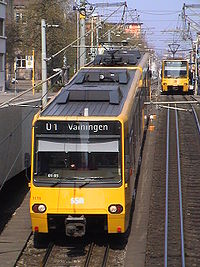
German language
German is a West Germanic language, related to and classified alongside English and Dutch. With an estimated 90 – 98 million native speakers, German is one of the world's major languages and is the most widely-spoken first language in the European Union....
for "city railway"; plural ) is a tram
Tram
A tram is a passenger rail vehicle which runs on tracks along public urban streets and also sometimes on separate rights of way. It may also run between cities and/or towns , and/or partially grade separated even in the cities...
way or light rail
Light rail
Light rail or light rail transit is a form of urban rail public transportation that generally has a lower capacity and lower speed than heavy rail and metro systems, but higher capacity and higher speed than traditional street-running tram systems...
way that includes segments built to rapid transit
Rapid transit
A rapid transit, underground, subway, elevated railway, metro or metropolitan railway system is an electric passenger railway in an urban area with a high capacity and frequency, and grade separation from other traffic. Rapid transit systems are typically located either in underground tunnels or on...
standards, usually as part of a process of conversion to a metro
Rapid transit
A rapid transit, underground, subway, elevated railway, metro or metropolitan railway system is an electric passenger railway in an urban area with a high capacity and frequency, and grade separation from other traffic. Rapid transit systems are typically located either in underground tunnels or on...
railway, mainly by the building of tunnel
Tunnel
A tunnel is an underground passageway, completely enclosed except for openings for egress, commonly at each end.A tunnel may be for foot or vehicular road traffic, for rail traffic, or for a canal. Some tunnels are aqueducts to supply water for consumption or for hydroelectric stations or are sewers...
s in the central city area.
Stadtbahnen were mostly implemented in the 1960s and 1970s with the long-term goal of establishing a full-scale metro system, but by the 1980s virtually all cities had abandoned these plans due to the excessive costs associated with converting the tramways. Most Stadtbahn systems are now a mixture of tramway-like operations in suburban and peripheral areas and a more metro-like mode of operation in city centres, with underground stations.
1920s: Berlin and Vienna cross-city lines
The term "Stadtbahn" first arose in the first half of the 20th century as a name for the cross-city lines in BerlinBerlin
Berlin is the capital city of Germany and is one of the 16 states of Germany. With a population of 3.45 million people, Berlin is Germany's largest city. It is the second most populous city proper and the seventh most populous urban area in the European Union...
and Vienna
Vienna
Vienna is the capital and largest city of the Republic of Austria and one of the nine states of Austria. Vienna is Austria's primary city, with a population of about 1.723 million , and is by far the largest city in Austria, as well as its cultural, economic, and political centre...
.
The Berlin Stadtbahn line is an elevated, heavy rail line linking the East and the West. Long distance, regional, suburban, and urban services (S-Bahn
S-Bahn
S-Bahn refers to an often combined city center and suburban railway system metro in Austria, Germany, Switzerland and Denmark...
) are operated on it.
The Wiener Stadtbahn
Wiener Stadtbahn
The Wiener Stadtbahn was a public transportation system operated under this name from 1898 to 1989. Today, the Vienna U-Bahn lines U4 and U6 and the Vienna S-Bahn run on its former lines....
(Vienna) was in the beginning a system of heavy rail lines circling the city, free of level crossings, operated by steam trains. After World War I the Wiental, Donaukanal and Gürtel lines were converted into an electric light rail system with tram-like two-axle cars (which on line 18G until 1945 switched into the tram network at Gumpendorfer Strasse station). In the 1970s to 1990s the infrastructure was updated, and the lines were partially relocated: they are now part of the Vienna U-Bahn
Vienna U-Bahn
The Vienna U-Bahn is a rapid transit system consisting of five lines. It is the backbone of one of the best performing public transport systems worldwide according to UITP in June 2009. More than 1.3 million passengers use the Vienna U-Bahn every day...
services 'U4' and 'U6'. The Vorortelinie line remained heavy rail and is now part of the Vienna S-Bahn
Vienna S-Bahn
The Vienna S-Bahn is a suburban metro railway network in Vienna, Austria. As opposed to the city-run urban metro network, the Vienna U-Bahn, it extends beyond the borders of the city, is operated by the ÖBB , and consists of many branch lines...
.
1960s: West Germany's 'pre-metro' projects
Since the 1960s the term "Stadtbahn" has become identified with a second, and now dominant, meaning.Post-World War II transport policies in West German cities aimed for a separation of public and private transport. The conflicts that arose between increasing car usage and the existing tramway systems led to the so-called 'second level' concept for future light rail schemes. This concept focused on the grade separation, i.e., elevation and/or tunneling of tram lines.
Munich
Munich
Munich The city's motto is "" . Before 2006, it was "Weltstadt mit Herz" . Its native name, , is derived from the Old High German Munichen, meaning "by the monks' place". The city's name derives from the monks of the Benedictine order who founded the city; hence the monk depicted on the city's coat...
and Nuremberg
Nuremberg
Nuremberg[p] is a city in the German state of Bavaria, in the administrative region of Middle Franconia. Situated on the Pegnitz river and the Rhine–Main–Danube Canal, it is located about north of Munich and is Franconia's largest city. The population is 505,664...
decided to build pure, full-scale U-Bahn (metro) systems. Berlin
Berlin
Berlin is the capital city of Germany and is one of the 16 states of Germany. With a population of 3.45 million people, Berlin is Germany's largest city. It is the second most populous city proper and the seventh most populous urban area in the European Union...
and Hamburg
Hamburg
-History:The first historic name for the city was, according to Claudius Ptolemy's reports, Treva.But the city takes its modern name, Hamburg, from the first permanent building on the site, a castle whose construction was ordered by the Emperor Charlemagne in AD 808...
planned expansions of their existing U-Bahn networks, while most West German cities decided to upgrade their tramway networks step by step, linking new 'second level' infrastructure to existing sections. While some cities regarded this solution as an interim step that would lead to a fully separated U-Bahn (metro) network independent of other forms of transport, others planned for a lesser degree of separation, one that would accommodate additional tram-like sections in the long run. For both the interim and the long-term based concepts, the following terms came into use: "U-Straßenbahn" or "Untergrund-Straßenbahn" (underground tramway, abbreviated as "U-Strab") , "Schnellstraßenbahn" (rapid tramway) and finally "Stadtbahn". (In French-speaking countries, these concepts were also known as "pre-metro
Premetro
A premetro is a tramway or light railway which includes segments built to rapid transit standards, usually as part of a process of conversion to a metro railway, mainly by the construction of tunnels in the central city area...
", stressing their interim nature.)
Some operators and cities decided to identify the term Stadtbahn with the eventual goal of installing an U-Bahn so that both the original U-Bahn logo (e.g. Frankfurt
Frankfurt
Frankfurt am Main , commonly known simply as Frankfurt, is the largest city in the German state of Hesse and the fifth-largest city in Germany, with a 2010 population of 688,249. The urban area had an estimated population of 2,300,000 in 2010...
, Cologne
Cologne
Cologne is Germany's fourth-largest city , and is the largest city both in the Germany Federal State of North Rhine-Westphalia and within the Rhine-Ruhr Metropolitan Area, one of the major European metropolitan areas with more than ten million inhabitants.Cologne is located on both sides of the...
, Hannover) and the derived U-Stadtbahn logos (e.g. North Rhine-Westphalia
North Rhine-Westphalia
North Rhine-Westphalia is the most populous state of Germany, with four of the country's ten largest cities. The state was formed in 1946 as a merger of the northern Rhineland and Westphalia, both formerly part of Prussia. Its capital is Düsseldorf. The state is currently run by a coalition of the...
, Stuttgart
Stuttgart
Stuttgart is the capital of the state of Baden-Württemberg in southern Germany. The sixth-largest city in Germany, Stuttgart has a population of 600,038 while the metropolitan area has a population of 5.3 million ....
; see example above) mark station entries and stops. The numbering scheme for Stadtbahn services was prefixed with a 'U', except in Cologne
Cologne
Cologne is Germany's fourth-largest city , and is the largest city both in the Germany Federal State of North Rhine-Westphalia and within the Rhine-Ruhr Metropolitan Area, one of the major European metropolitan areas with more than ten million inhabitants.Cologne is located on both sides of the...
, Bielefeld
Bielefeld
Bielefeld is an independent city in the Ostwestfalen-Lippe Region in the north-east of North Rhine-Westphalia, Germany. With a population of 323,000, it is also the most populous city in the Regierungsbezirk Detmold...
, and Hannover.
1980s: Renaissance of the tramway
By the 1980s conventional tramways had been seen by decision-makers as overloaded systems for almost two decades. However, public attention focused on them at this time for two reasons.The Stadtbahn cities' second level plans faced unexpected complications in the form of lengthy construction work, budgetary problems for tunnel projects, and protests against elevated sections. At the same time, the smaller cities which had not started Stadtbahn plans reassessed their options in relation to their existing tram systems.
The "Stadtbahn" term has now come to have the vague meaning of 'modern tramway' or 'modernized tramway'. It has become impossible to differentiate between Straßenbahn (trams) and Stadtbahn (light rail).
Among the first cities to use the "Stadtbahn" term to mean their upgraded tramway systems with no link to appreciable second level infrastructure were Würzburg
Würzburg
Würzburg is a city in the region of Franconia which lies in the northern tip of Bavaria, Germany. Located at the Main River, it is the capital of the Regierungsbezirk Lower Franconia. The regional dialect is Franconian....
and Mannheim
Mannheim
Mannheim is a city in southwestern Germany. With about 315,000 inhabitants, Mannheim is the second-largest city in the Bundesland of Baden-Württemberg, following the capital city of Stuttgart....
.
East German cities had no 1960s-style Stadtbahn plans in place, and the fleets and the infrastructure were in need of massive investment and improvement. After the reunification of Germany in 1990, the use of the "Stadtbahn" term became popular in the former East Germany as well, as in Erfurt
Erfurt
Erfurt is the capital city of Thuringia and the main city nearest to the geographical centre of Germany, located 100 km SW of Leipzig, 150 km N of Nuremberg and 180 km SE of Hannover. Erfurt Airport can be reached by plane via Munich. It lies in the southern part of the Thuringian...
and Dresden
Dresden
Dresden is the capital city of the Free State of Saxony in Germany. It is situated in a valley on the River Elbe, near the Czech border. The Dresden conurbation is part of the Saxon Triangle metropolitan area....
.
"Stadtbahn" in this wider meaning is thus not a clearly defined concept, but a vague one linked to a set of attributes, much in the same way that "Straßenbahn" (tram) is linked to very different, sometimes mutually incompatible attributes. A system that is called "Stadtbahn" today may not have all of the Stadtbahn attributes: barrier-free access, higher cruising speed than tramways, doors on both sides of the train, driver's cabs on both ends, higher operating voltage, wider cars with comfortable seats, and so on.
1990s: The tram goes railway
In 1992 KarlsruheKarlsruhe
The City of Karlsruhe is a city in the southwest of Germany, in the state of Baden-Württemberg, located near the French-German border.Karlsruhe was founded in 1715 as Karlsruhe Palace, when Germany was a series of principalities and city states...
started an innovative new service, using both heavy and light rail infrastructure, to link the wider region to the city. The vehicles were designed to comply with technical specifications for the (federal) heavy railway and for light rail (communal tramways). Such vehicles are called Dual-System Light Rail Vehicles. The meaning of Stadtbahn was enlarged to encompass this new type of "tram-train
Tram-train
A tram-train is a light-rail public transport system where trams run both on an urban tramway network and on main-line railways to combine the tram's flexibility and availability and the train's greater speed...
" service. In other regions, stimulated by the Karlsruhe example and planning to copy it, other terms are in use: Stadt-Umland-Bahn (city-to-region railway, e.g. Erlangen
Erlangen
Erlangen is a Middle Franconian city in Bavaria, Germany. It is located at the confluence of the river Regnitz and its large tributary, the Untere Schwabach.Erlangen has more than 100,000 inhabitants....
), Regional-Stadtbahn (regional light rail, e.g. Braunschweig
Braunschweig
Braunschweig , is a city of 247,400 people, located in the federal-state of Lower Saxony, Germany. It is located north of the Harz mountains at the farthest navigable point of the Oker river, which connects to the North Sea via the rivers Aller and Weser....
).
Straßenbahn (tram) and Stadtbahn in the Karlsruhe
Karlsruhe
The City of Karlsruhe is a city in the southwest of Germany, in the state of Baden-Württemberg, located near the French-German border.Karlsruhe was founded in 1715 as Karlsruhe Palace, when Germany was a series of principalities and city states...
region are differentiated more by the nature of their city-border crossings only, and not by the technical dimension (Dual-System Light Rail Vehicles). Only those services that extend into the suburbs are called Stadtbahn. They are represented by the 'S' logo that is used for 'S-Bahn' (Stadtschnellbahn) in the rest of Germany and therefore partially conflict with it, as it has acquired a second meaning in Karlsruhe.
2000s: The Tram logo

Deutsche Bahn
Deutsche Bahn AG is the German national railway company, a private joint stock company . Headquartered in Berlin, it came into existence in 1994 as the successor to the former state railways of Germany, the Deutsche Bundesbahn of West Germany and the Deutsche Reichsbahn of East Germany...
adopted a new logo to indicate Straßenbahn (tram) connections: a square containing the word 'Tram'. Although the design is the same nationwide, the colour varies from city to city to match local public transport operators' systems of colour coding. The logo is part of the 'S logo scheme' initially developed by Berlin
Berlin
Berlin is the capital city of Germany and is one of the 16 states of Germany. With a population of 3.45 million people, Berlin is Germany's largest city. It is the second most populous city proper and the seventh most populous urban area in the European Union...
public transport operator BVG
Berliner Verkehrsbetriebe
The is the main public transport company of Berlin, the capital city of Germany. It manages the city's U-Bahn underground railway, tram, bus and ferry networks, but not the S-Bahn urban rail system....
, based on the established logos for urban metro ('U', for U-Bahn) and suburban metro ('S', for S-Bahn) and including bus ('Bus') and ferry ('F', for Fähre) operations.
As the new logos became part of the information systems at more and more main railway stations, an increasing number of cities and public transport operators came to accept and adopt the scheme. As far as the Stadtbahn terminology problem is concerned, however, the scheme serves only to add further confusion to the matter, since there is no nationwide logo for Stadtbahn services. The result appears to be a contraction in the use of the term Stadtbahn, especially in cities where it has been used in its wider 1980s 'light-rail system' meaning.
In cities where Stadtbahn has the 1960s 'pre-metro
Premetro
A premetro is a tramway or light railway which includes segments built to rapid transit standards, usually as part of a process of conversion to a metro railway, mainly by the construction of tunnels in the central city area...
' meaning, both the 'U' (for U-Bahn) and the 'Tram' logo are used on city maps (to indicate the location of stops) and on railway station signage (to indicate connections). The 'U' Logo is normally used both where stops or stations are underground and where they serve 'second-level' pre-metro type lines. In cities which prefix all their Stadtbahn line numbers with a 'U' (e.g. Stuttgart
Stuttgart
Stuttgart is the capital of the state of Baden-Württemberg in southern Germany. The sixth-largest city in Germany, Stuttgart has a population of 600,038 while the metropolitan area has a population of 5.3 million ....
), the 'U' logo is used at stops on services that are essentially 'classic' tram lines, not 'second-level' at all.
Regionalstadtbahn
The concept of Regionalstadtbahnen (also known by RegioStadtbahn or other names) arose as a result of the harmonisation or integration of railway lines into Stadtbahn networks. In the area of Cologne–Bonn a single operational system (of so-called above ground lines or Hochflurstrecken) was created by the Cologne Stadtbahn and the Stadtbahn Bonn, opened in 1974,from the conversion of two former railway lines (the Rheinuferbahn and Vorgebirgsbahn belonging to the old Köln-Bonner Eisenbahnen). Further developments led to tram-train
Tram-train
A tram-train is a light-rail public transport system where trams run both on an urban tramway network and on main-line railways to combine the tram's flexibility and availability and the train's greater speed...
networks that rather resembled an S-Bahn
S-Bahn
S-Bahn refers to an often combined city center and suburban railway system metro in Austria, Germany, Switzerland and Denmark...
. This idea was first realised in 1992 in Karlsruhe (Stadtbahn Karlsruhe
Stadtbahn Karlsruhe
The Karlsruhe Stadtbahn is a German tram-train system combining tram lines in the city of Karlsruhe with railway lines in the surrounding countryside, serving the entire region of the middle upper Rhine valley and creating connections to neighbouring regions...
), where as part of the Karlsruhe model
Karlsruhe model
The Karlsruhe model reflects urban and heavy rail trains running on the same tracks. It was initially developed and implemented in the city of Karlsruhe, Germany by the local transit authority, Karlsruher Verkehrsverbund. It provides a connection between the regular railway network and the city's...
even so-called dual system railbuses were used, which in addition to the direct current
Direct current
Direct current is the unidirectional flow of electric charge. Direct current is produced by such sources as batteries, thermocouples, solar cells, and commutator-type electric machines of the dynamo type. Direct current may flow in a conductor such as a wire, but can also flow through...
of Straßenbahn lines (750 V) could also draw power from the 15-kV-alternating current
Alternating current
In alternating current the movement of electric charge periodically reverses direction. In direct current , the flow of electric charge is only in one direction....
from normal DB
Deutsche Bahn
Deutsche Bahn AG is the German national railway company, a private joint stock company . Headquartered in Berlin, it came into existence in 1994 as the successor to the former state railways of Germany, the Deutsche Bundesbahn of West Germany and the Deutsche Reichsbahn of East Germany...
catenary. In Karlsruhe this network reached as far as Heilbronn
Heilbronn
Heilbronn is a city in northern Baden-Württemberg, Germany. It is completely surrounded by Heilbronn County and with approximately 123.000 residents, it is the sixth-largest city in the state....
, 84 kilometres (52.2 mi) away, where a Stadtbahn network was created going out from this line. Both in Karlsruhe and in Heilbronn the Stadtbahn filled both the roles of a classic tramway system as well as an S-Bahn. The Karlsruhe mixed-operation concept was also adopted by the Saarbahn in Saarbrücken
Saarbrücken
Saarbrücken is the capital of the state of Saarland in Germany. The city is situated at the heart of a metropolitan area that borders on the west on Dillingen and to the north-east on Neunkirchen, where most of the people of the Saarland live....
. This model is today referred to in France as the tram-train
Tram-train
A tram-train is a light-rail public transport system where trams run both on an urban tramway network and on main-line railways to combine the tram's flexibility and availability and the train's greater speed...
.
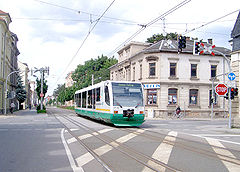
- KasselKasselKassel is a town located on the Fulda River in northern Hesse, Germany. It is the administrative seat of the Kassel Regierungsbezirk and the Kreis of the same name and has approximately 195,000 inhabitants.- History :...
(RegioTram Kassel with hybrid railcars for the transition between electrified and non-electrified routes) - ZwickauZwickauZwickau in Germany, former seat of the government of the south-western region of the Free State of Saxony, belongs to an industrial and economical core region. Nowadays it is the capital city of the district of Zwickau...
(Diesel railbuses of the VogtlandbahnVogtlandbahnThe Vogtlandbahn is a private railway company in Germany, which runs diesel trains on regional lines in the states of Saxony, Thuringia, Bavaria, Brandenburg, and Berlin and as well as routes into the Czech Republic...
on tramways in the city centre) - ChemnitzChemnitzChemnitz is the third-largest city of the Free State of Saxony, Germany. Chemnitz is an independent city which is not part of any county and seat of the government region Direktionsbezirk Chemnitz. Located in the northern foothills of the Ore Mountains, it is a part of the Saxon triangle...
(VariotramVariotramVariotram is a German-designed articulated low-floor tram model. Since its introduction in 1993, the Variotram has been manufactured variously by ABB, Adtranz, Bombardier Transportation, and since 2001 by Stadler Rail. As of 2009, 254 trams have been ordered, with an additional 110 on option...
s fitted with railway equipment, which City-Bahn Chemnitz runs daily on the Chemnitz - Stollberg/Erzgeb. line) - GothaGotha (town)Gotha is a town in Thuringia, within the central core of Germany. It is the capital of the district of Gotha.- History :The town has existed at least since the 8th century, when it was mentioned in a document signed by Charlemagne as Villa Gotaha . Its importance derives from having been chosen in...
(Straßenbahn Gotha/Thüringerwaldbahn), above ground tramway (24 km long), in existence since 1924, to WaltershausenWaltershausenWaltershausen is a city in the district of Gotha, Thuringia, Germany.The town has a population of 11475 .-Sister cities: Bruay-sur-l'Escaut, France Korbach, Germany Wolbrom, Poland Hanau, Germany -External links:*...
, FriedrichrodaFriedrichrodaFriedrichroda is a town in the district of Gotha, Thuringia, Germany. It is situated at the north foot of the Thuringian Forest, 21 km by rail southwest of the town of Gotha. It is surrounded by fir-clad hills and possesses numerous handsome villa residences, a Kurhaus and a sanatorium...
and TabarzTabarzTabarz is a municipality in the district of Gotha, in Thuringia, Germany. It is a winter sports resort and the terminus of the Thüringerwaldbahn rural tramway.... - NordhausenNordhausenNordhausen is a town at the southern edge of the Harz Mountains, in the state of Thuringia, Germany. It is the capital of the district of Nordhausen...
in the South Harz. This network run by the Harz Narrow Gauge Railways is notable because it supplements the diesel-hybrid cars with steam engines.
Public perception
This description of the Stadtbahn term has been about the intended use (what decision-makers and marketers intended). The public perception of politicians, passengers has been different.Mainly, the Stadtbahn term is much more widely used and well known among decision-makers and marketers.
Where it became clearly identified with investment and urban redevelopment, the term had some success in reaching the public, depending on whether it has still been used alongside other terms like 'U-Bahn', 'Straßenbahn' or 'U-Straßenbahn'.
Only little success in the meaning of getting widely used - instead of 'Straßenbahn' (tram) - was dedicated to most of the systems with 1980s concept of Stadtbahn. This evolution was further driven by the introduction of the 'Tram' logo and the absence of a nationwide standardized Stadtbahn logo (since for those systems without underground sections, the partially standardized 'U-Stadtbahn' logo would not be appropriate).
In most of the cities with systems that include underground, ground-level and sometimes elevated line sections, all three terms are in wide use for the whole system or to the corresponding sections: 'Straßenbahn' (tram), 'U-Bahn' (metro), Stadtbahn.
Legal terms
Although a precise legal definition of Stadtbahn was planned in the 1970s, there is currently no such definition. By law, the BOStrabBOStrab
The Verordnung über den Bau und Betrieb der Straßenbahnen is a German law governing regulations for tramway, metro and light rail operations....
regulates all Stadtbahn systems as tram
Tram
A tram is a passenger rail vehicle which runs on tracks along public urban streets and also sometimes on separate rights of way. It may also run between cities and/or towns , and/or partially grade separated even in the cities...
systems, as long as they are light rail rather than heavy rail.
Difference between Stadtbahn and S-Bahn
While the names Stadtbahn and S-Bahn have common origin ("rapid urban train"), their meaning today is different. S-BahnS-Bahn
S-Bahn refers to an often combined city center and suburban railway system metro in Austria, Germany, Switzerland and Denmark...
is heavy rail, usually integrated into the railway network and operated by the German railway company Deutsche Bahn
Deutsche Bahn
Deutsche Bahn AG is the German national railway company, a private joint stock company . Headquartered in Berlin, it came into existence in 1994 as the successor to the former state railways of Germany, the Deutsche Bundesbahn of West Germany and the Deutsche Reichsbahn of East Germany...
, but in certain cities it cannot be distinguished from the U-Bahn
U-Bahn
U-Bahn or Untergrundbahn is German for underground rapid transit or metro. Five systems take its name, with only four of them being metro systems:*Berlin U-Bahn*Hamburg U-Bahn*Munich U-Bahn*Nuremberg U-Bahn...
underground trains.
Stadtbahn, on the other hand, is light vehicles usually integrated into the tram network.
They also differ in legal status: S-Bahn systems are governed under the heavy rail rules of the Eisenbahn-Bau- und Betriebsordnung
Eisenbahn-Bau- und Betriebsordnung
The Eisenbahn-Bau- und Betriebsordnung or EBO is a German law specifying rules and regulations for railways....
("Federal regulations on building and operation mainline railways"), while Stadtbahn systems are tramways by law governed under the regulations of BOStrab
BOStrab
The Verordnung über den Bau und Betrieb der Straßenbahnen is a German law governing regulations for tramway, metro and light rail operations....
("Federal regulations on building and operating tramways").