

Heilbronn

Encyclopedia
Heilbronn is a city in northern Baden-Württemberg
, Germany. It is completely surrounded by Heilbronn County
and with approximately 123.000 residents, it is the sixth-largest city in the state.
The city on the Neckar
is a former Imperial Free City and current independent city
(i.e. not part of any county) and seat of Heilbronn County
. Heilbronn is also the "major economic centre" of the Heilbronn-Franken region that includes almost the entire northeast of Baden-Württemberg.
Heilbronn is known for its wine industry and is nicknamed Käthchenstadt after Heinrich von Kleist
's play Das Käthchen von Heilbronn
.
basin
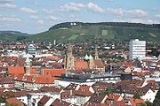
at the bottom of the Wartberg (308 m). It is spread out on both banks of the Neckar on a fertile terrace and the highest spot inside city limits is the Schweinsberg
with a height of 372 m. Heilbronn is located adjacent to the Schwäbisch-Fränkischer Wald State Park and is famous for the vineyards that surround it.
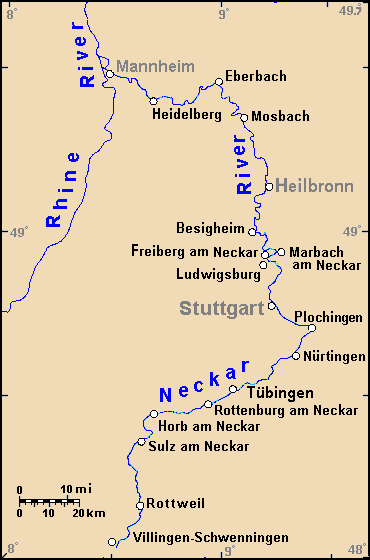 Heilbronn and its surroundings are located in the northern part of the larger Stuttgart
metropolitan area. The city acts as the economic centre of the Heilbronn-Franken region and is one of 14 cities referred to in the Baden-Württemberg master plan of 2002 as major economic centers. In addition, it serves the cities and towns of Abstatt
, Bad Rappenau
, Bad Wimpfen
, Beilstein
, Brackenheim
, Cleebronn
, Eberstatt, Ellhofen
, Eppingen
, Flein
, Gemmingen
, Güglingen
, Ilsfeld
, Ittlingen
, Kirchardt
, Lauffen am Neckar, Lehrensteinsfeld
, Leingarten
, Löwenstein
, Massenbachhausen
, Neckarwestheim
, Nordheim, Obersulm
, Pfaffenhofen, Schwaigern
, Siegelsbach
, Talheim
, Untergruppenbach
, Weinsberg
, Wüstenrot
and Zaberfeld
as an intermediate economic centre.
and listed here clockwise from the North: Bad Wimpfen
, Neckarsulm
, Erlenbach, Weinsberg
, Lehrensteinsfeld
, Untergruppenbach
, Flein
, Talheim
, Lauffen am Neckar, Nordheim, Leingarten
, Schwaigern
, Massenbachhausen
and Bad Rappenau
.
s. They are:
finds. Later on, but still before AD, the Celt
s already mined here for salt from brine.
Under Roman Emperor
Domitian
(AD 81–96) the Romans
pushed east away from the Rhine and the outer boundary of the Roman Empire
was set at the Neckar-Odenwald-Limes. A castle
in today's borough of Böckingen was part of that limes, and nearby numerous Roman villas and plantations were built. Around AD 150, the Neckar-Odenwald-Limes became obsolete when the boundary of the Roman Empire was moved approximately 30 km to the east, where it was subsequently fortified with the construction of the Upper Germanic Limes complete with parapet
and trench
es.
Around 260, the Romans surrendered the limes, and the Alamanni
became rulers of the Neckar basin. Between the 4th and 7th centuries, the area became part of the Frankish Empire
, and the first settlement was built in the general vicinity of the present center of town.
In 741 Heilbronn is first mentioned in an official document of the Diocese of Würzburg as villa Helibrunna (together with a Michaelsbasilica), and in 841, King Louis the German
set up court here for a period of time. The name Heilbrunna (healing well) hints to a well that is located not far from the basilica. In 1050 a significant settlement of Jews
is noted in official documents, and the Codex of the monastery in Hirsau
documented Heilbronn's right to hold market days and mint coins, mentioning its harbor and vineyards as well.
Empire as oppidum Heilecbrunnen. Oppidum signified a city fortified by parapet
and trench
es. Later during the 13th century, the Teutonic Knights
obtained ownership of a large area south of Heilbronn which would remain owned by that order until German Mediatisation
in 1805. Starting in 1268, the order built the Deutschhof there as one of its residences. The church building of the order that was located on the premises was modified and expanded several times: First in 1350 it was expanded (Gothic
), then it was remodeled in 1719 (Baroque
), and in 1977, it was consecrated as a cathedral.
After the demise of the Staufen
dynasty, King Rudolf I
returned city status to Heilbronn in 1281 and installed a regal advocate to rule the city. In addition to the advocate he put a council in place that was headed up by a mayor. Around 1300, the first city hall was erected in the market place and the Kilianskirche
(built on the foundation of the Michaelsbasilica) was expanded. The Neckar privilege gave the city the right to modify the flow of the river in 1333, which meant it now had the right to construct dams, harbours and mills. Because of the infrastructure thus created, Heilbronn became increasingly attractive to merchants and craftspeople during the 14th century whose influence had been growing and who were now demanding the right to determine their own fate.
In 1371 Charles IV, Holy Roman Emperor
, issued a new charter to the city. Now Heilbronn needed to answer only to the Emperor and as such was an Imperial Free City. Craftspeople and merchants were now represented in its council and the villages of Böckingen, Flein
, Frankenbach and Neckargartach became part of Heilbronn's territory.
As an Imperial Free City Heilbronn kept seeing itself threatened by the ambitious house of Württemberg. A very close relationship with the Holy Roman Emperor and a treaty with the Electoral Palatinate that was in effect from 1417 through 1622 strengthened Heilbronn's position and kept Württemberg at bay. The political stability enjoyed by the city during the 15th century caused it to bloom and many of its historic structures trace their roots back to that time as, for instance, the expansion of the Kilianskirche
from 1455 through 1460.
spent three years in "knightly custody" in Heilbronn starting in 1519 and even spent a night in the tower of the bastion. That same year people first took note of the pub owner Jäcklein Rohrbach who with accomplices would later kill the executor of Böckingen. After he had spent some time in the Hohenlohe Plains and collected similarly minded characters around him, he returned to Heilbronn in April 1525 just as the German Peasants' War
was getting into full swing. On April 16 the peasants killed many of the nobles in Weinsberg and on April 18 the Heilbronn cloister of the Order of Our Lady of Mt. Carmel
was attacked and ransacked. The city opened its gates in response to demands of the peasants and consequently more churches and municipal institutions were robbed the next day. For about a month Heilbronn remained under the control of revolting peasants. And even though Johann Lachmann, later a church reformer, had attempted to mediate, the peasants did not leave the city until one of their armies was defeated on May 12, 1525 in Böblingen
. Their leader Rohrbach was executed on May 21, 1525 in Neckargartach and his home town of Böckingen was partially burnt to the ground in punishment.
In 1528, the replacement of the mayor by Hans Riesser, a Protestant, brought on the previously delayed Reformation
and through the efforts of Reformer Lachmann schools and healthcare were also reorganized. In 1529 the Kilianskirche
(church tower of the Kilianskirche) was completed. It was the first important religious building of the Renaissance
in Germany. The year 1528 brought about the acceptance of the Augsburg Confession
by city council and residents and the Heilbronn Catechism of 1536 is the second oldest catechism in the Protestant Church. In 1538 Heilbronn joined the Schmalkaldic League
but by 1564 squabbles between troops of the Schmalkaldic League and those of the Emperor Charles V
escalated into battles that were won by the Emperor. As a result, Charles V spent Christmas 1546 in Heilbronn to attend the ensuing criminal proceedings. It is also Charles V who in 1522 changed the charter of the city and this charter survived almost unscathed until 1803.
During the Thirty Years' War
the city and surrounding villages suffered badly. After the battle of Wimpfen
in 1622, Neckargartach was burnt to the ground. In 1631 Heilbronn was occupied by imperial troops but the same year the Swedes succeeded in conquering the city. From 1644 through 1647, Heilbronn was again part of the Holy Roman Empire, but then French troops moved in and later those of the Palatinate. The city was not free of occupying forces until four years after the Peace of Westphalia
of 1648. But already in the 1670s the city again became the stage for armed manoeuvres, until it was occupied by French troops in 1688. But while that occupation of the city only lasted several months, the French were only persuaded to leave the surrounding areas in 1693, after a large defensive army had been put into the field and fortifications had been erected.
and Goethe
came to visit the city, and gorgeous buildings were being constructed in Rococo
style.
On September 9, 1802 the city of Heilbronn lost its status as Imperial Free City when the troops of Duke Frederick I of Württemberg
marched into town. The duke had lost his holdings on the left bank of the Rhine to France during the French Revolutionary Wars
but had been compensated with areas on the right bank. This is how Heilbronn together with other formerly Imperial Free Cities became part of Württemberg in 1803. Heilbronn became the seat of an Oberamt (district), and the four Imperial Free villages became separate communities within the district. In 1806 the Duchy of Württemberg became the Kingdom of Württemberg
.
In 1815, Heilbronn again became a staging area for major armies ahead of the campaign against Napoleon
, and 10,000 troops paraded in front of Emperor Franz of Austria
and 126 German princes and generals in the Theresienwiese. Tsar
Alexander I of Russia
met in Heilbronn with the Baltic
Baroness Juliane von Krüdener
who talked him into founding the "Holy Alliance
".
Industrialization arrived in 1820. When the first train lines were placed in service in Württemberg, Heilbronn was at the end of the line of the northern branch that connected Heilbronn with Stuttgart
and further fueled industrialization.
For a while Heilbronn suffered from the upheavals of the Baden Revolution that its civil guard participated in. During that time the 8th infantry regiment switched sides and joined the revolutionaries until it was subsequently disarmed and force-transferred out of the area.
Heilbronn became part of the German Empire
in 1871 during the unification of Germany
.
In the 1860s the train tracks were extended from Heilbronn to Heidelberg
via Bad Wimpfen
, to Würzburg
via Osterburken
, and to Crailsheim
(and later on to Nuremberg
) via Schwäbisch Hall
. In 1880, the Kraichgau
line was completed and created an important connection towards the Karlsruhe
area and by the end of the 19th century Heilbronn had become an important hub and second only to Stuttgart as one of Württemberg's largest industrial cities.
The year 1892 brought electricity via a connection to the power plant in Lauffen and thus Heilbronn became the first city in the world to enjoy long distance supply of power.
 With the dissolution of monarchy in the German Reich as a result of World War I, Heilbronn became part of the Free People's State of Württemberg
in 1918.
After almost a century of economic boom and growth of the local industry Heilbronn's citizenry included many labourers. The city came to be known as a "red hot spot" and numerous worker and sports clubs were founded. Already prior to World War I the SPD
cornered the majority of the vote and stayed that course during the period of the Weimar Republic
. At his visit to the city on May 15, 1926, Hitler
was clearly not welcome by everyone and several people were injured when a man was mistaken for Hitler and attacked. Hitler himself was able to give his speech in the city's community center Harmonie but the SPD had the majority in Heilbronn over the NSDAP as late as the elections on March 5, 1933.
Heilbronn's district leader of the NSDAP had been Richard Drauz since 1932 who had been born into a respected Heilbronn family. He was also elected to the Reichstag
from 1933 on and pushed hard for the Gleichschaltung
of the Heilbronn clubs and press in Nazi Germany
.
On July 28, 1935, the port was opened in a canal off the Neckar and 1936 saw the Autobahn between Heilbronn and Stuttgart completed. Economy and infrastructure were booming in Württemberg and Heilbronn was at the logistic centre of it all. As the result of a district reform on October 1, 1938, Heilbronn became seat of the newly created Heilbronn County
and regained independent city status. At the same time the previously independent communities of Böckingen, Sontheim and Neckargartach were annexed and with 72,000 residents Heilbronn now was the second largest city in Württemberg. The port turned into an important transfer station on the Neckar and one of the ten largest interior ports in the country.
On November 10, 1938, the Heilbronn synagogue
was destroyed and during 1939 the Jewish community was all but eliminated.
Starting in 1942 during World War II, the salt mines in and around Heilbronn were used to store art and artifacts from Germany, France and Italy. Similarly, important producers of the war industry were moved into the mine shafts
. The expansion of the shafts was undertaken by labour brigades of the concentration camp branches in Kochendorf and Neckargartach. From Heilbronn all the way to Neckarelz
numerous subterraneous complexes, some of them gigantic, were constructed and as of November 20, 1942 the Heilbronn Bureau of Labour had 8,000 forced labourers registered in its district.
In 1940 allied air raids started and the city and its surrounding area were hit about 20 times with minor damage. On September 10, 1944, a raid by the allies targeted the city and, specifically, the Böckingen train transfer station. 281 residents died as a result of 1,168 bombs dropped that day. The city was carpet-bombed from the southern quarter all the way to the Kilianskirche
in the centre of town. The church burnt out.
The catastrophe for Heilbronn was the bombing raid on December 4, 1944. During that raid the centre of town was completely destroyed and the surrounding boroughs were heavily damaged. Within one half hour 6,500 residents perished. Of those, 5,000 were later buried in mass graves in the Ehrenfriedhof (cemetery of honor) in the valley of the Köpfer creek close to the city. To this day, a memorial is held annually in memory of those that died that day. As a result of the war Heilbronn's population shrank to 46,350 (see Bombings of Heilbronn in World War II
).
After a ten-day battle
with the advancing allies over the strategically important Neckar crossings World War II ended for the destroyed city on April 12, 1945 with occupation by US troops. Local NSDAP leader Drauz took time for numerous courts-martial
while on the run from the allies and was hanged on December 4, 1946 in Landsberg
because of executions of American prisoners of war he had ordered in March 1945.
and Paul Meyle. Milestones were the rededication of historic city hall in 1953 and the reopening of the community centre Harmonie. Heilbronn was part of Württemberg-Baden
until 1952, after which it became part of Baden-Württemberg
.
From 1951 forward, US troops were permanently stationed in Heilbronn. They used barracks built prior to World War II and also added some structures of their own.
The opening of the Autobahn A 6
from Heilbronn to Mannheim
in 1968 was an important economic event for Heilbronn. When the A 81
to Würzburg
and the A 6
to Nuremberg
was completed in 1974 and 1979 respectively, Heilbronn became an important logistical centre in southern Germany. As a result, many of the larger companies opened locations in Heilbronn.
When Klingenberg became part of Heilbronn on January 1, 1970, the city's population passed the 100,000 mark and thus attained "major city" (Großstadt) status. During the last district reform in the 1970s, Kirchhausen, Biberach, Frankenbach and Horkheim were incorporated into Heilbronn and the city was reconfirmed as independent city and seat of Heilbronn County. It was also declared seat of the newly formed region Franken
, now Heilbronn-Franken.
Also during the 1970s, the centre of the city was transformed into a pedestrian zone and the rededication of the city theatre in 1982 closed one of the largest holes left in the inner city from World War II.
Pursuant to the NATO Double-Track Decision
of 1979, Pershing II intermediate-range nuclear missiles were stationed just uphill of the city in the Waldheide. This made Heilbronn the only major city in Germany with atomic missiles stationed inside its city limits — a fact which became front-page news during the missile accident on January 11, 1985. After the INF Treaty
was signed in 1987, the missiles were removed.
In the 1980s, Heilbronn hosted two major events (Heimatttage and Landesgartenschau) staged by the State of Baden-Württemberg. In 1998 Heilbronn was connected to the S-Bahn net with Karlsruhe. This caused another transformation of the city centre and the extension of the S-Bahn towards Öhringen
was opened on December 10, 2005. It marked the completion of the East-West axis of the regional transportation system. The North-South axis is still in the planning stages (as of February 2006).
Heilbronn won the European competition "Entente Florale 2000" on September 9, 2000, in Broughshane, Northern Ireland and in 2005–06 the city became the first UNICEF children's city in Germany.
Late in 2005, Heilbronn was chosen to host the Bundesgartenschau
in 2019. If plans are realized, this could create an entire new borough along the S-Bahn line Böckingen–Theresienwiese–Neckargartach.
under Chlodwig
settled in the Neckar region around 500 the area has been predominantly Christian
and when Heilbronn was first mentioned in an official document in 741 Christian Michaelsbasilica, present day's Kilianskirche
, was mentioned along with the city. The Teutonic Knights
constructed its church from the 13th century and both churches were continually expanded. They were joined later by other churches and cloisters in the city.
Around 1050 an important Jewish community was mentioned that had settled in what became known as the Judengasse (Lohtorstraße). In 1298, 143 Jews were killed during the Rintfleisch-Pogrom
and in 1350 Jews suffered attacks again during a European epidemic
of the Bubonic plague
. The city's constitution required the council to include Jews, but already in the middle of the 15th century Jews were the target of vigilantes again until they were evicted from the city in 1490 with the blessings of Emperor Frederick III
.
It is worth noting that the common Jewish name Halpern, and many variants such as Alpert, derive from the name of this city Heilbronn, and the early Jewish community there.
While Heilbronn was part of the Diocese of Würzburg, the independent villages of Böckingen, Neckargartach and Frankenbach were attached to the Diocese of Worms. From 1514 on the Heilbronn native Johann Lachmann was caretaker of the parish in St. Kilian, in 1521 he became its preacher, in 1524 he converted to Lutheranism
and proceeded to teach and lead the Reformation
in Heilbronn against the wishes of both dioceses. After the Protestant reformation
of Heilbronn was complete the city remained Lutheran for centuries and the council and citizens accepted the Augsburg Confession
without dissent. Catholics were no longer welcome, Jews were prohibited from settling in Heilbronn, and the city took part in the Protestation at Speyer
on April 19, 1529 (the Protestation was the origin of the terms Protestant and Protestantism).
The Age of Enlightenment
brought Heilbronn freedom of religion. As of 1803 Jews were again permitted to settle in the city, Catholics also began to move back in and by the 1860s Jews were granted equal rights as Heilbronn citizens.
After the city became part of Württemberg in 1803 it also became seat of a deacony and the Prelate
or regional bishop of the Protestant State Church in Württemberg. To this day Protestants are in the majority in Heilbronn. The Catholic parishes belong to the Deacony Heilbronn and are part of the Diocese of Rottenburg-Stuttgart
.
Around 1920 first groups of "Serious Bible Students" (now: Jehovah's Witnesses
) formed. Their small community suffered from oppression during the Third Reich and many of its members died in concentration camps. Similarly, the Jewish community had to watch as its colossal synagogue
went up in flames and its 350 members were subsequently all but extinguished. Jehovah's Witnesses built a first meeting room in Heilbronn in 1953 and many more have been added since then.
Since the 1970s, after guest workers and immigrants from Islam
ic or Russian-Orthodox
countries settled here, these faiths are practiced to by a growing part of the population and numerous mosques have been created since the 1990s in the city and county of Heilbronn.
data (¹), or official extensions thereof, counting only primary residences.
¹ Census data
For State elections to the Landtag of Baden-Württemberg
Heilbronn makes up an electoral district (District 18) together with Erlenbach. Before the 2006 elections, it was an electoral district all by itself.
features a black eagle with red tongue and claws on golden background. The eagle is protected by a red, silver and blue shield. The city flag is red, white and blue.
The oldest seal of the city dates back to 1265. The eagle is the symbol for the imperial freedom enjoyed by Heilbronn until it was annexed
by the Grand Duchy
(and later Kingdom) of Württemberg
. While it is established that it appeared for the first time with shield in 1556 to distinguish it from other versions of eagles, the origin of the colors of the shield has yet to be determined. The colors also appeared in reverse order in 1556, 1581 and 1681 and there have been other variations of colour as well, such as white rather than golden background.
Interesting is the fact that Heilbronn sports three colours in its flag. Newly dedicated municipal flags in Baden-Württemberg
only use two colours. According to State municipal laws, Heilbronn's flag was grandfathered as it had been in use prior to 1935.
-Alemannic
and the Franconian
dialects of the German language.
. Every other year the Neckarfest and Traubenblütenfest are added to this already full schedule.
is a football club based in Heilbronn, Baden-Württemberg formed only recently – in 2003 – out of a merger between two former clubs with the elder dating back to 1896 and playing a five year stint in the Regionalliga Süd
(II) / 2nd Bundesliga Süd
from 1969 to 1975.
Heilbronn hosts an annual tennis tournament Heilbronn Open
(see Heilbronn Open website) which is part of the ATP Challenger tour.
has a long tradition in Heilbronn and is an important part of its economy to this day. Its 514 ha
, two thirds of it growing red grapes, is the third largest vineyard in Württemberg's vine-growing region after Brackenheim
and Lauffen am Neckar. In 1888 the vintner
s of the Heilbronn area combined and formed the Weingärtnergesellschaft Heilbronn , a cooperative. In 1933 that cooperative then combined with the competing cooperative Winzergenossenschaft Heilbronn that had formed in 1919 and that cooperative again merged with the Vintner cooperatives of Erlenbach
and Weinsberg
to form the Genossenschaftskellerei Heilbronn-Erlenbach-Weinsberg with seat just outside the city limits in Erlenbach. In addition to the cooperative, numerous independent vintners are also located here.
South of the steam power plant is located the conveyor tower of the Südwestdeutsche Salzwerke AG (SWS). The SWS runs a salt
mine in the Heilbronn area. That mine was connected through an underground tunnel with the now shut-down (since 1994) salt mine Kochendorf in Bad Friedrichshall
. Extraction had extended the Heilbronn mine far to the west so that in 2004 a new shaft, Konradsberg, was added — probably the last mining shaft that was constructed in all of Germany.
 The city of Heilbronn is readily accessible by road courtesy of the Weinsberg Intersection just to the northeast of the city, the intersection of the Autobahn A 81
from Würzburg
to Gottmadingen
and the A 6
from Saarbrücken
to Waidhaus
. In addition to the Autobahns the city is connected via the Bundesstraße
n B 27 from Blankenburg
to Schaffhausen
, B 39 from Frankenstein (Palatine) to Mainhardt
and B 293 from Karlsruhe
to Heilbronn that both run through the city itself.
Heilbronn is also a forerunner of right turn on red
in Germany and 65 "Green arrow" signs have been installed at appropriate intersections since 1996.
Although Heilbronn Hauptbahnhof
(central station) does not benefit from the Deutsche Bahn long-distance service
, the city is well connected by train. The Franconia Railway (Frankenbahn) connects Stuttgart
and Würzburg, the Neckar Valley Railway
and Elsenz Valley Railway
run from Heilbronn to Heidelberg and Mannheim
, and the Hohenlohe Railway
accommodates travel to Schwäbisch Hall
via Öhringen
.
The Heilbronn and Karlsruhe Stadtbahns provide a connection all the way to Karlsruhe
on the Kraichgau Railway
's tracks. Currently the S 4 takes travellers from Karlsruhe through the central train station past the centre of town all the way to the Öhringen borough of Cappel (since December 11, 2005). Because of massive delays in the construction of the S-Bahn tracks through Heilbronn's city limits and with the modernization and electrification of the existing tracks from Heilbronn to Öhringen meant that the new section's official opening needed to be postponed several times. In the future, additional S-Bahn lines are planned to Neckarsulm
, Lauffen am Neckar and Zaberfeld
. As well a these new lines, additional stops will also be built in the inner city of Heilbronn.
Whilst the original Straßenbahn
of Heilbronn, nicknamed the Spatzenschaukel (German for "sparrows' swing"), was discontinued on April 1, 1955, the city used electrically powered trolley buses until 1960. Today, public transportation is provided by the S-Bahn that runs through Heilbronn similar to the Karlsruhe model
and this is complemented by buses run by the Stadtwerke Heilbronn (Verkehrsbetriebe) and several other enterprises. All now belong to the Heilbronner Verkehrsverbund.
 The canal port on the Neckar is one of the ten largest German interior port
s.
(SWR). From here regional programmes like Frankenradio are broadcast on SWR4 Baden-Württemberg. The Heilbronner Stimme is a daily newspaper published in the city and the advertisers Neckar Express, echo am Mittwoch and echo am Sonntag are available weekly free of charge. Heilbronners also peruse the monthly city magazines Freizeit Journal and Moritz.
Several courts are located in Heilbronn, two belonging to the Stuttgart court district, a specialty court hearing labour issues, and a family court whose district includes the city of Heilbronn and the counties of Heilbronn
, Ludwigsburg
, Schwäbisch Hall
, Hohenlohe and Main-Tauber.
The City is also the seat of the Prelature of Heilbronn and of the church district of Heilbronn (of the Protestant State Church as well as of the Heilbronn Deacony of the Diocese of Rottenburg-Stuttgart
).
since 1988. Starting with the fall semester on September 1, 2005 the Fachhochschule
was awarded the status of a Hochschule
.
The private Heilbronn Business School opened at the Neckarturm in January 2005.
As far as general education is concerned, Heilbronn operates five college-track highschools or gymnasiums
(Elly-Heuss-Knapp-Gymnasium, Justinus-Kerner-Gymnasium, Mönchsee-Gymnasium, Robert-Mayer-Gymnasium and Theodor-Heuss-Gymnasium), four non-college-track highschools or Realschulen (Dammrealschule, Helene-Lange-Realschule, Heinrich-von-Kleist-Realschule in Böckingen and Mörike-Realschule). There are also six special-education schools run by the city (Wilhelm-Hofmann-Förderschule, Pestalozzi-Förderschule, and Paul-Meyle-Schule for the mentally and physically impaired, two special-education schools run by Heilbronn County (Gebrüder-Grimm-Schule for the speech impaired and Hermann-Herzog-Schule for the seeing impaired), and the Lindenparkschule, which is run by the state of Baden-Württemberg for the hearing and speech impaired. The latter also includes a boarding school and consultation centre.
City grammar schools are the Damm-Grundschule, Deutschorden-Grundschule Kirchhausen, Grundschule Horkheim, Grundschule Klingenberg, Grünewaldschule Grundschule Böckingen, Reinöhlschule Grundschule Böckingen, Silcherschule Grundschule and Uhlandschule Grundschule Sontheim. Grammar and middle schools (some include vocational training programs) are Albrecht-Dürer-Schule Neckargartach, Elly-Heuss-Knapp-Schule Böckingen, Fritz-Ulrich-Schule Böckingen, Gerhart-Hauptmann-Schule, Grund- und Hauptschule mit Werkrealschule Biberach, Grund- und Hauptschule mit Werkrealschule Frankenbach, Ludwig-Pfau-Schule, Rosenauschule, Staufenbergschule Sontheim, Wartbergschule and Wilhelm-Hauff-Schule.
The Gustav-von-Schmoller-Schule and the Technische Schulzentrum Heilbronn consisting of the Johann-Jakob-Widmann-Schule and the Wilhelm-Maybach-Schule are professional training schools run by the city. The county runs the Andreas-Schneider-Schule and Christiane-Herzog-Schule, and in the fall of 2005 the Peter-Bruckmann-Schule was added to the already operating professional training schools.
Finally, the following private schools round out the education options offered in Heilbronn:
an elusive serial killer hunted by German police for several years. The "Phantom " was in March 2009 revealed not be a serial killer, but the result of procedural errors by the German police.
to the following six cities in five countries:
Béziers
, France
, since 1965 Port Talbot
, United Kingdom
, since 1966 Solothurn
, Switzerland
, since 1981 Stockport
, United Kingdom
, since 1982 Frankfurt on the Oder
, Germany
, since 1988 Słubice, Poland
, since 1998
Baden-Württemberg
Baden-Württemberg is one of the 16 states of Germany. Baden-Württemberg is in the southwestern part of the country to the east of the Upper Rhine, and is the third largest in both area and population of Germany's sixteen states, with an area of and 10.7 million inhabitants...
, Germany. It is completely surrounded by Heilbronn County
Heilbronn (district)
Heilbronn is a district in the north of Baden-Württemberg, Germany. Neighboring districts are Neckar-Odenwald, Hohenlohe, Schwäbisch Hall, Rems-Murr, Ludwigsburg, Enz, Karlsruhe and Rhein-Neckar...
and with approximately 123.000 residents, it is the sixth-largest city in the state.
The city on the Neckar
Neckar
The Neckar is a long river, mainly flowing through the southwestern state of Baden-Württemberg, but also a short section through Hesse, in Germany. The Neckar is a major right tributary of the River Rhine...
is a former Imperial Free City and current independent city
Urban districts of Germany
This is a list of urban districts in Germany. Germany's sixteen states are further subdivided into 402 districts of which 107 are urban districts – cities which constitute a district in their own right. A similar concept is the Statutarstadt in Austria...
(i.e. not part of any county) and seat of Heilbronn County
Heilbronn (district)
Heilbronn is a district in the north of Baden-Württemberg, Germany. Neighboring districts are Neckar-Odenwald, Hohenlohe, Schwäbisch Hall, Rems-Murr, Ludwigsburg, Enz, Karlsruhe and Rhein-Neckar...
. Heilbronn is also the "major economic centre" of the Heilbronn-Franken region that includes almost the entire northeast of Baden-Württemberg.
Heilbronn is known for its wine industry and is nicknamed Käthchenstadt after Heinrich von Kleist
Heinrich von Kleist
Bernd Heinrich Wilhelm von Kleist was a poet, dramatist, novelist and short story writer. The Kleist Prize, a prestigious prize for German literature, is named after him.- Life :...
's play Das Käthchen von Heilbronn
Das Käthchen von Heilbronn
Käthchen of Heilbronn or The Trial by Fire is a "great historical knightly play" in five acts by the German playwright Heinrich von Kleist. The action of the drama takes place in Swabia during the Middle Ages.The play was first performed at the Vienna Theater on March 17, 1810 and then published...
.
Geography
Heilbronn is located in the northern corner of the NeckarNeckar
The Neckar is a long river, mainly flowing through the southwestern state of Baden-Württemberg, but also a short section through Hesse, in Germany. The Neckar is a major right tributary of the River Rhine...
basin
Sedimentary basin
The term sedimentary basin is used to refer to any geographical feature exhibiting subsidence and consequent infilling by sedimentation. As the sediments are buried, they are subjected to increasing pressure and begin the process of lithification...
at the bottom of the Wartberg (308 m). It is spread out on both banks of the Neckar on a fertile terrace and the highest spot inside city limits is the Schweinsberg
Schweinsberg (mountain)
Schweinsberg is a mountain of Baden-Württemberg, Germany....
with a height of 372 m. Heilbronn is located adjacent to the Schwäbisch-Fränkischer Wald State Park and is famous for the vineyards that surround it.
Stuttgart
Stuttgart is the capital of the state of Baden-Württemberg in southern Germany. The sixth-largest city in Germany, Stuttgart has a population of 600,038 while the metropolitan area has a population of 5.3 million ....
metropolitan area. The city acts as the economic centre of the Heilbronn-Franken region and is one of 14 cities referred to in the Baden-Württemberg master plan of 2002 as major economic centers. In addition, it serves the cities and towns of Abstatt
Abstatt
Abstatt is a municipality in the district of Heilbronn in Baden-Württemberg in southern Germany.- Geography :Abstatt is situated in the south of the district of Heilbronn at the Schozach river...
, Bad Rappenau
Bad Rappenau
Bad Rappenau is a town in the district of Heilbronn in Baden-Württemberg in southern Germany. It is situated about 15 km northwest of Heilbronn.- Neighbouring municipalities :...
, Bad Wimpfen
Bad Wimpfen
Bad Wimpfen is an historic spa town in the district of Heilbronn in the Baden-Württemberg region of southern Germany. It lies north of the city of Heilbronn, on the river Neckar.-Geography:...
, Beilstein
Beilstein (Württemberg)
Beilstein is a town in the district of Heilbronn in Baden-Württemberg in southern Germany. It is situated 14 km southeast of Heilbronn. Beilstein is on the Württemberg wine route .- Geography :...
, Brackenheim
Brackenheim
Brackenheim is a town in the district of Heilbronn in Baden-Württemberg in southern Germany. It is situated 15 km southwest of Heilbronn.With an area of 826 hectare of vineyards, it's the biggest grape-growing municipality of Württemberg....
, Cleebronn
Cleebronn
Cleebronn is a municipality in the district of Heilbronn in Baden-Württemberg in southern Germany.- Geography :Cleebronn is situated in the Zabergäu in the south of the district of Heilbronn, directly in the north of the Stromberg mountain with an elevation of 220-260m. The landscape is...
, Eberstatt, Ellhofen
Ellhofen
Ellhofen is a town in the district of Heilbronn in Baden-Württemberg in southern Germany....
, Eppingen
Eppingen
Eppingen is a town in the district of Heilbronn in Baden-Württemberg in southern Germany. The town has the second-largest population in the district....
, Flein
Flein
Flein is a municipality in the district of Heilbronn in Baden-Württemberg in southern Germany.- Geography :Flein is situated in the south of the district of Heilbronn and directly borders on Heilbronn in the south.- Neighbouring municipalities :...
, Gemmingen
Gemmingen
Gemmingen is a town in the district of Heilbronn in Baden-Württemberg in southern Germany....
, Güglingen
Güglingen
Güglingen is a town in the district of Heilbronn in Baden-Württemberg in southern Germany. It is situated 18 km southwest of Heilbronn.-Geography:Güglingen is situated in a valley called Zabergäu in the southwest district of Heilbronn....
, Ilsfeld
Ilsfeld
Ilsfeld is a town in the district of Heilbronn in Baden-Württemberg in Germany. Ilsfeld is twinned with Ottery St Mary , Auenstein and Moşna ....
, Ittlingen
Ittlingen
Ittlingen is a town in the district of Heilbronn in Baden-Württemberg in Germany....
, Kirchardt
Kirchardt
- Geography :Kirchardt is in the north-west of Heilbronn and belongs to the outskirts of the Stuttgart Metropolitan Region. Starting in the north and proceeding in a clockwise direction, the neighbouring towns and cities of Kirchardt are Bad Rappenau, Massenbachhausen, Gemmingen, Eppingen,...
, Lauffen am Neckar, Lehrensteinsfeld
Lehrensteinsfeld
Lehrensteinsfeld is a town in the district of Heilbronn in Baden-Württemberg in Germany....
, Leingarten
Leingarten
Leingarten is a municipality in the district of Heilbronn, Baden-Württemberg, Germany. It is situated 7 km west of Heilbronn. It was formed 1 January 1970, when the municipalities of Großgartach and Schluchtern merged.-Location:...
, Löwenstein
Löwenstein
Löwenstein is a town in the district of Heilbronn in Baden-Württemberg, Germany. It was first mentioned in 1123. The castle of Löwenstein served as a residence for the counts of Löwenstein-Wertheim. In 1634 the castle was destroyed by the imperial forces....
, Massenbachhausen
Massenbachhausen
Massenbachhausen is a town in the district of Heilbronn in Baden-Württemberg in Germany....
, Neckarwestheim
Neckarwestheim
Neckarwestheim is a municipality with 3524 inhabitants in the Heilbronn district, Baden-Württemberg, in south-west Germany. It is located on the Neckar river and is well known as the location of a nuclear power station.-Geographical position:...
, Nordheim, Obersulm
Obersulm
Obersulm is a municipality in the district of Heilbronn, Baden-Württemberg, Germany, formed in the 1970-s as a merger of the formerly independent municipalities Affaltrach, Eichelberg, Eschenau, Sülzbach, Weiler, and Willsbach. It is situated 12 km east of Heilbronn...
, Pfaffenhofen, Schwaigern
Schwaigern
Schwaigern is a town in the district of Heilbronn, Baden-Württemberg, Germany. It is situated 12 km west of Heilbronn.-Neighbouring municipalities:...
, Siegelsbach
Siegelsbach
Siegelsbach is a town in the district of Heilbronn in Baden-Württemberg in Germany....
, Talheim
Talheim, Neckar
Talheim is a town in the district of Heilbronn in Baden-Württemberg in southern Germany. It is commonly known for its wine, the tennis tournament Heilbronn Open in its industrial park, and, additionally, for the Death Pit discovered in 1983....
, Untergruppenbach
Untergruppenbach
Untergruppenbach is a municipality near Heilbronn, a city in the northern half of the German state Baden-Württemberg.There are a total of 7,600 inhabitants living in six villages that form the municipality of Untergruppenbach. Approximately 5,100 live in Untergruppenbach, Donnbronn and...
, Weinsberg
Weinsberg
Weinsberg is a town in the north of the German state Baden-Württemberg. It was founded ca. 1200 and is situated in the Heilbronn district. The town has about 11,800 inhabitants. It is noted for its wine...
, Wüstenrot
Wüstenrot
Wüstenrot is a municipality in the Mainhardter Forest with about 6,800 inhabitants, more than half of them in small incorporated villages. The city is the birthplace of the Wüstenrot Bausparkasse .- Location :...
and Zaberfeld
Zaberfeld
Zaberfeld is a town in the district of Heilbronn in Baden-Württemberg in Germany.-Geography:Zaberfeld lies in the Zabergäu, in the southwestern corner of the Heilbronn district, at the head of the Zaber river.-Neighboring communities:...
as an intermediate economic centre.
Neighbouring communities
Heilbronn shares a border with the following cities and towns, all part of Heilbronn CountyHeilbronn (district)
Heilbronn is a district in the north of Baden-Württemberg, Germany. Neighboring districts are Neckar-Odenwald, Hohenlohe, Schwäbisch Hall, Rems-Murr, Ludwigsburg, Enz, Karlsruhe and Rhein-Neckar...
and listed here clockwise from the North: Bad Wimpfen
Bad Wimpfen
Bad Wimpfen is an historic spa town in the district of Heilbronn in the Baden-Württemberg region of southern Germany. It lies north of the city of Heilbronn, on the river Neckar.-Geography:...
, Neckarsulm
Neckarsulm
Neckarsulm is a city in northern Baden-Württemberg, Germany, near Stuttgart, and part of the district Heilbronn. As of 2004, Neckarsulm had 27,296 inhabitants....
, Erlenbach, Weinsberg
Weinsberg
Weinsberg is a town in the north of the German state Baden-Württemberg. It was founded ca. 1200 and is situated in the Heilbronn district. The town has about 11,800 inhabitants. It is noted for its wine...
, Lehrensteinsfeld
Lehrensteinsfeld
Lehrensteinsfeld is a town in the district of Heilbronn in Baden-Württemberg in Germany....
, Untergruppenbach
Untergruppenbach
Untergruppenbach is a municipality near Heilbronn, a city in the northern half of the German state Baden-Württemberg.There are a total of 7,600 inhabitants living in six villages that form the municipality of Untergruppenbach. Approximately 5,100 live in Untergruppenbach, Donnbronn and...
, Flein
Flein
Flein is a municipality in the district of Heilbronn in Baden-Württemberg in southern Germany.- Geography :Flein is situated in the south of the district of Heilbronn and directly borders on Heilbronn in the south.- Neighbouring municipalities :...
, Talheim
Talheim, Neckar
Talheim is a town in the district of Heilbronn in Baden-Württemberg in southern Germany. It is commonly known for its wine, the tennis tournament Heilbronn Open in its industrial park, and, additionally, for the Death Pit discovered in 1983....
, Lauffen am Neckar, Nordheim, Leingarten
Leingarten
Leingarten is a municipality in the district of Heilbronn, Baden-Württemberg, Germany. It is situated 7 km west of Heilbronn. It was formed 1 January 1970, when the municipalities of Großgartach and Schluchtern merged.-Location:...
, Schwaigern
Schwaigern
Schwaigern is a town in the district of Heilbronn, Baden-Württemberg, Germany. It is situated 12 km west of Heilbronn.-Neighbouring municipalities:...
, Massenbachhausen
Massenbachhausen
Massenbachhausen is a town in the district of Heilbronn in Baden-Württemberg in Germany....
and Bad Rappenau
Bad Rappenau
Bad Rappenau is a town in the district of Heilbronn in Baden-Württemberg in southern Germany. It is situated about 15 km northwest of Heilbronn.- Neighbouring municipalities :...
.
Boroughs
Heilbronn is made up of nine boroughBorough
A borough is an administrative division in various countries. In principle, the term borough designates a self-governing township although, in practice, official use of the term varies widely....
s. They are:
|
Heilbronn-Frankenbach Frankenbach is a borough of Heilbronn since 1974. It is situated in the North-West, about 4.5 kilometres as crow flies from the centre.thumb|left|View over Frankenbach... |
Up to AD 1200
The oldest traces of humans in and around Heilbronn date back to the Old Stone Age (30,000 BC). The fertile Neckar floodplains in the Heilbronn basin aided early settlement by farmers and ranchers. The city limits of present-day Heilbronn contain many sites of Bronze AgeBronze Age
The Bronze Age is a period characterized by the use of copper and its alloy bronze as the chief hard materials in the manufacture of some implements and weapons. Chronologically, it stands between the Stone Age and Iron Age...
finds. Later on, but still before AD, the Celt
Celt
The Celts were a diverse group of tribal societies in Iron Age and Roman-era Europe who spoke Celtic languages.The earliest archaeological culture commonly accepted as Celtic, or rather Proto-Celtic, was the central European Hallstatt culture , named for the rich grave finds in Hallstatt, Austria....
s already mined here for salt from brine.
Under Roman Emperor
Roman Emperor
The Roman emperor was the ruler of the Roman State during the imperial period . The Romans had no single term for the office although at any given time, a given title was associated with the emperor...
Domitian
Domitian
Domitian was Roman Emperor from 81 to 96. Domitian was the third and last emperor of the Flavian dynasty.Domitian's youth and early career were largely spent in the shadow of his brother Titus, who gained military renown during the First Jewish-Roman War...
(AD 81–96) the Romans
Ancient Rome
Ancient Rome was a thriving civilization that grew on the Italian Peninsula as early as the 8th century BC. Located along the Mediterranean Sea and centered on the city of Rome, it expanded to one of the largest empires in the ancient world....
pushed east away from the Rhine and the outer boundary of the Roman Empire
Roman Empire
The Roman Empire was the post-Republican period of the ancient Roman civilization, characterised by an autocratic form of government and large territorial holdings in Europe and around the Mediterranean....
was set at the Neckar-Odenwald-Limes. A castle
Castle
A castle is a type of fortified structure built in Europe and the Middle East during the Middle Ages by European nobility. Scholars debate the scope of the word castle, but usually consider it to be the private fortified residence of a lord or noble...
in today's borough of Böckingen was part of that limes, and nearby numerous Roman villas and plantations were built. Around AD 150, the Neckar-Odenwald-Limes became obsolete when the boundary of the Roman Empire was moved approximately 30 km to the east, where it was subsequently fortified with the construction of the Upper Germanic Limes complete with parapet
Parapet
A parapet is a wall-like barrier at the edge of a roof, terrace, balcony or other structure. Where extending above a roof, it may simply be the portion of an exterior wall that continues above the line of the roof surface, or may be a continuation of a vertical feature beneath the roof such as a...
and trench
Trench
A trench is a type of excavation or depression in the ground. Trenches are generally defined by being deeper than they are wide , and by being narrow compared to their length ....
es.
Around 260, the Romans surrendered the limes, and the Alamanni
Alamanni
The Alamanni, Allemanni, or Alemanni were originally an alliance of Germanic tribes located around the upper Rhine river . One of the earliest references to them is the cognomen Alamannicus assumed by Roman Emperor Caracalla, who ruled the Roman Empire from 211 to 217 and claimed thereby to be...
became rulers of the Neckar basin. Between the 4th and 7th centuries, the area became part of the Frankish Empire
Frankish Empire
Francia or Frankia, later also called the Frankish Empire , Frankish Kingdom , Frankish Realm or occasionally Frankland, was the territory inhabited and ruled by the Franks from the 3rd to the 10th century...
, and the first settlement was built in the general vicinity of the present center of town.
In 741 Heilbronn is first mentioned in an official document of the Diocese of Würzburg as villa Helibrunna (together with a Michaelsbasilica), and in 841, King Louis the German
Louis the German
Louis the German , also known as Louis II or Louis the Bavarian, was a grandson of Charlemagne and the third son of the succeeding Frankish Emperor Louis the Pious and his first wife, Ermengarde of Hesbaye.He received the appellation 'Germanicus' shortly after his death in recognition of the fact...
set up court here for a period of time. The name Heilbrunna (healing well) hints to a well that is located not far from the basilica. In 1050 a significant settlement of Jews
Jews
The Jews , also known as the Jewish people, are a nation and ethnoreligious group originating in the Israelites or Hebrews of the Ancient Near East. The Jewish ethnicity, nationality, and religion are strongly interrelated, as Judaism is the traditional faith of the Jewish nation...
is noted in official documents, and the Codex of the monastery in Hirsau
Hirsau
Hirsau is a district of the town of Calw in the German state of Baden-Württemberg, located in the south-west portion of the country, about two miles north of Calw and about twenty four miles west of Stuttgart.-Town:...
documented Heilbronn's right to hold market days and mint coins, mentioning its harbor and vineyards as well.
1200–1500
In 1225 Heilbronn was incorporated into the HohenstaufenHohenstaufen
The House of Hohenstaufen was a dynasty of German kings in the High Middle Ages, lasting from 1138 to 1254. Three of these kings were also crowned Holy Roman Emperor. In 1194 the Hohenstaufens also became Kings of Sicily...
Empire as oppidum Heilecbrunnen. Oppidum signified a city fortified by parapet
Parapet
A parapet is a wall-like barrier at the edge of a roof, terrace, balcony or other structure. Where extending above a roof, it may simply be the portion of an exterior wall that continues above the line of the roof surface, or may be a continuation of a vertical feature beneath the roof such as a...
and trench
Trench
A trench is a type of excavation or depression in the ground. Trenches are generally defined by being deeper than they are wide , and by being narrow compared to their length ....
es. Later during the 13th century, the Teutonic Knights
Teutonic Knights
The Order of Brothers of the German House of Saint Mary in Jerusalem , commonly the Teutonic Order , is a German medieval military order, in modern times a purely religious Catholic order...
obtained ownership of a large area south of Heilbronn which would remain owned by that order until German Mediatisation
German Mediatisation
The German Mediatisation was the series of mediatisations and secularisations that occurred in Germany between 1795 and 1814, during the latter part of the era of the French Revolution and then the Napoleonic Era....
in 1805. Starting in 1268, the order built the Deutschhof there as one of its residences. The church building of the order that was located on the premises was modified and expanded several times: First in 1350 it was expanded (Gothic
Gothic architecture
Gothic architecture is a style of architecture that flourished during the high and late medieval period. It evolved from Romanesque architecture and was succeeded by Renaissance architecture....
), then it was remodeled in 1719 (Baroque
Baroque
The Baroque is a period and the style that used exaggerated motion and clear, easily interpreted detail to produce drama, tension, exuberance, and grandeur in sculpture, painting, literature, dance, and music...
), and in 1977, it was consecrated as a cathedral.
After the demise of the Staufen
Hohenstaufen
The House of Hohenstaufen was a dynasty of German kings in the High Middle Ages, lasting from 1138 to 1254. Three of these kings were also crowned Holy Roman Emperor. In 1194 the Hohenstaufens also became Kings of Sicily...
dynasty, King Rudolf I
Rudolph I of Germany
Rudolph I was King of the Romans from 1273 until his death. He played a vital role in raising the Habsburg dynasty to a leading position among the Imperial feudal dynasties...
returned city status to Heilbronn in 1281 and installed a regal advocate to rule the city. In addition to the advocate he put a council in place that was headed up by a mayor. Around 1300, the first city hall was erected in the market place and the Kilianskirche
Kilianskirche (Heilbronn)
The Kilianskirche in Heilbronn is a Gothic hall church with origins going back to the 11th century.-External links:...
(built on the foundation of the Michaelsbasilica) was expanded. The Neckar privilege gave the city the right to modify the flow of the river in 1333, which meant it now had the right to construct dams, harbours and mills. Because of the infrastructure thus created, Heilbronn became increasingly attractive to merchants and craftspeople during the 14th century whose influence had been growing and who were now demanding the right to determine their own fate.
In 1371 Charles IV, Holy Roman Emperor
Charles IV, Holy Roman Emperor
Charles IV , born Wenceslaus , was the second king of Bohemia from the House of Luxembourg, and the first king of Bohemia to also become Holy Roman Emperor....
, issued a new charter to the city. Now Heilbronn needed to answer only to the Emperor and as such was an Imperial Free City. Craftspeople and merchants were now represented in its council and the villages of Böckingen, Flein
Flein
Flein is a municipality in the district of Heilbronn in Baden-Württemberg in southern Germany.- Geography :Flein is situated in the south of the district of Heilbronn and directly borders on Heilbronn in the south.- Neighbouring municipalities :...
, Frankenbach and Neckargartach became part of Heilbronn's territory.
As an Imperial Free City Heilbronn kept seeing itself threatened by the ambitious house of Württemberg. A very close relationship with the Holy Roman Emperor and a treaty with the Electoral Palatinate that was in effect from 1417 through 1622 strengthened Heilbronn's position and kept Württemberg at bay. The political stability enjoyed by the city during the 15th century caused it to bloom and many of its historic structures trace their roots back to that time as, for instance, the expansion of the Kilianskirche
Kilianskirche (Heilbronn)
The Kilianskirche in Heilbronn is a Gothic hall church with origins going back to the 11th century.-External links:...
from 1455 through 1460.
1500–1700
Götz von BerlichingenGötz von Berlichingen
Gottfried "Götz" von Berlichingen and also known as Götz of the Iron Hand, was a German Imperial Knight and mercenary....
spent three years in "knightly custody" in Heilbronn starting in 1519 and even spent a night in the tower of the bastion. That same year people first took note of the pub owner Jäcklein Rohrbach who with accomplices would later kill the executor of Böckingen. After he had spent some time in the Hohenlohe Plains and collected similarly minded characters around him, he returned to Heilbronn in April 1525 just as the German Peasants' War
German Peasants' War
The German Peasants' War or Great Peasants' Revolt was a widespread popular revolt in the German-speaking areas of Central Europe, 1524–1526. At its height in the spring and summer of 1525, the conflict involved an estimated 300,000 peasants: contemporary estimates put the dead at 100,000...
was getting into full swing. On April 16 the peasants killed many of the nobles in Weinsberg and on April 18 the Heilbronn cloister of the Order of Our Lady of Mt. Carmel
Carmelites
The Order of the Brothers of Our Lady of Mount Carmel or Carmelites is a Catholic religious order perhaps founded in the 12th century on Mount Carmel, hence its name. However, historical records about its origin remain uncertain...
was attacked and ransacked. The city opened its gates in response to demands of the peasants and consequently more churches and municipal institutions were robbed the next day. For about a month Heilbronn remained under the control of revolting peasants. And even though Johann Lachmann, later a church reformer, had attempted to mediate, the peasants did not leave the city until one of their armies was defeated on May 12, 1525 in Böblingen
Böblingen
Böblingen is a town in Baden-Württemberg, Germany, seat of Böblingen District. Physically Sindelfingen and Böblingen are continuous.-History:Böblingen was founded by Count Wilhelm von Tübingen-Böblingen in 1253. Württemberg acquired the town in 1357, and on 12 May 1525 one of the bloodiest battles...
. Their leader Rohrbach was executed on May 21, 1525 in Neckargartach and his home town of Böckingen was partially burnt to the ground in punishment.
In 1528, the replacement of the mayor by Hans Riesser, a Protestant, brought on the previously delayed Reformation
Protestant Reformation
The Protestant Reformation was a 16th-century split within Western Christianity initiated by Martin Luther, John Calvin and other early Protestants. The efforts of the self-described "reformers", who objected to the doctrines, rituals and ecclesiastical structure of the Roman Catholic Church, led...
and through the efforts of Reformer Lachmann schools and healthcare were also reorganized. In 1529 the Kilianskirche
Kilianskirche (Heilbronn)
The Kilianskirche in Heilbronn is a Gothic hall church with origins going back to the 11th century.-External links:...
(church tower of the Kilianskirche) was completed. It was the first important religious building of the Renaissance
Renaissance
The Renaissance was a cultural movement that spanned roughly the 14th to the 17th century, beginning in Italy in the Late Middle Ages and later spreading to the rest of Europe. The term is also used more loosely to refer to the historical era, but since the changes of the Renaissance were not...
in Germany. The year 1528 brought about the acceptance of the Augsburg Confession
Augsburg Confession
The Augsburg Confession, also known as the "Augustana" from its Latin name, Confessio Augustana, is the primary confession of faith of the Lutheran Church and one of the most important documents of the Lutheran reformation...
by city council and residents and the Heilbronn Catechism of 1536 is the second oldest catechism in the Protestant Church. In 1538 Heilbronn joined the Schmalkaldic League
Schmalkaldic League
The Schmalkaldic League was a defensive alliance of Lutheran princes within the Holy Roman Empire during the mid-16th century. Although originally started for religious motives soon after the start of the Protestant Reformation, its members eventually intended for the League to replace the Holy...
but by 1564 squabbles between troops of the Schmalkaldic League and those of the Emperor Charles V
Charles V, Holy Roman Emperor
Charles V was ruler of the Holy Roman Empire from 1519 and, as Charles I, of the Spanish Empire from 1516 until his voluntary retirement and abdication in favor of his younger brother Ferdinand I and his son Philip II in 1556.As...
escalated into battles that were won by the Emperor. As a result, Charles V spent Christmas 1546 in Heilbronn to attend the ensuing criminal proceedings. It is also Charles V who in 1522 changed the charter of the city and this charter survived almost unscathed until 1803.
During the Thirty Years' War
Thirty Years' War
The Thirty Years' War was fought primarily in what is now Germany, and at various points involved most countries in Europe. It was one of the most destructive conflicts in European history....
the city and surrounding villages suffered badly. After the battle of Wimpfen
Battle of Wimpfen
The Battle of Wimpfen was a battle in the Bohemian Revolt period of the Thirty Years' War on 6 May 1622 near Wimpfen. The forces of the Holy Roman Empire and Catholic League under Marshal Tilly and Gonzalo de Córdoba defeated the Protestant forces of General Ernst von Mansfeld and Georg Friedrich,...
in 1622, Neckargartach was burnt to the ground. In 1631 Heilbronn was occupied by imperial troops but the same year the Swedes succeeded in conquering the city. From 1644 through 1647, Heilbronn was again part of the Holy Roman Empire, but then French troops moved in and later those of the Palatinate. The city was not free of occupying forces until four years after the Peace of Westphalia
Peace of Westphalia
The Peace of Westphalia was a series of peace treaties signed between May and October of 1648 in Osnabrück and Münster. These treaties ended the Thirty Years' War in the Holy Roman Empire, and the Eighty Years' War between Spain and the Dutch Republic, with Spain formally recognizing the...
of 1648. But already in the 1670s the city again became the stage for armed manoeuvres, until it was occupied by French troops in 1688. But while that occupation of the city only lasted several months, the French were only persuaded to leave the surrounding areas in 1693, after a large defensive army had been put into the field and fortifications had been erected.
1700–1900
During the 18th century the citizens of Heilbronn witnessed a boom. The archives tell that during that time almost all members of the city council had enjoyed some sort of formal education, SchillerFriedrich Schiller
Johann Christoph Friedrich von Schiller was a German poet, philosopher, historian, and playwright. During the last seventeen years of his life , Schiller struck up a productive, if complicated, friendship with already famous and influential Johann Wolfgang von Goethe...
and Goethe
Johann Wolfgang von Goethe
Johann Wolfgang von Goethe was a German writer, pictorial artist, biologist, theoretical physicist, and polymath. He is considered the supreme genius of modern German literature. His works span the fields of poetry, drama, prose, philosophy, and science. His Faust has been called the greatest long...
came to visit the city, and gorgeous buildings were being constructed in Rococo
Rococo
Rococo , also referred to as "Late Baroque", is an 18th-century style which developed as Baroque artists gave up their symmetry and became increasingly ornate, florid, and playful...
style.
On September 9, 1802 the city of Heilbronn lost its status as Imperial Free City when the troops of Duke Frederick I of Württemberg
Frederick I of Württemberg
Frederick I William Charles of Württemberg was the first King of Württemberg. He was known for his size: at and about , he was in contrast to Napoleon, who recognized him as King of Württemberg.-Biography:...
marched into town. The duke had lost his holdings on the left bank of the Rhine to France during the French Revolutionary Wars
French Revolutionary Wars
The French Revolutionary Wars were a series of major conflicts, from 1792 until 1802, fought between the French Revolutionary government and several European states...
but had been compensated with areas on the right bank. This is how Heilbronn together with other formerly Imperial Free Cities became part of Württemberg in 1803. Heilbronn became the seat of an Oberamt (district), and the four Imperial Free villages became separate communities within the district. In 1806 the Duchy of Württemberg became the Kingdom of Württemberg
Kingdom of Württemberg
The Kingdom of Württemberg was a state that existed from 1806 to 1918, located in present-day Baden-Württemberg, Germany. It was a continuation of the Duchy of Württemberg, which came into existence in 1495...
.
In 1815, Heilbronn again became a staging area for major armies ahead of the campaign against Napoleon
Napoleon I of France
Napoleon Bonaparte was a French military and political leader during the latter stages of the French Revolution.As Napoleon I, he was Emperor of the French from 1804 to 1815...
, and 10,000 troops paraded in front of Emperor Franz of Austria
Francis II, Holy Roman Emperor
Francis II was the last Holy Roman Emperor, ruling from 1792 until 6 August 1806, when he dissolved the Empire after the disastrous defeat of the Third Coalition by Napoleon at the Battle of Austerlitz...
and 126 German princes and generals in the Theresienwiese. Tsar
Tsar
Tsar is a title used to designate certain European Slavic monarchs or supreme rulers. As a system of government in the Tsardom of Russia and Russian Empire, it is known as Tsarist autocracy, or Tsarism...
Alexander I of Russia
Alexander I of Russia
Alexander I of Russia , served as Emperor of Russia from 23 March 1801 to 1 December 1825 and the first Russian King of Poland from 1815 to 1825. He was also the first Russian Grand Duke of Finland and Lithuania....
met in Heilbronn with the Baltic
Baltic German
The Baltic Germans were mostly ethnically German inhabitants of the eastern shore of the Baltic Sea, which today form the countries of Estonia and Latvia. The Baltic German population never made up more than 10% of the total. They formed the social, commercial, political and cultural élite in...
Baroness Juliane von Krüdener
Barbara Juliana, Baroness von Krüdener
Baroness Barbara Juliane von Krüdener was a Baltic German religious mystic and author.Von Krüdener was born in Riga, Governorate of Livonia. Her father, Otto Hermann von Vietinghoff-Scheel, who had fought as a colonel in Catherine II's wars, was one of the two councillors for Livonia and a man of...
who talked him into founding the "Holy Alliance
Holy Alliance
The Holy Alliance was a coalition of Russia, Austria and Prussia created in 1815 at the behest of Czar Alexander I of Russia, signed by the three powers in Paris on September 26, 1815, in the Congress of Vienna after the defeat of Napoleon.Ostensibly it was to instill the Christian values of...
".
Industrialization arrived in 1820. When the first train lines were placed in service in Württemberg, Heilbronn was at the end of the line of the northern branch that connected Heilbronn with Stuttgart
Stuttgart
Stuttgart is the capital of the state of Baden-Württemberg in southern Germany. The sixth-largest city in Germany, Stuttgart has a population of 600,038 while the metropolitan area has a population of 5.3 million ....
and further fueled industrialization.
For a while Heilbronn suffered from the upheavals of the Baden Revolution that its civil guard participated in. During that time the 8th infantry regiment switched sides and joined the revolutionaries until it was subsequently disarmed and force-transferred out of the area.
Heilbronn became part of the German Empire
German Empire
The German Empire refers to Germany during the "Second Reich" period from the unification of Germany and proclamation of Wilhelm I as German Emperor on 18 January 1871, to 1918, when it became a federal republic after defeat in World War I and the abdication of the Emperor, Wilhelm II.The German...
in 1871 during the unification of Germany
Unification of Germany
The formal unification of Germany into a politically and administratively integrated nation state officially occurred on 18 January 1871 at the Versailles Palace's Hall of Mirrors in France. Princes of the German states gathered there to proclaim Wilhelm of Prussia as Emperor Wilhelm of the German...
.
In the 1860s the train tracks were extended from Heilbronn to Heidelberg
Heidelberg
-Early history:Between 600,000 and 200,000 years ago, "Heidelberg Man" died at nearby Mauer. His jaw bone was discovered in 1907; with scientific dating, his remains were determined to be the earliest evidence of human life in Europe. In the 5th century BC, a Celtic fortress of refuge and place of...
via Bad Wimpfen
Bad Wimpfen
Bad Wimpfen is an historic spa town in the district of Heilbronn in the Baden-Württemberg region of southern Germany. It lies north of the city of Heilbronn, on the river Neckar.-Geography:...
, to Würzburg
Würzburg
Würzburg is a city in the region of Franconia which lies in the northern tip of Bavaria, Germany. Located at the Main River, it is the capital of the Regierungsbezirk Lower Franconia. The regional dialect is Franconian....
via Osterburken
Osterburken
Osterburken is a town in the Neckar-Odenwald district, in Baden-Württemberg, Germany. It is situated 28 km southwest of Tauberbischofsheim, 50 km northeast of Heilbronn, 90 km east of Heidelberg, 60 km southwest of Würzburg and 30 km east of Mosbach...
, and to Crailsheim
Crailsheim
Crailsheim is a town in the German state of Baden-Württemberg, 32 km east of Schwäbisch Hall, 40 km southwest of Ansbach in the Schwäbisch Hall district, incorporated in 1338....
(and later on to Nuremberg
Nuremberg
Nuremberg[p] is a city in the German state of Bavaria, in the administrative region of Middle Franconia. Situated on the Pegnitz river and the Rhine–Main–Danube Canal, it is located about north of Munich and is Franconia's largest city. The population is 505,664...
) via Schwäbisch Hall
Schwäbisch Hall
Schwäbisch Hall is a town in the German state of Baden-Württemberg and capital of the district of Schwäbisch Hall. The town is located in the valley of the river Kocher in the north-eastern part of Baden-Württemberg....
. In 1880, the Kraichgau
Kraichgau
The Kraichgau is a hilly region in Baden-Württemberg, southwestern Germany. It is bordered by the Odenwald and the Neckar to the North, the Black Forest to the South, and the Upper Rhine Plain to the West. To the east, its boundary is considered to be the Stromberg, the Hardt, and the...
line was completed and created an important connection towards the Karlsruhe
Karlsruhe
The City of Karlsruhe is a city in the southwest of Germany, in the state of Baden-Württemberg, located near the French-German border.Karlsruhe was founded in 1715 as Karlsruhe Palace, when Germany was a series of principalities and city states...
area and by the end of the 19th century Heilbronn had become an important hub and second only to Stuttgart as one of Württemberg's largest industrial cities.
The year 1892 brought electricity via a connection to the power plant in Lauffen and thus Heilbronn became the first city in the world to enjoy long distance supply of power.
1900–1945
Free People's State of Württemberg
The Free People's State of Württemberg was a state of Germany during the Weimar Republic in Württemberg.-1918 revolution:As Germany underwent violent revolution near the end of World War I, the Kingdom of Württemberg was transformed from a monarchy to a democratic republic without bloodshed; its...
in 1918.
After almost a century of economic boom and growth of the local industry Heilbronn's citizenry included many labourers. The city came to be known as a "red hot spot" and numerous worker and sports clubs were founded. Already prior to World War I the SPD
Social Democratic Party of Germany
The Social Democratic Party of Germany is a social-democratic political party in Germany...
cornered the majority of the vote and stayed that course during the period of the Weimar Republic
Weimar Republic
The Weimar Republic is the name given by historians to the parliamentary republic established in 1919 in Germany to replace the imperial form of government...
. At his visit to the city on May 15, 1926, Hitler
Adolf Hitler
Adolf Hitler was an Austrian-born German politician and the leader of the National Socialist German Workers Party , commonly referred to as the Nazi Party). He was Chancellor of Germany from 1933 to 1945, and head of state from 1934 to 1945...
was clearly not welcome by everyone and several people were injured when a man was mistaken for Hitler and attacked. Hitler himself was able to give his speech in the city's community center Harmonie but the SPD had the majority in Heilbronn over the NSDAP as late as the elections on March 5, 1933.
Heilbronn's district leader of the NSDAP had been Richard Drauz since 1932 who had been born into a respected Heilbronn family. He was also elected to the Reichstag
Reichstag (Weimar Republic)
The Reichstag was the parliament of Weimar Republic .German constitution commentators consider only the Reichstag and now the Bundestag the German parliament. Another organ deals with legislation too: in 1867-1918 the Bundesrat, in 1919–1933 the Reichsrat and from 1949 on the Bundesrat...
from 1933 on and pushed hard for the Gleichschaltung
Gleichschaltung
Gleichschaltung , meaning "coordination", "making the same", "bringing into line", is a Nazi term for the process by which the Nazi regime successively established a system of totalitarian control and tight coordination over all aspects of society. The historian Richard J...
of the Heilbronn clubs and press in Nazi Germany
Nazi Germany
Nazi Germany , also known as the Third Reich , but officially called German Reich from 1933 to 1943 and Greater German Reich from 26 June 1943 onward, is the name commonly used to refer to the state of Germany from 1933 to 1945, when it was a totalitarian dictatorship ruled by...
.
On July 28, 1935, the port was opened in a canal off the Neckar and 1936 saw the Autobahn between Heilbronn and Stuttgart completed. Economy and infrastructure were booming in Württemberg and Heilbronn was at the logistic centre of it all. As the result of a district reform on October 1, 1938, Heilbronn became seat of the newly created Heilbronn County
Heilbronn (district)
Heilbronn is a district in the north of Baden-Württemberg, Germany. Neighboring districts are Neckar-Odenwald, Hohenlohe, Schwäbisch Hall, Rems-Murr, Ludwigsburg, Enz, Karlsruhe and Rhein-Neckar...
and regained independent city status. At the same time the previously independent communities of Böckingen, Sontheim and Neckargartach were annexed and with 72,000 residents Heilbronn now was the second largest city in Württemberg. The port turned into an important transfer station on the Neckar and one of the ten largest interior ports in the country.
On November 10, 1938, the Heilbronn synagogue
Synagogue
A synagogue is a Jewish house of prayer. This use of the Greek term synagogue originates in the Septuagint where it sometimes translates the Hebrew word for assembly, kahal...
was destroyed and during 1939 the Jewish community was all but eliminated.
Starting in 1942 during World War II, the salt mines in and around Heilbronn were used to store art and artifacts from Germany, France and Italy. Similarly, important producers of the war industry were moved into the mine shafts
Shaft mining
Shaft mining or shaft sinking refers to the method of excavating a vertical or near-vertical tunnel from the top down, where there is initially no access to the bottom....
. The expansion of the shafts was undertaken by labour brigades of the concentration camp branches in Kochendorf and Neckargartach. From Heilbronn all the way to Neckarelz
Neckarelz
-Geography:Neckarelz is in northern Baden-Württemberg, between the Odenwald and Kraichgau, at the confluence of the Neckar and Elz rivers. On the other side of the Neckar, are the towns of Hochhausen and Obrigheim. Next to Neckarelz, is the suburb of Diedesheim....
numerous subterraneous complexes, some of them gigantic, were constructed and as of November 20, 1942 the Heilbronn Bureau of Labour had 8,000 forced labourers registered in its district.
In 1940 allied air raids started and the city and its surrounding area were hit about 20 times with minor damage. On September 10, 1944, a raid by the allies targeted the city and, specifically, the Böckingen train transfer station. 281 residents died as a result of 1,168 bombs dropped that day. The city was carpet-bombed from the southern quarter all the way to the Kilianskirche
Kilianskirche (Heilbronn)
The Kilianskirche in Heilbronn is a Gothic hall church with origins going back to the 11th century.-External links:...
in the centre of town. The church burnt out.
The catastrophe for Heilbronn was the bombing raid on December 4, 1944. During that raid the centre of town was completely destroyed and the surrounding boroughs were heavily damaged. Within one half hour 6,500 residents perished. Of those, 5,000 were later buried in mass graves in the Ehrenfriedhof (cemetery of honor) in the valley of the Köpfer creek close to the city. To this day, a memorial is held annually in memory of those that died that day. As a result of the war Heilbronn's population shrank to 46,350 (see Bombings of Heilbronn in World War II
Bombings of Heilbronn in World War II
During World War II, the German city of Heilbronn was bombed many times by both the British and the Americans. The largest attack occurred on 4 December 1944, but there were many previous attacks targeted at Heilbronn that were almost as damaging...
).
After a ten-day battle
Battle of Heilbronn (1945)
The Battle of Heilbronn was a nine-day struggle in April 1945 during World War II between the United States Army and the German Army for the control of Heilbronn, a mid-sized city on the Neckar River located between Stuttgart and Heidelberg...
with the advancing allies over the strategically important Neckar crossings World War II ended for the destroyed city on April 12, 1945 with occupation by US troops. Local NSDAP leader Drauz took time for numerous courts-martial
Court-martial
A court-martial is a military court. A court-martial is empowered to determine the guilt of members of the armed forces subject to military law, and, if the defendant is found guilty, to decide upon punishment.Most militaries maintain a court-martial system to try cases in which a breach of...
while on the run from the allies and was hanged on December 4, 1946 in Landsberg
Landsberg
Landsberg may refer to:* Landsberg , Bavaria, Germany* Landsberg, Saxony-Anhalt, Germany* the Margraviate of Landsberg, Holy Roman Empire* Landsberg am Lech, Bavaria, Germany* Landsberg an der Warthe, German name of Gorzów Wielkopolski, Poland...
because of executions of American prisoners of war he had ordered in March 1945.
Since World War II
After the war Emil Beutinger, mayor until 1933, returned to office and began the formidable task of reconstruction that was subsequently continued by his successors Paul MetzPaul Metz
Paul Metz was a Danish field hockey player who competed in the 1920 Summer Olympics.He was a member of the Danish field hockey team, which won the silver medal.-External links:*...
and Paul Meyle. Milestones were the rededication of historic city hall in 1953 and the reopening of the community centre Harmonie. Heilbronn was part of Württemberg-Baden
Württemberg-Baden
Württemberg-Baden is a former state of Federal Republic of Germany. It was created in 1945 by the U.S. occupation forces, after the previous states of Baden and Württemberg had been split up between the US and French occupation zones. Its capital was Stuttgart...
until 1952, after which it became part of Baden-Württemberg
Baden-Württemberg
Baden-Württemberg is one of the 16 states of Germany. Baden-Württemberg is in the southwestern part of the country to the east of the Upper Rhine, and is the third largest in both area and population of Germany's sixteen states, with an area of and 10.7 million inhabitants...
.
From 1951 forward, US troops were permanently stationed in Heilbronn. They used barracks built prior to World War II and also added some structures of their own.
The opening of the Autobahn A 6
Bundesautobahn 6
, also known as Via Carolina is a 477 km long German autobahn. It starts at the French border near Saarbrücken in the west and end at the Czech border near Waidhaus in the east....
from Heilbronn to Mannheim
Mannheim
Mannheim is a city in southwestern Germany. With about 315,000 inhabitants, Mannheim is the second-largest city in the Bundesland of Baden-Württemberg, following the capital city of Stuttgart....
in 1968 was an important economic event for Heilbronn. When the A 81
Bundesautobahn 81
is a motorway in Germany. It branches off the A 3 at the Würzburg-West triangle and ends near the border to Switzerland.The oldest part of the A 81 between the Weinsberg intersection near Heilbronn and the Leonberg triangle near Stuttgart was finished in the years 1938 to 1940...
to Würzburg
Würzburg
Würzburg is a city in the region of Franconia which lies in the northern tip of Bavaria, Germany. Located at the Main River, it is the capital of the Regierungsbezirk Lower Franconia. The regional dialect is Franconian....
and the A 6
Bundesautobahn 6
, also known as Via Carolina is a 477 km long German autobahn. It starts at the French border near Saarbrücken in the west and end at the Czech border near Waidhaus in the east....
to Nuremberg
Nuremberg
Nuremberg[p] is a city in the German state of Bavaria, in the administrative region of Middle Franconia. Situated on the Pegnitz river and the Rhine–Main–Danube Canal, it is located about north of Munich and is Franconia's largest city. The population is 505,664...
was completed in 1974 and 1979 respectively, Heilbronn became an important logistical centre in southern Germany. As a result, many of the larger companies opened locations in Heilbronn.
When Klingenberg became part of Heilbronn on January 1, 1970, the city's population passed the 100,000 mark and thus attained "major city" (Großstadt) status. During the last district reform in the 1970s, Kirchhausen, Biberach, Frankenbach and Horkheim were incorporated into Heilbronn and the city was reconfirmed as independent city and seat of Heilbronn County. It was also declared seat of the newly formed region Franken
Franken
Franken may refer to:*Franks, medieval Germanic tribes*Franconia, a region in Bavaria, Germany*Franconia , one of the 13 wine regions of Germany*Franken, Haut-Rhin, a commune of the Haut-Rhin département of France*Franc, a currency unit...
, now Heilbronn-Franken.
Also during the 1970s, the centre of the city was transformed into a pedestrian zone and the rededication of the city theatre in 1982 closed one of the largest holes left in the inner city from World War II.
Pursuant to the NATO Double-Track Decision
NATO Double-Track Decision
The NATO Double-Track Decision is the decision of NATO from December 12, 1979 to offer the Warsaw Pact a mutual limitation of Medium-range ballistic missiles and Intermediate-range ballistic missiles combined with the threat that in case of disagreement NATO would deploy more middle range nuclear...
of 1979, Pershing II intermediate-range nuclear missiles were stationed just uphill of the city in the Waldheide. This made Heilbronn the only major city in Germany with atomic missiles stationed inside its city limits — a fact which became front-page news during the missile accident on January 11, 1985. After the INF Treaty
Intermediate-Range Nuclear Forces Treaty
The Intermediate-Range Nuclear Forces Treaty is a 1987 agreement between the United States and the Soviet Union. Signed in Washington, D.C. by U.S. President Ronald Reagan and General Secretary Mikhail Gorbachev on December 8, 1987, it was ratified by the United States Senate on May 27, 1988 and...
was signed in 1987, the missiles were removed.
In the 1980s, Heilbronn hosted two major events (Heimatttage and Landesgartenschau) staged by the State of Baden-Württemberg. In 1998 Heilbronn was connected to the S-Bahn net with Karlsruhe. This caused another transformation of the city centre and the extension of the S-Bahn towards Öhringen
Öhringen
Öhringen is the largest city in Hohenlohe in the state of Baden-Württemberg, in southwest Germany, near Heilbronn. Öhringen is on the railways to Schwäbisch Hall and Crailsheim.With a population of 22,745 , the city is diverse...
was opened on December 10, 2005. It marked the completion of the East-West axis of the regional transportation system. The North-South axis is still in the planning stages (as of February 2006).
Heilbronn won the European competition "Entente Florale 2000" on September 9, 2000, in Broughshane, Northern Ireland and in 2005–06 the city became the first UNICEF children's city in Germany.
Late in 2005, Heilbronn was chosen to host the Bundesgartenschau
Bundesgartenschau
The Bundesgartenschau is the biennial Federal horticulture show in Germany. It also covers topics like landscaping. Taking place in different cities, the location changes in a two-year cycle....
in 2019. If plans are realized, this could create an entire new borough along the S-Bahn line Böckingen–Theresienwiese–Neckargartach.
Religion
Ever since the FranksFranks
The Franks were a confederation of Germanic tribes first attested in the third century AD as living north and east of the Lower Rhine River. From the third to fifth centuries some Franks raided Roman territory while other Franks joined the Roman troops in Gaul. Only the Salian Franks formed a...
under Chlodwig
Clovis I
Clovis Leuthwig was the first King of the Franks to unite all the Frankish tribes under one ruler, changing the leadership from a group of royal chieftains, to rule by kings, ensuring that the kingship was held by his heirs. He was also the first Catholic King to rule over Gaul . He was the son...
settled in the Neckar region around 500 the area has been predominantly Christian
Christian
A Christian is a person who adheres to Christianity, an Abrahamic, monotheistic religion based on the life and teachings of Jesus of Nazareth as recorded in the Canonical gospels and the letters of the New Testament...
and when Heilbronn was first mentioned in an official document in 741 Christian Michaelsbasilica, present day's Kilianskirche
Kilianskirche (Heilbronn)
The Kilianskirche in Heilbronn is a Gothic hall church with origins going back to the 11th century.-External links:...
, was mentioned along with the city. The Teutonic Knights
Teutonic Knights
The Order of Brothers of the German House of Saint Mary in Jerusalem , commonly the Teutonic Order , is a German medieval military order, in modern times a purely religious Catholic order...
constructed its church from the 13th century and both churches were continually expanded. They were joined later by other churches and cloisters in the city.
Around 1050 an important Jewish community was mentioned that had settled in what became known as the Judengasse (Lohtorstraße). In 1298, 143 Jews were killed during the Rintfleisch-Pogrom
Rintfleisch-Pogrom
The Rintfleisch-Pogrom was a pogrom against Jews in the year 1298.It was set during the civil strife between King Adolf of Nassau and his rival Albert of Austria, when imperial authority, traditionally concerned with the protection of the Jews, had temporarily collapsed.The Jews of the Franconian...
and in 1350 Jews suffered attacks again during a European epidemic
Epidemic
In epidemiology, an epidemic , occurs when new cases of a certain disease, in a given human population, and during a given period, substantially exceed what is expected based on recent experience...
of the Bubonic plague
Bubonic plague
Plague is a deadly infectious disease that is caused by the enterobacteria Yersinia pestis, named after the French-Swiss bacteriologist Alexandre Yersin. Primarily carried by rodents and spread to humans via fleas, the disease is notorious throughout history, due to the unrivaled scale of death...
. The city's constitution required the council to include Jews, but already in the middle of the 15th century Jews were the target of vigilantes again until they were evicted from the city in 1490 with the blessings of Emperor Frederick III
Frederick III, Holy Roman Emperor
Frederick the Peaceful KG was Duke of Austria as Frederick V from 1424, the successor of Albert II as German King as Frederick IV from 1440, and Holy Roman Emperor as Frederick III from 1452...
.
It is worth noting that the common Jewish name Halpern, and many variants such as Alpert, derive from the name of this city Heilbronn, and the early Jewish community there.
While Heilbronn was part of the Diocese of Würzburg, the independent villages of Böckingen, Neckargartach and Frankenbach were attached to the Diocese of Worms. From 1514 on the Heilbronn native Johann Lachmann was caretaker of the parish in St. Kilian, in 1521 he became its preacher, in 1524 he converted to Lutheranism
Lutheranism
Lutheranism is a major branch of Western Christianity that identifies with the theology of Martin Luther, a German reformer. Luther's efforts to reform the theology and practice of the church launched the Protestant Reformation...
and proceeded to teach and lead the Reformation
Protestant Reformation
The Protestant Reformation was a 16th-century split within Western Christianity initiated by Martin Luther, John Calvin and other early Protestants. The efforts of the self-described "reformers", who objected to the doctrines, rituals and ecclesiastical structure of the Roman Catholic Church, led...
in Heilbronn against the wishes of both dioceses. After the Protestant reformation
Protestant Reformation
The Protestant Reformation was a 16th-century split within Western Christianity initiated by Martin Luther, John Calvin and other early Protestants. The efforts of the self-described "reformers", who objected to the doctrines, rituals and ecclesiastical structure of the Roman Catholic Church, led...
of Heilbronn was complete the city remained Lutheran for centuries and the council and citizens accepted the Augsburg Confession
Augsburg Confession
The Augsburg Confession, also known as the "Augustana" from its Latin name, Confessio Augustana, is the primary confession of faith of the Lutheran Church and one of the most important documents of the Lutheran reformation...
without dissent. Catholics were no longer welcome, Jews were prohibited from settling in Heilbronn, and the city took part in the Protestation at Speyer
Protestation at Speyer
On April 19, 1529 six Fürsten and 14 Imperial Free Cities, representing the Protestant minority, petitioned the Reichstag at Speyer against the Reichsacht against Martin Luther, as well as the proscription of his works and teachings, and called for the unhindered spread of the "evangelical" On...
on April 19, 1529 (the Protestation was the origin of the terms Protestant and Protestantism).
The Age of Enlightenment
Age of Enlightenment
The Age of Enlightenment was an elite cultural movement of intellectuals in 18th century Europe that sought to mobilize the power of reason in order to reform society and advance knowledge. It promoted intellectual interchange and opposed intolerance and abuses in church and state...
brought Heilbronn freedom of religion. As of 1803 Jews were again permitted to settle in the city, Catholics also began to move back in and by the 1860s Jews were granted equal rights as Heilbronn citizens.
After the city became part of Württemberg in 1803 it also became seat of a deacony and the Prelate
Prelate
A prelate is a high-ranking member of the clergy who is an ordinary or who ranks in precedence with ordinaries. The word derives from the Latin prælatus, the past participle of præferre, which means "carry before", "be set above or over" or "prefer"; hence, a prelate is one set over others.-Related...
or regional bishop of the Protestant State Church in Württemberg. To this day Protestants are in the majority in Heilbronn. The Catholic parishes belong to the Deacony Heilbronn and are part of the Diocese of Rottenburg-Stuttgart
Diocese of Rottenburg-Stuttgart
The Diocese of Rottenburg-Stuttgart is a diocese of the Latin Rite of the Roman Catholic Church in Germany. The diocese is located in the Württemberg part of the German State of Baden-Württemberg.-History:...
.
Around 1920 first groups of "Serious Bible Students" (now: Jehovah's Witnesses
Jehovah's Witnesses
Jehovah's Witnesses is a millenarian restorationist Christian denomination with nontrinitarian beliefs distinct from mainstream Christianity. The religion reports worldwide membership of over 7 million adherents involved in evangelism, convention attendance of over 12 million, and annual...
) formed. Their small community suffered from oppression during the Third Reich and many of its members died in concentration camps. Similarly, the Jewish community had to watch as its colossal synagogue
Synagogue
A synagogue is a Jewish house of prayer. This use of the Greek term synagogue originates in the Septuagint where it sometimes translates the Hebrew word for assembly, kahal...
went up in flames and its 350 members were subsequently all but extinguished. Jehovah's Witnesses built a first meeting room in Heilbronn in 1953 and many more have been added since then.
Since the 1970s, after guest workers and immigrants from Islam
Islam
Islam . The most common are and . : Arabic pronunciation varies regionally. The first vowel ranges from ~~. The second vowel ranges from ~~~...
ic or Russian-Orthodox
Russian Orthodox Church
The Russian Orthodox Church or, alternatively, the Moscow Patriarchate The ROC is often said to be the largest of the Eastern Orthodox churches in the world; including all the autocephalous churches under its umbrella, its adherents number over 150 million worldwide—about half of the 300 million...
countries settled here, these faiths are practiced to by a growing part of the population and numerous mosques have been created since the 1990s in the city and county of Heilbronn.
District reform
Over the years, the following, formerly independent towns or communities, have been annexed to Heilbronn:| Year | Town | Area (km²) |
|---|---|---|
| June 1, 1933 | Böckingen | 11.35 |
| October 1, 1938 | Neckargartach | 11.25 |
| October 1, 1938 | Sontheim | 7.40 |
| January 1, 1970 | Klingenberg | 2.72 |
| July 1, 1972 | Kirchhausen | 11.47 |
| January 1, 1974 | Biberach | 10.58 |
| April 1, 1974 | Frankenbach | 8.89 |
| April 1, 1974 | Horkheim | 4.86 |
Demographics
Figures reflect city limits at the time and are estimates (until 1870) or CensusCensus
A census is the procedure of systematically acquiring and recording information about the members of a given population. It is a regularly occurring and official count of a particular population. The term is used mostly in connection with national population and housing censuses; other common...
data (¹), or official extensions thereof, counting only primary residences.
|
|
¹ Census data
Government
In connection with the district reform in the 1970s, municipal laws of Baden-Württemberg were amended to introduce borough councils for certain boroughs. Residents of such boroughs elect their borough council at each municipal election and the borough council must be consulted on all matters of significance to the respective borough. The Borough President also presides over the Borough Council. In Heilbronn the boroughs of Biberach, Frankenbach, Horkheim, Kirchhausen and Klingenberg have borough councils.City council
After the municipal elections of June 7, 2009 the city council of Heilbronn was made up of 40 seats. The members belong to political parties as follows:| Party | Seats |
|---|---|
| CDU Christian Democratic Union (Germany) The Christian Democratic Union of Germany is a Christian democratic and conservative political party in Germany. It is regarded as on the centre-right of the German political spectrum... |
14 |
| SPD Social Democratic Party of Germany The Social Democratic Party of Germany is a social-democratic political party in Germany... |
11 |
| FDP Free Democratic Party (Germany) The Free Democratic Party , abbreviated to FDP, is a centre-right classical liberal political party in Germany. It is led by Philipp Rösler and currently serves as the junior coalition partner to the Union in the German federal government... |
5 |
| Bündnis 90/Green Party Worldwide green parties A Green party or ecologist party is a formally organized political party based on the principles of Green politics. These principles usually include social justice, reliance on grassroots democracy, nonviolence, and an emphasis on environmentalism... |
4 |
| FV Free Voters Free Voters is a German concept in which an association of persons participates in an election without having the status of a registered political party. Usually it is a locally organized group of voters in the form of a registered association . In most cases, Free Voters are active only at the... |
3 |
| Pro Heilbronn | 2 |
| The Left The Left (Germany) The Left , also commonly referred to as the Left Party , is a democratic socialist political party in Germany. The Left is the most left-wing party of the five represented in the Bundestag.... |
1 |
Mayor
At first Heilbronn was governed by a regal advocate and an executor. Later, the city had two mayors but ever since the city was made part of Württemberg it has had just one mayor at a time.
|
|
|
Representatives from Heilbronn
The city of Heilbronn together with the northern municipalities of Heilbronn County makes up the electoral District 268 for national elections of representatives to the Bundestag.For State elections to the Landtag of Baden-Württemberg
Landtag of Baden-Württemberg
The Landtag of Baden-Württemberg is the state diet of the German federal state of Baden-Württemberg. It convenes in Stuttgart and currently consists of 139 members of four Parties...
Heilbronn makes up an electoral district (District 18) together with Erlenbach. Before the 2006 elections, it was an electoral district all by itself.
Coat of arms
Heilbronn's coat of armsCoat of arms
A coat of arms is a unique heraldic design on a shield or escutcheon or on a surcoat or tabard used to cover and protect armour and to identify the wearer. Thus the term is often stated as "coat-armour", because it was anciently displayed on the front of a coat of cloth...
features a black eagle with red tongue and claws on golden background. The eagle is protected by a red, silver and blue shield. The city flag is red, white and blue.
The oldest seal of the city dates back to 1265. The eagle is the symbol for the imperial freedom enjoyed by Heilbronn until it was annexed
German Mediatisation
The German Mediatisation was the series of mediatisations and secularisations that occurred in Germany between 1795 and 1814, during the latter part of the era of the French Revolution and then the Napoleonic Era....
by the Grand Duchy
Grand duchy
A grand duchy, sometimes referred to as a grand dukedom, is a territory whose head of state is a monarch, either a grand duke or grand duchess.Today Luxembourg is the only remaining grand duchy...
(and later Kingdom) of Württemberg
Württemberg
Württemberg , formerly known as Wirtemberg or Wurtemberg, is an area and a former state in southwestern Germany, including parts of the regions Swabia and Franconia....
. While it is established that it appeared for the first time with shield in 1556 to distinguish it from other versions of eagles, the origin of the colors of the shield has yet to be determined. The colors also appeared in reverse order in 1556, 1581 and 1681 and there have been other variations of colour as well, such as white rather than golden background.
Interesting is the fact that Heilbronn sports three colours in its flag. Newly dedicated municipal flags in Baden-Württemberg
Baden-Württemberg
Baden-Württemberg is one of the 16 states of Germany. Baden-Württemberg is in the southwestern part of the country to the east of the Upper Rhine, and is the third largest in both area and population of Germany's sixteen states, with an area of and 10.7 million inhabitants...
only use two colours. According to State municipal laws, Heilbronn's flag was grandfathered as it had been in use prior to 1935.
Buildings
- Historic manual crane
- Bollwerksturm
- Deutschhof
- Steam power plant
- Community centre "Harmonie"
- Court and Fleischhaus
- Götzenturm
- Hafenmarktturm (pot market tower)
- Haus Zehender at the market place
- Käthchenhaus at the market place
- City Hall with historic astronomic clock
- Schießhaus
- Trappenseeschlösschen
- Weinvilla
Churches
- KilianskircheKilianskirche (Heilbronn)The Kilianskirche in Heilbronn is a Gothic hall church with origins going back to the 11th century.-External links:...
(Protestant): The tower from the early RenaissanceRenaissanceThe Renaissance was a cultural movement that spanned roughly the 14th to the 17th century, beginning in Italy in the Late Middle Ages and later spreading to the rest of Europe. The term is also used more loosely to refer to the historical era, but since the changes of the Renaissance were not...
is the logoLogoA logo is a graphic mark or emblem commonly used by commercial enterprises, organizations and even individuals to aid and promote instant public recognition...
of the city. The high altar by Hans SeyfferHans SeyfferHans Seyffer, also known as Hans Seyfer or Hans of Heilbronn , was a stone sculptor and wood carver of the late Gothic style...
was completed in 1498. - Deutschordensmünster St.-Peter-und-Paul (Catholic)
- Nikolaikirche (Protestant)
Museums
- Museum of Natural History
- City Galery Deutschhof
- Museum of archeology
- Kleist-Archiv Sembdner
- South-German Train Museum Heilbronn
Other sights
- Old cemetery (created in 1530, a park since 1882)
- Viewing tower on the Wartberg hill provides a nice view of Heilbronn and the neighboring area.
- Ehrenfriedhof for the victims of the air raid on December 4, 1944
- Fleinertorbrunnen
- Robert MayerJulius Robert von MayerJulius Robert von Mayer was a German physician and physicist and one of the founders of thermodynamics...
Memorial in the market place - BismarckOtto von BismarckOtto Eduard Leopold, Prince of Bismarck, Duke of Lauenburg , simply known as Otto von Bismarck, was a Prussian-German statesman whose actions unified Germany, made it a major player in world affairs, and created a balance of power that kept Europe at peace after 1871.As Minister President of...
Memorial - Siebenröhrenbrunnen
- TrappenseeTrappenseeTrappensee is a small lake in the eastern city of Heilbronn in northern Baden-Wuerttemberg, Germany.It is approximately 2 kilometers east of the city center. In the middle of the lake there is the Trappensee castle, a water castle that dates back to the 16th century and was rebuilt in its current...
Culture
Heilbronn is located near the border between the SwabianSwabian
Swabian may refer:* to the German region of Swabia ; or* to Swabian German, a dialect spoken in Baden-Württemberg in south-west Germany and adjoining areas See also:...
-Alemannic
Alemannic German
Alemannic is a group of dialects of the Upper German branch of the Germanic language family. It is spoken by approximately ten million people in six countries: Switzerland, Germany, Austria, Liechtenstein, France and Italy...
and the Franconian
Franconian languages
Franconian refers to a West Germanic dialect continuum spoken in the Rhineland, including Dutch at one end and all the transitional dialects between Dutch and standard German which do not fully participate in the High German consonant shift or German diphthongization of long vowels...
dialects of the German language.
Theater and music
- Stadttheater Heilbronn, built in 1982, mixed repertoire
- Theaterschiff Heilbronn, mixed repertoire
- Württembergisches Kammerorchester e.V. HeilbronnWürttembergisches Kammerorchester HeilbronnThe Wurttemberg Chamber Orchestra Heilbronn is one of the renowned German Chamber Orchestras, located in Heilbronn .The Orchestra was founded by Prof...
— the chamber orchestra, founded in 1960, plays mostly baroqueBaroqueThe Baroque is a period and the style that used exaggerated motion and clear, easily interpreted detail to produce drama, tension, exuberance, and grandeur in sculpture, painting, literature, dance, and music...
and classical music. - In a shut-down part of the Steam power plant Block-E has put on events since 1998.
Events
In February the citizens of Heilbronn and the surrounding area have an opportunity to enjoy themselves at the Pferdemarkt. In May the Trollinger marathon takes place. July brings the Gaffenberg Festival and the Unterländer Volksfest takes the city from July into August. It is the largest festival of its kind in Heilbronn and takes place on the Theresienwiese. Each year it begins on the last Friday in July and ends on the second Monday in August. In September, patrons enjoy themselves at the Heilbronner Weindorf, in October at the Hafenmarkt and in November and December at the Weihnachtsmarkt by the KilianskircheKilianskirche (Heilbronn)
The Kilianskirche in Heilbronn is a Gothic hall church with origins going back to the 11th century.-External links:...
. Every other year the Neckarfest and Traubenblütenfest are added to this already full schedule.
Sport
FC HeilbronnFC Heilbronn
FC Heilbronn is a German association football club based in Heilbronn, Baden-Württemberg formed in 2003 out of a merger between VfR Heilbronn and Heilbronner SpVgg.-History:...
is a football club based in Heilbronn, Baden-Württemberg formed only recently – in 2003 – out of a merger between two former clubs with the elder dating back to 1896 and playing a five year stint in the Regionalliga Süd
Regionalliga Süd (1963-74)
The Regionalliga Süd was the second-highest level of the German football league system. It existed in the south of Germany from 1963 until the formation of the 2nd Bundesliga in 1974. It covered the three states of Bavaria, Baden-Württemberg and Hessen....
(II) / 2nd Bundesliga Süd
2nd Bundesliga Süd (1974-81)
The 2. Fußball-Bundesliga Süd was the second-highest level of the German football league system in the south of Germany from 1974 until the formation of the single-division 2. Fußball-Bundesliga in 1981...
from 1969 to 1975.
Heilbronn hosts an annual tennis tournament Heilbronn Open
Intersport Heilbronn Open
The Intersport Heilbronn Open is a professional tennis tournament played on indoor hard courts. It is currently part of the Association of Tennis Professionals Challenger Tour. It is held annually in Talheim, Germany, since 1984.-Singles:-Doubles:...
(see Heilbronn Open website) which is part of the ATP Challenger tour.
Economy and infrastructure
ViticultureViticulture
Viticulture is the science, production and study of grapes which deals with the series of events that occur in the vineyard. When the grapes are used for winemaking, it is also known as viniculture...
has a long tradition in Heilbronn and is an important part of its economy to this day. Its 514 ha
Hectare
The hectare is a metric unit of area defined as 10,000 square metres , and primarily used in the measurement of land. In 1795, when the metric system was introduced, the are was defined as being 100 square metres and the hectare was thus 100 ares or 1/100 km2...
, two thirds of it growing red grapes, is the third largest vineyard in Württemberg's vine-growing region after Brackenheim
Brackenheim
Brackenheim is a town in the district of Heilbronn in Baden-Württemberg in southern Germany. It is situated 15 km southwest of Heilbronn.With an area of 826 hectare of vineyards, it's the biggest grape-growing municipality of Württemberg....
and Lauffen am Neckar. In 1888 the vintner
Vintner
A vintner is a wine merchant. You pronounce it like this In some modern use, in particular in American English, the term is alsoused as a synonym for winemaker....
s of the Heilbronn area combined and formed the Weingärtnergesellschaft Heilbronn , a cooperative. In 1933 that cooperative then combined with the competing cooperative Winzergenossenschaft Heilbronn that had formed in 1919 and that cooperative again merged with the Vintner cooperatives of Erlenbach
Erlenbach
Erlenbach may refer to:*in Switzerland**Erlenbach, Switzerland, Canton of Zurich**Erlenbach im Simmental, Canton of Berne*in Germany**Erlenbach bei Marktheidenfeld, in the district Main-Spessart, Bavaria...
and Weinsberg
Weinsberg
Weinsberg is a town in the north of the German state Baden-Württemberg. It was founded ca. 1200 and is situated in the Heilbronn district. The town has about 11,800 inhabitants. It is noted for its wine...
to form the Genossenschaftskellerei Heilbronn-Erlenbach-Weinsberg with seat just outside the city limits in Erlenbach. In addition to the cooperative, numerous independent vintners are also located here.
South of the steam power plant is located the conveyor tower of the Südwestdeutsche Salzwerke AG (SWS). The SWS runs a salt
Salt
In chemistry, salts are ionic compounds that result from the neutralization reaction of an acid and a base. They are composed of cations and anions so that the product is electrically neutral...
mine in the Heilbronn area. That mine was connected through an underground tunnel with the now shut-down (since 1994) salt mine Kochendorf in Bad Friedrichshall
Bad Friedrichshall
Bad Friedrichshall is a town in the district of Heilbronn in Baden-Württemberg in southern Germany. It is situated at the confluence of the Jagst and the Kocher into the Neckar, 10 km north of Heilbronn...
. Extraction had extended the Heilbronn mine far to the west so that in 2004 a new shaft, Konradsberg, was added — probably the last mining shaft that was constructed in all of Germany.
Infrastructure
Bundesautobahn 81
is a motorway in Germany. It branches off the A 3 at the Würzburg-West triangle and ends near the border to Switzerland.The oldest part of the A 81 between the Weinsberg intersection near Heilbronn and the Leonberg triangle near Stuttgart was finished in the years 1938 to 1940...
from Würzburg
Würzburg
Würzburg is a city in the region of Franconia which lies in the northern tip of Bavaria, Germany. Located at the Main River, it is the capital of the Regierungsbezirk Lower Franconia. The regional dialect is Franconian....
to Gottmadingen
Gottmadingen
Gottmadingen is a municipality in the district of Konstanz, in Baden-Württemberg, Germany. It is situated next to the border to Switzerland, 5 km southwest of Singen, and 12 km east of Schaffhausen....
and the A 6
Bundesautobahn 6
, also known as Via Carolina is a 477 km long German autobahn. It starts at the French border near Saarbrücken in the west and end at the Czech border near Waidhaus in the east....
from Saarbrücken
Saarbrücken
Saarbrücken is the capital of the state of Saarland in Germany. The city is situated at the heart of a metropolitan area that borders on the west on Dillingen and to the north-east on Neunkirchen, where most of the people of the Saarland live....
to Waidhaus
Waidhaus
Waidhaus is a municipality in the district of Neustadt in Bavaria in Germany. It lies near the border with Czech Republic, and near the major border crossing between Bavaria and Czech Republic, where Bavaria A6 meets the Czech D5 motorway...
. In addition to the Autobahns the city is connected via the Bundesstraße
Bundesstraße
Bundesstraße , abbreviated B, is the denotation for German and Austrian national highways.-Germany:...
n B 27 from Blankenburg
Blankenburg
Blankenburg may refer to:* Blankenburg am Harz, a German town in the district of Harz, Saxony-Anhalt* Blankenburg Castle , the castle in Blankenburg am Harz * Bad Blankenburg, a German town in the Saalfeld-Rudolstadt district of Thuringia...
to Schaffhausen
Schaffhausen
Schaffhausen is a city in northern Switzerland and the capital of the canton of the same name; it has an estimated population of 34,587 ....
, B 39 from Frankenstein (Palatine) to Mainhardt
Mainhardt
Mainhardt is a town in the district of Schwäbisch Hall in Baden-Württemberg in Germany....
and B 293 from Karlsruhe
Karlsruhe
The City of Karlsruhe is a city in the southwest of Germany, in the state of Baden-Württemberg, located near the French-German border.Karlsruhe was founded in 1715 as Karlsruhe Palace, when Germany was a series of principalities and city states...
to Heilbronn that both run through the city itself.
Heilbronn is also a forerunner of right turn on red
Right turn on red
Right turn on red, or simply right on red, is a principle of law permitting vehicles at a traffic light showing a red signal to turn right when the way is clear, in a country with right-hand traffic...
in Germany and 65 "Green arrow" signs have been installed at appropriate intersections since 1996.
Although Heilbronn Hauptbahnhof
Heilbronn Hauptbahnhof
is the main passenger station in Heilbronn in the German state of Baden-Württemberg.-Description :The station is located about 1 km west of the inner city of Heilbronn and the Old Neckar on a 1 km wide island between the old Neckar and the modern canalised Neckar. Southwest of the modern...
(central station) does not benefit from the Deutsche Bahn long-distance service
DB Fernverkehr
DB Fernverkehr AG is a semi-independent division of Deutsche Bahn that operates long-distance passenger trains in Germany. It was founded in 1999 in the second stage of the privatisation of German Federal Railways under the name of DB Reise&Touristik and renamed in 2003.DB Fernverkehr operates all...
, the city is well connected by train. The Franconia Railway (Frankenbahn) connects Stuttgart
Stuttgart
Stuttgart is the capital of the state of Baden-Württemberg in southern Germany. The sixth-largest city in Germany, Stuttgart has a population of 600,038 while the metropolitan area has a population of 5.3 million ....
and Würzburg, the Neckar Valley Railway
Neckar Valley Railway
The Neckar Valley Railway, or Neckar Valley Main Line is a railway line from Heidelberg via Eberbach and Mosbach to Bad Friedrichshall-Jagstfeld in southwestern Germany...
and Elsenz Valley Railway
Elsenz Valley Railway
The Elsenz Valley Railway is a partly double-tracked main line from Heidelberg via Sinsheim to Bad Friedrichshall-Jagstfeld, that, for part of its course, follows the Elsenz river that gives it its name. The crossing stations on the single-tracked sections are still controlled by mechanical signal...
run from Heilbronn to Heidelberg and Mannheim
Mannheim
Mannheim is a city in southwestern Germany. With about 315,000 inhabitants, Mannheim is the second-largest city in the Bundesland of Baden-Württemberg, following the capital city of Stuttgart....
, and the Hohenlohe Railway
Hohenlohe Railway
The Hohenlohe Railway is a double-tracked, main line railway in southwest Germany that runs from Heilbronn, crossing the Hohenlohe region.-History:...
accommodates travel to Schwäbisch Hall
Schwäbisch Hall
Schwäbisch Hall is a town in the German state of Baden-Württemberg and capital of the district of Schwäbisch Hall. The town is located in the valley of the river Kocher in the north-eastern part of Baden-Württemberg....
via Öhringen
Öhringen
Öhringen is the largest city in Hohenlohe in the state of Baden-Württemberg, in southwest Germany, near Heilbronn. Öhringen is on the railways to Schwäbisch Hall and Crailsheim.With a population of 22,745 , the city is diverse...
.
The Heilbronn and Karlsruhe Stadtbahns provide a connection all the way to Karlsruhe
Karlsruhe
The City of Karlsruhe is a city in the southwest of Germany, in the state of Baden-Württemberg, located near the French-German border.Karlsruhe was founded in 1715 as Karlsruhe Palace, when Germany was a series of principalities and city states...
on the Kraichgau Railway
Kraichgau Railway
The Kraichgau Railway is a 64.8 km long railway line in the region of Kraichgau in northwestern part of the German state of Baden-Württemberg. It runs from Karlsruhe via Bretten and Eppingen to Heilbronn and was built in 1880...
's tracks. Currently the S 4 takes travellers from Karlsruhe through the central train station past the centre of town all the way to the Öhringen borough of Cappel (since December 11, 2005). Because of massive delays in the construction of the S-Bahn tracks through Heilbronn's city limits and with the modernization and electrification of the existing tracks from Heilbronn to Öhringen meant that the new section's official opening needed to be postponed several times. In the future, additional S-Bahn lines are planned to Neckarsulm
Neckarsulm
Neckarsulm is a city in northern Baden-Württemberg, Germany, near Stuttgart, and part of the district Heilbronn. As of 2004, Neckarsulm had 27,296 inhabitants....
, Lauffen am Neckar and Zaberfeld
Zaberfeld
Zaberfeld is a town in the district of Heilbronn in Baden-Württemberg in Germany.-Geography:Zaberfeld lies in the Zabergäu, in the southwestern corner of the Heilbronn district, at the head of the Zaber river.-Neighboring communities:...
. As well a these new lines, additional stops will also be built in the inner city of Heilbronn.
Whilst the original Straßenbahn
Tram
A tram is a passenger rail vehicle which runs on tracks along public urban streets and also sometimes on separate rights of way. It may also run between cities and/or towns , and/or partially grade separated even in the cities...
of Heilbronn, nicknamed the Spatzenschaukel (German for "sparrows' swing"), was discontinued on April 1, 1955, the city used electrically powered trolley buses until 1960. Today, public transportation is provided by the S-Bahn that runs through Heilbronn similar to the Karlsruhe model
Karlsruhe model
The Karlsruhe model reflects urban and heavy rail trains running on the same tracks. It was initially developed and implemented in the city of Karlsruhe, Germany by the local transit authority, Karlsruher Verkehrsverbund. It provides a connection between the regular railway network and the city's...
and this is complemented by buses run by the Stadtwerke Heilbronn (Verkehrsbetriebe) and several other enterprises. All now belong to the Heilbronner Verkehrsverbund.
Port
A port is a location on a coast or shore containing one or more harbors where ships can dock and transfer people or cargo to or from land....
s.
Power plant
In the industrial part of Heilbronn EnBW AG runs a large powerplant that is powered by coal. Its two chimneys (250 m tall) and cooling tower (140 m tall) are visible from afar, see Heilbronn Power StationHeilbronn Power Station
Heilbronn Power Station is a coal-fired power station in Heilbronn, Germany . It is operated by EnBW, until 1997 by EVS, and has seven units. The capacity of the three units is 950 MW, two units with a capacity of approx. 200 MW are in cold reserve...
Transport
The public tram and bus system is run by HNV (Heilbronner Hohenloher Haller Nahverkehr).Media
Heilbronn is home to one of the studios of SüdwestrundfunkSüdwestrundfunk
The Südwestrundfunk is a public broadcasting company for the southwest of Germany, specifically the states of Baden-Württemberg and Rhineland-Palatinate. The company has main offices in three cities: Stuttgart, Baden-Baden and Mainz, with the director's office being in Stuttgart. It is an...
(SWR). From here regional programmes like Frankenradio are broadcast on SWR4 Baden-Württemberg. The Heilbronner Stimme is a daily newspaper published in the city and the advertisers Neckar Express, echo am Mittwoch and echo am Sonntag are available weekly free of charge. Heilbronners also peruse the monthly city magazines Freizeit Journal and Moritz.
Public service
As a major economic centre most major branches of government operate offices in Heilbronn. Examples are the Department of Labour, the Department of Finance and German Customs. It also is the seat of the regional chamber of commerce and several regional professional boards.Several courts are located in Heilbronn, two belonging to the Stuttgart court district, a specialty court hearing labour issues, and a family court whose district includes the city of Heilbronn and the counties of Heilbronn
Heilbronn (district)
Heilbronn is a district in the north of Baden-Württemberg, Germany. Neighboring districts are Neckar-Odenwald, Hohenlohe, Schwäbisch Hall, Rems-Murr, Ludwigsburg, Enz, Karlsruhe and Rhein-Neckar...
, Ludwigsburg
Ludwigsburg (district)
Ludwigsburg is a district in the middle of Baden-Württemberg, Germany. Neighboring districts are Heilbronn, Rems-Murr, the district-free city Stuttgart, and the districts Böblingen and Enz.-History:...
, Schwäbisch Hall
Schwäbisch Hall (district)
Schwäbisch Hall is a district in the north-east of Baden-Württemberg, Germany. Neighboring districts are Main-Tauber, the Bavarian district Ansbach, Ostalbkreis, Rems-Murr and Hohenlohe.-History:...
, Hohenlohe and Main-Tauber.
The City is also the seat of the Prelature of Heilbronn and of the church district of Heilbronn (of the Protestant State Church as well as of the Heilbronn Deacony of the Diocese of Rottenburg-Stuttgart
Diocese of Rottenburg-Stuttgart
The Diocese of Rottenburg-Stuttgart is a diocese of the Latin Rite of the Roman Catholic Church in Germany. The diocese is located in the Württemberg part of the German State of Baden-Württemberg.-History:...
).
Education
Heilbronn is the seat of the main campus of the Hochschule Heilbronn, founded in 1961 as a public engineering school. Since 1971 the school was known as the Fachhochschule Heilbronn (Heilbronn University) and has operated a secondary campus in KünzelsauKünzelsau
Künzelsau[p] is a town in Baden-Württemberg, in south central Germany. It is the capital of the Hohenlohe district. It is located on the river Kocher, 19 km north of Schwäbisch Hall, and 37 km northeast of Heilbronn....
since 1988. Starting with the fall semester on September 1, 2005 the Fachhochschule
Fachhochschule
A Fachhochschule or University of Applied Sciences is a German type of tertiary education institution, sometimes specialized in certain topical areas . Fachhochschulen were founded in Germany and later adopted by Austria, Liechtenstein, Switzerland and Greece...
was awarded the status of a Hochschule
Hochschule
Hochschule is a German term with two meanings.The literal meaning of the word Hochschule is “high school” which is not appropriate as a translation.- Generic term :...
.
The private Heilbronn Business School opened at the Neckarturm in January 2005.
As far as general education is concerned, Heilbronn operates five college-track highschools or gymnasiums
Gymnasium (school)
A gymnasium is a type of school providing secondary education in some parts of Europe, comparable to English grammar schools or sixth form colleges and U.S. college preparatory high schools. The word γυμνάσιον was used in Ancient Greece, meaning a locality for both physical and intellectual...
(Elly-Heuss-Knapp-Gymnasium, Justinus-Kerner-Gymnasium, Mönchsee-Gymnasium, Robert-Mayer-Gymnasium and Theodor-Heuss-Gymnasium), four non-college-track highschools or Realschulen (Dammrealschule, Helene-Lange-Realschule, Heinrich-von-Kleist-Realschule in Böckingen and Mörike-Realschule). There are also six special-education schools run by the city (Wilhelm-Hofmann-Förderschule, Pestalozzi-Förderschule, and Paul-Meyle-Schule for the mentally and physically impaired, two special-education schools run by Heilbronn County (Gebrüder-Grimm-Schule for the speech impaired and Hermann-Herzog-Schule for the seeing impaired), and the Lindenparkschule, which is run by the state of Baden-Württemberg for the hearing and speech impaired. The latter also includes a boarding school and consultation centre.
City grammar schools are the Damm-Grundschule, Deutschorden-Grundschule Kirchhausen, Grundschule Horkheim, Grundschule Klingenberg, Grünewaldschule Grundschule Böckingen, Reinöhlschule Grundschule Böckingen, Silcherschule Grundschule and Uhlandschule Grundschule Sontheim. Grammar and middle schools (some include vocational training programs) are Albrecht-Dürer-Schule Neckargartach, Elly-Heuss-Knapp-Schule Böckingen, Fritz-Ulrich-Schule Böckingen, Gerhart-Hauptmann-Schule, Grund- und Hauptschule mit Werkrealschule Biberach, Grund- und Hauptschule mit Werkrealschule Frankenbach, Ludwig-Pfau-Schule, Rosenauschule, Staufenbergschule Sontheim, Wartbergschule and Wilhelm-Hauff-Schule.
The Gustav-von-Schmoller-Schule and the Technische Schulzentrum Heilbronn consisting of the Johann-Jakob-Widmann-Schule and the Wilhelm-Maybach-Schule are professional training schools run by the city. The county runs the Andreas-Schneider-Schule and Christiane-Herzog-Schule, and in the fall of 2005 the Peter-Bruckmann-Schule was added to the already operating professional training schools.
Finally, the following private schools round out the education options offered in Heilbronn:
- The Abendrealschule Heilbronn e.V. allows students with middle school diplomas to achieve the first in a series of steps to gain college entrance prerequisites on a part-time basis after work. It is part of a structured program commonly referred to as the Alternate Path to Higher Education.
- Alice-Salomon-Schule
- Berufskolleg für Grafik Heilbronn
- Altenpflegeschule Heilbronn
- Freie Waldorfschule Heilbronn
- Internationaler Bund e. V. Bildungszentrum Heilbronn
- Katholisches Freies Bildungszentrum St. Kilian Heilbronn with grammar, middle, and college-track as well as non-college-track highschools
- Kolping-Bildungszentrum Heilbronn
- Academy for Communication sciences
Crime
A female police officer was in 2007 fatally shot in Heilbronn, an event that gave its name to the so-called Phantom of HeilbronnPhantom of Heilbronn
The Phantom of Heilbronn, often alternatively referred to as the "Woman Without a Face", was a hypothesized unknown female serial killer whose existence was inferred from DNA evidence found at numerous crime scenes in Austria, France and Germany from 1993 to 2009...
an elusive serial killer hunted by German police for several years. The "Phantom " was in March 2009 revealed not be a serial killer, but the result of procedural errors by the German police.
Famous people
A list of Honorary citizens of Heilbronn, Sons and daughters and other notable individuals with connection to the city are listed at List of Heilbronn Notable People.International relations
Heilbronn is sister cityTown twinning
Twin towns and sister cities are two of many terms used to describe the cooperative agreements between towns, cities, and even counties in geographically and politically distinct areas to promote cultural and commercial ties.- Terminology :...
to the following six cities in five countries:
Béziers
Béziers
Béziers is a town in Languedoc in southern France. It is a sub-prefecture of the Hérault department. Béziers hosts the famous Feria de Béziers, centred around bullfighting, every August. A million visitors are attracted to the five-day event...
, France
France
The French Republic , The French Republic , The French Republic , (commonly known as France , is a unitary semi-presidential republic in Western Europe with several overseas territories and islands located on other continents and in the Indian, Pacific, and Atlantic oceans. Metropolitan France...
, since 1965 Port Talbot
Port Talbot
Port Talbot is a town in Neath Port Talbot, Wales. It had a population of 35,633 in 2001.-History:Port Talbot grew out of the original small port and market town of Aberafan , which belonged to the medieval Lords of Afan. The area of the parish of Margam lying on the west bank of the lower Afan...
, United Kingdom
United Kingdom
The United Kingdom of Great Britain and Northern IrelandIn the United Kingdom and Dependencies, other languages have been officially recognised as legitimate autochthonous languages under the European Charter for Regional or Minority Languages...
, since 1966 Solothurn
Solothurn
The city of Solothurn is the capital of the Canton of Solothurn in Switzerland. The city also comprises the only municipality of the district of the same name.-Pre-roman settlement:...
, Switzerland
Switzerland
Switzerland name of one of the Swiss cantons. ; ; ; or ), in its full name the Swiss Confederation , is a federal republic consisting of 26 cantons, with Bern as the seat of the federal authorities. The country is situated in Western Europe,Or Central Europe depending on the definition....
, since 1981 Stockport
Stockport
Stockport is a town in Greater Manchester, England. It lies on elevated ground southeast of Manchester city centre, at the point where the rivers Goyt and Tame join and create the River Mersey. Stockport is the largest settlement in the metropolitan borough of the same name...
, United Kingdom
United Kingdom
The United Kingdom of Great Britain and Northern IrelandIn the United Kingdom and Dependencies, other languages have been officially recognised as legitimate autochthonous languages under the European Charter for Regional or Minority Languages...
, since 1982 Frankfurt on the Oder
Frankfurt (Oder)
Frankfurt is a town in Brandenburg, Germany, located on the Oder River, on the German-Polish border directly opposite the town of Słubice which was a part of Frankfurt until 1945. At the end of the 1980s it reached a population peak with more than 87,000 inhabitants...
, Germany
Germany
Germany , officially the Federal Republic of Germany , is a federal parliamentary republic in Europe. The country consists of 16 states while the capital and largest city is Berlin. Germany covers an area of 357,021 km2 and has a largely temperate seasonal climate...
, since 1988 Słubice, Poland
Poland
Poland , officially the Republic of Poland , is a country in Central Europe bordered by Germany to the west; the Czech Republic and Slovakia to the south; Ukraine, Belarus and Lithuania to the east; and the Baltic Sea and Kaliningrad Oblast, a Russian exclave, to the north...
, since 1998