

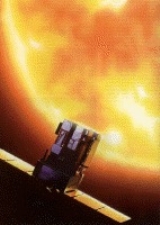
Solar and Heliospheric Observatory

Encyclopedia
The Solar and Heliospheric Observatory (SOHO) is a spacecraft
built by a European industrial consortium led by Matra Marconi Space (now Astrium) that was launched on a Lockheed Martin
Atlas IIAS
launch vehicle on December 2, 1995 to study the Sun
, and has discovered over 2100 comets. It began normal operations in May 1996. It is a joint project of international cooperation between the European Space Agency (ESA)
and NASA
. Originally planned as a two-year mission, SOHO currently continues to operate after over fifteen years in space
. In October 2009, a mission extension lasting until December 2012 was approved.
In addition to its scientific mission, it is currently the main source of near-real time solar data for space weather
prediction. Along with the GGS Wind and Advanced Composition Explorer
(ACE), SOHO is one of three spacecraft currently in the vicinity of the Earth
-Sun
L1 point, a point of gravitational balance located approximately 0.99 astronomical unit (AU)s
from the Sun and 0.01 AU from the Earth. In addition to its scientific contributions, SOHO is distinguished by being the first three-axis-stabilized spacecraft to use its reaction wheels as a kind of virtual gyroscope
; the technique was adopted after an on-board emergency in 1998 that nearly resulted in the loss of the spacecraft.
around the Sun
-Earth
L1 point, the point between the Earth and the Sun where the balance of the (larger) Sun's gravity and the (smaller) Earth's gravity is equal to the centripetal force needed for an object to have the same orbital period
in its orbit around the Sun as the Earth, with the result that the object will stay in that relative position.
Although sometimes described as being at , the SOHO spacecraft
is not exactly at as this would make communication difficult due to radio interference generated by the Sun, and because this would not be a stable orbit. Rather it lies in the (constantly moving) plane which passes through and is perpendicular to the line connecting the sun and the Earth. It stays in this plane, tracing out an elliptical lissajous orbit
centered about . It orbits once every six months, while itself orbits the sun every 12 months as it is coupled with the motion of the Earth. This keeps SOHO at a good position for communication with Earth at all times.
of ground stations. SOHOs data about solar activity are used to predict solar flare
s, so electrical grids and satellite
s can be protected from their damaging effects (mainly, solar flares may produce geomagnetic storm
s, which in turn produce geomagnetically induced current
creating black-outs, etc.).
In 2003 ESA reported the failure of the antenna Y-axis
stepper motor
, necessary for pointing the high gain antenna and allowing the downlink of high rate data. At the time, it was thought that the antenna anomaly might cause two to three week data-blackouts every three months. However, ESA and NASA engineers managed to use SOHO' s low gain antennas together with the larger 34 and 70 meter DSN ground stations and judicious use of SOHO' s Solid State Recorder (SSR) to prevent total data loss, with only a slightly reduced data flow every three months.
calibrations and maneuvers. Operations proceeded until 23:16 UTC when SOHO lost lock on the Sun, and entered an emergency attitude control mode called Emergency Sun Reacquisition (ESR). The SOHO Team attempted to recover the observatory, but SOHO entered the emergency mode
again on June 25 02:35 UTC. Recovery efforts continued, but SOHO entered the emergency mode
for the last time at 04:38 UTC. All contact with SOHO was lost, and the mission interruption had begun. SOHO was spinning, losing electrical power, and no longer pointing at the Sun.
Expert ESA personnel were immediately dispatched from Europe to the United States to direct operations. Days passed without contact from SOHO. On July 23, the Arecibo Observatory
and DSN
antennas were used to locate SOHO with radar
, and to determine its location and attitude
. SOHO was close to its predicted position, oriented with its side versus the usual front Optical Surface Reflector panel pointing toward the Sun, and was rotating at one RPM
. Once SOHO was located, plans for contacting SOHO were formed. On August 3 a carrier
was detected from SOHO, the first signal since June 25. After days of charging the battery
, a successful attempt was made to modulate
the carrier and downlink telemetry
on August 8. After instrument temperatures were downlinked on August 9, data analysis
was performed, and planning for the SOHO recovery began in earnest.
The SOHO Recovery Team began by allocating the limited electrical power. After this, SOHO's anomalous orientation in space was determined. Thawing the frozen hydrazine
fuel tank using SOHO's thermal control heaters began on August 12. Thawing pipes and the thrusters
was next, and SOHO was re-oriented towards the Sun on September 16. After nearly a week of spacecraft bus recovery activities and an orbital correction maneuver, the SOHO spacecraft (bus) returned to normal mode on September 25 at 19:52 UTC. Recovery of the instruments began on October 5 with SUMER, and ended on October 24, 1998 with CELIAS.
Only one gyro
remained operational after this recovery, and on December 21 that gyro failed. Attitude control was accomplished with manual thruster firings that consumed 7 kg of fuel weekly, while ESA developed a new gyroless operations mode that was successfully implemented on February 1, 1999.
Observations from some of the instruments can be formatted as images, most of which are also readily available on the internet
for either public or research use (see the official website). Others such as spectra and measurements of particles in the solar wind
do not lend themselves so readily to this. These images range in wavelength
or frequency
from optical (Hα
) to extreme ultraviolet
(UV). Images taken partly or exclusively with non-visible wavelengths are shown on the SOHO page and elsewhere in false color
. Unlike many space-based and ground telescopes, there is no time formally allocated by the SOHO program for observing proposals on individual instruments: interested parties can contact the instrument teams directly via e-mail and the SOHO web site to request time via that instrument team's internal processes (some of which are quite informal, provided that the ongoing reference observations are not disturbed). A formal process (the "JOP" program) does exist for using multiple SOHO instruments collaboratively on a single observation. JOP proposals are reviewed at the quarterly Science Working Team ("SWT") meetings, and JOP time is allocated at monthly meetings of the Science Planning Working Group. First results
have been presented in Solar Physics, volumes 170 and 175 (1997), edited by B. Fleck and
Z. Švestka.
As a consequence of its observing the Sun, SOHO (specifically the LASCO
instrument) has inadvertently allowed the discovery of comets by blocking out the Sun's glare. Approximately one-half of all known comets have been spotted by SOHO, discovered over the last 15 years by over 70 people representing 18 different countries searching through the publicly available SOHO images online. Michał Kusiak of the Polish Jagiellonian University (Uniwersytet Jagielloński) discovered SOHO's 1999th and 2000th comet
s on 26 December 2010.
contributed to SUMER, LASCO
and CELIAS instruments. The Smithsonian Astrophysical Observatory
built the UVCS instrument. The Lockheed Martin Solar and Astrophysics Laboratory (LMSAL) built the MDI instrument in collaboration with the solar group at Stanford University
.
Spacecraft
A spacecraft or spaceship is a craft or machine designed for spaceflight. Spacecraft are used for a variety of purposes, including communications, earth observation, meteorology, navigation, planetary exploration and transportation of humans and cargo....
built by a European industrial consortium led by Matra Marconi Space (now Astrium) that was launched on a Lockheed Martin
Lockheed Martin
Lockheed Martin is an American global aerospace, defense, security, and advanced technology company with worldwide interests. It was formed by the merger of Lockheed Corporation with Martin Marietta in March 1995. It is headquartered in Bethesda, Maryland, in the Washington Metropolitan Area....
Atlas IIAS
Atlas II
Atlas II was a member of the Atlas family of launch vehicles, which evolved from the successful Atlas missile program of the 1950s. Atlas II was the last Atlas to use a three engine, "stage-and-a-half" design: two of its three engines were jettisoned during ascent, but its fuel tanks and other...
launch vehicle on December 2, 1995 to study the Sun
Sun
The Sun is the star at the center of the Solar System. It is almost perfectly spherical and consists of hot plasma interwoven with magnetic fields...
, and has discovered over 2100 comets. It began normal operations in May 1996. It is a joint project of international cooperation between the European Space Agency (ESA)
European Space Agency
The European Space Agency , established in 1975, is an intergovernmental organisation dedicated to the exploration of space, currently with 18 member states...
and NASA
NASA
The National Aeronautics and Space Administration is the agency of the United States government that is responsible for the nation's civilian space program and for aeronautics and aerospace research...
. Originally planned as a two-year mission, SOHO currently continues to operate after over fifteen years in space
Space
Space is the boundless, three-dimensional extent in which objects and events occur and have relative position and direction. Physical space is often conceived in three linear dimensions, although modern physicists usually consider it, with time, to be part of a boundless four-dimensional continuum...
. In October 2009, a mission extension lasting until December 2012 was approved.
In addition to its scientific mission, it is currently the main source of near-real time solar data for space weather
Space weather
Space weather is the concept of changing environmental conditions in near-Earth space or thespace from the Sun's atmosphere to the Earth's atmosphere. It is distinct from the concept ofweather within the Earth's planetary atmosphere...
prediction. Along with the GGS Wind and Advanced Composition Explorer
Advanced Composition Explorer
Advanced Composition Explorer is a NASA space exploration mission being conducted as part of the Explorer program to study matter in situ, comprising energetic particles from the solar wind, the interplanetary medium, and other sources. Real-time data from ACE is used by the Space Weather...
(ACE), SOHO is one of three spacecraft currently in the vicinity of the Earth
Earth
Earth is the third planet from the Sun, and the densest and fifth-largest of the eight planets in the Solar System. It is also the largest of the Solar System's four terrestrial planets...
-Sun
Sun
The Sun is the star at the center of the Solar System. It is almost perfectly spherical and consists of hot plasma interwoven with magnetic fields...
L1 point, a point of gravitational balance located approximately 0.99 astronomical unit (AU)s
Astronomical unit
An astronomical unit is a unit of length equal to about or approximately the mean Earth–Sun distance....
from the Sun and 0.01 AU from the Earth. In addition to its scientific contributions, SOHO is distinguished by being the first three-axis-stabilized spacecraft to use its reaction wheels as a kind of virtual gyroscope
Gyroscope
A gyroscope is a device for measuring or maintaining orientation, based on the principles of angular momentum. In essence, a mechanical gyroscope is a spinning wheel or disk whose axle is free to take any orientation...
; the technique was adopted after an on-board emergency in 1998 that nearly resulted in the loss of the spacecraft.
Orbit
The 610 kg SOHO spacecraft is in a halo orbitHalo orbit
A halo orbit is a periodic, three-dimensional orbit near the , , or Lagrange points in the three-body problem of orbital mechanics. A spacecraft in a halo orbit does not technically orbit the Lagrange point itself , but travels in a closed, repeating path near the Lagrange point...
around the Sun
Sun
The Sun is the star at the center of the Solar System. It is almost perfectly spherical and consists of hot plasma interwoven with magnetic fields...
-Earth
Earth
Earth is the third planet from the Sun, and the densest and fifth-largest of the eight planets in the Solar System. It is also the largest of the Solar System's four terrestrial planets...
L1 point, the point between the Earth and the Sun where the balance of the (larger) Sun's gravity and the (smaller) Earth's gravity is equal to the centripetal force needed for an object to have the same orbital period
Orbital period
The orbital period is the time taken for a given object to make one complete orbit about another object.When mentioned without further qualification in astronomy this refers to the sidereal period of an astronomical object, which is calculated with respect to the stars.There are several kinds of...
in its orbit around the Sun as the Earth, with the result that the object will stay in that relative position.
Although sometimes described as being at , the SOHO spacecraft
Spacecraft
A spacecraft or spaceship is a craft or machine designed for spaceflight. Spacecraft are used for a variety of purposes, including communications, earth observation, meteorology, navigation, planetary exploration and transportation of humans and cargo....
is not exactly at as this would make communication difficult due to radio interference generated by the Sun, and because this would not be a stable orbit. Rather it lies in the (constantly moving) plane which passes through and is perpendicular to the line connecting the sun and the Earth. It stays in this plane, tracing out an elliptical lissajous orbit
Lissajous orbit
In orbital mechanics, a Lissajous orbit, , named after Jules Antoine Lissajous, is a quasi-periodic orbital trajectory that an object can follow around a Lagrangian point of a three-body system without requiring any propulsion. Lyapunov orbits around a libration point are curved paths that lie...
centered about . It orbits once every six months, while itself orbits the sun every 12 months as it is coupled with the motion of the Earth. This keeps SOHO at a good position for communication with Earth at all times.
Communication with Earth
In normal operation the spacecraft transmits a continuous 200 kbit/s data stream of photographs and other measurements via the NASA Deep Space NetworkDeep Space Network
The Deep Space Network, or DSN, is a world-wide network of large antennas and communication facilities that supports interplanetary spacecraft missions. It also performs radio and radar astronomy observations for the exploration of the solar system and the universe, and supports selected...
of ground stations. SOHOs data about solar activity are used to predict solar flare
Solar flare
A solar flare is a sudden brightening observed over the Sun surface or the solar limb, which is interpreted as a large energy release of up to 6 × 1025 joules of energy . The flare ejects clouds of electrons, ions, and atoms through the corona into space. These clouds typically reach Earth a day...
s, so electrical grids and satellite
Satellite
In the context of spaceflight, a satellite is an object which has been placed into orbit by human endeavour. Such objects are sometimes called artificial satellites to distinguish them from natural satellites such as the Moon....
s can be protected from their damaging effects (mainly, solar flares may produce geomagnetic storm
Geomagnetic storm
A geomagnetic storm is a temporary disturbance of the Earth's magnetosphere caused by a disturbance in the interplanetary medium. A geomagnetic storm is a major component of space weather and provides the input for many other components of space weather...
s, which in turn produce geomagnetically induced current
Geomagnetically induced current
Geomagnetically induced currents , affecting the normal operation of long electrical conductor systems, are a manifestation at ground level of space weather. During space weather events, electric currents in the magnetosphere and ionosphere experience large variations, which manifest also in the...
creating black-outs, etc.).
In 2003 ESA reported the failure of the antenna Y-axis
Cartesian coordinate system
A Cartesian coordinate system specifies each point uniquely in a plane by a pair of numerical coordinates, which are the signed distances from the point to two fixed perpendicular directed lines, measured in the same unit of length...
stepper motor
Stepper motor
A stepper motor is a brushless, electric motor that can divide a full rotation into a large number of steps. The motor's position can be controlled precisely without any feedback mechanism , as long as the motor is carefully sized to the application...
, necessary for pointing the high gain antenna and allowing the downlink of high rate data. At the time, it was thought that the antenna anomaly might cause two to three week data-blackouts every three months. However, ESA and NASA engineers managed to use SOHO
Near Loss of SOHO
The SOHO Mission Interruption sequence of events began on June 24, 1998, while the SOHO Team was conducting a series of spacecraft gyroscopeGyroscope
A gyroscope is a device for measuring or maintaining orientation, based on the principles of angular momentum. In essence, a mechanical gyroscope is a spinning wheel or disk whose axle is free to take any orientation...
calibrations and maneuvers. Operations proceeded until 23:16 UTC when SOHO lost lock on the Sun, and entered an emergency attitude control mode called Emergency Sun Reacquisition (ESR). The SOHO Team attempted to recover the observatory, but SOHO entered the emergency mode
Safe mode (spacecraft)
Safe mode is an operating mode of a modern spacecraft during which all non-essential systems are shut down and only essential functions such as thermal management, radio reception and attitude control are active.-Triggering events:...
again on June 25 02:35 UTC. Recovery efforts continued, but SOHO entered the emergency mode
Safe mode (spacecraft)
Safe mode is an operating mode of a modern spacecraft during which all non-essential systems are shut down and only essential functions such as thermal management, radio reception and attitude control are active.-Triggering events:...
for the last time at 04:38 UTC. All contact with SOHO was lost, and the mission interruption had begun. SOHO was spinning, losing electrical power, and no longer pointing at the Sun.
Expert ESA personnel were immediately dispatched from Europe to the United States to direct operations. Days passed without contact from SOHO. On July 23, the Arecibo Observatory
Arecibo Observatory
The Arecibo Observatory is a radio telescope near the city of Arecibo in Puerto Rico. It is operated by SRI International under cooperative agreement with the National Science Foundation...
and DSN
Deep Space Network
The Deep Space Network, or DSN, is a world-wide network of large antennas and communication facilities that supports interplanetary spacecraft missions. It also performs radio and radar astronomy observations for the exploration of the solar system and the universe, and supports selected...
antennas were used to locate SOHO with radar
Radar
Radar is an object-detection system which uses radio waves to determine the range, altitude, direction, or speed of objects. It can be used to detect aircraft, ships, spacecraft, guided missiles, motor vehicles, weather formations, and terrain. The radar dish or antenna transmits pulses of radio...
, and to determine its location and attitude
Angle of attack
Angle of attack is a term used in fluid dynamics to describe the angle between a reference line on a lifting body and the vector representing the relative motion between the lifting body and the fluid through which it is moving...
. SOHO was close to its predicted position, oriented with its side versus the usual front Optical Surface Reflector panel pointing toward the Sun, and was rotating at one RPM
Revolutions per minute
Revolutions per minute is a measure of the frequency of a rotation. It annotates the number of full rotations completed in one minute around a fixed axis...
. Once SOHO was located, plans for contacting SOHO were formed. On August 3 a carrier
Carrier wave
In telecommunications, a carrier wave or carrier is a waveform that is modulated with an input signal for the purpose of conveying information. This carrier wave is usually a much higher frequency than the input signal...
was detected from SOHO, the first signal since June 25. After days of charging the battery
Battery (electricity)
An electrical battery is one or more electrochemical cells that convert stored chemical energy into electrical energy. Since the invention of the first battery in 1800 by Alessandro Volta and especially since the technically improved Daniell cell in 1836, batteries have become a common power...
, a successful attempt was made to modulate
Modulation
In electronics and telecommunications, modulation is the process of varying one or more properties of a high-frequency periodic waveform, called the carrier signal, with a modulating signal which typically contains information to be transmitted...
the carrier and downlink telemetry
Telemetry
Telemetry is a technology that allows measurements to be made at a distance, usually via radio wave transmission and reception of the information. The word is derived from Greek roots: tele = remote, and metron = measure...
on August 8. After instrument temperatures were downlinked on August 9, data analysis
Data analysis
Analysis of data is a process of inspecting, cleaning, transforming, and modeling data with the goal of highlighting useful information, suggesting conclusions, and supporting decision making...
was performed, and planning for the SOHO recovery began in earnest.
The SOHO Recovery Team began by allocating the limited electrical power. After this, SOHO's anomalous orientation in space was determined. Thawing the frozen hydrazine
Hydrazine
Hydrazine is an inorganic compound with the formula N2H4. It is a colourless flammable liquid with an ammonia-like odor. Hydrazine is highly toxic and dangerously unstable unless handled in solution. Approximately 260,000 tons are manufactured annually...
fuel tank using SOHO's thermal control heaters began on August 12. Thawing pipes and the thrusters
Rocket engine
A rocket engine, or simply "rocket", is a jet engineRocket Propulsion Elements; 7th edition- chapter 1 that uses only propellant mass for forming its high speed propulsive jet. Rocket engines are reaction engines and obtain thrust in accordance with Newton's third law...
was next, and SOHO was re-oriented towards the Sun on September 16. After nearly a week of spacecraft bus recovery activities and an orbital correction maneuver, the SOHO spacecraft (bus) returned to normal mode on September 25 at 19:52 UTC. Recovery of the instruments began on October 5 with SUMER, and ended on October 24, 1998 with CELIAS.
Only one gyro
Gyroscope
A gyroscope is a device for measuring or maintaining orientation, based on the principles of angular momentum. In essence, a mechanical gyroscope is a spinning wheel or disk whose axle is free to take any orientation...
remained operational after this recovery, and on December 21 that gyro failed. Attitude control was accomplished with manual thruster firings that consumed 7 kg of fuel weekly, while ESA developed a new gyroless operations mode that was successfully implemented on February 1, 1999.
Additional References
-PDF Image Halo Orbit Recovery From the Attitude Control Anomalies of 1998 | url=http://www.ieec.fcr.es/libpoint/papers/roberts.pdf |format=PDF| accessdate = 2007-07-25}}Scientific Objectives
The three main scientific objectives of SOHO are:- Investigation of the outer layer of the Sun, which consists of the chromosphereChromosphereThe chromosphere is a thin layer of the Sun's atmosphere just above the photosphere, roughly 2,000 kilometers deep....
, transition region, and the coronaCoronaA corona is a type of plasma "atmosphere" of the Sun or other celestial body, extending millions of kilometers into space, most easily seen during a total solar eclipse, but also observable in a coronagraph...
. CDS, EIT, LASCOLASCO Large Angle and Spectrometric CoronagraphThe Large Angle and Spectrometric Coronagraph is one of a number of instruments aboard the Solar and Heliospheric Observatory satellite...
, SUMER, SWAN, and UVCS are used for this solar atmosphere remote sensing. - Making observations of solar windSolar windThe solar wind is a stream of charged particles ejected from the upper atmosphere of the Sun. It mostly consists of electrons and protons with energies usually between 1.5 and 10 keV. The stream of particles varies in temperature and speed over time...
and associated phenomena in the vicinity of . CELIAS and CEPAC are used for "in situIn situIn situ is a Latin phrase which translated literally as 'In position'. It is used in many different contexts.-Aerospace:In the aerospace industry, equipment on board aircraft must be tested in situ, or in place, to confirm everything functions properly as a system. Individually, each piece may...
" solar wind observations. - Probing the interior structure of the Sun. GOLF, MDI, and VIRGO are used for helioseismologyHelioseismologyHelioseismology is the study of the propagation of wave oscillations, particularly acoustic pressure waves, in the Sun. Unlike seismic waves on Earth, solar waves have practically no shear component . Solar pressure waves are believed to be generated by the turbulence in the convection zone near...
.
Instruments
The SOHO Payload Module (PLM) consists of twelve instruments, each capable of independent or coordinated observation of the Sun or parts of the Sun, and some spacecraft components. The instruments are:- Coronal Diagnostic Spectrometer (CDS) which measures density, temperature and flows in the corona.
- Charge ELement and Isotope Analysis System (CELIAS) which studies the ion composition of the solar wind.
- Comprehensive SupraThermal and Energetic Particle analyser collaboration (COSTEP) which studies the ion and electron composition of the solar wind. COSTEP and ENRE are sometimes referred to together as the COSTEP-ERNE Particle Analyzer Collaboration (CEPAC).
- Extreme ultraviolet Imaging TelescopeExtreme ultraviolet Imaging TelescopeThe Extreme ultraviolet Imaging Telescope is an instrument on the SOHO spacecraft used to obtain high-resolution images of the solar corona in the ultraviolet range...
(EIT) which studies the low coronal structure and activity. - Energetic and Relativistic Nuclei and Electron experiment (ERNE) which studies the ion and electron composition of the solar wind. (See note above in COSTEP entry.)
- Global Oscillations at Low Frequencies (GOLF) which measures velocity variations of the whole solar disk to explore the core of the sun.
- Large Angle and Spectrometric COronagraphCoronagraphA coronagraph is a telescopic attachment designed to block out the direct light from a star so that nearby objects – which otherwise would be hidden in the star's bright glare – can be resolved...
experiment (LASCO) which studies the structure and evolution of the corona by creating an artificial solar eclipse. - Michelson Doppler Imager (MDI) which measures velocity and magnetic fields in the photospherePhotosphereThe photosphere of an astronomical object is the region from which externally received light originates. The term itself is derived from Ancient Greek roots, φῶς, φωτός/phos, photos meaning "light" and σφαῖρα/sphaira meaning "sphere", in reference to the fact that it is a spheric surface perceived...
to learn about the convection zoneConvection zoneThe convection zone of a star is the range of radii in which energy is transported primarily by convection. In the radiation zone, energy is transported by radiation...
which forms the outer layer of the interior of the sun and about the magnetic fields which control the structure of the coronaCoronaA corona is a type of plasma "atmosphere" of the Sun or other celestial body, extending millions of kilometers into space, most easily seen during a total solar eclipse, but also observable in a coronagraph...
. The MDI is the biggest producer of data by far on SOHO. In fact, two of SOHO's virtual channelVirtual channelIn telecommunications, a logical channel number , also known as virtual channel, is a channel designation which differs from that of the actual radio channel on which the signal travels....
s are named after MDI, VC2 (MDI-M) carries MDI magnetogramMagnetogramThe term magnetogram has two meanings, used separately in the contexts of magnetic fields of the Sun and the Earth.In the context of the magnetic field of the Sun, the term magnetogram refers to a pictorial representation of the spatial variations in strength of the solar magnetic field...
data, and VC3 (MDI-H) carries MDI HelioseismologyHelioseismologyHelioseismology is the study of the propagation of wave oscillations, particularly acoustic pressure waves, in the Sun. Unlike seismic waves on Earth, solar waves have practically no shear component . Solar pressure waves are believed to be generated by the turbulence in the convection zone near...
data. - Solar Ultraviolet Measurement of Emitted Radiation (SUMER) which measures plasma flows, temperature and density in the corona.
- Solar Wind ANisotropies (SWAN) which uses telescopes sensitive to a characteristic wavelength of hydrogen to measure the solar wind mass flux, map the density of the heliosphere, and observe the large-scale structure of the solar wind streams.
- UltraViolet Coronagraph Spectrometer (UVCS) which measures density and temperature in the corona.
- Variability of solar IRradiance and Gravity Oscillations (VIRGO) which measures oscillations and solar constant both of the whole solar disk and at low resolution, again exploring the core of the sun.
Observations from some of the instruments can be formatted as images, most of which are also readily available on the internet
Internet
The Internet is a global system of interconnected computer networks that use the standard Internet protocol suite to serve billions of users worldwide...
for either public or research use (see the official website). Others such as spectra and measurements of particles in the solar wind
Solar wind
The solar wind is a stream of charged particles ejected from the upper atmosphere of the Sun. It mostly consists of electrons and protons with energies usually between 1.5 and 10 keV. The stream of particles varies in temperature and speed over time...
do not lend themselves so readily to this. These images range in wavelength
Wavelength
In physics, the wavelength of a sinusoidal wave is the spatial period of the wave—the distance over which the wave's shape repeats.It is usually determined by considering the distance between consecutive corresponding points of the same phase, such as crests, troughs, or zero crossings, and is a...
or frequency
Frequency
Frequency is the number of occurrences of a repeating event per unit time. It is also referred to as temporal frequency.The period is the duration of one cycle in a repeating event, so the period is the reciprocal of the frequency...
from optical (Hα
H-alpha
H-alpha is a specific red visible spectral line created by hydrogen with a wavelength of 656.28 nm, which occurs when a hydrogen electron falls from its third to second lowest energy level...
) to extreme ultraviolet
Ultraviolet
Ultraviolet light is electromagnetic radiation with a wavelength shorter than that of visible light, but longer than X-rays, in the range 10 nm to 400 nm, and energies from 3 eV to 124 eV...
(UV). Images taken partly or exclusively with non-visible wavelengths are shown on the SOHO page and elsewhere in false color
False-color
A false-color image is an image that depicts a subject in colors that differ from those a full-color photograph would show.-True- and false-color:...
. Unlike many space-based and ground telescopes, there is no time formally allocated by the SOHO program for observing proposals on individual instruments: interested parties can contact the instrument teams directly via e-mail and the SOHO web site to request time via that instrument team's internal processes (some of which are quite informal, provided that the ongoing reference observations are not disturbed). A formal process (the "JOP" program) does exist for using multiple SOHO instruments collaboratively on a single observation. JOP proposals are reviewed at the quarterly Science Working Team ("SWT") meetings, and JOP time is allocated at monthly meetings of the Science Planning Working Group. First results
have been presented in Solar Physics, volumes 170 and 175 (1997), edited by B. Fleck and
Z. Švestka.
As a consequence of its observing the Sun, SOHO (specifically the LASCO
LASCO Large Angle and Spectrometric Coronagraph
The Large Angle and Spectrometric Coronagraph is one of a number of instruments aboard the Solar and Heliospheric Observatory satellite...
instrument) has inadvertently allowed the discovery of comets by blocking out the Sun's glare. Approximately one-half of all known comets have been spotted by SOHO, discovered over the last 15 years by over 70 people representing 18 different countries searching through the publicly available SOHO images online. Michał Kusiak of the Polish Jagiellonian University (Uniwersytet Jagielloński) discovered SOHO's 1999th and 2000th comet
Comet
A comet is an icy small Solar System body that, when close enough to the Sun, displays a visible coma and sometimes also a tail. These phenomena are both due to the effects of solar radiation and the solar wind upon the nucleus of the comet...
s on 26 December 2010.
Instrument contributors
The Max Planck Institute for Solar System ResearchMax Planck Institute for Solar System Research
The Max Planck Institute for Solar System Research is a research institute in Astronomy/Astrophysics, located in Lindau , Germany; 20 km north east of Göttingen. The exploration of our solar system is the central theme for the scientific research done at this Institute...
contributed to SUMER, LASCO
LASCO Large Angle and Spectrometric Coronagraph
The Large Angle and Spectrometric Coronagraph is one of a number of instruments aboard the Solar and Heliospheric Observatory satellite...
and CELIAS instruments. The Smithsonian Astrophysical Observatory
Smithsonian Astrophysical Observatory
The Smithsonian Astrophysical Observatory is a research institute of the Smithsonian Institution headquartered in Cambridge, Massachusetts, where it is joined with the Harvard College Observatory to form the Harvard-Smithsonian Center for Astrophysics .-History:The SAO was founded in 1890 by...
built the UVCS instrument. The Lockheed Martin Solar and Astrophysics Laboratory (LMSAL) built the MDI instrument in collaboration with the solar group at Stanford University
Stanford University
The Leland Stanford Junior University, commonly referred to as Stanford University or Stanford, is a private research university on an campus located near Palo Alto, California. It is situated in the northwestern Santa Clara Valley on the San Francisco Peninsula, approximately northwest of San...
.
See also
- HeliophysicsHeliophysicsHeliophysics is a word coined by Dr. George Siscoe of Boston University and subsequently used by the NASA Science Mission Directorate to encompass the study of the system composed of the Sun's heliosphere and the objects that interact with it—most notably, but not limited to, planetary atmospheres...
- TrianaTriana (satellite)Deep Space Climate Observatory is a NASA satellite proposed in 1998 by then-Vice President Al Gore for the purpose of Earth observation. It is intended to be positioned at the Earth's Lagrangian point, at a distance of 1.5 million kilometers...
, satellite intended for
External links
- ESA SOHO webpage
- SOHO Homepage, free to use for educational and non-commercial purposes.
- SOHO Mission Profile by NASA's Solar System Exploration Halo Orbit Recovery From the Attitude Control Anomalies of 1998 | url=http://europa.ieec.fcr.es/libpoint/papers/roberts.pdf |format=PDF| accessdate=24 October 2005}} - PDF
- Sun trek website A useful resource about the Sun and its effect on the Earth
- Coordinating with SOHO (Stein Vidar Hagfors Haugan. COSPAR Published by Elsevier Ltd. 2004)
- SOHO Spots 2000th Comet
- Transits of Objects through the LASCO/C3 field of view (FOV) in 2011 (Michal Kusiak)
- LASCO Star Maps (identify objects in the field of view for any day of the year)
- You can discover the next comet…from your couch! (science for citizens 18 Oct 2011)