
Home      Discussion      Topics      Dictionary      Almanac
Signup       Login
Geomagnetically induced current

Geomagnetically induced current

Overview
Geomagnetically induced currents (GIC), affecting the normal operation of long electrical conductor
Electrical conductor
In physics and electrical engineering, a conductor is a material which contains movable electric charges. In metallic conductors such as copper or aluminum, the movable charged particles are electrons...

 systems, are a manifestation at ground level of space weather
Space weather
Space weather is the concept of changing environmental conditions in near-Earth space or thespace from the Sun's atmosphere to the Earth's atmosphere. It is distinct from the concept ofweather within the Earth's planetary atmosphere...

. During space weather events, electric currents in the magnetosphere
Magnetosphere
A magnetosphere is formed when a stream of charged particles, such as the solar wind, interacts with and is deflected by the intrinsic magnetic field of a planet or similar body. Earth is surrounded by a magnetosphere, as are the other planets with intrinsic magnetic fields: Mercury, Jupiter,...

 and ionosphere
Ionosphere
The ionosphere is a part of the upper atmosphere, comprising portions of the mesosphere, thermosphere and exosphere, distinguished because it is ionized by solar radiation. It plays an important part in atmospheric electricity and forms the inner edge of the magnetosphere...

 experience large variations, which manifest also in the Earth's magnetic field
Earth's magnetic field
Earth's magnetic field is the magnetic field that extends from the Earth's inner core to where it meets the solar wind, a stream of energetic particles emanating from the Sun...

. These variations induce currents (GIC) in conductors operated on the surface of Earth. Electric transmission grids
Electric power transmission
Electric-power transmission is the bulk transfer of electrical energy, from generating power plants to Electrical substations located near demand centers...

 and buried pipelines
Pipeline transport
Pipeline transport is the transportation of goods through a pipe. Most commonly, liquids and gases are sent, but pneumatic tubes that transport solid capsules using compressed air are also used....

 are common examples of such conductor systems. GIC can cause problems, such as increased corrosion
Corrosion
Corrosion is the disintegration of an engineered material into its constituent atoms due to chemical reactions with its surroundings. In the most common use of the word, this means electrochemical oxidation of metals in reaction with an oxidant such as oxygen...

 of pipeline steel
Steel
Steel is an alloy that consists mostly of iron and has a carbon content between 0.2% and 2.1% by weight, depending on the grade. Carbon is the most common alloying material for iron, but various other alloying elements are used, such as manganese, chromium, vanadium, and tungsten...

 and damaged high-voltage power transformer
Transformer
A transformer is a device that transfers electrical energy from one circuit to another through inductively coupled conductors—the transformer's coils. A varying current in the first or primary winding creates a varying magnetic flux in the transformer's core and thus a varying magnetic field...

s. GIC are one possible consequence of geomagnetic storms, which may also affect geophysical exploration surveys
Geophysical survey
Geophysical survey is the systematic collection of geophysical data for spatial studies. Geophysical surveys may use a great variety of sensing instruments, and data may be collected from above or below the Earth's surface or from aerial or marine platforms. Geophysical surveys have many...

 and oil
Oil well
An oil well is a general term for any boring through the earth's surface that is designed to find and acquire petroleum oil hydrocarbons. Usually some natural gas is produced along with the oil. A well that is designed to produce mainly or only gas may be termed a gas well.-History:The earliest...

 and gas drilling operations.
Discussion
Ask a question about 'Geomagnetically induced current'
Start a new discussion about 'Geomagnetically induced current'
Answer questions from other users
Full Discussion Forum
 
Recent Discussions
Encyclopedia
Geomagnetically induced currents (GIC), affecting the normal operation of long electrical conductor
Electrical conductor
In physics and electrical engineering, a conductor is a material which contains movable electric charges. In metallic conductors such as copper or aluminum, the movable charged particles are electrons...

 systems, are a manifestation at ground level of space weather
Space weather
Space weather is the concept of changing environmental conditions in near-Earth space or thespace from the Sun's atmosphere to the Earth's atmosphere. It is distinct from the concept ofweather within the Earth's planetary atmosphere...

. During space weather events, electric currents in the magnetosphere
Magnetosphere
A magnetosphere is formed when a stream of charged particles, such as the solar wind, interacts with and is deflected by the intrinsic magnetic field of a planet or similar body. Earth is surrounded by a magnetosphere, as are the other planets with intrinsic magnetic fields: Mercury, Jupiter,...

 and ionosphere
Ionosphere
The ionosphere is a part of the upper atmosphere, comprising portions of the mesosphere, thermosphere and exosphere, distinguished because it is ionized by solar radiation. It plays an important part in atmospheric electricity and forms the inner edge of the magnetosphere...

 experience large variations, which manifest also in the Earth's magnetic field
Earth's magnetic field
Earth's magnetic field is the magnetic field that extends from the Earth's inner core to where it meets the solar wind, a stream of energetic particles emanating from the Sun...

. These variations induce currents (GIC) in conductors operated on the surface of Earth. Electric transmission grids
Electric power transmission
Electric-power transmission is the bulk transfer of electrical energy, from generating power plants to Electrical substations located near demand centers...

 and buried pipelines
Pipeline transport
Pipeline transport is the transportation of goods through a pipe. Most commonly, liquids and gases are sent, but pneumatic tubes that transport solid capsules using compressed air are also used....

 are common examples of such conductor systems. GIC can cause problems, such as increased corrosion
Corrosion
Corrosion is the disintegration of an engineered material into its constituent atoms due to chemical reactions with its surroundings. In the most common use of the word, this means electrochemical oxidation of metals in reaction with an oxidant such as oxygen...

 of pipeline steel
Steel
Steel is an alloy that consists mostly of iron and has a carbon content between 0.2% and 2.1% by weight, depending on the grade. Carbon is the most common alloying material for iron, but various other alloying elements are used, such as manganese, chromium, vanadium, and tungsten...

 and damaged high-voltage power transformer
Transformer
A transformer is a device that transfers electrical energy from one circuit to another through inductively coupled conductors—the transformer's coils. A varying current in the first or primary winding creates a varying magnetic flux in the transformer's core and thus a varying magnetic field...

s. GIC are one possible consequence of geomagnetic storms, which may also affect geophysical exploration surveys
Geophysical survey
Geophysical survey is the systematic collection of geophysical data for spatial studies. Geophysical surveys may use a great variety of sensing instruments, and data may be collected from above or below the Earth's surface or from aerial or marine platforms. Geophysical surveys have many...

 and oil
Oil well
An oil well is a general term for any boring through the earth's surface that is designed to find and acquire petroleum oil hydrocarbons. Usually some natural gas is produced along with the oil. A well that is designed to produce mainly or only gas may be termed a gas well.-History:The earliest...

 and gas drilling operations.

Background


The Earth's magnetic field varies over a wide range of timescales. The longer-term variations, typically occurring over decades to millennia, are predominantly the result of dynamo action in the Earth's core. Geomagnetic variations on timescales of seconds to years also occur, due to dynamic processes in the ionosphere
Ionosphere
The ionosphere is a part of the upper atmosphere, comprising portions of the mesosphere, thermosphere and exosphere, distinguished because it is ionized by solar radiation. It plays an important part in atmospheric electricity and forms the inner edge of the magnetosphere...

, magnetosphere
Magnetosphere
A magnetosphere is formed when a stream of charged particles, such as the solar wind, interacts with and is deflected by the intrinsic magnetic field of a planet or similar body. Earth is surrounded by a magnetosphere, as are the other planets with intrinsic magnetic fields: Mercury, Jupiter,...

 and heliosphere
Heliosphere
The heliosphere is a bubble in space "blown" into the interstellar medium by the solar wind. Although electrically neutral atoms from interstellar volume can penetrate this bubble, virtually all of the material in the heliosphere emanates from the Sun itself...

. These changes are ultimately tied to variations associated with the solar activity (or sunspot) cycle
Solar cycle
The solar cycle, or the solar magnetic activity cycle, is a periodic change in the amount of irradiation from the Sun that is experienced on Earth. It has a period of about 11 years, and is one component of solar variation, the other being aperiodic fluctuations. Solar variation causes changes in...

 and are manifestations of space weather.

The fact that the geomagnetic field does respond to solar conditions can be useful, for example in investigating Earth structure using magnetotellurics
Magnetotellurics
Magnetotellurics is an electromagnetic geophysical method of imaging the earth's subsurface by measuring natural variations of electrical and magnetic fields at the Earth's surface. Investigation depth ranges from 300m below ground by recording higher frequencies down to 10,000m or deeper with...

, but it also creates a hazard. This geomagnetic hazard is primarily a risk to technology under the Earth's protective atmospheric blanket.

Risk to infrastructure


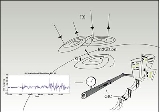
A time-varying magnetic field external to the Earth induces electric currents in the conducting ground. These currents create a secondary (internal) magnetic field. As a consequence of Faraday's law of induction
Faraday's law of induction
Faraday's law of induction dates from the 1830s, and is a basic law of electromagnetism relating to the operating principles of transformers, inductors, and many types of electrical motors and generators...

, an electric field at the surface of the Earth is induced associated with time variations of the magnetic field. The surface electric field causes electrical currents, known as geomagnetically induced currents (GIC), to flow in any conducting structure, for example, a power or pipeline grid grounded in the Earth. This electric field, measured in V/km, acts as a voltage source across networks.

Examples of conducting networks are electrical power transmission grids, oil and gas pipelines, undersea communication cables, telephone and telegraph networks and railways. GIC are often described as being quasi direct current
Direct current
Direct current is the unidirectional flow of electric charge. Direct current is produced by such sources as batteries, thermocouples, solar cells, and commutator-type electric machines of the dynamo type. Direct current may flow in a conductor such as a wire, but can also flow through...

 (DC), although the variation frequency of GIC is governed by the time variation of the electric field. For GIC to be a hazard to technology, the current has to be of a magnitude and occurrence frequency that makes the equipment susceptible to either immediate or cumulative damage. The size of the GIC in any network is governed by the electrical properties and the topology of the network. The largest magnetospheric-ionospheric current variations, resulting in the largest external magnetic field variations, occur during geomagnetic storms and it is then that the largest GIC occur. Significant variation periods are typically from seconds to about an hour, so the induction process involves the upper mantle
Mantle (geology)
The mantle is a part of a terrestrial planet or other rocky body large enough to have differentiation by density. The interior of the Earth, similar to the other terrestrial planets, is chemically divided into layers. The mantle is a highly viscous layer between the crust and the outer core....

 and lithosphere
Lithosphere
The lithosphere is the rigid outermost shell of a rocky planet. On Earth, it comprises the crust and the portion of the upper mantle that behaves elastically on time scales of thousands of years or greater.- Earth's lithosphere :...

. Since the largest magnetic field variations are observed at higher magnetic latitudes, GIC have been regularly measured in Canadian, Finnish and Scandinavian power grids and pipelines since the 1970s. GIC of tens to hundreds of ampere
Ampere
The ampere , often shortened to amp, is the SI unit of electric current and is one of the seven SI base units. It is named after André-Marie Ampère , French mathematician and physicist, considered the father of electrodynamics...

s have been recorded. GIC have also been recorded at mid-latitudes during major storms. There may even be a risk to low latitude areas, especially during a storm commencing suddenly because of the high, short-period rate of change of the field that occurs on the dayside of the Earth.

GIC have been known since the mid-19th century when it was noted that electrical telegraph
Electrical telegraph
An electrical telegraph is a telegraph that uses electrical signals, usually conveyed via telecommunication lines or radio. The electromagnetic telegraph is a device for human-to-human transmission of coded text messages....

 systems could sometimes run without power during geomagnetic storms, described at the time as operating on the "celestial battery", while at other times they were completely inoperative.

GIC in power grids


Modern electric power transmission systems
Electric power transmission
Electric-power transmission is the bulk transfer of electrical energy, from generating power plants to Electrical substations located near demand centers...

 consist of generating plants inter-connected by electrical circuits that operate at fixed transmission voltages controlled at substations. The grid voltages employed are largely dependent on the path length between these substations and 200-700 kV system voltages are common. There is a trend towards higher voltages and lower line resistances to reduce transmission losses over longer and longer path lengths. Low line resistances produce a situation favourable to the flow of GIC. Power transformers
Transformer
A transformer is a device that transfers electrical energy from one circuit to another through inductively coupled conductors—the transformer's coils. A varying current in the first or primary winding creates a varying magnetic flux in the transformer's core and thus a varying magnetic field...

 have a magnetic circuit that is disrupted by the quasi-DC GIC: the field produced by the GIC offsets the operating point of the magnetic circuit and the transformer may go into half-cycle saturation. This produces harmonics to the AC waveform, localised heating and leads to high reactive power demands, inefficient power transmission and possible mis-operation of protective measures. Balancing the network in such situations requires significant additional reactive power capacity. The magnitude of GIC that will cause significant problems to transformers varies with transformer type. Modern industry practice is to specify GIC tolerance levels on new transformers.

On 13 March 1989, a severe geomagnetic storm
March 1989 geomagnetic storm
The March 1989 geomagnetic storm was a severe geomagnetic storm that caused the collapse of Hydro-Québec's electricity transmission system. It occurred during solar cycle 22.-Geomagnetic storm and auroras:...

 caused the collapse of the Hydro-Québec power grid in a matter of seconds as equipment protective relay
Protective relay
In electrical engineering, a protective relay is a complex electromechanical apparatus, often with more than one coil, designed to calculate operating conditions on an electrical circuit and trip circuit breakers when a fault is detected...

s tripped in a cascading sequence of events. Six million people were left without power for nine hours, with significant economic loss. Since 1989, power companies in North America, the UK, Northern Europe, and elsewhere have invested in evaluating the GIC risk and in developing mitigation strategies.

GIC risk can, to some extent, be reduced by capacitor blocking systems, maintenance schedule changes, additional on-demand generating capacity, and ultimately, load shedding. These options are expensive and sometimes impractical. The continued growth of high voltage power networks results in higher risk. This is partly due to the increase in the interconnectedness at higher voltages, connections in terms of power transmission to grids in the auroral zone, and grids operating closer to capacity than in the past.

To understand the flow of GIC in power grids and to advise on GIC risk, analysis of the quasi-DC properties of the grid is necessary. This must be coupled with a geophysical model of the Earth that provides the driving surface electric field, determined by combining time-varying ionospheric source fields and a conductivity model of the Earth. Such analyses have been performed for North America, the UK and in Northern Europe. The complexity of power grids, the source ionospheric current systems and the 3D ground conductivity make an accurate analysis difficult. By being able to analyze major storms and their consequences we can build a picture of the weak spots in a transmission system and run hypothetical event scenarios.

Grid management is also aided by space weather forecasts of major geomagnetic storms. This allows for mitigation strategies to be implemented. Solar observations provide a one- to three-day warning of an Earthbound coronal mass ejection
Coronal mass ejection
A coronal mass ejection is a massive burst of solar wind, other light isotope plasma, and magnetic fields rising above the solar corona or being released into space....

 (CME), depending on CME speed. Following this, detection of the solar wind
Solar wind
The solar wind is a stream of charged particles ejected from the upper atmosphere of the Sun. It mostly consists of electrons and protons with energies usually between 1.5 and 10 keV. The stream of particles varies in temperature and speed over time...

 shock that precedes the CME in the solar wind, by spacecraft at the Lagrangian point
Lagrangian point
The Lagrangian points are the five positions in an orbital configuration where a small object affected only by gravity can theoretically be stationary relative to two larger objects...

, gives a definite 20 to 60 minutes warning of a geomagnetic storm (again depending on local solar wind speed). The magnitude and arrival time of a CME after detection is unknown, although there is much research and model development within the space weather community.

GIC hazard in pipelines


Major pipeline networks exist at all latitudes and many systems are on a continental scale. Pipeline networks are constructed from steel to contain high-pressure liquid or gas and have corrosion resistant coatings. Weathering and other damage to the pipeline coating can result in the steel being exposed to moist air or to the ground, causing localised corrosion problems. Cathodic protection
Cathodic protection
Cathodic protection is a technique used to control the corrosion of a metal surface by making it the cathode of an electrochemical cell. The simplest method to apply CP is by connecting the metal to be protected with another more easily corroded "sacrificial metal" to act as the anode of the...

 is used to minimise corrosion by maintaining the steel at a negative potential with respect to the ground. The operating potential is determined from the electro-chemical properties of the soil and Earth in the vicinity of the pipeline. The GIC hazard to pipelines is that GIC cause swings in the pipe-to-soil potential, increasing the rate of corrosion during major geomagnetic storms (Gummow, 2002). GIC risk is not a risk of catastrophic failure, but a reduced service life of the pipeline.

Pipeline networks are modelled in a similar manner to power grids, for example through distributed source transmission line models that provide the pipe-to-soil potential at any point along the pipe (Boteler, 1997; Pulkkinen et al., 2001). These models need to consider complicated pipeline topologies, including bends and branches, as well as electrical insulators (or flanges) that electrically isolate different sections. From a detailed knowledge of the pipeline response to GIC, pipeline engineers can understand the behaviour of the cathodic protection system even during a geomagnetic storm, when pipeline surveying and maintenance may be suspended.

See also

  • 1859 solar superstorm
  • Aurora (astronomy)

Further reading

  • Bolduc, L., GIC observations and studies in the Hydro-Québec power system. J. Atmos. Sol. Terr. Phys., 64(16), 1793–1802, 2002.
  • Boteler, D. H., Distributed source transmission line theory for electromagnetic induction studies. In Supplement of the Proceedings of the 12th International Zurich Symposium and Technical Exhibition on Electromagnetic Compatibility. pp. 401–408, 1997.
  • Boteler, D. H., Pirjola, R. J. and Nevanlinna, H., The effects of geomagnetic disturbances on electrical systems at the Earth's surface. Adv. Space. Res., 22(1), 17-27, 1998.
  • Erinmez, I. A., Kappenman, J. G. and Radasky, W. A., Management of the geomagnetically induced current risks on the national grid company's electric power transmission system. J. Atmos. Sol. Terr. Phys., 64(5-6), 743-756, 2002.
  • Gummow, R. A., GIC effects on pipeline corrosion and corrosion-control systems. J. Atmos. Sol. Terr. Phys., 64(16), 1755–1764, 2002.
  • Lanzerotti, L. J., Space weather effects on technologies. In Song, P., Singer, H. J., Siscoe, G. L. (eds.), Space Weather. American Geophysical Union, Geophysical Monograph, 125, pp. 11–22, 2001.
  • Lehtinen, M., and R. Pirjola, Currents produced in earthed conductor networks by geomagnetically-induced electric fields, Annales Geophysicae, 3, 4, 479-484, 1985.
  • Pirjola, R., Fundamentals about the flow of geomagnetically induced currents in a power system applicable to estimating space weather risks and designing remedies. J. Atmos. Sol. Terr. Phys., 64(18), 1967–1972, 2002.
  • Pirjola, R., Kauristie, K., Lappalainen, H. and Viljanen, A. and Pulkkinen A., Space weather risk. AGU Space Weather, 3, S02A02, doi:10.1029/2004SW000112, 2005.
  • Thomson, A. W. P., A. J. McKay, E. Clarke, and S. J. Reay, Surface electric fields and geomagnetically induced currents in the Scottish Power grid during the 30 October 2003 geomagnetic storm, AGU Space Weather, 3, S11002, doi:10.1029/2005SW000156, 2005.
  • Pulkkinen, A., R. Pirjola, D. Boteler, A. Viljanen, and I. Yegorov, Modelling of space weather effects on pipelines, Journal of Applied Geophysics, 48, 233-256, 2001.
  • Pulkkinen, A. Geomagnetic Induction During Highly Disturbed Space Weather Conditions: Studies of Ground Effects, PhD thesis, University of Helsinki, 2003. (available at eThesis)
  • Price, P.R., Geomagnetically induced current effects on transformers, IEEE Transactions on Power Delivery, 17 , 4, 1002 - 1008, 2002, doi: 10.1109/TPWRD.2002.803710

External GIC links


Power grid related links