
|
|
|
|
Solar flare
|
| |
|
| |
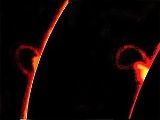
A solar flare is a violent explosion in a star's (like the Sun's) atmosphere releasing as much energy as 6 × 1025 Joules. Solar flares affect all layers of the solar atmosphere (photosphere, corona, and chromosphere), heating plasma to tens of million Kelvin and accelerating electrons, protons and heavier ions to near the speed of light. They produced radiation across the electromagnetic spectrum at all wavelengths, from radio waves to gamma rays. Most flares occur in active regions around sunspots, where intense magnetic fields penetrate the photosphere to link the corona to the solar interior.
Flares are powered by the sudden (timescales of minutes to tens of minutes) release of magnetic energy stored in the corona.
X-rays and UV radiation emitted by solar flares can affect Earth's ionosphere and disrupt long-range radio communications.

Discussion
Ask a question about 'Solar flare'
Start a new discussion about 'Solar flare'
Answer questions from other users
|
Encyclopedia
A solar flare is a violent explosion in a star's (like the Sun's) atmosphere releasing as much energy as 6 × 1025 Joules. Solar flares affect all layers of the solar atmosphere (photosphere, corona, and chromosphere), heating plasma to tens of million Kelvin and accelerating electrons, protons and heavier ions to near the speed of light. They produced radiation across the electromagnetic spectrum at all wavelengths, from radio waves to gamma rays. Most flares occur in active regions around sunspots, where intense magnetic fields penetrate the photosphere to link the corona to the solar interior.
Flares are powered by the sudden (timescales of minutes to tens of minutes) release of magnetic energy stored in the corona.
X-rays and UV radiation emitted by solar flares can affect Earth's ionosphere and disrupt long-range radio communications. Direct radio emission at decimetric wavelengths may disturb operation of radars and other devices operating at these frequencies.
Solar flares were first observed on the Sun by Richard Christopher Carrington and independently by Richard Hodgson in 1859 as localized visible brightenings of small areas within a sunspot group. Stellar flares have also been observed on a variety of other stars.
The frequency of occurrence of solar flares varies, from several per day when the Sun is particularly "active" to less than one each week when the Sun is "quiet". Large flares are less frequent than smaller ones. Solar activity varies with an 11-year cycle (the solar cycle). At the peak of the cycle there are typically more sunspots on the Sun, and hence more solar flares.
Classification of flares
Solar flares are a fierce explosion in a stars atmosphere, which release enormous amounts of energy. Solar flares have an effect on all of the layers of the star and have the power to heat plasma to tens of millions of Kelvin and accelerate protons, neutrons and electrons to almost the exact speed of light. They bring forth radiation across the electromagnetic spectrum at all types of wavelengths. Flares are powered by the discharge of magnetic energy from the corona of the star. Rays that are emitted from solar flares can have a great effect on the Earth’s ionosphere and cut off long range communications. When the sun is active, it can have several solar flares, and when it is quiet, it will not have one for over the range of a week.
Hazards Solar flares and associated Coronal Mass Ejections (CMEs) strongly influence our local space weather. They produce streams of highly energetic particles in the solar wind and the Earth's magnetosphere that can present radiation hazards to spacecraft and astronauts. The soft X-ray flux of X class flares increases the ionisation of the upper atmosphere, which can interfere with short-wave radio communication, and can increase the drag on low orbiting satellites, leading to orbital decay. Energetic particles in the magnetosphere contribute to the aurora borealis and aurora australis.
Solar flares release a cascade of high energy particles known as a proton storm. Protons can pass through the human body, doing biochemical damage. Most proton storms take two or more hours from the time of visual detection to reach Earth. A solar flare on January 20, 2005 released the highest concentration of protons ever directly measured, taking only 15 minutes after observation to reach Earth, indicating a velocity of approximately one-third light speed.
The radiation risk posted by solar flares and CMEs is one of the major concerns in discussions of manned missions to Mars or to the moon or any other planets. Some kind of physical or magnetic shielding would be required to protect the astronauts. Originally it was thought that astronauts would have two hours time to get into shelter, but based on the January 20, 2005 event, they may have as little as 15 minutes to do so.
Flare Observations
The following missions have flares as their main observation target.
- Yohkoh - The Yohkoh (originally Solar A) spacecraft observed the Sun with a variety of instruments from its launch in 1991 until its failure in 2001. The observations spanned a period from one solar maximum to the next. Two instruments of particular use for flare observations were the Soft X-ray Telescope (SXT), a glancing incidence low energy X-ray telescope for photon energies of order 1 keV, and the Hard X-ray Telescope (HXT), a collimation counting instrument which produced images in higher energy X-rays (15-92 keV) by image synthesis.
- GOES - The GOES spacecraft have measured the soft X-ray flux from the Sun since the mid 1970s, following the use of similar instruments on the satellites. The GOES X-ray observations are commonly used to classify flares, with A, B, C, M, and X representing different powers of ten - an X-class flare has a peak 2-8 A flux above 0.1 W/m2.
- RHESSI - RHESSI is designed to image solar flares in energetic photons from soft X rays (~3 keV) to gamma rays (up to ~20 MeV) and to provide high resolution spectroscopy up to gamma-ray energies of ~20 MeV. Furthermore, it has the capability to perform spatially resolved spectroscopy with high spectral resolution.
- Hinode - A new spacecraft, originally called Solar B, was launched by the Japan Aerospace Exploration Agency in September 2006 to observe solar flares in more precise detail. Its instrumentation, supplied by an international collaboration including Norway, the U.K., and the U.S., focuses on the powerful magnetic fields thought to be the source of solar flares. Such studies shed light on the causes of this activity, possibly helping to forecast future flares and thus minimize their dangerous effects on satellites and astronauts..
The most powerful flare of the last 500 years is believed to have occurred in September 1859: it was seen by British astronomer Richard Carrington and left a trace in Greenland ice in the form of nitrates and beryllium-10, which allow its strength to be measured today (New Scientist, 2005).
Prediction Current methods of flare prediction are probabilistic, and there is no certain indication that an active region on the Sun will produce a flare. However, many properties of sunspots and active regions correlate with flaring. For example, magnetically complex regions (based on line of sight magnetic field) called delta spots produce most large flares. A simple scheme of sunspot classification due to McIntosh is commonly used as a starting point for flare prediction. Predictions are usually stated in terms of probabilities for occurrence
of flares above M or X GOES class with 24 or 48 hours. The U.S. National Oceanic and Atmospheric Administration (NOAA) issues forecasts of this kind.
See also
External links
-
-
-
-
-
-
- - D. Montes, UCM.
- - D. Montes, UCM.
-
- , lecture by Dr Stuart Clark on the discovery of solar flares given at Gresham College, 12 September 2007 (available as a video or audio download as well as a text file).
- - NASA Astronomy Picture of the Day
- An educational resource for teachers and students about the Sun and its effect on the Earth
- NASA May 6 2008
-
|
| |
|
|