
Home      Discussion      Topics      Dictionary      Almanac
Signup       Login
Architectural drawing

Architectural drawing

Overview
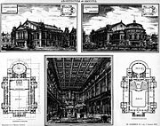
An architectural drawing or architect's drawing is a technical drawing
Technical drawing
Technical drawing, also known as drafting or draughting, is the act and discipline of composing plans that visually communicate how something functions or has to be constructed.Drafting is the language of industry....

 of a building (or building project) that falls within the definition of architecture
Architecture
Architecture is both the process and product of planning, designing and construction. Architectural works, in the material form of buildings, are often perceived as cultural and political symbols and as works of art...

. Architectural drawings are used by architect
Architect
An architect is a person trained in the planning, design and oversight of the construction of buildings. To practice architecture means to offer or render services in connection with the design and construction of a building, or group of buildings and the space within the site surrounding the...

s and others for a number of purposes: to develop a design idea into a coherent proposal, to communicate ideas and concepts, to convince clients of the merits of a design, to enable a building contractor to construct it, as a record of the completed work, and to make a record of a building that already exists.
Discussion
Ask a question about 'Architectural drawing'
Start a new discussion about 'Architectural drawing'
Answer questions from other users
Full Discussion Forum
 
Unanswered Questions
Encyclopedia
An architectural drawing or architect's drawing is a technical drawing
Technical drawing
Technical drawing, also known as drafting or draughting, is the act and discipline of composing plans that visually communicate how something functions or has to be constructed.Drafting is the language of industry....

 of a building (or building project) that falls within the definition of architecture
Architecture
Architecture is both the process and product of planning, designing and construction. Architectural works, in the material form of buildings, are often perceived as cultural and political symbols and as works of art...

. Architectural drawings are used by architect
Architect
An architect is a person trained in the planning, design and oversight of the construction of buildings. To practice architecture means to offer or render services in connection with the design and construction of a building, or group of buildings and the space within the site surrounding the...

s and others for a number of purposes: to develop a design idea into a coherent proposal, to communicate ideas and concepts, to convince clients of the merits of a design, to enable a building contractor to construct it, as a record of the completed work, and to make a record of a building that already exists.

Architectural drawings are drawn according to a set of conventions
Convention (norm)
A convention is a set of agreed, stipulated or generally accepted standards, norms, social norms or criteria, often taking the form of a custom....

, which include particular views (floor plan, section etc.), sheet sizes, units of measurement and scales, annotation and cross referencing. Conventionally, drawings were made in ink on paper or a similar material, and any copies required had to be laboriously made by hand. The twentieth century saw a shift to drawing on tracing paper, so that mechanical copies could be run off efficiently.

The development of the computer
Computer
A computer is a programmable machine designed to sequentially and automatically carry out a sequence of arithmetic or logical operations. The particular sequence of operations can be changed readily, allowing the computer to solve more than one kind of problem...

 had a major impact on the methods used to design and create technical drawings, making manual draughting almost obsolete, and opening up new possibilities of form using organic shapes and complex geometry. Today the vast majority of drawings are created using CAD
Computer-aided design
Computer-aided design , also known as computer-aided design and drafting , is the use of computer technology for the process of design and design-documentation. Computer Aided Drafting describes the process of drafting with a computer...

 software.

Sketches and diagrams


A sketch
Sketch (drawing)
A sketch is a rapidly executed freehand drawing that is not usually intended as a finished work...

 is a rapidly executed freehand drawing, a quick way to record and develop an idea, not intended as a finished work. A diagram
Diagram
A diagram is a two-dimensional geometric symbolic representation of information according to some visualization technique. Sometimes, the technique uses a three-dimensional visualization which is then projected onto the two-dimensional surface...

 may also be drawn freehand but deals with symbols, to develop the logic of a design. Both may be worked up into a more presentable form and used to communicate the principles of a design.

In architecture, the finished work is expensive and time consuming, so it is important to resolve the design as fully as possible before construction work begins. Complex modern buildings involve a large team of different specialist disciplines, and communication at the early design stages is essential to keep the design moving towards a coordinated outcome. Architects (and other designers) start investigating a new design with sketches and diagrams, to develop a rough design that provides an adequate response to the particular design problems.

There are two basic elements to a building design, the aesthetic and the practical. The aesthetic element includes the layout and visual appearance, the anticipated feel of the materials, and cultural references that will influence the way people perceive the building. Practical concerns include space allocated for different activities, how people enter and move around the building, daylight and artificial lighting, acoustics, traffic noise, legal matters and building codes, and many other issues. While both aspects are partly a matter of customary practice, every site is different. Many architects actively seek innovation, thereby increasing the number of problems to be resolved.

Architectural legend
Legend
A legend is a narrative of human actions that are perceived both by teller and listeners to take place within human history and to possess certain qualities that give the tale verisimilitude...

 often refers to designs made on the back of an envelope/napkin/cigarette packet. Initial thoughts are important, even if they have to be discarded along the way, because they provide the central idea around which the design can develop. Although a sketch is inaccurate, it is disposable and allows for freedom of thought, for trying different ideas quickly. Choice becomes sharply reduced once the design is committed to a scale drawing, and the sketch stage is almost always essential.

Diagrams are mainly used to resolve practical matters. In the early phases of the design architects use diagrams to develop, explore, and communicate ideas and solutions. They are essential tools for thinking, problem solving, and communication in the design disciplines. Design is ultimately about the configurations, connections, shape, and orientations of physical forms. Diagrams can be used to resolve spatial relationships, but they can also represent forces and flows, e.g. the forces of sun and wind, or the flows of people and materials through a building.

An exploded view shows component parts dis-assembled in some way, so that each can be seen on its own. These views are common in technical manuals, but are also used in architecture, either in conceptual diagrams or to illustrate technical details.

In a cutaway view
Cutaway (3D graphics)
A cutaway drawing, also called a cutaway diagram is a 3D graphics, drawing, diagram and or illustration, in which surface elements a three-dimensional model are selectively removed, to make internal features visible, but without sacrificing the outer context entirely.- Overview :According to...

 parts of the exterior are omitted to show the interior, or details of internal construction. "The convention of the rough architectural cutaway can be used to create a more intense dialogue between exterior and interior." (this kind of drawing may be more visually interesting than the building it describes). Although common in technical illustration, the cutaway is in fact little used in architectural drawing. It is used mainly as 3D sketches to illustrate and expand on formal construction details.


Size and scale


The size of drawings reflects the materials available and the size that is convenient to transport – rolled up or folded, laid out on a table, or pinned up on a wall. The draughting process may impose limitations on the size that is realistically workable. Sizes are determined by a consistent paper size
Paper size
Many paper size standards conventions have existed at different times and in different countries. Today there is one widespread international ISO standard and a localised standard used in North America . The paper sizes affect writing paper, stationery, cards, and some printed documents...

 system, according to local usage. Normally the largest paper size
Paper size
Many paper size standards conventions have existed at different times and in different countries. Today there is one widespread international ISO standard and a localised standard used in North America . The paper sizes affect writing paper, stationery, cards, and some printed documents...

 used in modern architectural practice is ISO A0 (841 ×) or in the USA Arch E (762 ×), although there is a Large E size (915 ×) which does not have an ISO equivalent.

Architectural drawings are drawn to scale, so that relative sizes are correctly represented. The scale is chosen both to ensure the whole building will fit on the chosen sheet size, and to show the required amount of detail. At the scale of one eighth of an inch to one foot (1/96th) or the metric equivalent 1 to 100, walls are typically shown as simple outlines corresponding to the overall thickness. At a larger scale, half an inch to one foot (1/24th) or the nearest common metric equivalent 1 to 20, the layers of different materials that make up the wall construction are shown. Construction details are drawn to a larger scale, in some cases full size (1 to 1 scale).

Scale drawings enable dimensions to be 'read' off the drawing, i.e. measured directly. Imperial scales (feet and inches), while lacking the simple logic of the metric system, are equally readable using an ordinary ruler. On a one-eighth inch to one foot scale drawing, the one-eighth divisions on the ruler can be read off as feet. Architects normally use a scale ruler with different scales marked on each edge. A third method, used by builders in estimating, is to measure directly off the drawing and multiply by the scale factor.

Dimensions can be measured off drawings made on a stable medium such as vellum. All processes of reproduction introduce small errors, especially now that different copying methods mean that the same drawing may be re-copied or copies made in several different ways. Consequently dimensions need to be written ('figured') on the drawing. The disclaimer "Do not scale off dimensions" is commonly inscribed on architects drawings, to guard against errors arising in the copying process.

Standard views used in architectural drawing


This section deals with the conventional views used to represent a building or structure.
See the Types of architectural drawing section below for drawings classified according to their purpose.

Floor plan


A floor plan
Floor plan
In architecture and building engineering, a floor plan, or floorplan, is a diagram, usually to scale, showing a view from above of the relationships between rooms, spaces and other physical features at one level of a structure....

 is the most fundamental architectural diagram
Diagram
A diagram is a two-dimensional geometric symbolic representation of information according to some visualization technique. Sometimes, the technique uses a three-dimensional visualization which is then projected onto the two-dimensional surface...

, a view from above showing the arrangement of spaces in building in the same way as a map
Map
A map is a visual representation of an area—a symbolic depiction highlighting relationships between elements of that space such as objects, regions, and themes....

, but showing the arrangement at a particular level of a building. Technically it is a horizontal section cut through a building (conventionally at three feet / one metre above floor level), showing walls, windows and door openings and other features at that level. The plan view includes anything that could be seen below that level: the floor, stairs (but only up to the plan level), fittings and sometimes furniture. Objects above the plan level (e.g. beams overhead) can be indicated as dotted lines.

Geometrically, plan view is defined as a vertical orthographic projection
Orthographic projection
Orthographic projection is a means of representing a three-dimensional object in two dimensions. It is a form of parallel projection, where all the projection lines are orthogonal to the projection plane, resulting in every plane of the scene appearing in affine transformation on the viewing surface...

 of an object on to a horizontal plane, with the horizontal plane cutting through the building.

Site plan


A site plan
Site plan
A site plan is an architectural plan, landscape architecture document, and a detailed engineering drawing of proposed improvements to a given lot...

 is a specific type of plan, showing the whole context of a building or group of buildings. A site plan shows property boundaries and means of access to the site, and nearby structures if they are relevant to the design. For a development
Real estate development
Real estate development, or Property Development, is a multifaceted business, encompassing activities that range from the renovation and re-lease of existing buildings to the purchase of raw land and the sale of improved land or parcels to others...

 on an urban site, the site plan may need to show adjoining streets to demonstrate how the design fits in to the urban fabric. Within the site boundary, the site plan gives an overview of the entire scope of work. It shows the buildings (if any) already existing and those that are proposed, usually as a building footprint; roads, parking lots, footpaths, hard landscaping
Hardscape
Hardscape, in the practice of landscaping, refers to the paved areas like streets & sidewalks, large business complexes & housing developments, and other industrial areas where the upper soil profile is no longer exposed to the actual surface of the Earth...

, trees and planting. For a construction project, the site plan also needs to show all the services connections: drainage and sewer lines, water supply, electrical and communications cables, exterior lighting etc.

Site plans are commonly used to represent
Representation (arts)
Representation is the use of signs that stand in for and take the place of something else. It is through representation that people organize the world and reality through the act of naming its elements...

 a building proposal prior to detailed design: drawing up a site plan is a tool for deciding both the site layout and the size and orientation of proposed new buildings. A site plan is used to verify that a proposal complies with local development codes, including restrictions on historical sites. In this context the site plan forms part of a legal agreement, and there may be a requirement for it to be drawn up by a licenced professional: architect, engineer, landscape architect or land surveyor.

Elevation


An elevation is a view of a building seen from one side, a flat representation of one façade
Facade
A facade or façade is generally one exterior side of a building, usually, but not always, the front. The word comes from the French language, literally meaning "frontage" or "face"....

. This is the most common view used to describe the external appearance of a building. Each elevation is labelled in relation to the compass direction it faces, e.g. the north elevation of a building is the side that most closely faces north. Buildings are rarely a simple rectangular shape in plan, so a typical elevation may show all the parts of the building that are seen from a particular direction.

Geometrically, an elevation is a horizontal orthographic projection of a building on to a vertical plane, the vertical plane normally being parallel to one side of the building.

Architects also use the word elevation as a synonym
Synonym
Synonyms are different words with almost identical or similar meanings. Words that are synonyms are said to be synonymous, and the state of being a synonym is called synonymy. The word comes from Ancient Greek syn and onoma . The words car and automobile are synonyms...

 for façade
Facade
A facade or façade is generally one exterior side of a building, usually, but not always, the front. The word comes from the French language, literally meaning "frontage" or "face"....

, so the north elevation is literally the north wall of the building.


Cross section


A cross section
Cross section (geometry)
In geometry, a cross-section is the intersection of a figure in 2-dimensional space with a line, or of a body in 3-dimensional space with a plane, etc...

, also simply called a section, represents a vertical plane cut through the object, in the same way as a floor plan
Floor plan
In architecture and building engineering, a floor plan, or floorplan, is a diagram, usually to scale, showing a view from above of the relationships between rooms, spaces and other physical features at one level of a structure....

 is a horizontal section viewed from the top. In the section view, everything cut by the section plane is shown as a bold line, often with a solid fill to show objects that are cut through, and anything seen beyond generally shown in a thinner line. Sections are used to describe the relationship between different levels of a building. In the Observatorium drawing illustrated here, the section shows the dome seen from the outside, a second dome that can only be seen inside the building, and the way the space between the two accommodates a large astronomical telescope: relationships that would be difficult to understand from plans alone.

A sectional elevation is a combination of a cross section, with elevations of other parts of the building seen beyond the section plane.

Geometrically, a cross section is a horizontal orthographic projection of a building on to a vertical plane, with the vertical plane cutting through the building.


Isometric and axonometric projections


Isometric and axonometric projections are a simple way of representing a three dimensional object, keeping the elements to scale and showing the relationship between several sides of the same object, so that the complexities of a shape can be clearly understood.

There is some confusion about the terms isometric and axonometric. “Axonometric is a word that has been used by architects for hundreds of years. Engineers use the word axonometric as a generic term to include isometric, diametric and trimetric drawings.” This article uses the terms in the architecture-specific sense.

Despite fairly complex geometrical explanations, for the purposes of practical draughting the difference between isometric and axonometric is simple (see diagram above). In both, the plan is drawn on a skewed or rotated grid, and the verticals are projected vertically on the page. All lines are drawn to scale so that relationships between elements are accurate. In many cases a different scale is required for different axes
Cartesian coordinate system
A Cartesian coordinate system specifies each point uniquely in a plane by a pair of numerical coordinates, which are the signed distances from the point to two fixed perpendicular directed lines, measured in the same unit of length...

, and again this can be calculated but in practice was often simply estimated by eye.
  • An isometric
    Isometric projection
    Isometric projection is a method for visually representing three-dimensional objects in two dimensions in technical and engineering drawings...

     uses a plan grid at 30 degrees from the horizontal in both directions, which distorts the plan shape. Isometric graph paper can be used to construct this kind of drawing. This view is useful to explain construction details (e.g. three dimensional joints in joinery). The isometric was the standard view until the mid twentieth century, remaining popular until the 1970s, especially for textbook diagrams and illustrations.
  • Cabinet projection is similar, but only one axis is skewed, the others being horizontal and vertical. Originally used in cabinet making, the advantage is that a principal side (e.g. a cabinet front) is displayed without distortion, so only the less important sides are skewed. The lines leading away from the eye are drawn at a reduced scale to lessen the degree of distortion. The cabinet projection is seen in Victorian engraved advertisements and architectural textbooks, but has virtually disappeared from general use.
  • An axonometric
    Axonometric projection
    Axonometric projection is a type of parallel projection, more specifically a type of orthographic projection, used to create a pictorial drawing of an object, where the object is rotated along one or more of its axes relative to the plane of projection....

     uses a 45 degree plan grid, which keeps the original orthogonal geometry of the plan. The great advantage of this view for architecture is that the draughtsman can work directly from a plan, without having to reconstruct it on a skewed grid. In theory the plan should be set at 45 degrees, but this introduces confusing coincidences where opposite corners align. Unwanted effects can be avoided by rotating the plan while still projecting vertically. This is sometimes called a planometric or plan oblique view, and allows freedom to choose any suitable angle to present the most useful view of an object.


Traditional draughting techniques used 30-60 and 45 degree set square
Set square
A set square or triangle is an object used in engineering and technical drawing, with the aim of providing a straightedge at a right angle or other particular planar angle to a baseline....

s, and that determined the angles used in these views. Once the adjustable square became common those limitations were lifted.

The axonometric gained in popularity in the twentieth century, not just as a convenient diagram but as a formal presentation technique, adopted in particular by the Modern Movement. Axonometric drawings feature prominently in the influential 1970's drawings of Michael Graves
Michael Graves
Michael Graves is an American architect. Identified as one of The New York Five, Graves has become a household name with his designs for domestic products sold at Target stores in the United States....

, James Stirling
James Stirling (architect)
Sir James Frazer Stirling FRIBA was a British architect. He is considered to be among the most important and influential British architects of the second half of the 20th century...

 and others, using not only straightforward views but worms-eye view, unusually and exaggerated rotations of the plan, and exploded elements.

The axonometric view is not readily generated by CAD programmes, which work best by generating a view from a three dimensional model. Consequently it is now little used except to illustrate relatively simple construction details.

Detail drawings


Detail drawings show a small part of the construction at a larger scale, to show how the component parts fit together. They are also used to show small surface details, for example decorative elements. Section drawings at large scale are a standard way of showing building construction details, typically showing complex junctions (such as floor to wall junction, window openings, eaves and roof apex) that cannot be clearly shown on a drawing that includes the full height of the building. A full set of construction details needs to show plan details as well as vertical section details. One detail is seldom produced in isolation: a set of details shows the information needed to understand the construction in three dimensions. Typical scales for details are 1/10, 1/5 and full size.

In traditional construction, many details were so fully standardised, that few detail drawings were required to construct a building. For example, the construction of a sash window
Sash window
A sash window or hung sash window is made of one or more movable panels or "sashes" that form a frame to hold panes of glass, which are often separated from other panes by narrow muntins...

 would be left to the carpenter, who would fully understand what was required, but unique decorative details of the facade would be drawn up in detail. In contrast, modern buildings need to be fully detailed because of the proliferation of different products, methods and possible solutions.

Architectural perspective


Perspective
Perspective (graphical)
Perspective in the graphic arts, such as drawing, is an approximate representation, on a flat surface , of an image as it is seen by the eye...

 in drawing is an approximate representation on a flat surface of an image as it is perceived by the eye. The key concepts here are:
  • Perspective is the view from a particular fixed viewpoint.
  • Horizontal and vertical edges in the object are represented by horizontals and verticals in the drawing.
  • Lines leading away into the distance appear to converge at a vanishing point
    Vanishing point
    A vanishing point is a point in a perspective drawing to which parallel lines not parallel to the image plane appear to converge. The number and placement of the vanishing points determines which perspective technique is being used...

    .
  • All horizontals converge to a point on the horizon
    Horizon
    The horizon is the apparent line that separates earth from sky, the line that divides all visible directions into two categories: those that intersect the Earth's surface, and those that do not. At many locations, the true horizon is obscured by trees, buildings, mountains, etc., and the resulting...

    , which is a horizontal line at eye level.
  • Verticals converge to a point either above or below the horizon.


The basic categorization of artificial perspective is by the number of vanishing points:
  • One-point perspective where objects facing the viewer are orthogonal, and receding lines converge to a single vanishing point.
  • Two-point perspective reduces distortion by viewing objects at an angle, with all the horizontal lines receding to one of two vanishing points, both located on the horizon.
  • Three-point perspective introduces additional realism by making the verticals recede to a third vanishing point, which is above or below depending upon whether the view is seen from above or below.


The normal convention is architectural perspective is to use two-point perspective, with all the verticals drawn as verticals on the page.

Three-point perspective gives a casual, photographic snapshot effect. In professional architectural photography
Architectural photography
Architectural photography is the practice of photographing buildings and similar structures, both inside and out. Architectural photographs are usually produced by Architectural photographers, who are skilled in the use of specialized techniques and equipment...

, conversely, a view camera
View camera
The view camera is a type of camera first developed in the era of the Daguerreotype and still in use today, though with many refinements. It comprises a flexible bellows which forms a light-tight seal between two adjustable standards, one of which holds a lens, and the other a viewfinder or a...

 or a perspective control lens is used to eliminate the third vanishing point, so that all the verticals are vertical on the photograph, as with the perspective convention. This can also be done by digital manipulation of a photograph taken with a normal camera.

Aerial perspective
Aerial perspective
Aerial perspective or atmospheric perspective refers to the effect the atmosphere has on the appearance of an object as it is viewed from a distance. As the distance between an object and a viewer increases, the contrast between the object and its background decreases, and the contrast of any...

 is a technique in painting, for indicating distance by approximating the effect of the atmosphere on distant objects. In daylight, as an ordinary object gets further from the eye, its contrast with the background is reduced, its colour saturation is reduced, and its colour becomes more blue. Not to be confused with aerial view
Aerial View
Aerial View is the fourth studio album by the German band Blackmail. The album was released on Friday, January 13, 2006 under City Slang Records. The album is noted for its harsh guitar melodies and mellow vocals. Crediting the album release, the band's website released a promotional e-card with...

 or bird's eye view, which is the view as seen (or imagined) from a high vantage point. In J M Gandy's perspective (see illustration above) of the Bank of England, Gandy portrayed the building as a picturesque ruin in order to show the internal plan arrangement, a precursor of the cutaway view.

A montage
Montage
-Filmmaking:*Montage , a technique which uses rapid editing, special effects and music to present compressed narrative information*Soviet montage theory in the 1920s-Other:* Montage , Documentary television series from 1960s and 1970s...

 image is produced by superimposing a perspective image of a building on to a photographic background. Care is needed to record the position from which the photograph was taken, and to generate the perspective using the same viewpoint. This technique is popular in computer visualisation, where the building can be photorealistically
Photorealism
Photorealism is the genre of painting based on using the camera and photographs to gather information and then from this information creating a painting that appears photographic...

 rendered, and the final image is intended to be almost indistinguishable from a photograph.

Types of architectural drawing


Architectural drawings are produced for a specific purpose, and can be classified accordingly. Several elements are often included on the same sheet, for example a sheet showing a plan together with the principal façade.

Presentation drawings


Drawings intended to explain a scheme and to promote its merits. Working drawings may include tones or hatches
Hatching
Hatching is an artistic technique used to create tonal or shading effects by drawing closely spaced parallel lines...

 to emphasise different materials, but they are diagrams, not intended to appear realistic. Basic presentation drawings typically include people, vehicles and trees, taken from a library of such images, and are otherwise very similar in style to working drawings. Rendering
Artistic rendering
Rendering in visual art and technical drawing means the process of creating, shading, and texturing of an image, especially a photorealistic one. It can also be used to describe the quality of execution of that process...

 is the art of adding surface textures and shadows to show the visual qualities of a building more realistically. An architectural illustrator
Architectural illustrator
An architectural illustrator is an artist who creates imagery for the design professional that accurately portray the details of an architectural project...

 or graphic designer
Graphic designer
A graphic designer is a professional within the graphic design and graphic arts industry who assembles together images, typography or motion graphics to create a piece of design. A graphic designer creates the graphics primarily for published, printed or electronic media, such as brochures and...

 may be employed to prepare specialist presentation images, usually perspectives or highly finished site plans, floor plans and elevations etc.

Survey drawings


Measured drawings of existing land, structures and buildings. Architects need an accurate set of survey drawings as a basis for their working drawings, to establish exact dimensions for the construction work. Surveys are usually measured and drawn up by specialist land surveyors
Surveying
See Also: Public Land Survey SystemSurveying or land surveying is the technique, profession, and science of accurately determining the terrestrial or three-dimensional position of points and the distances and angles between them...

.

Record drawings


Historically, architects have made record drawings in order to understand and emulate the great architecture known to them. In the Renaissance, architects from all over Europe studied and recorded the remains of the Roman and Greek civilizations, and used these influences to develop the architecture of the period. Records are made both individually, for local purposes, and on a large scale for publication. Historic surveys worth referring to include:
  • Colen Campbell
    Colen Campbell
    Colen Campbell was a pioneering Scottish architect who spent most of his career in England, and is credited as a founder of the Georgian style...

    's Vitruvius Brittanicus, illustrations of English buildings by Inigo Jones
    Inigo Jones
    Inigo Jones is the first significant British architect of the modern period, and the first to bring Italianate Renaissance architecture to England...

     and Sir Christopher Wren, as well as Campbell himself and other prominent architects of the era.
  • The Survey of London
    Survey of London
    The Survey of London is a research project to produce a comprehensive architectural survey of the former County of London. It was founded in 1894 by Charles Robert Ashbee, an Arts-and-Crafts architect and social thinker, and was motivated by a desire to record and preserve London's ancient monuments...

    , founded in 1894 by Charles Robert Ashbee
    Charles Robert Ashbee
    Charles Robert Ashbee was an English designer and entrepreneur who was a prime mover of the Arts and Crafts movement that took its craft ethic from the works of John Ruskin and its co-operative structure from the socialism of William Morris.-Early life:He was the son of businessman and erotic...

     and now available through English Heritage
    English Heritage
    English Heritage . is an executive non-departmental public body of the British Government sponsored by the Department for Culture, Media and Sport...

    . A record of notable streets and individual buildings in the former County of London.
  • Historic American Buildings Survey
    Historic American Buildings Survey
    The Historic American Buildings Survey , Historic American Engineering Record , and Historic American Landscapes Survey are programs of the National Park Service established for the purpose of documenting historic places. Records consists of measured drawings, archival photographs, and written...

    , records of notable buildings drawn up during the 1930s Depression
    Great Depression
    The Great Depression was a severe worldwide economic depression in the decade preceding World War II. The timing of the Great Depression varied across nations, but in most countries it started in about 1929 and lasted until the late 1930s or early 1940s...

    , this collection is held by the Library of Congress and is available copyright-free on the internet.


Record drawings are also used in construction projects, where "as-built" drawings of the completed building take account of all the variations made during the course of construction.

Working drawings


A comprehensive set of drawings used in a building construction project: these will include not only architect's drawings but structural and services engineer's drawings etc. Working drawings logically subdivide into location, assembly and component drawings.
  • Location drawings, also called general arrangement drawings, include floor plans, sections and elevations: they show where the construction elements are located.
  • Assembly drawings show how the different parts are put together. For example a wall detail will show the layers that make up the construction, how they are fixed to structural elements, how to finish the edges of openings, and how prefabricated components are to be fitted.
  • Component drawings enable self-contained elements e.g. windows and doorsets, to be fabricated in a workshop, and delivered to site complete and ready for installation. Larger components may include roof trusses, cladding panels, cupboards and kitchens. Complete rooms, especially hotel bedrooms and bathrooms, may be made as prefabricated pods complete with internal decorations and fittings.
  • Traditionally, working drawings would typically combine plans, sections, elevations and some details to provide a complete explanation of a building on one sheet. That was possible because little detail was included, the building techniques involved being common knowledge amongst building professionals. Modern working drawings are much more detailed and it is standard practice to isolate each view on a separate sheet. Notes included on drawings are brief, referring to standardised specification documents for more information. Understanding the layout and construction of a modern building involves studying an often-sizeable set of drawings and documents.

Drafting


Until the latter part of the twentieth century, all architectural drawings were manually produced, either by architects or by trained (but less skilled) draughtsmen
Draughtsman
A draughtsman or draftsman , is a person skilled in drawing, either:*drawing for artistic purposes, or*technical drawing for practical purposes such as architecture or engineering...

 (or drafters), who did not generate the design, although they made many of the less important decisions. This system continues with CAD draughting: many design architects have little or no knowledge of CAD software programmes and rely upon others to take their designs beyond the sketch stage. Draughtsmen may specialize in a type of structure, such as residential or commercial, or in a type of construction: timber frame, reinforced concrete, prefabrication etc.

The traditional tools of the architect were the drawing board
Drawing board
A drawing board is, in its antique form, a kind of multipurpose desk which can be used for any kind of drawing, writing or impromptu sketching on a large sheet of paper or for reading a large format book or other oversized document or for drafting precise technical illustrations...

 or draughting table, T-square
T-square
A T-square is a technical drawing instrument used by draftsmen primarily as a guide for drawing horizontal lines on a drafting table. It may also guide a triangle to draw vertical or diagonal lines. Its name comes from the general shape of the instrument where the horizontal member of the T slides...

 and set square
Set square
A set square or triangle is an object used in engineering and technical drawing, with the aim of providing a straightedge at a right angle or other particular planar angle to a baseline....

s, protractor
Protractor
In geometry, a protractor is a circular or semicircular tool for measuring an angle or a circle. The units of measurement utilized are usually degrees.Some protractors are simple half-discs; these have existed since ancient times...

, compasses
Compass (drafting)
A compass or pair of compasses is a technical drawing instrument that can be used for inscribing circles or arcs. As dividers, they can also be used as a tool to measure distances, in particular on maps...

, pencil
Pencil
A pencil is a writing implement or art medium usually constructed of a narrow, solid pigment core inside a protective casing. The case prevents the core from breaking, and also from marking the user’s hand during use....

 and drawing pens
Technical pen
A technical pen is a specialized instrument used by an engineer, architect, or drafter to make lines of constant width for architectural, engineering, or technical drawings. It has been also generally called "rapidograph", although that particular name is officially a trademarked line of products...

 of different types. Drawings were made on vellum
Vellum
Vellum is mammal skin prepared for writing or printing on, to produce single pages, scrolls, codices or books. It is generally smooth and durable, although there are great variations depending on preparation, the quality of the skin and the type of animal used...

, coated linen
Linen
Linen is a textile made from the fibers of the flax plant, Linum usitatissimum. Linen is labor-intensive to manufacture, but when it is made into garments, it is valued for its exceptional coolness and freshness in hot weather....

, and on tracing paper
Tracing paper
Tracing paper is a type of translucent paper. It is made by immersing uncut and unloaded paper of good quality in sulphuric acid for a few seconds. The acid converts some of the cellulose into amyloid form having a gelatinous and impermeable character. When the treated paper is thoroughly washed...

. Lettering
Technical lettering
Technical lettering is the process of forming letters, numerals, and other characters in technical drawing. It is used to describe, or provide detailed specifications for, an object...

 would either be done by hand, mechanically using a stencil
Stencil
A stencil is a thin sheet of material, such as paper, plastic, or metal, with letters or a design cut from it, used to produce the letters or design on an underlying surface by applying pigment through the cut-out holes in the material. The key advantage of a stencil is that it can be reused to...

, or a combination of the two. Ink lines were drawn with a ruling pen
Ruling pen
A ruling pen is a vintage drawing instrument for drawing with ink or with other drawing fluids.A ruling pen contains ink in a slot between two flexible metal jaws, which are tapered to a point. It enables precise rendering of the thinnest lines. The line width can be adjusted by an adjustment screw...

, a relatively sophisticated device similar to a dip-in pen but with adjustable line width, capable of producing a very fine controlled line width. Ink pens had to be dipped into ink frequently. Draughtsmen worked standing up, and kept the ink on a separate table to avoid spilling ink on the drawing.

Twentieth century developments include the parallel motion
Parallel motion
The parallel motion is a mechanical linkage invented by the Scottish engineer James Watt in 1784 for his double-acting steam engine.In previous engines built by Newcomen and Watt, the piston pulled one end of the walking beam downwards during the power stroke using a chain, and the weight of the...

 drawing board, and more complicated improvements on the basic T-square. The development of reliable technical drawing pens
Technical pen
A technical pen is a specialized instrument used by an engineer, architect, or drafter to make lines of constant width for architectural, engineering, or technical drawings. It has been also generally called "rapidograph", although that particular name is officially a trademarked line of products...

 allowed for faster draughting and stencilled lettering. Letraset
Letraset
Letraset is a company based in the Kingsnorth Industrial Estate in Ashford, Kent, UK.It is known mainly for manufacturing sheets of artwork elements which can be transferred to artwork being prepared. The name Letraset was often used to refer generically to sheets of dry transferrable lettering of...

 dry transfer lettering and half-tone sheets were popular from the 1970s until computers made those processes obsolete.

Computer-aided design


Computer-aided design
Computer-aided design , also known as computer-aided design and drafting , is the use of computer technology for the process of design and design-documentation. Computer Aided Drafting describes the process of drafting with a computer...

 is the use of computer software to create drawings. Today the vast majority of technical drawings of all kinds are made using CAD. Instead of drawing lines on paper, the computer records similar information electronically. There are many advantages to this system: repetition is reduced because complex elements can be copied, duplicated and stored for re-use. Errors can be deleted, and the speed of draughting allows many permutations to be tried before the design is finalised. On the other hand, CAD drawing encourages a proliferation of detail and increased expectations of accuracy, aspects which reduce the efficiency originally expected from the move to computerisation.

CAD programmes, for example the worldwide market leader AutoCAD
AutoCAD
AutoCAD is a software application for computer-aided design and drafting in both 2D and 3D. It is developed and sold by Autodesk, Inc. First released in December 1982, AutoCAD was one of the first CAD programs to run on personal computers, notably the IBM PC...

, are complex and require both training and experience before the operator becomes fully productive. Consequently skilled CAD operators are often divorced from the design process. There are other more basic programmes such as SketchUp
SketchUp
SketchUp is a 3D modeling program marketed by Google and designed for architectural, civil, and mechanical engineers as well as filmmakers, game developers,...

 that allow for more intuitive drawing and are intended as a design tool.

CAD is used to create all kinds of drawings, from working drawings to photorealistic perspective views. Architectural rendering
Architectural rendering
Architectural rendering, or architectural illustration, is the art of creating two-dimensional images or animations showing the attributes of a proposed architectural design.-Computer-generated renderings:...

s (also called visualisations) are made by creating a three-dimensional model using CAD. The model can be viewed from any direction to find the most useful viewpoints. Different software (for example Autodesk 3ds Max) is then used to apply colour and texture to surfaces, and to represent shadows and reflections. The result can be accurately combined with photographic elements: people, cars, background landscape.

An architectural animation
Architectural animation
Architectural Animation is a short architectural movie created on a computer. A computer-generated building is created along with landscaping and sometimes moving people and vehicles. Unlike an architectural rendering, which is a single image from a single point of view, an architectural animation...

 is a short film showing how a proposed building will look: the moving image makes three-dimensional forms much easier to understand. An animation is generated from a series of hundreds or even thousands of still images, each made in the same way as an architectural visualisation. A computer-generated building is created using a CAD programme, and that is used to create more or less realistic views from a sequence of viewpoints. The simplest animations use a moving viewpoint, while more complex animations can include moving objects: people, vehicles and so on.

Architectural reprographics


Reprographics or reprography covers a variety of technologies, media, and support services used to make multiple copies of original drawings. Prints of architectural drawings are still sometimes called blueprint
Blueprint
A blueprint is a type of paper-based reproduction usually of a technical drawing, documenting an architecture or an engineering design. More generally, the term "blueprint" has come to be used to refer to any detailed plan....

s, after one of the early processes which produced a white line on blue paper. The process was superseded by the dye-line print system which prints black on white coated paper. The standard modern processes are the ink-jet printer, laser printer
Laser printer
A laser printer is a common type of computer printer that rapidly produces high quality text and graphics on plain paper. As with digital photocopiers and multifunction printers , laser printers employ a xerographic printing process, but differ from analog photocopiers in that the image is produced...

 and photocopier
Photocopier
A photocopier is a machine that makes paper copies of documents and other visual images quickly and cheaply. Most current photocopiers use a technology called xerography, a dry process using heat...

, of which the ink-jet and laser printers are commonly used for large-format printing. Although colour printing is now commonplace, it remains expensive above A3 size, and architect's working drawings still tend to adhere to the black and white / greyscale aesthetic.

See also


  • Architectural plan
    Architectural plan
    An architectural plan is a plan for architecture, and the documentation of written and graphic descriptions of the architectural elements of a building project including sketches, drawings and details.- Overview :...

  • Architectural model
    Architectural model
    An architectural model is a type of a scale model, tangible representation of a structure built to study aspects of an architectural design or to communicate design ideas to clients, committees, and the general public...

  • Copyright in architecture in the United States
    Copyright in architecture in the United States
    Copyright in architecture is an important, but little understood subject in the architectural discipline. Copyright is a legal concept that gives the creator of a work the exclusive right to use that work for a limited time...

  • Drawing
    Drawing
    Drawing is a form of visual art that makes use of any number of drawing instruments to mark a two-dimensional medium. Common instruments include graphite pencils, pen and ink, inked brushes, wax color pencils, crayons, charcoal, chalk, pastels, markers, styluses, and various metals .An artist who...

  • Engineering drawing
    Engineering drawing
    An engineering drawing, a type of technical drawing, is used to fully and clearly define requirements for engineered items.Engineering drawing produces engineering drawings . More than just the drawing of pictures, it is also a language—a graphical language that communicates ideas and information...

  • Layers in a standard architectural drawing
  • List of museums with major collections of European prints and drawings
  • Linear scale
    Linear scale
    A linear scale, also called a bar scale, scale bar, graphic scale, or graphical scale, is a means of visually showing the scale of a map, nautical chart, engineering drawing, or architectural drawing....

  • Preservation: Library and Archival Science

External links

  • Flickr
    Flickr
    Flickr is an image hosting and video hosting website, web services suite, and online community that was created by Ludicorp in 2004 and acquired by Yahoo! in 2005. In addition to being a popular website for users to share and embed personal photographs, the service is widely used by bloggers to...

    group: Architectural Drawings mainly sketches of existing buildings