


Slonim

Encyclopedia
Slonim is a city in Hrodna Voblast
, Belarus
, capital of the Slonim District. It is located at the junction of the Shchara and Isa river
s, 143 km southeast of Hrodna
. The population in 2008 was 50,800.
), Słonim (Polish
), Сло́ним (Russian
). Slonim was first mentioned in chronicles in 1252 as Uslonim and in 1255 as Vslonim. 'Uzslenimas' in the Lithuanian language
simply means 'beyond the valley'.
The area was disputed between Lithuania
and Kievan Rus'
in early history and it changed hands several times. In 1040, the Kievans won control of the area after a battle but lost Slonim to the Lithuanians in 1103. The Rutenians retook the area early in the 13th century but were expelled by a Tartar
invasion in 1241 and the town was pillaged. When, later in the year, the Tartars withdrew, Slonim became Lithuanian again.
In 1569, Lithuania and Poland
united and Slonim became an important regional centre within Commonwealth of Lithuania-Poland. From 1631 to 1685 the city flourished as the seat of the Lithuanian diet
.
The Commonwealth of Lithuania-Poland was dismantled in a series of three "partitions" in the second half of the 18th century and divided among its neighbours, Germany
, Austria
and Russia
which took the largest portion of the territory. Slonim was in the area annexed by Russia. The wars had damaged Slonim, but in the 18th century, a local landowner, count Oginski, encouraged the recovery of the area; a canal was dug to connect the Shchara with the Dnieper river, now known as the Oginski Canal
.
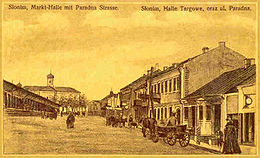 Russian control lasted until 1915, when the German army captured the town. After the First World War, the Slonim area was disputed between the Soviet Union
and the newly recreated state of Poland
. The town suffered badly in the Polish-Soviet war of 1920, but in 1920 the Poles established control of the province.
Slonim was one of the many towns in Poland and Russia that had a significant Jewish population.
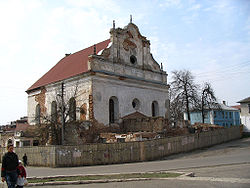
The imposing Great Synagogue, built in 1642, survived the destruction and brutal Nazi(Einsatzgruppen) murder of the 10,000 strong Slonim Jewish community in 1942. The 10 small synagogues around the Great Synagogue, did not. There were dozens of small Synagogues in Slonim called Stiblach.
In 1939, the Molotov–Ribbentrop Pact between Nazi Germany
and the Soviet Union
resulted in the invasion of Poland by the two powers and its division between them. Slonim was in the area designated by the Pact to fall within the Soviet sphere of influence. The Soviets placed that area within the Byelorussian SSR
. Two years later, Germany invaded the Soviets (Operation Barbarossa
) and Slonim was captured. Soon after, 70% of Slonim's Jews had been killed in a single Nazi operation (9,000 on 14 November 1941). The second mass murder of 8,000 Jews took place in 1942. In 1944, the Soviet Union retained possession of this part of the former Poland, as agreed between the Allies
.
After the breakup of the Soviet Union, Belarus
became an independent state.
came from there. Michael
and Ephraim Marks (of Marks & Spencer
) were born in Slonim.
The wealthiest family in Slonim before WW2, were the Rabinowicz brothers Vigdor and Yossel. Their father Dovber Rabinovicz was married to a Rivka Rochel (nee Kancepolski). After WW1, they entered the forestry business together with Yaakov Milikowski, and were known as the Rabmils. They escaped the Nazi atrocities by flying to Israel ( Palestine at the time.) Vigor's son, Professor Raviv, became a world famous Computer scientist. In 1971, after spending a sabbatical year in Israel and talking with the late David Cohen, General Manager of IBM-Israel at that time, Raviv convinced IBM management to begin a research and development activity in Haifa, Israel. Under his dynamic and respected leadership, this research center, that began as an attachment to the Technion Institute, eventually employed 300 people.
Slonim has varied food, consumer, and engineering industries. Corn, tar, and especially timber are exported. There is the Slonim artistic goods factory, a worsted factory and “Textilschik”, a paperboard factory, a motor- and a car repair plants, dry non-fat milk factory and meat processing plant. There are also flax preprocessing, feed mill and woodworking enterprises in the town.
and Belarusian
.
An earlier Gazeta Slonimskaya was originally published in 1938 and 1939, at that time in Polish
.
, Volkovysk, Lida. Buses, Taxi and Mini-buses are the only transport in Slonim. Slonim is on the railway line between Baranavichy and Vaukavysk
.
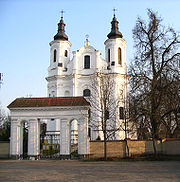
 The two main religions in Slonim are Orthodox Christianity
and Roman Catholic.
Slonim has also a theatre and a museum of regional studies, as well as a medical school. There is a new recreation area development in north-east Slonim called Enka. The main sports are: running, gymnastics, football and ice hockey. The telecommunication guyed mast, 350 metres tall, for FM-/TV-broadcasting is located at Novaya Strazha (53°03′53"N 25°28′31"E).
Northeast of Slonim, there is a CHAYKA
-transmitter.
Hrodna Voblast
Hrodna Voblast or Grodno Oblast is a voblast in northwestern Belarus.The capital - Grodno is the biggest city of the province. It lies on the Neman River. Grodno's existence is attested to from 1127. Two castles dating from the 14th - 18th centuries are located here on the steep right bank of...
, Belarus
Belarus
Belarus , officially the Republic of Belarus, is a landlocked country in Eastern Europe, bordered clockwise by Russia to the northeast, Ukraine to the south, Poland to the west, and Lithuania and Latvia to the northwest. Its capital is Minsk; other major cities include Brest, Grodno , Gomel ,...
, capital of the Slonim District. It is located at the junction of the Shchara and Isa river
Isa River
The Isa is a river of Belarus. Slonim is located on the river....
s, 143 km southeast of Hrodna
Hrodna
Grodno or Hrodna , is a city in Belarus. It is located on the Neman River , close to the borders of Poland and Lithuania . It has 327,540 inhabitants...
. The population in 2008 was 50,800.
Etymology and historical names
Slonim has been known by several versions of its name: Сло́нім (BelarusianBelarusian language
The Belarusian language , sometimes referred to as White Russian or White Ruthenian, is the language of the Belarusian people...
), Słonim (Polish
Polish language
Polish is a language of the Lechitic subgroup of West Slavic languages, used throughout Poland and by Polish minorities in other countries...
), Сло́ним (Russian
Russian language
Russian is a Slavic language used primarily in Russia, Belarus, Uzbekistan, Kazakhstan, Tajikistan and Kyrgyzstan. It is an unofficial but widely spoken language in Ukraine, Moldova, Latvia, Turkmenistan and Estonia and, to a lesser extent, the other countries that were once constituent republics...
). Slonim was first mentioned in chronicles in 1252 as Uslonim and in 1255 as Vslonim. 'Uzslenimas' in the Lithuanian language
Lithuanian language
Lithuanian is the official state language of Lithuania and is recognized as one of the official languages of the European Union. There are about 2.96 million native Lithuanian speakers in Lithuania and about 170,000 abroad. Lithuanian is a Baltic language, closely related to Latvian, although they...
simply means 'beyond the valley'.
History
The earliest record is of a wooden fort on the left bank of the Shchara river in the 11th century, although there may have been earlier settlement.The area was disputed between Lithuania
Lithuania
Lithuania , officially the Republic of Lithuania is a country in Northern Europe, the biggest of the three Baltic states. It is situated along the southeastern shore of the Baltic Sea, whereby to the west lie Sweden and Denmark...
and Kievan Rus'
Kievan Rus'
Kievan Rus was a medieval polity in Eastern Europe, from the late 9th to the mid 13th century, when it disintegrated under the pressure of the Mongol invasion of 1237–1240....
in early history and it changed hands several times. In 1040, the Kievans won control of the area after a battle but lost Slonim to the Lithuanians in 1103. The Rutenians retook the area early in the 13th century but were expelled by a Tartar
Tatars
Tatars are a Turkic speaking ethnic group , numbering roughly 7 million.The majority of Tatars live in the Russian Federation, with a population of around 5.5 million, about 2 million of which in the republic of Tatarstan.Significant minority populations are found in Uzbekistan, Kazakhstan,...
invasion in 1241 and the town was pillaged. When, later in the year, the Tartars withdrew, Slonim became Lithuanian again.
In 1569, Lithuania and Poland
Poland
Poland , officially the Republic of Poland , is a country in Central Europe bordered by Germany to the west; the Czech Republic and Slovakia to the south; Ukraine, Belarus and Lithuania to the east; and the Baltic Sea and Kaliningrad Oblast, a Russian exclave, to the north...
united and Slonim became an important regional centre within Commonwealth of Lithuania-Poland. From 1631 to 1685 the city flourished as the seat of the Lithuanian diet
Diet (assembly)
In politics, a diet is a formal deliberative assembly. The term is mainly used historically for the Imperial Diet, the general assembly of the Imperial Estates of the Holy Roman Empire, and for the legislative bodies of certain countries.-Etymology:...
.
The Commonwealth of Lithuania-Poland was dismantled in a series of three "partitions" in the second half of the 18th century and divided among its neighbours, Germany
Germany
Germany , officially the Federal Republic of Germany , is a federal parliamentary republic in Europe. The country consists of 16 states while the capital and largest city is Berlin. Germany covers an area of 357,021 km2 and has a largely temperate seasonal climate...
, Austria
Habsburg Monarchy
The Habsburg Monarchy covered the territories ruled by the junior Austrian branch of the House of Habsburg , and then by the successor House of Habsburg-Lorraine , between 1526 and 1867/1918. The Imperial capital was Vienna, except from 1583 to 1611, when it was moved to Prague...
and Russia
Russian Empire
The Russian Empire was a state that existed from 1721 until the Russian Revolution of 1917. It was the successor to the Tsardom of Russia and the predecessor of the Soviet Union...
which took the largest portion of the territory. Slonim was in the area annexed by Russia. The wars had damaged Slonim, but in the 18th century, a local landowner, count Oginski, encouraged the recovery of the area; a canal was dug to connect the Shchara with the Dnieper river, now known as the Oginski Canal
Oginski Canal
The Oginski Canal is a canal in Belarus which connects Yaselda River and Shchara River of length 54 km. Its construction was started in 1765 by count Michał Kazimierz Ogiński, hence the name....
.
Soviet Union
The Soviet Union , officially the Union of Soviet Socialist Republics , was a constitutionally socialist state that existed in Eurasia between 1922 and 1991....
and the newly recreated state of Poland
Poland
Poland , officially the Republic of Poland , is a country in Central Europe bordered by Germany to the west; the Czech Republic and Slovakia to the south; Ukraine, Belarus and Lithuania to the east; and the Baltic Sea and Kaliningrad Oblast, a Russian exclave, to the north...
. The town suffered badly in the Polish-Soviet war of 1920, but in 1920 the Poles established control of the province.
Slonim was one of the many towns in Poland and Russia that had a significant Jewish population.
The imposing Great Synagogue, built in 1642, survived the destruction and brutal Nazi(Einsatzgruppen) murder of the 10,000 strong Slonim Jewish community in 1942. The 10 small synagogues around the Great Synagogue, did not. There were dozens of small Synagogues in Slonim called Stiblach.
In 1939, the Molotov–Ribbentrop Pact between Nazi Germany
Nazi Germany
Nazi Germany , also known as the Third Reich , but officially called German Reich from 1933 to 1943 and Greater German Reich from 26 June 1943 onward, is the name commonly used to refer to the state of Germany from 1933 to 1945, when it was a totalitarian dictatorship ruled by...
and the Soviet Union
Soviet Union
The Soviet Union , officially the Union of Soviet Socialist Republics , was a constitutionally socialist state that existed in Eurasia between 1922 and 1991....
resulted in the invasion of Poland by the two powers and its division between them. Slonim was in the area designated by the Pact to fall within the Soviet sphere of influence. The Soviets placed that area within the Byelorussian SSR
Byelorussian SSR
The Byelorussian Soviet Socialist Republic was one of fifteen constituent republics of the Soviet Union. It was one of the four original founding members of the Soviet Union in 1922, together with the Ukrainian SSR, the Transcaucasian SFSR and the Russian Soviet Federative Socialist Republic...
. Two years later, Germany invaded the Soviets (Operation Barbarossa
Operation Barbarossa
Operation Barbarossa was the code name for Germany's invasion of the Soviet Union during World War II that began on 22 June 1941. Over 4.5 million troops of the Axis powers invaded the USSR along a front., the largest invasion in the history of warfare...
) and Slonim was captured. Soon after, 70% of Slonim's Jews had been killed in a single Nazi operation (9,000 on 14 November 1941). The second mass murder of 8,000 Jews took place in 1942. In 1944, the Soviet Union retained possession of this part of the former Poland, as agreed between the Allies
Allies
In everyday English usage, allies are people, groups, or nations that have joined together in an association for mutual benefit or to achieve some common purpose, whether or not explicit agreement has been worked out between them...
.
After the breakup of the Soviet Union, Belarus
Belarus
Belarus , officially the Republic of Belarus, is a landlocked country in Eastern Europe, bordered clockwise by Russia to the northeast, Ukraine to the south, Poland to the west, and Lithuania and Latvia to the northwest. Its capital is Minsk; other major cities include Brest, Grodno , Gomel ,...
became an independent state.
Historic population
Population of Slonim fluctuated, influenced by local prosperity and wars {1883, 21,110; 1897 15,893}. Jewish settlement in Slonim appears to have started in 1388, following encouragement from the Lithuanian authorities. They were credited with the development of local commerce in the 15th century, nonetheless, they were temporarily expelled by the Lithuanian Duchy in 1503. In the late 19th century, Slonim's Jewish population had risen to more than 10,000. The Slonimer Hasidic dynastySlonim (Hasidic dynasty)
Slonim is a Hasidic dynasty originating in the town of Slonim, which is now in Belarus.Today, there are two Slonimer Rebbes, both in Israel: one resides in Jerusalem and the other in Bnei Brak...
came from there. Michael
Michael Marks
Michael Marks, , was one of the two co-founders of the retail chain Marks & Spencer.-Biography:...
and Ephraim Marks (of Marks & Spencer
Marks & Spencer
Marks and Spencer plc is a British retailer headquartered in the City of Westminster, London, with over 700 stores in the United Kingdom and over 300 stores spread across more than 40 countries. It specialises in the selling of clothing and luxury food products...
) were born in Slonim.
The wealthiest family in Slonim before WW2, were the Rabinowicz brothers Vigdor and Yossel. Their father Dovber Rabinovicz was married to a Rivka Rochel (nee Kancepolski). After WW1, they entered the forestry business together with Yaakov Milikowski, and were known as the Rabmils. They escaped the Nazi atrocities by flying to Israel ( Palestine at the time.) Vigor's son, Professor Raviv, became a world famous Computer scientist. In 1971, after spending a sabbatical year in Israel and talking with the late David Cohen, General Manager of IBM-Israel at that time, Raviv convinced IBM management to begin a research and development activity in Haifa, Israel. Under his dynamic and respected leadership, this research center, that began as an attachment to the Technion Institute, eventually employed 300 people.
Economy
Slonim's importance derives from the river, which is navigable and joins the Oginsky canal, connecting the Niemen with the Dnieper.Slonim has varied food, consumer, and engineering industries. Corn, tar, and especially timber are exported. There is the Slonim artistic goods factory, a worsted factory and “Textilschik”, a paperboard factory, a motor- and a car repair plants, dry non-fat milk factory and meat processing plant. There are also flax preprocessing, feed mill and woodworking enterprises in the town.
Media
Slonim's biggest newspaper is the independent Gazeta Slonimskaya (Газета Слонімская). Founded in 1997, it is a weekly newspaper with a circulation of slightly more than 500 copies. It is published every Wednesday, and contains local and regional news, sections on sport, culture and lifestyle, and local advertising. It is currently 40 pages, plus an additional weekly 8-page supplement called Otdushina (Отдушина), focusing on youth, culture and religious affairs. The newspaper is written in both RussianRussian language
Russian is a Slavic language used primarily in Russia, Belarus, Uzbekistan, Kazakhstan, Tajikistan and Kyrgyzstan. It is an unofficial but widely spoken language in Ukraine, Moldova, Latvia, Turkmenistan and Estonia and, to a lesser extent, the other countries that were once constituent republics...
and Belarusian
Belarusian language
The Belarusian language , sometimes referred to as White Russian or White Ruthenian, is the language of the Belarusian people...
.
An earlier Gazeta Slonimskaya was originally published in 1938 and 1939, at that time in Polish
Polish language
Polish is a language of the Lechitic subgroup of West Slavic languages, used throughout Poland and by Polish minorities in other countries...
.
Transport and infrastructure
Slonim has road-links with Baranovichi, Ivatsevichi, RuzhanyRuzhany
Ruzhany is a small town located in Pruzhany Raion of Brest Voblast, Belarus.-Geography:Ruzhany is situated on the river Ruzhanka and surrounded by picturesque hills...
, Volkovysk, Lida. Buses, Taxi and Mini-buses are the only transport in Slonim. Slonim is on the railway line between Baranavichy and Vaukavysk
Vaukavysk
Vawkavysk or Vaŭkavysk or Volkovysk is a town in the Hrodna Province of Belarus. It is the center of Vaŭkavysk district and has a population of around 48,000....
.
Notable buildings
- Orthodox church of the Holy Trinity
- ConventConventA convent is either a community of priests, religious brothers, religious sisters, or nuns, or the building used by the community, particularly in the Roman Catholic Church and in the Anglican Communion...
of BenedictineBenedictineBenedictine refers to the spirituality and consecrated life in accordance with the Rule of St Benedict, written by Benedict of Nursia in the sixth century for the cenobitic communities he founded in central Italy. The most notable of these is Monte Cassino, the first monastery founded by Benedict... - ChapelChapelA chapel is a building used by Christians as a place of fellowship and worship. It may be part of a larger structure or complex, such as a church, college, hospital, palace, prison or funeral home, located on board a military or commercial ship, or it may be an entirely free-standing building,...
of St. Dominick - Catholic church of St. Andrew the Apostle
- Catholic church of the Immaculate ConceptionImmaculate ConceptionThe Immaculate Conception of Mary is a dogma of the Roman Catholic Church, according to which the Virgin Mary was conceived without any stain of original sin. It is one of the four dogmata in Roman Catholic Mariology...
of Blessed Virgin Mary and the convent of Bernardine - Orthodox church of TransfigurationTransfiguration of JesusThe Transfiguration of Jesus is an event reported in the New Testament in which Jesus is transfigured and becomes radiant upon a mountain. The Synoptic Gospels describe it, and 2 Peter 1:16-18 refers to it....
- The SynagogueSynagogueA synagogue is a Jewish house of prayer. This use of the Greek term synagogue originates in the Septuagint where it sometimes translates the Hebrew word for assembly, kahal...
is standing but in a dilapidated condition. It's listed by the private World Monuments FundWorld Monuments FundWorld Monuments Fund is a private, international, non-profit organization dedicated to the preservation of historic architecture and cultural heritage sites around the world through fieldwork, advocacy, grantmaking, education, and training....
as their top priority site of Jewish interest in Eastern Europe that requires restoration. The building was left untouched by the German LuftwaffeLuftwaffeLuftwaffe is a generic German term for an air force. It is also the official name for two of the four historic German air forces, the Wehrmacht air arm founded in 1935 and disbanded in 1946; and the current Bundeswehr air arm founded in 1956....
during World War IIWorld War IIWorld War II, or the Second World War , was a global conflict lasting from 1939 to 1945, involving most of the world's nations—including all of the great powers—eventually forming two opposing military alliances: the Allies and the Axis...
, but it has subsequently deteriorated and is now in urgent need of protection and restoration. British TV personality Natasha KaplinskyNatasha KaplinskyNatasha Margaret Kaplinsky is a British newsreader and television presenter, currently employed by ITV having previously worked for Channel 5, Sky News and the BBC...
was the subject of one of a series of BBC television programmes, Who Do You Think You Are?. Kaplinsky visited the synagogue, it having been the place of worship of her great grandparents. Her cousin sang a lament in Hebrew in the synagogue.
Orthodox Christianity
The term Orthodox Christianity may refer to:* the Eastern Orthodox Church and its various geographical subdivisions...
and Roman Catholic.
Slonim has also a theatre and a museum of regional studies, as well as a medical school. There is a new recreation area development in north-east Slonim called Enka. The main sports are: running, gymnastics, football and ice hockey. The telecommunication guyed mast, 350 metres tall, for FM-/TV-broadcasting is located at Novaya Strazha (53°03′53"N 25°28′31"E).
Northeast of Slonim, there is a CHAYKA
CHAYKA
Chayka is a Russian terrestrial radio navigation system, similar to LORAN-C. It is also run on 100 kHz and is described like LORAN-C by its GRI.-Chayka-Chains:There are 5 Chayka-chains in use:...
-transmitter.