


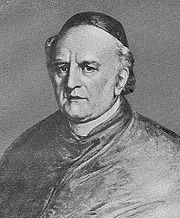
Angelo Mai

Encyclopedia
Italy
Italy , officially the Italian Republic languages]] under the European Charter for Regional or Minority Languages. In each of these, Italy's official name is as follows:;;;;;;;;), is a unitary parliamentary republic in South-Central Europe. To the north it borders France, Switzerland, Austria and...
Cardinal
Cardinal (Catholicism)
A cardinal is a senior ecclesiastical official, usually an ordained bishop, and ecclesiastical prince of the Catholic Church. They are collectively known as the College of Cardinals, which as a body elects a new pope. The duties of the cardinals include attending the meetings of the College and...
and philologist. He won a European reputation for publishing for the first time a series of previously unknown ancient texts. These he was able to discover and publish, first while in charge of the Biblioteca Ambrosiana
Biblioteca Ambrosiana
The Biblioteca Ambrosiana is a historic library in Milan, Italy, also housing the Pinacoteca Ambrosiana, the Ambrosian art gallery. Named after Ambrose, the patron saint of Milan, it was founded by Cardinal Federico Borromeo , whose agents scoured Western Europe and even Greece and Syria for books...
in Milan and then in the same role at the Vatican Library
Vatican Library
The Vatican Library is the library of the Holy See, currently located in Vatican City. It is one of the oldest libraries in the world and contains one of the most significant collections of historical texts. Formally established in 1475, though in fact much older, it has 75,000 codices from...
. The texts were often in parchment palimpsests; he was able to read the lower text using chemicals such as Gallic acid
Gallic acid
Gallic acid is a trihydroxybenzoic acid, a type of phenolic acid, a type of organic acid, also known as 3,4,5-trihydroxybenzoic acid, found in gallnuts, sumac, witch hazel, tea leaves, oak bark, and other plants. The chemical formula is C6H23COOH. Gallic acid is found both free and as part of...
. In particular he was able to locate a substantial portion of the long known of and much sought-after De re publica
De re publica
De re publica is a dialogue on Roman politics by Cicero, written in six books between 54 and 51 BC. It is written in the format of a Socratic dialogue in which Scipio Africanus Minor takes the role of a wise old man — an obligatory part for the genre...
of Cicero.
Biography
He was born of humble parents at SchilparioSchilpario
Schilpario is a comune in the Province of Bergamo in the Italian region of Lombardy, located about 100 km northeast of Milan and about 50 km northeast of Bergamo...
in what is now the province of Bergamo
Province of Bergamo
The Province of Bergamo is a province in the Lombardy region of Italy. It has a population of 1,098,740 , an area of 2,722.86 square km, and contains 244 comuni...
, Lombardy
Lombardy
Lombardy is one of the 20 regions of Italy. The capital is Milan. One-sixth of Italy's population lives in Lombardy and about one fifth of Italy's GDP is produced in this region, making it the most populous and richest region in the country and one of the richest in the whole of Europe...
.
In 1799 he entered the Society of Jesus
Society of Jesus
The Society of Jesus is a Catholic male religious order that follows the teachings of the Catholic Church. The members are called Jesuits, and are also known colloquially as "God's Army" and as "The Company," these being references to founder Ignatius of Loyola's military background and a...
, and in 1804 he became a teacher of classics in the Jesuit college of Naples
Naples
Naples is a city in Southern Italy, situated on the country's west coast by the Gulf of Naples. Lying between two notable volcanic regions, Mount Vesuvius and the Phlegraean Fields, it is the capital of the region of Campania and of the province of Naples...
. After completing his studies at the Collegium Romanum, he lived for some time at Orvieto
Orvieto
Orvieto is a city and comune in Province of Terni, southwestern Umbria, Italy situated on the flat summit of a large butte of volcanic tuff...
, where he was engaged in teaching and palaeographical studies. Though he returned to Rome, the deteriorating papal
Pope Pius VII
Pope Pius VII , born Barnaba Niccolò Maria Luigi Chiaramonti, was a monk, theologian and bishop, who reigned as Pope from 14 March 1800 to 20 August 1823.-Early life:...
relations with Napoleon and the city's subsequent occupation by General Miollis
Sextius Alexandre François de Miollis
Sextius Alexandre François de Miollis was a French military officer serving in the American Revolutionary War, the French Revolutionary Wars, and the Napoleonic Wars.-Biography:...
in 1808 necessitated Mai's withdrawal to Milan
Milan
Milan is the second-largest city in Italy and the capital city of the region of Lombardy and of the province of Milan. The city proper has a population of about 1.3 million, while its urban area, roughly coinciding with its administrative province and the bordering Province of Monza and Brianza ,...
, where in 1813 he was made custodian of the Ambrosian library
Biblioteca Ambrosiana
The Biblioteca Ambrosiana is a historic library in Milan, Italy, also housing the Pinacoteca Ambrosiana, the Ambrosian art gallery. Named after Ambrose, the patron saint of Milan, it was founded by Cardinal Federico Borromeo , whose agents scoured Western Europe and even Greece and Syria for books...
.
He now threw himself with characteristic energy and zeal into the task of examining the numerous manuscripts committed to his charge, and in the course of the next six years was able to restore to the world a considerable number of long-lost works. Having withdrawn from the Society of Jesus, he was invited to Rome in 1819 as chief keeper of the Vatican Library
Vatican Library
The Vatican Library is the library of the Holy See, currently located in Vatican City. It is one of the oldest libraries in the world and contains one of the most significant collections of historical texts. Formally established in 1475, though in fact much older, it has 75,000 codices from...
. In 1833 he was transferred to the office of secretary of the Congregation of the Propaganda Fide
Congregation for the Evangelization of Peoples
The Congregation for the Evangelization of Peoples in Rome is the congregation of the Roman Curia responsible for missionary work and related activities...
; on February 12, 1838 he was raised to the dignity of Cardinal. He died at Castel Gandolfo
Castel Gandolfo
Castel Gandolfo is a small Italian town or comune in Lazio that occupies a height overlooking Lake Albano about 15 miles south-east of Rome, on the Alban Hills. It is best known as the summer residence of the Pope. It is an Italian town with the population of 8834...
, near Albano Laziale
Albano Laziale
Albano Laziale is a comune in the province of Rome, on the Alban Hills, in Latium, central Italy. It is also a suburb of Rome, which is 25 km distant. It is bounded by other communes of Castel Gandolfo, Rocca di Papa, Ariccia and Ardea. Located in the Castelli Romani area of Lazio...
, on 8 September 1854.
Works
It is on his skill as a reader of palimpsestPalimpsest
A palimpsest is a manuscript page from a scroll or book from which the text has been scraped off and which can be used again. The word "palimpsest" comes through Latin palimpsēstus from Ancient Greek παλίμψηστος originally compounded from πάλιν and ψάω literally meaning “scraped...
s that Mai's fame chiefly rests. To the period of his residence at Milan belong:
- fragments of CiceroCiceroMarcus Tullius Cicero , was a Roman philosopher, statesman, lawyer, political theorist, and Roman constitutionalist. He came from a wealthy municipal family of the equestrian order, and is widely considered one of Rome's greatest orators and prose stylists.He introduced the Romans to the chief...
's judicial orations Pro Scauro, Pro TullioPro TullioPro Tullio is a partially preserved speech delivered by the Roman orator Cicero in 72 BC or 71 BC. The speech was made on behalf of Cicero's client, Marcus Tullius, who claimed legal damages from his neighbor, Publius Fabius, on the basis that Fabius had murdered several of Tullius' slaves in a...
, Pro Flacco, and his In Clodium et Curionem, De aere alieno Milonis, and De rege Alexandrino (1814) - M. Corn. Frontonis opera inedita, cum epistolis item ineditis, Antonini Pii, Marci Aurelii, Lucii Veri et Appiani (1815; new ed., 1823, with more than 100 additional letters found in the Vatican library)
- portions of eight speeches of Quintus Aurelius SymmachusQuintus Aurelius SymmachusQuintus Aurelius Symmachus was a Roman statesman, orator, and man of letters. He held the offices of governor of Africa in 373, urban prefect of Rome in 384 and 385, and consul in 391...
- fragments of PlautusPlautusTitus Maccius Plautus , commonly known as "Plautus", was a Roman playwright of the Old Latin period. His comedies are the earliest surviving intact works in Latin literature. He wrote Palliata comoedia, the genre devised by the innovator of Latin literature, Livius Andronicus...
- the oration of IsaeusIsaeusIsaeus , fl. early 4th century BC. One of the ten Attic Orators according to the Alexandrian canon. He was a student of Isocrates in Athens, and later taught Demosthenes while working as a metic speechwriter for others. Only eleven of his speeches survive, with fragments of a twelfth. They are...
' De hereditate Cleonymi - the last nine books of the Antiquities of Dionysius of Halicarnassus, and a number of other works.
- Cicero's De Re PublicaDe re publicaDe re publica is a dialogue on Roman politics by Cicero, written in six books between 54 and 51 BC. It is written in the format of a Socratic dialogue in which Scipio Africanus Minor takes the role of a wise old man — an obligatory part for the genre...
, published as M Tullii Ciceronis de republica quae supersunt, Rome, 1822 - Scriptorum veterum nova collectio, e Vaticanis codicibus edita in 1825-1838
- Classici scriptores e Vaticanis codicibus editi in 1828-1838
- Spicilegium Romanum in 1839-1844 (Tomus III, Tomus IX)
- Patrum nova bibliotheca in 1845-1853
His edition of the celebrated Codex Vaticanus Graecus 1209, completed in 1838, but not published (ostensibly the ground of inaccuracies) till four years after his death (1858), is the least satisfactory of his labours and was superseded by the edition of Vercellone and Cozza (1868), which itself leaves much to be desired.
Although Mai was not as successful in textual criticism
Textual criticism
Textual criticism is a branch of literary criticism that is concerned with the identification and removal of transcription errors in the texts of manuscripts...
as in the decipherment of manuscripts, he will always be remembered as a laborious and persevering pioneer, by whose efforts many ancient writings have been rescued from oblivion.