
All Topics  
Gila monster


   Email Print
   Bookmark   Link


Gila monster


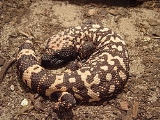
The Gila monster (HEE-la), Heloderma suspectum, is a species of venomous lizard
Lizard

Lizards are a large and widespread group of squamate reptiles, with nearly 5,000 species, ranging across all continents except Antarctica as well as most oceanic island chains....
 native to the southwestern United States
Southwestern United States

The Southwestern area of the United States could be defined as the states west of the Mississippi River, with the qualification of a certain northern limit, such as the 37th parallel north, 38th parallel north, 39th parallel north, or 40th parallel north line....
 and northern Mexico
Mexico

The United Mexican States , commonly known as Mexico , is a federalism constitutionalism republic in North America. It is bordered on the north by the United States; on the south and west by the Pacific Ocean; on the southeast by Guatemala, Belize, and the Caribbean Sea; and on the east by the Gulf of Mexico....
 (but not Baja California). A heavy, slow-moving lizard, up to long, the Gila monster is the only venomous lizard native to the United States, and one of only two known species of venomous lizards in North America, the other being its close relative the beaded lizard
Beaded lizard

The beaded lizard is a species of venomous lizard found in Guatemala and Mexico. It and its close relative, the Gila monster , are the only venomous lizards in the world....
 (H. horridum).


Discussion
Ask a question about 'Gila monster'
Start a new discussion about 'Gila monster'
Answer questions from other users
Full Discussion Forum


Encyclopedia


The Gila monster (HEE-la), Heloderma suspectum, is a species of venomous lizard
Lizard

Lizards are a large and widespread group of squamate reptiles, with nearly 5,000 species, ranging across all continents except Antarctica as well as most oceanic island chains....
 native to the southwestern United States
Southwestern United States

The Southwestern area of the United States could be defined as the states west of the Mississippi River, with the qualification of a certain northern limit, such as the 37th parallel north, 38th parallel north, 39th parallel north, or 40th parallel north line....
 and northern Mexico
Mexico

The United Mexican States , commonly known as Mexico , is a federalism constitutionalism republic in North America. It is bordered on the north by the United States; on the south and west by the Pacific Ocean; on the southeast by Guatemala, Belize, and the Caribbean Sea; and on the east by the Gulf of Mexico....
 (but not Baja California). A heavy, slow-moving lizard, up to long, the Gila monster is the only venomous lizard native to the United States, and one of only two known species of venomous lizards in North America, the other being its close relative the beaded lizard
Beaded lizard

The beaded lizard is a species of venomous lizard found in Guatemala and Mexico. It and its close relative, the Gila monster , are the only venomous lizards in the world....
 (H. horridum). Though the Gila monster is venomous, its sluggish nature means that it represents little threat to humans. However, it has earned a fearsome reputation, and is often killed by hikers and homeowners, despite being protected by state law in Arizona
Arizona

The State of Arizona is a U.S. state located in the Southwestern United States of the United States. The capital and largest city is Phoenix, Arizona....
 and Nevada
Nevada

Nevada is a U.S. state located in the Western United States of the United States of America. The capital is Carson City and the largest city is Las Vegas, Nevada....
.

Taxonomy and etymology

There are two subspecies of Gila monster: the reticulate Gila monster (H. suspectum suspectum) and the banded Gila monster (H. suspectum cinctum). The reticulate Gila monster lives in the southern region of the Gila monster's range, while the banded Gila monster is a northern subspecies occurring primarily in the Mojave Desert
Mojave Desert

The Mojave Desert , , locally referred to as the High Desert, occupies a significant portion of southeastern California and smaller parts of central California, southern Nevada, and northwestern Arizona, in the United States....
. The reticulate Gila monster tends to have its lighter markings broken up by dark scales, giving it a reticulated pattern, while the banded Gila monster generally have more unbroken bands of lighter scales.

The Gila monster has one close living relative, the beaded lizard (H. horridum), as well as many extinct relatives in the Helodermatidae whose evolutionary history may be traced back to the Cretaceous
Cretaceous

The Cretaceous , usually abbreviated K for its German translation Kreide, is a geologic period from circa to million years ago . In the geologic timescale, the Cretaceous follows on the Jurassic period and is followed by the Paleogene period....
 period. The genus Heloderma has existed since the Miocene
Miocene

The Miocene is a Geologic time scale of the Neogene period and extends from about 23.03 to 5.33 million years before the present. As with other older geologic periods, the rock beds that define the start and end are well identified but the exact dates of the start and end of the period are uncertain....
, when H. texana lived, and fragments of osteoderm
Osteoderm

Osteoderms are bony deposits forming scales, plates or other structures in the dermal layers of the skin. Osteoderms are found in many groups of Extant taxon and extinct reptiles, including lizards, various groups of dinosaurs , crocodylians, phytosaurs, aetosaurs, placodonts, and Nanchangosaurus ....
s from the Gila monster have been found in late Pleistocene
Pleistocene

The Pleistocene is the epoch from 1.8 million to 10,000 years Before Present covering the world's recent period of repeated glaciations. The name pleistocene is derived from the Greek and ....
 (8000-10,000 years ago) deposits near Las Vegas, Nevada
Las Vegas, Nevada

Las Vegas is the most populous city in the U.S. state of Nevada, the seat of Clark County, Nevada, and an internationally renowned major resort city for gambling, shopping, and entertainment....
. Because the Helodermatids have remained relatively unchanged morphologically, they are occasionally regarded as living fossil
Living fossil

Living fossil is an informal term for any living species of organism which appears to be the same as a species otherwise only known from fossils and which has no close living relatives....
s. Although the Gila monster appears closely related to the monitor lizard
Monitor lizard

Monitor lizards or biawak are members of the family Varanidae, a group of carnivorous lizard which includes the heaviest living lizard, the Komodo dragon, with the crocodile monitor being the longest in the world....
s (varanids) of Africa, Asia and Australia, the wide geographical separation and unique features not found in the varanids indicates that the Gila monster is better placed in a separate family.

The name Gila refers to the Gila River
Gila River

The Gila River The Gila River has its source in western New Mexico, in Sierra County, New Mexico on the western slopes of Continental Divide in the Black Range....
 Basin in Arizona
Arizona

The State of Arizona is a U.S. state located in the Southwestern United States of the United States. The capital and largest city is Phoenix, Arizona....
, where they were once plentiful. Heloderma means "studded skin", from the Ancient Greek
Ancient Greek

Ancient Greek is the historical stage in the development of the Greek language spanning across the Archaic Greece , Classical Greece , and Hellenistic civilization periods of ancient Greece and the classical antiquity....
 words Helos — the head of a nail or stud — and derma, or skin. Suspectum comes from the describer, paleontologist Edward Drinker Cope
Edward Drinker Cope

Edward Drinker Cope was an United States paleontology and comparative anatomy, as well as a noted herpetology and ichthyology.Born to a wealthy Society of Friends family, Cope quickly distinguished himself as a child prodigy interested in science; he published his first scientific paper in 1859....
, who suspected that the lizard might be venomous due to the grooves in the teeth.

Description

H. suspectum is a bulky, sausage-shaped lizard with a length of to and a weight of to . Although smaller than the bearded lizard, which can grow to be a long, the Gila monster is the largest lizard in the United States. It has a thick tail that is used to store fat, from which it can live off for months, or for years according to several anecdotes. Its tail is proportionately longer than that of the beaded lizard, a trait used to differentiate between the two. Unlike many other lizards, a Gila monster's tail does not autotomize
Autotomy

Autotomy or self amputation is the act whereby an animal severs one or more of its own appendages, usually as a self preservation mechanism designed to elude a predation's grasp....
 and cannot grow back if broken. The Gila monster also possesses large forefeet and sharp claws, ideal for digging, as well as a thick black tongue, used to smell with the help of a Jacobson's organ.

The Gila monster's scales have the appearance of blue, hot pink, silver, pink, orange, or yellow beads, laid down in intricate patterns. These beads are small bony plates that form scales
Scale (zoology)

In most biology nomenclature, a scale is a small rigid plate that grows out of an animal's skin to provide protection. In lepidopteran species, scales are plates on the surface of the insect wing, and provide coloration....
, and are known as osteoderms. The colors of its osteoderms are more vivid than those of its close relative, the beaded lizard. The scales on the belly are rectangular rather than rounded. It was the beaded skin of the Gila monster that caught the attention of Native Americans, the designs of which are recreated in Native American art and basketry. The scales are most vivid when the Gila monster is young; as it ages, the colors become paler and more reticulated. The Gila monster shed
Moult

In biology, moulting signifies the manner in which an animal routinely casts off a part of its body , either at specific times of year, or at specific points in its life-cycle....
s its skin in small patches, such that they always seem to be in the process of shedding. Complete molting
Moult

In biology, moulting signifies the manner in which an animal routinely casts off a part of its body , either at specific times of year, or at specific points in its life-cycle....
 is thought to occur once per year.

Distribution and habitat

The Gila monster is found in the Southwestern United States
Southwestern United States

The Southwestern area of the United States could be defined as the states west of the Mississippi River, with the qualification of a certain northern limit, such as the 37th parallel north, 38th parallel north, 39th parallel north, or 40th parallel north line....
 and Mexico, a range entailing Sonora
Sonora

Sonora is one of the 31 States of Mexico and is located in the northwest of the country....
, Sinaloa
Sinaloa

Sinaloa is one of the 31 mexican state of Mexico....
, Arizona
Arizona

The State of Arizona is a U.S. state located in the Southwestern United States of the United States. The capital and largest city is Phoenix, Arizona....
, parts of California
California

California is a U.S. state on the West Coast of the United States of the United States, along the Pacific Ocean. It is bordered by Oregon to the north, Nevada to the east, Arizona to the southeast, and to the south the Mexico state of Baja California....
, Nevada
Nevada

Nevada is a U.S. state located in the Western United States of the United States of America. The capital is Carson City and the largest city is Las Vegas, Nevada....
, Utah
Utah

The State of Utah is a western United States U.S. state of the United States. It was the List of U.S. states by date of statehood admitted to the United States on January 4, 1896....
, and New Mexico
New Mexico

New Mexico is a U. S. State located in the Southwestern United States of the United States. Inhabited by Native Americans in the United States populations for many centuries, it has also has been part of the Spanish Empire viceroyalty of New Spain, part of Mexico, and a U.S....
 (but not Baja California). They inhabit scrubland
Scrubland

Scrubland is a plant community characterized by scrub vegetation. Scrubland consists of shrubs, mixed with grasses, herbs, and geophytes. Scrublands may either occur naturally or be the result of human activity....
, succulent desert, and oak woodland, seeking shelter in burrows, thickets, and under rocks in locations with ready access to moisture. In fact, Gila monsters seem to like water, and can be observed immersing themselves in puddles of water after a summer rain. They avoid living in open areas such as flats and farmland.

Ecology

It is estimated that the Gila monster spends 95% of its time underground in mammal burrows or rocky shelters. It is active in the morning during the dry season (spring and early summer); later in the summer it may be active on warm nights or after a thunderstorm
Thunderstorm

File:FoggDam-NT.jpgA thunderstorm, also known as an electrical storm or a lightning storm, is a form of weather characterized by the presence of lightning and its effect: thunder....
. On the surface, it maintains a body temperature of about . Gila monsters are slow in terms of sprinting ability, but they have relatively high endurance and maximal aerobic capacity (VO2max) for a lizard.

Diet

The Gila monster feeds primarily on bird and reptile egg
Egg (biology)

In most birds and reptiles, an egg is the zygote, resulting from fertilization of the ovum. To enable incubation the egg is usually kept within a favourable temperature range as it nourishes and protects the growing embryo....
s, and occasionally upon small birds, mammals, frogs, lizards, insects, and carrion
Carrion

Carrion refers to the carcass of a dead animal. Carrion is an important food source for large carnivores and omnivores in most ecosystems. Examples of carrion-eaters, or scavengers, include Hyenas, Vultures, Virginia Opossum, Tasmanian Devils, Black Bears, Komodo Dragons, Bald Eagles, Raccoons and Blue-tongued lizards....
. The Gila monster eats infrequently (only five to ten times a year in the wild), but when it does feed, it may eat up to one-third of its body mass. It uses its extremely acute sense of smell to locate prey, especially eggs. Its sense of smell is so keen that it can locate and dig up chicken eggs buried deep and accurately follow a trail made by rolling an egg.

Prey may be crushed to death if large or eaten alive if small, swallowed head-first and helped down by muscular contractions and neck flexing. Unusually, after food has been swallowed, the Gila monster immediately resumes tongue flicking and search behavior, probably as a result of a history of finding clumped prey such as eggs and babies in nests. Gila monsters are able to climb trees and cacti
Cactus

A cactus is any member of the spine plant family Cactaceae, native to the Americas. They are often used as ornamental plants, but some are also Crop plants....
 in search of eggs.

Venom


Venom is produced in modified salivary glands in the Gila monster's lower jaw, unlike snakes, whose venom is produced in the upper jaw. The Gila monster lacks the musculature to forcibly inject the venom; instead, the venom is propelled from the gland to the tooth by chewing. Capillary action
Capillary action

Capillary action, capillarity, capillary motion, or wicking refers to two phenomena:# The movement of liquids in thin tubes...
 brings the venom out of the tooth and into the victim. The teeth are loosely anchored, which allows them to be broken off and replaced throughout life. Gila monsters have also been observed to flip over while biting the victim, presumably to aid the flow of the venom into the wound. Because the Gila monster's prey consists mainly of eggs, small animals, and otherwise "helpless" prey, it is thought that the Gila monster's venom evolved for defensive rather than for hunting use. A defensive use would also explain the Gila monster's bright warning coloration.

Although the venom is a neurotoxin
Neurotoxin

A neurotoxin is a toxin that acts specifically on nerve cells , usually by interacting with membrane proteins such as ion channels.Some sources are more general, and define the effect of neurotoxins as occurring at nerve tissue....
 as toxic as that of a Western diamondback rattlesnake, H. suspectum produces only small amounts. The Gila monster's bite is normally not fatal to adult humans (there are no confirmed reports of fatalities), but it can bite quickly and hold on tenaciously and painfully. If bitten, the victim may need to fully submerge the attacking lizard in water to break free from its bite. Symptoms of the bite include excruciating pain
Pain

Pain, in the sense of physical pain, is a typical sensory experience that may be described as the unpleasant awareness of a noxious stimulus or bodily harm....
, edema
Edema

File:Oedema.jpgEdema or Oedema , formerly known as dropsy or hydropsy, is an abnormal accumulation of fluid beneath the skin, or in one or more cavities of the body....
, and weakness associated with a rapid drop in blood pressure
Blood pressure

Blood pressure is the pressure exerted by circulating blood on the walls of blood vessels, and constitutes one of the principal vital signs. The pressure of the circulating blood decreases as it moves away from the heart through artery and capillary, and toward the heart through veins....
. More than a dozen peptide
Peptide

Peptides are short polymers formed from the linking, in a defined order, of a-amino acids. The link between one amino acid residue and the next is known as an amide chemical bond or a peptide bond....
s and protein
Protein

Proteins are organic compounds made of amino acids arranged in a linear chain and joined together by peptide bonds between the carboxyl and amino groups of adjacent amino acid Residue ....
s have been isolated from the Gila monster's venom, including hyaluronidase
Hyaluronidase

The hyaluronidases are a family of enzymes that degrade hyaluronic acid.In humans, there are six associated genes, including HYAL1, HYAL2 and HYAL3....
, serotonin
Serotonin

Serotonin is a monoamine neurotransmitter synthesized in serotonergic neurons in the central nervous system and enterochromaffin cells in the gastrointestinal tract of animals including humans....
, phospholipase
Phospholipase

A phospholipase is an enzyme that hydrolyzes phospholipids into fatty acids and other lipophilic substances. There are four major classes, termed A, B, C and D distinguished by what type of reaction they catalyze:...
 A2, and several kallikrein
Kallikrein

Kallikreins are peptidases , a subgroup of the serine protease family....
-like glycoprotein
Glycoprotein

Not to be confused with peptidoglycan or proteoglycan.Glycoproteins are proteins that contain oligosaccharide chains covalently attached to their Peptide side-chains....
s responsible for the pain and edema caused by a bite. Four potentially lethal toxins have also been isolated from the Gila monster's venom, including horridum venom, which causes hemorrhage in internal organs and bulging of the eyes, and helothermine, which causes lethargy, partial paralysis
Paralysis

Paralysis is the complete loss of muscle function for one or more muscle groups. Paralysis can cause loss of feeling or loss of mobility in the affected area....
 of the limbs, and hypothermia
Hypothermia

Hypothermia is a condition in which an organism's temperature drops below that required for normal metabolism and bodily functions. In warm-blooded animals, core body temperature is maintained near a constant level through biologic homeostasis....
 in rat
Rat

Rats are various medium sized, long-tailed rodents of the Family Muroidea. "True rats" are members of the genus Rattus, the most important of which to humans are the black rat, Rattus rattus, and the brown rat, Rattus norvegicus....
s. However, the constituents most focused on are the bioactive peptides, including helodermin, helospectin, exendin-3, and exendin-4. Most are similar in form to vasoactive intestinal peptide
Vasoactive intestinal peptide

Vasoactive intestinal peptide is a peptide hormone containing 28 amino acid residue s and is produced in many areas of the human body including the gut, pancreas and suprachiasmatic nuclei of the hypothalamus in the brain....
 (VIP), which relaxes smooth muscle
Smooth muscle

Smooth muscle is a type of non-striated muscle, found within the tunica media layer of large and small arteries and veins, the urinary bladder, uterus, male and female reproductive tracts, gastrointestinal tract, respiratory tract, the ciliary muscle, and iris of the eye....
 and regulates water
Water

Water is a common chemical substance that is essential for the survival of all known forms of life. In typical usage, water refers only to its liquid form or States of matter, but the substance also has a solid state, ice, and a gaseous state, water vapor or steam....
 and electrolyte
Electrolyte

An electrolyte is any substance containing free ions that behaves as an electrical conductor medium. Because they generally consist of ions in solution, electrolytes are also known as ionic solutions, but molten electrolytes and solid electrolytes are also possible....
 secretion between the small
Small intestine

In vertebrates, including mammals, reptiles, birds, and bony fish, the small intestine is the part of the gastrointestinal tract following the stomach, and is where the vast majority of digestion takes place....
 and large intestine
Large intestine

The large intestine is the last part of the digestive system?the final stage of the alimentary canal?in vertebrate animals. Its function is to absorb water from the remaining indigestible food matter, and then to pass this useless feces from the body....
s. These bioactive peptides are able to bind to VIP receptors in many different human tissues. One of these, helodermin, has been shown to inhibit the growth of lung cancer
Lung cancer

Lung cancer is a disease of uncontrolled cell growth in tissue of the lung. This growth may lead to metastasis, which is the invasion of adjacent tissue and infiltration beyond the lungs....
.

Drug research
In 2005 the U.S. Food and Drug Administration
Food and Drug Administration

The U.S. Food and Drug Administration is an Government agency of the United States Department of Health and Human Services and is responsible for regulating and supervising the safety of foods, dietary supplements, Medications, vaccines, Biopharmaceutical, blood transfusion, medical devices, Electromagnetic radiation-emitting devices, veteri...
 approved the drug exenatide
Exenatide

Exenatide is one of a new class of medications approved for the treatment of diabetes mellitus type 2. Exenatide is administered as a subcutaneous injection of the abdomen, thigh, or arm, 30 to 60 minutes before the first and last meal of the day....
 for the management of type 2 diabetes
Diabetes mellitus type 2

Diabetes mellitus type 2 or type 2 diabetes is a metabolism metabolic disorder that is characterized by high blood glucose in the context of insulin resistance and relative insulin deficiency....
. It is a synthetic version of a protein, exendin-4, derived from the Gila monster's saliva. In a three-year study with people with type 2 diabetes, exenatide led to healthy sustained glucose
Glucose

Glucose , a monosaccharide also known as grape sugar, blood sugar, or corn sugar, is a very important carbohydrate in biology....
 levels and progressive weight loss. The effectiveness is due to the fact that the lizard hormone is about 50 percent identical to glucagon-like peptide-1
Glucagon-like peptide-1

Glucagon-like peptide-1 is derived from the transcription product of the proglucagon gene. The major source of GLP-1 in the body is the intestine L cell that secretes GLP-1 as a gut hormone....
 analog (GLP-1), a hormone in the human digestive tract, that increases the production of insulin when blood sugar levels are high. The lizard hormone remains effective much longer than the human hormone, helping diabetics keep their blood sugar levels from getting too high. Exenatide also slows the emptying of the stomach and causes a decrease in appetite, contributing to weight loss.

Life history

Gila
The Gila monster emerges from hibernation
Hibernation

Hibernation is a state of inactivity and Metabolism depression in animals, characterized by lower body temperature, slower breathing, and lower metabolic rate....
 in the months of January or February and mates in May and June. The male initiates courtship by flicking his tongue to search for the female's scent. If the female rejects his advances she will bite him and crawl away. When successful, copulation has been observed to last from 15 minutes to as long as 2.5 hours. The female will lay eggs in July or August, burying them in sand below the surface. The clutch consists of two to twelve eggs, with five being the average clutch. The process of incubation
Incubation

The word incubation may refer to:* Avian incubation, sitting on or brooding bird's eggs in order to hatch them* Incubation period, a medical term for the time between being exposed to infection and showing first symptoms...
 lasts nine months as the hatchlings emerge during the months of April through June the following year. The hatchlings are about long, and are able to bite and inject venom upon hatching. The juveniles typically have larger bands of pink scales than adults, although the banded Gila monster (H. s. cinctum) has a tendency to retain the band pattern. H. suspectum sexually matures at 3-5 years. After egg-laying, adult Gila monsters gradually spend less time on the surface to avoid the hottest part of the summer (although they may be active in the evening), eventually starting their hibernation
Hibernation

Hibernation is a state of inactivity and Metabolism depression in animals, characterized by lower body temperature, slower breathing, and lower metabolic rate....
 around November.

Little is known about the social behavior of H. suspectum, but they have been observed engaging in male-male combat, in which the dominant male lies on top of the subordinate one and pins it with its front and hind limbs. Both lizards arch their bodies, pushing against each other, and twisting around in an effort to gain the dominant position. A wrestling match ends when the pressure exerted forces them to separate, although bouts may be repeated over a continuous amount of time. These bouts are typically observed just before the mating season. It is thought that those with greater strength and endurance win more often and enjoy greater reproductive success. Although the Gila monster has a low metabolism and one of the lowest lizard sprint speeds, it has one of the highest aerobic scope values (the increase in oxygen
Oxygen

Oxygen no O2 produced; 2) O2 produced, but absorbed in oceans & seabed rock; 3) O2 starts to gas out of the oceans, but is absorbed by land surfaces and formation of ozone layer; 4-5) O2 sinks filled and the gas accumulates]]...
 consumption from rest to maximum metabolic exertion) among lizards, allowing them to engage in intense aerobic activity for a sustained period of time. It has also been observed that males have a higher aerobic scope than females, presumably because of sexual selection
Sexual selection

Sexual selection is the theory proposed by Charles Darwin that states that certain evolutionary traits can be explained by intraspecific competition....
 for a trait advantageous in prolonged combat. The Gila monster may live up to 20 years in the wild, or 30 in captivity.

Conservation status

Urban sprawl
Urban sprawl

Urban sprawl, also known as suburban sprawl, is the spreading of a city and its suburbs over rural land at the fringe of an urban area. Residents of sprawling neighborhoods tend to live in single-family homes and commute by automobile to work....
, the pet trade, and habitat destruction has affected Gila monster numbers. As a result, Gila monsters are protected by Arizona
Arizona

The State of Arizona is a U.S. state located in the Southwestern United States of the United States. The capital and largest city is Phoenix, Arizona....
 and Nevada
Nevada

Nevada is a U.S. state located in the Western United States of the United States of America. The capital is Carson City and the largest city is Las Vegas, Nevada....
 state law; it is illegal to "harass, harm, pursue, hunt, shoot, wound, kill, trap, capture, or collect the Gila Monster." In 1952, they became the first venomous animal to be given legal protection. Gila monsters are listed as Near Threatened
Near Threatened

Near Threatened is a conservation status assigned to species or lower taxa that may be considered threatened species with extinction in the near future, although it does not currently qualify for the threatened status....
 by the IUCN. The San Diego Zoo
San Diego Zoo

The San Diego Zoo in Balboa Park, San Diego, California, San Diego, California is one of the largest, most progressive zoos in the world with over 4,000 animals of more than 800 species....
 was the first zoo to successfully breed Gila monsters in captivity, doing so in 1963.

Relation with humans

Though the Gila monster is venomous, its laggard movement means that it poses little threat to humans. However, it has earned a fearsome reputation, and is often killed. Among Native American tribes, the Gila monster had a mixed standing. The Apache
Apache

Apache is the collective term for several culturally related groups of Native Americans in the United States. These indigenous peoples of North America speak a Southern Athabaskan languages language, and are related linguistically to the languages of Athabaskan speakers of Alaska and western Canada....
 believed that its breath could kill a man, and the Tohono O'Odham
Tohono O'odham

File:Carlos Rios - Papago.jpgThe Tohono O'odham, also known as the Papago, are a group of Native Americans in the United States who reside primarily in the Sonoran Desert of the southwest United States and northwest Mexico....
 and the Pima
Pima

File:Pima baskets.jpgThe Pima are a group of Indigenous peoples of the Americas living in an area consisting of what is now central and southern Arizona and Sonora ....
 believed that it possessed a spiritual power that could cause sickness. In contrast, the Seri
Seri

The Seris are an indigenous group of the Mexico States of Mexico of Sonora. The majority reside on the Seri communal property , in the towns of Punta Chueca and El Desemboque on the mainland coast of the Gulf of California....
 and the Yaquai believed that the Gila monster's hide had healing properties. The Gila monster has even starred as a monster in a B movie, The Giant Gila Monster
The Giant Gila Monster

The Giant Gila Monster is a 1959 black-and-white science fiction film directed by Ray Kellogg, and produced by Ken Curtis. It stars Don Sullivan, Lisa Simone, as well as Fred Graham, Shug Fisher and Bob Thompson....
. Myths that the animal's breath is toxic enough to kill humans, that it can spit venom, or leap several feet in the air to attack are all false. Another myth held that the Gila monster did not have an anus
Anus

The anus is an opening at the opposite end of an animal's digestive tract from the mouth. Its function is to expel feces, unwanted semi-solid matter produced during digestion, which, depending on the type of animal, may be one or more of: matter which the animal cannot digest, such as coprolite ; food material after all the nutrients have b...
 and therefore expelled waste from its mouth, the source of its venom and "fetid breath".

Further reading