

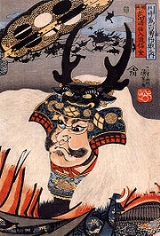
Takeda Shingen

Encyclopedia
Kai Province
, also known as , is an old province in Japan in the area of Yamanashi Prefecture. It lies in central Honshū, west of Tokyo, in a landlocked mountainous region that includes Mount Fuji along its border with Shizuoka Prefecture....
, was a preeminent daimyo
Daimyo
is a generic term referring to the powerful territorial lords in pre-modern Japan who ruled most of the country from their vast, hereditary land holdings...
in feudal Japan with exceptional military prestige in the late stage of the Sengoku period
Sengoku period
The or Warring States period in Japanese history was a time of social upheaval, political intrigue, and nearly constant military conflict that lasted roughly from the middle of the 15th century to the beginning of the 17th century. The name "Sengoku" was adopted by Japanese historians in reference...
.
Name
Shingen was called "Tarō" (a commonly used pet name for the eldest son of a Japanese family) or "Katsuchiyo" (勝千代) during his childhood. When he celebrated his coming of age, he was given a formal name of "Harunobu" (晴信), which included a character from the name of Ashikaga YoshiharuAshikaga Yoshiharu
was the 12th shogun of the Ashikaga shogunate who held the reins of supreme power from 1521 through 1546 during the late Muromachi period of Japan...
(足利義晴), the 12th Ashikaga Shogun
Shogun
A was one of the hereditary military dictators of Japan from 1192 to 1867. In this period, the shoguns, or their shikken regents , were the de facto rulers of Japan though they were nominally appointed by the emperor...
. It was a common practice in feudal Japan for a higher-ranked warrior
Samurai
is the term for the military nobility of pre-industrial Japan. According to translator William Scott Wilson: "In Chinese, the character 侍 was originally a verb meaning to wait upon or accompany a person in the upper ranks of society, and this is also true of the original term in Japanese, saburau...
to bestow a character from his own name to his inferiors as a symbol of recognition. From the local warlord
Warlord
A warlord is a person with power who has both military and civil control over a subnational area due to armed forces loyal to the warlord and not to a central authority. The term can also mean one who espouses the ideal that war is necessary, and has the means and authority to engage in war...
's perspective, it was glorious to receive a character from the shogunate, although the authority of the latter had greatly degenerated in the mid-16th century.
Both the Ashikaga and the Takeda clans descended from the noble Minamoto (源) clan. Technically, Harunobu, as well as his forefathers, had borne the surname of Minamoto. Therefore, Harunobu would be referred to as "Minamoto-no Harunobu" (源晴信) in official records kept by the Imperial Court
Imperial House of Japan
The , also referred to as the Imperial Family or the Yamato Dynasty, comprises those members of the extended family of the reigning Emperor of Japan who undertake official and public duties. Under the present Constitution of Japan, the emperor is the symbol of the state and unity of the people...
when he was conferred the official title of "Daizen Dayu" (大膳大夫). The Imperial Court had maintained a system of ritsuryō
Ritsuryo
is the historical law system based on the philosophies of Confucianism and Chinese Legalism in Japan. The political system in accord to Ritsuryō is called "Ritsuryō-sei"...
(律令) that was parallel to the shogunate apparatus.
In 1559 Harunobu chose to live a pabbajja
Pabbajja
Pabbajja literally means "to go forth" and refers to when a layperson leaves home to live the life of a Buddhist renunciate among a community of monks . This generally involves preliminary ordination as a novice...
life and received a dharma name
Dharma name
A Dharma name is a new name acquired during a Buddhist initiation ritual in Mahayana Buddhism and monk ordination in Theravada Buddhism. The name is traditionally given by a Buddhist monastic, but is also given to newly ordained monks, nuns and laity....
, Shingen (信玄), from his Buddhist
Buddhism
Buddhism is a religion and philosophy encompassing a variety of traditions, beliefs and practices, largely based on teachings attributed to Siddhartha Gautama, commonly known as the Buddha . The Buddha lived and taught in the northeastern Indian subcontinent some time between the 6th and 4th...
master. The kanji
Kanji
Kanji are the adopted logographic Chinese characters hanzi that are used in the modern Japanese writing system along with hiragana , katakana , Indo Arabic numerals, and the occasional use of the Latin alphabet...
of "Shingen" can also be pronounced as "Nobuharu," which is the inversion of his official name, Harunobu. In ancient times, such stylish/religious names of recognized Japanese aristocrats
Aristocracy
Aristocracy , is a form of government in which a few elite citizens rule. The term derives from the Greek aristokratia, meaning "rule of the best". In origin in Ancient Greece, it was conceived of as rule by the best qualified citizens, and contrasted with monarchy...
/warriors/officials would be read in "on'yomi" (音読み), the Chinese
Chinese language
The Chinese language is a language or language family consisting of varieties which are mutually intelligible to varying degrees. Originally the indigenous languages spoken by the Han Chinese in China, it forms one of the branches of Sino-Tibetan family of languages...
-styled pronunciation, instead of "kun'yomi" (訓読み), the indigenous Japanese
Japanese language
is a language spoken by over 130 million people in Japan and in Japanese emigrant communities. It is a member of the Japonic language family, which has a number of proposed relationships with other languages, none of which has gained wide acceptance among historical linguists .Japanese is an...
pronunciation. Although widely known by the dharma name, Takeda Shingen's formal name remained "Harunobu" throughout the rest of his life.
Shingen is sometimes referred to as "The Tiger of Kai
Kai Province
, also known as , is an old province in Japan in the area of Yamanashi Prefecture. It lies in central Honshū, west of Tokyo, in a landlocked mountainous region that includes Mount Fuji along its border with Shizuoka Prefecture....
" (甲斐の虎) for his martial prowess on the battlefield. His primary rival, Uesugi Kenshin
Uesugi Kenshin
was a daimyo who ruled Echigo province in the Sengoku period of Japan.He was one of the most powerful lords of the Sengoku period. While chiefly remembered for his prowess on the battlefield, Kenshin is also regarded as an extremely skillful administrator who fostered the growth of local industries...
(上杉謙信), was often called "The Dragon of Echigo
Echigo Province
was an old province in north-central Japan, on the shores of the Sea of Japan. It was sometimes called , with Echizen and Etchū Provinces. Today the area is part of Niigata Prefecture, which also includes the island which was the old Sado Province. This province was the northernmost part of the...
" (越後の龍) or also "The Tiger of Echigo" (越後の虎).
Early life
Takeda Shingen was the first born son of Takeda NobutoraTakeda Nobutora
was a Japanese daimyo who controlled the Province of Kai, and fought in a number of battles of the Sengoku period. He was the father of the famous Takeda Shingen, who was originally named Harunobu, along with two other sons, Nobushige and Nobukado.Nobutora fought Hiraga Genshin at the Battle of...
(武田信虎), leader of the Takeda clan
Takeda family
The ' was a famous clan of daimyō in Japan's late Heian Period to Sengoku period.The Takeda were descendants of Emperor Seiwa and are a branch of the Minamoto clan , by Minamoto no Yoshimitsu , brother to the Chinjufu-shogun Minamoto no Yoshiie...
, and daimyo
Daimyo
is a generic term referring to the powerful territorial lords in pre-modern Japan who ruled most of the country from their vast, hereditary land holdings...
of the province of Kai
Kai Province
, also known as , is an old province in Japan in the area of Yamanashi Prefecture. It lies in central Honshū, west of Tokyo, in a landlocked mountainous region that includes Mount Fuji along its border with Shizuoka Prefecture....
. He had been an accomplished poet in his youth. He assisted his father with the older relatives and vassals of the Takeda family, and became quite a valuable addition to the clan at a fairly young age. But at some point in his life after his "coming of age" ceremony, the young man decided to rebel against his father.
He finally succeeded at the age of 21, successfully taking control of the clan. Events regarding this change of leadership are not entirely clear, but it is thought that his father had planned to name the second son, Takeda Nobushige
Takeda Nobushige
was a samurai of Japan's Sengoku period, and younger brother of Takeda Shingen. Takeda Nobushige held the favor of their father, and was meant to inherit the Takeda lands, wealth and power, becoming head of the clan. However, Shingen rebelled against their father and seized the lands and power for...
, as his heir instead of Shingen. The end result for the father was a miserable retirement that was forced upon him by his son and his supporters: he was sent to Suruga Province
Suruga Province
was an old province in the area that is today the central part of Shizuoka prefecture. It was sometimes called . Suruga bordered on Izu, Kai, Sagami, Shinano, and Tōtōmi provinces; and had access to the Pacific Ocean through Suruga Bay.-History:...
(駿河) (on the southern border of Kai) to be kept in custody under the scrutiny of the Imagawa clan
Imagawa clan
The was a Japanese clan that claimed descent from Emperor Seiwa . It was a branch of the Minamoto clan by the Ashikaga clan.-Origins:Ashikaga Kuniuji, grandson of Ashikaga Yoshiuji, established himself in the 13th century at Imagawa and took its name.Imagawa Norikuni received from his cousin the...
, led by Imagawa Yoshimoto
Imagawa Yoshimoto
was one of the leading daimyo in the Sengoku period Japan. Based in Suruga Province, he was one of the three daimyo that dominated the Tōkaidō region. He was one of the dominant daimyo in Japan for a time, until his death in 1560....
(今川義元), the daimyo of Suruga. For their help in this bloodless coup, an alliance was formed between the Imagawa and the Takeda clans.
Initial expansion
Shingen's first act was to gain a hold of the area around him. His goal was to conquer Shinano ProvinceShinano Province
or is an old province of Japan that is now present day Nagano Prefecture.Shinano bordered on Echigo, Etchū, Hida, Kai, Kōzuke, Mikawa, Mino, Musashi, Suruga, and Tōtōmi Provinces...
(信州). A number of the major daimyos in the Shinano region marched on the border of Kai Province
Kai Province
, also known as , is an old province in Japan in the area of Yamanashi Prefecture. It lies in central Honshū, west of Tokyo, in a landlocked mountainous region that includes Mount Fuji along its border with Shizuoka Prefecture....
, hoping to neutralize the power of the still-young Shingen before he had a chance to expand into their lands. However, planning to beat him down at Fuchu (where word had it Shingen was gathering his forces for a stand), they were unprepared when Takeda forces suddenly came down upon them at the battle of Sezawa
Battle of Sezawa
The battle of Sezawa was one of many battles fought by Takeda Shingen in his bid to take control of Shinano Province. Here he was opposed by the combined forces of Ogasawara Nagatoki, Suwa Yorishige, Murakami Yoshikiyo, Kiso Yoshiyasu, and Tozawa Yorichika. They gathered a force of 12000 Shinano...
. Taking advantage of their confusion, Shingen was able to score a quick victory, which set the stage for his drive into Shinano lands that same year. The young warlord made considerable advances into the region, conquering the Suwa headquarters in the siege of Kuwabara
Siege of Kuwabara
The siege of Kuwabara took place the day after the siege of Uehara; Takeda Shingen continued to gain power in Shinano Province by seizing Kuwabara castle from Suwa Yorishige. Suwa was escorted back to the provincial capital of Kōfu under the pretext of safe conduct, but he was then forced to commit...
before moving into central Shinano with the defeat of both Tozawa Yorichika and Takato Yoritsugu. However, the warlord was checked at Uetahara by Murakami Yoshikiyo
Murakami Yoshikiyo
Murakami Yoshikiyo a retainer of the Japanese clan of Uesugi during the Sengoku Period of the 16th century. Yoshikiyo followed in fighting against both Takeda Nobutora and his son Takeda Shingen. Yoshikiyo was also a very close ally under Uesugi Kenshin.He fought at the Battles of Kawanakajima in...
, losing two of his generals in a heated battle which Murakami won. Shingen managed to avenge this loss and the Murakami clan was eventually defeated. Murakami fled the region, eventually coming to plead for help from the Province of Echigo
Echigo Province
was an old province in north-central Japan, on the shores of the Sea of Japan. It was sometimes called , with Echizen and Etchū Provinces. Today the area is part of Niigata Prefecture, which also includes the island which was the old Sado Province. This province was the northernmost part of the...
(越後).
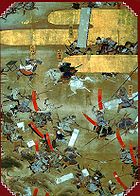
Battles of Kawanakajima
The ' were fought in the Sengoku Period of Japan between Takeda Shingen of Kai Province and Uesugi Kenshin of Echigo Province in the plain of Kawanakajima, in the north of Shinano Province. The location is in the southern part of the present-day city of Nagano.The five major battles took place in...
. These battles were generally confined to controlled skirmishes, neither daimyo willing to devote himself entirely to a single all-out attempt. The conflict between the two that had the fiercest fighting, and might have decided victory or defeat for one side or the other, was the fourth battle, during which the famous tale arose of Uesugi Kenshin
Uesugi Kenshin
was a daimyo who ruled Echigo province in the Sengoku period of Japan.He was one of the most powerful lords of the Sengoku period. While chiefly remembered for his prowess on the battlefield, Kenshin is also regarded as an extremely skillful administrator who fostered the growth of local industries...
's forces clearing a path through the Takeda troops and Kenshin engaging Shingen in single combat. The tale has Kenshin attacking Shingen with his sword while Shingen defends with his iron war fan or tessen. Both lords lost many men in this fight, and Shingen in particular lost two of his main generals, Yamamoto Kansuke
Yamamoto Kansuke
was a Japanese samurai of the 16th century who was one of Takeda Shingen's most trusted Twenty-Four Generals. Also known by his formal name, Haruyuki . He was a brilliant strategist, and is particularly known for his plan which led to victory in the fourth battle of Kawanakajima against Uesugi...
and his younger brother Takeda Nobushige
Takeda Nobushige
was a samurai of Japan's Sengoku period, and younger brother of Takeda Shingen. Takeda Nobushige held the favor of their father, and was meant to inherit the Takeda lands, wealth and power, becoming head of the clan. However, Shingen rebelled against their father and seized the lands and power for...
.
After the fourth battle of Kawanakajima, Takeda clan suffered two internal setbacks. Shingen uncovered two plots on his life, the first from his cousin Katanuma Nobumoto (whom he ordered to commit seppuku
Seppuku
is a form of Japanese ritual suicide by disembowelment. Seppuku was originally reserved only for samurai. Part of the samurai bushido honor code, seppuku was either used voluntarily by samurai to die with honor rather than fall into the hands of their enemies , or as a form of capital punishment...
), and the second, a few years later, from his own son Takeda Yoshinobu
Takeda Yoshinobu
was a Japanese daimyo of the Sengoku period. Born Takeda Tarō , he was the son of Takeda Shingen, by Shingen's wife,. He came of age in 1550, and took the formal name of Yoshinobu, receiving the "yoshi" from the 13th Ashikaga shogun, Ashikaga Yoshiteru. In 1552, to further Takeda-Imagawa ties, he...
(武田義信). His son was confined to the Tokoji, where he died two years later; it is not known whether his death was natural or ordered by his father. After this incident, Shingen designated his fourth son, Takeda Katsuyori
Takeda Katsuyori
was a Japanese daimyo of the Sengoku Period, who was famed as the head of the Takeda clan and the successor to the legendary warlord Takeda Shingen. He was the son of Shingen by the , the daughter of Suwa Yorishige...
(武田勝頼), as the acting leader of the clan after himself until Katsuyori's son came of age. Katsuyori himself, however, never became the formal head of the clan.
The death of Yoshinobu is believed to have much to do with the change in Shingen's Imagawa policy. After Imagawa Yoshimoto's death in a battle against Oda Nobunaga
Oda Nobunaga
was the initiator of the unification of Japan under the shogunate in the late 16th century, which ruled Japan until the Meiji Restoration in 1868. He was also a major daimyo during the Sengoku period of Japanese history. His opus was continued, completed and finalized by his successors Toyotomi...
(織田信長) in 1560, Shingen had started to plan an invasion of Suruga
Suruga Province
was an old province in the area that is today the central part of Shizuoka prefecture. It was sometimes called . Suruga bordered on Izu, Kai, Sagami, Shinano, and Tōtōmi provinces; and had access to the Pacific Ocean through Suruga Bay.-History:...
, a territory now controlled by Yoshimoto's son Ujizane
Imagawa Ujizane
was a Japanese daimyo who lived from the mid-Sengoku through early Edo periods. He was the son of Imagawa Yoshimoto, and the father of Imagawa Norimochi and Shinagawa Takahisa.-Early life:Ujizane was born in Sunpu; he was the eldest son of Imagawa Yoshimoto...
. Yoshinobu, however, had strongly opposed such a plan because his wife was the daughter of late Yoshimoto. By 1567, nonetheless, after Shingen had successfully kept the forces led by Uesugi Kenshin
Uesugi Kenshin
was a daimyo who ruled Echigo province in the Sengoku period of Japan.He was one of the most powerful lords of the Sengoku period. While chiefly remembered for his prowess on the battlefield, Kenshin is also regarded as an extremely skillful administrator who fostered the growth of local industries...
out of the northern boundaries of Shinano
Shinano Province
or is an old province of Japan that is now present day Nagano Prefecture.Shinano bordered on Echigo, Etchū, Hida, Kai, Kōzuke, Mikawa, Mino, Musashi, Suruga, and Tōtōmi Provinces...
, taken over a strategically important castle in western Kōzuke
Kozuke Province
was an old province located in the Tōsandō of Japan, which today comprises Gunma Prefecture. It is nicknamed as or .The ancient provincial capital was near modern Maebashi. During the Sengoku period, Kōzuke was controlled variously by Takeda Shingen, Uesugi Kenshin, the late Hōjō clan, and...
, and suppressed internal objection to his plans to take advantage of the weakened Imagawa clan, he was ready to carry out his planned Suruga invasion.
During this time Shingen also ordered the damming project of the Fuji River
Fuji River
The is a river in Yamanashi and Shizuoka Prefectures of central Japan. It is long and has a watershed of . With the Mogami River and the Kuma River, it is regarded as one of the three most rapid flows of Japan....
, which was one of the major domestic activities of the time.
Shingen and Tokugawa Ieyasu
Tokugawa Ieyasu
was the founder and first shogun of the Tokugawa shogunate of Japan , which ruled from the Battle of Sekigahara in 1600 until the Meiji Restoration in 1868. Ieyasu seized power in 1600, received appointment as shogun in 1603, abdicated from office in 1605, but...
(徳川家康) are believed to have made a pact to share the remaining Imagawa lands between them, and they both fought against Yoshimoto's heir. After defeating the intervention forces commanded by Hōjō Ujimasa
Hojo Ujimasa
was the fourth head of the late Hōjō clan, and daimyo of Odawara.Ujimasa commanded in many battles, consolidating his clan's position, and retired in 1590. His son Hōjō Ujinao became head of the clan and lord of Odawara, but later that year they failed to hold Odawara against the forces of Toyotomi...
(北條氏政) of Sagami
Sagami Province
was an old province in the area that is today the central and western Kanagawa prefecture. It was sometimes called . Sagami bordered on Izu, Musashi, Suruga provinces; and had access to the Pacific Ocean through Sagami Bay...
, Shingen finally secured the Province of Suruga
Suruga Province
was an old province in the area that is today the central part of Shizuoka prefecture. It was sometimes called . Suruga bordered on Izu, Kai, Sagami, Shinano, and Tōtōmi provinces; and had access to the Pacific Ocean through Suruga Bay.-History:...
, formerly base of the prestigious Imagawa clan, as a Takeda asset in 1569.
Upon securing Takeda control over Suruga, northern Shinano, and western Kōzuke, Shingen moved to challenge the Oda-Tokugawa alliance, leading a formidable force of over 30,000 into the latter's territories in Tōtōmi
Totomi Province
was a province of Japan in the area of Japan that is today western Shizuoka Prefecture. Tōtōmi bordered on Mikawa, Suruga and Shinano Provinces. Its abbreviated form name was .-History:...
, Mikawa
Mikawa Province
is an old province in the area that today forms the eastern half of Aichi Prefecture. It was sometimes called . Mikawa bordered on Owari, Mino, Shinano, and Tōtōmi Provinces....
and Mino
Mino Province
, one of the old provinces of Japan, encompassed part of modern-day Gifu Prefecture. It was sometimes called . Mino Province bordered Echizen, Hida, Ise, Mikawa, Ōmi, Owari, and Shinano Provinces....
Provinces in 1572.
Death
The exact circumstances surrounding Takeda Shingen's death are not absolutely known. There are many different stories, some of which are as follows.When Takeda Shingen was 49 years old, he was the only daimyo with the necessary power and tactical skill to stop Oda Nobunaga
Oda Nobunaga
was the initiator of the unification of Japan under the shogunate in the late 16th century, which ruled Japan until the Meiji Restoration in 1868. He was also a major daimyo during the Sengoku period of Japanese history. His opus was continued, completed and finalized by his successors Toyotomi...
's rush to rule Japan
Japan
Japan is an island nation in East Asia. Located in the Pacific Ocean, it lies to the east of the Sea of Japan, China, North Korea, South Korea and Russia, stretching from the Sea of Okhotsk in the north to the East China Sea and Taiwan in the south...
. He engaged Tokugawa Ieyasu
Tokugawa Ieyasu
was the founder and first shogun of the Tokugawa shogunate of Japan , which ruled from the Battle of Sekigahara in 1600 until the Meiji Restoration in 1868. Ieyasu seized power in 1600, received appointment as shogun in 1603, abdicated from office in 1605, but...
's forces in 1572 and captured Futamata, and in January engaged in the battle of Mikatagahara
Battle of Mikatagahara
The ' was one of the most famous battles of Takeda Shingen's campaigns, and one of the best demonstrations of his cavalry-based tactics.-Background:...
, where he defeated, but not decisively, a small combined army of Nobunaga and Ieyasu. After defeating Tokugawa Ieyasu, Shingen stopped his advance temporarily due to outside influences, which allowed Tokugawa to prepare for battle again. He entered Mikawa Province, but soon died in the camp. Some accounts say he succumbed to an old war wound, some say a sniper wounded him earlier, and some accounts say he died of pneumonia. He was buried at Erin temple
Temple
A temple is a structure reserved for religious or spiritual activities, such as prayer and sacrifice, or analogous rites. A templum constituted a sacred precinct as defined by a priest, or augur. It has the same root as the word "template," a plan in preparation of the building that was marked out...
in what is now Kōshū, Yamanashi
Koshu, Yamanashi
is a city located in Yamanashi Prefecture, Japan.The city was founded on November 1, 2005, when the city of Enzan was merged with the town of Katsunuma, and the village of Yamato, both from Higashiyamanashi District, to form the new city of Kōshū....
.
The film Kagemusha
Kagemusha
is a 1980 film by Akira Kurosawa. The title is a term used for an impersonator. It is set in the Warring States era of Japanese history and tells the story of a lower-class criminal who is taught to impersonate a dying warlord in order to dissuade opposing lords from attacking the newly vulnerable...
, by director Akira Kurosawa, loosely depicts a well-known version of his death in which a single sniper shot him at night. The other aspects of his death depicted in the film were artistic liberties taken by the director.
After death
Takeda KatsuyoriTakeda Katsuyori
was a Japanese daimyo of the Sengoku Period, who was famed as the head of the Takeda clan and the successor to the legendary warlord Takeda Shingen. He was the son of Shingen by the , the daughter of Suwa Yorishige...
became the daimyo of the Takeda clan. Katsuyori was ambitious and desired to continue the legacy of his father. He moved on to take Tokugawa forts. However an allied force of Tokugawa Ieyasu and Oda Nobunaga dealt a crushing blow to the Takeda in the Battle of Nagashino
Battle of Nagashino
The ' took place in 1575 near Nagashino Castle on the plain of Shitaragahara in the Mikawa province of Japan. Forces under Takeda Katsuyori had besieged the castle since the 17th of June; Okudaira Sadamasa , a Tokugawa vassal, commanded the defending force...
. Here Oda Nobunaga's matchlock
Matchlock
The matchlock was the first mechanism, or "lock" invented to facilitate the firing of a hand-held firearm. This design removed the need to lower by hand a lit match into the weapon's flash pan and made it possible to have both hands free to keep a firm grip on the weapon at the moment of firing,...
-armed infantry destroyed the Takeda cavalry. Ieyasu seized the opportunity and defeated the weak Takeda led by Takeda Katsuyori
Takeda Katsuyori
was a Japanese daimyo of the Sengoku Period, who was famed as the head of the Takeda clan and the successor to the legendary warlord Takeda Shingen. He was the son of Shingen by the , the daughter of Suwa Yorishige...
in the battle of Temmokuzan
Battle of Temmokuzan
The 1582 in Japan, also known as the Battle of Toriibata, is regarded as the last stand of the Takeda family. This was the final attempt by Takeda Katsuyori to resist the combined forces of Tokugawa Ieyasu and Oda Nobunaga, who had been campaigning against him for some time.In his bid to hide from...
. Katsuyori committed suicide after the battle, and the Takeda clan never recovered.
Upon Shingen's death, Kenshin reportedly cried at the loss of one of his strongest and most deeply respected rivals. One of the most lasting tributes to Shingen's prowess was that of Tokugawa Ieyasu
Tokugawa Ieyasu
was the founder and first shogun of the Tokugawa shogunate of Japan , which ruled from the Battle of Sekigahara in 1600 until the Meiji Restoration in 1868. Ieyasu seized power in 1600, received appointment as shogun in 1603, abdicated from office in 1605, but...
himself, who is known to have borrowed heavily from the old Takeda leader's governmental and military innovations after he had taken leadership of Kai during Toyotomi Hideyoshi
Toyotomi Hideyoshi
was a daimyo warrior, general and politician of the Sengoku period. He unified the political factions of Japan. He succeeded his former liege lord, Oda Nobunaga, and brought an end to the Sengoku period. The period of his rule is often called the Momoyama period, named after Hideyoshi's castle...
's rise to power. Many of these designs were put to use in the Tokugawa Shogunate
Tokugawa shogunate
The Tokugawa shogunate, also known as the and the , was a feudal regime of Japan established by Tokugawa Ieyasu and ruled by the shoguns of the Tokugawa family. This period is known as the Edo period and gets its name from the capital city, Edo, which is now called Tokyo, after the name was...
.
While the Takeda were for the most part destroyed by the loss of Shingen's heir, Katsuyori, Shingen had a profound effect on the period in Japan. He influenced many lords with his law, tax, and administration systems, and many tales were told about him. Although aggressive towards military enemies he was probably not as cruel as other warlords. His war banner contained the famous phrase , taken from Sun Tzu
Sun Tzu
Sun Wu , style name Changqing , better known as Sun Tzu or Sunzi , was an ancient Chinese military general, strategist and philosopher who is traditionally believed, and who is most likely, to have authored The Art of War, an influential ancient Chinese book on military strategy...
's 'The Art of War
The Art of War
The Art of War is an ancient Chinese military treatise that is attributed to Sun Tzu , a high ranking military general and strategist during the late Spring and Autumn period...
.' This phrase refers to the idea of Swift as the Wind, Silent as a Forest, Fierce as Fire and Immovable as a Mountain. The motto applied to Shingen's policies and his military strategy.
Retainers
During the Edo periodEdo period
The , or , is a division of Japanese history which was ruled by the shoguns of the Tokugawa family, running from 1603 to 1868. The political entity of this period was the Tokugawa shogunate....
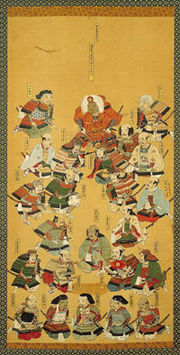
, 24 retainers who served under Shingen were chosen as a popular topic for Ukiyo-e
Ukiyo-e
' is a genre of Japanese woodblock prints and paintings produced between the 17th and the 20th centuries, featuring motifs of landscapes, tales from history, the theatre, and pleasure quarters...
and Bunraku
Bunraku
, also known as Ningyō jōruri , is a form of traditional Japanese puppet theater, founded in Osaka in 1684.Three kinds of performers take part in a bunraku performance:* Ningyōtsukai or Ningyōzukai—puppeteers* Tayū—the chanters* Shamisen players...
. The names vary from work to work and the following list is the widely agreed version of retainers. They had not worked together, as some had died before others served, but they were noted for their exceptional contributions to Shingen and the Takeda family
Takeda family
The ' was a famous clan of daimyō in Japan's late Heian Period to Sengoku period.The Takeda were descendants of Emperor Seiwa and are a branch of the Minamoto clan , by Minamoto no Yoshimitsu , brother to the Chinjufu-shogun Minamoto no Yoshiie...
.
Kosaka Masanobu
also known as was one of Takeda Shingen's most loyal retainers, and one of his "Twenty-Four Generals" during the Sengoku period of Japan. He is often credited as the original author of Kōyō Gunkan, which records the history of the Takeda family and their military tactics...
stands out as being one of Shingen's better known beloveds, in the style of the Japanese shudo tradition. The two entered into the relationship when Shingen was 22 and Masanobu 16. The love pact signed by the two, in Tokyo University's Historical Archive, documents Shingen's pledge that he was not involved in, nor had any intentions of entering into, a sexual relationship with a certain other retainer, and asserts that "since I want to be intimate with you" he will in no way harm the boy, and calls upon the gods to be his guarantors. (Leupp, pp. 53–54)
Twenty-Four Generals of Takeda Shingen
Twenty-Four Generals of Takeda Shingen
The Twenty-Four Generals were just one of many historically famous groupings of battle commanders from Japan's Sengoku Period. These Twenty-Four were the most trusted commanders of the armies of Takeda Shingen...
- Akiyama NobutomoAkiyama Nobutomowas a samurai during the Age of Warring States in Japan. He was a retainer in the service of the Takeda family who served as one of the Twenty-Four Generals of Takeda Shingen. Nobutomo also served under Shingen's son, Takeda Katsuyori.-Early career:...
- Amari TorayasuAmari Torayasuwas a Japanese samurai of the Sengoku period, and served the Takeda clan under Takeda Nobutora and Shingen. Amari was a shukurō, or clan elder, following Shingen's accession to family headship and was one of Takeda Shingen's twenty-four generals. He was killed in action at the battle of Uedahara in...
- Anayama NobukimiAnayama Nobukimi, also known as Baisetsu Nobukimi, was a Japanese samurai. He was the son of Anayama Nobutomo and a nephew of Takeda Shingen. He became famous as one the Twenty-Four Generals of Takeda Shingen....
- Baba NobuharuBaba Nobuharu, also known as ', was a samurai of Japan's Sengoku period and one of Takeda Shingen's so-called "Twenty-Four Generals"; they were his most trusted commanders. Baba fought at the battles of Mikatagahara and Nagashino, where he led the vanguard of Takeda Katsuyori's right-wing.When Takeda Shingen...
- Hara MasataneHara Masatanewas a senior retainer of the Takeda clan during the late Sengoku period of Japanese history. Masatane was a relative of Hara Toratane, though from a different branch of the family, and was also a skilled commander. He was present at the Battle of Mimasetoge and was killed in the forefront of the...
- Hara TorataneHara Toratane' was a senior retainer of the Takeda clan during the late Sengoku period of Japanese history. He is known for being one of the Twenty-Four Generals of Takeda Shingen....
- Ichijō NobutatsuIchijo Nobutatsuwas a Japanese samurai of the Sengoku period, who was the younger brother of Takeda Shingen, the ruler of Kai Province. He is known for being one of the Twenty-Four Generals of Takeda Shingen....
- Itagaki NobukataItagaki Nobukatawas a retainer of the Takeda family. His name is also seen with different kanji as 信形.Nobukata served under both Takeda Nobutora and Takeda Shingen and also was tasked with young Shingen...
- Kōsaka MasanobuKosaka Masanobualso known as was one of Takeda Shingen's most loyal retainers, and one of his "Twenty-Four Generals" during the Sengoku period of Japan. He is often credited as the original author of Kōyō Gunkan, which records the history of the Takeda family and their military tactics...
- Naitō MasatoyoNaito Masatoyo' also known as was a Japanese samurai of the Sengoku period. As one of Takeda Shingen's most reliable generals, he fought in many of the Takeda clan's battles. Masatoyo was the second son of Takeda Nobutora's senior retainer, Kudō Toratoyo. He was first called Kudō Sukenaga...
- Obata MasamoriObata MasamoriObata Masamori , also known as Obata Nobusada, was one of Takeda Shingen's 'Twenty-four Generals', his most trusted commanders. He was the son of Obata Toramori, and came from western Kozuke province. He fled Kozuke and joined the Takeda around 1560...
- Obata ToramoriObata Toramoriwas a retainer of the Takeda clan throughout the latter Sengoku Period of Feudal Japan. He was one of Takeda Shingen's 'Twenty-four Generals', his most trusted commanders. He was the father of Obata Masamori.-References:...
- Obu ToramasaObu Toramasa, known as the "Wild Tiger of Kai", was a Japanese samurai of the Sengoku period, who served the Takeda clan. He was the tutor of Takeda Shingen's younger brother Takeda Nobushige. He later betrayed Shingen with Shingen's eldest child, the rebellious Takeda Yoshinobu. A historically accurate...
- Ohama KagetakaOhama Kagetakawas a Japanese pirate during the latter part of the Sengoku period and the Azuchi-Momoyama period of Japan. He operated in the Shima Province area , later becoming a general leading naval forces for both Takeda Shingen and Tokugawa Ieyasu before his death in 1597 at the age of 58.-History:Ohama...
- Oyamada NobushigeOyamada Nobushigewas a Japanese samurai general in the Takeda army under Takeda Shingen, and later under Takeda Katsuyori. He was considered one of the "Twenty-Four Generals of Takeda Shingen", the clan's greatest commanders...
- Saigusa Moritomo
- Sanada NobutsunaSanada Nobutsunawas a 16th century Japanese samurai who served the Takeda clan. He was born in Matsuo castle and was the eldest son of Sanada Yukitaka, a castle lord in Shinano Province who, by the time of his son's coming-of-age, had pledged his loyalty to the Takeda...
- Sanada YukitakaSanada Yukitakawas a daimyō of Shinano Province who became one of Takeda Shingen's 'Twenty-four Generals' , submitting to become Takeda's vassal after a long and difficult struggle against him....
- Tada MitsuyoriTada Mitsuyoriwas a Japanese Sengoku period samurai. He first served under the daimyo Takeda Nobutora, but later on served under Takeda Shingen, Nobutora's son. Mitsuyori was a native of the Mino Province....
- Tsuchiya MasatsuguTsuchiya Masatsuguwas a senior retainer beneath the clan of Takeda throughout the late Sengoku period of Feudal Japan....
- Takeda NobukadoTakeda Nobukadowas a samurai commander of the late Sengoku period of Japanese history. He was a brother of Takeda Shingen, and one of his 'Twenty-Four Generals'. Nobukado commanded the Takeda central company in the Battle of Nagashino, as an adviser under Katsuyori....
- Takeda NobushigeTakeda Nobushigewas a samurai of Japan's Sengoku period, and younger brother of Takeda Shingen. Takeda Nobushige held the favor of their father, and was meant to inherit the Takeda lands, wealth and power, becoming head of the clan. However, Shingen rebelled against their father and seized the lands and power for...
- Yamagata MasakageYamagata Masakagewas one of the 24 generals of the Takeda clan. He was famous for his red armour and skill in battlefield, and was a personal friend of Takeda Shingen. He was the younger brother of Obu Toramasa who was also a retainer of Shingen leading the famous "red fire unit"...
- Yamamoto KansukeYamamoto Kansukewas a Japanese samurai of the 16th century who was one of Takeda Shingen's most trusted Twenty-Four Generals. Also known by his formal name, Haruyuki . He was a brilliant strategist, and is particularly known for his plan which led to victory in the fourth battle of Kawanakajima against Uesugi...
Other Generals
- Sanada MasayukiSanada Masayukiwas a Japanese Sengoku period daimyo. He was the third son of Sanada Yukitaka, a vassal daimyo to the Takeda family in Shinano province. He is known as a master strategist. Sanada Nobuyuki and Sanada Yukimura were his sons.-Biography:...
- Yokota TakatoshiYokota Takatoshiwas a Japanese samurai of the Sengoku period who served the Takeda clan. During the siege of Toishi castle he suffered many wounds and was killed in battle.- References :* Stephen Turnbull. Ashigaru 1467-1649....
- Kiso YoshimasaKiso Yoshimasawas a retainer beneath the Takeda clan of Kai Province during the latter Sengoku period of Feudal Japan....
Takeda Shingen Festival
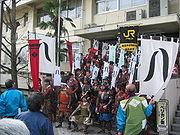
Takeda Shrine
is a Shinto shrine located in Kōfu, Yamanashi Prefecture, Japan, and houses the kami of Takeda Shingen.-History:After the end of the Meiji Restoration, a push began to honor the loyalists who had served during the time. Also, with the completion of the Russo-Japanese War, a shrine was needed to...
and Kofu Castle
Maizuru Castle Park
Maizuru Castle Park is a park and historical site in Kofu, Yamanashi, Japan. It contains the ruins of Kōfu Castle , also called Maizuru Castle, which is about 400 years old and has been designated as a Yamanashi Historical Site...
. These parades are very theatrical involving serious re-enactors who practice the rest of the year for this one weekend in April. The parades reflect the different comings and goings of Takeda Shingen during his life.
In popular culture
Takeda Shingen's death is fictionalized in Akira KurosawaAkira Kurosawa
was a Japanese film director, producer, screenwriter and editor. Regarded as one of the most important and influential filmmakers in the history of cinema, Kurosawa directed 30 filmsIn 1946, Kurosawa co-directed, with Hideo Sekigawa and Kajiro Yamamoto, the feature Those Who Make Tomorrow ;...
's film Kagemusha
Kagemusha
is a 1980 film by Akira Kurosawa. The title is a term used for an impersonator. It is set in the Warring States era of Japanese history and tells the story of a lower-class criminal who is taught to impersonate a dying warlord in order to dissuade opposing lords from attacking the newly vulnerable...
.
Shingen the Ruler
Shingen the Ruler
is a turn-based strategy game for the Nintendo Entertainment System , produced by HOT・B in 1989, and released in North America in 1990. The original Takeda Shingen video game was never released in North America. This game was called Takeda Shingen 2 in Japan.-Summary:left|thumb|A typical screen in...
(Takeda Shingen 2 in Japan) is a turn-based strategy game for the Nintendo Entertainment System (NES), produced by Hot B in 1989, and released in North America in 1990. The Takeda Clan is a faction in Sega's
Sega
, usually styled as SEGA, is a multinational video game software developer and an arcade software and hardware development company headquartered in Ōta, Tokyo, Japan, with various offices around the world...
Total War: Shogun 2.
Takeda Shingen
Takeda Shingen
, of Kai Province, was a preeminent daimyo in feudal Japan with exceptional military prestige in the late stage of the Sengoku period.-Name:Shingen was called "Tarō" or "Katsuchiyo" during his childhood...
has appeared in the highly popular Samurai Warriors
Samurai Warriors
is the first title in the series of video games created by Koei's Omega Force team based loosely around the Sengoku period of Japanese history and it is a spinoff of the Dynasty Warriors series...
and Sengoku Basara
Sengoku Basara
is a series of video games developed and published by Capcom, as well as a bigger media franchise based on it, including two anime series and an animated film...
video game franchises, and in the anime Sengoku Basara: Samurai Kings. He is also referenced in the Japanese anime
Anime
is the Japanese abbreviated pronunciation of "animation". The definition sometimes changes depending on the context. In English-speaking countries, the term most commonly refers to Japanese animated cartoons....
Mirage of Blaze
Mirage of Blaze
is a shōnen-ai light novel series by Mizuna Kuwabara, which are published under Shueisha's Cobalt label. It was adapted into a TV anime series directed by Susumu Kudo in 2002 and an OVA in 2004....
.
One of his notable descendants is video game music composer Ryu Umemoto
Ryu Umemoto
Ryu Umemoto was a Japanese video game music composer, born in Yokohama, Kanagawa Prefecture. He is known for composing soundtracks to various visual novel and shoot 'em up games since the 1990s, for several companies including FamilySoft, C's Ware, ELF Corporation, D4 Enterprise, and Cave...
(1974-2011).
External links
- Samurai archives- Takeda Shingen
- Suwako Museum - (Japanese)-helmet of Suwa Hossyou (Shingen's Legendary Helmet)
- "Ten-Chi-Jin" General of Uesugi Clan Naoe Kanetsugu - (Japanese)-Kabuto (samurai helmet) Papercraft